
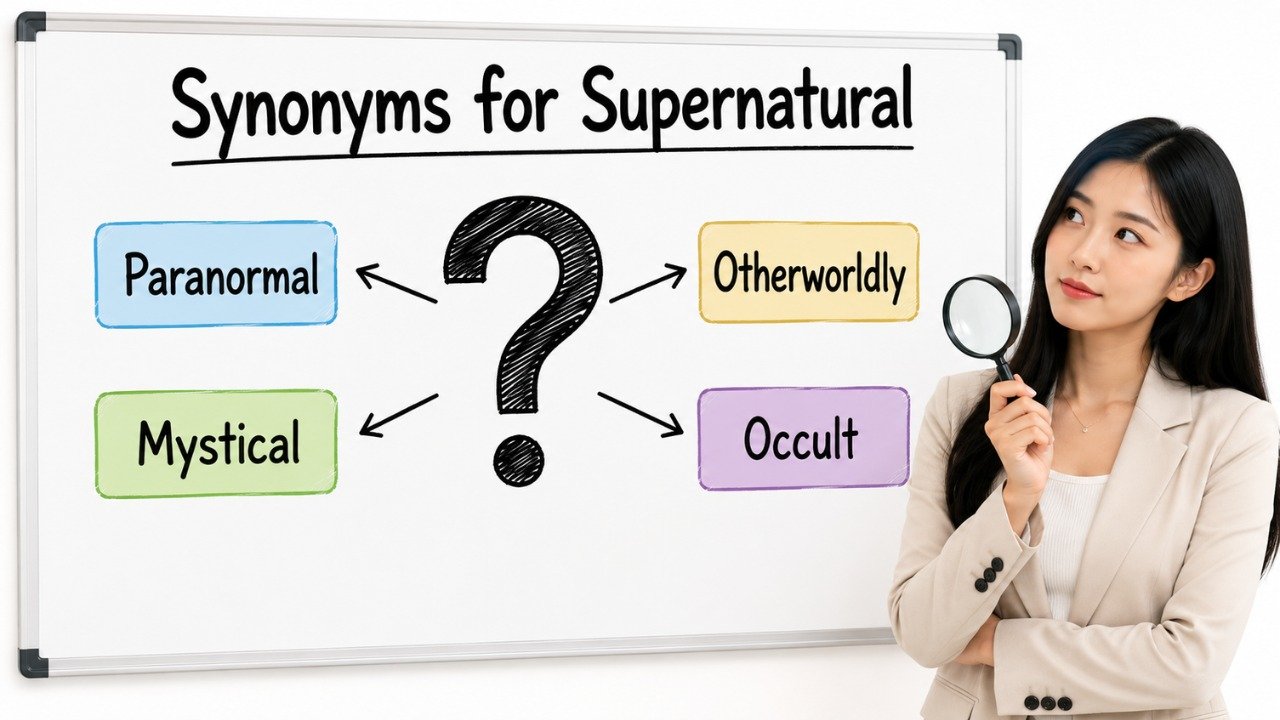
Quick Answer: The best synonyms for supernatural include paranormal, otherworldly, mystical, unearthly, preternatural, uncanny, spectral, ghostly, magical, and occult. Paranormal works well for unexplained events or phenomena, while mystical suits spiritual or mysterious experiences. Otherworldly and unearthly are strong choices for unusual appearances or atmospheres. Ghostly and spectral fit spirits and apparitions. Magical works for enchanted powers, while occult is better for hidden or esoteric practices. The best choice among synonyms for supernatural depends on whether the context involves spirits, unexplained events, magic, mystery, religion, or unusual powers.
Pronunciation and Word Details
Word: Supernatural
Pronunciation: /ˌsuːpərˈnætʃərəl/
Part of Speech: Adjective and noun
Meaning: Existing or happening beyond what is normally explained by natural laws or ordinary human experience.
US Pronunciation:
UK Pronunciation:
What Does “Supernatural” Mean?
Supernatural means existing, happening, or appearing to operate beyond the known laws of nature.
As an adjective, supernatural can describe events, beings, abilities, forces, or experiences that seem impossible to explain through ordinary natural causes.
Example: The story includes supernatural creatures and mysterious events.
The word can also function as a noun in the phrase “the supernatural,” referring collectively to mysterious forces, beings, or events believed to exist beyond the natural world.
Example: The novel explores humanity’s fascination with the supernatural.
Supernatural often appears in discussions of ghosts, spirits, magic, unexplained phenomena, extraordinary powers, folklore, legends, religious beliefs, and imaginative fiction.
In some contexts, the word is neutral and descriptive. In others, it creates a mysterious, frightening, spiritual, or dramatic tone.
Meaning, Tone, and Context of “Supernatural”
Supernatural is a flexible word with a generally neutral core meaning, although its tone changes according to context.
Neutral Context: Supernatural can simply describe something that is believed to exist beyond ordinary natural explanation.
Example: The researchers recorded stories about supernatural experiences.
Mysterious Context: The word often creates a sense of mystery or uncertainty.
Example: Strange sounds gave the abandoned building a supernatural atmosphere.
Frightening Context: In horror or suspense writing, supernatural may suggest ghosts, spirits, curses, or unknown forces.
Example: The family believed a supernatural presence was inside the house.
Spiritual Context: Supernatural may refer to divine, spiritual, or transcendent powers.
Example: The tradition describes supernatural forces associated with the sacred place.
Literary Context: Writers often use supernatural to describe characters, powers, events, or settings that go beyond realistic experience.
Example: The tale combines historical events with supernatural elements.
Academic Context: The word can appear in discussions of mythology, folklore, religion, culture, literature, and belief systems.
Conversational Context: In everyday speech, supernatural may describe anything that seems strangely impossible or beyond ordinary explanation.
The word is stronger and broader than many related terms, so choosing a more specific synonym can make writing clearer.
When and How to Use “Supernatural”
For Unexplained Events
Use: Supernatural can describe events that seem impossible to explain through ordinary natural causes.
Example: The villagers associated the strange lights with supernatural activity.
For Ghosts and Spirits
Use: Supernatural works naturally when discussing ghosts, spirits, apparitions, or unseen beings.
Example: The old house was said to contain a supernatural presence.
For Magic
Use: The word can describe powers, abilities, or events associated with magic or enchantment.
Example: The character possesses supernatural abilities.
For Spiritual Experiences
Use: Supernatural can describe experiences interpreted as spiritual, divine, or beyond ordinary physical reality.
Example: She described the moment as a supernatural experience.
For Fiction and Folklore
Use: Supernatural commonly describes creatures, events, powers, or themes in imaginative stories and traditional legends.
Example: The tale features several supernatural beings.
For Extraordinary Ability
Use: In figurative language, supernatural can describe an ability that seems almost impossible because it is so impressive.
Example: His supernatural memory amazed everyone in the room.
For Mysterious Atmosphere
Use: Supernatural can describe an eerie or strange mood that seems disconnected from normal reality.
Example: The pale light created a supernatural atmosphere in the forest.
Best Synonyms for Supernatural
Paranormal: Beyond normal scientific explanation, especially involving unexplained events.
Example: The investigators examined reports of paranormal activity.
Otherworldly: Seeming to belong to another world or realm.
Example: The landscape had an otherworldly beauty.
Mystical: Connected with spiritual mystery, hidden meaning, or experiences beyond ordinary understanding.
Example: The ceremony had a deeply mystical atmosphere.
Unearthly: Strange, extraordinary, or seemingly not belonging to the natural world.
Example: An unearthly sound echoed through the valley.
Preternatural: Beyond what is normal or natural, especially in an unusual or extraordinary way.
Example: She displayed a preternatural ability to notice tiny details.
Uncanny: Strangely unfamiliar, unsettling, or difficult to explain.
Example: He had an uncanny ability to predict what would happen next.
Spectral: Resembling or relating to a ghost.
Example: A spectral figure appeared near the doorway.
Ghostly: Resembling, involving, or associated with a ghost.
Example: A ghostly shape moved across the hallway.
Magical: Involving magic, enchantment, or extraordinary powers.
Example: The story follows a child with magical abilities.
Occult: Connected with mysterious, hidden, or esoteric supernatural practices.
Example: The manuscript contained references to occult rituals.
50 Synonyms for Supernatural with Short Meanings
- Paranormal: Beyond ordinary scientific explanation.
- Otherworldly: Seeming to belong to another world.
- Mystical: Connected with spiritual mystery or hidden meaning.
- Unearthly: Strange or apparently beyond the natural world.
- Preternatural: Beyond what is considered normal or natural.
- Uncanny: Strangely mysterious or difficult to explain.
- Spectral: Resembling or relating to a ghost.
- Ghostly: Having the appearance or qualities of a ghost.
- Magical: Involving magic or extraordinary powers.
- Occult: Connected with hidden supernatural knowledge or practices.
- Spiritual: Relating to spirits, the soul, or nonphysical existence.
- Ethereal: Delicate, heavenly, or seemingly beyond ordinary physical reality.
- Celestial: Relating to heaven or the heavens.
- Divine: Relating to a god, sacred power, or heavenly force.
- Miraculous: Apparently impossible through ordinary natural causes.
- Enchanted: Affected by magic or magical influence.
- Bewitched: Influenced or affected by supposed magic.
- Haunted: Believed to be visited or occupied by ghosts.
- Phantasmal: Resembling a ghost, vision, or apparition.
- Phantomlike: Resembling a ghostly or unreal figure.
- Apparitional: Relating to a ghostly appearance or apparition.
- Spiritualistic: Relating to beliefs or practices involving communication with spirits.
- Metaphysical: Concerned with reality beyond ordinary physical experience.
- Transcendent: Existing beyond normal physical limits or experience.
- Transcendental: Going beyond ordinary experience or physical existence.
- Esoteric: Understood by a small group and associated with hidden knowledge.
- Arcane: Mysterious and known by only a few people.
- Mysterious: Difficult or impossible to explain fully.
- Inexplicable: Unable to be explained by ordinary reasoning.
- Unexplained: Not yet given a clear or satisfactory explanation.
- Extraordinary: Far beyond what is usual or expected.
- Unnatural: Not appearing to follow ordinary natural conditions.
- Unworldly: Seeming removed from ordinary earthly experience.
- Numinous: Inspiring a mysterious sense of spiritual or sacred presence.
- Sacred: Connected with holiness or spiritual significance.
- Spiritlike: Resembling or relating to a spirit.
- Demonic: Relating to demons or destructive supernatural forces.
- Angelic: Resembling or relating to angels.
- Enchanted: Possessing or influenced by magical qualities.
- Wondrous: So extraordinary that it inspires wonder.
- Phenomenal: Remarkably extraordinary or impressive.
- Marvelous: Causing wonder because of unusual excellence or strangeness.
- Fantastic: Extremely unusual, imaginative, or seemingly impossible.
- Fabulous: Legendary, extraordinary, or associated with imaginative tales.
- Mythical: Existing in myths, legends, or traditional stories.
- Legendary: Associated with legends or extraordinary stories.
- Magical: Suggesting enchantment or powers beyond normal reality.
- Eerie: Strangely unsettling or mysterious.
- Spooky: Mysterious or frightening in a way associated with ghosts.
- Unreal: Seeming impossible, dreamlike, or unlike normal reality.
Read Also:
Synonyms for Oversee

Synonyms for Supernatural by Context
When Supernatural Means Paranormal
Paranormal is one of the closest alternatives when supernatural describes unexplained phenomena.
Paranormal: Beyond normal scientific explanation.
Example: The group investigated reports of paranormal activity.
Unexplained: Lacking a clear natural explanation.
Example: Several unexplained noises came from the empty room.
Inexplicable: Difficult or impossible to explain logically.
Example: The sudden movement remained inexplicable.
Uncanny: Strange enough to feel mysterious or unsettling.
Example: She had an uncanny sense of when someone was about to call.
When Supernatural Means Ghostly
When supernatural refers specifically to spirits or apparitions, ghostly and spectral are more precise.
Ghostly: Resembling or involving a ghost.
Example: A ghostly figure appeared at the top of the stairs.
Spectral: Having the appearance or qualities of a spirit.
Example: A spectral shape moved through the mist.
Phantasmal: Resembling an apparition or imagined ghost.
Example: A phantasmal image appeared near the old gate.
Apparitional: Related to the appearance of a ghost or spirit.
Example: Witnesses described an apparitional figure near the ruins.
When Supernatural Means Magical
Magical words work best when supernatural refers to spells, enchantment, or extraordinary powers.
Magical: Involving magic or special powers.
Example: The hero discovered a magical ability.
Enchanted: Influenced by magic.
Example: They entered an enchanted forest.
Bewitched: Affected by supposed magical influence.
Example: The villagers believed the object was bewitched.
Arcane: Mysterious and connected with specialized hidden knowledge.
Example: The scholar studied arcane traditions.
When Supernatural Means Spiritual
Supernatural sometimes refers to experiences or forces understood as spiritual rather than physical.
Spiritual: Relating to the spirit or soul.
Example: She viewed the event as a spiritual experience.
Mystical: Connected with deep spiritual mystery.
Example: The temple created a mystical atmosphere.
Numinous: Producing a profound sense of sacred or spiritual presence.
Example: The ancient site had a numinous quality.
Divine: Associated with sacred or heavenly power.
Example: They interpreted the event as a sign of divine intervention.
When Supernatural Means Otherworldly
Otherworldly and related terms work well for appearances, sounds, beauty, or atmospheres that seem detached from normal reality.
Otherworldly: Seeming to belong to another world.
Example: The mountains had an otherworldly appearance at sunrise.
Unearthly: Strange and seemingly beyond ordinary earthly existence.
Example: An unearthly sound came from the darkness.
Ethereal: Light, delicate, and almost heavenly.
Example: Her voice had an ethereal quality.
Unworldly: Removed from everyday earthly experience.
Example: The quiet landscape possessed an unworldly stillness.
When Supernatural Means Extraordinary
Sometimes supernatural is used figuratively to describe unusually impressive ability.
Preternatural: Exceptionally developed beyond normal expectations.
Example: He had a preternatural talent for recognizing patterns.
Extraordinary: Remarkably unusual or impressive.
Example: She demonstrated extraordinary skill.
Uncanny: Strikingly unusual in an almost mysterious way.
Example: His uncanny memory impressed the entire class.
Phenomenal: Exceptionally impressive.
Example: Her phenomenal speed surprised everyone.
Another Word for Supernatural
Another word for supernatural is paranormal when the context involves unexplained events or phenomena. However, no single synonym works in every context.
Otherworldly is better for unusual beauty or atmosphere, mystical for spiritual mystery, ghostly for spirits, and magical for enchantment or special powers.
Original: They investigated supernatural activity in the building.
Better Option: They investigated paranormal activity in the building.
Original: The forest had a supernatural beauty.
Better Option: The forest had an otherworldly beauty.
Original: A supernatural figure appeared near the window.
Better Option: A ghostly figure appeared near the window.
Original: The character possesses supernatural powers.
Better Option: The character possesses magical powers.
When Not to Use “Supernatural”
Supernatural is useful, but it can become vague when a more specific word would communicate the intended meaning more clearly.
When You Mean Ghostly
If the sentence specifically refers to a ghost, spirit, or apparition, ghostly or spectral may be more precise.
Weak: A supernatural figure appeared in the hallway.
Better: A spectral figure appeared in the hallway.
When You Mean Unexplained
Supernatural can imply that something actually exists beyond natural laws. If the cause is simply unknown, unexplained may be more neutral.
Weak: Scientists recorded a supernatural sound.
Better: Scientists recorded an unexplained sound.
When You Mean Spiritual
Supernatural may be too broad when discussing personal faith, sacred experiences, or inner beliefs.
Weak: She described the ceremony as supernatural.
Better: She described the ceremony as spiritual.
When You Mean Magical
In fantasy writing, magical may be clearer when spells or enchantment are specifically involved.
Weak: The ring had supernatural properties.
Better: The ring had magical properties.
When You Mean Extraordinary Ability
Using supernatural for normal human talent can sound exaggerated.
Weak: She has supernatural mathematical ability.
Better: She has extraordinary mathematical ability.
When Repetition Makes Writing Vague
Using supernatural repeatedly can weaken descriptive writing.
Weak: The supernatural story followed a supernatural character facing supernatural forces.
Better: The paranormal story followed a mystical character facing otherworldly forces.
Words Commonly Confused With Supernatural
Supernatural vs Paranormal: Supernatural broadly refers to forces, beings, or events beyond natural laws. Paranormal usually refers to unexplained phenomena that fall outside ordinary scientific understanding.
Supernatural vs Preternatural: Supernatural suggests something beyond nature itself. Preternatural often describes something unusually advanced, strange, or extraordinary while not necessarily implying magic.
Supernatural vs Mystical: Supernatural is broad and can include ghosts, magic, spirits, or unusual powers. Mystical focuses more on spiritual mystery, transcendence, and profound inner experience.
Supernatural vs Magical: Supernatural covers many phenomena beyond ordinary nature. Magical specifically suggests spells, enchantment, or magic based powers.
Supernatural vs Spiritual: Supernatural may involve spiritual beings or forces, but spiritual usually focuses on the soul, sacred experience, inner belief, or religion.
Supernatural vs Ghostly: Supernatural includes many kinds of unexplained or extraordinary phenomena. Ghostly specifically relates to ghosts or things that resemble them.
Supernatural vs Otherworldly: Supernatural refers to phenomena beyond natural explanation. Otherworldly often describes something that seems strangely beautiful, unfamiliar, or as if it belongs to another world.
Supernatural vs Uncanny: Supernatural suggests forces or events beyond nature. Uncanny describes something strangely familiar, unusual, or unsettling without necessarily claiming a supernatural cause.
Which Synonym Should You Choose?
Choose paranormal when writing about unexplained events, unusual activity, strange experiences, or phenomena that appear beyond normal scientific understanding.
Choose otherworldly when describing unusual beauty, appearance, atmosphere, music, landscapes, or experiences that seem to belong to another realm.
Choose mystical when discussing spirituality, sacred experiences, hidden meaning, meditation, or profound mystery.
Choose ghostly when the sentence directly involves ghosts, spirits, apparitions, or pale mysterious appearances.
Choose spectral in literary, descriptive, or formal writing when referring to a ghostlike figure or presence.
Choose magical when discussing spells, enchantment, fantasy powers, enchanted objects, or imaginary worlds.
Choose occult when writing about hidden practices, secret traditions, esoteric knowledge, or supernatural rituals.
Choose preternatural in formal or literary writing when describing an ability or quality that seems exceptionally beyond normal human standards.
Choose uncanny in conversation, essays, descriptions, and fiction when something feels strangely accurate, familiar, mysterious, or unsettling.
Choose unexplained in reports or neutral writing when the cause of something is unknown and you do not want to suggest that it is definitely supernatural.
Choose extraordinary in professional writing when describing remarkable talent without implying mystical or paranormal causes.
Real Life Examples of “Supernatural” in Sentences
Original: The visitors reported supernatural activity in the old house.
Better Option: The visitors reported paranormal activity in the old house.
Original: The moonlight gave the valley a supernatural appearance.
Better Option: The moonlight gave the valley an otherworldly appearance.
Original: A supernatural figure stood beside the gate.
Better Option: A spectral figure stood beside the gate.
Original: The character has supernatural powers.
Better Option: The character has magical powers.
Original: She described the ceremony as a supernatural experience.
Better Option: She described the ceremony as a mystical experience.
Original: His supernatural ability to remember details impressed everyone.
Better Option: His preternatural ability to remember details impressed everyone.
Original: They heard a supernatural sound from the empty room.
Better Option: They heard an unexplained sound from the empty room.
Original: The story contains several supernatural creatures.
Better Option: The story contains several mythical creatures.
Original: An unusual light created a supernatural atmosphere.
Better Option: An unusual light created an eerie atmosphere.
Original: The legend describes supernatural forces protecting the mountain.
Better Option: The legend describes mystical forces protecting the mountain.
Synonym Groups and Usage Differences
Paranormal Group
Paranormal, unexplained, inexplicable, uncanny, and mysterious describe events or experiences that cannot easily be explained.
Paranormal is the closest general synonym in contexts involving strange activity. Unexplained is more neutral because it does not assume a supernatural cause.
Example: The investigator documented several unexplained events.
Ghost and Spirit Group
Ghostly, spectral, phantasmal, apparitional, spiritlike, and haunted relate specifically to ghosts, spirits, or apparitions.
Ghostly is common and easy to understand, while spectral sounds more literary and descriptive.
Example: A spectral figure appeared through the mist.
Spiritual Group
Mystical, spiritual, divine, numinous, sacred, transcendent, and transcendental relate to spiritual experiences or realities beyond ordinary physical life.
Mystical emphasizes mystery, while divine suggests a connection with sacred or heavenly power.
Example: Visitors described the place as having a numinous atmosphere.
Magical Group
Magical, enchanted, bewitched, arcane, and occult relate to magic, spells, mysterious knowledge, or hidden practices.
Magical is broad and familiar. Occult and arcane suggest secret or specialized traditions.
Example: The story centers on an enchanted object with unusual powers.
Otherworldly Group
Otherworldly, unearthly, ethereal, unworldly, and celestial describe something that seems removed from normal earthly reality.
Otherworldly is excellent for beauty and atmosphere. Unearthly often adds a strange or unsettling feeling.
Example: The singer’s ethereal voice filled the hall.
Extraordinary Ability Group
Preternatural, uncanny, extraordinary, phenomenal, remarkable, and exceptional can describe abilities that seem almost beyond normal human limits.
Preternatural and uncanny retain some mysterious force, while extraordinary is safer in formal or factual writing.
Example: She showed an uncanny ability to recognize voices.
Antonyms of Supernatural
The opposite of supernatural depends on whether the word refers to natural causes, ordinary experience, physical existence, or realistic events.
Natural: Existing according to normal laws of nature.
Ordinary: Normal and not unusual or mysterious.
Normal: Following expected patterns or conditions.
Physical: Existing in material form and measurable through the senses.
Material: Relating to physical substances or objects.
Earthly: Belonging to ordinary life or the physical world.
Mundane: Ordinary and lacking mystery or extraordinary qualities.
Rational: Explainable through reason or logical thought.
Scientific: Based on systematic observation, testing, or natural explanation.
Explainable: Capable of being understood through clear causes.
Realistic: Consistent with ordinary reality.
Conventional: Following familiar or generally accepted patterns.
Commonplace: Ordinary and frequently encountered.
Secular: Not primarily connected with religion or sacred matters.
Everyday: Part of normal daily experience.
Comparison: Supernatural vs Related Words
Supernatural vs Paranormal
Supernatural broadly describes beings, events, forces, or abilities believed to exist beyond natural laws. Paranormal usually refers to unexplained phenomena outside normal scientific understanding.
Example With Supernatural: The legend describes a supernatural creature living near the lake.
Example With Paranormal: The team investigated reports of paranormal activity in the building.
Supernatural vs Mystical
Supernatural can involve ghosts, magic, spirits, powers, or unexplained events. Mystical more specifically relates to spiritual mystery, sacred experience, or transcendence.
Example With Supernatural: The story contains supernatural forces.
Example With Mystical: The ceremony created a mystical atmosphere.
Supernatural vs Otherworldly
Supernatural directly suggests something beyond ordinary natural explanation. Otherworldly means that something seems as though it belongs to another world.
Example With Supernatural: The villagers feared a supernatural presence.
Example With Otherworldly: The landscape had an otherworldly beauty.
Supernatural vs Preternatural
Supernatural suggests forces or phenomena outside natural laws. Preternatural often describes something exceptionally unusual or advanced without necessarily claiming it comes from magic.
Example With Supernatural: The tale describes supernatural powers.
Example With Preternatural: She possessed a preternatural ability to notice subtle changes.
Supernatural vs Ghostly
Supernatural is broad enough to include ghosts, magic, spirits, or extraordinary forces. Ghostly specifically relates to ghosts or appearances resembling them.
Example With Supernatural: The building was associated with supernatural events.
Example With Ghostly: A ghostly figure appeared beside the staircase.
Supernatural vs Magical
Supernatural includes many phenomena beyond natural explanation. Magical specifically refers to magic, enchantment, spells, or extraordinary powers.
Example With Supernatural: The story includes several supernatural beings.
Example With Magical: The child discovers a magical object.
Supernatural vs Uncanny
Supernatural implies something beyond natural causes. Uncanny describes something strangely unusual, accurate, familiar, or unsettling.
Example With Supernatural: They believed the event had a supernatural cause.
Example With Uncanny: She had an uncanny ability to remember names.
Supernatural vs Spiritual
Supernatural can describe any force or being beyond nature. Spiritual focuses more narrowly on the soul, sacred matters, inner belief, or religious experience.
Example With Supernatural: The legend describes supernatural guardians.
Example With Spiritual: Meditation became an important spiritual practice for her.
Common Phrases and Expressions With Supernatural
Supernatural Powers: Abilities believed to go beyond normal human capabilities.
Supernatural Being: A creature or entity believed to exist beyond the natural world.
Supernatural Force: A mysterious power believed to operate outside ordinary natural laws.
Supernatural Phenomenon: An event believed to be beyond normal scientific explanation.
Supernatural Activity: Unusual events associated with ghosts, spirits, or unexplained forces.
Supernatural Experience: An event perceived as involving forces beyond ordinary reality.
Supernatural Ability: A power that appears impossible through normal human means.
Supernatural Presence: A mysterious being or force believed to be nearby.
Supernatural Element: A magical, ghostly, spiritual, or unexplained feature within a story or situation.
Supernatural World: An imagined or believed realm containing spirits, magical forces, or beings beyond ordinary nature.
Common Mistakes to Avoid
Treating Every Mysterious Event as Supernatural
Something unexplained is not automatically supernatural. In factual or neutral writing, unexplained is often safer.
Weak: The unexplained noise proved that something supernatural happened.
Better: The unexplained noise remained mysterious because its cause could not be identified.
Confusing Paranormal With Supernatural
The words overlap but are not always identical. Paranormal commonly describes unexplained phenomena, while supernatural has a broader meaning that includes spirits, magical forces, divine beings, and extraordinary powers.
Choose the word that matches the exact context.
Using Ghostly for Every Supernatural Situation
Ghostly is appropriate only when something relates to ghosts or resembles them.
Weak: The wizard possessed ghostly powers.
Better: The wizard possessed magical powers.
Using Mystical When You Mean Frightening
Mystical usually suggests spiritual mystery rather than fear.
Weak: A mystical figure chased them through the abandoned house.
Better: A ghostly figure chased them through the abandoned house.
Overusing Supernatural
Repeating supernatural makes descriptive writing less precise.
Weak: The supernatural forest contained supernatural creatures with supernatural powers.
Better: The enchanted forest contained mythical creatures with magical powers.
Using Supernatural as Proof of a Cause
In neutral, academic, or factual writing, supernatural should not automatically be presented as an established explanation for unexplained events.
Weak: The strange movement was caused by a supernatural force.
Better: The cause of the strange movement remained unexplained.
Choosing an Overly Dramatic Synonym
Preternatural, occult, and phantasmal have specialized tones. They may sound unnatural in simple everyday sentences.
Weak: She showed phantasmal talent in mathematics.
Better: She showed extraordinary talent in mathematics.
Ignoring Context When Replacing the Word
A synonym that works in one sentence may fail in another.
Paranormal activity sounds natural, but paranormal beauty may sound awkward when otherworldly beauty expresses the intended meaning better.
Always choose synonyms according to the meaning of the full sentence.
Conclusion
Understanding synonyms for supernatural helps you describe mystery, magic, spirituality, ghosts, and unexplained events more precisely. Paranormal works best for unexplained phenomena, while ghostly and spectral suit spirits and apparitions. Mystical and spiritual fit sacred experiences, while magical and enchanted describe spells or extraordinary powers. Otherworldly and unearthly are useful for unusual appearances or atmospheres. Choosing the right synonym for supernatural makes descriptions clearer, more natural, and better suited to the exact context.
FAQs About Synonyms for Supernatural
What Is the Best Synonym for Supernatural?
Paranormal is one of the closest general synonyms for supernatural, especially when describing unexplained events. The best choice changes with context.
What Is Another Word for Supernatural Powers?
Magical powers, paranormal abilities, extraordinary abilities, mystical powers, and preternatural abilities can work depending on the intended meaning.
What Is a Synonym for Supernatural Activity?
Paranormal activity, unexplained activity, mysterious activity, ghostly activity, and occult activity are possible alternatives. Paranormal activity is usually the closest general option.
What Is Another Word for a Supernatural Being?
Spirit, apparition, ghost, mythical being, mystical being, and otherworldly entity may work depending on what type of being is being described.
Is Paranormal the Same as Supernatural?
The meanings overlap, but they are not completely identical. Paranormal often refers to unexplained phenomena, while supernatural can include spirits, magic, divine forces, unusual powers, and beings beyond nature.
What Is a Formal Synonym for Supernatural?
Preternatural, paranormal, metaphysical, transcendent, and inexplicable may work in formal writing, depending on the exact meaning.
What Is a Synonym for Supernatural in Fiction?
Magical, mystical, otherworldly, ghostly, spectral, mythical, enchanted, and paranormal are useful alternatives for fiction. The best word depends on whether the story involves magic, spirits, mystery, or another realm.
