
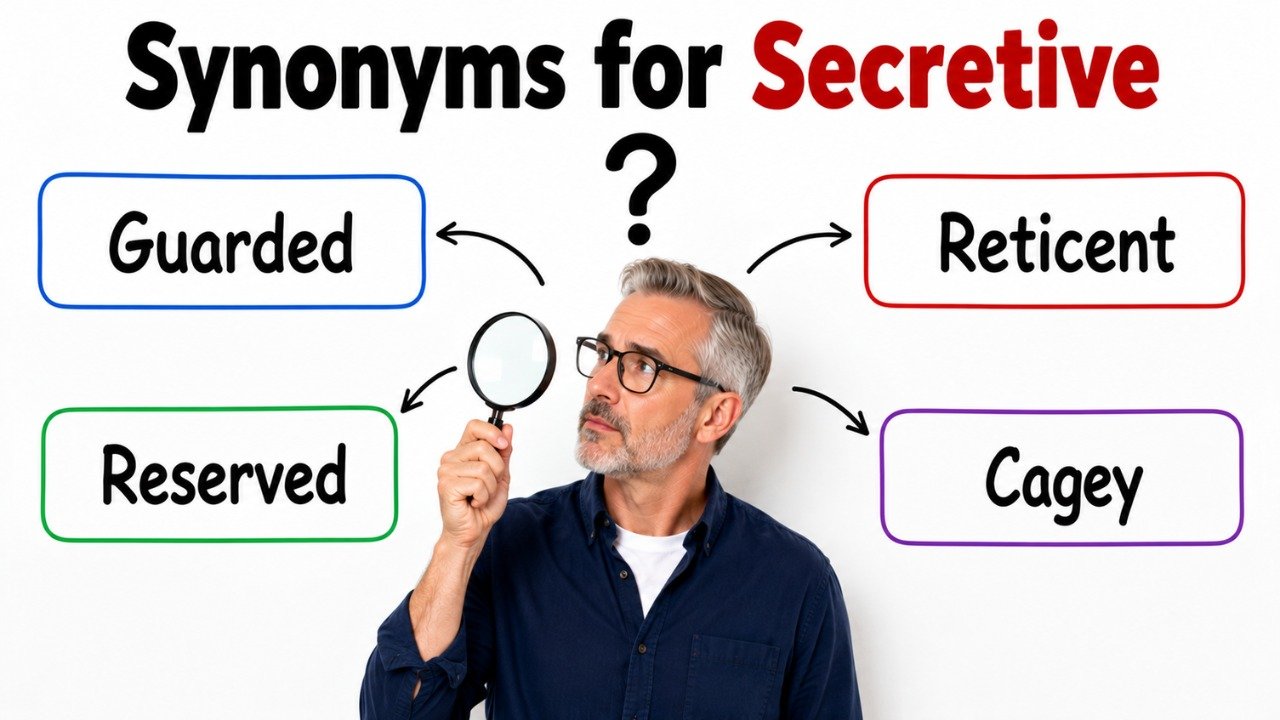
Quick Answer: The best synonyms for secretive include private, reserved, reticent, discreet, guarded, evasive, cagey, furtive, covert, and mysterious. Use private for someone who does not share personal information. Reserved and reticent suit quiet or restrained behavior, while discreet has a positive meaning connected with confidentiality. Guarded and evasive suggest avoiding direct answers. Cagey is more conversational, furtive describes suspicious hidden actions, covert suits planned secrecy, and mysterious emphasizes difficulty in understanding someone.
Pronunciation and Word Details
Word: Secretive.
Pronunciation: /ˈsiː.krə.tɪv/.
Part of Speech: Adjective.
Meaning: Unwilling to share information, feelings, plans, or activities with other people.
US Pronunciation:
UK Pronunciation:
What Does “Secretive” Mean?
Secretive means deliberately unwilling to reveal information, thoughts, feelings, plans, or actions. It is an adjective used to describe a person, group, organization, manner, or activity that keeps things hidden from others.
A secretive person may avoid discussing personal matters.
Example: Daniel became secretive whenever anyone asked about his future plans.
The word can also describe behavior that appears suspicious because information is being concealed.
Example: Her secretive phone calls made the family curious.
Secretive may refer to an organization or process that operates without public explanation.
Example: The committee followed a secretive decision making process.
In some sentences, secretive simply means highly private. In others, it suggests dishonesty, suspicion, or an intention to hide something important. The surrounding context determines whether the word sounds neutral, negative, or critical.
Meaning, Tone, and Context of “Secretive”
Secretive usually has a negative or suspicious tone. It often implies that someone is hiding more information than the situation reasonably requires.
A person may be private without doing anything wrong, but calling that person secretive can suggest that the lack of openness feels deliberate or unusual.
Neutral Context: She is private about her family life.
More Suspicious Context: She has been secretive about where she spends her evenings.
The word is common in everyday conversation, news style writing, fiction, workplace discussions, relationship advice, character descriptions, and reports about hidden activities.
In formal writing, guarded, reticent, confidential, covert, or undisclosed may be more precise. In casual conversation, cagey, quiet, closed, or mysterious may sound more natural.
Secretive can describe emotional behavior.
Example: He became secretive about his feelings after the disagreement.
It can describe hidden plans.
Example: The group was secretive about the purpose of its meeting.
It can also describe suspicious physical behavior.
Example: She gave him a secretive look before leaving the room.
Writers should use the word carefully because it may communicate criticism. When the intention is simply to respect privacy, private or discreet is often kinder and more accurate.
When and How to Use “Secretive”
For Personal Privacy
Use secretive when someone consistently refuses to share personal details and this behavior seems intentional or unusual.
Example: He was secretive about his childhood and rarely answered personal questions.
For Hidden Plans
Use secretive when a person or group keeps plans away from people who would normally expect an explanation.
Example: The managers were secretive about the upcoming changes.
For Avoiding Questions
Secretive works when someone gives incomplete answers, changes the subject, or refuses to explain something.
Example: She became secretive when asked about the missing documents.
For Suspicious Behavior
Use secretive when actions appear hidden, furtive, or designed to prevent observation.
Example: His secretive meetings raised concerns among his colleagues.
For Emotional Withdrawal
The word can describe someone who hides emotions, fears, relationships, or personal problems.
Example: The normally cheerful student became secretive and withdrawn.
For Confidential Activities
Secretive can describe a process that takes place without public access, although confidential or closed may be more neutral.
Example: The negotiations were conducted in a secretive manner.
For Fictional Characters
Writers often use secretive to develop mystery around a character’s motives, identity, or past.
Example: The secretive traveler refused to reveal his real name.
For Critical Descriptions
Use the word when lack of openness is part of the criticism.
Example: Residents objected to the secretive way the decision was made.
Best Synonyms for Secretive
Private: Unwilling to share personal information or allow others into personal matters.
Example: She is private about her relationships but friendly in public.
Reserved: Quiet and controlled, especially when expressing feelings or opinions.
Example: The reserved student listened carefully before speaking.
Reticent: Reluctant to speak openly or provide information.
Example: The witness remained reticent about what she had observed.
Discreet: Careful not to reveal confidential or sensitive information.
Example: The adviser was discreet when discussing the family matter.
Guarded: Cautious about revealing thoughts, feelings, or facts.
Example: His answers were guarded during the interview.
Evasive: Avoiding direct answers or clear explanations.
Example: The official gave an evasive response to the question.
Cagey: Unwilling to provide information, usually because of caution or strategy.
Example: The coach was cagey about the final team selection.
Furtive: Acting secretly in a way that suggests fear, guilt, or suspicion.
Example: She cast a furtive glance toward the locked door.
Covert: Hidden, planned, and not openly acknowledged.
Example: They carried out a covert investigation.
Mysterious: Difficult to understand because important information is unknown or concealed.
Example: The mysterious visitor left without introducing himself.
50 Synonyms for Secretive with Short Meanings
- Private: Unwilling to share personal information.
- Reserved: Restrained in speech, emotion, or behavior.
- Reticent: Reluctant to speak or reveal information.
- Discreet: Careful about keeping sensitive matters confidential.
- Guarded: Cautious about revealing thoughts or facts.
- Unforthcoming: Not willing to provide requested information.
- Evasive: Avoiding direct answers or explanations.
- Cagey: Cautious and unwilling to disclose plans.
- Taciturn: Naturally speaking very little.
- Uncommunicative: Not willing or able to communicate openly.
- Withdrawn: Quiet and removed from social interaction.
- Reclusive: Avoiding other people and public attention.
- Aloof: Emotionally distant and difficult to approach.
- Quiet: Not speaking much or attracting attention.
- Silent: Refusing or failing to speak about something.
- Close: Unwilling to reveal personal thoughts or feelings.
- Circumspect: Careful about words, actions, and possible consequences.
- Cautious: Avoiding unnecessary disclosure or risk.
- Wary: Watchful and hesitant because of possible danger.
- Restrained: Controlled in expression or communication.
- Noncommittal: Avoiding a definite opinion, answer, or promise.
- Inscrutable: Impossible or very difficult to understand.
- Enigmatic: Mysterious and difficult to interpret.
- Mysterious: Not fully explained or understood.
- Cryptic: Expressing information in an unclear or hidden way.
- Opaque: Difficult to understand or lacking transparency.
- Elusive: Difficult to discover, define, or understand.
- Veiled: Partly hidden or indirectly expressed.
- Concealed: Kept out of sight or knowledge.
- Hidden: Prevented from being seen or known.
- Covert: Secretly planned or performed.
- Clandestine: Kept secret because it may be improper or forbidden.
- Surreptitious: Done secretly to avoid attention or discovery.
- Furtive: Secretive in a nervous or suspicious way.
- Stealthy: Quiet and careful to avoid being noticed.
- Undercover: Operating with a hidden identity or purpose.
- Underground: Operating secretly outside normal public activity.
- Confidential: Intended to remain private or restricted.
- Classified: Officially restricted from public access.
- Undisclosed: Not made known to others.
- Unrevealing: Providing little useful information.
- Self contained: Depending on oneself and sharing little with others.
- Tight lipped: Refusing to reveal information.
- Close mouthed: Habitually unwilling to discuss private matters.
- Hush hush: Deliberately kept very secret.
- Conspiratorial: Suggesting shared secrets or hidden plans.
- Sly: Secretive in a clever or deceptive way.
- Sneaky: Acting secretly in a dishonest or annoying way.
- Shifty: Appearing dishonest, nervous, or evasive.
- Underhanded: Secretive and dishonest in method.
Read Also:
Synonyms for Work Together

Synonyms for Secretive by Context
When Secretive Means Private
Private is the most neutral alternative when someone prefers not to discuss personal matters.
Reserved, quiet, withdrawn, and self contained may also fit, depending on the reason for the behavior.
Example With Secretive: Maya is secretive about her personal life.
Example With Private: Maya is private about her personal life.
Private does not necessarily suggest dishonesty. It often communicates a healthy desire for personal boundaries.
Reserved describes someone who does not express emotions easily.
Example: He is reserved around people he has only recently met.
Withdrawn is stronger and may suggest that someone has moved away from social interaction.
Example: She became withdrawn after the stressful experience.
When Secretive Means Reluctant to Speak
Reticent, guarded, unforthcoming, taciturn, and uncommunicative describe limited speech or a refusal to provide information.
Example With Secretive: The witness was secretive about the evening.
Example With Reticent: The witness was reticent about the evening.
Reticent is useful in formal reports and professional writing. It describes reluctance without automatically suggesting dishonesty.
Guarded suggests carefully controlled answers.
Example: The manager remained guarded when discussing the investigation.
Unforthcoming means that expected information was not provided.
Example: The representative was unforthcoming about the delay.
Taciturn usually describes a person who speaks very little by nature.
Example: The taciturn farmer answered with only a few words.
When Secretive Means Evasive
Evasive, cagey, noncommittal, tight lipped, and close mouthed fit situations where someone avoids giving a clear answer.
Example With Secretive: The director was secretive about the project budget.
Example With Evasive: The director was evasive about the project budget.
Evasive often suggests deliberate avoidance.
Example: His evasive reply did not address the actual question.
Cagey is more informal and may suggest strategic caution.
Example: The company remained cagey about the release date.
Noncommittal describes an answer that avoids taking a clear position.
Example: She gave a noncommittal response when asked whether she would attend.
When Secretive Means Hidden
Covert, concealed, clandestine, surreptitious, hidden, and undisclosed describe activities or information kept away from public knowledge.
Example With Secretive: The group conducted a secretive operation.
Example With Covert: The group conducted a covert operation.
Covert works well for organized, planned, or official activity.
Clandestine often suggests that the activity may be forbidden, improper, or dangerous.
Example: They arranged a clandestine meeting outside the city.
Surreptitious focuses on the manner in which something is done.
Example: He took a surreptitious photograph of the document.
Undisclosed is useful when a fact, amount, name, or location has not been made public.
Example: The property was sold for an undisclosed amount.
When Secretive Means Suspicious
Furtive, sneaky, shifty, sly, and underhanded describe secrecy that appears dishonest or suspicious.
Example With Secretive: He made a secretive movement toward the drawer.
Example With Furtive: He made a furtive movement toward the drawer.
Furtive suggests nervousness or fear of discovery.
Sneaky is common in casual speech and clearly expresses disapproval.
Example: It was sneaky to read the letter without permission.
Shifty often describes someone whose behavior or appearance creates distrust.
Example: The customer became suspicious of the shifty stranger.
Underhanded describes secretive behavior that is also unfair or dishonest.
Example: They used underhanded tactics to influence the decision.
When Secretive Means Mysterious
Mysterious, enigmatic, inscrutable, cryptic, opaque, and elusive suit people or information that are difficult to understand.
Example With Secretive: The author was secretive about the meaning of the final chapter.
Example With Enigmatic: The author was enigmatic about the meaning of the final chapter.
Enigmatic describes someone or something that creates curiosity.
Inscrutable is stronger and means nearly impossible to interpret.
Example: Her expression remained inscrutable throughout the discussion.
Cryptic describes speech or writing that hides its meaning.
Example: He left a cryptic message on the table.
Opaque is common in formal criticism of unclear systems, explanations, or processes.
Example: The selection process was unnecessarily opaque.
Another Word for Secretive
Private is often the best single replacement for secretive when the sentence describes a person who protects personal information. It is more neutral and less judgmental.
However, the best alternative depends on the context. Use guarded for cautious answers, evasive for deliberate avoidance, covert for hidden operations, and furtive for suspicious movements.
Original: She is secretive about her family.
Better Option: She is private about her family.
Original: The manager was secretive during the interview.
Better Option: The manager was guarded during the interview.
Original: He gave a secretive answer when asked about the payment.
Better Option: He gave an evasive answer when asked about the payment.
Original: The group carried out a secretive investigation.
Better Option: The group carried out a covert investigation.
When Not to Use “Secretive”
Do not use secretive when someone is simply respecting privacy. The word may make normal boundaries sound suspicious.
Weak: She is secretive about her medical appointments.
Better: She is private about her medical appointments.
Avoid secretive when a more precise word can explain how someone is hiding information.
Weak: His response was secretive.
Better: His response was evasive and did not answer the question.
Do not use secretive for information that is officially protected unless you intend to criticize the lack of openness.
Weak: The employee records are secretive.
Better: The employee records are confidential.
Secretive can sound vague when describing an action.
Weak: She moved in a secretive way.
Better: She moved quietly and cast a furtive glance toward the door.
Avoid repeating secretive when several kinds of secrecy appear in one paragraph.
Weak: The secretive leader held a secretive meeting and gave a secretive answer.
Better: The guarded leader held a clandestine meeting and gave an evasive answer.
Do not use secretive as a direct replacement for shy. A shy person may feel nervous in social situations but may still be honest and open.
Weak: He is secretive when speaking to strangers.
Better: He is shy when speaking to strangers.
Use discreet rather than secretive when the behavior is respectful and appropriate.
Weak: The assistant was secretive about the private conversation.
Better: The assistant was discreet about the private conversation.
Words Commonly Confused With Secretive
Secretive vs Private: Secretive often suggests deliberate concealment or suspicious behavior. Private usually means someone prefers personal boundaries without intending to deceive.
Secretive vs Reserved: Secretive describes hiding information. Reserved describes limited emotional expression or quiet social behavior.
Secretive vs Reticent: Secretive can suggest a general habit of concealment. Reticent means reluctant to speak about a particular matter.
Secretive vs Discreet: Secretive may sound suspicious. Discreet usually has a positive meaning and describes careful handling of sensitive information.
Secretive vs Guarded: Secretive describes a person or pattern of behavior. Guarded often describes carefully controlled words, expressions, or reactions.
Secretive vs Evasive: Secretive means unwilling to reveal information. Evasive specifically means avoiding a direct question or explanation.
Secretive vs Mysterious: A secretive person deliberately hides information. A mysterious person may simply be difficult to understand, even without intending to conceal anything.
Secretive vs Covert: Secretive can describe personality or behavior. Covert usually describes a hidden operation, plan, investigation, or organized activity.
Secretive vs Furtive: Secretive is broad. Furtive describes nervous, suspicious, or hidden actions intended to avoid observation.
Secretive vs Shy: Secretive concerns concealment. Shy concerns nervousness, discomfort, or lack of confidence in social situations.
Which Synonym Should You Choose?
Choose private when describing someone who protects personal information without deceiving others.
Choose reserved when a person expresses little emotion or speaks carefully in social situations.
Choose reticent for formal writing about someone who is reluctant to speak.
Choose discreet when secrecy is respectful, professional, or necessary.
Choose guarded when answers, emotions, or reactions are carefully controlled.
Choose evasive when someone avoids answering a direct question.
Choose cagey in casual conversation when someone is strategically withholding information.
Choose tight lipped when someone firmly refuses to reveal a secret.
Choose mysterious when a person’s identity, motives, or background are difficult to understand.
Choose enigmatic in essays or descriptive writing when the mystery creates curiosity.
Choose cryptic when a message, comment, or answer has a hidden or unclear meaning.
Choose opaque in reports when a process, policy, or explanation lacks transparency.
Choose covert when describing a planned hidden operation or investigation.
Choose clandestine when a meeting or activity is deliberately hidden because it may be forbidden.
Choose confidential in professional emails, records, or workplace communication when information must remain restricted.
Choose undisclosed when a fact, amount, identity, or location has not been made public.
Choose furtive when describing suspicious glances, movements, or actions.
Choose sneaky in casual speech when the secrecy seems dishonest or annoying.
Choose underhanded when the secretive behavior is unfair, deceptive, or unethical.
Real Life Examples of “Secretive” in Sentences
Original: The employee became secretive when asked about the missing file.
Better Option: The employee became evasive when asked about the missing file.
Original: Sara is secretive about her personal relationships.
Better Option: Sara is private about her personal relationships.
Original: The witness remained secretive during questioning.
Better Option: The witness remained reticent during questioning.
Original: The director gave a secretive response about the planned changes.
Better Option: The director gave a guarded response about the planned changes.
Original: The group arranged a secretive meeting after midnight.
Better Option: The group arranged a clandestine meeting after midnight.
Original: He gave the locked cabinet a secretive glance.
Better Option: He gave the locked cabinet a furtive glance.
Original: The organization followed a secretive process.
Better Option: The organization followed an opaque process.
Original: The investigator began a secretive inquiry.
Better Option: The investigator began a covert inquiry.
Original: Her secretive message confused everyone.
Better Option: Her cryptic message confused everyone.
Original: The assistant was secretive about the client’s personal details.
Better Option: The assistant was discreet about the client’s personal details.
Synonym Groups and Usage Differences
Privacy Group
Private, reserved, discreet, self contained, and close describe limited sharing without necessarily suggesting dishonesty.
Private is the most neutral choice. Reserved focuses on emotional control. Discreet suggests good judgment and respect for confidentiality.
Example: Although she was private about her life, she remained warm and helpful toward others.
Reluctance Group
Reticent, guarded, unforthcoming, taciturn, and uncommunicative describe a lack of open communication.
Reticent suggests hesitation. Guarded suggests caution. Unforthcoming means expected information has not been provided. Taciturn describes a naturally quiet person.
Example: The normally taciturn witness became especially guarded during questioning.
Avoidance Group
Evasive, cagey, noncommittal, tight lipped, and close mouthed describe active resistance to giving a direct answer.
Evasive is the clearest choice for avoiding questions. Cagey is informal and strategic. Noncommittal describes refusal to take a clear position.
Example: The spokesperson remained cagey and gave several noncommittal answers.
Mystery Group
Mysterious, enigmatic, inscrutable, cryptic, opaque, and elusive describe something difficult to understand.
Mysterious is broad and common. Enigmatic sounds more literary. Inscrutable suggests that a person’s expression or motives cannot be interpreted. Opaque often criticizes unclear systems.
Example: His cryptic note made the already mysterious situation even more difficult to understand.
Concealment Group
Hidden, concealed, veiled, covert, undisclosed, and confidential relate to information or activity kept from view.
Hidden and concealed are general. Veiled suggests partial concealment. Covert describes planned secrecy. Confidential refers to information that should be protected.
Example: The confidential report contained several previously undisclosed details.
Suspicious Action Group
Furtive, surreptitious, stealthy, sneaky, shifty, sly, and underhanded describe hidden behavior that may appear dishonest.
Furtive suggests fear of discovery. Surreptitious is formal. Sneaky is conversational. Underhanded clearly communicates unfairness.
Example: His furtive movements and underhanded methods made the others suspicious.
Antonyms of Secretive
The most suitable antonym depends on whether secretive describes personality, communication, information, or behavior.
Open: Willing to share information, feelings, or ideas.
Frank: Honest and direct in speech.
Candid: Truthful and straightforward, even about difficult matters.
Transparent: Easy to understand and open to examination.
Communicative: Willing to share thoughts and information.
Talkative: Speaking freely and frequently.
Expressive: Showing thoughts and emotions clearly.
Outgoing: Friendly, confident, and socially open.
Forthright: Direct and honest without unnecessary avoidance.
Honest: Truthful and free from deliberate deception.
Revealing: Providing important or previously hidden information.
Public: Open or available to the general community.
Disclosed: Officially or clearly made known.
Unconcealed: Not hidden from sight or knowledge.
Accessible: Easy to approach, understand, or obtain information from.
Comparison: Secretive vs Related Words
Secretive vs Private
Private describes a reasonable desire to protect personal information. Secretive often suggests that the person is intentionally hiding something important.
Example With Secretive: He was secretive about where the money had gone.
Example With Private: He was private about his family difficulties.
Secretive vs Reserved
Secretive focuses on concealed information. Reserved focuses on controlled emotions and limited social expression.
Example With Secretive: She would not explain why she had left the meeting.
Example With Reserved: She listened politely but shared few personal opinions.
Secretive vs Reticent
Secretive can describe a continuing personality trait. Reticent usually describes reluctance to discuss a particular subject.
Example With Secretive: The secretive neighbor rarely spoke about his past.
Example With Reticent: The neighbor was reticent when asked about the accident.
Secretive vs Discreet
Secretive may suggest suspicious concealment. Discreet suggests responsible silence and respect for privacy.
Example With Secretive: The group was secretive about its real intentions.
Example With Discreet: The counselor was discreet about the student’s concerns.
Secretive vs Guarded
Secretive describes someone who generally hides information. Guarded describes careful control over particular words, feelings, or responses.
Example With Secretive: He kept his activities hidden from everyone.
Example With Guarded: He gave a guarded answer when questioned about his activities.
Secretive vs Evasive
Secretive means unwilling to share information. Evasive means deliberately avoiding a direct question.
Example With Secretive: She was secretive about her travel plans.
Example With Evasive: She changed the subject when asked where she was traveling.
Secretive vs Mysterious
Secretive suggests deliberate concealment. Mysterious means difficult to understand or explain.
Example With Secretive: The visitor refused to reveal his name.
Example With Mysterious: Nobody understood why the visitor disappeared so suddenly.
Secretive vs Covert
Secretive can describe personality, communication, or behavior. Covert mainly describes hidden operations or planned activity.
Example With Secretive: The director was secretive about the investigation.
Example With Covert: The agency conducted a covert investigation.
Secretive vs Furtive
Secretive is a general description. Furtive describes a specific movement, glance, or action that seems nervous and hidden.
Example With Secretive: He concealed his conversations from his colleagues.
Example With Furtive: He cast a furtive glance at the confidential folder.
Common Phrases and Expressions With Secretive
Secretive Person: Someone who regularly hides personal information, plans, or feelings.
Example: The secretive person rarely discussed his past.
Secretive Behavior: Actions that suggest deliberate concealment.
Example: Her secretive behavior caused unnecessary suspicion.
Secretive Nature: A natural tendency to keep thoughts and activities private.
Example: His secretive nature made him difficult to understand.
Secretive Manner: A way of speaking or acting that suggests hidden information.
Example: She answered in a secretive manner.
Secretive About Something: Unwilling to discuss a particular subject.
Example: He was secretive about his reasons for leaving.
Become Secretive: To begin hiding information or communicating less openly.
Example: The student became secretive after receiving the message.
Increasingly Secretive: Gradually becoming less open over time.
Example: The manager grew increasingly secretive about the project.
Highly Secretive: Extremely careful about preventing information from becoming known.
Example: The organization was highly secretive about its internal procedures.
Strangely Secretive: Secretive in a way that seems unusual or difficult to explain.
Example: She was strangely secretive about the harmless package.
Secretive Operation: An activity carried out without public knowledge.
Example: The secretive operation continued for several months.
Common Mistakes to Avoid
Confusing Privacy With Secrecy
Do not describe every private person as secretive. Private is neutral, while secretive often sounds suspicious.
Incorrect: She is secretive because she does not discuss her salary.
Better: She is private about her salary.
Using Secretive Instead of Shy
Shyness is social discomfort. Secretiveness is deliberate concealment.
Incorrect: The child was secretive and nervous around new classmates.
Better: The child was shy and nervous around new classmates.
Choosing an Overly Negative Synonym
Sneaky, shifty, and underhanded imply dishonesty. Do not use them when someone is simply cautious or discreet.
Incorrect: The counselor was sneaky about the confidential discussion.
Better: The counselor was discreet about the confidential discussion.
Using Covert for Personality
Covert normally describes actions, operations, or plans rather than a person’s general personality.
Unnatural: He is a covert man.
Natural: He is a secretive man.
Natural: He conducted a covert investigation.
Confusing Reticent With Reluctant
Reticent traditionally refers to reluctance to speak or reveal information. Reluctant can describe unwillingness to perform any action.
Correct: She was reticent about discussing the incident.
Correct: She was reluctant to attend the meeting.
Repeating Secretive Too Often
Use precise alternatives to improve clarity and rhythm.
Repetitive: The secretive official held a secretive meeting and gave a secretive reply.
Improved: The guarded official held a clandestine meeting and gave an evasive reply.
Using Vague Descriptions
Explain what the person is hiding or how the behavior appears.
Vague: He acted secretive.
Clear: He lowered his voice, hid the document, and refused to answer questions.
Ignoring Tone
Secretive may sound judgmental in professional emails or reports. Use factual terms such as confidential, undisclosed, closed, or restricted when criticism is not intended.
Judgmental: The salary information is secretive.
Neutral: The salary information is confidential.
Using the Wrong Word Form
Secretive is an adjective. Secretively is an adverb, and secretiveness is a noun.
Adjective: She became secretive.
Adverb: She spoke secretively.
Noun: His secretiveness worried his friends.
Conclusion
The best synonyms for secretive depend on whether the sentence describes privacy, silence, mystery, concealment, or suspicious behavior. Private and reserved are neutral choices, while reticent and guarded suit formal descriptions of limited communication. Evasive and cagey describe avoidance, whereas covert and clandestine fit hidden activities. Furtive, sneaky, and underhanded carry stronger negative meanings. Understanding these differences helps you choose synonyms for secretive that accurately express tone, intention, and context without unfairly suggesting dishonesty.
FAQs About Synonyms for Secretive
What Is the Best Synonym for Secretive?
Private is the best neutral synonym. Guarded is better for cautious communication, while evasive fits someone who avoids direct questions.
Is Secretive the Same as Private?
No. Private usually describes healthy personal boundaries. Secretive often suggests deliberate concealment or suspicious behavior.
What Is a Positive Synonym for Secretive?
Discreet is a positive alternative when someone responsibly protects confidential or sensitive information.
What Is a Formal Synonym for Secretive?
Reticent, guarded, circumspect, covert, clandestine, and unforthcoming are useful formal alternatives, depending on the context.
What Is a Negative Synonym for Secretive?
Sneaky, shifty, furtive, sly, and underhanded express secrecy with a suspicious or dishonest tone.
What Word Describes Someone Who Avoids Questions?
Evasive is the clearest word for someone who avoids giving direct answers. Cagey and noncommittal are useful alternatives.
Can Mysterious Replace Secretive?
Sometimes. Mysterious means difficult to understand, while secretive means deliberately hiding information. The words are not interchangeable in every sentence.
