
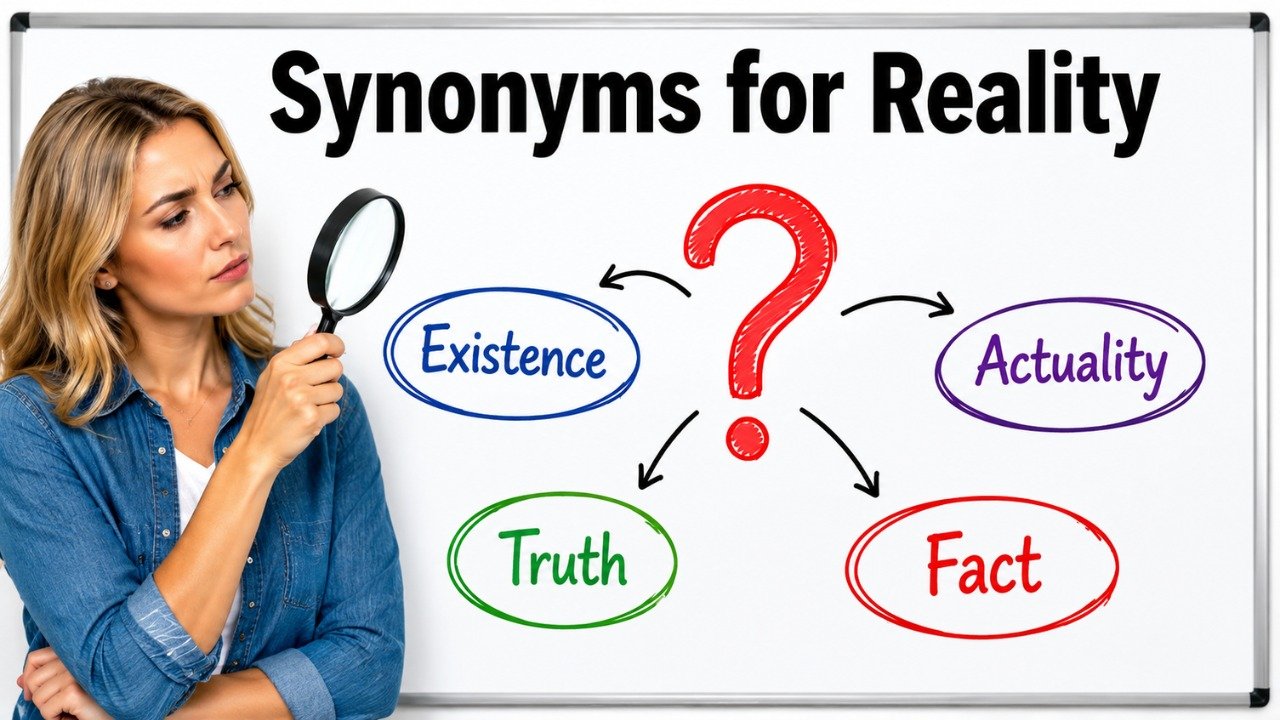
Quick Answer: The best synonyms for reality include actuality, truth, fact, existence, real life, authenticity, certainty, circumstances, the real world, and lived experience. Use actuality in formal writing when referring to what truly exists. Choose truth when contrasting facts with false information. Use real life or the real world in casual speech. Existence works best in philosophical discussions, while circumstances and situation describe someone’s present conditions. Authenticity is suitable when reality means genuineness rather than imitation.
Pronunciation and Word Details
Word: Reality.
Pronunciation: /riˈæl.ə.ti/
Part of Speech: Noun.
Meaning: The true state of things as they exist rather than as they are imagined or described.
US Pronunciation:
UK Pronunciation:
What Does “Reality” Mean?
Reality means the actual state of the world, a situation, or an experience as it truly exists. It is a noun that often contrasts with imagination, fantasy, illusion, expectation, or falsehood.
Reality can be uncountable when it refers generally to everything that exists.
Example: Scientists continue to explore the nature of reality.
It can also be countable when it refers to a particular situation, experience, or way of life.
Example: The financial realities of running a business surprised him.
The word may describe objective facts, physical existence, practical conditions, personal experiences, or the difference between appearance and truth.
Meaning, Tone, and Context of “Reality”
Reality is generally a neutral word. It can sound formal, conversational, philosophical, technical, emotional, or practical depending on the sentence.
In academic and formal writing, reality may refer to objective existence, factual conditions, or the true nature of a subject.
Example: The report examines the economic reality facing rural communities.
In casual conversation, it often describes what life is actually like.
Example: The reality of working from home was different from her expectations.
In emotional contexts, reality may sound serious or difficult, especially in phrases such as harsh reality, painful reality, or face reality.
Example: He finally accepted the painful reality of the situation.
In philosophy, science, and psychology, reality may refer to existence, consciousness, perception, or the physical world.
Example: People may interpret the same reality differently.
When and How to Use “Reality”
For Factual Truth
Use reality when describing what is true rather than what is false, imagined, or misleading.
Example: The reality was very different from the story he had told.
For Actual Existence
Use reality when discussing something that exists physically, objectively, or independently.
Example: Researchers continue to debate the relationship between perception and reality.
For Practical Conditions
Use reality when describing the true circumstances of a situation.
Example: The plan looked simple, but the financial reality was complicated.
For Everyday Life
Use reality when contrasting ordinary life with dreams, entertainment, expectations, or theories.
Example: The course prepared students for the reality of professional work.
For Personal Experience
Use reality when describing how a person experiences life or understands a situation.
Example: Her reality was shaped by years of responsibility and sacrifice.
For Difficult Acceptance
Use reality when someone must recognize an unpleasant fact.
Example: He had to face the reality that the project would not be completed on time.
For Turning Ideas Into Results
Use reality when an idea, dream, or plan becomes something real.
Example: Their careful planning turned the concept into reality.
Best Synonyms for Reality
Actuality
Synonym: Actuality means the true state of something as it exists.
Example: The proposal sounded affordable, but in actuality, it required a large investment.
Truth
Synonym: Truth means the real facts about a person, event, or situation.
Example: She wanted to discover the truth behind the confusing report.
Fact
Synonym: A fact is something known or proven to be true.
Example: The fact remained that the deadline had already passed.
Existence
Synonym: Existence means the state of being real or present.
Example: Scientists found evidence supporting the existence of water beneath the surface.
Real Life
Synonym: Real life means ordinary human experience outside imagination, theory, or fiction.
Example: The skills are useful in real life as well as in the classroom.
Authenticity
Synonym: Authenticity means the quality of being genuine, original, or true.
Example: The handmade details added authenticity to the design.
State of Affairs
Synonym: State of affairs means the current condition of a situation.
Example: The investigation revealed a troubling state of affairs.
Circumstances
Synonym: Circumstances are the conditions affecting a person, decision, or event.
Example: Her circumstances changed after she accepted the new position.
The Real World
Synonym: The real world means practical life outside theories, expectations, or protected environments.
Example: Students need opportunities to apply their knowledge in the real world.
Lived Experience
Synonym: Lived experience means a situation as personally experienced by an individual.
Example: Her lived experience gave her a deeper understanding of the issue.
50 Synonyms for Reality with Short Meanings
- Actuality: The true condition of something as it exists.
- Truth: The real facts about something.
- Fact: Something known or proven to be true.
- Existence: The state of being real or present.
- Being: The condition of existing.
- Realness: The quality of being real.
- Authenticity: The quality of being genuine.
- Genuineness: The state of being true and original.
- Factuality: The quality of being based on facts.
- Verity: A truth or accepted fact.
- Certainty: Something firmly known to be true.
- Substance: Real importance, meaning, or physical presence.
- Materiality: The quality of having physical or practical existence.
- Concreteness: The quality of being definite and real.
- Objectivity: Reality viewed without personal bias.
- Real Life: Ordinary life as it is actually experienced.
- Actual Life: Life as it genuinely occurs.
- Everyday Life: Normal daily experience.
- Practical Life: Life involving real duties and conditions.
- Day to Day Life: Regular experiences and responsibilities.
- The Real World: Practical existence outside imagination or theory.
- The Physical World: Everything that exists materially.
- The Material World: The world of physical objects and conditions.
- The Objective World: Existence independent of personal opinion.
- The Observable World: Reality that can be seen, measured, or studied.
- The Concrete World: Definite and physical existence.
- Lived Experience: Reality as personally experienced.
- Human Experience: The events and feelings people encounter in life.
- Personal Experience: An individual’s direct knowledge of life.
- Actual Experience: Something personally encountered rather than imagined.
- Situation: The current set of conditions.
- Circumstances: Conditions affecting an event or person.
- Conditions: The factors defining a situation.
- State of Affairs: The current condition of events.
- Current Situation: What is happening at the present time.
- Real Situation: The true circumstances behind an event.
- Actual Situation: The genuine condition of something.
- True State: The condition that really exists.
- Actual State: The existing condition rather than the expected one.
- Present Conditions: The circumstances that currently exist.
- Existing Conditions: The facts and circumstances already present.
- Facts of the Matter: The important truths about a situation.
- Truth of the Matter: What is actually true.
- True Nature: The genuine character of something.
- Actual Nature: What something is genuinely like.
- What Is: The situation as it presently exists.
- What Exists: Everything that has actual being.
- What Happened: The true events of a situation.
- Real Events: Occurrences that genuinely took place.
- Practical Reality: The actual conditions affecting a plan or decision.
Read Also:
Synonyms for Before
Synonyms for Reality by Context
When Reality Means Truth or Actuality
Use actuality, truth, fact, factuality, verity, or certainty when reality refers to something that is true.
Actuality Example: In actuality, the meeting lasted less than an hour.
Truth Example: The truth became clear after the documents were reviewed.
Fact Example: It is a fact that the company received the application.
Factuality Example: The editor questioned the factuality of several claims.
Verity Example: The story was based on an important historical verity.
Certainty Example: Change is one of the few certainties of life.
When Reality Means Existence
Use existence, being, realness, materiality, substance, or concreteness when discussing something that exists.
Existence Example: The discovery confirmed the existence of the ancient settlement.
Being Example: Philosophers have long examined the nature of human being.
Realness Example: The natural dialogue gave the characters a sense of realness.
Materiality Example: The discussion focused on the materiality of the physical world.
Substance Example: The proposal had style but lacked substance.
Concreteness Example: Specific examples gave concreteness to the argument.
When Reality Means Real Life
Use real life, actual life, everyday life, practical life, or the real world when discussing normal human experience.
Real Life Example: Communication skills are valuable in real life.
Actual Life Example: The character was inspired by events from actual life.
Everyday Life Example: Technology has changed many parts of everyday life.
Practical Life Example: The lessons prepare students for practical life.
The Real World Example: Classroom knowledge must eventually work in the real world.
When Reality Means a Situation
Use situation, circumstances, conditions, state of affairs, actual state, or present conditions when referring to current circumstances.
Situation Example: The situation became more complicated after the delay.
Circumstances Example: The decision was reasonable under the circumstances.
Conditions Example: Working conditions improved after the building was repaired.
State of Affairs Example: The review exposed an unacceptable state of affairs.
Actual State Example: The inspection revealed the actual state of the property.
Present Conditions Example: The schedule may change because of present conditions.
When Reality Means Authenticity
Use authenticity, genuineness, true nature, or realness when reality refers to something genuine.
Authenticity Example: Readers admired the authenticity of her writing.
Genuineness Example: The genuineness of his apology was clear.
True Nature Example: Pressure revealed the true nature of the problem.
Realness Example: Small imperfections added realness to the scene.
When Reality Means Personal Experience
Use lived experience, personal experience, human experience, or actual experience when discussing life from an individual viewpoint.
Lived Experience Example: Policies should consider the lived experience of local families.
Personal Experience Example: She spoke from personal experience.
Human Experience Example: Loss is a difficult part of the human experience.
Actual Experience Example: Actual experience often teaches lessons that theory cannot provide.
Another Word for Reality
The best single formal replacement for reality is actuality. It clearly refers to the true state of a situation rather than an imagined, expected, or reported version. However, the strongest alternative depends on the sentence. Truth is better for factual accuracy, existence is better for philosophical subjects, and real life is more natural in casual conversation.
Original: The reality was different from our expectations.
Better Option: The actuality was different from our expectations.
Original: We need to understand the reality of the situation.
Better Option: We need to understand the truth of the situation.
Original: This theory may not work in reality.
Better Option: This theory may not work in real life.
Original: The discovery changed our understanding of reality.
Better Option: The discovery changed our understanding of existence.
When Not to Use “Reality”
Reality is useful, but it can sound vague or repetitive when a more precise word is available.
When Discussing a Verified Detail
Use fact when you are referring to one specific piece of proven information.
Weak: The reality is that the payment was received on Monday.
Better: The fact is that the payment was received on Monday.
When Describing Current Conditions
Use situation, circumstances, or conditions when practical details are more important than broad truth.
Weak: The reality at the office has improved.
Better: Working conditions at the office have improved.
When Discussing Genuine Character
Use authenticity or genuineness when describing whether something feels sincere or original.
Weak: The reality of her performance impressed the audience.
Better: The authenticity of her performance impressed the audience.
When Discussing Physical Presence
Use existence when the issue is whether something is real or present.
Weak: Researchers questioned the reality of the hidden structure.
Better: Researchers questioned the existence of the hidden structure.
When Describing Personal Experience
Use lived experience when discussing how events affect a particular person or group.
Weak: The policy ignored the reality of working parents.
Better: The policy ignored the lived experience of working parents.
When Reality Becomes Repetitive
Avoid using reality several times in the same paragraph.
Weak: The reality of the situation is that the reality faced by families differs from the reality shown in the report.
Better: The truth is that the circumstances faced by families differ from the situation described in the report.
Words Commonly Confused With Reality
Reality vs Truth: Reality refers broadly to what exists or what is actually happening. Truth refers to accurate facts, statements, or beliefs about that reality.
Reality vs Fact: Reality is the complete condition of things. A fact is one specific piece of verified information.
Reality vs Actuality: These words are close synonyms. Actuality sounds more formal and often emphasizes the difference between appearance and the true situation.
Reality vs Existence: Reality includes everything that is real. Existence refers specifically to the state of being present or real.
Reality vs Realism: Reality is what actually exists. Realism is a style, attitude, or approach that represents life accurately and practically.
Reality vs Authenticity: Reality refers to actual existence or circumstances. Authenticity describes whether something is genuine, sincere, or original.
Reality vs Perception: Reality is what actually exists. Perception is how a person notices, interprets, or understands it.
Reality vs Appearance: Reality is the true condition. Appearance is how something seems from the outside.
Which Synonym Should You Choose?
Choose actuality when formal writing requires a direct contrast between appearance and the true situation.
Choose truth when discussing honesty, accurate information, evidence, or false claims.
Choose fact when referring to one specific and verifiable detail.
Choose existence when discussing whether a person, object, idea, or condition is real.
Choose real life for natural, casual conversations about ordinary experience.
Choose the real world when contrasting practical experience with theory, education, fantasy, or expectations.
Choose circumstances when describing conditions that affect a person or decision.
Choose state of affairs when formally discussing the current condition of an organization, system, or situation.
Choose authenticity when describing genuineness, originality, or sincerity.
Choose lived experience when discussing reality from the personal viewpoint of an individual or community.
Choose practical reality when evaluating whether an idea, proposal, or plan can work under actual conditions.
Choose conditions when reports, essays, or professional documents require specific information about an environment or situation.
Real Life Examples of “Reality” in Sentences
Original: The reality of the job was more demanding than she expected.
Better Option: The actual nature of the job was more demanding than she expected.
Original: He refused to accept the reality of the situation.
Better Option: He refused to accept the truth of the situation.
Original: The plan sounded effective, but reality proved otherwise.
Better Option: The plan sounded effective, but actual experience proved otherwise.
Original: Students need preparation for the reality of professional life.
Better Option: Students need preparation for the practical conditions of professional life.
Original: The documentary showed the reality faced by local families.
Better Option: The documentary showed the lived experience of local families.
Original: Their dream finally became a reality.
Better Option: Their dream finally became an actuality.
Original: The reality is that the budget cannot support another project.
Better Option: The fact is that the budget cannot support another project.
Original: Her description did not match reality.
Better Option: Her description did not match the actual situation.
Original: Technology has changed our understanding of reality.
Better Option: Technology has changed our understanding of the real world.
Original: The reality behind the beautiful image was disappointing.
Better Option: The truth behind the beautiful image was disappointing.
Synonym Groups and Usage Differences
Truth and Fact Group
This group includes truth, fact, actuality, verity, factuality, and certainty. These words describe what is correct, proven, or genuinely the case.
Truth is broad and often contrasts with dishonesty. Fact refers to a specific verified detail. Actuality emphasizes what exists beneath appearances.
Example: The investigation revealed the truth about what happened.
Existence Group
This group includes existence, being, realness, materiality, substance, and concreteness. These words focus on whether something exists or has a definite form.
Existence is the most direct word. Materiality is more technical. Substance can describe physical presence or meaningful content.
Example: The evidence confirmed the existence of the underground chamber.
Practical Life Group
This group includes real life, actual life, everyday life, practical life, day to day life, and the real world. These alternatives describe ordinary experience outside imagination or theory.
Real life is natural in casual speech. The real world often contrasts practical experience with classroom learning or abstract ideas.
Example: The method may be difficult to use in the real world.
Situation and Conditions Group
This group includes situation, circumstances, conditions, state of affairs, present conditions, and actual state. These words describe the current reality surrounding a person or event.
Situation is general. Circumstances emphasize influencing factors. Conditions focus on the environment or requirements.
Example: The current situation requires careful planning.
Authenticity Group
This group includes authenticity, genuineness, realness, true nature, and actual nature. These words describe whether something is sincere, original, or faithful to its real character.
Authenticity is common in discussions of art, writing, behavior, culture, and personal expression.
Example: The natural dialogue gave the story greater authenticity.
Personal Experience Group
This group includes lived experience, personal experience, actual experience, and human experience. These alternatives describe reality as encountered by people.
Lived experience is especially useful when individual or community perspectives are important.
Example: Her lived experience helped the team understand the problem more clearly.
Antonyms of Reality
The opposite of reality changes according to meaning. A word may contrast reality with imagination, falsehood, appearance, or nonexistence.
Illusion: A false idea or misleading appearance.
Fantasy: An imagined situation that is unlikely or impossible.
Fiction: An invented story or description.
Imagination: The ability to create ideas or images that are not physically present.
Unreality: The condition of not being real.
Falsehood: A statement or belief that is not true.
Deception: An act designed to make someone believe something false.
Appearance: The way something seems rather than what it truly is.
Dream: An imagined hope, vision, or experience.
Myth: A widely repeated belief or traditional story that may not be factual.
Fabrication: Something deliberately invented or falsely created.
Pretense: Behavior intended to create a false impression.
Possibility: Something that may happen but is not yet actual.
Theory: An explanation or idea that may not yet be proven in practice.
Nonexistence: The state of not being present or real.
Comparison: Reality vs Related Words
Reality vs Actuality
Reality is the more common and flexible word. It can describe existence, life, facts, experiences, or circumstances. Actuality is more formal and usually contrasts the true situation with an assumption or appearance.
Example With Reality: The reality of the project was more complicated than expected.
Example With Actuality: In actuality, the project required several additional approvals.
Reality vs Truth
Reality is everything that actually exists or happens. Truth is an accurate statement, understanding, or account of that reality.
Example With Reality: The reality of life in the region was difficult.
Example With Truth: She told the truth about what had happened.
Reality vs Fact
Reality is broad, while a fact is a specific detail that can be verified.
Example With Reality: The report described the economic reality of the community.
Example With Fact: The report included the fact that unemployment had increased.
Reality vs Existence
Reality refers to the actual world or true circumstances. Existence refers to the state of being real or present.
Example With Reality: Our understanding of reality continues to develop.
Example With Existence: The discovery proved the existence of the missing document.
Reality vs Realism
Reality is what actually exists. Realism is an accurate representation of life or a practical attitude toward situations.
Example With Reality: The story was inspired by reality.
Example With Realism: The detailed dialogue added realism to the story.
Reality vs Perception
Reality is the true state of things. Perception is an individual interpretation of what is seen, heard, or experienced.
Example With Reality: The financial reality remained unchanged.
Example With Perception: Public perception improved after the announcement.
Reality vs Authenticity
Reality describes what is real. Authenticity describes whether something is genuine or true to its origin or character.
Example With Reality: The photograph captured the reality of daily work.
Example With Authenticity: The natural expressions gave the photograph authenticity.
Common Phrases and Expressions With “Reality”
In Reality: Used to introduce the true situation.
Example: The task looked simple, but in reality, it required careful preparation.
The Reality Is: Used to state an important or unavoidable fact.
Example: The reality is that the work cannot be completed without additional support.
Face Reality: To accept an unpleasant or difficult truth.
Example: We must face reality and revise the schedule.
Accept Reality: To recognize the true situation without denying it.
Example: She accepted reality and began planning her next step.
Harsh Reality: A difficult or unpleasant truth.
Example: The high cost was a harsh reality for many families.
Painful Reality: A truth that causes sadness or emotional discomfort.
Example: Losing the opportunity was a painful reality.
Practical Reality: The actual conditions affecting what can be done.
Example: The design was attractive, but practical reality required a simpler solution.
Reality Check: An event or observation that corrects unrealistic expectations.
Example: The first difficult assignment gave him a reality check.
Turn Into Reality: To make an idea, hope, or plan become real.
Example: Years of effort helped them turn the idea into reality.
Escape From Reality: To temporarily avoid thinking about ordinary problems or responsibilities.
Example: Reading offered her a brief escape from reality.
Common Mistakes to Avoid
Repeating Reality Too Often
Using reality several times in one paragraph makes the writing sound heavy and repetitive. Replace some uses with truth, situation, circumstances, fact, or real life.
Repetitive: The reality is that the reality of the market affects the reality faced by workers.
Improved: The truth is that market conditions affect the circumstances faced by workers.
Using Reality for One Specific Fact
Reality is broad. Use fact when referring to a single verified detail.
Unclear: The reality is that the train arrived at nine.
Clearer: The fact is that the train arrived at nine.
Confusing Reality With Realism
Reality means what actually exists. Realism means accurate representation or a practical attitude.
Incorrect: The painting shows great reality.
Better: The painting shows great realism.
Using Truth When Existence Is Intended
Truth concerns accuracy, while existence concerns whether something is real or present.
Less Accurate: Scientists questioned the truth of the distant planet.
Better: Scientists questioned the existence of the distant planet.
Using Authenticity for General Circumstances
Authenticity describes genuineness. It normally does not describe practical conditions.
Incorrect: The authenticity of the financial problem worried the team.
Better: The reality of the financial problem worried the team.
Choosing an Overly Formal Synonym
Actuality may sound stiff in casual conversation.
Too Formal: In actuality, I forgot my keys at home.
Natural: In reality, I forgot my keys at home.
Treating Every Synonym as Interchangeable
Reality, truth, fact, existence, authenticity, and circumstances overlap, but they do not have identical meanings. Choose the word that communicates the exact idea.
Using Vague Phrases
Expressions such as the reality of things may sound unclear. Name the specific situation whenever possible.
Vague: We discussed the reality of things.
Clearer: We discussed the actual financial conditions affecting the project.
Conclusion
The best synonyms for reality depend on the intended meaning. Actuality, truth, and fact work well when discussing what is true. Existence suits philosophical or scientific contexts, while real life and the real world sound natural in everyday speech. Circumstances, conditions, and situation describe practical details. Authenticity refers to genuineness, and lived experience expresses a personal viewpoint. Choosing among these synonyms for reality makes writing clearer, more accurate, and better suited to its context.
FAQs About Synonyms for Reality
What Is the Best Synonym for Reality?
Actuality is one of the closest formal synonyms for reality. Truth, fact, existence, and real life may be better in specific contexts.
Is Truth a Synonym for Reality?
Yes, truth can replace reality when the sentence refers to accurate facts or the true condition of a situation. However, truth does not always describe physical existence.
What Is a Formal Word for Reality?
Actuality is a formal alternative to reality. State of affairs, objective existence, and factuality may also work in academic or professional writing.
What Is Another Word for Reality in Everyday Speech?
Real life and the real world are natural alternatives in everyday conversation.
What Is Another Word for Harsh Reality?
Painful truth, unpleasant fact, difficult situation, and harsh actuality can express a similar meaning.
Are Reality and Existence the Same?
They are related but not identical. Existence means the state of being real, while reality includes everything that exists and the true conditions of life.
What Is the Opposite of Reality?
Common opposites of reality include illusion, fantasy, fiction, imagination, unreality, and falsehood. The best antonym depends on the sentence.
