
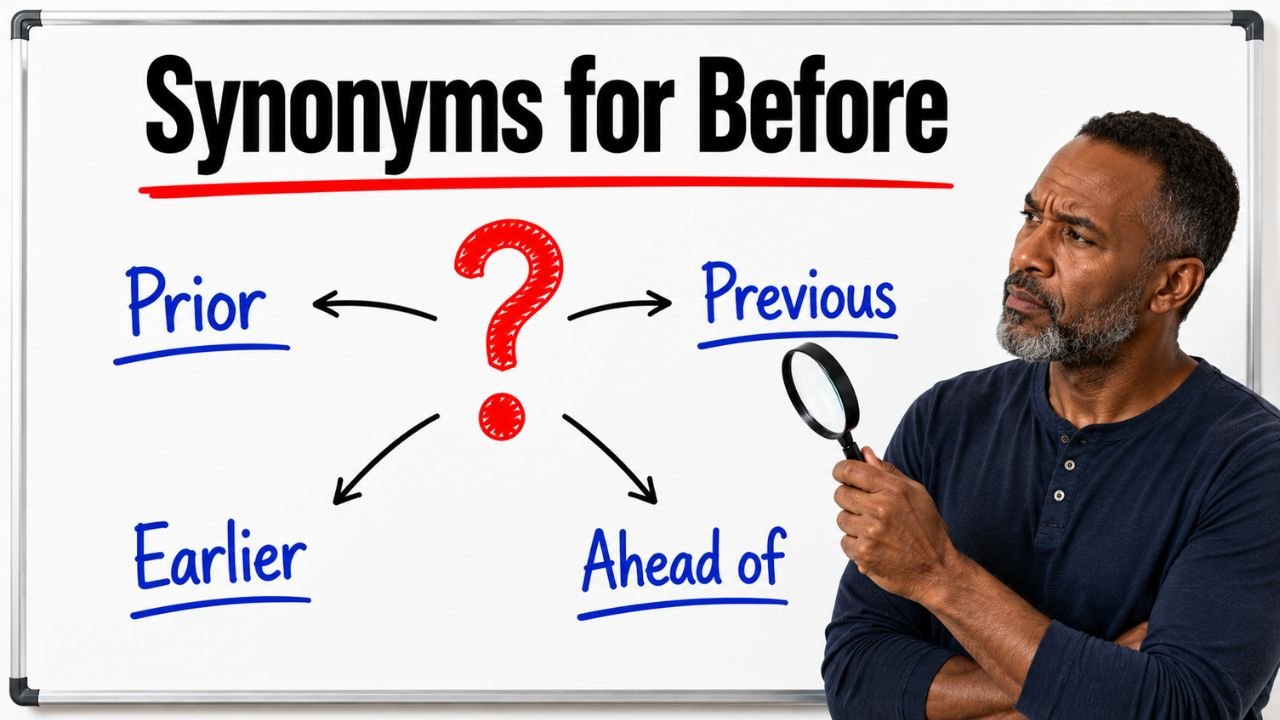
Quick Answer: Common synonyms for before include prior to, earlier than, ahead of, in advance of, previously, beforehand, formerly, preceding, in front of, and rather than. Use prior to in formal writing, earlier than when comparing times, ahead of for schedules or progress, beforehand for advance preparation, previously when referring to an earlier action, preceding for order, in front of for physical position, and rather than when expressing preference. The best choice depends on whether before describes time, sequence, position, preparation, or preference.
Pronunciation and Word Details
Word: Before.
Pronunciation: /bɪˈfɔːr/
Part of Speech: Preposition, conjunction, and adverb.
Meaning: At an earlier time, in advance of something, or in front of someone or something.
US Pronunciation:
UK Pronunciation:
What Does “Before” Mean?
Before means earlier than a particular time, action, event, person, or position. It can function as a preposition, conjunction, or adverb.
As a preposition, before appears in front of a noun or pronoun.
Example: We arrived before sunset.
As a conjunction, it connects two clauses and shows that one action happens earlier than another.
Example: Finish your work before you leave.
As an adverb, it refers to an earlier time without being followed by a noun.
Example: I have seen this painting before.
Before can also describe physical position, order, priority, or preference. For example, someone may stand before a judge, place safety before convenience, or complete one task before another.
Meaning, Tone, and Context of “Before”
Before is a neutral and highly versatile word. It is natural in casual conversations, formal documents, academic writing, instructions, stories, reports, and professional communication.
In everyday speech, before usually refers to time.
Example: Call me before dinner.
In formal writing, prior to may replace before.
Example: Submit the documents prior to the meeting.
In instructions, before shows the required order of actions.
Example: Wash your hands before preparing the food.
In descriptions of position, before can mean in front of or in the presence of someone.
Example: The witness appeared before the court.
In statements about values or priorities, before can mean ahead of something in importance.
Example: She places honesty before personal gain.
The tone of before usually depends on the surrounding sentence. It can sound neutral, urgent, formal, reflective, commanding, or emotional.
When and How to Use “Before”
For Time
Use before when one event happens earlier than another event or time.
Example: We should leave before noon.
For Sequence
Use before to show which action must happen first.
Example: Read the instructions before starting the test.
For Preparation
Use before when someone needs to prepare in advance.
Example: Check the weather before planning the trip.
For Deadlines
Use before when something must be completed earlier than a stated limit.
Example: Please submit the form before Friday.
For Physical Position
Use before to describe someone or something positioned in front of another person or object.
Example: A beautiful garden stretched before the house.
For an Audience or Authority
Use before when someone appears in the presence of a group, official, judge, or audience.
Example: She spoke before a large audience.
For Priority
Use before when one responsibility, value, or concern is considered more important than another.
Example: The organization puts safety before speed.
For Preference
Use before to express that one thing is preferred over another.
Example: He would choose peace before conflict.
For Earlier Experience
Use before as an adverb when discussing something that happened previously.
Example: I have heard that explanation before.
For Earlier Written Information
Use before when referring to a point already mentioned in a text or conversation.
Example: As explained before, every applicant must provide identification.
Best Synonyms for Before
Prior To
Synonym: Prior to.
Meaning: Earlier than a particular time or event, especially in formal writing.
Example: All equipment must be inspected prior to use.
Earlier Than
Synonym: Earlier than.
Meaning: At a time that comes first when two times are compared.
Example: She arrived earlier than expected.
Ahead Of
Synonym: Ahead of.
Meaning: Earlier than a scheduled time or more advanced in progress.
Example: The team completed the project ahead of schedule.
In Advance Of
Synonym: In advance of.
Meaning: Before an event happens, often for preparation.
Example: Invitations were sent in advance of the ceremony.
Previously
Synonym: Previously.
Meaning: At an earlier time.
Example: The building was previously used as a library.
Beforehand
Synonym: Beforehand.
Meaning: Earlier, especially as preparation for something.
Example: Let us review the questions beforehand.
Formerly
Synonym: Formerly.
Meaning: In the past, especially when a situation has changed.
Example: The property was formerly a school.
Preceding
Synonym: Preceding.
Meaning: Coming directly before something in time, position, or order.
Example: Review the preceding paragraph for additional details.
In Front Of
Synonym: In front of.
Meaning: In a position ahead of someone or something.
Example: A delivery truck stopped in front of the building.
Rather Than
Synonym: Rather than.
Meaning: Used when one choice is preferred to another.
Example: She chose to listen rather than argue.
50 Synonyms for Before with Short Meanings
- Prior to: Earlier than a stated time or event.
- Earlier than: Happening first when times are compared.
- Ahead of: Earlier than a schedule, person, or event.
- In advance of: Earlier than an event for preparation.
- Previous to: Existing or happening earlier than something else.
- Preceding: Coming directly earlier in time or order.
- Antecedent to: Existing or occurring earlier than another thing.
- Anterior to: Positioned or occurring earlier, especially in formal contexts.
- Ere: Before, in old or literary language.
- Sooner than: Earlier than a particular time or action.
- Beforehand: At an earlier time in preparation.
- Previously: At some time in the past.
- Earlier: At a previous time.
- Formerly: In the past when circumstances were different.
- Once: At a previous time.
- Prior: Earlier in time or sequence.
- In advance: Earlier than necessary or expected.
- At an earlier time: During a previous period.
- In the past: At a time that has already gone.
- Already: Earlier than the present time or expected time.
- Up to: Continuing until a particular time or limit.
- Until: Continuing to a stated point in time.
- By: No later than a stated time.
- No later than: At or before a fixed deadline.
- Ahead of time: Earlier than expected or required.
- In front of: In a position facing or leading something.
- Ahead of another: Positioned farther forward than someone else.
- In the presence of: Appearing in front of someone or a group.
- In the sight of: Visible to a person or audience.
- Facing: Positioned with the front directed toward something.
- Under the gaze of: In a position where others can observe.
- At the head of: Occupying the first or leading position.
- Leading: Coming first in position, progress, or importance.
- First: Earlier than all others in order.
- Earlier in order: Appearing at a previous point in a sequence.
- Foregoing: Mentioned or written earlier in a document.
- Above: Mentioned earlier in a written text.
- Previously mentioned: Referred to at an earlier point.
- Earlier stated: Expressed at a previous point.
- Previously stated: Already explained or declared.
- Preparatory to: Done as preparation for something.
- Preliminary to: Happening as an introduction to a later action.
- In preparation for: Done to become ready for something.
- In anticipation of: Done because a future event is expected.
- On the eve of: Immediately before an important event.
- Leading up to: Happening during the period before an event.
- Rather than: Used to prefer one choice over another.
- Instead of: In place of another action or choice.
- In preference to: Chosen because it is more desirable.
- Over: Preferred or given greater importance than something else.
Read Also:
Synonyms for Correct
Synonyms for Before by Context
When Before Means Earlier Than a Time or Event
Prior to, earlier than, ahead of, in advance of, previous to, and preceding all express an earlier time.
Prior to is especially common in formal instructions, policies, and reports.
Example: The application must be completed prior to registration.
Earlier than is useful when directly comparing two times.
Example: The train arrived earlier than the published time.
Ahead of often suggests that something happened sooner than planned.
Example: Construction finished ahead of schedule.
When Before Means Previously
Previously, earlier, beforehand, formerly, once, and in the past refer to something that happened at an earlier time.
Previously works well in reports and explanations.
Example: The issue was previously discussed during the meeting.
Earlier is common in both speech and writing.
Example: I spoke with the manager earlier.
Formerly describes a past state, role, name, or condition that has changed.
Example: The building was formerly a private residence.
When Before Means In Front Of
In front of, facing, in the presence of, in the sight of, and under the gaze of can replace before when physical position or an audience is involved.
Example: The speaker stood in front of the audience.
In the presence of is more formal and often refers to an official, authority, or respected person.
Example: The agreement was signed in the presence of two witnesses.
Facing focuses on direction or physical orientation.
Example: She sat facing the entrance.
When Before Means Earlier in Order
Preceding, prior, first, foregoing, above, and previously mentioned describe something that appears earlier in a sequence or document.
Example: The preceding chapter explains the central theory.
Foregoing is formal and usually refers to information already provided.
Example: The foregoing conditions apply to every participant.
Above is common when referring to earlier written information.
Example: Complete the form using the instructions above.
When Before Means Rather Than
Rather than, instead of, in preference to, and over can express preference or priority.
Example: She chose patience rather than anger.
Instead of emphasizes replacing one option with another.
Example: We walked instead of taking the bus.
Over is concise and natural when comparing preferences.
Example: He prefers coffee over tea.
When Before Marks a Deadline or Limit
By, no later than, until, and up to can relate to the deadline meaning of before, but they are not always interchangeable.
By means at or earlier than a deadline.
Example: Submit your response by Monday.
No later than strongly emphasizes the final acceptable time.
Example: Arrive no later than nine o’clock.
Until describes an action or condition continuing to a stated point.
Example: The office will remain open until six o’clock.
Another Word for Before
Prior to is often the best formal replacement for before when referring to time. However, the best alternative depends on whether the sentence describes time, position, sequence, preparation, or preference.
Original: Check the document before the meeting.
Better Option: Check the document prior to the meeting.
Original: I had visited the city before.
Better Option: I had previously visited the city.
Original: We completed the work before the deadline.
Better Option: We completed the work ahead of the deadline.
Original: The car stopped before the entrance.
Better Option: The car stopped in front of the entrance.
When Not to Use “Before”
Before is clear in most situations, but another word may provide greater precision.
When Formal Language Is Required
Prior to may sound more appropriate in formal policies, instructions, or reports.
Weak: Employees must register before entering the restricted area.
Better: Employees must register prior to entering the restricted area.
When Referring to an Earlier Experience
Previously may be clearer when the exact comparison point is not stated.
Weak: The researcher worked here before.
Better: The researcher previously worked here.
When Describing Preparation
Beforehand may better emphasize preparation completed in advance.
Weak: We should discuss the questions before.
Better: We should discuss the questions beforehand.
When Comparing Arrival Times
Earlier than is clearer when comparing two specific people, actions, or times.
Weak: Maria arrived before Daniel did.
Better: Maria arrived earlier than Daniel did.
When Describing Physical Position
In front of may be more natural in everyday descriptions.
Weak: A bicycle was parked before the gate.
Better: A bicycle was parked in front of the gate.
When Expressing a Deadline
By may be more accurate when completion at the deadline is acceptable.
Weak: Submit the report before Friday.
Better: Submit the report by Friday.
The weak sentence requires submission earlier than Friday. The better sentence allows submission at any time up to and including Friday.
When Expressing Preference
Rather than or instead of is usually clearer than before.
Weak: She chose silence before an argument.
Better: She chose silence rather than an argument.
Words Commonly Confused With Before
Before vs Earlier: Before usually needs a reference point, while earlier can stand alone or compare two times. “Before dinner” identifies the reference event. “I arrived earlier” does not need one.
Before vs Prior To: Both can mean earlier than. Before is more natural in everyday language, while prior to is more formal.
Before vs Until: Before identifies an action that happens earlier than a point. Until describes something continuing up to that point.
Before vs By: Before excludes the stated deadline, while by includes it. “Before Monday” means earlier than Monday. “By Monday” means no later than Monday.
Before vs Ago: Before refers to an earlier point relative to another time. Ago measures backward from the present.
Before vs Previously: Before may require a time, action, or event as its reference. Previously simply means at an earlier time.
Before vs Formerly: Before has a broad time meaning. Formerly describes a past identity, role, name, state, or condition that has changed.
Before vs Ahead Of: Before simply places one thing earlier than another. Ahead of may also suggest progress, advantage, position, or early completion.
Before vs Preceding: Before is flexible and conversational. Preceding usually describes something directly earlier in a formal sequence.
Before vs In Front Of: Before can describe time or position. In front of only describes physical or figurative position.
Which Synonym Should You Choose?
Choose prior to for formal instructions, policies, academic writing, and professional reports.
Choose earlier than when directly comparing two times, actions, or arrivals.
Choose ahead of when something happens sooner than scheduled or expected.
Choose in advance of when discussing preparation for a planned event.
Choose previously when referring to an action, fact, decision, or experience from an earlier time.
Choose beforehand when emphasizing that preparation should happen early.
Choose formerly when describing a past name, position, use, identity, or condition.
Choose preceding when referring to the previous item in a sequence, chapter, paragraph, or stage.
Choose in front of when describing ordinary physical position.
Choose in the presence of when someone appears before an authority, witness, official, or audience.
Choose by when an action may be completed at any time up to a deadline.
Choose rather than when comparing choices or preferences.
Choose instead of when one option replaces another.
Choose first when clearly stating the required order of actions.
Real Life Examples of “Before” in Sentences
Original: Please call me before the appointment.
Better Option: Please call me prior to the appointment.
Original: We arrived before the other guests.
Better Option: We arrived earlier than the other guests.
Original: The team completed the assignment before the deadline.
Better Option: The team completed the assignment ahead of the deadline.
Original: I had read the book before.
Better Option: I had previously read the book.
Original: Let us prepare the materials before.
Better Option: Let us prepare the materials beforehand.
Original: The warehouse was a factory before.
Better Option: The warehouse was formerly a factory.
Original: Read the paragraph before this one.
Better Option: Read the preceding paragraph.
Original: A large tree stood before the house.
Better Option: A large tree stood in front of the house.
Original: She appeared before the committee.
Better Option: She appeared in the presence of the committee.
Original: He chose honesty before personal advantage.
Better Option: He chose honesty over personal advantage.
Synonym Groups and Usage Differences
Time Group
Prior to, earlier than, previous to, and sooner than indicate that one thing happens earlier than another.
Prior to is formal, while earlier than is more natural in direct comparisons.
Example: The inspection occurred prior to the opening ceremony.
Previous Experience Group
Previously, earlier, once, formerly, and in the past refer to earlier experiences or conditions.
Previously describes an earlier event. Formerly describes an earlier state that has changed.
Example: She previously managed a smaller department.
Preparation Group
Beforehand, in advance, in preparation for, and in anticipation of focus on readiness.
Beforehand is conversational, while in anticipation of suggests an expected future event.
Example: We booked our seats in advance.
Position Group
In front of, facing, in the presence of, and under the gaze of refer to position or visibility.
In front of is direct and neutral. Under the gaze of creates a more expressive or dramatic tone.
Example: The children gathered in front of the stage.
Sequence Group
Preceding, prior, foregoing, above, and first describe order.
Preceding usually means directly earlier. Foregoing refers to information already presented in formal writing.
Example: The preceding section outlines the main requirements.
Deadline Group
By, no later than, until, and up to relate to time limits, but each has a different grammatical function.
By marks the final acceptable completion time. Until describes continuation.
Example: Please respond by Thursday.
Preference Group
Rather than, instead of, in preference to, and over express choice or priority.
Rather than compares alternatives. Instead of shows replacement. Over states preference or importance.
Example: She selected quality over convenience.
Antonyms of Before
The opposite of before changes according to whether the word refers to time, order, position, or preference.
After: At a later time than something else.
Later than: Happening at a more advanced time.
Afterward: At a later time following an event.
Later: At a time following the present or another stated time.
Subsequently: At a later point, especially in formal writing.
Following: Coming after something in time or order.
Next: Immediately after the current item or action.
Behind: In a position at the back of someone or something.
Beyond: Farther than a particular point or position.
Thereafter: After a stated event or time.
Eventually: At a later time after a delay.
Last: Coming after all others in order.
Under: Given less importance or priority than something else.
Secondary to: Considered less important than another concern.
Comparison: Before vs Related Words
Before vs Prior To
Before and prior to both mean earlier than. Before is concise and natural in almost every context. Prior to sounds more formal and is common in official instructions or reports.
Example With Before: Turn off the lights before leaving.
Example With Prior To: All visitors must register prior to entry.
Before vs Earlier
Before normally connects an event to a reference point. Earlier can describe a previous time without naming the reference point.
Example With Before: We met before lunch.
Example With Earlier: We met earlier.
Before vs Previously
Before often appears with a noun, clause, or stated event. Previously functions as an adverb meaning at an earlier time.
Example With Before: I had met her before the conference.
Example With Previously: I had previously met her.
Before vs Until
Before indicates that an action happens earlier than a particular point. Until indicates that an action continues and stops at that point.
Example With Before: Finish the assignment before six o’clock.
Example With Until: Continue working until six o’clock.
Before vs By
Before means earlier than a stated time and does not include that time. By means no later than the stated time and usually includes it.
Example With Before: Submit the application before Friday.
Example With By: Submit the application by Friday.
Before vs Ago
Before connects one past action to another reference point. Ago measures time backward from the present moment.
Example With Before: She had visited the museum two years before the renovation.
Example With Ago: She visited the museum two years ago.
Before vs Ahead Of
Before indicates basic time or position. Ahead of may suggest early completion, forward position, or greater progress.
Example With Before: We arrived before the event began.
Example With Ahead Of: We arrived ahead of schedule.
Before vs Formerly
Before can refer to any earlier time. Formerly describes something that once had a different name, purpose, role, or condition.
Example With Before: I worked in this building before.
Example With Formerly: This building was formerly a hospital.
Common Phrases and Expressions With Before
Before Long: Soon or after a short period.
Before Now: At some earlier time.
Before Then: Earlier than a previously mentioned time.
Before Dawn: Earlier than sunrise.
Before Dark: Earlier than nightfall.
Before Anything Else: As the first action or highest priority.
Before Your Eyes: In full view while something is happening.
Before the Fact: Prior to an event or action.
Before Its Time: Earlier than expected or earlier than society was ready for it.
Before All Else: More importantly than anything else.
Never Before: Not at any earlier time.
The Day Before: The previous day.
Think Before You Speak: Consider your words before saying them.
Look Before You Leap: Consider possible consequences before acting.
Common Mistakes to Avoid
Using Before and Prior Together
Before and prior to express the same basic time relationship. Using them together is repetitive.
Incorrect: Submit the document prior before the deadline.
Correct: Submit the document before the deadline.
Correct: Submit the document prior to the deadline.
Confusing Before With Ago
Use ago when measuring backward from the present. Use before when referring to an earlier time in relation to another point.
Incorrect: I moved here five years before.
Correct: I moved here five years ago.
Correct: I moved there five years before the company closed.
Confusing Before With By
Before excludes the named time, while by usually includes it.
Unclear: Send the payment before Tuesday.
Clear: Send the payment by Tuesday.
Use before Tuesday only when the payment must arrive earlier than Tuesday.
Using Beforehand Before a Noun
Beforehand is an adverb, so it does not normally come directly before a noun.
Incorrect: We prepared beforehand the meeting.
Correct: We prepared before the meeting.
Correct: We prepared beforehand.
Using Prior To Too Often
Prior to can sound unnecessarily formal in casual sentences.
Unnatural: Brush your teeth prior to bed.
Natural: Brush your teeth before bed.
Repeating Before in One Sentence
Too many uses of before can make a sentence difficult to follow.
Weak: Before leaving, check the door before you go before sunset.
Better: Check the door, then leave before sunset.
Using Formerly for a Single Earlier Action
Formerly usually describes an earlier condition or identity, not one completed action.
Incorrect: She formerly called me this morning.
Correct: She called me earlier this morning.
Replacing Before With Until Incorrectly
Until describes continuation, not simple sequence.
Incorrect: Finish the report until the meeting.
Correct: Finish the report before the meeting.
Correct: Work on the report until the meeting begins.
Choosing an Unclear Position Word
Before can sound literary when describing ordinary physical position.
Less Natural: A bench stood before the entrance.
More Natural: A bench stood in front of the entrance.
Forgetting the Reference Point
Before may become vague when readers cannot identify the earlier event.
Vague: She completed it before.
Clear: She completed it before the deadline.
Clear: She had completed it previously.
Conclusion
The most useful synonyms for before depend on its meaning in the sentence. Use prior to for formal time references, earlier than for comparisons, ahead of for schedules, beforehand for preparation, previously for earlier experiences, preceding for sequence, and in front of for position. Rather than and over work when before expresses preference or priority. Understanding these differences helps you select natural, precise alternatives. The best synonyms for before should always match the intended time, order, position, deadline, or comparison.
FAQs About Synonyms for Before
What Is the Best Synonym for Before?
Prior to is the best formal synonym for before. Earlier than is better for time comparisons, while previously works for past actions.
Can Prior To Always Replace Before?
No. Prior to works mainly for time. It cannot naturally replace before when the word refers to physical position, preference, or an earlier experience.
What Is a Casual Synonym for Before?
Earlier is a natural casual alternative when discussing time. Beforehand is useful when talking about preparation.
What Is a Formal Word for Before?
Prior to is the most common formal alternative. Preceding, antecedent to, and preliminary to may also work in specialized contexts.
What Is Another Word for Beforehand?
In advance is a close alternative to beforehand. Previously may work when the meaning is simply at an earlier time.
What Is the Difference Between Before and Earlier?
Before usually connects one event to another reference point. Earlier simply means at a previous time and can stand alone.
What Is the Opposite of Before?
After is the main opposite when discussing time or order. Behind is the opposite when discussing physical position.
