
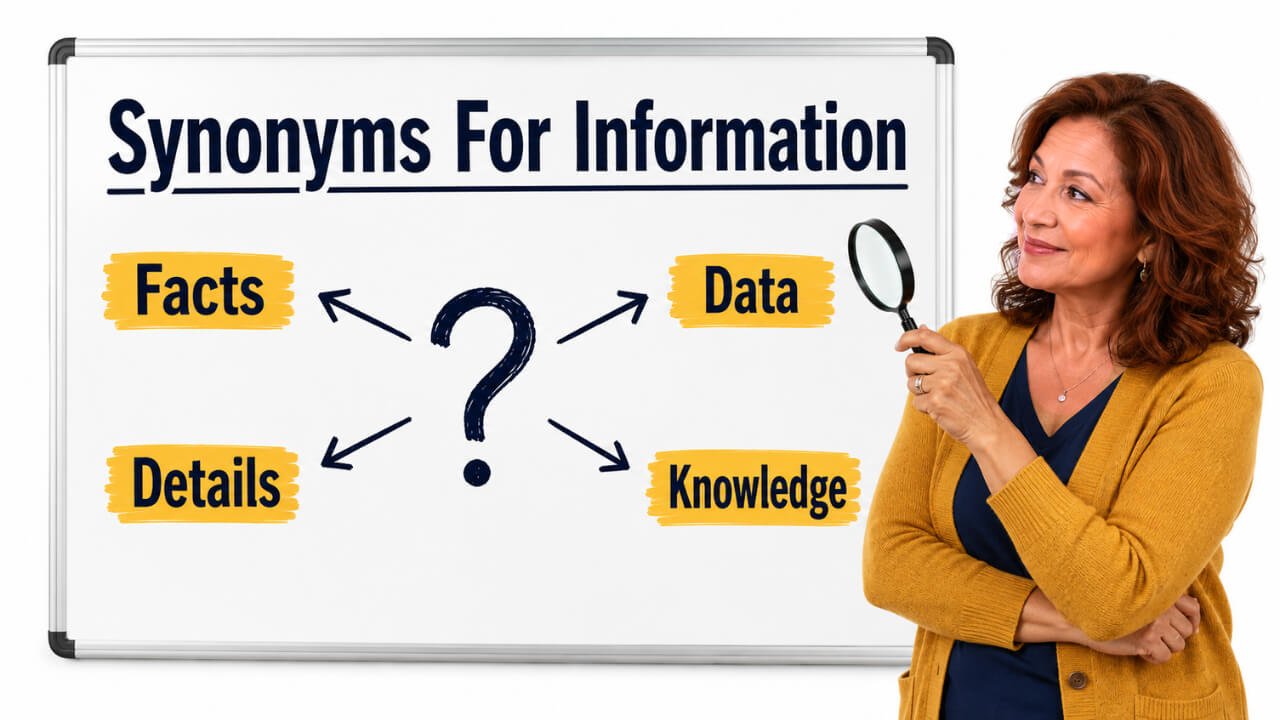
Quick Answer: The best synonyms for information include data, facts, details, knowledge, intelligence, evidence, report, news, insight, and documentation. Use data for numbers or collected facts, facts for proven truth, details for specific points, knowledge for understanding, intelligence for secret or strategic information, evidence for proof, and report for organized information.
Pronunciation and Word Details
Word: Information
Pronunciation: /ˌɪn.fəˈmeɪ.ʃən/
Part of Speech: Noun
Meaning: Facts, details, knowledge, or data about a subject, person, event, or situation.
US Pronunciation:
UK Pronunciation:
What Does “Information” Mean?
Information means facts, details, knowledge, or data that help someone understand something. It is a noun used for anything that explains, describes, reports, proves, or communicates knowledge about a topic.
Information can be general or specific. It can appear in reports, messages, instructions, records, conversations, documents, research, news, forms, and explanations. The word can refer to simple details, such as a phone number, or complex material, such as research findings or technical documentation.
Example: The form asks for basic information about your address and contact details.
Meaning, Tone, and Context of “Information”
Information has a neutral and widely accepted tone. It is common in formal writing, casual speech, academic work, business communication, technical documents, reports, learning materials, and everyday conversation.
The word is not emotional or informal. It simply refers to what is known, shared, recorded, explained, or discovered. In academic writing, information may mean knowledge, evidence, data, or findings. In business writing, it may mean details, records, updates, or reports. In daily conversation, it may mean facts, news, instructions, or helpful details.
Information is useful when the exact type of knowledge is not the main focus. However, when you need precision, a synonym like data, evidence, details, or documentation may be stronger.
When and How to Use “Information”
For General Knowledge: Use information when talking about facts or knowledge in a broad way.
Example: The book gives useful information about healthy habits.
For Specific Details: Use information when asking for or giving important points about something.
Example: Please send the information about the meeting time and location.
For Reports and Records: Use information when referring to written or organized facts.
Example: The report contains information about monthly progress.
For Learning and Explanation: Use information when something helps a reader or listener understand a subject.
Example: The lesson provides clear information about grammar rules.
For Communication: Use information when details are shared between people.
Example: The office sent information about the new schedule.
Best Synonyms for Information
Data: Collected facts, numbers, or details used for study, analysis, or decision making.
Example: The team reviewed the data before making a decision.
Facts: True details that can be checked or proven.
Example: The article explains the facts about the case.
Details: Specific pieces of information about something.
Example: She shared the details of the event.
Knowledge: Understanding gained through learning, experience, or study.
Example: Reading improves your knowledge of vocabulary.
Intelligence: Important information, often gathered for planning, security, or strategy.
Example: The officers studied the intelligence before taking action.
Evidence: Information that helps prove whether something is true.
Example: The evidence supported the final conclusion.
Report: Organized information presented in spoken or written form.
Example: The manager prepared a report on sales performance.
News: Recent information about events or developments.
Example: We received news about the change in policy.
Insight: Deep understanding or useful information about a topic.
Example: Her comments gave insight into the problem.
Documentation: Written records, instructions, or proof that explain or support something.
Example: The application requires complete documentation.
50 Synonyms for Information with Short Meanings
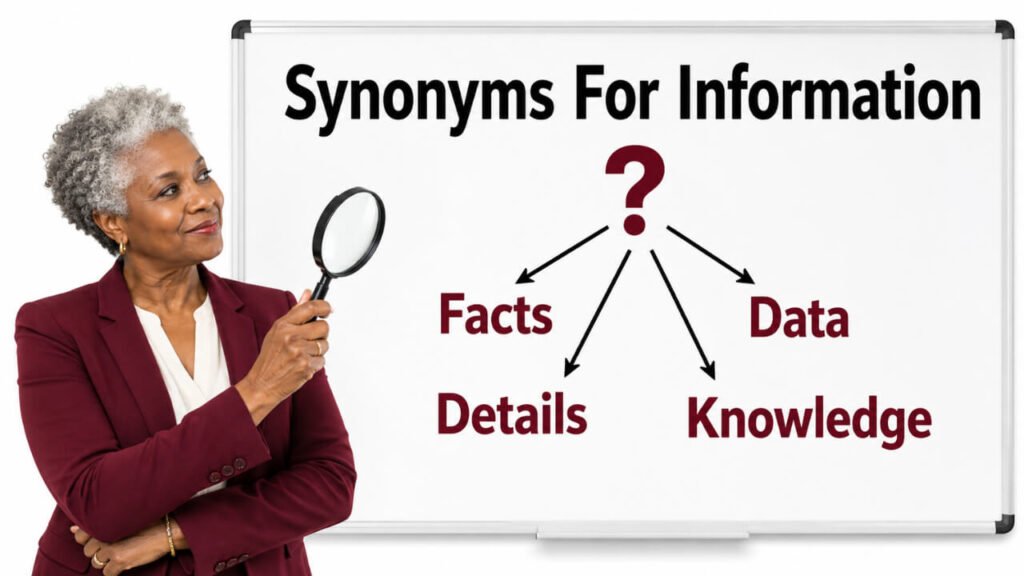
- Data: Collected facts or figures.
- Facts: True and proven details.
- Details: Specific points about something.
- Knowledge: Understanding gained through learning.
- Intelligence: Important gathered information.
- Evidence: Information used as proof.
- Report: Organized information about a subject.
- News: Recent information about events.
- Insight: Deep understanding of a topic.
- Documentation: Written records or supporting material.
- Factsheet: A short document with key facts.
- Briefing: A short explanation or update.
- Summary: A short version of important information.
- Update: New or latest information.
- Record: Stored information about something.
- File: A collection of related information.
- Document: Written or digital information.
- Material: Information used for study or reference.
- Content: Information inside a text, page, or document.
- Message: Information sent from one person to another.
- Notice: Official or direct information shared publicly.
- Statement: A spoken or written piece of information.
- Disclosure: Information made known or revealed.
- Notification: Information sent as an alert.
- Announcement: Information shared formally or publicly.
- Communication: Shared information between people.
- Explanation: Information that makes something clear.
- Guidance: Information that helps someone decide or act.
- Instruction: Information that tells someone what to do.
- Advice: Information given to help someone choose.
- Input: Information added to a discussion or process.
- Feedback: Information about performance or results.
- Findings: Information discovered through research or review.
- Results: Information showing what happened after a process.
- Statistics: Numerical information.
- Figures: Numbers used as information.
- Background: Information that explains context.
- Context: Information surrounding a situation.
- Particulars: Exact details about something.
- Specifics: Clear and exact pieces of information.
- Description: Information that explains what something is like.
- Account: A spoken or written report of events.
- Reference: Information used for checking or support.
- Dossier: A collection of detailed information.
- Clue: Information that helps solve a question.
- Lead: Information that may guide investigation.
- Tip: Useful or informal piece of information.
- Proof: Information that shows something is true.
- Testimony: Formal information given as a statement.
- Awareness: Knowledge or understanding of something.
Read Also:
Synonyms For Helpful

Synonyms for Information by Context
When Information Means Data
Use these synonyms when information refers to numbers, records, research, or collected facts.
Data: The data showed a clear increase in attendance.
Statistics: The statistics helped explain the trend.
Figures: The figures were included in the final report.
Results: The results gave useful information about the test.
When Information Means Facts
Use these words when information refers to true, reliable, or proven details.
Facts: The facts were checked before publication.
Evidence: The evidence helped support the decision.
Proof: The document served as proof of payment.
Findings: The findings explained the main cause of the issue.
When Information Means Details
Use these synonyms when the focus is on specific points or exact parts of a subject.
Details: The email included all the details about the event.
Particulars: The form asks for the particulars of your request.
Specifics: We need the specifics before we can answer.
Description: The description gave clear information about the product.
When Information Means Knowledge
Use these words when information refers to learning, understanding, or awareness.
Knowledge: The course improved his knowledge of grammar.
Insight: The discussion gave insight into the topic.
Awareness: The campaign increased awareness of safety rules.
Understanding: The examples improved her understanding of the concept.
When Information Means Communication
Use these words when information is shared, sent, announced, or explained.
Message: The message contained important information.
Notice: The notice explained the new office hours.
Announcement: The announcement gave information about the event.
Notification: The notification reminded users about the deadline.
When Information Means Official Records
Use these words when information appears in files, records, forms, or documents.
Documentation: The process requires proper documentation.
Record: The record contains information about previous visits.
File: The file includes the applicant’s information.
Dossier: The dossier contains detailed information about the case.
Another Word for Information
Data is often the best single replacement for information when the context involves facts, figures, research, or collected details. However, the best alternative depends on meaning. Use details for specific points, facts for proven truth, knowledge for understanding, and documentation for written records.
Original: The report contains information about student progress.
Better Option: The report contains data about student progress.
Original: Please send me the information about the class.
Better Option: Please send me the details about the class.
Original: The article gives information about the topic.
Better Option: The article gives facts about the topic.
Original: You must provide information with your application.
Better Option: You must provide documentation with your application.
When Not to Use “Information”
Do not use information when a more specific word gives clearer meaning. Information is broad, so it can sound vague if the reader needs to know whether you mean data, facts, details, evidence, instructions, or records.
Use data when talking about numbers or collected facts. Use details when asking for exact points. Use evidence when something proves a claim. Use documentation when referring to written proof or records. Use instructions when something tells people what to do.
Weak: The study gives information about the results.
Better: The study gives data about the results.
Weak: Send me the information for the appointment.
Better: Send me the details for the appointment.
Weak: The lawyer presented information in court.
Better: The lawyer presented evidence in court.
Weak: Read the information before using the device.
Better: Read the instructions before using the device.
Words Commonly Confused With Information
Information vs Data: Information is a broad word for facts, details, or knowledge. Data usually means collected facts, numbers, or records used for analysis.
Information vs Knowledge: Information is what is learned or shared. Knowledge is deeper understanding gained from information, study, or experience.
Information vs Facts: Information can be true, unclear, complete, or incomplete. Facts are details that are true and can be checked.
Information vs Evidence: Information can explain or describe something. Evidence supports or proves a claim.
Information vs Details: Information can be broad. Details are specific pieces of information.
Information vs News: Information can be old or new. News usually means recent information about events.
Information vs Documentation: Information can be spoken, written, or observed. Documentation is written or recorded information used as proof, instruction, or support.
Which Synonym Should You Choose?
Choose data when writing about research, numbers, surveys, tables, measurements, or analysis.
Choose facts when you want to emphasize truth, accuracy, or proven information.
Choose details when asking for specific points, names, dates, times, places, or requirements.
Choose knowledge when the meaning is understanding gained through learning, reading, study, or experience.
Choose evidence when information is used to prove a claim, support an argument, or confirm a conclusion.
Choose report when information is organized and presented in a formal or structured way.
Choose news when the information is recent and connected to events or updates.
Choose documentation when referring to written proof, records, forms, instructions, or official papers.
Choose insight when the information gives deeper understanding, not just basic facts.
Choose briefing when someone gives a short organized explanation before a meeting, task, or decision.
Real Life Examples of “Information” in Sentences
Original: The teacher gave us information about the exam.
Better Option: The teacher gave us details about the exam.
Original: The chart shows information about yearly sales.
Better Option: The chart shows data about yearly sales.
Original: The article includes information about healthy eating.
Better Option: The article includes facts about healthy eating.
Original: The officer asked for information about the incident.
Better Option: The officer asked for an account of the incident.
Original: The email contains information about the new rule.
Better Option: The email contains a notice about the new rule.
Original: The research provides information about student behavior.
Better Option: The research provides findings about student behavior.
Original: The guide gives information about how to apply.
Better Option: The guide gives instructions about how to apply.
Original: The report has information about the company’s performance.
Better Option: The report has figures about the company’s performance.
Original: She shared information that helped solve the problem.
Better Option: She shared a clue that helped solve the problem.
Original: The website has information for new learners.
Better Option: The website has resources for new learners.
Synonym Groups and Usage Differences
Data Group
This group includes words used for collected, measured, or analyzed information. Use data, statistics, figures, and results when accuracy, numbers, or research matter.
Example: The statistics showed a change in reading habits.
Detail Group
This group includes words that focus on exact points. Use details, specifics, particulars, and description when you need clear and specific information.
Example: The invitation included the details of the ceremony.
Knowledge Group
This group includes words related to learning and understanding. Use knowledge, awareness, understanding, and insight when information improves what someone knows.
Example: The lesson gave students insight into sentence structure.
Proof Group
This group includes words used to support truth or claims. Use evidence, proof, testimony, and findings when information confirms something.
Example: The evidence supported the final decision.
Communication Group
This group includes words for shared information. Use message, notice, announcement, and notification when information is sent, posted, or delivered.
Example: The notice explained the change in schedule.
Record Group
This group includes words for stored or written information. Use record, file, document, and documentation when information is saved or used officially.
Example: The file contained the required documentation.
Antonyms of Information
Information has different opposites depending on meaning. If information means knowledge, the opposite may be ignorance. If it means facts, the opposite may be misinformation or falsehood. If it means clarity, the opposite may be confusion.
Ignorance: Lack of knowledge or awareness.
Confusion: Lack of clear understanding.
Misinformation: Incorrect information shared as if it were true.
Disinformation: False information shared intentionally to mislead.
Falsehood: Something that is not true.
Secrecy: Keeping information hidden.
Silence: Lack of shared information.
Uncertainty: Lack of clear or confirmed knowledge.
Mystery: Something not understood or explained.
Vagueness: Lack of specific information or detail.
Comparison: Information vs Related Words
Information vs Data
Information is a broad term for facts, details, or knowledge. Data is usually collected information, often in the form of numbers, records, or measurements.
Example With Information: The article gives information about the topic.
Example With Data: The survey gives data about user behavior.
Information vs Facts
Information may include facts, opinions, explanations, or incomplete details. Facts are true details that can be verified.
Example With Information: We received information about the event.
Example With Facts: We checked the facts before making a statement.
Information vs Knowledge
Information is what someone reads, hears, receives, or records. Knowledge is what someone understands after learning or experience.
Example With Information: The guide provides information about grammar.
Example With Knowledge: Practice builds knowledge of grammar.
Information vs Evidence
Information can explain, describe, or report something. Evidence is information used to prove or support a point.
Example With Information: The document contains information about the case.
Example With Evidence: The document contains evidence for the case.
Information vs Details
Information can be broad or general. Details are the specific parts that explain who, what, when, where, why, or how.
Example With Information: Send me the information about the meeting.
Example With Details: Send me the details about the meeting time and location.
Information vs News
Information can refer to any facts or knowledge. News refers to recent information about events or changes.
Example With Information: The letter included information about the policy.
Example With News: The letter included news about the policy change.
Common Phrases and Expressions With Information
Basic Information: Simple and necessary details.
Contact Information: Details used to reach someone.
Personal Information: Details about a person.
Useful Information: Information that helps someone understand or act.
Accurate Information: Information that is correct and reliable.
Detailed Information: Information with many specific points.
Confidential Information: Private information that should not be shared freely.
Background Information: Context that helps explain a subject.
Further Information: More details about a topic.
Relevant Information: Information connected to the subject or need.
Common Mistakes to Avoid
One common mistake is using information when a more exact synonym would be clearer. If you mean numbers, use data. If you mean proven truth, use facts. If you mean written proof, use documentation. If you mean specific points, use details.
Another mistake is treating information as a regular countable noun in standard usage. Instead of saying an information, say a piece of information, some information, or details.
Avoid repeating information too many times in the same paragraph. Repetition can make writing sound dull and vague. Replace it with precise words like report, evidence, records, instructions, or findings when the meaning is clear.
Also avoid confusing information with knowledge. Information is what you receive. Knowledge is what you understand and can use.
Conclusion
The keyword synonyms for information includes many strong alternatives, but the right word depends on context. Use data for collected facts, details for specific points, facts for truth, knowledge for understanding, evidence for proof, and documentation for written records. Information is a useful general word, but choosing a sharper synonym can make your writing clearer, more accurate, and more professional.
FAQs About Synonyms for Information
What is the best synonym for information?
The best synonym for information is data when talking about collected facts or figures. For general use, details and facts are also strong choices.
What is another word for information in formal writing?
In formal writing, you can use data, documentation, evidence, findings, or report, depending on the meaning.
Is data the same as information?
Data is a type of information. It usually refers to collected facts, numbers, or records used for analysis or decision making.
What is another word for useful information?
Another word for useful information is insight, guidance, advice, or helpful details, depending on the context.
What is another word for personal information?
Another word for personal information is personal details. In official contexts, you may also use personal data.
What is the opposite of information?
The opposite of information can be ignorance, confusion, misinformation, secrecy, or uncertainty, depending on the meaning.
How do I choose the right synonym for information?
Choose the synonym by context. Use data for numbers, facts for truth, details for specific points, evidence for proof, news for recent updates, and documentation for written records.
