
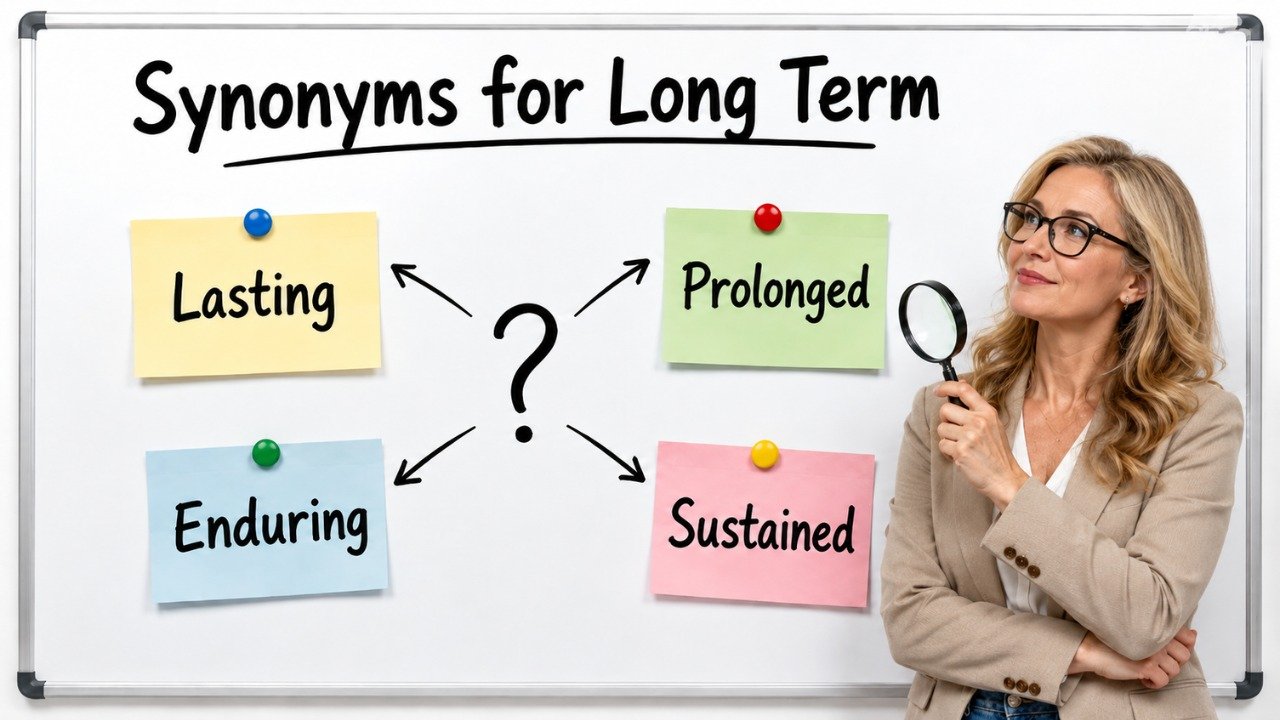
Quick Answer: The best synonyms for long term include lasting, enduring, prolonged, extended, sustained, permanent, ongoing, durable, lifelong, and strategic. Use lasting or enduring for something that continues for years. Choose sustained for continuous effort, prolonged for an unusually long situation, and permanent when something is not expected to end. Strategic works best for future planning, while lifelong describes something that continues throughout a person’s life.
Pronunciation and Word Details
Word: Long term.
Pronunciation: /ˌlɔːŋ ˈtɜːrm/.
Part of Speech: Adjective phrase, noun phrase, or adverbial expression.
Meaning: Lasting, continuing, planned, or expected to remain important for a long period.
US Pronunciation:
UK Pronunciation:
What Does “Long Term” Mean?
Long term means continuing, developing, or remaining important over a long period.
The phrase commonly describes plans, goals, effects, relationships, solutions, investments, conditions, and commitments that are expected to last for months, years, or even a lifetime.
As an adjective phrase, long term describes a noun.
Example: The company needs a long term strategy.
As a noun phrase, it refers to an extended future period.
Example: The decision will benefit everyone in the long term.
As an adverbial expression, it explains when an effect, action, or result will become important.
Example: The change may save time over the long term.
The exact length of long term depends on the subject. A long term study may continue for several years, while a long term friendship may last for decades. The phrase does not identify a fixed number of days, months, or years.
Meaning, Tone, and Context of “Long Term”
Long term usually has a neutral, practical, and forward looking tone. It is common in everyday conversation, professional writing, academic discussion, planning, health communication, education, finance, relationships, and public policy.
The phrase often suggests patience, stability, preparation, or future benefits. It may also describe continuing problems, delayed effects, or responsibilities that require sustained attention.
Neutral Context: Long term can describe any extended period without expressing approval or criticism.
Example: The researchers examined the long term effects of the change.
Positive Context: It may suggest stability, commitment, growth, and thoughtful planning.
Example: They developed a long term plan for improving student performance.
Negative Context: It can describe problems, damage, delays, or conditions that continue for years.
Example: The accident caused long term difficulties for local residents.
Formal Context: Long term is suitable for reports, essays, proposals, policies, and professional communication.
Example: The report recommends a long term approach to infrastructure development.
Conversational Context: The phrase also sounds natural in casual speech.
Example: I am looking for a long term solution, not a quick repair.
Academic Context: It often appears in discussions about research, development, behavior, health, economics, and social change.
Example: The study focused on the long term influence of early education.
Technical Context: Long term may describe data, storage, maintenance, treatment, performance, or system planning.
Example: Regular maintenance improves the long term performance of the equipment.
When and How to Use “Long Term”
For Future Plans
Use long term when a plan is designed for several years rather than for an immediate need.
Example: The committee created a long term plan for improving public services.
For Goals
Use the phrase for objectives that require patience, regular effort, and considerable time.
Example: Becoming fluent is a long term goal that requires consistent practice.
For Effects and Results
Long term can describe consequences that continue or become noticeable over an extended period.
Example: The new training program may produce long term improvements.
For Relationships
Use long term when a personal or professional relationship is expected to remain stable.
Example: They want to build a long term working relationship.
For Commitments
The phrase describes responsibilities or promises that continue for years.
Example: Caring for the property is a long term commitment.
For Solutions
Use long term for an answer that addresses the main cause of a problem instead of providing temporary relief.
Example: Better planning may offer a long term solution to overcrowding.
For Health and Care
Long term can describe treatment, support, care, symptoms, or conditions that continue for an extended period.
Example: Some patients require long term care and regular monitoring.
For Learning and Development
The phrase suits skills, habits, and improvements that develop gradually.
Example: Daily reading supports long term language development.
For Strategy
Use long term when decisions are based on future needs rather than immediate results.
Example: The organization needs a long term strategy for staff development.
For Benefits
Long term can describe advantages that may not appear immediately but become valuable later.
Example: Regular exercise can support long term physical strength.
Best Synonyms for Long Term
Lasting: Continuing for a considerable period.
Example: The program created lasting improvements in the community.
Enduring: Remaining strong, important, or effective over time.
Example: Their cooperation developed into an enduring partnership.
Prolonged: Continuing longer than expected or desired.
Example: The region experienced a prolonged period of dry weather.
Extended: Continuing for more time than usual.
Example: The students participated in an extended research project.
Sustained: Maintained continuously at a steady level.
Example: Meaningful progress requires sustained effort.
Permanent: Intended or expected to remain indefinitely.
Example: The temporary office later became a permanent location.
Ongoing: Continuing at the present time and not yet completed.
Example: The team is conducting an ongoing review of the process.
Durable: Able to remain useful, strong, or effective for a long time.
Example: The builders selected durable materials for the structure.
Lifelong: Continuing throughout a person’s life.
Example: Reading can become a lifelong habit.
Strategic: Carefully planned to achieve future goals.
Example: The organization made a strategic decision to invest in staff training.
50 Synonyms for Long Term with Short Meanings
- Lasting: Continuing for a considerable time.
- Enduring: Remaining strong or important over time.
- Prolonged: Continuing longer than usual or expected.
- Extended: Lasting beyond the normal period.
- Sustained: Maintained continuously over time.
- Permanent: Expected to remain indefinitely.
- Ongoing: Continuing and not yet finished.
- Durable: Able to remain useful for many years.
- Lifelong: Continuing throughout a person’s life.
- Strategic: Planned with future results in mind.
- Continuing: Remaining active or present.
- Continued: Kept in progress without ending.
- Persistent: Continuing despite time or difficulty.
- Stable: Unlikely to change or end quickly.
- Steady: Developing or continuing at a regular rate.
- Established: Existing successfully for a considerable time.
- Longstanding: Existing or continuing for many years.
- Long lasting: Remaining useful or effective for a long time.
- Long range: Concerned with a distant future period.
- Long lived: Existing or surviving for many years.
- Future: Connected with a later period.
- Future oriented: Focused on later needs and results.
- Forward looking: Planning carefully for future developments.
- Far sighted: Showing wise concern for future consequences.
- Multiyear: Continuing across several years.
- Lengthy: Taking or lasting a considerable amount of time.
- Protracted: Continuing for an unusually long time.
- Chronic: Continuing for a long time, especially a problem or condition.
- Abiding: Continuing without weakening or disappearing.
- Perpetual: Continuing repeatedly or without an expected end.
- Indefinite: Continuing without a fixed ending date.
- Permanent in nature: Intended to remain rather than change quickly.
- Of long duration: Continuing for an extended period.
- For years: Lasting across several years.
- Over time: Developing or continuing gradually.
- In the long run: Considering results over an extended future period.
- For the foreseeable future: Expected to continue for as long as can currently be predicted.
- For an extended period: Continuing beyond a short or normal duration.
- Across many years: Existing or developing through numerous years.
- Over a prolonged period: Continuing for an unusually lengthy time.
- Lasting for years: Remaining present or effective for several years.
- Built to last: Designed to remain useful for a long time.
- Designed for the future: Planned to meet later needs.
- Sustained over time: Maintained through an extended period.
- Continuing into the future: Expected to remain active later.
- Deep rooted: Firmly established and difficult to change.
- Settled: Stable and unlikely to change soon.
- Secure: Stable, dependable, and protected from sudden loss.
- Committed: Dedicated to continuing a relationship or purpose.
- Lasting in effect: Producing consequences that remain important over time.
Read Also:
Synonyms for Leaders
Synonyms for Long Term by Context
When Long Term Means Lasting for Years
Lasting, enduring, longstanding, long lasting, and long lived describe something that remains present, useful, or important for many years.
Lasting: A broad alternative for effects, memories, benefits, and changes.
Example: The experience made a lasting impression on the students.
Enduring: Best for ideas, values, relationships, and qualities that remain strong.
Example: Respect is the foundation of an enduring friendship.
Longstanding: Suitable for relationships, traditions, problems, and disagreements that have existed for years.
Example: The two groups resolved a longstanding disagreement.
Long Lasting: Useful for products, effects, results, and materials that remain effective.
Example: Proper care can produce long lasting results.
Long Lived: Often describes people, animals, plants, systems, organizations, or ideas that survive for many years.
Example: The region is known for its long lived trees.
When Long Term Means Future Planning
Strategic, long range, future oriented, forward looking, and far sighted describe decisions based on later needs and results.
Strategic: Best for organized plans intended to achieve an important goal.
Example: Hiring additional staff was a strategic decision.
Long Range: Common in planning, forecasting, and development.
Example: The council approved a long range transport plan.
Future Oriented: Describes thinking that gives priority to future opportunities and needs.
Example: The curriculum takes a future oriented approach to technical education.
Forward Looking: Suggests awareness of coming developments.
Example: The proposal presents a forward looking approach to energy use.
Far Sighted: Praises someone for considering distant consequences.
Example: Her far sighted leadership prepared the group for future challenges.
When Long Term Means Continuing Without Interruption
Ongoing, continuing, continued, sustained, and steady describe an action or process that remains active.
Ongoing: Something is happening now and has not finished.
Example: The department is conducting an ongoing investigation.
Continuing: An activity remains in progress.
Example: Continuing support will be necessary during the transition.
Continued: Something has been maintained after it began.
Example: Continued investment improved the quality of the service.
Sustained: An effort, level, or activity remains strong and consistent.
Example: The project succeeded through sustained cooperation.
Steady: Progress or activity continues at a regular pace.
Example: The student made steady progress throughout the year.
When Long Term Means Longer Than Expected
Prolonged, protracted, lengthy, and extended work well when an event or situation lasts longer than usual.
Prolonged: Often describes delays, illness, conflict, silence, or difficult conditions.
Example: Prolonged uncertainty affected employee confidence.
Protracted: A formal word for an event that continues for an unusually long time.
Example: The parties finally ended the protracted disagreement.
Lengthy: Describes something that takes considerable time.
Example: The application requires a lengthy review process.
Extended: Neutral language for a period that has been made longer.
Example: The visitors stayed for an extended period.
When Long Term Means Permanent
Permanent, indefinite, settled, established, and secure suggest that something is unlikely to end or change quickly.
Permanent: The strongest choice when no ending is expected.
Example: The role became permanent after the trial period.
Indefinite: No exact ending date has been decided.
Example: The project was delayed for an indefinite period.
Settled: Something is stable and no longer uncertain.
Example: They hope to build a settled life in the area.
Established: Something has existed successfully for enough time to become accepted.
Example: The clinic has an established record of reliable service.
Secure: Something is stable and protected from sudden change.
Example: She is looking for secure employment.
When Long Term Describes Health or Problems
Chronic, persistent, prolonged, continuing, and deep rooted describe conditions or difficulties that remain for a long time.
Chronic: Most suitable for a continuing condition or recurring problem.
Example: The patient receives treatment for chronic pain.
Persistent: A symptom or problem continues despite attempts to stop it.
Example: Persistent headaches should not be ignored.
Prolonged: A condition lasts longer than expected.
Example: Prolonged stress can affect concentration.
Continuing: The condition remains present.
Example: The report describes continuing concerns about safety.
Deep Rooted: The cause is firmly established and difficult to remove.
Example: The community is addressing deep rooted social problems.
When Long Term Describes Relationships
Enduring, committed, lasting, stable, and lifelong work well for personal and professional relationships.
Enduring: The relationship survives challenges and time.
Example: They developed an enduring friendship.
Committed: The people involved intend to remain dedicated.
Example: Both partners want a committed relationship.
Lasting: The connection continues for a considerable period.
Example: Honest communication helps create lasting partnerships.
Stable: The relationship is dependable and unlikely to change suddenly.
Example: The organization wants a stable relationship with its suppliers.
Lifelong: The relationship continues throughout life.
Example: Their shared experience created a lifelong friendship.
When Long Term Describes Effects
Lasting, enduring, sustained, far reaching, and permanent describe consequences that remain important.
Lasting: The effect continues after the original event.
Example: The teacher had a lasting influence on her students.
Enduring: The result remains important for many years.
Example: The agreement created enduring benefits.
Sustained: The effect is maintained continuously.
Example: The reforms produced sustained improvement.
Broad and Lasting: The effect influences many people or areas for a long time.
Example: The decision had a broad and lasting impact.
Permanent: The effect cannot easily be reversed.
Example: The fire caused permanent damage to the building.
Another Word for Long Term
The best single replacement for long term is lasting. It is clear, natural, and suitable for effects, changes, benefits, memories, and relationships. However, the best alternative depends on whether the sentence describes planning, duration, stability, health, commitment, or permanence.
Original: The program may create long term benefits for students.
Better Option: The program may create lasting benefits for students.
Original: The organization needs a long term plan for growth.
Better Option: The organization needs a strategic plan for growth.
Original: They hope to develop a long term partnership.
Better Option: They hope to develop an enduring partnership.
Original: The patient requires long term medical support.
Better Option: The patient requires ongoing medical support.
When Not to Use “Long Term”
Long term can sound vague when the reader needs an exact time period or a more specific meaning. A precise synonym may communicate the idea more clearly.
When the Duration Is Known
Use the actual number of months or years when accuracy matters.
Weak: The study will continue for a long term period.
Better: The study will continue for five years.
When You Mean Permanent
Long term does not always mean forever. Use permanent when something has no planned ending.
Weak: The temporary repair became a long term change with no expected ending.
Better: The temporary repair became a permanent change.
When You Mean Ongoing
Use ongoing when an activity is currently happening and has not finished.
Weak: The department is carrying out a long term investigation that is still active.
Better: The department is carrying out an ongoing investigation.
When You Mean Strategic
Use strategic when a plan is carefully designed to achieve future goals.
Weak: The board made a long term decision about future expansion.
Better: The board made a strategic decision about future expansion.
When You Mean Chronic
Use chronic for a medical condition or recurring problem that continues for a long period.
Weak: He is receiving care for a long term pain condition.
Better: He is receiving care for chronic pain.
When You Mean Prolonged
Use prolonged when something lasts longer than expected or desired.
Weak: The area experienced long term heavy rainfall for several weeks.
Better: The area experienced prolonged heavy rainfall.
When You Mean Lifelong
Use lifelong when something continues throughout a person’s life.
Weak: The experience created a long term interest that remained throughout her life.
Better: The experience created a lifelong interest.
When Long Term Becomes Repetitive
Repeating the phrase several times can make a paragraph sound mechanical.
Weak: The long term plan offers long term benefits and supports long term development.
Better: The strategic plan offers lasting benefits and supports future development.
Words Commonly Confused With Long Term
Long Term vs Lasting: Long term describes something expected to continue for an extended period. Lasting emphasizes that an effect, quality, or result remains.
Example With Long Term: The organization needs a long term solution.
Example With Lasting: The training created lasting improvements.
Long Term vs Permanent: Long term means continuing for a considerable time, but it may eventually end. Permanent means not expected to end or change.
Example With Long Term: She needs long term support during her recovery.
Example With Permanent: The damage to the structure was permanent.
Long Term vs Ongoing: Long term emphasizes duration or future planning. Ongoing means something is currently continuing.
Example With Long Term: The team developed a long term strategy.
Example With Ongoing: The team is conducting an ongoing review.
Long Term vs Prolonged: Long term is often neutral or positive. Prolonged frequently suggests that something lasted longer than expected or desired.
Example With Long Term: The program has long term educational goals.
Example With Prolonged: The prolonged delay caused frustration.
Long Term vs Chronic: Long term is a broad phrase. Chronic is mainly used for continuing health conditions, difficulties, or social problems.
Example With Long Term: The patient needs long term support.
Example With Chronic: The patient is receiving treatment for a chronic condition.
Long Term vs Longstanding: Long term usually looks toward the future. Longstanding describes something that has already existed for many years.
Example With Long Term: They are planning a long term partnership.
Example With Longstanding: The two families have a longstanding friendship.
Long Term vs Lifelong: Long term means many months or years. Lifelong means continuing for an entire lifetime.
Example With Long Term: She has a long term interest in language learning.
Example With Lifelong: She developed a lifelong love of reading.
Long Term vs Strategic: Long term describes duration. Strategic describes careful planning intended to achieve a goal.
Example With Long Term: They need a long term approach.
Example With Strategic: They need a strategic approach.
Which Synonym Should You Choose?
Choose lasting when describing effects, benefits, changes, memories, or impressions that remain over time.
Choose enduring when describing values, relationships, ideas, traditions, or qualities that remain strong.
Choose prolonged when a delay, illness, conflict, or difficult situation lasts longer than expected.
Choose extended when a period, visit, study, or activity continues beyond its usual length.
Choose sustained when effort, growth, support, attention, or performance remains steady.
Choose permanent when something is not expected to end, disappear, or change.
Choose ongoing when an activity, discussion, investigation, or process is happening now.
Choose durable when describing a product, material, system, or solution that remains useful.
Choose lifelong when something continues throughout a person’s life.
Choose strategic when discussing professional planning, organizational goals, or future decisions.
Choose long range for plans, forecasts, and objectives that focus on a distant future period.
Choose longstanding for a relationship, custom, dispute, or issue that has already existed for many years.
Choose chronic when discussing continuing health conditions or recurring problems.
Choose persistent when a problem, symptom, behavior, or effect continues despite attempts to stop it.
Choose future oriented in essays or reports about development, education, innovation, and preparation.
Choose in the long run in casual speech when discussing eventual results.
Real Life Examples of “Long Term” in Sentences
Original: The new policy may produce long term benefits.
Better Option: The new policy may produce lasting benefits.
Original: The team created a long term plan for expansion.
Better Option: The team created a strategic plan for expansion.
Original: She wants a long term relationship with the organization.
Better Option: She wants an enduring relationship with the organization.
Original: The patient needs long term treatment.
Better Option: The patient needs ongoing treatment.
Original: The repairs should provide a long term solution.
Better Option: The repairs should provide a durable solution.
Original: The project requires long term effort from everyone.
Better Option: The project requires sustained effort from everyone.
Original: Reading offers long term educational value.
Better Option: Reading offers lasting educational value.
Original: The disagreement caused long term tension between the groups.
Better Option: The disagreement caused prolonged tension between the groups.
Original: Her long term interest in science began during childhood.
Better Option: Her lifelong interest in science began during childhood.
Original: The organization wants to protect its long term stability.
Better Option: The organization wants to protect its future stability.
Synonym Groups and Usage Differences
Duration Group
Lasting, extended, prolonged, lengthy, protracted, and multiyear describe how long something continues.
Lasting is broad and usually positive. Extended is neutral. Prolonged and protracted often suggest that something continued longer than expected. Lengthy focuses on the amount of time involved. Multiyear provides a more specific sense of duration.
Example: The research team began a multiyear study of language development.
Continuity Group
Ongoing, continuing, continued, sustained, persistent, and steady describe something that remains active.
Ongoing means not yet finished. Continuing and continued are broad alternatives. Sustained emphasizes maintained strength. Persistent often describes something difficult to stop. Steady suggests regular progress.
Example: Sustained attention helped the student complete the complex task.
Permanence Group
Permanent, indefinite, established, settled, secure, and abiding suggest stability or an uncertain ending.
Permanent is the strongest word. Indefinite means that no ending date has been decided. Established and settled suggest stability. Secure emphasizes protection from sudden change. Abiding often describes feelings, values, or influence.
Example: The experience left an abiding respect for careful research.
Planning Group
Strategic, long range, forward looking, future oriented, and far sighted relate to preparation for later needs.
Strategic emphasizes purposeful decisions. Long range focuses on distant objectives. Forward looking and future oriented suggest readiness for change. Far sighted praises wise consideration of future consequences.
Example: The city adopted a forward looking approach to transport planning.
Relationship Group
Enduring, committed, stable, lasting, lifelong, and longstanding describe connections between people or groups.
Enduring and lasting emphasize duration. Committed emphasizes dedication. Stable suggests reliability. Lifelong means lasting for life. Longstanding means the relationship has already existed for years.
Example: Mutual respect helped them build an enduring professional relationship.
Health and Problem Group
Chronic, persistent, prolonged, deep rooted, continuing, and ongoing describe conditions or difficulties that remain.
Chronic often relates to health or recurring problems. Persistent describes something that refuses to disappear. Prolonged focuses on unusual duration. Deep rooted describes a firmly established cause. Ongoing and continuing are neutral.
Example: The committee proposed several ways to address deep rooted inequality.
Effect Group
Lasting, enduring, sustained, permanent, and broad and lasting describe results that remain important.
Lasting is the most flexible choice. Enduring sounds stronger and more formal. Sustained describes an effect that remains at a steady level. Permanent means the effect cannot easily be reversed.
Example: The program had a lasting influence on local education.
Antonyms of Long Term
The opposite of long term depends on whether the phrase describes duration, planning, effects, relationships, or solutions.
Short Term: Continuing for only a limited period.
Temporary: Intended to remain for a short time.
Brief: Lasting only a small amount of time.
Immediate: Happening without delay.
Momentary: Continuing for only a moment.
Passing: Present briefly before disappearing.
Transient: Existing for a short and limited time.
Short Lived: Ending soon after beginning.
Provisional: Arranged temporarily until a final decision is made.
Interim: Used during the period before a permanent arrangement.
Near Term: Related to the immediate or close future.
Current: Connected with the present period.
Instant: Happening or becoming available immediately.
Fleeting: Lasting for a very short time.
Temporary in Nature: Not intended to remain.
Comparison: Long Term vs Related Words
Long Term vs Lasting
Long term describes duration, planning, or future importance. Lasting focuses on something that remains after an event or experience.
Example With Long Term: The school introduced a long term improvement plan.
Example With Lasting: The teacher made a lasting impression on the class.
Long Term vs Enduring
Long term is neutral and practical. Enduring sounds stronger and often describes values, relationships, influence, or qualities that survive challenges.
Example With Long Term: They are seeking a long term partnership.
Example With Enduring: They developed an enduring partnership based on trust.
Long Term vs Permanent
Long term may eventually end. Permanent suggests that no ending or reversal is expected.
Example With Long Term: The family needs long term housing support.
Example With Permanent: The family moved into a permanent home.
Long Term vs Ongoing
Long term emphasizes future duration. Ongoing emphasizes that something is currently happening.
Example With Long Term: The group developed a long term research agenda.
Example With Ongoing: The group is conducting an ongoing research project.
Long Term vs Prolonged
Long term is usually neutral. Prolonged often describes something that continued longer than expected or desired.
Example With Long Term: The organization needs long term financial planning.
Example With Prolonged: The prolonged discussion delayed the final decision.
Long Term vs Sustained
Long term describes the overall period. Sustained describes an effort, level, result, or activity that remains continuously strong.
Example With Long Term: Long term improvement requires patience.
Example With Sustained: Sustained effort produced gradual improvement.
Long Term vs Longstanding
Long term often refers to the future. Longstanding refers to something that has already existed for many years.
Example With Long Term: They hope to form a long term partnership.
Example With Longstanding: The organizations have a longstanding partnership.
Long Term vs Lifelong
Long term describes a considerable period. Lifelong specifically means continuing throughout life.
Example With Long Term: He has a long term interest in history.
Example With Lifelong: He has a lifelong interest in history.
Long Term vs Chronic
Long term is broad and neutral. Chronic commonly describes medical conditions or serious problems that continue or return repeatedly.
Example With Long Term: She needs long term medical care.
Example With Chronic: She receives treatment for a chronic condition.
Common Phrases and Expressions With “Long Term”
Long Term Goal: An objective that may require years to achieve.
Example: Completing advanced training is one of her long term goals.
Long Term Plan: A detailed approach designed for an extended future period.
Example: The committee prepared a long term plan for improving facilities.
Long Term Effect: A result that remains or appears over an extended period.
Example: Researchers studied the long term effect of the new teaching method.
Long Term Solution: An answer designed to solve a problem for a considerable time.
Example: Better drainage may provide a long term solution to flooding.
Long Term Strategy: A planned approach for achieving future objectives.
Example: Staff development is part of the organization’s long term strategy.
Long Term Relationship: A personal or professional connection expected to continue.
Example: Trust is essential in a long term relationship.
Long Term Commitment: A responsibility or promise that lasts for years.
Example: Maintaining the building requires a long term commitment.
Long Term Care: Continuing support for someone with lasting needs.
Example: The family discussed suitable long term care options.
Long Term Success: Achievement that remains stable rather than disappearing quickly.
Example: Careful planning is important for long term success.
Long Term Benefits: Advantages that remain valuable or appear later.
Example: Early education can provide long term benefits.
Common Mistakes to Avoid
Using Long Term Without Explaining the Period
Long term can be too vague when the exact duration matters. Give a specific number of months or years whenever possible.
Vague: The program will continue for the long term.
Better: The program will continue for at least six years.
Treating Long Term as Permanent
A long term arrangement may still end. Do not use long term when permanent is the intended meaning.
Unclear: The temporary position became long term with no planned ending.
Better: The temporary position became permanent.
Using Long Term for Something Happening Now
Use ongoing when the main idea is that an activity is currently in progress.
Unclear: The team is completing a long term review this week.
Better: The team is completing an ongoing review.
Using Long Term Instead of Longstanding
Longstanding describes something that has existed for many years. Long term often describes something expected to continue into the future.
Incorrect Choice: They resolved a long term disagreement that began twenty years ago.
Better: They resolved a longstanding disagreement that began twenty years ago.
Using Long Term Instead of Lifelong
Use lifelong when something continues throughout a person’s life.
Weak: She developed a long term love of music that remained until her final years.
Better: She developed a lifelong love of music.
Repeating Long Term Too Often
Repeated use can make writing sound dull and mechanical.
Repetitive: The long term strategy creates long term value and supports long term growth.
Better: The strategic plan creates lasting value and supports future growth.
Choosing a Synonym With the Wrong Tone
Prolonged may sound negative, while enduring often sounds positive. Choose the word that matches the emotional context.
Unnatural: They enjoyed a prolonged friendship based on trust.
Better: They enjoyed an enduring friendship based on trust.
Using Permanent for a Limited Period
Permanent is too strong when something may eventually end.
Incorrect: She needs permanent support for the next three years.
Better: She needs long term support for the next three years.
Using Chronic Outside a Suitable Context
Chronic is most natural for medical conditions, repeated problems, shortages, and serious difficulties.
Unnatural: They created a chronic plan for development.
Better: They created a long term plan for development.
Making the Sentence Unnecessarily Wordy
Avoid combining long term with another phrase that repeats the same meaning.
Wordy: The project will continue over a long term period of many years.
Better: The project will continue for many years.
Conclusion
Synonyms for long term allow writers to express duration, planning, stability, and future impact more precisely. Lasting and enduring suit benefits, effects, and relationships. Strategic and long range work well for plans and goals. Use ongoing for active processes, sustained for continuous effort, chronic for continuing conditions, and permanent when no ending is expected. Choosing the right alternative makes sentences clearer, reduces repetition, and helps readers understand whether something is continuing, established, future focused, or designed to last.
FAQs About Synonyms for Long Term
What Is the Best Synonym for Long Term?
Lasting is the best general synonym. It works naturally for effects, benefits, changes, results, and relationships.
What Is a Formal Synonym for Long Term?
Enduring, sustained, strategic, prolonged, extended, and longstanding are useful formal alternatives, depending on the context.
What Is Another Word for a Long Term Plan?
Strategic plan, long range plan, future plan, and forward looking plan are suitable alternatives.
Is Permanent the Same as Long Term?
No. Long term means continuing for a considerable period, while permanent means not expected to end.
What Is Another Word for Long Term Effects?
Lasting effects, enduring effects, sustained effects, continuing effects, and permanent effects are useful alternatives.
What Is a Casual Alternative to Long Term?
For years, over time, in the long run, and built to last are natural choices in casual conversation.
What Is the Opposite of Long Term?
Short term is the direct opposite. Other antonyms include temporary, brief, immediate, passing, and short lived.
