
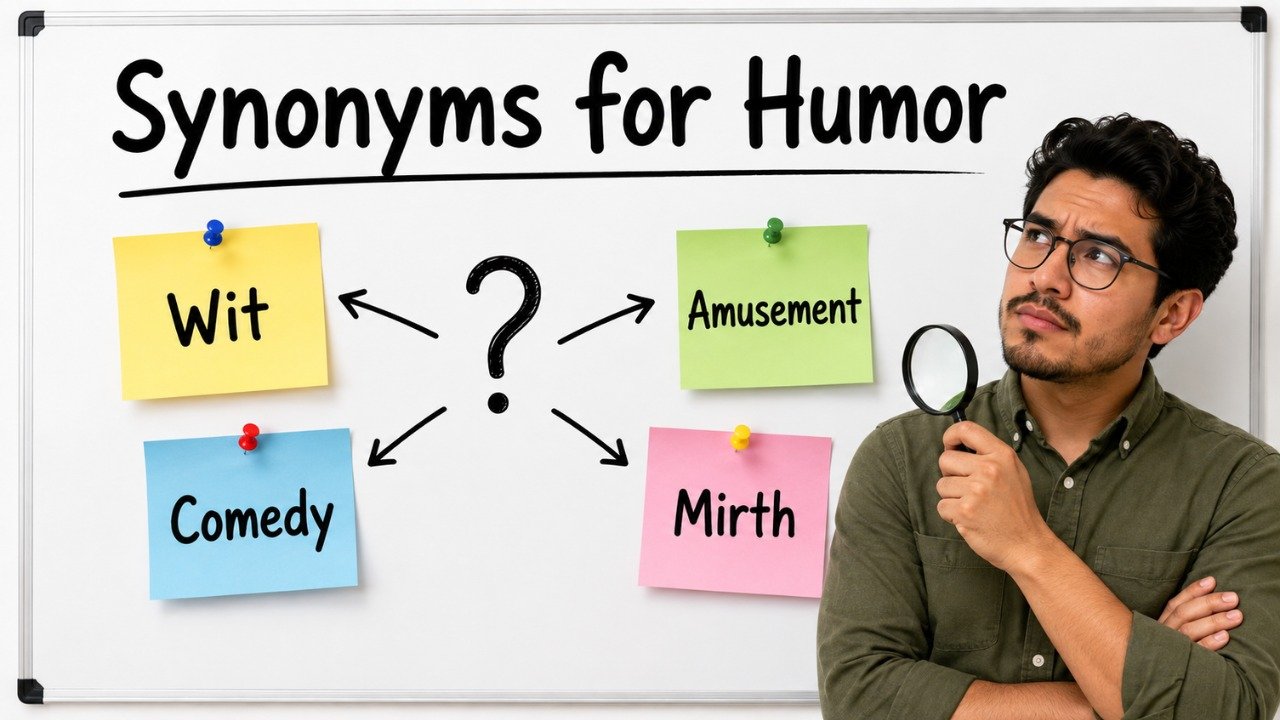
Quick Answer: The best synonyms for humor include wit, comedy, amusement, mirth, levity, playfulness, satire, irony, banter, and jocularity. Use wit for clever language, comedy for entertainment, amusement for enjoyment, mirth for cheerful laughter, and levity for a light tone in a serious situation. Satire suits formal or academic writing about social criticism, while banter works best for casual and playful conversation. The most accurate choice among synonyms for humor depends on whether you mean cleverness, laughter, entertainment, mood, or a particular comic style.
Pronunciation and Word Details
Word: Humor.
Pronunciation: /ˈhjuː.mər/.
Part of Speech: Noun and verb.
Meaning: As a noun, humor means the quality of being funny or the ability to notice and express amusing ideas.
US Pronunciation:
UK Pronunciation:
What Does “Humor” Mean?
Humor is the quality in words, actions, or situations that makes people feel amused or want to laugh.
As a noun, humor can describe funny content, a person’s ability to recognize amusement, or a particular style of comedy. It can also describe someone’s mood, especially in expressions such as good humor or bad humor.
Funny Quality: The story was filled with gentle humor.
Personal Ability: Her humor helped everyone relax.
Comic Style: The writer is known for dry humor.
Mood: He accepted the unexpected change with good humor.
Humor can also function as a verb. To humor someone means to accept, satisfy, or temporarily agree with that person’s wishes, often to keep the situation peaceful.
Verb Example: We decided to humor him and listen to his unusual idea.
The spelling humor is common in American English, while humour is common in British English. Both forms have the same basic meanings.
Meaning, Tone, and Context of “Humor”
Humor is generally a neutral and flexible word. Its tone changes according to the type of comedy, the situation, and the speaker’s intention.
Conversational Tone: Humor is common in everyday speech when discussing jokes, funny stories, or amusing people.
Formal Tone: It can appear in essays, reports, reviews, and professional communication when discussing communication style or emotional response.
Academic Tone: Humor is used in the study of literature, language, psychology, culture, and communication.
Positive Tone: Gentle humor, warm humor, and playful humor can create comfort, connection, and enjoyment.
Critical Tone: Satirical or sarcastic humor may criticize people, habits, systems, or social problems.
Emotional Tone: Humor can reduce tension, express confidence, or help people respond to difficult experiences.
Polite Tone: Light humor may make a conversation feel friendly, but the subject and audience must be considered carefully.
Strong Tone: Dark humor, ridicule, and biting sarcasm can sound harsh, offensive, or insensitive.
Technical Context: Writers may classify humor as verbal, visual, physical, observational, ironic, satirical, or absurd.
The word is used in conversation, literature, speeches, entertainment, workplaces, classrooms, advertising, and social interaction. However, not every amusing situation requires the general word humor. A more specific synonym often communicates the exact style or purpose more clearly.
When and How to Use “Humor”
For Something Funny
Use humor when referring generally to words, actions, or situations that cause amusement.
Example: The speech included enough humor to keep the audience interested.
For Clever Language
Use humor when someone creates amusement through intelligent observations, surprising expressions, or word choices.
Example: Her humor made an ordinary story sound memorable.
For Entertainment
Use humor when discussing funny books, performances, programs, or stories.
Example: The play combines humor with a serious message.
For a Lighthearted Tone
Use humor when someone makes a serious or uncomfortable situation feel less tense.
Example: The teacher used humor to help the nervous students relax.
For Personal Character
Use humor when describing someone’s ability to notice and communicate amusing ideas.
Example: His natural humor makes him enjoyable to work with.
For Friendly Conversation
Use humor when people exchange playful comments without intending to cause harm.
Example: Their conversation was filled with warmth and humor.
For Social Criticism
Use humor when funny content exposes foolish behavior, unfair systems, or social problems.
Example: The writer uses humor to criticize political dishonesty.
For a Cheerful Mood
Use humor when describing a positive or patient emotional state.
Example: She handled the delay with good humor.
For a Particular Comic Style
Use humor with words such as dry, dark, visual, observational, or absurd to identify a specific approach.
Example: His dry humor is easy to miss because he rarely changes his expression.
For Accommodating Someone
Use humor as a verb when temporarily accepting someone’s wishes or ideas.
Example: Humor me for a moment and imagine that the plan succeeds.
Best Synonyms for Humor
Wit
Synonym: Clever and amusing use of language or ideas.
Example: Her quick wit made the discussion more enjoyable.
Comedy
Synonym: Entertainment, writing, or performance intended to make people laugh.
Example: The play balances serious drama with light comedy.
Amusement
Synonym: The feeling of pleasure caused by something funny or entertaining.
Example: The children watched the performance with great amusement.
Mirth
Synonym: Cheerful laughter and lively enjoyment.
Example: The unexpected joke filled the room with mirth.
Levity
Synonym: Lightness or humor introduced into a serious situation.
Example: A moment of levity helped reduce the tension.
Playfulness
Synonym: A cheerful quality involving fun, imagination, or gentle teasing.
Example: The speaker’s playfulness made the lesson more engaging.
Satire
Synonym: Humor used to expose or criticize foolishness, dishonesty, or social problems.
Example: The novel uses satire to examine political corruption.
Irony
Synonym: Humor or meaning created by a contrast between expectations and reality.
Example: There was clear irony in the expert forgetting his own advice.
Banter
Synonym: Friendly and playful conversation involving jokes or teasing.
Example: The coworkers exchanged cheerful banter during lunch.
Jocularity
Synonym: A cheerful and joking manner.
Example: His natural jocularity helped new employees feel welcome.
50 Synonyms for Humor with Short Meanings
- Wit: Cleverness that creates amusement through language or ideas.
- Comedy: Entertainment designed to make people laugh.
- Amusement: Pleasure caused by something funny or entertaining.
- Fun: Enjoyment, excitement, or playful entertainment.
- Mirth: Cheerful laughter and happiness.
- Hilarity: Loud or intense amusement and laughter.
- Levity: Lightness introduced into a serious situation.
- Jocularity: A cheerful and joking manner.
- Playfulness: A lively quality involving fun or gentle teasing.
- Drollery: Amusement created by unusual or quietly funny behavior.
- Waggishness: Playful and mischievous humor.
- Facetiousness: Humor used when treating a serious matter lightly.
- Jocoseness: A joking, cheerful, or playful quality.
- Joking: The act of saying or doing amusing things.
- Jesting: Playful speech intended to entertain.
- Banter: Friendly conversation involving jokes and teasing.
- Repartee: Quick and clever exchange of amusing remarks.
- Wordplay: Humor created through clever use of language.
- Punning: Humor based on words with multiple meanings or similar sounds.
- Wisecracking: Making clever, humorous, and sometimes bold remarks.
- Quipping: Making short, clever, and amusing comments.
- Satire: Humor that criticizes foolishness or wrongdoing.
- Irony: Meaning or humor created through contrast.
- Sarcasm: Sharp humor that often expresses criticism or mockery.
- Parody: Comic imitation of a style, person, or work.
- Spoof: A humorous imitation intended to entertain.
- Farce: Exaggerated comedy involving unlikely situations.
- Slapstick: Physical comedy based on exaggerated actions.
- Clowning: Silly behavior performed to create laughter.
- Foolery: Absurd or playful behavior intended to amuse.
- Buffoonery: Ridiculous behavior designed to entertain others.
- Comicality: The quality of being amusing or funny.
- Absurdity: Humor created by unreasonable or impossible situations.
- Ridicule: Humor used to make someone or something appear foolish.
- Mockery: Unkind imitation or humor intended to criticize.
- Teasing: Playful or critical remarks directed at someone.
- Raillery: Good natured joking or teasing conversation.
- Pleasantry: A polite, light, or amusing remark.
- Merriment: Lively enjoyment, laughter, and celebration.
- Cheerfulness: A bright, happy, and positive manner.
- Joviality: Friendly and cheerful behavior.
- Gaiety: Lively happiness and enjoyment.
- Lightheartedness: A relaxed and cheerful attitude.
- Good Spirits: A happy, confident, and positive mood.
- Sense of Fun: The ability to enjoy playful or amusing experiences.
- Comic Relief: Humor that briefly reduces tension in a serious situation.
- Mood: A person’s temporary emotional state.
- Temper: A person’s emotional condition or state of mind.
- Disposition: A person’s usual emotional character or attitude.
- High Spirits: A lively, excited, and cheerful mood.
Read Also:
Synonyms for Long Term
Synonyms for Humor by Context
When Humor Means Clever Amusement
Wit, repartee, wordplay, punning, quipping, and wisecracking describe humor based on intelligence, language, and quick thinking.
Wit is the most flexible choice for clever humor. Repartee describes a fast exchange between speakers, while wordplay focuses on creative language.
Example: Her humor made every conversation interesting.
Alternative: Her wit made every conversation interesting.
Example: Their humor during the debate entertained the audience.
Alternative: Their repartee during the debate entertained the audience.
When Humor Means Comedy or Entertainment
Comedy, fun, amusement, hilarity, farce, slapstick, and clowning describe content or behavior intended to entertain.
Comedy is the broadest alternative. Farce involves exaggerated situations, while slapstick depends mainly on physical action.
Example: The story contains humor for younger readers.
Alternative: The story contains comedy for younger readers.
Example: The performance relied on physical humor.
Alternative: The performance relied on slapstick.
When Humor Means Cheerful Laughter
Mirth, merriment, hilarity, gaiety, joviality, and high spirits describe happiness expressed through laughter or lively behavior.
Mirth is suitable for literary or descriptive writing. Hilarity suggests stronger and louder laughter.
Example: The joke created humor throughout the room.
Alternative: The joke created hilarity throughout the room.
Example: Music and humor filled the celebration.
Alternative: Music and merriment filled the celebration.
When Humor Means a Light Tone
Levity, lightheartedness, playfulness, cheerfulness, and comic relief describe humor that makes a situation feel less serious.
Levity works well in formal writing, while lightheartedness sounds warmer and more emotional.
Example: The speaker added humor to the serious discussion.
Alternative: The speaker added levity to the serious discussion.
Example: The humorous scene reduced the tension.
Alternative: The comic relief reduced the tension.
When Humor Means Friendly Conversation
Banter, raillery, pleasantry, teasing, jesting, and joking describe social humor exchanged between people.
Banter is usually friendly and mutual. Teasing can be friendly or hurtful depending on intention and tone.
Example: Their humor showed that they were comfortable with each other.
Alternative: Their banter showed that they were comfortable with each other.
When Humor Means Social Criticism
Satire, sarcasm, irony, parody, ridicule, mockery, and spoof describe humor that comments on people, ideas, or society.
Satire often has a serious critical purpose. Sarcasm is sharper and usually directed at a person or statement. Parody imitates a recognizable style.
Example: The author uses humor to expose dishonesty.
Alternative: The author uses satire to expose dishonesty.
When Humor Means a Cheerful Mood
Good spirits, cheerfulness, joviality, mood, temper, and disposition relate to the older meaning of humor as a person’s emotional condition.
Example: He accepted the criticism with good humor.
Alternative: He accepted the criticism in good spirits.
When Humor Means Ridiculous Behavior
Foolery, buffoonery, absurdity, clowning, and comicality describe behavior or situations that appear silly or unreasonable.
Example: The scene’s humor came from the characters’ impossible plan.
Alternative: The scene’s absurdity came from the characters’ impossible plan.
Another Word for Humor
Another word for humor is wit, especially when humor refers to clever and amusing language. However, the best replacement depends on the intended meaning.
Use comedy for funny entertainment, amusement for the feeling produced by humor, levity for lightness in a serious situation, and satire for humor that criticizes society or behavior.
Original: Her humor made the speech memorable.
Better Option: Her wit made the speech memorable.
Original: The film combines action with humor.
Better Option: The film combines action with comedy.
Original: He added humor to the tense meeting.
Better Option: He added levity to the tense meeting.
Original: The article uses humor to criticize dishonest officials.
Better Option: The article uses satire to criticize dishonest officials.
When Not to Use “Humor”
Humor is useful, but it can sound too general when the exact type, purpose, or effect is important.
When the Comic Style Is Specific
Use satire, irony, sarcasm, parody, slapstick, or wordplay when the style can be identified.
Weak: The writer uses humor to criticize social inequality.
Better: The writer uses satire to criticize social inequality.
When Describing Clever Language
Use wit, repartee, quips, or wordplay when intelligence and language create the amusement.
Weak: Her humor was quick and intelligent.
Better: Her wit was quick and intelligent.
When Referring to Physical Comedy
Use slapstick, clowning, or buffoonery when exaggerated movements create the laughter.
Weak: The performance contained physical humor.
Better: The performance contained slapstick.
When Describing a Cheerful Mood
Use good spirits, cheerfulness, or joviality when discussing someone’s emotional state.
Weak: He remained in humor despite the delay.
Better: He remained in good spirits despite the delay.
When the Subject Is Sensitive
Avoid saying humor when the joke may be insulting, cruel, or inappropriate. Name the exact behavior instead.
Weak: His humor about her mistake upset the team.
Better: His mockery of her mistake upset the team.
When Humor Becomes Repetitive
Replace repeated uses with precise alternatives.
Weak: The story’s humor comes from humorous characters who use humor in every scene.
Better: The story’s comedy comes from playful characters who exchange witty remarks in every scene.
When Writing Formal Analysis
A broad statement about humor may be less informative than a specific literary or rhetorical term.
Weak: The poem contains humor.
Better: The poem uses irony and wordplay.
When Discussing Simple Enjoyment
Use amusement or fun when the focus is the audience’s reaction rather than the comic material.
Weak: The children watched with humor.
Better: The children watched with amusement.
Words Commonly Confused With Humor
Humor vs Wit: Humor is the broad quality of being funny. Wit is clever humor created through intelligent observations or language.
Humor vs Comedy: Humor may appear in conversation, writing, behavior, or situations. Comedy is usually a form of entertainment designed to produce laughter.
Humor vs Amusement: Humor is the funny quality or material. Amusement is the feeling of enjoyment produced by it.
Humor vs Sarcasm: Humor can be warm, playful, or harmless. Sarcasm is usually sharper and may express criticism or contempt.
Humor vs Irony: Humor is a broad category. Irony depends on a contrast between appearance and reality, words and meaning, or expectation and result.
Humor vs Satire: Humor entertains broadly. Satire uses amusement, exaggeration, or irony to criticize behavior, institutions, or society.
Humor vs Banter: Humor can exist in any form. Banter is a playful exchange of remarks between people.
Humor vs Levity: Humor refers to funny content or ability. Levity is lightness introduced into a situation that might otherwise feel serious.
Humor vs Ridicule: Humor may be kind or neutral. Ridicule deliberately makes someone or something appear foolish.
Humor vs Mood: Humor usually refers to comedy in modern usage. Mood refers to a temporary emotional condition, although humor can carry this meaning in certain expressions.
Which Synonym Should You Choose?
Choose wit when the humor is clever, intelligent, or based on sharp observations.
Choose comedy when referring to entertainment, performances, stories, or content intended to make people laugh.
Choose amusement when describing the pleasure or enjoyment caused by something funny.
Choose mirth when writing formally or descriptively about cheerful laughter.
Choose hilarity when the reaction involves intense or uncontrollable laughter.
Choose levity when humor lightens a serious, formal, or uncomfortable situation.
Choose banter for friendly and playful conversation between people.
Choose repartee for quick, intelligent exchanges of humorous remarks.
Choose wordplay when the humor depends on sounds, meanings, spelling, or creative language.
Choose satire in essays, reports, or literary analysis when humor criticizes society, politics, or human behavior.
Choose irony when there is a contrast between what is expected and what actually happens.
Choose sarcasm when the humor is sharp, critical, or mocking.
Choose parody when a person, genre, or style is copied for comic effect.
Choose slapstick when physical actions, accidents, or exaggerated movements create laughter.
Choose playfulness in friendly emails or conversation when the tone is light, imaginative, and cheerful.
Choose merriment when describing celebrations, gatherings, and shared happiness.
Choose good spirits when referring to someone’s cheerful emotional state.
Choose comic relief when a funny moment temporarily reduces tension in a serious story or situation.
Choose ridicule or mockery only when the humor is intended to embarrass, criticize, or make someone appear foolish.
Choose humor itself when no more specific style, emotional effect, or social purpose needs to be identified.
Real Life Examples of “Humor” in Sentences
Original: Her humor made the presentation more engaging.
Better Option: Her wit made the presentation more engaging.
Original: The film combines adventure with humor.
Better Option: The film combines adventure with comedy.
Original: The teacher used humor to reduce the students’ anxiety.
Better Option: The teacher used levity to reduce the students’ anxiety.
Original: Their humor continued throughout the friendly discussion.
Better Option: Their banter continued throughout the friendly discussion.
Original: The writer uses humor to expose social hypocrisy.
Better Option: The writer uses satire to expose social hypocrisy.
Original: The audience reacted to the scene with humor.
Better Option: The audience reacted to the scene with amusement.
Original: The children’s humor filled the room with laughter.
Better Option: The children’s playfulness filled the room with laughter.
Original: The performance depends heavily on physical humor.
Better Option: The performance depends heavily on slapstick.
Original: He faced the inconvenience with good humor.
Better Option: He faced the inconvenience in good spirits.
Original: The characters’ humor provides a break from the serious story.
Better Option: The characters provide comic relief from the serious story.
Synonym Groups and Usage Differences
Clever Language Group
Wit, repartee, wordplay, punning, quipping, and wisecracking describe humor created through language and quick thinking.
Wit is broad and positive. Repartee requires an exchange between people. Wisecracking can sound bold, casual, or slightly disrespectful.
Example: Her witty repartee kept the entire group entertained.
Entertainment Group
Comedy, farce, parody, spoof, slapstick, and clowning describe forms of entertainment intended to create laughter.
Comedy is general. Farce uses exaggerated and unlikely situations. Slapstick relies on physical action.
Example: The play combines comedy with elements of farce.
Cheerful Laughter Group
Mirth, hilarity, merriment, gaiety, joviality, and high spirits describe visible happiness and shared laughter.
Mirth sounds literary, while hilarity suggests a stronger reaction.
Example: The surprising ending caused great hilarity.
Lightness Group
Levity, playfulness, lightheartedness, cheerfulness, and comic relief make situations feel less serious or tense.
Levity is common in formal descriptions. Playfulness is warmer and more personal.
Example: A little levity helped everyone feel comfortable.
Critical Humor Group
Satire, irony, sarcasm, parody, ridicule, and mockery can expose weaknesses or criticize behavior.
Satire often targets larger social problems. Sarcasm usually targets a statement, action, or person. Ridicule and mockery can be openly unkind.
Example: The essay uses satire rather than direct criticism.
Friendly Conversation Group
Banter, jesting, joking, raillery, teasing, and pleasantry describe humorous interaction between people.
Banter and raillery are usually friendly. Teasing depends strongly on tone and relationship.
Example: Their light banter made the long journey enjoyable.
Silly Behavior Group
Foolery, buffoonery, absurdity, clowning, and waggishness describe behavior that is playful, ridiculous, or exaggerated.
Buffoonery is louder and more ridiculous than simple playfulness.
Example: The character’s buffoonery entertained the younger audience.
Emotional State Group
Good spirits, cheerfulness, mood, temper, disposition, and joviality relate to humor as a state of mind.
This meaning appears most naturally in expressions such as good humor and bad humor.
Example: She accepted the disappointing result with good humor.
Antonyms of Humor
The opposite of humor changes according to whether humor means comedy, cheerfulness, lightness, or a positive mood.
Seriousness: A lack of joking or playful behavior.
Solemnity: A deeply serious and formal manner.
Gravity: Seriousness caused by an important or difficult situation.
Sadness: An unhappy emotional state.
Gloom: A dark, discouraged, or hopeless mood.
Misery: Great unhappiness or suffering.
Melancholy: A quiet and lasting feeling of sadness.
Dullness: A lack of interest, excitement, or amusement.
Boredom: The feeling produced by something uninteresting.
Sternness: A strict and serious manner.
Tension: Mental or emotional pressure that prevents relaxation.
Hostility: Unfriendly or aggressive behavior.
Bitterness: Anger and unhappiness caused by unfair treatment.
Despair: A complete loss of hope.
Sobriety: Serious and controlled behavior, especially in tone or judgment.
Comparison: Humor vs Related Words
Humor vs Wit
Humor is any quality that creates amusement. Wit is intelligent humor expressed through clever language or observations.
Example With Humor: The story contains gentle humor.
Example With Wit: The speaker’s wit made every answer memorable.
Humor vs Comedy
Humor is a quality, ability, or style. Comedy is an established form of entertainment intended to make people laugh.
Example With Humor: His humor made the interview enjoyable.
Example With Comedy: She writes comedy for live performances.
Humor vs Amusement
Humor is the source of the funny effect. Amusement is the enjoyable feeling experienced by the audience.
Example With Humor: The story’s humor comes from its unusual characters.
Example With Amusement: The audience watched the unusual characters with amusement.
Humor vs Levity
Humor is broad and may appear in any situation. Levity specifically introduces lightness into something serious.
Example With Humor: The conversation included gentle humor.
Example With Levity: Her comment brought levity to the tense meeting.
Humor vs Satire
Humor may exist only to entertain. Satire uses humor to expose or criticize foolishness, corruption, or social problems.
Example With Humor: The article uses humor to entertain readers.
Example With Satire: The article uses satire to criticize dishonest leadership.
Humor vs Irony
Humor may be created in many ways. Irony depends on a contradiction or contrast between expectation and reality.
Example With Humor: The speaker used humor to engage the audience.
Example With Irony: The fire safety officer accidentally triggered the alarm.
Humor vs Sarcasm
Humor can be gentle and friendly. Sarcasm often communicates criticism by saying something different from the intended meaning.
Example With Humor: His humor made the new employee feel welcome.
Example With Sarcasm: His sarcastic remark made the new employee uncomfortable.
Humor vs Banter
Humor is the general quality of being funny. Banter is a playful exchange between two or more people.
Example With Humor: The meeting included moments of humor.
Example With Banter: The coworkers exchanged banter before the meeting.
Humor vs Parody
Humor is a broad concept. Parody creates comedy by copying and exaggerating a familiar style, person, or work.
Example With Humor: The performance contains visual humor.
Example With Parody: The performance is a parody of traditional detective stories.
Humor vs Ridicule
Humor may entertain without causing harm. Ridicule makes someone or something appear foolish and often carries a negative tone.
Example With Humor: The joke created a relaxed atmosphere.
Example With Ridicule: The cruel remark exposed him to ridicule.
Common Phrases and Expressions With “Humor”
Sense of Humor: The ability to recognize, enjoy, or create amusing ideas.
Good Humor: A cheerful, patient, and pleasant mood.
Dry Humor: Subtle humor delivered in a serious or unemotional manner.
Dark Humor: Comedy based on serious, disturbing, or uncomfortable subjects.
Gentle Humor: Kind and mild amusement that avoids cruelty.
Subtle Humor: Amusement that is quiet, indirect, or easy to miss.
Visual Humor: Comedy created through images, expressions, movements, or physical situations.
Observational Humor: Comedy based on ordinary experiences and everyday behavior.
Self Deprecating Humor: Humor in which a person jokes about personal weaknesses or mistakes.
Comic Humor: Words, behavior, or situations designed to create laughter.
In Good Humor: Being in a cheerful, friendly, or patient mood.
Use Humor: To include amusing language or behavior in communication.
Common Mistakes to Avoid
Using Humor and Humorous Incorrectly
Humor is usually a noun, while humorous is an adjective.
Incorrect: The story was full of humorous.
Correct: The story was full of humor.
Correct: The story was humorous.
Confusing Humor With Comedy
Comedy usually refers to entertainment, while humor can describe any amusing quality or personal ability.
Unclear: Her comedy helped everyone relax during the meeting.
Better: Her humor helped everyone relax during the meeting.
Using Humor for the Audience’s Reaction
The audience feels amusement rather than humor.
Incorrect: The audience watched with humor.
Correct: The audience watched with amusement.
Repeating Humor Too Often
Use precise alternatives to improve flow and meaning.
Weak: The film uses humor, and its humor comes from humorous situations.
Better: The film uses comedy, and much of its amusement comes from absurd situations.
Treating Every Synonym as Interchangeable
Satire, sarcasm, banter, wit, and slapstick describe different kinds of humor.
Incorrect: The physical satire made the children laugh.
Correct: The physical slapstick made the children laugh.
Using Sarcasm for Friendly Humor
Sarcasm often contains criticism and may not sound friendly.
Weak: The teacher used sarcasm to welcome the nervous students.
Better: The teacher used gentle humor to welcome the nervous students.
Ignoring the Audience
Humor that works with close friends may sound inappropriate in a formal, professional, or sensitive situation.
Advice: Consider the subject, relationship, setting, and possible effect before using a strong joke.
Confusing Humor as a Noun and Verb
As a noun, humor means amusement or mood. As a verb, it means to satisfy or temporarily accept someone’s wishes.
Noun Example: The speech included gentle humor.
Verb Example: Humor me and listen to the entire proposal.
Using an Unnatural Article
Humor is usually an uncountable noun when referring generally to comedy.
Unnatural: The story contains a humor.
Natural: The story contains humor.
Mixing American and British Spelling
Humor is the usual American spelling. Humour is the usual British spelling.
Advice: Choose one spelling style and use it consistently throughout the article or document.
Conclusion
The most useful synonyms for humor include wit, comedy, amusement, mirth, levity, satire, irony, banter, and playfulness. Choose wit for clever language, comedy for entertainment, levity for lightness in serious situations, and satire for social criticism. Banter fits friendly conversation, while mirth and hilarity describe cheerful laughter. Because humor can refer to comic material, personal ability, or emotional mood, selecting a precise alternative makes sentences clearer, more expressive, and better suited to their audience and context.
FAQs About Synonyms for Humor
What Is the Best Synonym for Humor?
Wit is one of the best synonyms when humor means clever amusement. Comedy is better when referring to entertainment.
What Is a Formal Synonym for Humor?
Levity, wit, satire, irony, and jocularity are suitable formal alternatives, depending on the intended meaning.
What Is Another Word for a Sense of Humor?
Wit, playfulness, comic instinct, and sense of fun can describe a person’s ability to recognize or create amusement.
What Is a Synonym for Funny Humor?
Comedy, hilarity, wit, joking, and comicality are useful choices. The best word depends on the type of funny content.
What Is a Synonym for Clever Humor?
Wit, repartee, wordplay, quipping, and irony can describe clever humor.
What Is the Difference Between Humor and Comedy?
Humor is any quality or ability that creates amusement. Comedy is a form of entertainment intended to make people laugh.
Can Humor Mean Mood?
Yes. Humor can refer to a person’s emotional state, especially in expressions such as good humor, bad humor, and in good humor.
