
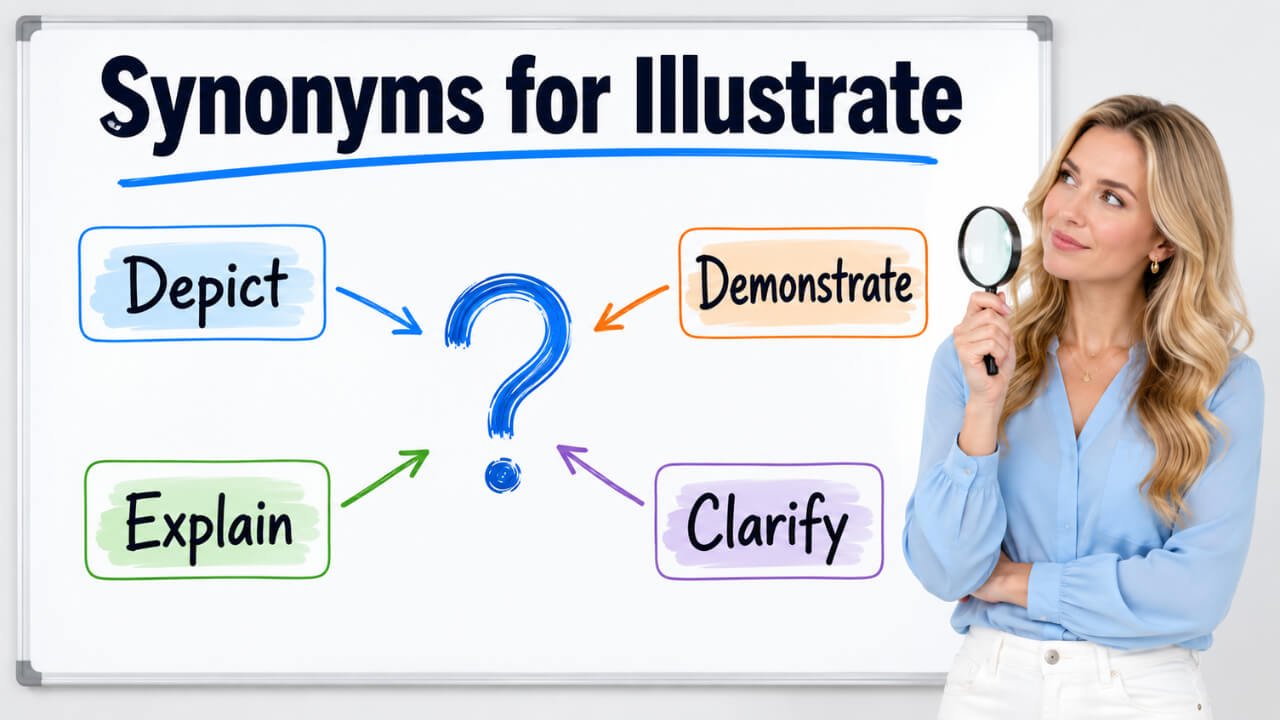
Quick Answer: Synonyms for illustrate include explain, show, demonstrate, clarify, depict, portray, represent, describe, exemplify, and illuminate. Use explain when making an idea easier to understand, show when giving visible proof, demonstrate for formal or instructional writing, depict for images or scenes, exemplify when giving an example, and clarify when removing confusion. The best synonym depends on whether you mean to explain with words, show with evidence, present visually, or give a clear example.
Pronunciation and Word Details
Word: Illustrate.
Pronunciation: /ˈɪləstreɪt/.
Part of Speech: Verb.
Meaning: Illustrate means to explain, show, or make something clear by using examples, pictures, details, or evidence.
US Pronunciation:
UK Pronunciation:
What Does “Illustrate” Mean?
Illustrate means to make an idea, point, story, or subject clearer by using examples, images, descriptions, or details. It is mainly used as a verb. You can illustrate an idea with an example, illustrate a book with pictures, or illustrate a point with facts.
The word works in both visual and written contexts. In a sentence, illustrate can mean to explain clearly, show evidence, create pictures, or represent something in a way that helps people understand it. Because it has more than one use, choosing the right synonym depends on the meaning you want.
Meaning, Tone, and Context of “Illustrate”
Illustrate is a clear, useful, and slightly formal word. It is common in academic writing, teaching, reports, presentations, essays, instructions, art, design, and storytelling. It can sound professional when used in business or educational writing, but it is still easy enough for everyday use.
The tone of illustrate is usually neutral and helpful. It does not sound emotional or casual. It often suggests that something is being made easier to understand. In visual contexts, it can mean to create drawings or pictures. In writing and speaking, it often means to explain with examples or evidence.
When and How to Use “Illustrate”
For Explanation: Use illustrate when an example helps make an idea clear.
Example: The teacher used a simple story to illustrate the meaning of honesty.
For Visual Meaning: Use illustrate when someone adds pictures, drawings, or visual details.
Example: The artist was asked to illustrate the children’s book.
For Evidence: Use illustrate when facts, numbers, or events show that a point is true.
Example: The report uses recent results to illustrate the problem.
For Academic Writing: Use illustrate when supporting an argument with examples or details.
Example: The essay illustrates how small choices can affect long term success.
For Storytelling: Use illustrate when a scene, character, or event makes a theme clearer.
Example: The final chapter illustrates the importance of forgiveness.
Best Synonyms for Illustrate
Explain: To make something clear by giving information.
Example: The guide explains how the system works.
Show: To make something visible, clear, or understandable.
Example: The chart shows the change in sales.
Demonstrate: To show clearly through proof, action, or example.
Example: The experiment demonstrates the effect of heat.
Clarify: To make something easier to understand.
Example: The note clarifies the main rule.
Depict: To show something in a picture, story, or description.
Example: The painting depicts a quiet village.
Portray: To represent a person, place, feeling, or situation.
Example: The novel portrays life in a small town.
Represent: To stand for, show, or describe something.
Example: The symbol represents peace.
Describe: To tell what something is like using details.
Example: The paragraph describes the old house clearly.
Exemplify: To serve as a clear example of something.
Example: Her actions exemplify courage.
Illuminate: To make an idea clearer or easier to understand.
Example: The example illuminates the deeper meaning of the poem.
50 Synonyms for Illustrate with Short Meanings
- Explain: Make something clear with words.
- Show: Make something visible or clear.
- Demonstrate: Prove or explain through example.
- Clarify: Remove confusion from an idea.
- Depict: Show through art, words, or images.
- Portray: Represent a person, scene, or idea.
- Represent: Stand for or show something.
- Describe: Give details about something.
- Exemplify: Serve as a clear example.
- Illuminate: Make meaning clearer.
- Visualize: Form or present a clear image.
- Picture: Show or imagine visually.
- Render: Present something in artistic form.
- Draw: Create a visual image.
- Sketch: Show with a simple drawing or outline.
- Paint: Show through color, words, or art.
- Diagram: Explain with a visual layout.
- Chart: Show information in organized visual form.
- Graph: Show data using a visual format.
- Outline: Present the main points clearly.
- Detail: Explain with specific information.
- Define: Explain the meaning clearly.
- Interpret: Explain the meaning of something.
- Expound: Explain in detail.
- Elucidate: Make something clear, especially formally.
- Explicate: Explain carefully and thoroughly.
- Highlight: Draw attention to an important point.
- Emphasize: Give special importance to something.
- Indicate: Point out or show something.
- Display: Show something clearly.
- Exhibit: Show or present for understanding.
- Reveal: Make something known or clear.
- Present: Show or explain an idea.
- Express: Communicate an idea or feeling.
- Convey: Communicate meaning or feeling.
- Communicate: Share meaning clearly.
- Symbolize: Represent through a symbol.
- Embody: Represent an idea through action or form.
- Typify: Be a typical example of something.
- Personify: Represent an idea through a person or character.
- Cite: Mention as an example or proof.
- Quote: Repeat words as support or example.
- Support: Strengthen a point with evidence.
- Prove: Show that something is true.
- Confirm: Show that something is correct.
- Evidence: Show proof of something.
- Instance: Give as an example.
- Model: Show a pattern or example.
- Map: Show relationships or structure visually.
- Make clear: Help someone understand something.
Read Also:
Synonyms for Illustrate
Synonyms for Illustrate by Context
When Illustrate Means Explain Clearly
Use these synonyms when illustrate means to make an idea easier to understand.
Explain: The speaker explained the rule with a simple example.
Clarify: The teacher clarified the confusing sentence.
Elucidate: The expert elucidated the main cause of the issue.
Expound: The professor expounded the theory in detail.
When Illustrate Means Show With Examples
Use these words when an example supports or explains a point.
Exemplify: Her kindness exemplifies true leadership.
Demonstrate: The case demonstrates the need for better planning.
Cite: The writer cited a real event to support the point.
Instance: The report instances several cases of poor management.
When Illustrate Means Show Visually
Use these synonyms when the meaning is connected to pictures, diagrams, art, or visual design.
Depict: The image depicts a busy market.
Draw: The artist drew a map for the story.
Sketch: She sketched the building before painting it.
Diagram: The page diagrams the parts of the machine.
When Illustrate Means Represent
Use these words when something stands for an idea, quality, group, or meaning.
Represent: The dove represents peace.
Symbolize: The color symbolizes hope.
Embody: His actions embody honesty.
Typify: The scene typifies village life.
When Illustrate Means Describe in Detail
Use these synonyms when illustrate means to describe something through words.
Describe: The passage describes the storm clearly.
Portray: The story portrays a brave young woman.
Render: The writer renders the scene with strong detail.
Convey: The final paragraph conveys deep sadness.
Another Word for Illustrate
Another word for illustrate is explain when the goal is to make something clear. However, the best alternative depends on context. Use demonstrate when giving proof, depict when showing visually, exemplify when giving an example, and clarify when removing confusion.
Original: The teacher used a story to illustrate the lesson.
Better Option: The teacher used a story to explain the lesson.
Original: The chart illustrates the rise in costs.
Better Option: The chart shows the rise in costs.
Original: The painting illustrates life in the village.
Better Option: The painting depicts life in the village.
Original: Her behavior illustrates patience.
Better Option: Her behavior exemplifies patience.
When Not to Use “Illustrate”
Do not use illustrate when a simpler or more exact word fits better. In casual speech, show or explain may sound more natural. In visual writing, depict or draw can be more accurate. In academic or report writing, demonstrate may sound stronger when evidence is involved.
Weak: Can you illustrate this rule to me?
Better: Can you explain this rule to me?
Weak: The child illustrated a flower on the page.
Better: The child drew a flower on the page.
Weak: The numbers illustrate that sales improved.
Better: The numbers demonstrate that sales improved.
Weak: The photo illustrates a mountain.
Better: The photo shows a mountain.
Words Commonly Confused With Illustrate
Illustrate vs Explain: Illustrate often means to explain with examples, pictures, or details, while explain can mean to make anything clear with words.
Illustrate vs Demonstrate: Illustrate can make something clearer, while demonstrate often proves something through evidence, action, or example.
Illustrate vs Depict: Illustrate can mean explain or show, while depict usually means show through a picture, scene, or description.
Illustrate vs Describe: Illustrate may use examples or visuals, while describe focuses on giving details in words.
Illustrate vs Represent: Illustrate makes something clear, while represent means to stand for or show the meaning of something.
Illustrate vs Clarify: Illustrate may use examples or images, while clarify focuses on removing confusion.
Which Synonym Should You Choose?
Choose explain when you want the simplest and clearest replacement in everyday writing.
Choose show when something makes a point visible, obvious, or easy to notice.
Choose demonstrate when writing about proof, evidence, experiments, reports, or formal examples.
Choose clarify when the goal is to remove confusion or make a rule easier to understand.
Choose depict when writing about pictures, scenes, artwork, or visual description.
Choose portray when describing a person, character, situation, feeling, or social condition.
Choose exemplify when someone or something is a strong example of a quality.
Choose represent when something stands for a larger idea, group, value, or meaning.
Choose describe when you need to give details in words.
Choose illuminate when you want a formal word that means to make an idea clearer.
Real Life Examples of “Illustrate” in Sentences
Original: The teacher used a diagram to illustrate the process.
Better Option: The teacher used a diagram to explain the process.
Original: The chart illustrates the company’s growth.
Better Option: The chart shows the company’s growth.
Original: The story illustrates the value of honesty.
Better Option: The story demonstrates the value of honesty.
Original: The artist illustrated the cover beautifully.
Better Option: The artist drew the cover beautifully.
Original: The example illustrates the problem clearly.
Better Option: The example clarifies the problem clearly.
Original: The painting illustrates a peaceful garden.
Better Option: The painting depicts a peaceful garden.
Original: His actions illustrate courage under pressure.
Better Option: His actions exemplify courage under pressure.
Original: The scene illustrates the sadness of the character.
Better Option: The scene portrays the sadness of the character.
Original: The symbol illustrates unity.
Better Option: The symbol represents unity.
Original: The paragraph illustrates the writer’s main idea.
Better Option: The paragraph explains the writer’s main idea.
Synonym Groups and Usage Differences
Explanation Group
Words like explain, clarify, elucidate, expound, and explicate focus on making meaning clear. These synonyms are best for teaching, instructions, essays, and complex ideas.
Example: The guide explains each step in simple language.
Visual Group
Words like depict, draw, sketch, diagram, chart, graph, and render focus on showing something visually. These words are useful for art, design, data, books, and educational materials.
Example: The diagram shows how the system works.
Example Group
Words like exemplify, demonstrate, cite, instance, and model focus on showing something through an example. These are helpful in essays, reports, arguments, and explanations.
Example: The case demonstrates why planning matters.
Representation Group
Words like represent, symbolize, embody, typify, and personify focus on standing for an idea, quality, or meaning. These words often appear in literature, analysis, art, and speeches.
Example: The character symbolizes courage and hope.
Description Group
Words like describe, portray, convey, express, and present focus on communicating meaning through words, details, or style. They work well in stories, reviews, essays, and analysis.
Example: The writer portrays the city as crowded but beautiful.
Antonyms of Illustrate
Confuse: Make something harder to understand.
Obscure: Hide or make meaning unclear.
Conceal: Keep something hidden.
Blur: Make details less clear.
Complicate: Make something more difficult to understand.
Misrepresent: Present something in a false or incorrect way.
Distort: Change the truth or meaning unfairly.
Hide: Keep something from being seen or known.
Cloud: Make an idea unclear.
Muddle: Mix up information in a confusing way.
Comparison: Illustrate vs Related Words
Illustrate vs Explain
Illustrate often means to explain through examples, pictures, or details. Explain is broader and can mean to make something clear using words only.
Example With Illustrate: The chart illustrates the main trend.
Example With Explain: The teacher explains the main trend.
Illustrate vs Demonstrate
Illustrate makes an idea clear, while demonstrate often shows proof or practical evidence.
Example With Illustrate: The example illustrates the rule.
Example With Demonstrate: The experiment demonstrates the rule.
Illustrate vs Depict
Illustrate can mean explain or show, while depict usually means show through an image, artwork, or detailed description.
Example With Illustrate: The story illustrates the danger of pride.
Example With Depict: The painting depicts a stormy sea.
Illustrate vs Clarify
Illustrate can use examples or visuals, while clarify mainly means to make something less confusing.
Example With Illustrate: The speaker used a story to illustrate the point.
Example With Clarify: The speaker clarified the point after several questions.
Illustrate vs Exemplify
Illustrate can mean explain, show, or draw. Exemplify means to be or provide a clear example of something.
Example With Illustrate: The situation illustrates a common mistake.
Example With Exemplify: The situation exemplifies poor planning.
Common Phrases and Expressions With Illustrate
Illustrate a Point: Make an idea clearer with an example or detail.
Illustrate an Idea: Explain a thought through words, images, or examples.
Illustrate a Concept: Make an abstract subject easier to understand.
Illustrate a Book: Add pictures or drawings to a book.
Illustrate a Story: Show scenes or ideas through art or description.
Illustrate the Problem: Make the issue clearer.
Illustrate the Difference: Show how two things are not the same.
Illustrate With Examples: Explain by giving useful examples.
Clearly Illustrate: Show or explain in an easy to understand way.
Help Illustrate: Support understanding with a visual, example, or detail.
Common Mistakes to Avoid
A common mistake is using illustrate when explain would sound simpler. In everyday speech, explain often feels more natural. Another mistake is using illustrate for every visual action. If someone creates a picture, draw, sketch, or depict may be more exact.
Writers also confuse illustrate with demonstrate. Use demonstrate when evidence proves something. Use illustrate when an example, image, or detail makes something clearer. Avoid repeating illustrate too often in one paragraph. Mix it with show, explain, clarify, depict, or exemplify to improve flow and accuracy.
Conclusion
Synonyms for illustrate help you choose the right word for explaining, showing, depicting, or giving examples. Use explain or clarify for clear meaning, demonstrate for proof, depict or portray for visual description, exemplify for examples, and represent for symbols or ideas. Illustrate is useful in academic, creative, business, and everyday writing, but a more specific synonym can make your sentence sharper. The best choice depends on whether your meaning is visual, explanatory, evidential, or descriptive.
FAQs About Synonyms for Illustrate
What are the best synonyms for illustrate?
The best synonyms for illustrate are explain, show, demonstrate, clarify, depict, portray, represent, describe, exemplify, and illuminate.
What is the closest synonym for illustrate?
Explain is often the closest synonym when illustrate means to make something clear. Depict is closest when illustrate means to show visually.
What is a formal synonym for illustrate?
Demonstrate, elucidate, explicate, and illuminate are formal synonyms for illustrate. Demonstrate is especially useful in reports and academic writing.
What is a simple synonym for illustrate?
Show is the simplest synonym for illustrate. Explain is also a simple and natural choice in many sentences.
What is the difference between illustrate and demonstrate?
Illustrate means to make something clear with examples, pictures, or details. Demonstrate often means to prove something through evidence, action, or example.
Can illustrate mean draw?
Yes. Illustrate can mean to add drawings or pictures, especially in books, stories, articles, and learning materials.
Which synonym should I use for an example?
Use exemplify when something serves as a clear example. Use illustrate when the example helps explain a point.
