
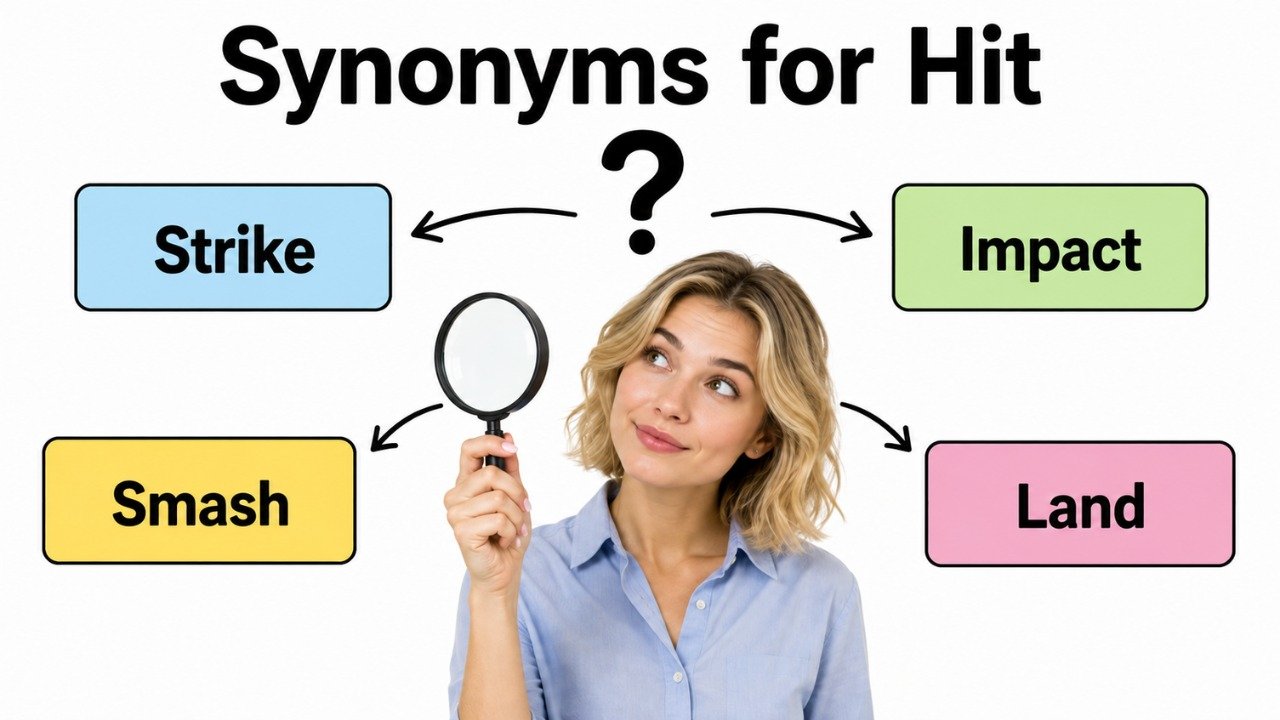
Quick Answer: Common synonyms for hit include strike, impact, contact, reach, attain, affect, collide with, beat, succeed, and success. The best choice depends on context. Use strike for physical contact, impact or affect when something causes a strong effect, reach or attain for a number or goal, collide with for accidental contact, beat for defeating an opponent, succeed for achieving a desired result, and success when hit is a noun describing something popular or well received.
Pronunciation and Word Details
Word: Hit.
Pronunciation: /hɪt/
Part of Speech: Verb and noun.
Meaning: To make forceful contact with something, reach a level or target, affect someone or something, or describe something that becomes successful or popular.
US Pronunciation:
UK Pronunciation:
What Does “Hit” Mean?
Hit means to make contact with something, often with force, but it also has several important figurative meanings.
As a verb, hit can describe striking an object or person.
Example: The ball hit the wall.
It can also mean reaching a particular number, level, place, or target.
Example: Temperatures hit 30 degrees in the afternoon.
Hit can mean affecting someone or something strongly.
Example: The sudden change hit the industry hard.
In achievement contexts, hit can mean reaching a goal.
Example: The team hit its monthly target.
As a noun, a hit can describe something highly successful or popular.
Example: The new song became a hit.
Because hit has many meanings, its best synonym depends heavily on the sentence.
Meaning, Tone, and Context of “Hit”
Hit is a common, neutral, and highly flexible word. It appears frequently in everyday conversation, sports, news writing, business communication, descriptions, entertainment, and informal speech.
In physical contexts, hit can sound direct and forceful.
Example: The stone hit the window.
In formal writing, strike, impact, reach, attain, or affect may sound more precise depending on the intended meaning.
Informal: Sales hit a new high.
Formal: Sales reached a new high.
When describing effects, hit can sound vivid and conversational.
Example: The price increase hit families hard.
A more formal version might use affected.
Formal: The price increase affected families significantly.
As a noun, hit is often positive when it describes success.
Example: The performance was a hit with the audience.
The word can therefore express physical contact, achievement, effect, arrival at a level, or popularity.
When and How to Use “Hit”
For Physical Contact
For Striking: Use hit when something makes forceful contact with another object.
Example: The ball hit the fence.
For Accidental Contact
For Collision: Hit can describe one object accidentally coming into contact with another.
Example: The bicycle hit the gate.
For Reaching a Number
For Levels: Use hit when a measurement, total, price, or other figure reaches a certain point.
Example: Attendance hit 5,000 by noon.
For Reaching a Goal
For Achievement: Hit can mean reaching a target, goal, or milestone.
Example: The department hit its annual target.
For Strong Effects
For Impact: Use hit when an event affects a person, group, or situation strongly.
Example: The shortage hit small businesses hardest.
For Sudden Realization
For Understanding: Hit can describe an idea or realization occurring suddenly.
Example: It suddenly hit her that she had forgotten the appointment.
For Popularity
For Success: As a noun, hit can describe something that becomes widely liked or successful.
Example: The new comedy was an immediate hit.
For Reaching a Place
For Arrival: In conversational English, hit can mean arriving at or entering a place.
Example: We hit the road early in the morning.
Best Synonyms for Hit
Strike
Synonym: To make forceful physical contact with something.
Example: The ball struck the side of the building.
Impact
Synonym: To make contact with or strongly affect something.
Example: The object impacted the surface at high speed.
Reach
Synonym: To arrive at a particular level, number, point, or destination.
Example: Sales reached a new record.
Attain
Synonym: To successfully reach a goal, level, or achievement.
Example: The team attained its performance target.
Affect
Synonym: To produce a change or influence in someone or something.
Example: The new regulations affected several businesses.
Collide With
Synonym: To crash into something, usually accidentally.
Example: The vehicle collided with a barrier.
Contact
Synonym: To touch or make physical contact with something.
Example: The ball contacted the edge of the bat.
Beat
Synonym: To defeat someone in a game, contest, or competition.
Example: Their team beat the defending champions.
Succeed
Synonym: To achieve the intended result.
Example: The campaign succeeded beyond expectations.
Success
Synonym: Something that achieves popularity or a desired result.
Example: The performance was a great success.
50 Synonyms for Hit with Short Meanings
- Strike: To make forceful contact.
- Impact: To contact or affect strongly.
- Smack: To strike sharply.
- Tap: To hit lightly.
- Knock: To strike a surface or object.
- Bump: To make light accidental contact.
- Contact: To touch or make contact with.
- Collide with: To crash into something.
- Crash into: To hit something forcefully by accident.
- Bang into: To strike something suddenly.
- Reach: To arrive at a level or point.
- Attain: To reach something successfully.
- Achieve: To reach a desired result.
- Meet: To reach a target or requirement.
- Gain: To reach or obtain something.
- Arrive at: To reach a figure, point, or conclusion.
- Touch: To reach a particular level briefly.
- Approach: To come near a level or point.
- Equal: To reach the same level as something else.
- Match: To equal a result, level, or performance.
- Affect: To influence someone or something.
- Impact upon: To have a strong effect on something.
- Influence: To change or shape an outcome.
- Harm: To affect negatively.
- Disrupt: To interfere with normal activity.
- Damage: To cause physical or practical harm.
- Shake: To affect emotionally or seriously.
- Shock: To affect someone strongly or suddenly.
- Surprise: To affect someone unexpectedly.
- Move: To affect someone emotionally.
- Beat: To defeat an opponent.
- Defeat: To win against someone.
- Overcome: To successfully deal with opposition.
- Surpass: To go beyond a previous level.
- Outperform: To perform better than another person or result.
- Score: To gain a point or success.
- Succeed: To achieve the intended result.
- Connect: To make successful contact.
- Land: To successfully make contact.
- Register: To produce or record an effect or result.
- Success: A successful result or creation.
- Triumph: A notable success.
- Winner: Something highly successful.
- Sensation: Something that becomes extremely popular.
- Favorite: Something widely liked.
- Achievement: A successful accomplishment.
- Breakthrough: A major successful advance.
- Popular success: Something widely accepted and successful.
- Big success: Something that performs very well.
- Crowd favorite: Something especially popular with a group.
Read Also:
Synonyms for Grew

Synonyms for Hit by Context
When Hit Means Strike
When hit refers to physical contact, useful alternatives include strike, smack, knock, tap, contact, and land.
Example: The branch struck the roof.
Example: The ball tapped the edge of the post.
Strike is a strong general replacement. Tap is better for light contact, while smack suggests sharper contact.
When Hit Means Collide With
For accidental physical contact, collide with, crash into, bump into, and bang into are more specific.
Example: The bicycle collided with the fence.
Example: He accidentally bumped into the table.
Collide with sounds more formal, while bump into often describes minor contact.
When Hit Means Reach a Number or Level
Reach, attain, touch, meet, and arrive at are useful alternatives when hit describes a figure, level, or target.
Example: Temperatures reached 35 degrees.
Example: Sales attained the expected level.
Reach is the most natural general alternative for numbers and measurements.
When Hit Means Reach a Goal
Achieve, attain, meet, reach, and accomplish are useful when hit refers to completing a goal or target.
Example: The team achieved its quarterly goal.
Example: The company met its production target.
Meet is especially natural with targets, deadlines, standards, and requirements.
When Hit Means Affect Strongly
Affect, impact, harm, disrupt, damage, shake, and shock can replace hit when something has a strong effect.
Example: Rising costs affected local businesses.
Example: The storm disrupted transportation.
Affect is neutral, while harm and damage specifically suggest negative effects.
When Hit Means Defeat
Beat, defeat, overcome, surpass, and outperform work when hit describes success against opposition or previous performance.
Example: The team defeated its closest competitor.
Example: This year’s results surpassed last year’s total.
Beat sounds natural in conversation and sports, while outperform is common in performance comparisons.
When Hit Means Become Successful
Success, sensation, winner, favorite, and popular success work when hit is a noun describing something widely appreciated.
Example: The new play became a major success.
Example: The dish quickly became a crowd favorite.
Success is the broadest formal alternative, while sensation emphasizes exceptional popularity.
Another Word for Hit
Strike is a strong general replacement for hit when the meaning involves physical contact. However, because hit has several meanings, another word may be more accurate in many contexts.
Use reach for numbers, attain or achieve for goals, affect for consequences, and success when hit is a noun describing popularity.
Original: The ball hit the wall.
Better Option: The ball struck the wall.
Original: Sales hit a new record.
Better Option: Sales reached a new record.
Original: The team hit its target.
Better Option: The team achieved its target.
Original: The new show was a hit.
Better Option: The new show was a success.
When Not to Use “Hit”
Hit is sometimes too general when a more specific verb would make the meaning clearer.
Weak: The storm hit transportation.
Better: The storm disrupted transportation.
The stronger version explains what actually happened.
Hit may also sound too conversational in formal reports involving statistics.
Weak: Revenue hit 10 million.
Better: Revenue reached 10 million.
When writing about goals, meet or achieve can provide more precision.
Weak: The department hit every requirement.
Better: The department met every requirement.
Avoid hit when its meaning could be misunderstood.
Weak: The idea hit him.
Better: The idea suddenly occurred to him.
When describing popularity in formal writing, success may sound more appropriate than hit.
Weak: The exhibition was a hit.
Better: The exhibition was a major success.
Repeated use can also weaken writing.
Weak: Sales hit a record, attendance hit a peak, and demand hit a new level.
Better: Sales reached a record, attendance peaked, and demand rose to a new level.
Words Commonly Confused With Hit
Hit vs Strike: Both can describe forceful contact. Strike often sounds more precise or formal, while hit is more common in everyday English.
Hit vs Impact: Hit describes the act of contact, while impact can refer to physical contact or the effect something has.
Hit vs Reach: Hit can mean arriving at a number or level, but reach is clearer in formal descriptions of statistics and measurements.
Hit vs Attain: Hit is conversational when discussing goals, while attain sounds more formal and emphasizes successful achievement.
Hit vs Affect: Hit can mean causing a strong effect, while affect simply means producing a change or influence.
Hit vs Collide: Hit describes contact generally. Collide specifically suggests two moving objects coming forcefully together.
Hit vs Beat: Hit usually describes contact, while beat can mean defeating an opponent or repeatedly striking something.
Hit vs Success: Hit can be a noun for something popular, while success is a broader term for something that achieves a favorable result.
Which Synonym Should You Choose?
Choose strike when describing forceful physical contact.
Choose tap when the contact is light.
Choose bump into when describing minor accidental contact.
Choose collide with for a more serious or formal description of accidental contact.
Choose reach when writing about prices, numbers, temperatures, totals, ages, or measurements.
Choose attain when formal writing emphasizes reaching a level or goal.
Choose meet when discussing targets, standards, requirements, or expectations.
Choose achieve when describing successful completion of a goal.
Choose affect when explaining how an event influences people, businesses, systems, or conditions.
Choose disrupt when an event interrupts normal activity.
Choose harm or damage when the effect is clearly negative.
Choose beat or defeat for competition.
Choose outperform when comparing performance in reports or analytical writing.
Choose success when hit is a noun meaning something successful.
Choose sensation when something becomes exceptionally popular.
For essays and reports, reach, affect, achieve, attain, and success usually sound more precise than hit.
For casual conversation, hit, beat, bump into, and success are all natural depending on meaning.
Real Life Examples of “Hit” in Sentences
Original: The ball hit the window.
Better Option: The ball struck the window.
Original: The bicycle hit the fence.
Better Option: The bicycle collided with the fence.
Original: Temperatures hit 40 degrees in the afternoon.
Better Option: Temperatures reached 40 degrees in the afternoon.
Original: The team hit its sales goal.
Better Option: The team achieved its sales goal.
Original: Rising costs hit small businesses hard.
Better Option: Rising costs affected small businesses significantly.
Original: Attendance hit a record level.
Better Option: Attendance reached a record level.
Original: The news hit him unexpectedly.
Better Option: The news shocked him unexpectedly.
Original: Their team hit a new performance level.
Better Option: Their team attained a new performance level.
Original: The new comedy became a hit.
Better Option: The new comedy became a success.
Original: The product was a hit with customers.
Better Option: The product became a customer favorite.
Synonym Groups and Usage Differences
Physical Contact Group
Strike, smack, knock, tap, contact, and land all describe contact with an object or surface.
Strike is broad and strong. Tap describes light contact, while land often describes successfully making contact.
Example: The ball struck the post.
Collision Group
Collide with, crash into, bump into, and bang into describe accidental or forceful contact.
Collide with is neutral and formal. Crash into suggests greater force, while bump into usually describes minor contact.
Example: The cart bumped into the wall.
Achievement Group
Reach, attain, achieve, meet, and gain can replace hit when describing goals or levels.
Reach is broad, attain is more formal, achieve emphasizes success, and meet is natural with targets or requirements.
Example: The team met its annual target.
Effect Group
Affect, impact, influence, disrupt, harm, and damage describe consequences.
Affect is the broadest choice. Disrupt suggests interruption, while harm and damage indicate negative consequences.
Example: The shortage affected production.
Competition Group
Beat, defeat, surpass, overcome, and outperform relate to competition or comparative success.
Beat is conversational, defeat is more formal, and outperform is particularly useful in reports.
Example: The new model outperformed the previous version.
Popularity Group
Success, winner, sensation, favorite, and breakthrough can describe something that receives positive attention.
Success is broad, sensation emphasizes widespread excitement, and favorite highlights preference.
Example: The performance was a major success.
Antonyms of Hit
The opposite of hit depends on the intended meaning. If hit means making contact, the opposite may be miss. If it means reaching a goal, the opposite may be fail or fall short. If it means becoming successful, the opposite may be failure.
Miss: To fail to make contact with a target.
Avoid: To prevent contact with something.
Dodge: To move away from something approaching.
Fail: To not achieve the intended result.
Fall short: To fail to reach a goal or level.
Lose: To fail to defeat an opponent.
Decline: To move downward instead of reaching a higher level.
Drop: To decrease rather than rise to a level.
Fail to reach: To remain below a target.
Underperform: To perform below expectations.
Failure: An unsuccessful result.
Flop: Something that performs poorly or fails to gain popularity.
Comparison: Hit vs Related Words
Hit vs Strike
Hit is common and broad, while strike often sounds more deliberate, forceful, or formal.
Example With Hit: The ball hit the wall.
Example With Strike: The ball struck the wall.
Hit vs Reach
Hit can mean reaching a number or level, but reach is clearer and more formal.
Example With Hit: Sales hit 5,000 units.
Example With Reach: Sales reached 5,000 units.
Hit vs Achieve
Hit can describe reaching a target informally. Achieve emphasizes successful accomplishment.
Example With Hit: The team hit its target.
Example With Achieve: The team achieved its target.
Hit vs Meet
Hit and meet can both refer to targets, but meet is especially natural with requirements, standards, deadlines, and expectations.
Example With Hit: The department hit its target.
Example With Meet: The department met its target.
Hit vs Affect
Hit can describe a strong effect in conversational writing. Affect is more neutral and precise.
Example With Hit: The shortage hit businesses hard.
Example With Affect: The shortage affected businesses significantly.
Hit vs Impact
Hit often refers directly to contact or a strong effect. Impact can describe either physical contact or influence.
Example With Hit: The object hit the ground.
Example With Impact: The change impacted several areas of the project.
Hit vs Success
A hit is something especially popular or successful. Success is broader and more formal.
Example With Hit: The play was a hit.
Example With Success: The play was a major success.
Common Phrases and Expressions With Hit
Hit a Target: Reach or achieve a specific goal.
Hit a Record: Reach a record level or result.
Hit a Peak: Reach the highest point.
Hit the Mark: Achieve the intended result or be accurate.
Hit the Road: Begin a journey or leave a place.
Hit Hard: Affect someone or something severely.
Hit Home: Become personally clear, meaningful, or emotionally powerful.
Hit a Milestone: Reach an important stage or achievement.
Hit the Limit: Reach the maximum permitted level.
Hit New Heights: Reach a higher level of achievement or success.
Common Mistakes to Avoid
A common mistake is assuming that one synonym can replace hit in every sentence. Because hit has many meanings, context must guide the choice.
Incorrect: Sales struck a record level.
Better: Sales reached a record level.
Strike works for physical contact but usually sounds unnatural for numerical achievement.
Another mistake is using reach for physical impact.
Incorrect: The ball reached the wall with force.
Better: The ball struck the wall with force.
Avoid confusing hit as a verb with hit as a noun.
Verb: The ball hit the fence.
Noun: The performance was a hit.
Writers should also avoid vague repeated use of hit in reports.
Repetitive: Revenue hit a record, demand hit a peak, and attendance hit a new high.
Better: Revenue reached a record, demand peaked, and attendance rose to a new high.
Be careful with affect and impact. Affect generally describes influence, while physical hit usually requires strike, contact, or collide with.
Choose synonyms according to the exact meaning rather than replacing hit automatically.
Conclusion
Synonyms for hit vary widely because the word can describe physical contact, achievement, effects, competition, numbers, or popularity. Strike is a strong choice for physical contact, while reach works well for figures and levels. Achieve and meet suit goals and targets, affect describes consequences, and collide with fits accidental contact. When hit is a noun meaning something popular, success, sensation, or favorite may work better. Choosing the right synonym makes each sentence clearer and more precise.
FAQs About Synonyms for Hit
What is the best synonym for hit?
Strike is the best general synonym when hit means making physical contact. For other meanings, reach, affect, achieve, or success may be more accurate.
What is a formal synonym for hit?
Strike is formal for physical contact, reach works for numbers, attain works for goals, and affect is useful for describing consequences.
What is another word for hit a target?
Meet, reach, achieve, and attain can all replace hit when referring to a goal or target.
What is another word for hit something accidentally?
Collide with, bump into, crash into, and bang into are useful alternatives depending on the force of the contact.
What is a synonym for hit when talking about numbers?
Reach is usually the clearest choice.
Example: Sales reached 10,000 units.
What is another word for a hit meaning something popular?
Success, sensation, favorite, winner, and popular success can describe something that becomes widely liked.
Are hit and strike always interchangeable?
No. Both can describe physical contact, but hit also has meanings such as reach, affect, achieve, and become successful, where strike would not be appropriate.
