
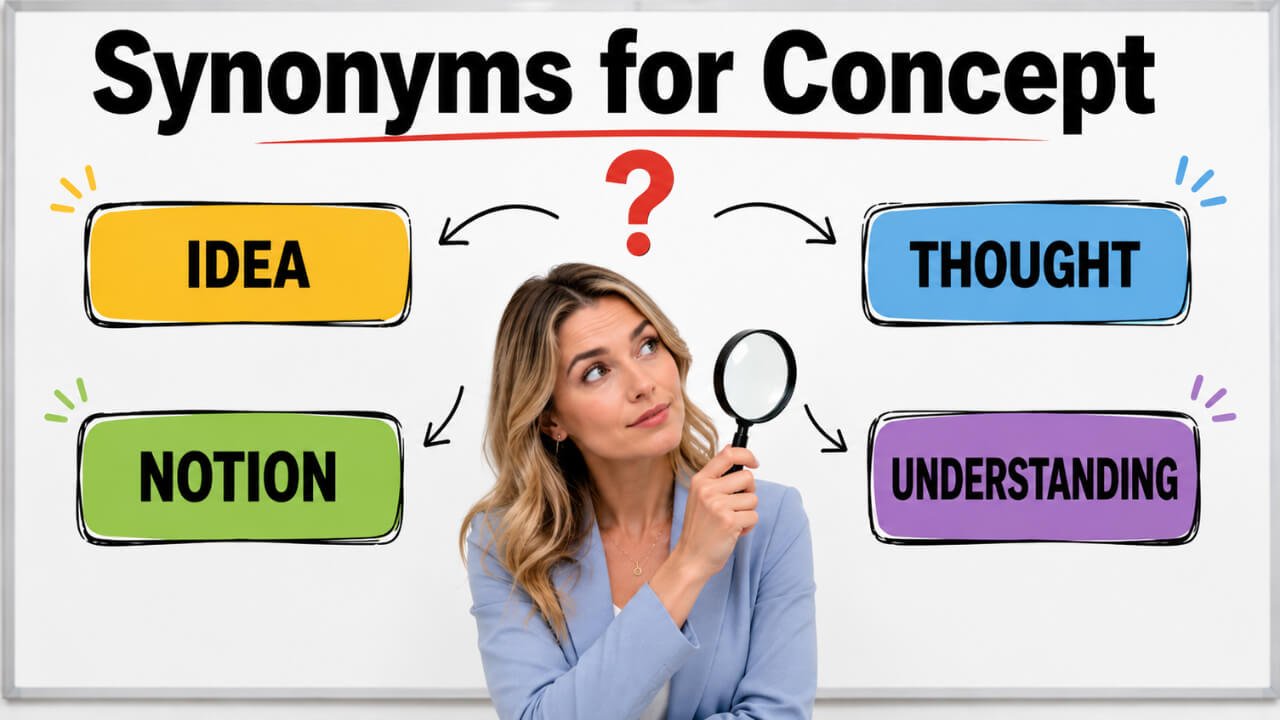
Quick Answer: The best synonyms for concept include idea, notion, conception, theory, principle, framework, model, theme, vision, and construct. Idea is the most natural replacement in everyday speech. Notion suits a personal or less developed thought, while theory works for an explanation supported by reasoning. Framework and model are useful in academic, technical, and professional writing. Theme describes a central message, vision expresses an imagined future, and construct refers to an abstract idea created for analysis.
Pronunciation and Word Details
Word: Concept.
Pronunciation: /ˈkɒn.sept/
Part of Speech: Noun.
Meaning: An idea, principle, or general understanding used to explain, organize, design, or represent something.
US Pronunciation:
UK Pronunciation:
What Does “Concept” Mean?
A concept is a general idea or mental understanding of something. It is a countable noun and can refer to an abstract thought, a guiding principle, a creative plan, or a structured way of explaining a subject.
In everyday conversation, concept often means a basic idea. In academic writing, it may describe an important principle, theory, category, or abstract construct. In business and design, it can refer to an early plan or creative vision.
General Idea: The concept of fairness influences many social decisions.
Academic Principle: Students studied the concept of natural selection.
Creative Plan: The designer presented a new concept for the room.
Technical Understanding: The course explains the basic concepts of programming.
The meaning becomes clearer when the word is connected to a specific subject, purpose, or area of study.
Meaning, Tone, and Context of “Concept”
Concept usually has a neutral, formal, and intellectual tone. It appears frequently in academic writing, education, science, philosophy, design, technology, business, psychology, and professional communication.
In casual speech, idea is often more natural than concept. A person might say, “I have an idea for dinner,” rather than, “I have a concept for dinner.” Concept sounds more suitable when the thought is organized, abstract, creative, or connected to a larger system.
Academic Context: Concept refers to an important idea that helps explain a subject.
Technical Context: It describes a principle, process, model, or structure.
Creative Context: It refers to the main vision behind a design or project.
Business Context: It can describe a proposed product, service, strategy, or plan.
Conversational Context: It may mean a basic idea that someone understands or finds difficult.
Concept is not usually emotional. Its tone is thoughtful and analytical, although it can become persuasive when used to introduce an original vision.
When and How to Use “Concept”
For a General Idea: Use concept when referring to a broad thought or understanding.
Example: Freedom is a concept that can have different meanings in different cultures.
For Academic Explanation: Use concept for an important principle taught within a subject.
Example: The lesson introduces the concept of supply and demand.
For Creative Planning: Use concept for the main vision behind a design, campaign, product, or project.
Example: The architect developed a concept based on natural light and open space.
For Technical Understanding: Use concept when discussing a basic principle needed to understand a system.
Example: Students must understand the concept of data storage before studying databases.
For Abstract Thinking: Use concept for something understood mentally rather than experienced as a physical object.
Example: Time is an abstract concept that people measure in practical ways.
For a Proposed Idea: Use concept when a plan is still being developed or tested.
Example: The team created an early concept for the new service.
For a Central Message: Use concept when identifying the main idea behind a piece of work.
Example: The central concept of the story is personal responsibility.
Best Synonyms for Concept
Idea: A thought, suggestion, or general understanding.
Example: Her idea could improve the way the system works.
Notion: A personal belief, impression, or loosely formed idea.
Example: He rejected the notion that talent alone guarantees success.
Conception: A particular way of understanding or imagining something.
Example: Their conception of leadership focuses on service and trust.
Theory: An organized explanation based on principles, evidence, or reasoning.
Example: The theory attempts to explain changes in human behavior.
Principle: A basic rule, belief, or truth that guides thought or action.
Example: Respect is a central principle of the organization.
Framework: A structure of ideas used to organize, explain, or develop something.
Example: The researcher created a framework for evaluating the results.
Model: A simplified representation of a system, process, or idea.
Example: The model shows how different economic factors interact.
Theme: The central subject or message in a creative or written work.
Example: Courage is the main theme of the novel.
Vision: A clear mental image of a future goal or possibility.
Example: The founder shared a vision for a more accessible service.
Construct: An abstract idea created for analysis or explanation.
Example: Intelligence is a complex psychological construct.
50 Synonyms for Concept with Short Meanings
- Idea: A thought or suggestion about something.
- Notion: A belief or loosely developed idea.
- Thought: Something formed or considered in the mind.
- Conception: A particular way of imagining or understanding something.
- Impression: A feeling or belief formed from experience.
- Belief: An idea accepted as true.
- View: A personal way of thinking about a subject.
- Opinion: A judgment or belief that may not be proven.
- Understanding: Knowledge or awareness of how something works.
- Interpretation: An explanation of the meaning of something.
- Perception: A way of noticing or understanding something.
- Perspective: A particular position or way of viewing a subject.
- Theory: An organized explanation of facts or events.
- Principle: A basic rule, truth, or guiding belief.
- Model: A representation used to explain a system or idea.
- Framework: A structure that organizes ideas or processes.
- Construct: An abstract idea created for study or discussion.
- Abstraction: A general idea separated from specific examples.
- Proposition: An idea or statement presented for consideration.
- Hypothesis: A possible explanation that can be tested.
- Premise: A basic statement on which reasoning is built.
- Assumption: Something accepted as true without complete proof.
- Thesis: A central argument or main position.
- Doctrine: A set of principles taught by a group or system.
- Philosophy: A system of beliefs or guiding ideas.
- Ideology: An organized set of political, social, or cultural ideas.
- Theme: The main subject or message of a work.
- Motif: A recurring idea, image, or subject.
- Subject: The main matter being discussed or studied.
- Topic: A particular matter for discussion or writing.
- Plan: A developed idea for achieving a goal.
- Design: A planned arrangement or creative intention.
- Vision: A mental picture of a future possibility.
- Approach: A particular way of dealing with something.
- Method: An organized way of completing a task.
- Strategy: A planned method for achieving a result.
- Scheme: A structured plan or arrangement.
- Proposal: An idea or plan presented for consideration.
- Blueprint: A detailed plan for creating or developing something.
- Outline: A general description of the main parts of an idea.
- Definition: A statement explaining the meaning of something.
- Meaning: The idea or message expressed by something.
- Sense: A particular meaning or interpretation.
- Category: A group based on shared qualities or ideas.
- Classification: A system for organizing things into groups.
- Archetype: A typical or original model of a person or thing.
- Paradigm: A pattern or model that shapes understanding.
- Representation: Something that expresses or stands for an idea.
- Image: A mental picture or representation.
- Mental Picture: An imagined view or understanding formed in the mind.
Read Also:
Synonyms for Tall
Synonyms for Concept by Context
When Concept Means a General Idea
Idea, thought, notion, belief, impression, and view work well when concept refers to something formed in the mind.
Example With Concept: She introduced a concept for improving classroom communication.
Example With Idea: She introduced an idea for improving classroom communication.
Idea is the most flexible option. Thought is more personal, while notion may suggest that the idea is uncertain or not fully developed.
When Concept Means an Academic Principle
Principle, theory, construct, abstraction, premise, and hypothesis are useful in academic and analytical contexts.
Example With Concept: The students discussed the concept of social identity.
Example With Construct: The students discussed social identity as a psychological construct.
Principle refers to a basic truth or rule. Theory describes an organized explanation. Construct is often used for abstract ideas created for research or analysis.
When Concept Means an Organizing Structure
Framework, model, paradigm, system, and approach describe ideas that organize information or guide action.
Example With Concept: The report presents a concept for evaluating performance.
Example With Framework: The report presents a framework for evaluating performance.
Framework emphasizes structure. Model emphasizes representation. Paradigm describes a broader pattern that influences how people understand a subject.
When Concept Means a Creative Plan
Vision, design, proposal, blueprint, plan, and scheme are useful for creative or practical projects.
Example With Concept: The team approved the concept for the new building.
Example With Design: The team approved the design for the new building.
Vision focuses on the desired future result. Design refers to the planned appearance or structure. Proposal describes an idea formally presented for approval.
When Concept Means a Central Message
Theme, motif, subject, topic, meaning, and thesis are useful when discussing writing, art, arguments, or communication.
Example With Concept: The main concept of the story is forgiveness.
Example With Theme: The main theme of the story is forgiveness.
Theme is best for a central message in creative work. Thesis is best for the main argument in an essay or academic paper.
Another Word for Concept
Idea is usually the best single replacement for concept because it is simple, natural, and suitable for many situations. However, the strongest alternative depends on whether the sentence describes a theory, principle, theme, framework, design, or plan.
Original: The concept could solve the current problem.
Better Option: The idea could solve the current problem.
Original: The course explains several scientific concepts.
Better Option: The course explains several scientific principles.
Original: The central concept of the novel is sacrifice.
Better Option: The central theme of the novel is sacrifice.
Original: The team developed a concept for measuring progress.
Better Option: The team developed a framework for measuring progress.
When Not to Use “Concept”
Avoid concept when a more specific word would communicate the intended meaning more clearly.
Weak: The concept of the essay is responsibility.
Better: The theme of the essay is responsibility.
Theme is more accurate when referring to the central message of a creative or literary work.
Weak: We followed a concept to complete the project.
Better: We followed a plan to complete the project.
Plan is clearer when referring to a series of practical actions.
Weak: The scientist tested a concept about plant growth.
Better: The scientist tested a hypothesis about plant growth.
Hypothesis is the correct term for an explanation that can be tested.
Weak: The report uses a concept to organize the findings.
Better: The report uses a framework to organize the findings.
Framework explains that the idea provides structure.
Concept can also sound unnecessarily formal in casual conversation.
Weak: I have a concept for tonight’s dinner.
Better: I have an idea for tonight’s dinner.
Avoid repeating concept several times in one paragraph. Replace repeated uses with idea, principle, model, framework, or another precise alternative.
Words Commonly Confused With Concept
Concept vs Idea: Concept often refers to an organized, abstract, or developed understanding. Idea is broader and more natural in everyday speech.
Concept vs Notion: A concept may be clearly defined, while a notion is often a personal, uncertain, or loosely formed belief.
Concept vs Theory: A concept is a general idea. A theory is an organized explanation that connects ideas and may be supported by evidence.
Concept vs Theme: A concept can describe almost any general idea. A theme is the central message or recurring subject of a creative work.
Concept vs Principle: A concept is something understood mentally. A principle is a basic rule, truth, or belief that guides actions or reasoning.
Concept vs Model: A concept is an idea. A model represents, demonstrates, or simplifies how that idea or system works.
Concept vs Plan: A concept explains what something could be. A plan explains how it will be completed.
Concept vs Definition: A concept is the idea itself, while a definition explains the meaning of the word representing that idea.
Which Synonym Should You Choose?
Choose idea for everyday speech, general writing, suggestions, and simple thoughts.
Choose notion when describing a personal belief, uncertain impression, or loosely developed thought.
Choose conception when discussing a particular way of understanding or imagining something.
Choose theory when presenting an organized explanation supported by evidence or reasoning.
Choose principle when referring to a basic truth, rule, value, or standard.
Choose framework when an idea provides structure for research, analysis, planning, or decision making.
Choose model when representing a process, system, relationship, or pattern in a simplified form.
Choose construct in academic or research writing when discussing an abstract idea created for analysis.
Choose theme when identifying the main message of a story, speech, artwork, or discussion.
Choose vision when describing a clear and inspiring picture of a future result.
Choose proposal when an idea is formally presented for discussion or approval.
Choose plan when the sentence explains practical actions for achieving a goal.
Real Life Examples of “Concept” in Sentences
Original: The teacher explained the concept using a simple diagram.
Better Option: The teacher explained the principle using a simple diagram.
Original: The concept for the new library includes quiet study areas.
Better Option: The design for the new library includes quiet study areas.
Original: She found the concept difficult to understand at first.
Better Option: She found the idea difficult to understand at first.
Original: The researchers developed a concept for measuring confidence.
Better Option: The researchers developed a framework for measuring confidence.
Original: The concept of the story focuses on personal growth.
Better Option: The theme of the story focuses on personal growth.
Original: Their concept could improve access to education.
Better Option: Their proposal could improve access to education.
Original: The course introduces the concept of emotional intelligence.
Better Option: The course introduces the construct of emotional intelligence.
Original: His concept of success has changed over time.
Better Option: His understanding of success has changed over time.
Original: The company tested the concept before developing the full product.
Better Option: The company tested the prototype idea before developing the full product.
Original: This concept helps explain how people make decisions.
Better Option: This theory helps explain how people make decisions.
Synonym Groups and Usage Differences
General Idea Group
Idea, thought, notion, impression, and view describe something formed in the mind. Idea is the broadest and most natural word. Notion is less certain, while view often expresses a personal position.
Example: Her idea encouraged the group to consider a different solution.
Academic Meaning Group
Theory, principle, construct, abstraction, premise, and hypothesis are useful in education and research. Each word has a more precise academic role.
Example: The hypothesis was tested through a controlled experiment.
Structure Group
Framework, model, paradigm, category, and classification organize information or explain relationships. These words are useful in reports, essays, technical documents, and research.
Example: The framework divides the findings into four main areas.
Creative Planning Group
Vision, design, blueprint, proposal, and plan describe ideas connected to future creation or action. Vision is imaginative, while blueprint and plan are more practical.
Example: The architect’s vision combined modern design with natural materials.
Central Meaning Group
Theme, motif, subject, topic, thesis, and meaning describe what a text, discussion, or creative work communicates.
Example: Responsibility is a recurring theme throughout the story.
Personal Understanding Group
Perception, perspective, interpretation, conception, and understanding describe how someone mentally views or explains something.
Example: Her perspective changed after she learned more about the issue.
Antonyms of Concept
Concept does not have one exact opposite because it has several meanings. Its opposites depend on whether it refers to an abstract idea, a proposal, a theory, or a general understanding.
Fact: Something known or proven to be true.
Reality: The actual state of things rather than an imagined idea.
Actuality: Something that exists or happens in real life.
Object: A physical thing rather than an abstract thought.
Instance: A specific example rather than a general idea.
Detail: A particular feature rather than a broad concept.
Practice: The performance of an action rather than its theory.
Implementation: The process of putting an idea into action.
Concreteness: The quality of being definite, physical, or specific.
Evidence: Information that proves or supports a claim or theory.
Comparison: Concept vs Related Words
Concept vs Idea
Concept often suggests an organized or abstract understanding. Idea is broader and more conversational.
Example With Concept: The concept of equality shapes many legal discussions.
Example With Idea: She shared an idea for improving the meeting.
Concept vs Notion
Concept may be clearly explained or formally defined. Notion often describes an uncertain, personal, or informal belief.
Example With Concept: The course teaches the concept of probability.
Example With Notion: He had a notion that the plan might fail.
Concept vs Theory
Concept is a basic idea. Theory is a structured explanation that connects multiple ideas, observations, or facts.
Example With Concept: Gravity is an important scientific concept.
Example With Theory: The theory explains how gravitational forces affect objects.
Concept vs Principle
Concept refers to something understood mentally. Principle refers to a basic rule, truth, or value.
Example With Concept: Students explored the concept of justice.
Example With Principle: Fair treatment is a guiding principle of justice.
Concept vs Theme
Concept has a broad meaning across many subjects. Theme specifically identifies a central message or recurring idea in a creative work.
Example With Concept: The concept of memory influenced the project.
Example With Theme: Memory is the central theme of the novel.
Concept vs Framework
Concept is the idea being considered. Framework is the structure used to organize or apply ideas.
Example With Concept: The concept focuses on improving public participation.
Example With Framework: The framework explains how participation will be measured.
Concept vs Model
Concept is an abstract understanding. Model is a representation that demonstrates how an idea, system, or process works.
Example With Concept: The concept describes cooperation between communities.
Example With Model: The model shows how the communities share resources.
Concept vs Vision
Concept describes a general idea or planned approach. Vision expresses an inspiring mental picture of a desired future.
Example With Concept: The concept includes flexible learning spaces.
Example With Vision: Their vision is to create education that is accessible to everyone.
Common Phrases and Expressions With “Concept”
Basic Concept: A simple or foundational idea needed for understanding a subject.
Key Concept: A particularly important idea within a topic.
Central Concept: The main idea around which other information is organized.
Core Concept: The most essential principle or idea in a system.
Abstract Concept: An idea that cannot be physically touched or directly observed.
Broad Concept: A general idea that covers several related subjects.
New Concept: An original or recently introduced idea.
Design Concept: The main creative idea behind the appearance and function of something.
Working Concept: An idea being developed, discussed, or tested.
Proof of Concept: Evidence showing that an idea can work in practice.
Concept Development: The process of turning an early idea into a clearer and more complete plan.
Concept Map: A visual structure that shows connections between ideas.
Common Mistakes to Avoid
Repeating the Word: Using concept several times in one paragraph can make writing sound mechanical. Replace repeated uses with idea, principle, framework, theory, or another precise synonym.
Choosing an Overly General Word: Concept may be too broad when the sentence clearly refers to a theme, plan, model, hypothesis, or design.
Confusing Concept With Theory: A concept is a single idea, while a theory is a developed explanation involving several ideas or principles.
Using Concept for Every Suggestion: In everyday conversation, idea is usually more natural for a simple suggestion.
Using Theme Incorrectly: Theme should describe a central message or recurring subject, not every general idea.
Ignoring Context: Framework is suitable for organized structures, model for representations, principle for basic truths, and vision for future goals.
Creating Vague Sentences: Expressions such as “a good concept” or “an interesting concept” may not explain enough. State what the concept involves and why it matters.
Using the Wrong Word Form: Concept is a noun, conceptual is an adjective, and conceptualize is a verb.
Correct: The concept is easy to understand.
Correct: The diagram provides a conceptual explanation.
Correct: The team began to conceptualize a new approach.
Conclusion
The best synonyms for concept depend on the meaning and setting of the sentence. Idea is the strongest general replacement, while notion suits an uncertain belief and theory describes an organized explanation. Use principle for a basic truth, framework for a structure, model for a representation, and theme for a central message. Vision, design, proposal, and plan work well for creative or practical projects. Choosing precise synonyms for concept makes writing clearer, more natural, and more informative.
FAQs About Synonyms for Concept
What is the best synonym for concept?
Idea is the best general synonym because it works naturally in both speech and writing.
Is notion another word for concept?
Yes. Notion can replace concept when referring to a personal belief, impression, or loosely developed idea.
What is a formal synonym for concept?
Conception, principle, framework, construct, paradigm, and theory are useful formal alternatives, depending on context.
What is the difference between a concept and an idea?
An idea can be any thought or suggestion. A concept is often a more organized, general, or abstract understanding.
Can theory replace concept?
Theory can replace concept only when the sentence refers to an organized explanation based on reasoning, observations, or evidence.
What synonym for concept is best in academic writing?
Principle, theory, construct, framework, model, and paradigm are strong academic choices. The correct word depends on the subject.
What synonym should replace concept in a story?
Theme is usually the best choice when concept refers to the central message of a story. Motif works when an idea or image appears repeatedly.
