
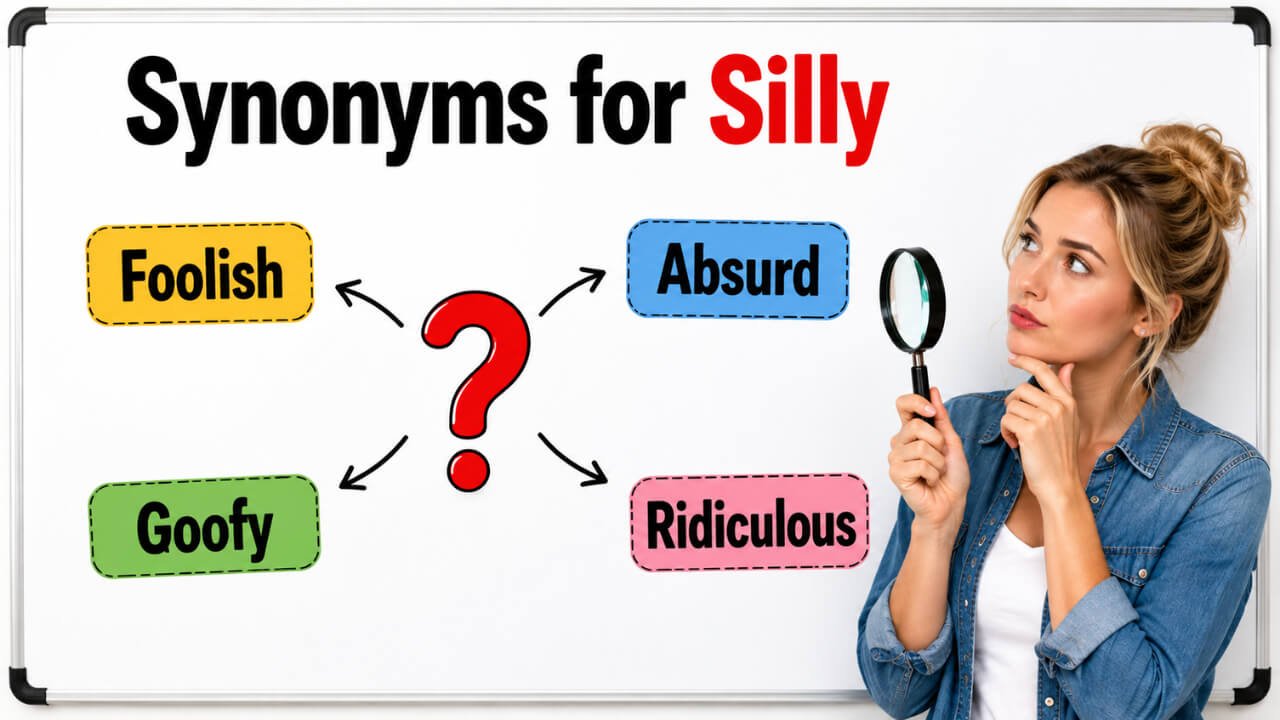
Quick Answer: The best synonyms for silly include foolish, absurd, ridiculous, goofy, playful, childish, nonsensical, unwise, frivolous, and daft. Choose foolish for poor judgment, absurd for something unreasonable, and ridiculous for an idea that deserves criticism. Goofy and playful are friendlier choices for casual behavior. Childish describes immature actions, while nonsensical suits statements that lack meaning. Among synonyms for silly, the best choice depends on whether you mean amusing, unintelligent, immature, unreasonable, or unimportant.
Pronunciation and Word Details
Word: Silly.
Pronunciation: /ˈsɪli/
Part of Speech: Adjective.
Meaning: Showing poor judgment, lacking seriousness, or behaving in a playful and amusing way.
US Pronunciation:
UK Pronunciation:
What Does “Silly” Mean?
Silly means foolish, unreasonable, playful, or not serious. It is mainly used as an adjective to describe a person, action, idea, mistake, expression, or situation.
The meaning of silly changes according to context. It can describe harmless and amusing behavior.
Example: The children made silly faces for the photograph.
It can also criticize a decision that shows poor judgment.
Example: It was silly to leave the door unlocked.
Silly may describe an idea that is unreasonable or a concern that is not important.
Example: Do not worry about such a silly problem.
The word can therefore sound affectionate, humorous, dismissive, or mildly critical.
Meaning, Tone, and Context of “Silly”
Silly is usually an informal and conversational word. It commonly appears in everyday speech, friendly messages, stories, and casual descriptions.
Its tone may be warm and playful when it describes harmless behavior. Calling a close friend silly can express affection rather than criticism.
Example: You are being silly, but you made everyone laugh.
The word can sound mildly negative when it refers to poor judgment.
Example: That was a silly mistake to make.
It may also sound dismissive when used to describe another person’s feelings, fears, or opinions. In sensitive situations, words such as minor, mistaken, unreasonable, or unnecessary may sound more respectful and precise.
Silly is less common in formal, academic, or technical writing. Foolish, irrational, trivial, illogical, or imprudent may be better choices in those contexts.
When and How to Use “Silly”
For Playful Behavior: Use silly to describe amusing actions that are not intended to be serious.
Example: We told silly jokes during the long journey.
For Poor Judgment: Use silly when someone makes an avoidable or unwise decision.
Example: It was silly to ignore the warning signs.
For Unreasonable Ideas: Use silly when an idea does not seem logical or practical.
Example: The suggestion sounded silly because it ignored the budget.
For Minor Concerns: Use silly for something that appears unimportant or undeserving of worry.
Example: They argued over a silly misunderstanding.
For Affectionate Teasing: Silly can gently describe a friend or family member who behaves playfully.
Example: You silly person, you left your glasses on your head.
For Childlike Amusement: Use silly for behavior intended to entertain children or create laughter.
Example: The teacher used a silly voice while reading the story.
For Embarrassing Mistakes: Silly can describe a small error that makes someone feel awkward.
Example: I made a silly spelling mistake in the first sentence.
Best Synonyms for Silly
Foolish: Showing poor judgment or a lack of wisdom.
Example: It was foolish to spend all the money at once.
Absurd: Completely unreasonable or impossible to take seriously.
Example: The claim was so absurd that nobody believed it.
Ridiculous: Extremely unreasonable, inappropriate, or deserving of laughter.
Example: The proposed price seemed ridiculous.
Goofy: Amusingly awkward, unusual, or playful.
Example: He wore a goofy expression for the photograph.
Playful: Full of fun and not intended to be serious.
Example: Her playful behavior helped everyone relax.
Childish: Showing the behavior or immaturity associated with a child.
Example: Refusing to listen was a childish response.
Nonsensical: Having no clear meaning or logical sense.
Example: The final paragraph was completely nonsensical.
Unwise: Not based on good judgment.
Example: Ignoring professional advice would be unwise.
Frivolous: Lacking seriousness, value, or useful purpose.
Example: The committee rejected the frivolous complaint.
Daft: Foolish, strange, or amusing in an informal way.
Example: He had a daft idea about walking home in the storm.
50 Synonyms for Silly with Short Meanings
- Foolish: Showing poor judgment or little wisdom.
- Absurd: Completely unreasonable or illogical.
- Ridiculous: Extremely unreasonable or laughable.
- Goofy: Amusingly awkward or playful.
- Playful: Intended for fun rather than seriousness.
- Childish: Immature in behavior or attitude.
- Nonsensical: Lacking meaning or logical sense.
- Unwise: Not based on sensible judgment.
- Frivolous: Lacking seriousness or useful purpose.
- Daft: Foolish or amusingly strange.
- Irrational: Not guided by reason or logic.
- Senseless: Having no sensible purpose or meaning.
- Thoughtless: Acting without considering the consequences.
- Imprudent: Failing to show care or wisdom.
- Ill Advised: Unwise or likely to cause problems.
- Unreasonable: Not supported by fair or logical thinking.
- Illogical: Not following clear reasoning.
- Preposterous: Extremely unreasonable or unbelievable.
- Ludicrous: So unreasonable that it seems amusing.
- Comical: Funny in an amusing or unusual way.
- Laughable: So poor or unreasonable that it causes laughter.
- Amusing: Causing enjoyment or gentle laughter.
- Funny: Causing laughter or entertainment.
- Zany: Unusually energetic, strange, and amusing.
- Wacky: Funny because of unusual or unpredictable behavior.
- Quirky: Unusual in an interesting or amusing way.
- Clownish: Behaving like a clown to entertain others.
- Buffoonish: Foolish and exaggerated in behavior.
- Mischievous: Playfully causing minor trouble.
- Lighthearted: Cheerful and free from seriousness.
- Carefree: Not worried about problems or responsibilities.
- Giddy: Excited and behaving without seriousness.
- Facetious: Treating a serious matter with inappropriate humor.
- Flippant: Not showing enough seriousness or respect.
- Trivial: Too minor or unimportant to deserve attention.
- Petty: Unimportant or focused on small concerns.
- Insignificant: Too small or unimportant to matter greatly.
- Pointless: Having no useful purpose.
- Futile: Unlikely to produce a useful result.
- Inane: Lacking sense, meaning, or intelligence.
- Witless: Showing little intelligence or awareness.
- Simpleminded: Lacking careful or complex thought.
- Naive: Lacking experience or practical judgment.
- Immature: Not behaving with expected emotional development.
- Juvenile: Childish or unsuitable for a mature person.
- Harebrained: Extremely foolish or poorly planned.
- Cockamamie: Strange, foolish, or unbelievable.
- Scatterbrained: Forgetful and unable to think clearly.
- Empty Headed: Lacking sensible or careful thought.
- Fatuous: Foolish and lacking meaningful intelligence.
Read Also:
Synonyms for Laugh
Synonyms for Silly by Context
When Silly Means Foolish
Foolish, unwise, imprudent, thoughtless, ill advised, and harebrained describe actions that show poor judgment. Foolish is the most general alternative, while imprudent is more formal.
Example: It was foolish to travel without checking the weather.
Example: Investing everything in one uncertain plan would be imprudent.
When Silly Means Absurd
Absurd, ridiculous, preposterous, ludicrous, irrational, and illogical describe ideas or claims that do not make sense.
Absurd and preposterous are strong choices. Ridiculous often expresses criticism, while ludicrous may suggest that something is amusing because it is so unreasonable.
Example: The accusation was completely absurd.
Example: Their demand for immediate perfection was preposterous.
When Silly Means Playful
Goofy, playful, funny, amusing, zany, wacky, quirky, and lighthearted describe harmless behavior intended to create enjoyment.
Goofy is friendly and informal. Playful is more neutral and positive. Zany and wacky suggest unusual or energetic behavior.
Example: He made a goofy face to cheer up the children.
Example: Her playful remarks made the conversation enjoyable.
When Silly Means Childish
Childish, immature, juvenile, naive, and simpleminded describe behavior that lacks maturity.
Childish and immature are common choices. Juvenile is often more critical, while naive may describe a lack of experience rather than bad behavior.
Example: Refusing to apologize was childish.
Example: His immature reaction made the disagreement worse.
When Silly Means Unimportant
Trivial, petty, insignificant, frivolous, and pointless describe matters that have little importance, value, or purpose.
Trivial suits minor issues. Petty often describes small complaints or arguments. Frivolous is useful in formal writing.
Example: They wasted an hour discussing a trivial detail.
Example: The complaint was considered frivolous.
When Silly Means Nonsensical
Nonsensical, senseless, inane, illogical, and meaningless describe statements or ideas that lack clear meaning.
Nonsensical is direct and widely understood. Inane is stronger and often criticizes empty or unintelligent speech.
Example: His explanation became increasingly nonsensical.
Example: The discussion was filled with inane comments.
Another Word for Silly
Foolish is often the best single replacement for silly when referring to poor judgment. However, the strongest alternative depends on whether silly means playful, absurd, immature, meaningless, or unimportant.
Original: It was silly to ignore the instructions.
Better Option: It was foolish to ignore the instructions.
Original: The children wore silly costumes.
Better Option: The children wore goofy costumes.
Original: Her excuse sounded silly.
Better Option: Her excuse sounded absurd.
Original: They had a silly argument about seating.
Better Option: They had a petty argument about seating.
When Not to Use “Silly”
Avoid using silly when a more precise word would communicate the intended meaning. The word is broad and may not explain whether something is foolish, playful, unreasonable, or unimportant.
Weak: The decision was silly.
Better: The decision was financially unwise.
Do not use silly in formal writing when a more professional alternative is available.
Weak: The report identified several silly spending choices.
Better: The report identified several imprudent spending choices.
Avoid calling a person silly during a serious disagreement. It may sound insulting or dismissive.
Weak: Your concerns are silly.
Better: Your concerns may be based on incomplete information.
Do not use silly when describing harmful or dangerous conduct.
Weak: Driving at that speed was silly.
Better: Driving at that speed was reckless and dangerous.
Avoid silly when you mean that something has no logical meaning.
Weak: The explanation was silly.
Better: The explanation was nonsensical.
Do not use a harsh synonym when the behavior is harmless and playful.
Weak: The children behaved irrationally during the game.
Better: The children behaved playfully during the game.
Words Commonly Confused With Silly
Silly vs Foolish: Silly can describe playful behavior or poor judgment. Foolish mainly describes a lack of wisdom or sensible judgment.
Silly vs Stupid: Silly is usually milder and may sound affectionate. Stupid is much harsher and directly attacks intelligence or judgment.
Silly vs Goofy: Silly has both positive and negative meanings. Goofy usually describes harmless, amusing, or awkward behavior.
Silly vs Childish: Silly may be playful without being negative. Childish usually criticizes immature behavior.
Silly vs Absurd: Silly can describe a person, action, or minor mistake. Absurd describes something extremely unreasonable or impossible to take seriously.
Silly vs Ridiculous: Silly is often mild and informal. Ridiculous is stronger and expresses clear criticism or disbelief.
Silly vs Nonsensical: Silly may mean playful or foolish. Nonsensical specifically means lacking sense or clear meaning.
Silly vs Frivolous: Silly is common in conversation. Frivolous is more formal and describes something lacking seriousness, value, or purpose.
Silly vs Funny: Silly may describe behavior that causes amusement. Funny directly means causing laughter or entertainment.
Which Synonym Should You Choose?
Choose foolish when describing poor judgment in general writing or conversation.
Choose unwise when offering polite advice or warning someone about a decision.
Choose imprudent in formal reports, essays, professional analysis, or financial writing.
Choose absurd when an idea, statement, or claim is completely unreasonable.
Choose ridiculous when expressing strong criticism or disbelief.
Choose nonsensical when a statement lacks meaning or logical structure.
Choose illogical when discussing weak reasoning in essays, reports, or arguments.
Choose goofy when describing harmless and amusing behavior in casual speech.
Choose playful when the behavior is friendly, cheerful, and intended for fun.
Choose childish when criticizing immature actions.
Choose juvenile when describing behavior that is unsuitable for a mature person.
Choose frivolous when discussing complaints, spending, activities, or concerns that lack seriousness.
Choose trivial when a detail or problem is too minor to deserve much attention.
Choose flippant when someone treats a serious matter too casually.
Choose lighthearted when describing a cheerful tone without criticism.
Real Life Examples of “Silly” in Sentences
Original: It was silly to leave without an umbrella.
Better Option: It was unwise to leave without an umbrella.
Original: He made a silly face at the baby.
Better Option: He made a goofy face at the baby.
Original: The proposal sounded silly to the committee.
Better Option: The proposal sounded absurd to the committee.
Original: They had a silly disagreement over the final chair.
Better Option: They had a petty disagreement over the final chair.
Original: Her silly comments distracted everyone.
Better Option: Her inane comments distracted everyone.
Original: The children played a silly game after lunch.
Better Option: The children played a playful game after lunch.
Original: His silly response made the problem worse.
Better Option: His immature response made the problem worse.
Original: That is a silly reason to cancel the event.
Better Option: That is an illogical reason to cancel the event.
Original: I made a silly error in the calculation.
Better Option: I made a careless error in the calculation.
Original: She was in a silly mood all evening.
Better Option: She was in a lighthearted mood all evening.
Synonym Groups and Usage Differences
Poor Judgment Group
Foolish, unwise, imprudent, thoughtless, and ill advised describe choices made without enough care or wisdom.
Foolish is general and conversational. Imprudent is more formal, while thoughtless may suggest that someone failed to consider other people.
Example: Leaving confidential papers unattended was imprudent.
Absurdity Group
Absurd, ridiculous, preposterous, ludicrous, irrational, and illogical describe ideas or situations that do not follow reasonable thinking.
Preposterous and ludicrous are especially strong. Illogical is useful when discussing reasoning rather than behavior.
Example: The claim was illogical because the evidence contradicted it.
Playful Behavior Group
Goofy, playful, zany, wacky, quirky, amusing, and lighthearted describe behavior that is funny without being harmful.
Playful is positive and neutral. Goofy is casual, while zany suggests energetic and unusual behavior.
Example: His goofy dance made everyone smile.
Immaturity Group
Childish, immature, juvenile, naive, and simpleminded describe a lack of maturity, experience, or careful thought.
Childish and juvenile usually criticize behavior. Naive is softer and often describes limited experience.
Example: Walking away from the discussion was an immature reaction.
Lack of Seriousness Group
Frivolous, flippant, facetious, trivial, and petty describe speech, behavior, or concerns that are not treated with enough seriousness.
Flippant suggests disrespect toward a serious subject. Facetious describes joking at an inappropriate time.
Example: His flippant response offended the concerned audience.
Lack of Meaning Group
Nonsensical, senseless, inane, pointless, and futile describe language, actions, or efforts that lack meaning, purpose, or value.
Nonsensical concerns meaning, while futile describes an action that cannot achieve its goal.
Example: Continuing the argument without new evidence seemed futile.
Antonyms of Silly
The opposite of silly depends on whether the word refers to judgment, maturity, seriousness, logic, or behavior.
Sensible: Showing practical and reasonable judgment.
Wise: Having good judgment based on knowledge or experience.
Intelligent: Able to understand and reason effectively.
Logical: Following clear and reasonable thinking.
Rational: Guided by facts and sensible judgment.
Reasonable: Fair, practical, and supported by logic.
Prudent: Careful and wise about possible consequences.
Thoughtful: Showing careful consideration for ideas or people.
Mature: Behaving with emotional and practical responsibility.
Serious: Showing careful attention rather than amusement.
Meaningful: Having clear importance, purpose, or value.
Important: Deserving attention or concern.
Practical: Focused on useful and realistic action.
Responsible: Acting with care and awareness of duties.
Dignified: Calm, serious, and worthy of respect.
Comparison: Silly vs Related Words
Silly vs Foolish
Silly can describe playful behavior, minor mistakes, or poor judgment. Foolish is more directly connected to a lack of wisdom.
Example With Silly: We wore silly hats during the celebration.
Example With Foolish: It was foolish to ignore the safety instructions.
Silly vs Goofy
Silly has both positive and negative uses. Goofy usually communicates harmless amusement or awkward playfulness.
Example With Silly: She told a silly joke during lunch.
Example With Goofy: He gave the camera a goofy smile.
Silly vs Absurd
Silly is mild and conversational. Absurd is stronger and describes something completely unreasonable.
Example With Silly: That seems like a silly excuse.
Example With Absurd: The claim that nobody needed sleep was absurd.
Silly vs Ridiculous
Silly may sound playful or gently critical. Ridiculous expresses stronger criticism and disbelief.
Example With Silly: I made a silly mistake in the message.
Example With Ridiculous: The demand for payment without evidence was ridiculous.
Silly vs Childish
Silly behavior may be amusing and harmless. Childish behavior shows a lack of maturity and is usually negative.
Example With Silly: They made silly sounds to entertain the baby.
Example With Childish: Refusing to cooperate was childish.
Silly vs Nonsensical
Silly has several meanings, including playful and foolish. Nonsensical specifically describes something without meaning or logic.
Example With Silly: He wore a silly costume to the party.
Example With Nonsensical: His explanation was confusing and nonsensical.
Silly vs Frivolous
Silly is informal and broad. Frivolous is more formal and describes something lacking seriousness, importance, or useful purpose.
Example With Silly: They argued about a silly issue.
Example With Frivolous: The court rejected the frivolous complaint.
Silly vs Stupid
Silly is usually mild and can be affectionate. Stupid is much more insulting and suggests a serious lack of intelligence or judgment.
Example With Silly: You look silly wearing both hats.
Example With Stupid: Calling someone stupid may sound unnecessarily cruel.
Common Phrases and Expressions With Silly
Silly Mistake: A minor or avoidable error.
Silly Question: A question considered obvious, unnecessary, or unreasonable.
Silly Idea: A plan that appears foolish or impractical.
Silly Joke: A simple or childish joke intended to amuse.
Silly Face: An exaggerated facial expression made for fun.
Silly Mood: A playful and unserious emotional state.
Silly Behavior: Actions that seem playful, foolish, or immature.
Silly Excuse: An explanation that is weak or unreasonable.
Silly Argument: A disagreement about something minor or unimportant.
Silly Little Thing: A small matter that does not deserve serious concern.
Common Mistakes to Avoid
A common mistake is using silly without considering its tone. It may sound affectionate in one situation but dismissive or insulting in another.
Avoid calling a serious fear or concern silly. This wording may make the other person feel ignored. Use unnecessary, unlikely, mistaken, or unsupported when those meanings are more accurate.
Do not treat silly and stupid as equal synonyms. Stupid is stronger and more offensive.
Avoid using goofy, playful, and childish interchangeably. Goofy and playful are often positive, while childish usually expresses criticism.
Do not choose absurd when describing harmless behavior. Absurd is better for unreasonable ideas, statements, claims, or situations.
Avoid using frivolous in very casual conversation unless its formal tone fits naturally.
Do not repeat silly throughout a paragraph. Replace it with precise alternatives such as foolish, playful, trivial, nonsensical, or immature.
Check whether the word describes a person, decision, idea, statement, mistake, or concern. Choosing the synonym according to the noun will make the sentence clearer.
Conclusion
The most useful synonyms for silly depend on the intended meaning and tone. Foolish and unwise describe poor judgment, while absurd, ridiculous, and nonsensical suit unreasonable ideas. Goofy, playful, and lighthearted express harmless amusement. Childish and immature describe behavior that lacks maturity, while trivial and frivolous refer to unimportant matters. Choosing precise synonyms for silly helps readers understand whether you mean funny, foolish, unreasonable, immature, or insignificant. Always consider the situation before selecting the strongest alternative.
FAQs About Synonyms for Silly
What Is the Best Synonym for Silly?
Foolish is the best general synonym when silly refers to poor judgment. Playful is better when the meaning is friendly and amusing.
What Is a Polite Synonym for Silly?
Unwise, mistaken, playful, or lighthearted can sound more polite, depending on the context.
What Is a Formal Synonym for Silly?
Imprudent, irrational, frivolous, illogical, or nonsensical may suit formal writing.
What Is a Synonym for Silly Behavior?
Goofy, playful, childish, immature, clownish, and zany can describe silly behavior.
What Is a Synonym for a Silly Idea?
Absurd, ridiculous, preposterous, illogical, harebrained, or impractical may replace silly idea.
Is Silly the Same as Stupid?
No. Silly is usually milder and can describe playful behavior. Stupid is harsher and may directly insult intelligence.
Which Synonyms for Silly Have a Positive Meaning?
Playful, goofy, amusing, funny, lighthearted, quirky, and mischievous can communicate a positive or affectionate meaning.
