
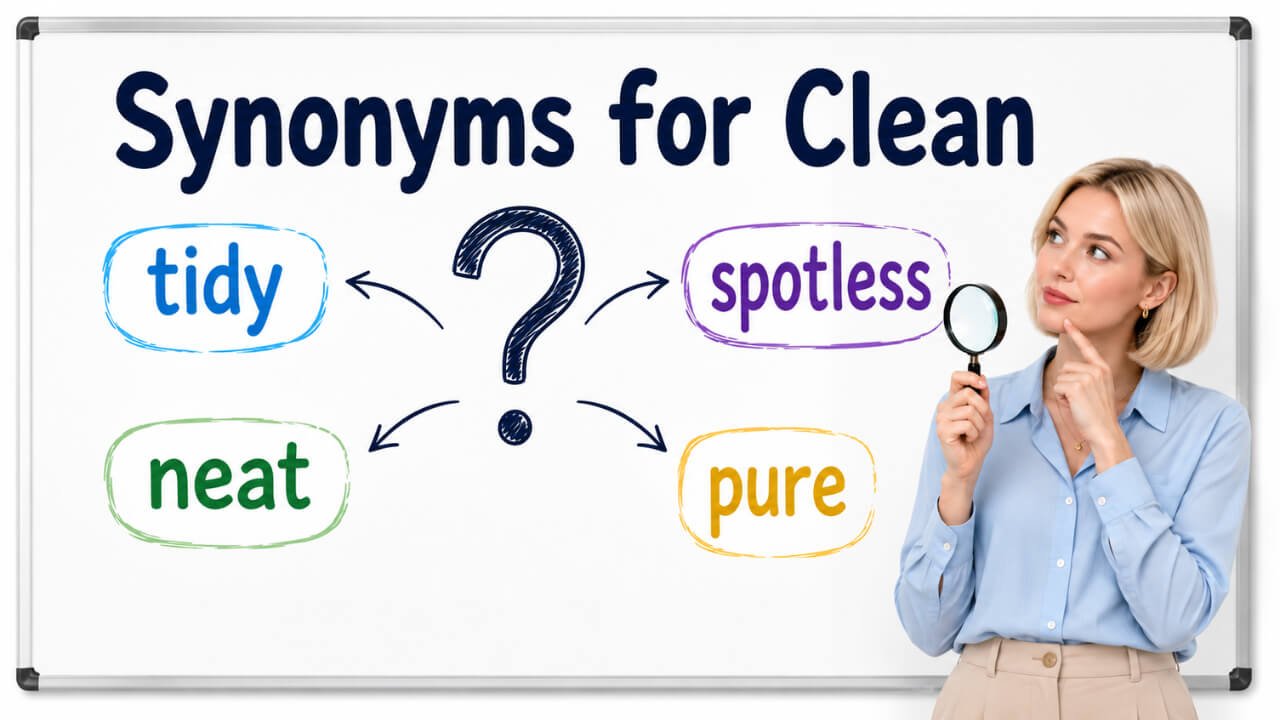
Quick Answer: Synonyms for clean include spotless, neat, tidy, pure, fresh, clear, sanitary, pristine, unsoiled, and immaculate. Use spotless for something with no dirt, tidy for an organized space, pure for something free from pollution, sanitary for health and hygiene, clear for simple writing or transparent surfaces, and fresh for a pleasant new feeling.
Pronunciation and Word Details
Word: Clean
Pronunciation: /kliːn/
Part of Speech: Adjective, verb, adverb, and noun
Meaning: Clean means free from dirt, pollution, clutter, moral fault, or confusion.
US Pronunciation:
UK Pronunciation:
What Does “Clean” Mean?
Direct Answer: Clean means free from dirt, stains, mess, pollution, guilt, or unnecessary detail.
Clean is most often used as an adjective. It can describe a clean room, clean clothes, clean water, clean design, clean record, or clean sentence. As a verb, clean means to remove dirt, dust, stains, or mess. As an adverb, it can mean completely, as in “cut clean through.” As a noun, it may refer to an act of cleaning, though this use is less common.
The word changes meaning by context. A clean kitchen is hygienic. A clean design is simple and uncluttered. A clean record means no wrongdoing. A clean answer means clear and direct.
Meaning, Tone, and Context of “Clean”
Tone: Clean is neutral, common, useful, and easy to understand.
Formality: Clean works in both casual and formal writing. However, some synonyms sound more precise in specific settings. Use sanitary in health contexts, pristine in polished descriptions, pure for substances or morals, and clear for writing, speech, or information.
Emotional Use: Clean can suggest comfort, safety, order, freshness, honesty, simplicity, or purity.
Common Contexts: Clean is used for homes, clothes, bodies, food, water, air, writing, design, behavior, records, tools, and public spaces.
Example: The room is clean and bright.
More Specific: The room is spotless and bright.
When and How to Use “Clean”
For Physical Dirt: Use clean when something has no dirt, dust, stains, or marks.
Example: Please keep the table clean after lunch.
For Organization: Use clean when a space looks neat, simple, and free from clutter.
Example: Her desk always looks clean and organized.
For Hygiene: Use clean when something is safe, washed, or sanitary.
Example: The nurse used clean equipment.
For Purity: Use clean when something is free from pollution, chemicals, or unwanted material.
Example: Everyone needs clean drinking water.
For Writing: Use clean when a sentence, paragraph, or style is clear and simple.
Example: The final draft has clean wording.
For Design: Use clean when a layout looks simple, balanced, and uncluttered.
Example: The page has a clean design.
For Morality: Use clean when someone has no guilt, dishonesty, or wrongdoing.
Example: He has a clean record.
For Freshness: Use clean when something smells, feels, or looks fresh.
Example: The sheets had a clean scent.
Best Synonyms for Clean
Spotless: Completely free from dirt or marks.
Example: The kitchen was spotless after the deep cleaning.
Neat: Orderly and arranged well.
Example: His notes were neat and easy to read.
Tidy: Free from mess and clutter.
Example: She kept her bedroom tidy.
Pure: Free from pollution, mixture, or moral fault.
Example: The village is known for pure spring water.
Fresh: Pleasantly new, washed, or clean smelling.
Example: The room smelled fresh after the windows were opened.
Clear: Easy to see through, understand, or follow.
Example: The instructions were clear and simple.
Sanitary: Clean in a way that protects health.
Example: Food must be prepared in sanitary conditions.
Pristine: Perfectly clean, fresh, and unspoiled.
Example: The beach looked pristine in the morning light.
Immaculate: Extremely clean and perfect in appearance.
Example: Her white shirt was immaculate.
Unsoiled: Not dirty, stained, or marked.
Example: The cloth remained unsoiled after use.
50 Synonyms for Clean with Short Meanings
- Spotless: Completely free from dirt or stains.
- Neat: Orderly and well arranged.
- Tidy: Free from mess or clutter.
- Pure: Free from pollution or unwanted matter.
- Fresh: Newly clean or pleasant smelling.
- Clear: Easy to see, read, or understand.
- Sanitary: Clean enough to protect health.
- Pristine: Perfectly clean and unspoiled.
- Immaculate: Extremely clean and flawless.
- Unsoiled: Not dirty or stained.
- Washed: Cleaned with water or liquid.
- Scrubbed: Cleaned firmly by rubbing.
- Polished: Smooth, shiny, and cleaned.
- Shining: Bright and clean looking.
- Gleaming: Shiny from being clean.
- Sparkling: Bright, fresh, and clean.
- Stainless: Free from stains or marks.
- Unstained: Not marked by stains.
- Unmarked: Without spots, marks, or damage.
- Dustless: Free from dust.
- Sterile: Completely free from germs.
- Disinfected: Cleaned to kill harmful germs.
- Hygienic: Clean and healthy.
- Aseptic: Free from harmful microorganisms.
- Purified: Made clean by removing impurities.
- Filtered: Cleaned by passing through a filter.
- Unpolluted: Free from harmful pollution.
- Wholesome: Clean, healthy, and good.
- Orderly: Arranged in a neat way.
- Organized: Put in a structured order.
- Uncluttered: Free from unnecessary items.
- Simple: Clear and free from excess detail.
- Minimal: Clean because it uses very few elements.
- Plain: Simple and not decorated heavily.
- Streamlined: Clean, smooth, and efficient.
- Sleek: Smooth, clean, and stylish.
- Crisp: Fresh, sharp, and clean in appearance.
- Bright: Clear, fresh, and lively looking.
- Clearcut: Easy to understand and not confused.
- Lucid: Clear and easy to understand.
- Transparent: Clear enough to see through or understand.
- Honest: Free from deceit.
- Innocent: Free from guilt.
- Blameless: Free from fault or blame.
- Upright: Morally honest and clean.
- Respectable: Proper, decent, and socially acceptable.
- Decent: Proper and not offensive.
- Chaste: Morally pure or modest.
- Whitened: Made white or cleaner looking.
- Refined: Clean, polished, and improved.
Read Also:
Synonyms for Vibe
Synonyms for Clean by Context
When Clean Means Free From Dirt
Use these words when describing objects, rooms, clothing, surfaces, or places without dirt, dust, stains, or marks.
Spotless: Completely free from dirt or stains.
Example: The floor was spotless after cleaning.
Unsoiled: Not dirty or marked.
Example: He wore an unsoiled shirt to the meeting.
Stainless: Free from stains.
Example: The white counter remained stainless.
Dustless: Free from dust.
Example: The shelves looked dustless and polished.
When Clean Means Neat or Organized
Use these synonyms when clean means arranged, tidy, or free from clutter.
Neat: Orderly and easy to look at.
Example: Her handwriting is neat.
Tidy: Free from mess.
Example: The living room looked tidy before the guests arrived.
Orderly: Arranged in a structured way.
Example: The files were kept in an orderly system.
Uncluttered: Free from unnecessary things.
Example: The office felt calm because it was uncluttered.
When Clean Means Healthy or Hygienic
Use these alternatives when clean refers to safety, hygiene, health, or germ control.
Sanitary: Clean and safe for health.
Example: The kitchen must stay sanitary.
Hygienic: Clean in a healthy way.
Example: Hygienic habits help prevent illness.
Sterile: Completely free from germs.
Example: The doctor used sterile tools.
Disinfected: Cleaned to remove harmful germs.
Example: The table was disinfected after use.
When Clean Means Pure or Unpolluted
Use these words when talking about air, water, food, nature, substances, or moral purity.
Pure: Free from unwanted mixture or pollution.
Example: The bottle contains pure water.
Unpolluted: Not harmed by pollution.
Example: The mountain air felt unpolluted.
Purified: Cleaned by removing impurities.
Example: The machine provides purified water.
Filtered: Cleaned through a filtering process.
Example: The family drinks filtered water.
When Clean Means Clear or Simple
Use these synonyms when clean describes writing, design, speech, layout, or instructions.
Clear: Easy to understand.
Example: The teacher gave clear directions.
Simple: Free from unnecessary detail.
Example: The form has a simple layout.
Minimal: Using few elements.
Example: The room has a minimal design.
Streamlined: Smooth, efficient, and uncluttered.
Example: The process became streamlined after the update.
When Clean Means Honest or Innocent
Use these words when clean describes behavior, reputation, record, or moral condition.
Honest: Free from deceit.
Example: She gave an honest answer.
Innocent: Free from guilt.
Example: The evidence showed he was innocent.
Blameless: Not responsible for wrongdoing.
Example: The worker was blameless in the mistake.
Upright: Morally good and honorable.
Example: He is known as an upright person.
Another Word for Clean
Best Single Replacement: The best single replacement for clean is spotless when talking about dirt, tidy when talking about organization, pure when talking about substances, and clear when talking about writing or ideas.
The best alternative depends on context. A clean room may be spotless or tidy. Clean water is often pure or filtered. Clean writing is clear. A clean record is blameless or honest.
Original: The kitchen is clean.
Better Option: The kitchen is spotless.
Original: His desk is clean.
Better Option: His desk is tidy.
Original: The water looks clean.
Better Option: The water looks pure.
Original: Her explanation was clean.
Better Option: Her explanation was clear.
When Not to Use “Clean”
Do not use clean when a more exact word would make the meaning clearer. Clean can be too general if you are describing hygiene, design, writing, purity, or morality. It can also sound repetitive if used again and again in the same paragraph.
Weak: The hospital room was clean.
Better: The hospital room was sanitary.
Weak: The design is clean and clean looking.
Better: The design is simple and uncluttered.
Weak: The water is clean.
Better: The water is purified.
Weak: He has a clean history.
Better: He has a blameless record.
Weak: The sentence is clean.
Better: The sentence is clear and concise.
Words Commonly Confused With Clean
Clean vs Neat: Clean means free from dirt, while neat means arranged well. A room can be neat but still dusty.
Clean vs Tidy: Clean focuses on dirt or hygiene, while tidy focuses on order. A tidy desk has items arranged properly.
Clean vs Pure: Clean means free from dirt or mess, while pure means free from pollution, mixture, or moral fault.
Clean vs Sanitary: Clean can be general, while sanitary specifically means clean enough for health and safety.
Clean vs Sterile: Clean means washed or free from dirt. Sterile means completely free from germs, often in medical contexts.
Clean vs Clear: Clean can mean simple or uncluttered, but clear means easy to understand or see through.
Clean vs Spotless: Clean is general. Spotless is stronger and means absolutely no visible dirt, stains, or marks.
Which Synonym Should You Choose?
Choose spotless when describing a room, surface, floor, shirt, or object with no dirt or stains.
Choose tidy when describing a room, desk, shelf, or area that is arranged well.
Choose neat when talking about order, handwriting, clothes, or appearance.
Choose sanitary when writing about kitchens, hospitals, bathrooms, food handling, or health.
Choose sterile when writing about medical tools, laboratories, or germ free environments.
Choose pure when describing water, air, ingredients, substances, or moral quality.
Choose fresh when describing smell, laundry, air, sheets, or a newly washed feeling.
Choose clear when describing writing, speech, explanations, glass, water, or ideas.
Choose pristine when describing something perfectly clean, new looking, or unspoiled.
Choose immaculate when you want a strong word for extreme cleanliness and perfect appearance.
Real Life Examples of “Clean” in Sentences
Original: The bathroom is clean.
Better Option: The bathroom is sanitary.
Original: The white dress is clean.
Better Option: The white dress is spotless.
Original: His desk is clean.
Better Option: His desk is tidy.
Original: The air feels clean after the rain.
Better Option: The air feels fresh after the rain.
Original: The water in the stream is clean.
Better Option: The water in the stream is pure.
Original: The instructions are clean.
Better Option: The instructions are clear.
Original: The website has a clean design.
Better Option: The website has a simple design.
Original: She has a clean record.
Better Option: She has a blameless record.
Original: The kitchen tools are clean.
Better Option: The kitchen tools are disinfected.
Original: The room looked clean and peaceful.
Better Option: The room looked uncluttered and peaceful.
Synonym Groups and Usage Differences
Dirt Free Group
This group includes spotless, unsoiled, stainless, washed, and scrubbed. These words describe things that have no visible dirt, stains, dust, or marks.
Example: The windows were spotless after washing.
Hygiene Group
This group includes sanitary, hygienic, sterile, disinfected, and aseptic. These words are useful for health, medicine, food, safety, and cleanliness standards.
Example: The tools were sterile before the procedure.
Organization Group
This group includes neat, tidy, orderly, organized, and uncluttered. These words describe spaces or objects arranged in a proper and pleasing way.
Example: Her workspace was tidy and calm.
Purity Group
This group includes pure, purified, filtered, unpolluted, and wholesome. These words describe things free from pollution, harmful matter, or unwanted mixture.
Example: The family drinks filtered water.
Simplicity Group
This group includes clear, simple, minimal, plain, and streamlined. These words work well for writing, design, speech, instructions, and layout.
Example: The report used clear language.
Moral Group
This group includes honest, innocent, blameless, upright, and respectable. These words describe a person, record, action, or reputation without guilt or wrongdoing.
Example: The judge found him innocent.
Antonyms of Clean
Opposites of clean depend on whether clean means free from dirt, organized, pure, clear, or morally good.
Dirty: Covered with dirt, stains, or marks.
Filthy: Extremely dirty.
Messy: Not tidy or organized.
Cluttered: Filled with too many things.
Dusty: Covered with dust.
Stained: Marked by a spot or discoloration.
Polluted: Made harmful or unclean by unwanted substances.
Contaminated: Made unsafe by harmful matter.
Impure: Not pure or mixed with unwanted elements.
Unhygienic: Not clean or healthy.
Unsanitary: Unsafe because of poor cleanliness.
Cloudy: Not clear or transparent.
Confusing: Not clear in meaning.
Guilty: Responsible for wrongdoing.
Corrupt: Morally dishonest or polluted by wrongdoing.
Comparison: Clean vs Related Words
Clean vs Spotless
Difference: Clean means free from dirt in a general way. Spotless is stronger and means completely free from visible marks, dirt, or stains.
Example With Clean: The mirror is clean.
Example With Spotless: The mirror is spotless.
Clean vs Neat
Difference: Clean focuses on dirt or hygiene. Neat focuses on order and arrangement.
Example With Clean: The shirt is clean.
Example With Neat: The shirt is neatly folded.
Clean vs Tidy
Difference: Clean means not dirty. Tidy means not messy or cluttered.
Example With Clean: The room is clean.
Example With Tidy: The room is tidy.
Clean vs Pure
Difference: Clean can describe surfaces, spaces, or behavior. Pure often describes substances, air, water, ingredients, or moral quality.
Example With Clean: The glass is clean.
Example With Pure: The glass contains pure water.
Clean vs Sanitary
Difference: Clean is a general word. Sanitary means clean enough to protect health.
Example With Clean: The table is clean.
Example With Sanitary: The food area is sanitary.
Clean vs Clear
Difference: Clean can mean free from dirt or clutter. Clear means easy to see through, understand, or follow.
Example With Clean: The window is clean.
Example With Clear: The window is clear.
Common Phrases and Expressions With Clean
Clean Room: A room free from dirt, dust, or mess.
Clean Clothes: Clothes that have been washed.
Clean Water: Water that is safe or free from dirt and pollution.
Clean Air: Air that feels fresh or unpolluted.
Clean Design: A simple and uncluttered visual style.
Clean Record: A record with no wrongdoing or serious fault.
Clean Break: A complete separation or ending.
Clean Slate: A fresh start without past problems.
Clean Copy: A final version without marks or errors.
Clean Lines: Simple, sharp, and uncluttered design features.
Common Mistakes to Avoid
Using Clean Too Generally: Clean is useful, but sometimes it is not exact enough. Use spotless for no visible dirt, sanitary for health, pure for substances, and clear for meaning.
Confusing Clean With Tidy: A tidy room may still need washing. A clean room may still look cluttered if items are not organized.
Using Sterile Too Often: Sterile is stronger than clean and usually belongs in medical, laboratory, or germ related contexts.
Repeating Clean in Descriptions: Repetition makes writing dull. Replace repeated clean with fresh, neat, spotless, uncluttered, or polished.
Calling Writing Clean Without Detail: Clean writing usually means clear, simple, concise, or well organized. Choose the word that explains the quality better.
Using Pure for Every Clean Thing: Pure works best for water, air, ingredients, substances, intentions, and moral ideas. It does not always fit rooms or clothes.
Ignoring Context: The best synonym depends on what you mean. A clean kitchen is sanitary, a clean shirt is washed, and a clean layout is minimal.
Conclusion
Synonyms for clean help you describe dirt, order, hygiene, purity, design, writing, and moral character with more precision. Use spotless for visible cleanliness, tidy or neat for organization, sanitary for health, pure for substances, clear for writing, and pristine or immaculate for a polished effect. Clean is a strong everyday word, but the right synonym can make your sentence clearer, sharper, and more natural for the exact context.
FAQs About Synonyms for Clean
What are the best synonyms for clean?
The best synonyms for clean are spotless, neat, tidy, pure, fresh, clear, sanitary, pristine, immaculate, and unsoiled.
What is another word for very clean?
Another word for very clean is spotless, immaculate, pristine, gleaming, or sparkling. These words show a stronger level of cleanliness.
What is a formal synonym for clean?
A formal synonym for clean is sanitary in health contexts, pristine in descriptive writing, pure for substances, and clear for ideas or communication.
What is another word for clean and organized?
Another word for clean and organized is tidy, neat, orderly, organized, or uncluttered.
What is another word for clean water?
Another word for clean water is pure water, filtered water, purified water, or unpolluted water, depending on the context.
What is another word for clean design?
Another word for clean design is simple design, minimal design, uncluttered design, streamlined design, or sleek design.
Is clean the same as sanitary?
Clean and sanitary are related, but they are not exactly the same. Clean means free from dirt, while sanitary means clean enough to protect health.
