
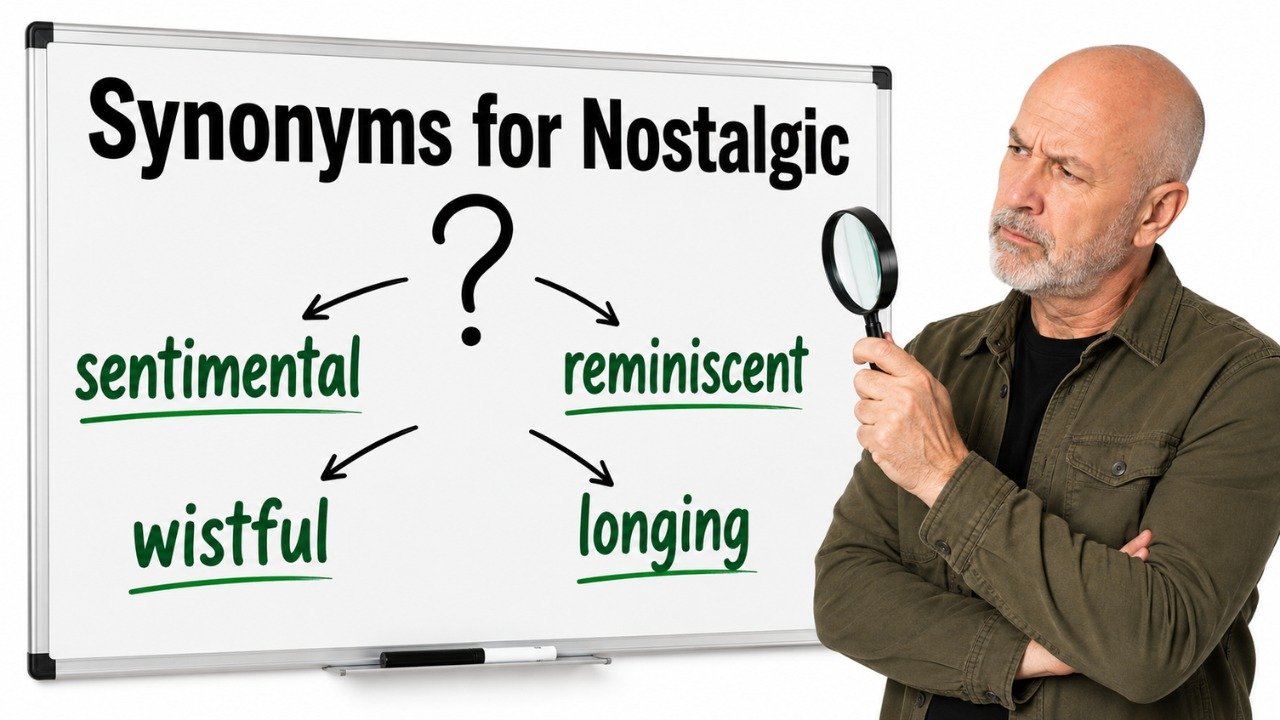
Quick Answer: Common synonyms for nostalgic include sentimental, wistful, reminiscent, longing, yearning, reflective, homesick, bittersweet, evocative, and regretful. The best choice depends on context. Sentimental works well for emotional memories, wistful suggests gentle sadness about the past, reminiscent describes something that recalls an earlier time, yearning expresses strong desire for what is gone, reflective suits thoughtful writing, and evocative is useful when a place, object, sound, or experience brings old memories to mind.
Pronunciation and Word Details
Word: Nostalgic.
Pronunciation: /nɒˈstældʒɪk/
Part of Speech: Adjective.
Meaning: Feeling or causing a warm, emotional, and sometimes sad longing for the past.
US Pronunciation:
UK Pronunciation:
What Does “Nostalgic” Mean?
Nostalgic means feeling emotionally drawn toward the past or causing someone to remember an earlier time with affection, longing, or gentle sadness.
Nostalgic is an adjective. It can describe a person, feeling, memory, experience, place, object, song, photograph, story, or atmosphere.
When someone feels nostalgic, they are remembering a past experience that carries emotional importance.
Example: She felt nostalgic while looking through her childhood photographs.
The word can also describe something that produces such memories.
Example: The familiar smell created a nostalgic feeling.
Nostalgic experiences are not always sad. They can be comforting, joyful, tender, reflective, or bittersweet. The central idea is an emotional connection with an earlier period of life.
Meaning, Tone, and Context of “Nostalgic”
Nostalgic usually has a warm, emotional, and reflective tone. It is common in both casual conversation and formal writing.
In everyday speech, people use nostalgic when talking about childhood, former homes, family traditions, school memories, old friendships, favorite places, music, clothing, photographs, or experiences from earlier life.
In descriptive and literary writing, nostalgic can create a thoughtful or emotional atmosphere. A writer may describe a character as nostalgic when memories of the past affect the character deeply.
In essays and reflective writing, the word can describe personal attachment to earlier experiences.
Nostalgic may also have a bittersweet quality because pleasant memories can bring happiness while also reminding someone that a particular time has passed.
The word is generally neutral to positive, although it can sometimes suggest sadness, regret, or excessive attachment to the past.
When and How to Use “Nostalgic”
For Childhood Memories: Use nostalgic when someone remembers childhood with warmth or emotional longing.
Example: She became nostalgic when she visited her old neighborhood.
For Family Memories: Nostalgic can describe emotions connected with family traditions or earlier gatherings.
Example: The family photographs made him nostalgic for summers at his grandparents’ home.
For Places From the Past: Use the word when a familiar place brings back strong memories.
Example: Walking through the old school made her feel nostalgic.
For Objects and Photographs: Nostalgic works when an object reminds someone of an earlier stage of life.
Example: The old toy gave him a nostalgic feeling.
For Music and Sounds: A familiar sound can produce emotional memories.
Example: The melody made her nostalgic for her university days.
For Reflective Writing: Nostalgic can describe a thoughtful emotional connection with earlier experiences.
Example: His essay has a nostalgic tone as he recalls growing up near the sea.
For a Bittersweet Mood: Use nostalgic when happy memories are mixed with sadness because the past cannot be repeated.
Example: Their reunion created a nostalgic and bittersweet mood.
For Describing Style: Nostalgic can describe something intentionally designed to recall an earlier era.
Example: The room had a nostalgic atmosphere that recalled traditional family homes.
Best Synonyms for Nostalgic
Sentimental: Emotionally attached to memories, people, places, or experiences.
Example: She became sentimental while reading letters from her childhood.
Wistful: Feeling gentle sadness and longing for something from the past.
Example: He gave a wistful smile while remembering his school years.
Reminiscent: Suggesting or reminding someone of a past person, place, style, or experience.
Example: The garden was reminiscent of the one beside her childhood home.
Longing: Showing a strong emotional desire for something absent or lost.
Example: His voice carried a longing for the peaceful days of his youth.
Yearning: Expressing a deep desire for something that is no longer present.
Example: She felt a strong yearning for the town where she grew up.
Reflective: Thoughtfully considering past experiences or memories.
Example: His reflective mood led him to think about old friendships.
Homesick: Longing emotionally for one’s home or familiar surroundings.
Example: The photographs made the student homesick for his family.
Bittersweet: Combining pleasant memories or feelings with sadness.
Example: Returning to the empty house was a bittersweet experience.
Evocative: Bringing strong memories, images, or emotions to mind.
Example: The scent was evocative of summer afternoons from childhood.
Regretful: Feeling sadness about something from the past, especially something that cannot be changed.
Example: She sounded regretful when discussing opportunities she had missed.
50 Synonyms for Nostalgic with Short Meanings
- Sentimental: Emotionally attached to memories or experiences.
- Wistful: Gently sad while longing for the past.
- Reminiscent: Suggesting or recalling something from earlier times.
- Longing: Strongly desiring something that is absent.
- Yearning: Feeling deep emotional desire for something lost or distant.
- Reflective: Thoughtfully considering past experiences.
- Homesick: Longing for home or familiar surroundings.
- Bittersweet: Pleasant yet touched by sadness.
- Evocative: Bringing memories or emotions strongly to mind.
- Regretful: Feeling sadness about something in the past.
- Pensive: Deeply thoughtful, often with a serious mood.
- Melancholic: Quietly sad and thoughtful.
- Melancholy: Filled with gentle or reflective sadness.
- Tender: Showing soft and affectionate emotion.
- Emotional: Strongly affected by feelings.
- Fond: Showing affectionate attachment or liking.
- Affectionate: Showing warmth and emotional attachment.
- Dreamy: Lost in pleasant thoughts or memories.
- Musing: Thoughtfully considering memories or experiences.
- Remembering: Thinking about something from the past.
- Recollective: Connected with recalling past experiences.
- Memory filled: Rich in reminders of previous experiences.
- Reminiscing: Thinking or talking pleasantly about past events.
- Retrospective: Looking back at past events or experiences.
- Backward looking: Focused mainly on earlier times.
- Old fashioned: Connected with the style or character of an earlier period.
- Vintage: Having qualities associated with an earlier era.
- Traditional: Connected with established ways from the past.
- Historic: Associated with an earlier period of importance.
- Period inspired: Designed to recall a particular past era.
- Old world: Suggesting the atmosphere or charm of an earlier age.
- Memory provoking: Causing memories to return.
- Thoughtful: Showing careful and emotional reflection.
- Contemplative: Deeply considering experiences or memories.
- Introspective: Examining personal thoughts and feelings.
- Sorrowful: Feeling sadness, sometimes about what has passed.
- Mournful: Expressing sadness about something lost.
- Rueful: Showing regret mixed with reflection.
- Lonesome: Feeling sadness through absence or separation.
- Homesick at heart: Emotionally longing for a familiar past or place.
- Tenderhearted: Easily moved by warm or emotional memories.
- Fondly reflective: Looking back with warmth and affection.
- Memory conscious: Strongly aware of past experiences.
- Past focused: Giving strong attention to earlier times.
- Remembrance filled: Full of emotional memories.
- Emotionally reflective: Thoughtful about experiences that carry personal feeling.
- Warmly reminiscent: Recalling earlier times with affection.
- Yearningly reflective: Looking back with deep emotional desire.
- Sentimentally attached: Emotionally connected with something from the past.
- Memory laden: Carrying many strong associations with earlier experiences.
Read Also:
Synonyms for Protagonist

Synonyms for Nostalgic by Context
When Nostalgic Means Sentimental
When nostalgic describes warm emotional attachment to memories, useful alternatives include sentimental, fond, affectionate, tender, tenderhearted, and emotional.
Example: She felt sentimental while sorting through her childhood belongings.
Example: He spoke fondly about family holidays from years ago.
Sentimental is one of the closest general replacements for nostalgic, although it can apply to emotional attachment that is not necessarily connected with the distant past.
When Nostalgic Means Wistful
When nostalgia includes gentle sadness because an earlier time is gone, use wistful, melancholy, melancholic, pensive, rueful, or sorrowful.
Example: He became wistful while remembering friends he had not seen for years.
Example: Her expression turned pensive as she looked at the empty playground.
Wistful is especially useful when the feeling involves both affection and quiet sadness.
When Nostalgic Means Longing for the Past
When the emphasis is on wanting to return to an earlier time, useful alternatives include longing, yearning, homesick, lonesome, and sentimentally attached.
Example: She felt a deep yearning for the peaceful summers of her childhood.
Example: Living far away made him homesick for familiar family traditions.
Yearning is stronger than nostalgic because it emphasizes desire rather than simple remembrance.
When Nostalgic Means Reminiscent
When something causes memories rather than describing the person’s emotion, use reminiscent, evocative, memory provoking, memory laden, or remembrance filled.
Example: The scent was evocative of mornings in her grandmother’s kitchen.
Example: The small cottage was reminiscent of houses from his childhood village.
Reminiscent is particularly useful for objects, places, styles, sounds, smells, and experiences that resemble or recall the past.
When Nostalgic Means Reflective
For thoughtful writing about previous experiences, choose reflective, contemplative, introspective, musing, retrospective, or recollective.
Example: Her reflective essay explored memories of growing up near the countryside.
Example: He became contemplative while reading his old journal.
These alternatives work especially well in essays, memoir style writing, personal reflections, and thoughtful descriptions.
When Nostalgic Describes an Earlier Style
When nostalgic refers to appearance, design, clothing, decoration, or atmosphere inspired by the past, useful alternatives include vintage, old fashioned, traditional, old world, and period inspired.
Example: The café had a vintage interior inspired by an earlier era.
Example: The furniture created an old world atmosphere.
These words describe style rather than the emotion of nostalgia itself.
Another Word for Nostalgic
A strong general replacement for nostalgic is sentimental, especially when someone feels emotionally attached to memories. However, the best alternative depends on whether the sentence emphasizes affection, sadness, longing, reflection, or something that brings memories back.
Original: She felt nostalgic when she found her childhood diary.
Better Option: She felt sentimental when she found her childhood diary.
Original: He looked nostalgic while remembering his school friends.
Better Option: He looked wistful while remembering his school friends.
Original: The old melody gave the evening a nostalgic atmosphere.
Better Option: The old melody gave the evening an evocative atmosphere.
Original: She became nostalgic for the town where she grew up.
Better Option: She began yearning for the town where she grew up.
When Not to Use “Nostalgic”
Avoid nostalgic when another word communicates the emotion more precisely.
If someone simply remembers a past event without emotional longing, reflective or reminiscent may be more accurate.
If someone strongly wants to return home, homesick is more specific.
If the emotion is mainly sadness or regret, melancholy, regretful, or rueful may fit better.
When describing a physical style from an earlier period, vintage, traditional, or old fashioned can be more precise than nostalgic.
Repeated use of nostalgic can also weaken descriptive writing. Varying the word according to the exact emotion can improve clarity.
Weak: She was nostalgic because she was thinking seriously about her past decisions.
Better: She was reflective as she considered her past decisions.
Weak: The traveler felt nostalgic because he missed his family and home.
Better: The traveler felt homesick because he missed his family and home.
Weak: The room contained nostalgic furniture from an earlier design period.
Better: The room contained vintage furniture inspired by an earlier design period.
Weak: His nostalgic expression showed sadness about the opportunity he had lost.
Better: His regretful expression showed sadness about the opportunity he had lost.
Words Commonly Confused With Nostalgic
Nostalgic vs Sentimental: Nostalgic specifically involves emotional feelings about the past. Sentimental is broader and can describe strong emotional attachment to people, objects, experiences, or memories.
Nostalgic vs Reminiscent: Nostalgic usually describes an emotional feeling. Reminiscent usually describes something that reminds a person of something else.
Nostalgic vs Wistful: Nostalgic may be warm, happy, sad, or bittersweet. Wistful places more emphasis on gentle sadness and longing.
Nostalgic vs Homesick: Nostalgic can involve any meaningful part of the past. Homesick specifically describes longing for home or familiar surroundings.
Nostalgic vs Melancholy: Nostalgic emphasizes memories and the past. Melancholy emphasizes sadness and thoughtful unhappiness.
Nostalgic vs Reflective: Nostalgic carries emotional attachment to the past. Reflective simply means thoughtfully considering something and does not necessarily involve longing.
Nostalgic vs Regretful: Nostalgic can involve pleasant memories without regret. Regretful describes sadness about a decision, action, or lost opportunity.
Nostalgic vs Evocative: Nostalgic describes a feeling or quality related to the past. Evocative describes something capable of bringing memories, images, or emotions to mind.
Which Synonym Should You Choose?
Choose sentimental when describing emotional attachment to memories, possessions, people, or experiences.
Choose wistful when the memory carries gentle sadness or a desire for something that cannot easily return.
Choose reminiscent when a place, object, sound, smell, or style reminds someone of an earlier experience.
Choose yearning when the feeling involves a strong desire to experience something from the past again.
Choose longing for strong emotional desire toward a lost time, place, or relationship.
Choose reflective for essays, personal writing, professional writing, and thoughtful descriptions of the past.
Choose evocative when describing something that powerfully brings memories or emotions to mind.
Choose homesick when the person specifically misses home, family, or familiar surroundings.
Choose bittersweet when a memory creates happiness and sadness at the same time.
Choose regretful when sadness about the past comes mainly from wishing something had happened differently.
For formal writing, reflective, reminiscent, evocative, retrospective, and contemplative are often effective.
For casual conversation, sentimental, wistful, homesick, longing, and bittersweet usually sound natural.
For descriptive writing, evocative, reminiscent, wistful, and memory laden provide more specific emotional detail.
Real Life Examples of “Nostalgic” in Sentences
Original: She felt nostalgic while looking through old family photographs.
Better Option: She felt sentimental while looking through old family photographs.
Original: He became nostalgic when he walked past his childhood school.
Better Option: He became wistful when he walked past his childhood school.
Original: The smell of fresh bread made her nostalgic for mornings at her grandmother’s house.
Better Option: The smell of fresh bread made her long for mornings at her grandmother’s house.
Original: The familiar song created a nostalgic mood.
Better Option: The familiar song created an evocative mood.
Original: He sounded nostalgic when describing his university years.
Better Option: He sounded fondly reflective when describing his university years.
Original: She felt nostalgic for the small town she had left years earlier.
Better Option: She felt homesick for the small town she had left years earlier.
Original: The old photographs gave the book a nostalgic quality.
Better Option: The old photographs gave the book a reminiscent quality.
Original: Their final visit to the family home felt nostalgic.
Better Option: Their final visit to the family home felt bittersweet.
Original: His nostalgic thoughts returned to summers spent near the lake.
Better Option: His reflective thoughts returned to summers spent near the lake.
Original: The traditional decorations gave the room a nostalgic appearance.
Better Option: The traditional decorations gave the room an old world appearance.
Synonym Groups and Usage Differences
Sentimental Group
Sentimental, affectionate, fond, tender, tenderhearted, and emotional describe warm feelings connected with people, memories, or experiences.
These words are useful when nostalgia is mainly affectionate rather than sad.
Example: She felt sentimental when she found the handmade card from her childhood.
Wistful Group
Wistful, melancholy, melancholic, pensive, sorrowful, and rueful describe nostalgia mixed with sadness or quiet reflection.
Wistful is usually the closest choice when someone misses a past experience but remembers it warmly.
Example: He gave a wistful smile as he remembered his old classmates.
Longing Group
Longing, yearning, homesick, lonesome, and sentimentally attached emphasize emotional desire for something absent.
These words work when the person wants to return to a place, relationship, period, or experience.
Example: She felt a strong yearning for the carefree summers of her youth.
Memory Group
Reminiscent, evocative, recollective, remembering, memory provoking, memory laden, and remembrance filled focus on the act of recalling or causing memories.
These choices are especially useful for objects, music, places, scents, and visual details.
Example: The sound of rain was evocative of evenings in his childhood home.
Reflection Group
Reflective, contemplative, introspective, musing, thoughtful, and retrospective describe careful thought about past experiences.
These terms can be more suitable than nostalgic in essays, reports, memoir style writing, and thoughtful personal discussion.
Example: Her reflective account explored how her childhood influenced her values.
Past Style Group
Vintage, traditional, old fashioned, old world, historic, and period inspired describe styles or appearances connected with earlier eras.
These words do not necessarily describe emotion, but they can replace nostalgic when the sentence refers to visual style or atmosphere.
Example: The restaurant used vintage furniture to create the feeling of an earlier era.
Antonyms of Nostalgic
The opposite of nostalgic depends on whether the word describes emotion, memory, or attachment to the past.
Forward looking: Focused on the future rather than the past.
Future focused: Concerned mainly with what is ahead.
Uns sentimental: Lacking emotional attachment to memories.
Detached: Emotionally separate from past experiences.
Indifferent: Showing little emotional interest or attachment.
Unreflective: Not thinking deeply about previous experiences.
Forgetful: Unable or unlikely to remember past events clearly.
Modern: Associated with current rather than earlier styles.
Contemporary: Belonging to the present time.
Progressive: Favoring development, improvement, or future change.
Unattached: Not emotionally connected with a person, place, or memory.
Practical: Focused on present needs rather than emotional memories.
Comparison: Nostalgic vs Related Words
Nostalgic vs Sentimental
Nostalgic specifically involves emotional attachment to the past. Sentimental describes emotional attachment more broadly.
Example With Nostalgic: She became nostalgic when she saw her childhood bedroom.
Example With Sentimental: She became sentimental when she found a gift from her mother.
Nostalgic vs Wistful
Nostalgic can include happiness, warmth, sadness, or longing. Wistful usually has a softer and more noticeably sad quality.
Example With Nostalgic: He felt nostalgic while watching old family recordings.
Example With Wistful: He gave a wistful smile as he remembered friends who had moved away.
Nostalgic vs Reminiscent
Nostalgic usually describes someone’s emotional state. Reminiscent usually describes something that resembles or recalls something from the past.
Example With Nostalgic: The photograph made her nostalgic.
Example With Reminiscent: The photograph was reminiscent of summers spent in the countryside.
Nostalgic vs Reflective
Nostalgic includes an emotional connection to earlier times. Reflective means thoughtful and does not require longing or sentiment.
Example With Nostalgic: She felt nostalgic while remembering her childhood.
Example With Reflective: She became reflective while considering how much her life had changed.
Nostalgic vs Homesick
Nostalgic can concern any part of the past. Homesick is specifically connected with missing home or familiar people and surroundings.
Example With Nostalgic: He felt nostalgic for his school years.
Example With Homesick: He felt homesick after moving far from his family.
Nostalgic vs Melancholy
Nostalgic centers on memories of the past. Melancholy centers on sadness, although memories may cause that sadness.
Example With Nostalgic: The old letters gave her a nostalgic feeling.
Example With Melancholy: She felt melancholy after reading the final letter.
Nostalgic vs Evocative
Nostalgic describes an emotional quality connected with earlier times. Evocative describes something that strongly brings memories, images, or feelings to mind.
Example With Nostalgic: The old melody sounded nostalgic.
Example With Evocative: The old melody was evocative of peaceful childhood evenings.
Common Phrases and Expressions With Nostalgic
Feel Nostalgic: Experience emotional longing or affection for the past.
Become Nostalgic: Begin remembering earlier experiences with emotion.
Nostalgic Feeling: A warm or bittersweet emotion connected with past experiences.
Nostalgic Memories: Memories that create affection or longing for earlier times.
Nostalgic Mood: An emotional state focused warmly or sadly on the past.
Nostalgic Moment: A particular experience that brings meaningful memories back.
Nostalgic Journey: An experience of revisiting places, memories, or activities connected with the past.
Nostalgic Atmosphere: A setting or mood that strongly recalls an earlier period.
Nostalgic Reminder: Something that causes emotional memories to return.
Nostalgic for the Past: Feeling emotional longing for an earlier time.
Common Mistakes to Avoid
One common mistake is treating nostalgic as identical to sad. Nostalgia can include sadness, but it can also involve warmth, comfort, happiness, affection, and gratitude.
Another mistake is using nostalgic when reminiscent would be clearer. A person generally feels nostalgic, while an object, smell, sound, or place may be reminiscent of something from the past.
Avoid replacing nostalgic with homesick unless the sentence specifically concerns missing home, family, or familiar surroundings.
Do not use regretful as a general synonym when no regret exists. Someone can enjoy remembering childhood without wishing that any decision had been different.
Another frequent problem is repeating nostalgic several times within a short passage. Choose more precise alternatives such as wistful, sentimental, reflective, evocative, longing, or bittersweet according to the intended emotion.
Be careful with vintage and old fashioned. These words describe style or age rather than the emotional feeling of nostalgia.
Context should guide your synonym choice. Determine whether the sentence emphasizes warm memories, sadness, longing, reflection, a familiar atmosphere, or an earlier visual style before choosing an alternative.
Conclusion
Synonyms for nostalgic include sentimental, wistful, reminiscent, yearning, reflective, evocative, homesick, and bittersweet, but each carries a slightly different meaning. Sentimental emphasizes emotional attachment, wistful adds gentle sadness, reminiscent describes something that recalls the past, and yearning expresses stronger longing. Reflective suits thoughtful writing, while evocative works well for memories triggered by sounds, places, or objects. Choosing the right synonym helps you express whether a memory feels warm, sad, thoughtful, comforting, or deeply personal.
FAQs About Synonyms for Nostalgic
What is the best synonym for nostalgic?
Sentimental is one of the best general synonyms for nostalgic. Wistful, reminiscent, reflective, and yearning may be better when the context requires greater emotional precision.
What is another word for feeling nostalgic?
You can say sentimental, wistful, reflective, homesick, yearning, or longing, depending on what the person is remembering and how strongly they feel about it.
Is wistful a synonym for nostalgic?
Yes. Wistful is especially appropriate when nostalgia includes gentle sadness or longing for something that has passed.
Is reminiscent the same as nostalgic?
Not exactly. Nostalgic usually describes an emotional feeling about the past, while reminiscent describes something that reminds someone of another person, place, time, or experience.
What is a formal synonym for nostalgic?
Reflective, reminiscent, evocative, contemplative, and retrospective can work well in formal writing, depending on the intended meaning.
What is a positive synonym for nostalgic?
Fond, sentimental, affectionate, tender, and warmly reminiscent can express the positive and comforting side of nostalgia.
What synonym describes sad nostalgia?
Wistful, melancholy, melancholic, rueful, or bittersweet can describe nostalgia that includes sadness, loss, or longing.
