
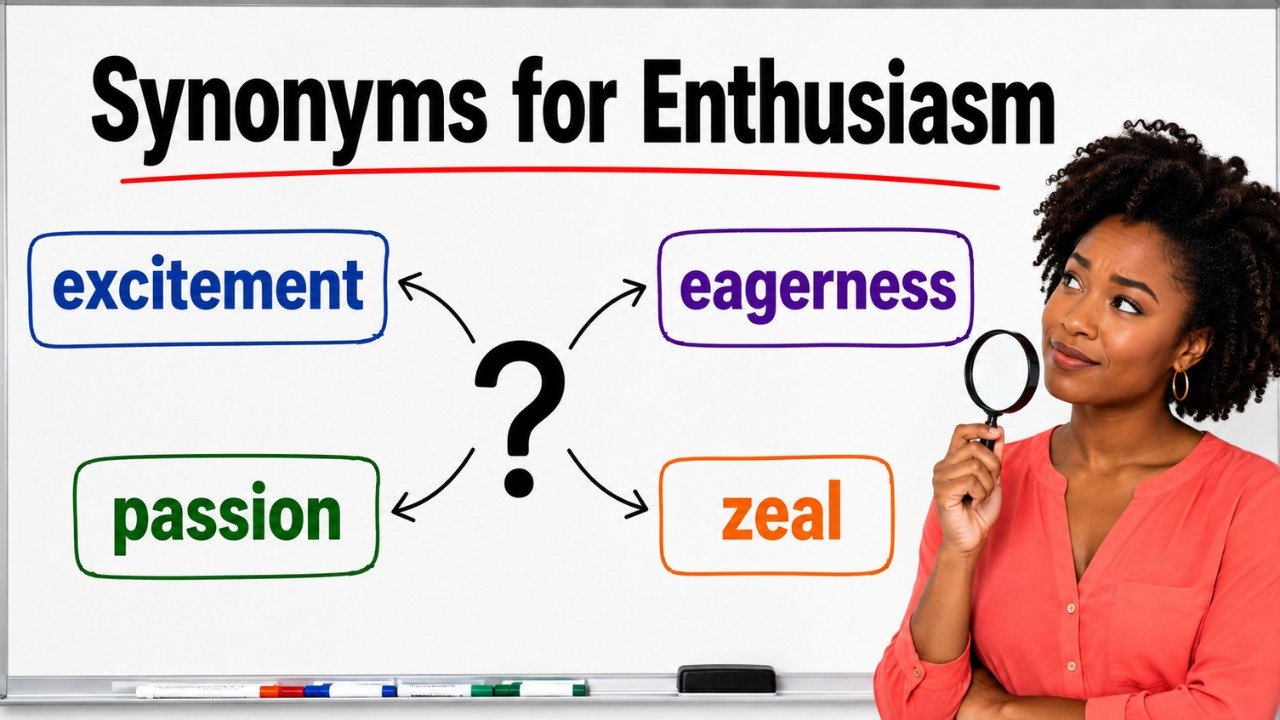
Quick Answer: The best synonyms for enthusiasm include excitement, eagerness, passion, zeal, energy, interest, devotion, fervor, keenness, and ardor. The best choice depends on context. Use excitement for strong positive emotion, eagerness for willingness to begin something, passion for deep personal interest, zeal for energetic commitment, keenness for active interest, and fervor or ardor when you want a stronger or more expressive word in formal writing.
Pronunciation and Word Details
Word: Enthusiasm
Pronunciation: /ɪnˈθuːziæzəm/
Part of Speech: Noun
Meaning: A strong feeling of excitement, interest, enjoyment, or eager support for something.
US Pronunciation:
UK Pronunciation:
What Does “Enthusiasm” Mean?
Enthusiasm means a strong and positive feeling of excitement, interest, or eagerness toward an activity, idea, person, goal, or opportunity.
Enthusiasm is a noun. It often describes the energy people show when they are genuinely interested in something or excited about participating.
Example: Her enthusiasm for learning made every lesson more enjoyable.
In this sentence, enthusiasm describes her strong interest and positive energy toward learning.
The word can also describe eager support for a plan or idea.
Example: The proposal was received with great enthusiasm.
Here, enthusiasm means strong approval and excitement.
It can also refer to visible motivation.
Example: He approached the new assignment with enthusiasm.
In this context, enthusiasm suggests willingness, energy, and a positive attitude toward the work.
Enthusiasm can therefore express emotional excitement, active interest, motivation, dedication, or energetic support depending on the situation.
Meaning, Tone, and Context of “Enthusiasm”
Enthusiasm usually has a positive and energetic tone. It suggests genuine interest rather than reluctant participation.
Positive Tone: Enthusiasm often communicates happiness, excitement, and willingness.
Example: The children showed great enthusiasm for the science activity.
Professional Context: Enthusiasm can describe a motivated attitude toward work, projects, responsibilities, or new opportunities.
Example: Her enthusiasm for the position was clear during the interview.
Academic Context: The word can describe strong interest in learning, research, reading, or a particular subject.
Example: His enthusiasm for history encouraged him to study the subject in greater depth.
Conversational Context: Enthusiasm is natural in ordinary conversation when discussing hobbies, plans, experiences, and interests.
Example: She spoke with enthusiasm about her upcoming trip.
Emotional Context: Enthusiasm can express strong positive emotion without necessarily suggesting deep long term commitment.
Example: His initial enthusiasm faded after several difficult weeks.
Formal Context: Words such as zeal, fervor, ardor, and dedication may provide a stronger or more elevated alternative when formal writing requires greater precision.
The word is generally complimentary, although excessive enthusiasm can sometimes imply more excitement than careful judgment.
When and How to Use “Enthusiasm”
For Excitement: Use enthusiasm when someone feels strongly positive and excited about an activity or event.
Example: She could barely hide her enthusiasm about the upcoming celebration.
For Learning: Use enthusiasm to describe a strong interest in studying or discovering new information.
Example: His enthusiasm for science was obvious from the questions he asked.
For Work: Use enthusiasm when describing someone who approaches responsibilities with positive energy.
Example: The new employee began the project with impressive enthusiasm.
For Support: Use enthusiasm when people strongly approve of an idea, plan, proposal, or decision.
Example: The audience responded to the announcement with enthusiasm.
For Hobbies: Use enthusiasm to describe deep enjoyment of an activity.
Example: Her enthusiasm for gardening grew after she planted her first vegetable garden.
For Motivation: Use enthusiasm when positive emotion encourages someone to act.
Example: His enthusiasm motivated the rest of the group to participate.
For Communication: Use enthusiasm when someone speaks or writes with visible excitement.
Example: She described the project with genuine enthusiasm.
Best Synonyms for Enthusiasm
Excitement: A strong feeling of happiness, anticipation, or emotional energy.
Example: There was great excitement about the upcoming event.
Eagerness: Strong willingness or desire to do or experience something.
Example: Her eagerness to learn impressed the instructor.
Passion: Deep and powerful interest, love, or commitment.
Example: His passion for music influenced his career choice.
Zeal: Energetic and devoted enthusiasm for a purpose or activity.
Example: She approached the community project with remarkable zeal.
Energy: Active strength, liveliness, or positive force.
Example: His energy brought new life to the discussion.
Interest: A feeling of curiosity, attention, or desire to know more.
Example: The topic attracted considerable interest from students.
Devotion: Deep loyalty, dedication, or commitment.
Example: Her devotion to the project continued despite several difficulties.
Fervor: Intense and sincere enthusiasm or emotion.
Example: He defended the idea with great fervor.
Keenness: Strong interest, eagerness, or willingness.
Example: Her keenness to improve was evident from the start.
Ardor: Strong enthusiasm, passion, or emotional intensity.
Example: He pursued his goal with youthful ardor.
50 Synonyms for Enthusiasm with Short Meanings
- Excitement: Strong positive emotion about something.
- Eagerness: Strong desire or willingness to act.
- Passion: Deep and powerful interest or devotion.
- Zeal: Energetic dedication to a purpose.
- Energy: Active and lively force.
- Interest: Curiosity or attention toward something.
- Devotion: Strong loyalty and dedication.
- Fervor: Intense enthusiasm or sincere emotion.
- Keenness: Strong interest or eagerness.
- Ardor: Intense passion or enthusiasm.
- Zest: Great enjoyment and energetic interest.
- Gusto: Lively enjoyment and enthusiasm.
- Exuberance: Energetic and cheerful excitement.
- Animation: Lively energy or spirited excitement.
- Spirit: Energetic willingness or positive attitude.
- Passionateness: Strong emotional involvement or enthusiasm.
- Dedication: Strong commitment to a task or cause.
- Commitment: Firm devotion to a purpose.
- Motivation: Desire or reason to take action.
- Drive: Strong determination and internal energy.
- Vigor: Physical or mental energy and strength.
- Vitality: Lively and energetic quality.
- Liveliness: Active, cheerful, and energetic behavior.
- Ebullience: Cheerful and energetic enthusiasm.
- Intensity: Great strength of feeling or effort.
- Excitability: Readiness to become emotionally excited.
- Readiness: Willingness and preparation to act.
- Willingness: Positive readiness to do something.
- Desire: Strong wish for something.
- Appetite: Strong desire or enthusiasm for an experience.
- Avidity: Strong eagerness or intense interest.
- Earnestness: Serious and sincere enthusiasm.
- Wholeheartedness: Complete sincerity and commitment.
- Optimism: Positive expectation about future outcomes.
- Cheerfulness: Positive and lively emotional quality.
- Joy: Strong feeling of happiness.
- Delight: Great pleasure or enjoyment.
- Pleasure: Feeling of satisfaction or enjoyment.
- Enjoyment: Positive feeling gained from an activity.
- Inspiration: Excitement that encourages thought or action.
- Encouragement: Support that increases confidence or enthusiasm.
- Determination: Firm intention to achieve something.
- Ambition: Strong desire to accomplish a goal.
- Purposefulness: Clear and energetic commitment to an objective.
- Interestfulness: Quality of holding attention or generating interest.
- Curiosity: Desire to learn or discover more.
- Fascination: Strong and absorbing interest.
- Admiration: Warm approval that may inspire enthusiasm.
- Support: Approval or encouragement for an idea or cause.
- Applause: Strong approval or enthusiastic appreciation.
Read Also:
Synonyms for Introduction

Synonyms for Enthusiasm by Context
When Enthusiasm Means Excitement
Use these synonyms when enthusiasm describes an energetic positive emotion.
Excitement: Best for anticipation, happiness, and emotional energy.
Example: The announcement created excitement throughout the room.
Exuberance: Suggests lively and highly visible excitement.
Example: The children celebrated their success with exuberance.
Ebullience: Describes cheerful and energetic enthusiasm.
Example: Her natural ebullience made the gathering more enjoyable.
Animation: Refers to visible liveliness in expression or behavior.
Example: He spoke with animation about his latest idea.
When Enthusiasm Means Eagerness
These alternatives work when someone is especially willing or ready to participate.
Eagerness: The most direct choice for strong willingness.
Example: Her eagerness to begin the course was obvious.
Keenness: Expresses strong interest combined with willingness.
Example: His keenness to develop new skills impressed his supervisor.
Readiness: Focuses on willingness and preparation.
Example: She showed a readiness to accept greater responsibility.
Avidity: A more formal word for intense eagerness.
Example: He studied the material with avidity.
When Enthusiasm Means Passion
Use these words when enthusiasm is deeper and emotionally stronger.
Passion: Best for a deep and lasting interest.
Example: Her passion for art shaped many of her life choices.
Ardor: Expresses intense passion or energetic enthusiasm.
Example: He pursued the project with considerable ardor.
Fervor: Suggests powerful and sincere emotional commitment.
Example: She spoke with fervor about protecting the environment.
Zeal: Describes energetic commitment to a cause, goal, or duty.
Example: He carried out his responsibilities with exceptional zeal.
When Enthusiasm Means Positive Energy
These synonyms emphasize liveliness and active spirit.
Energy: A broad and natural word for active enthusiasm.
Example: She brought fresh energy to the team.
Zest: Suggests enjoyment, liveliness, and eager participation.
Example: He approached every challenge with zest.
Gusto: Describes vigorous enjoyment and lively participation.
Example: She joined the discussion with gusto.
Vigor: Highlights strength and energetic effort.
Example: He pursued the campaign with renewed vigor.
Vitality: Suggests lively and sustained energy.
Example: Her vitality made her presence noticeable in every meeting.
When Enthusiasm Means Dedication
These alternatives are appropriate when positive interest is connected to commitment.
Devotion: Describes deep and continuing dedication.
Example: Her devotion to teaching influenced generations of students.
Dedication: Best for sustained effort and commitment.
Example: His dedication to the research was impressive.
Commitment: Emphasizes willingness to continue supporting an objective.
Example: Her commitment to improving the program never weakened.
Wholeheartedness: Suggests complete sincerity and involvement.
Example: He accepted the challenge with wholeheartedness.
When Enthusiasm Means Strong Interest
Use these synonyms when excitement mainly comes from curiosity or attraction.
Interest: A broad word for attention and curiosity.
Example: Her interest in languages began during childhood.
Fascination: Strong interest that holds a person’s attention.
Example: His fascination with astronomy continued for decades.
Curiosity: Desire to discover or understand something.
Example: Curiosity encouraged her to explore the unfamiliar subject.
Avidity: Strong and eager interest.
Example: The students read the new material with avidity.
Another Word for Enthusiasm
The best general replacement for enthusiasm is excitement because it naturally describes a strong positive reaction in many everyday contexts. However, excitement does not always express the dedication or depth that enthusiasm can carry.
Passion is better for deep personal interest. Eagerness works when someone strongly wants to begin or participate. Zeal is especially effective for energetic commitment, while fervor suits intense emotional support.
Original: She showed great enthusiasm for the new project.
Better Option: She showed great eagerness for the new project.
Original: His enthusiasm for photography has lasted for many years.
Better Option: His passion for photography has lasted for many years.
Original: The volunteers worked with enthusiasm.
Better Option: The volunteers worked with zeal.
Original: She spoke with enthusiasm about the cause.
Better Option: She spoke with fervor about the cause.
When Not to Use “Enthusiasm”
Enthusiasm is useful, but it can become repetitive or less precise when a more specific word communicates the exact feeling.
Avoid using enthusiasm repeatedly when discussing several different kinds of positive emotion. Choose excitement, passion, eagerness, zeal, interest, or dedication according to the intended meaning.
Weak: She had enthusiasm to begin immediately.
Better: She had eagerness to begin immediately.
Even better, the sentence can be expressed naturally as follows.
Better: She was eager to begin immediately.
Use passion instead of enthusiasm when the interest is deep and long lasting.
Weak: Music has been his enthusiasm since childhood.
Better: Music has been his passion since childhood.
Use zeal when describing energetic dedication to a cause or duty.
Weak: The volunteers performed their duties with great enthusiasm and commitment.
Better: The volunteers performed their duties with great zeal.
Avoid enthusiasm when the emotion is simply happiness without strong interest or motivation.
Weak: She felt enthusiasm when she heard the good news.
Better: She felt excitement when she heard the good news.
A specific synonym makes the emotional meaning clearer and improves sentence variety.
Words Commonly Confused With Enthusiasm
Enthusiasm vs Excitement: Enthusiasm combines positive excitement with interest or willingness. Excitement mainly describes a heightened emotional state and may be temporary.
Enthusiasm vs Passion: Enthusiasm may be temporary or situational, while passion usually suggests deeper and more lasting emotional commitment.
Enthusiasm vs Eagerness: Enthusiasm is a broader feeling of excitement and interest. Eagerness focuses more specifically on the desire to do or receive something.
Enthusiasm vs Zeal: Enthusiasm is broad and commonly positive. Zeal usually suggests energetic dedication to a cause, responsibility, belief, or goal.
Enthusiasm vs Motivation: Enthusiasm is a positive emotional state, while motivation is the reason or desire that causes someone to act.
Enthusiasm vs Interest: Interest means something attracts attention or curiosity. Enthusiasm is stronger and usually includes visible excitement.
Enthusiasm vs Energy: Energy describes liveliness or capacity for activity. Enthusiasm describes the positive feeling that may produce energetic behavior.
Which Synonym Should You Choose?
Choose excitement when describing an immediate positive emotional reaction.
Choose eagerness when someone strongly wants to start, participate, learn, or receive something.
Choose passion when the feeling is deep, personal, and likely to last.
Choose zeal when discussing energetic commitment to a cause, responsibility, goal, or belief.
Choose fervor when strong emotional intensity is important, especially in formal or expressive writing.
Choose keenness when describing strong willingness or interest in professional or conversational contexts.
Choose interest when the feeling is positive but not especially intense.
Choose dedication when long term commitment matters more than emotional excitement.
Choose energy when describing visible liveliness, activity, or positive force.
Choose zest or gusto when the context emphasizes lively enjoyment.
For essays and reports, passion, zeal, dedication, fervor, motivation, and commitment can provide precise distinctions.
For professional emails, eagerness, interest, motivation, commitment, and keenness usually sound natural.
For casual conversation, excitement, passion, interest, energy, and eagerness are common choices.
For highly expressive writing, ardor, fervor, exuberance, zest, and ebullience can add greater emotional strength.
Real Life Examples of “Enthusiasm” in Sentences
Original: She showed enthusiasm for the new training program.
Better Option: She showed eagerness for the new training program.
Original: His enthusiasm for painting began when he was young.
Better Option: His passion for painting began when he was young.
Original: The crowd reacted with enthusiasm.
Better Option: The crowd reacted with excitement.
Original: The volunteers approached their responsibilities with enthusiasm.
Better Option: The volunteers approached their responsibilities with zeal.
Original: She discussed the subject with great enthusiasm.
Better Option: She discussed the subject with great fervor.
Original: His enthusiasm gave the team confidence.
Better Option: His energy gave the team confidence.
Original: Her enthusiasm for learning never disappeared.
Better Option: Her keenness for learning never disappeared.
Original: They accepted the challenge with enthusiasm.
Better Option: They accepted the challenge with gusto.
Original: The students demonstrated enthusiasm for the experiment.
Better Option: The students demonstrated strong interest in the experiment.
Original: His enthusiasm for helping others was inspiring.
Better Option: His dedication to helping others was inspiring.
Synonym Groups and Usage Differences
Excitement Group
This group includes excitement, exuberance, ebullience, animation, joy, and delight. These words focus on positive emotional intensity.
Excitement is broad and natural. Exuberance suggests highly visible energy. Ebullience sounds more formal and describes cheerful liveliness.
Example: The children greeted the announcement with excitement.
Eagerness Group
This group includes eagerness, keenness, avidity, readiness, and willingness. These words emphasize the desire to participate or begin.
Eagerness is the most flexible choice. Keenness often works well in professional contexts. Avidity has a more formal tone.
Example: Her eagerness to learn made rapid progress possible.
Passion Group
This group includes passion, ardor, fervor, intensity, and zeal. These words express stronger emotional commitment.
Passion often suggests lasting personal interest. Ardor and fervor are more expressive. Zeal combines enthusiasm with energetic action.
Example: His passion for literature influenced his studies.
Energy Group
This group includes energy, zest, gusto, vigor, vitality, spirit, and liveliness. These words emphasize active and visible enthusiasm.
Zest and gusto suggest enjoyment. Vigor emphasizes strength. Vitality suggests sustained liveliness.
Example: She completed the task with remarkable energy.
Commitment Group
This group includes devotion, dedication, commitment, wholeheartedness, determination, and drive. These words describe enthusiasm expressed through sustained effort.
Dedication and commitment are especially useful when emotional excitement is less important than continued effort.
Example: His dedication to the project remained strong despite setbacks.
Interest Group
This group includes interest, curiosity, fascination, and avidity. These alternatives are useful when enthusiasm comes from a strong desire to learn, understand, or experience something.
Example: Her fascination with ancient history encouraged further study.
Antonyms of Enthusiasm
The opposite of enthusiasm depends on whether the contrast involves emotion, interest, motivation, willingness, or energy.
Apathy: Lack of interest, feeling, or concern.
Indifference: Lack of particular interest or preference.
Disinterest: Absence of personal interest or involvement.
Reluctance: Unwillingness or hesitation to act.
Boredom: Lack of interest caused by dullness or repetition.
Lethargy: Lack of physical or mental energy.
Listlessness: Lack of energy, enthusiasm, or interest.
Unconcern: Absence of interest or worry.
Detachment: Emotional distance or lack of involvement.
Passivity: Lack of energetic participation or action.
Disinclination: Lack of desire or willingness.
Weariness: Tiredness that reduces energy or enthusiasm.
Dullness: Lack of excitement, liveliness, or interest.
Aversion: Strong dislike or unwillingness.
Resistance: Opposition to accepting or participating in something.
Comparison: Enthusiasm vs Related Words
Enthusiasm vs Excitement
Enthusiasm combines excitement with positive interest, while excitement refers more broadly to a heightened emotional state.
A person can feel excitement because something surprising happened without having any lasting interest in it.
Example With Enthusiasm: She began the course with enthusiasm and remained committed throughout the semester.
Example With Excitement: She felt excitement when she opened the unexpected package.
Enthusiasm vs Passion
Enthusiasm is often immediate and energetic. Passion is usually deeper, stronger, and more enduring.
Example With Enthusiasm: He showed enthusiasm during the first photography lesson.
Example With Passion: Photography became his lifelong passion.
Enthusiasm vs Eagerness
Enthusiasm describes positive excitement and interest. Eagerness focuses specifically on wanting something to happen or wanting to participate.
Example With Enthusiasm: She spoke with enthusiasm about the program.
Example With Eagerness: She waited with eagerness for the program to begin.
Enthusiasm vs Zeal
Enthusiasm is a general positive feeling. Zeal implies energetic and determined dedication.
Example With Enthusiasm: The students greeted the new project with enthusiasm.
Example With Zeal: The volunteers pursued the fundraising goal with zeal.
Enthusiasm vs Fervor
Enthusiasm can range from mild to strong. Fervor usually indicates intense emotion, belief, or commitment.
Example With Enthusiasm: He discussed the proposal with enthusiasm.
Example With Fervor: He defended the proposal with fervor.
Enthusiasm vs Motivation
Enthusiasm is an emotional state of positive interest. Motivation is the internal or external reason that encourages action.
Example With Enthusiasm: Her enthusiasm made the first week enjoyable.
Example With Motivation: Her desire for professional growth provided strong motivation.
Enthusiasm vs Interest
Interest means attention or curiosity, while enthusiasm indicates a stronger and more energetic form of interest.
Example With Enthusiasm: She showed enthusiasm for every new assignment.
Example With Interest: She expressed interest in learning more about the topic.
Common Phrases and Expressions With Enthusiasm
Great Enthusiasm: A high level of excitement or interest.
Example: The students welcomed the activity with great enthusiasm.
Genuine Enthusiasm: Sincere and authentic excitement.
Example: Her genuine enthusiasm made the presentation engaging.
Renewed Enthusiasm: Enthusiasm that returns after becoming weaker.
Example: The successful result gave the team renewed enthusiasm.
Initial Enthusiasm: Strong excitement experienced at the beginning.
Example: Their initial enthusiasm gradually became steady commitment.
Boundless Enthusiasm: Enthusiasm that appears extremely strong or unlimited.
Example: His boundless enthusiasm inspired everyone around him.
Youthful Enthusiasm: Energetic excitement often associated with young people or a fresh outlook.
Example: She approached the opportunity with youthful enthusiasm.
Show Enthusiasm: To visibly express excitement or interest.
Example: Candidates should show enthusiasm for learning new skills.
Full of Enthusiasm: Feeling or displaying strong excitement.
Example: The group arrived full of enthusiasm for the activity.
With Enthusiasm: In an eager and energetic manner.
Example: She accepted the responsibility with enthusiasm.
Lack of Enthusiasm: Absence of interest, energy, or excitement.
Example: His lack of enthusiasm suggested that he was not interested in the proposal.
Common Mistakes to Avoid
One common mistake is treating every synonym for enthusiasm as interchangeable. Each alternative emphasizes a different kind of positive feeling.
Wrong Synonym Choice: Passion is usually stronger and more lasting than enthusiasm. Do not use passion when you simply mean temporary excitement.
Example: A person can show enthusiasm for attending one event without having a passion for that type of event.
Confusing Enthusiasm With Eagerness: Eagerness focuses on wanting to do something, while enthusiasm includes broader positive excitement and interest.
Unnatural Phrasing: Some expressions require an adjective rather than the noun enthusiasm.
Weak: She was enthusiasm about the opportunity.
Better: She was enthusiastic about the opportunity.
Repetition: Avoid using enthusiasm several times in a short paragraph.
Weak: Her enthusiasm inspired the group, and her enthusiasm helped everyone maintain enthusiasm.
Better: Her enthusiasm inspired the group, and her positive energy helped everyone remain motivated.
Using Overly Strong Words: Fervor and ardor may sound excessive when the emotion is mild.
Weak: He expressed tremendous fervor about trying a new sandwich.
Better: He expressed enthusiasm about trying a new sandwich.
Using Informal Words in Formal Contexts: Gusto can be lively and effective, but dedication, zeal, eagerness, or commitment may be more suitable in formal reports and essays.
Confusing Energy With Enthusiasm: Someone can have physical energy without feeling enthusiastic about a particular task.
Vague Usage: Avoid saying someone showed enthusiasm when you can explain the exact behavior.
Vague: She showed enthusiasm for the role.
Better: She asked thoughtful questions, volunteered for responsibilities, and expressed eagerness to learn.
Specific language creates a clearer and more useful description.
Conclusion
Synonyms for enthusiasm include excitement, eagerness, passion, zeal, energy, fervor, keenness, zest, devotion, and ardor. Choose excitement for immediate positive emotion, eagerness for willingness to act, passion for deep personal interest, zeal for energetic commitment, and dedication for sustained effort. Fervor and ardor add stronger emotional intensity, while zest and gusto emphasize lively enjoyment. Understanding these differences helps you choose words that express the exact level and type of enthusiasm intended.
FAQs About Synonyms for Enthusiasm
What is the best synonym for enthusiasm?
Excitement is a strong general synonym for enthusiasm. Eagerness, passion, zeal, and interest may be more precise depending on the situation.
What is a strong word for enthusiasm?
Fervor, ardor, passion, and zeal are strong words for enthusiasm. They suggest greater emotional intensity or commitment than ordinary excitement.
What is another word for showing enthusiasm?
Useful expressions include showing eagerness, displaying excitement, demonstrating passion, expressing interest, and showing zeal.
What is a formal synonym for enthusiasm?
Zeal, fervor, ardor, dedication, commitment, and avidity can work as formal alternatives depending on the intended meaning.
Is passion the same as enthusiasm?
Not exactly. Passion usually describes deeper and more lasting interest, while enthusiasm can be strong but temporary.
What is the opposite of enthusiasm?
Common opposites include apathy, indifference, reluctance, boredom, listlessness, disinterest, and passivity.
What synonym for enthusiasm works best in professional writing?
Eagerness works well when describing willingness to learn or participate. Commitment and dedication are better for sustained effort, while motivation is useful when discussing the desire to achieve a goal.
