
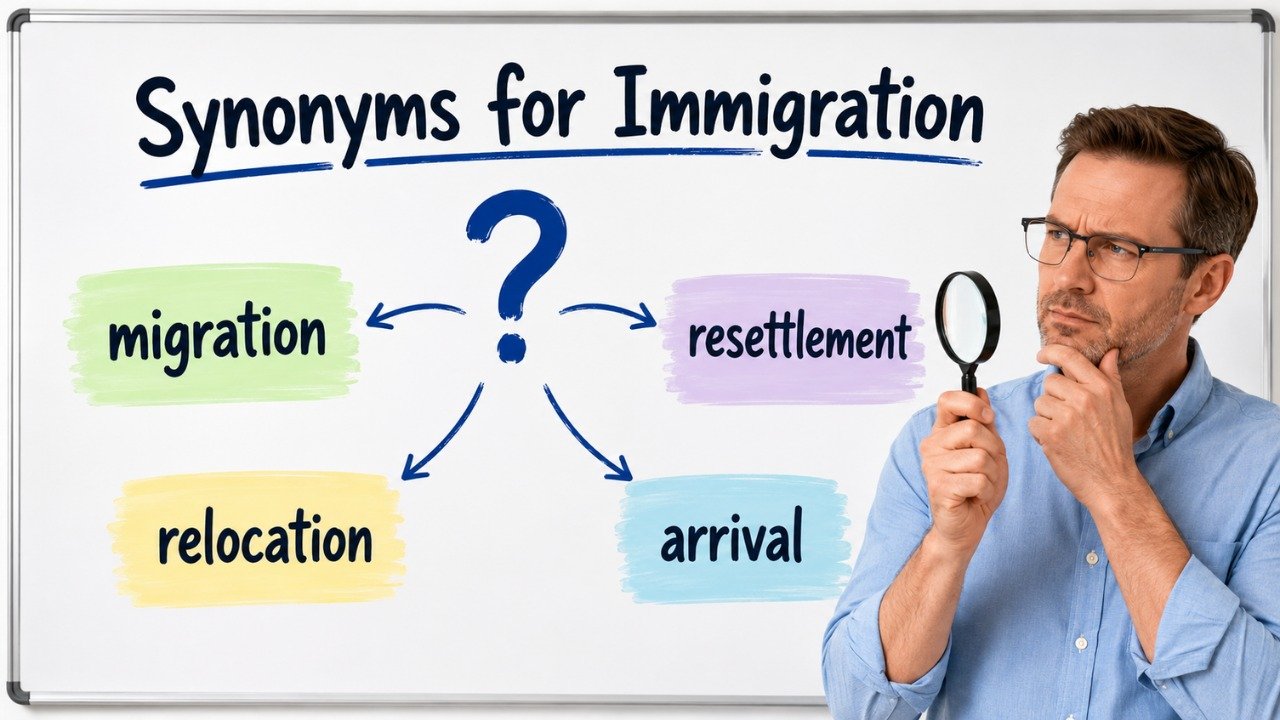
Quick Answer: The best synonyms for immigration include migration, inward migration, international migration, relocation, resettlement, settlement, cross border movement, population inflow, entry, and admission. Use migration as the broadest general alternative, international migration in academic writing, and relocation in everyday discussion about moving. Resettlement is best when people establish a new home, while population inflow suits demographic reports. Entry and admission are more appropriate when discussing official permission or the process of entering a country.
Pronunciation and Word Details
Word: Immigration.
Pronunciation: /ˌɪm.ɪˈɡreɪ.ʃən/.
Part of Speech: Noun.
Meaning: The process of entering another country in order to live there temporarily or permanently.
US Pronunciation:
UK Pronunciation:
What Does “Immigration” Mean?
“Immigration” means the movement of people into a country where they intend to live.
It is a noun that describes the process of arriving in a foreign country for residence, work, education, family life, safety, or other long term purposes. The related verb is “immigrate,” while a person who immigrates is called an “immigrant.”
The word focuses on movement from the viewpoint of the destination country. For example, when people move into a country, that country experiences immigration. From the viewpoint of the country they leave, the same movement is called emigration.
Immigration can describe an individual experience, a social pattern, an official process, or a subject of public policy.
Individual Context: A person may discuss immigration when describing a move to another country.
Family Context: Families may experience immigration when they establish a home in a new nation.
Legal Context: The word may refer to entry requirements, residence permission, applications, and official procedures.
Economic Context: Immigration may be discussed in relation to employment, labor, business, skills, and population change.
Academic Context: Researchers may study immigration patterns, causes, effects, and historical developments.
Demographic Context: The term can describe an increase in population caused by people arriving from other countries.
In a sentence, immigration usually functions as an uncountable noun.
Example: Immigration has influenced the city’s culture and population.
It can also modify another noun.
Example: The family completed the immigration process before moving.
Meaning, Tone, and Context of “Immigration”
“Immigration” usually has a neutral, formal, and factual tone. However, its emotional meaning may change depending on the context.
In academic writing, the word is analytical and commonly appears in discussions of history, population, economics, geography, and society. In legal writing, it has a more technical meaning connected with entry, residence, documentation, and official status.
In personal conversation, immigration may carry feelings of hope, uncertainty, sacrifice, belonging, opportunity, or separation. A person discussing an immigration experience may be describing a major life change rather than only a physical move.
Formal Tone: Immigration is appropriate in reports, essays, official documents, and research.
Neutral Tone: The word can describe movement into a country without expressing approval or criticism.
Technical Tone: In legal and administrative contexts, immigration refers to regulated entry and residence procedures.
Academic Tone: Scholars use the word when analyzing population movement and social change.
Personal Tone: Individuals may use immigration when discussing family history, identity, adjustment, or a new beginning.
Emotional Tone: The word may suggest hope, difficulty, reunion, uncertainty, or cultural adaptation depending on the situation.
Conversational Tone: In casual speech, people often use simpler phrases such as moving abroad, moving to another country, or starting a life in a new country.
Because immigration can be a sensitive subject, clear and respectful language is important. Writers should avoid using broad labels when a more precise term such as relocation, asylum, resettlement, migration, or naturalization is needed.
When and How to Use “Immigration”
Use “immigration” when referring specifically to people entering a country to live there.
For Movement Into a Country
Explanation: Use immigration when the destination country is the main viewpoint.
Example: Immigration increased as more families moved into the country for work.
For Personal Relocation
Explanation: Use the word when someone moves from one country to another for residence.
Example: Her immigration experience began when she accepted a job overseas.
For Family Settlement
Explanation: Immigration can describe a family establishing a new home in another country.
Example: The family prepared carefully for immigration and permanent settlement.
For Official Procedures
Explanation: Use immigration when discussing applications, permission, interviews, records, or residence requirements.
Example: He gathered the documents needed for the immigration process.
For Academic Analysis
Explanation: Immigration is suitable for essays and research about population, history, culture, labor, or geography.
Example: The essay examines immigration during a period of industrial growth.
For Population Change
Explanation: Use immigration when discussing the arrival of people as part of demographic growth.
Example: Immigration contributed to the region’s population increase.
For Social and Cultural Discussion
Explanation: Immigration can describe how newcomers influence language, food, communities, traditions, and cultural exchange.
Example: Immigration brought new cultural traditions to the growing city.
For Historical Context
Explanation: Use the term when describing past movements of people into a country.
Example: The museum presents stories of immigration from several historical periods.
For Employment and Education
Explanation: Immigration may describe international movement motivated by work, study, or professional opportunity.
Example: Employment was the main reason for his immigration to the new country.
For Long Term Residence
Explanation: Use immigration when the person intends to remain in the destination country for a significant period.
Example: Their immigration plans included finding housing and establishing permanent residence.
Best Synonyms for Immigration
Migration
Synonym: The movement of people from one place, region, or country to another.
Example: International migration has shaped the population of many cities.
Inward Migration
Synonym: The movement of people into a particular country or region.
Example: The report measured inward migration over a ten year period.
International Migration
Synonym: The movement of people between different countries.
Example: The research focuses on international migration and employment.
Relocation
Synonym: The act of moving to a different place to live or work.
Example: The family planned its relocation several months in advance.
Resettlement
Synonym: The process of establishing a new home in another place.
Example: Community support helped with the family’s resettlement.
Settlement
Synonym: The act of establishing residence in a new area or country.
Example: Their settlement in the new country took time and careful preparation.
Cross Border Movement
Synonym: The movement of people from one country across a national border into another.
Example: The study examined cross border movement for work and education.
Population Inflow
Synonym: An increase in population caused by people entering a country or region.
Example: The city experienced a steady population inflow.
Entry
Synonym: The act of entering a country, especially through an official process.
Example: The applicant received permission for entry into the country.
Admission
Synonym: Official permission to enter and remain in a country.
Example: Admission was granted after the application was reviewed.
50 Synonyms for Immigration with Short Meanings
- Migration: The movement of people from one location to another.
- Inward Migration: Movement into a particular country or region.
- International Migration: Movement between two or more countries.
- Cross Border Migration: Movement from one country across a national border.
- Overseas Migration: Movement to a country located across the sea.
- Human Migration: The movement of people between places.
- Population Movement: The movement of groups from one area to another.
- Population Mobility: The ability or tendency of people to change locations.
- Geographic Mobility: Movement between different geographic areas.
- International Mobility: Movement between countries for residence, work, or study.
- Relocation: The act of moving to another place.
- International Relocation: Moving from one country to another.
- Overseas Relocation: Moving to a country abroad.
- Cross Border Relocation: Establishing a home across a national border.
- Permanent Relocation: Moving with the intention of remaining long term.
- Long Term Relocation: Moving to another place for an extended period.
- Resettlement: Establishing a new home after moving.
- International Resettlement: Establishing residence in another country.
- Overseas Resettlement: Beginning a new life in a country abroad.
- Permanent Resettlement: Establishing a lasting home in a new country.
- Settlement: The act of making a new place one’s home.
- Foreign Settlement: Establishing residence in a foreign country.
- Overseas Settlement: Making a permanent or long term home abroad.
- Permanent Settlement: Establishing a home with the intention of staying.
- Settlement Abroad: Beginning residence in another country.
- Settlement in a New Country: Establishing a home outside one’s country of origin.
- Entry: The act of entering a country.
- International Entry: Entry into a country from abroad.
- Entry Into a Country: The act of crossing into another nation.
- Entry for Residence: Entering a country with the intention of living there.
- Arrival: The act of reaching a new country or destination.
- International Arrival: Arrival from another country.
- Migrant Arrival: The arrival of a person moving between countries or regions.
- Newcomer Arrival: The arrival of someone who intends to join a new community.
- Arrival From Abroad: Entry into a country from a foreign location.
- Admission: Official permission to enter a country.
- Admission for Residence: Permission to enter for the purpose of living in a country.
- Admission Into a Country: Formal acceptance for entry into a nation.
- Population Inflow: The arrival of people that increases a population.
- Migrant Inflow: The movement of migrants into a place.
- Newcomer Inflow: The arrival of new residents into a country or region.
- Inward Population Movement: Movement of people toward and into a location.
- Movement Into a Country: Travel into a nation for residence.
- Movement Across Borders: Travel from one country into another.
- Transfer of Residence: Changing one’s official or usual place of residence.
- Change of Country of Residence: Moving one’s home from one country to another.
- Establishment Abroad: Creating a home or life in another country.
- Permanent Move Abroad: Moving to another country with long term intentions.
- Relocation to Another Country: Moving one’s residence across national borders.
- Movement of People Into a Nation: The arrival of individuals or groups from abroad.
Read Also:
Synonyms for Surround

Synonyms for Immigration by Context
When Immigration Means Movement Into a Country
Use these alternatives when the main idea is physical movement across a national border.
Inward Migration: Focuses specifically on movement into a place.
Example: Inward migration increased the region’s working age population.
Cross Border Migration: Emphasizes crossing an international boundary.
Example: Cross border migration became easier after transportation improved.
International Migration: Describes movement between countries.
Example: International migration is the main subject of the research paper.
Movement Into a Country: Provides a plain and direct explanation.
Example: The chart shows movement into the country over several decades.
When Immigration Means Moving to Live Abroad
These expressions are useful when describing an individual or family changing residence.
International Relocation: A formal term for moving to another country.
Example: The company assisted the worker with international relocation.
Overseas Relocation: Best when the destination is abroad, particularly across the sea.
Example: The family viewed overseas relocation as a major new beginning.
Permanent Move Abroad: Clearly communicates an intention to remain.
Example: They prepared for a permanent move abroad after retirement.
Change of Country of Residence: A precise phrase for official or administrative writing.
Example: The form requested the date of the applicant’s change of country of residence.
When Immigration Means Establishing a New Home
Use these alternatives when the focus is adjustment, housing, community, or long term residence.
Resettlement: Emphasizes establishing life in a new place.
Example: Language classes supported the newcomers during resettlement.
Permanent Settlement: Focuses on lasting residence.
Example: The couple chose the city for permanent settlement.
Settlement Abroad: Describes building a life in another country.
Example: Settlement abroad required careful financial planning.
Establishment Abroad: Refers to creating a stable home or professional life overseas.
Example: Her establishment abroad became easier after she found permanent housing.
When Immigration Means Official Entry
These terms are useful in legal, administrative, or procedural contexts.
Entry: Focuses on entering a country.
Example: The traveler presented the documents required for entry.
Admission: Refers to official permission to enter.
Example: Admission was approved after all requirements were satisfied.
Entry for Residence: Indicates that the purpose of entry is to live in the country.
Example: The permit allowed entry for residence and employment.
Admission Into a Country: A formal phrase for approval to enter.
Example: The application concerned admission into the country for family reasons.
When Immigration Means Population Increase
Use these terms in demographic, economic, and academic writing.
Population Inflow: Emphasizes the increase caused by arriving residents.
Example: The region’s population inflow created demand for additional housing.
Migrant Inflow: Refers to migrants arriving within a particular period.
Example: The report recorded a gradual migrant inflow.
Newcomer Inflow: Focuses on newly arriving residents.
Example: The town prepared public services for a larger newcomer inflow.
Inward Population Movement: A formal demographic expression.
Example: Inward population movement affected the area’s age distribution.
When Immigration Means General Human Movement
These alternatives are broader than immigration and should be used when movement is not limited to entry into one country.
Migration: May include immigration, emigration, internal movement, or temporary travel.
Example: Migration can occur within a country or between countries.
Human Migration: A broad academic term for the movement of people.
Example: Human migration has occurred throughout history.
Population Movement: Refers to the movement of groups rather than one individual.
Example: Conflict, employment, and environmental change may influence population movement.
Geographic Mobility: Describes people’s ability or willingness to move between places.
Example: Better transportation increased geographic mobility.
Another Word for Immigration
“Migration” is the best general alternative to “immigration,” but the two words are not always completely interchangeable. Immigration refers specifically to entering a country, while migration can describe movement into, out of, or within a country.
Use “international migration” when writing broadly about movement between nations. Choose “relocation” for an individual or family move, “resettlement” for establishing a new home, and “population inflow” for demographic analysis.
Original: Immigration changed the population of the coastal region.
Better Option: Inward migration changed the population of the coastal region.
Original: The family began planning its immigration two years ago.
Better Option: The family began planning its international relocation two years ago.
Original: Local organizations helped families after immigration.
Better Option: Local organizations helped families during resettlement.
Original: The report measures immigration into major cities.
Better Option: The report measures population inflow into major cities.
When Not to Use “Immigration”
Do not use “immigration” when another word describes the movement more accurately.
When People Are Leaving a Country
Immigration describes entering a country. Emigration describes leaving one.
Weak: The country experienced immigration as thousands of residents moved overseas.
Better: The country experienced emigration as thousands of residents moved overseas.
When the Move Is Within One Country
A move between cities or regions within the same nation is internal migration or relocation, not immigration.
Weak: Her immigration from the northern city to the southern city took place in June.
Better: Her relocation from the northern city to the southern city took place in June.
When the Person Is Only Traveling
Short visits for tourism or business are not normally described as immigration.
Weak: His immigration lasted for a two week holiday.
Better: His international visit lasted for two weeks.
When Discussing Citizenship
Immigration and citizenship are connected, but they are not the same process.
Weak: She completed immigration and became a citizen during the ceremony.
Better: She completed the naturalization process and became a citizen during the ceremony.
When Discussing a Request for Protection
Asylum is a specific request for protection. Immigration is a broader term.
Weak: The family submitted an immigration request because they feared returning home.
Better: The family submitted an asylum request because they feared returning home.
When the Focus Is Adjustment After Arrival
Use resettlement or integration when discussing housing, language, education, employment, and community adjustment.
Weak: The organization provided immigration support after the family had already arrived.
Better: The organization provided resettlement support after the family arrived.
When the Word Becomes Repetitive
Repeated use of immigration can make a paragraph sound heavy or vague.
Weak: Immigration affected the city, and immigration also increased housing demand because immigration brought new residents.
Better: Immigration affected the city, while the arrival of new residents also increased housing demand.
Words Commonly Confused With Immigration
Immigration vs Migration: Immigration specifically means movement into a country. Migration is broader and may refer to movement into, out of, or within a country.
Immigration vs Emigration: Immigration is entering a country to live there. Emigration is leaving one country to settle elsewhere.
Immigration vs Relocation: Immigration always involves entry into another country. Relocation can occur internationally or within the same country.
Immigration vs Resettlement: Immigration focuses on entering a country. Resettlement focuses on establishing a home and adjusting after moving.
Immigration vs Asylum: Immigration is a broad process of moving into another country. Asylum is a request for protection based on a fear of returning to one’s country.
Immigration vs Naturalization: Immigration concerns entering and residing in a country. Naturalization is the process through which an eligible noncitizen may become a citizen.
Immigration vs Citizenship: Immigration describes movement and residence. Citizenship describes legal membership in a country.
Immigration vs Integration: Immigration is the act or process of entering a country. Integration is the longer process of participating in the social, economic, and cultural life of the new society.
Immigration vs Entry: Entry describes crossing into a country. Immigration usually includes the intention to live there rather than simply visit.
Immigration vs Population Inflow: Immigration refers to people entering a country to live. Population inflow is a broader statistical term that may describe arrivals into a country, city, or region.
Which Synonym Should You Choose?
Choose “migration” when discussing human movement in a broad or general way.
Choose “inward migration” when you need to emphasize movement into a country or region.
Choose “international migration” for essays, research papers, academic discussions, and reports about movement between countries.
Choose “relocation” when describing an individual, employee, couple, or family moving to another place.
Choose “international relocation” when the move crosses a national border and the writing requires a professional or formal tone.
Choose “resettlement” when discussing the establishment of a new home and adjustment after arrival.
Choose “settlement” when emphasizing permanent residence or the creation of a new community.
Choose “entry” when discussing the act of entering a country.
Choose “admission” when referring to official approval or legal permission to enter.
Choose “population inflow” for statistics, demographic reports, planning documents, and economic analysis.
Choose “migrant inflow” when discussing the number or rate of migrants entering a place.
Choose “cross border movement” when emphasizing the crossing of national boundaries.
Choose “moving to another country” in casual conversation because it sounds direct and natural.
Choose “permanent move abroad” when the speaker wants to make the long term intention clear.
Choose “change of country of residence” for forms, records, administrative documents, or precise official explanations.
Real Life Examples of “Immigration” in Sentences
Academic Writing
Original: Immigration influenced the development of the industrial city.
Better Option: International migration influenced the development of the industrial city.
Family Relocation
Original: The family prepared for immigration by saving money and studying the local language.
Better Option: The family prepared for international relocation by saving money and studying the local language.
Population Research
Original: Immigration caused the urban population to grow.
Better Option: Population inflow caused the urban population to grow.
Official Entry
Original: Her immigration was approved after the application was reviewed.
Better Option: Her admission was approved after the application was reviewed.
Community Support
Original: The center helps families with immigration after they arrive.
Better Option: The center helps families with resettlement after they arrive.
Historical Discussion
Original: Immigration transformed the region during the nineteenth century.
Better Option: Inward migration transformed the region during the nineteenth century.
Workplace Context
Original: His immigration was connected with a new employment opportunity.
Better Option: His international relocation was connected with a new employment opportunity.
Long Term Residence
Original: The couple viewed immigration as a permanent life decision.
Better Option: The couple viewed settlement abroad as a permanent life decision.
Demographic Report
Original: Immigration was higher in cities with expanding employment markets.
Better Option: Migrant inflow was higher in cities with expanding employment markets.
Everyday Conversation
Original: They are considering immigration next year.
Better Option: They are considering moving to another country next year.
Synonym Groups and Usage Differences
General Movement Group
This group includes migration, human migration, population movement, geographic mobility, and international mobility.
These terms describe movement broadly. They may include immigration, emigration, internal migration, temporary movement, or repeated movement.
Example: Human migration may occur for economic, family, educational, or environmental reasons.
Movement Into a Country Group
This group includes inward migration, international entry, movement into a country, cross border migration, and inward population movement.
These alternatives emphasize direction toward the destination.
Example: Inward migration increased as employment opportunities expanded.
Personal Move Group
This group includes relocation, international relocation, overseas relocation, permanent relocation, and change of country of residence.
These terms work well when the subject is a person, family, employee, or household.
Example: The employee received financial assistance for international relocation.
Settlement Group
This group includes settlement, resettlement, permanent settlement, settlement abroad, and establishment abroad.
These words emphasize creating a home and beginning life in a new place.
Example: Permanent settlement required the family to find housing, work, and schools.
Official Entry Group
This group includes entry, admission, entry for residence, admission for residence, and international entry.
These terms focus on permission, procedure, or the act of crossing into the country.
Example: Admission for residence was granted after the required checks were completed.
Demographic Group
This group includes population inflow, migrant inflow, newcomer inflow, and inward population movement.
These alternatives are useful in reports, statistics, planning, and population studies.
Example: Population inflow increased demand for public transportation.
Casual Language Group
This group includes moving abroad, moving to another country, starting a life abroad, and making a permanent move overseas.
These phrases are easier to understand in everyday conversation than formal terms such as international migration.
Example: The couple is thinking about moving to another country for work.
Antonyms of Immigration
The clearest opposite of immigration is emigration because immigration describes entering a country, while emigration describes leaving one.
Emigration: The process of leaving one country to live in another.
Outward Migration: Movement away from a country or region.
Outmigration: The movement of people out of a particular location.
Departure: The act of leaving a place or country.
Exit: The act of going out of a country.
Population Outflow: A decrease caused by people leaving a location.
Migrant Outflow: The movement of migrants away from a country or region.
Return Migration: Movement back to a person’s original country or place of residence.
Repatriation: The process of returning a person to their country of origin.
Permanent Departure: Leaving a country without intending to return for residence.
Relocation Outward: Moving away from a country or region to establish residence elsewhere.
Remaining in One’s Home Country: Choosing not to move internationally.
Not every term is a direct grammatical antonym. The most accurate choice depends on whether the contrast involves entering, leaving, returning, or remaining.
Comparison: Immigration vs Related Words
Immigration vs Migration
Immigration refers specifically to entering a foreign country to live there. Migration is a broader word that describes movement between locations.
Example With Immigration: Immigration increased as more workers entered the country.
Example With Migration: Migration occurred both within the country and across its borders.
Immigration vs Emigration
Immigration is viewed from the destination country. Emigration is viewed from the country of departure.
Example With Immigration: Her arrival was recorded as immigration into the destination country.
Example With Emigration: Her departure was recorded as emigration from her home country.
Immigration vs Relocation
Immigration always involves movement into another country. Relocation can describe any move, including one within the same city.
Example With Immigration: The family completed the immigration process before entering the country.
Example With Relocation: The family completed its relocation from one neighborhood to another.
Immigration vs Resettlement
Immigration focuses on entering a country. Resettlement focuses on establishing a new home and adjusting after arrival.
Example With Immigration: Immigration brought the family into a new country.
Example With Resettlement: Resettlement helped the family establish a stable life after arrival.
Immigration vs Asylum
Immigration is a broad term covering many reasons for moving. Asylum refers specifically to a request for protection.
Example With Immigration: Employment was the reason for her immigration.
Example With Asylum: The applicant requested asylum because returning home was considered unsafe.
Immigration vs Naturalization
Immigration involves entering and residing in a country. Naturalization concerns becoming a citizen after meeting the required conditions.
Example With Immigration: His immigration journey began when he received residence permission.
Example With Naturalization: His naturalization process ended when he became a citizen.
Immigration vs Integration
Immigration describes entry and movement. Integration describes participation and adjustment within the new society.
Example With Immigration: Immigration brought new residents to the city.
Example With Integration: Integration helped newcomers participate in education, employment, and community life.
Immigration vs Population Inflow
Immigration refers to people entering another country to live. Population inflow is a statistical expression that may apply to countries, cities, or smaller regions.
Example With Immigration: Immigration increased during the decade.
Example With Population Inflow: Population inflow increased demand for housing in the city center.
Common Phrases and Expressions With Immigration
Immigration Process: The steps involved in applying for entry or residence.
Immigration Policy: A set of principles or plans governing entry and residence.
Immigration Law: The body of rules related to entering, living in, or leaving a country.
Immigration System: The institutions and procedures used to manage entry and residence.
Immigration Status: A person’s official position under the rules governing residence.
Immigration Application: A formal request connected with entry, residence, or permission to remain.
Immigration Documents: Records required for an immigration procedure.
Immigration Services: Assistance related to applications, residence, settlement, or official procedures.
Immigration Control: The regulation of entry into a country.
Immigration Trends: Patterns showing how immigration changes over time.
Immigration History: The study or record of people entering a country over time.
Immigration Experience: A person’s personal journey of moving to and living in another country.
Common Mistakes to Avoid
Confusing Immigration and Emigration
The most common mistake is using immigration when the sentence is about leaving a country.
Incorrect: His immigration from his home country reduced its population.
Correct: His emigration from his home country reduced its population.
Using Immigration for Movement Within One Country
Immigration requires movement into another country.
Incorrect: Her immigration from one province to another took three days.
Correct: Her relocation from one province to another took three days.
Using Immigration for Short Visits
Tourism, short business travel, and brief study visits are not automatically immigration.
Incorrect: Our immigration to the country lasted one week.
Correct: Our visit to the country lasted one week.
Confusing the Noun and Verb Forms
“Immigration” is a noun. “Immigrate” is a verb. “Immigrant” refers to a person.
Incorrect: They immigration to another country last year.
Correct: They immigrated to another country last year.
Incorrect: She is an immigration.
Correct: She is an immigrant.
Treating Immigration as a Countable Noun
“Immigration” is generally uncountable when referring to the overall process.
Unnatural: The country experienced many immigrations.
Natural: The country experienced several periods of immigration.
Using Migration as an Exact Replacement Every Time
Migration is broader than immigration. It may include internal movement or movement out of a country.
Vague: Migration into the country increased.
Precise: Immigration into the country increased.
Using Relocation Without Clarifying the Destination
Relocation does not necessarily involve another country.
Vague: The family completed its relocation.
Clearer: The family completed its international relocation.
Confusing Immigration With Citizenship
A person may immigrate without becoming a citizen.
Incorrect: Immigration means officially becoming a citizen.
Correct: Immigration means entering another country to live, while citizenship concerns legal membership in that country.
Using Vague Language About People
Avoid describing people only as an inflow, burden, wave, or number when discussing personal experiences. Statistical language may be useful in reports, but people centered writing should remain respectful.
Vague: The inflow created new neighborhoods.
Clearer: Newly arrived residents established communities and contributed to neighborhood growth.
Repeating Immigration Too Frequently
Use precise alternatives where appropriate, but do not replace the word with a weaker term merely to avoid repetition.
Repetitive: Immigration affected housing because immigration increased the population, and immigration also changed employment patterns.
Improved: Immigration affected housing because population growth increased demand, while international migration also changed employment patterns.
Conclusion
Synonyms for immigration include migration, inward migration, relocation, resettlement, settlement, entry, admission, and population inflow. Choose international migration for academic writing, relocation for a personal move, and resettlement when the focus is building a new life. Entry and admission suit official procedures, while population inflow works well in demographic reports. Because immigration specifically describes movement into a country, writers should not confuse it with emigration, internal relocation, citizenship, asylum, or naturalization.
FAQs About Synonyms for Immigration
What Is the Best Synonym for Immigration?
“Migration” is the broadest synonym, but “inward migration” is more precise because it clearly describes movement into a country.
Is Migration the Same as Immigration?
Not exactly. Migration is any movement between locations, while immigration specifically means entering another country to live.
What Is a Formal Word for Immigration?
“International migration,” “inward migration,” and “cross border migration” are suitable formal alternatives for reports and academic writing.
What Is a Simple Way to Say Immigration?
A simple alternative is “moving to another country” or “moving abroad to live.”
What Is the Difference Between Immigration and Emigration?
Immigration means entering a country. Emigration means leaving a country to live somewhere else.
Can Relocation Be Used Instead of Immigration?
Relocation can replace immigration when describing a move, but it does not automatically mean that a national border was crossed.
What Word Describes Settling in a New Country?
“Resettlement,” “settlement abroad,” and “international relocation” describe the process of establishing a home in a new country.
