
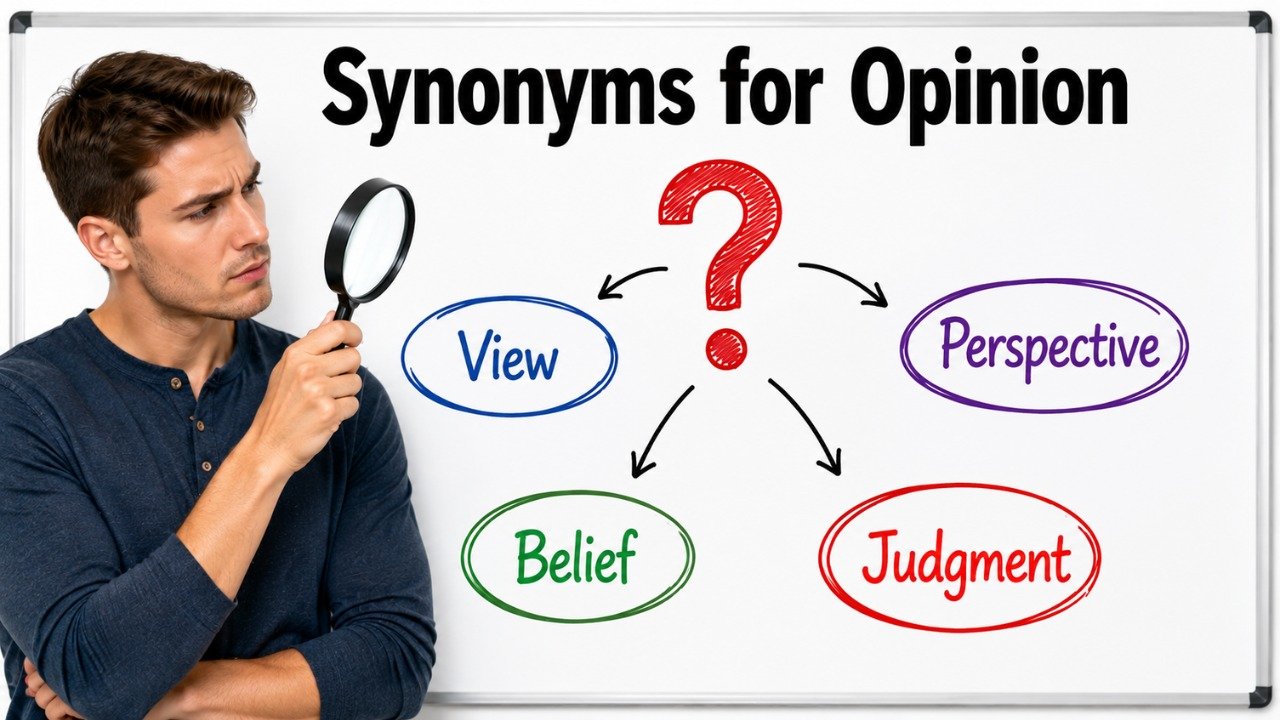
Quick Answer: The best synonyms for opinion include view, viewpoint, perspective, belief, judgment, stance, position, impression, assessment, and conviction. View is the most natural general alternative, while viewpoint describes how someone sees an issue. Perspective is useful when experience shapes an opinion. Judgment and assessment suit formal or professional writing. Stance and position express a clear public belief. Impression works for an early reaction, while conviction describes a strongly held belief. The best choice among the synonyms for opinion depends on context, certainty, formality, and purpose.
Pronunciation and Word Details
Word: Opinion.
Pronunciation: /əˈpɪnjən/
Part of Speech: Noun.
Meaning: A belief, judgment, or personal view about someone or something.
US Pronunciation:
UK Pronunciation:
What Does “Opinion” Mean?
Opinion means a belief, judgment, or view that a person forms about a subject. It may be based on experience, knowledge, feelings, interpretation, or personal preference.
Opinion is a countable noun. A person can have one opinion or several opinions.
Example: She expressed an opinion about the proposed changes.
An opinion is not always a proven fact. It explains what someone thinks rather than what can necessarily be demonstrated as objectively true.
Example: In my opinion, the second design is more attractive.
The word can also describe a professional conclusion based on knowledge and experience.
Example: The consultant offered an expert opinion on the situation.
Opinion may refer to a personal belief, public attitude, formal judgment, early impression, or professional assessment. Its exact meaning depends on the sentence.
Personal View: He shared his opinion about the film.
Public Attitude: Public opinion changed after the announcement.
Professional Judgment: The engineer gave an opinion about the condition of the structure.
Preference: Her opinion was that the blue curtains suited the room better.
Meaning, Tone, and Context of “Opinion”
Opinion is generally a neutral word. It can appear in casual conversation, formal writing, essays, reports, debates, reviews, meetings, surveys, and professional discussions.
In casual speech, opinion usually means what someone personally thinks or prefers.
Example: What is your opinion of the new menu?
In academic writing, opinion may refer to a claim or interpretation that needs evidence and reasoning.
Example: The writer supports her opinion with clear examples.
In professional contexts, an opinion may be a considered judgment based on expertise.
Example: The accountant provided a formal opinion after reviewing the records.
In public discussion, opinion can describe a clear stance on a social, political, ethical, or practical matter.
Example: Public opinion remains divided on the proposal.
The word can sound polite when used to invite another person’s thoughts.
Example: I would value your opinion on this plan.
It can also sound dismissive when someone treats another person’s statement as merely personal.
Example: That is only your opinion.
The tone therefore depends on the surrounding words. Opinion can be respectful, neutral, uncertain, strong, personal, analytical, or critical.
When and How to Use “Opinion”
For a Personal View
Use opinion when describing what someone thinks about a subject.
Example: My opinion is that the room needs more natural light.
For a Preference
Use opinion when someone favors one option over another.
Example: In her opinion, the smaller table fits the space better.
For a Professional Judgment
Use opinion when an experienced person reaches a conclusion within an area of expertise.
Example: The architect gave a professional opinion about the renovation plan.
For an Academic Argument
Use opinion when presenting an interpretation that must be supported with reasoning or evidence.
Example: The student explained her opinion and supported it with examples from the text.
For Public Attitudes
Use opinion when describing what many people think about an issue.
Example: Public opinion became more favorable over time.
For an Initial Reaction
Use opinion when someone forms a judgment after seeing or experiencing something.
Example: His opinion of the restaurant improved after the second visit.
For Advice and Feedback
Use opinion when politely asking someone to evaluate an idea, plan, design, or decision.
Example: Could you give me your opinion on this proposal?
For Agreement or Disagreement
Use opinion when acknowledging that people may think differently.
Example: We have different opinions about the best solution.
For a Strong Belief
Use opinion when a person holds a clear and confident view.
Example: She defended her opinion during the discussion.
For a Formal Conclusion
Use opinion when a report or professional statement presents a reasoned judgment.
Example: The final opinion was based on the available records and observations.
Best Synonyms for Opinion
View
Synonym: View.
Meaning: A personal idea or belief about a subject.
Example: She explained her view of the proposed changes.
Viewpoint
Synonym: Viewpoint.
Meaning: A particular way of thinking about or understanding something.
Example: The discussion included viewpoints from several community members.
Perspective
Synonym: Perspective.
Meaning: A way of seeing an issue shaped by experience, knowledge, or position.
Example: His experience gave him a different perspective on the problem.
Belief
Synonym: Belief.
Meaning: An idea that someone accepts as true or right.
Example: She expressed her belief that patience leads to better decisions.
Judgment
Synonym: Judgment.
Meaning: A considered conclusion formed after examining information.
Example: The final judgment was based on years of experience.
Stance
Synonym: Stance.
Meaning: A clearly stated position on an issue.
Example: The committee clarified its stance on the proposal.
Position
Synonym: Position.
Meaning: A formal or firmly held opinion about a subject.
Example: He explained his position during the meeting.
Impression
Synonym: Impression.
Meaning: An opinion or feeling formed from an early experience.
Example: My first impression of the neighborhood was positive.
Assessment
Synonym: Assessment.
Meaning: A judgment formed after careful examination.
Example: Her assessment of the project was realistic and detailed.
Conviction
Synonym: Conviction.
Meaning: A strong and firmly held belief.
Example: He spoke with conviction about the importance of fairness.
50 Synonyms for Opinion with Short Meanings
- View: A personal belief or idea about something.
- Viewpoint: A particular way of considering an issue.
- Perspective: A way of seeing something shaped by experience.
- Belief: An idea accepted as true or correct.
- Judgment: A conclusion formed after careful thought.
- Stance: A clearly expressed position on an issue.
- Position: A settled or formal opinion.
- Impression: A belief or feeling formed from experience.
- Assessment: A judgment made after examination.
- Conviction: A strong and firmly held belief.
- Idea: A thought about what may be true or suitable.
- Thought: Something a person thinks about a subject.
- Outlook: A general attitude toward life or a situation.
- Attitude: A settled way of thinking or feeling.
- Interpretation: A personal explanation of meaning.
- Conclusion: A judgment reached after considering information.
- Evaluation: A judgment about quality, value, or effectiveness.
- Estimation: A considered opinion about value or importance.
- Appraisal: A careful judgment of quality or condition.
- Perception: The way someone understands or notices something.
- Sentiment: A feeling or attitude about a subject.
- Feeling: A personal belief that may be partly emotional.
- Notion: An idea or belief, sometimes formed without strong evidence.
- Theory: An explanation or idea about why something happens.
- Assumption: A belief accepted without complete proof.
- Supposition: An idea considered possible but not certain.
- Inference: A conclusion drawn from available information.
- Take: An informal opinion or interpretation.
- Standpoint: A position from which someone considers an issue.
- Angle: A particular way of approaching or viewing a subject.
- Point of View: A personal position or way of understanding something.
- Frame of Mind: A person’s current attitude or mental outlook.
- School of Thought: A shared set of beliefs about a subject.
- Line of Thought: A connected way of reasoning about something.
- Way of Thinking: A person’s usual approach to ideas or issues.
- Verdict: A final judgment or conclusion.
- Ruling: An official decision or judgment.
- Decision: A conclusion reached after considering choices.
- Determination: A firm conclusion made after examination.
- Finding: A conclusion reached through study or investigation.
- Recommendation: An opinion about the best action to take.
- Advice: Guidance based on someone’s judgment or experience.
- Counsel: Formal advice or considered guidance.
- Commentary: An expression of views or observations about a subject.
- Critique: A detailed judgment of strengths and weaknesses.
- Analysis: A careful examination that may lead to a judgment.
- Observation: A comment or judgment based on what someone notices.
- Reaction: An immediate feeling or opinion about something.
- Preference: A stronger liking for one option than another.
- Persuasion: A belief, opinion, or way of thinking held by a person.
Read Also:
Synonyms for Reality
Synonyms for Opinion by Context
When Opinion Means a Personal View
View, viewpoint, point of view, take, thought, and idea describe what a person thinks about a subject.
View is the strongest general replacement because it sounds natural in both formal and casual contexts.
Example: She shared her view of the new schedule.
Take is more conversational and often introduces a personal interpretation.
Example: His take on the situation was surprisingly positive.
Point of view emphasizes the position from which someone understands an issue.
Example: Try to consider the problem from her point of view.
When Opinion Means a Way of Seeing Something
Perspective, standpoint, angle, outlook, and perception describe how someone understands a subject.
Perspective often reflects personal experience, background, or circumstances.
Example: Working with children changed her perspective on education.
Standpoint emphasizes the position from which an issue is considered.
Example: From a financial standpoint, the plan appears practical.
Angle is useful when discussing one particular side of a complex subject.
Example: The article examines the issue from a historical angle.
When Opinion Means a Strong Belief
Belief, conviction, position, stance, and persuasion describe ideas that someone holds with confidence.
Conviction suggests a deeply held belief.
Example: She expressed her conviction that every person deserves respect.
Stance is often used for a clear public or official position.
Example: The group maintained a firm stance on safety.
Position is suitable for formal discussions, reports, and debates.
Example: He clearly stated his position on the proposed policy.
When Opinion Means a Professional Judgment
Judgment, assessment, evaluation, appraisal, estimation, and analysis suit professional or formal contexts.
Assessment is useful when someone examines a situation before reaching a conclusion.
Example: The manager’s assessment identified several practical risks.
Evaluation often involves judging quality, performance, or value.
Example: The final evaluation showed that the program was effective.
Appraisal commonly describes a careful judgment of condition, worth, or quality.
Example: The property appraisal provided an estimate of its value.
When Opinion Means an Early Impression
Impression, reaction, feeling, perception, and observation describe a judgment formed through experience or immediate response.
Impression is especially useful for an early or incomplete opinion.
Example: My first impression of the candidate was favorable.
Reaction emphasizes an immediate emotional or mental response.
Example: Her initial reaction to the plan was cautious.
Feeling can express an opinion based more on instinct than evidence.
Example: I have a feeling that the second approach will work better.
When Opinion Means an Interpretation
Interpretation, conclusion, inference, theory, notion, assumption, and supposition describe attempts to explain information or events.
Interpretation explains how someone understands meaning.
Example: Her interpretation of the poem focused on loss and memory.
Inference is a conclusion drawn from evidence or clues.
Example: That inference is reasonable based on the available information.
Assumption describes something accepted without complete proof.
Example: The plan was based on the assumption that demand would increase.
When Opinion Means Advice
Advice, recommendation, counsel, judgment, and guidance can replace opinion when someone suggests what another person should do.
Recommendation is best when proposing a specific action.
Example: My recommendation is to review the contract carefully.
Advice is more general and conversational.
Example: She asked for advice about choosing a course.
Counsel is more formal and often suggests thoughtful guidance.
Example: He sought counsel from an experienced colleague.
When Opinion Means a Final Decision
Verdict, decision, determination, finding, ruling, and conclusion describe a settled judgment.
Verdict suggests a final judgment after evidence or arguments have been considered.
Example: The panel delivered its verdict at the end of the review.
Finding is common when a conclusion comes from research, inspection, or investigation.
Example: The main finding was that better communication improved results.
Decision describes a chosen conclusion or course of action.
Example: The final decision will be announced next week.
Another Word for Opinion
View is usually the best single replacement for opinion because it is natural, clear, and suitable for many contexts. However, the strongest alternative depends on whether the sentence refers to a personal belief, professional judgment, early impression, public stance, or strong conviction.
Original: What is your opinion about the proposal?
Better Option: What is your view of the proposal?
Original: The specialist gave an opinion about the damage.
Better Option: The specialist provided an assessment of the damage.
Original: Her opinion changed after hearing the explanation.
Better Option: Her perspective changed after hearing the explanation.
Original: He has a strong opinion about personal responsibility.
Better Option: He has a firm conviction about personal responsibility.
When Not to Use “Opinion”
Opinion is useful, but it may be too general when a more precise word would explain the intended meaning.
When Referring to a Proven Fact
Do not use opinion when the statement is supported by clear and verifiable evidence.
Weak: It is my opinion that water freezes under suitable cold conditions.
Better: It is a fact that water freezes under suitable cold conditions.
When Describing a Professional Examination
Assessment or evaluation may sound more precise when a conclusion follows careful analysis.
Weak: The inspector gave an opinion of the building’s condition.
Better: The inspector provided an assessment of the building’s condition.
When Referring to an Immediate Reaction
Impression may communicate an early or incomplete judgment more accurately.
Weak: My opinion of the office was positive when I entered.
Better: My first impression of the office was positive.
When Expressing a Public Position
Stance or position may be stronger when someone has clearly committed to a side.
Weak: The committee explained its opinion on the issue.
Better: The committee explained its position on the issue.
When Describing a Deep Belief
Conviction may be more effective when a belief is strong and firmly held.
Weak: She has an opinion that honesty is essential.
Better: She has a firm conviction that honesty is essential.
When Giving a Recommendation
Advice or recommendation is clearer when suggesting an action.
Weak: My opinion is that you should review the agreement.
Better: My recommendation is that you review the agreement.
When the Word Becomes Repetitive
Repeating opinion can make writing sound plain or mechanical.
Weak: In my opinion, his opinion is different from the manager’s opinion.
Better: In my view, his position differs from the manager’s assessment.
When the Source of the View Is Unclear
Specify whose opinion is being discussed.
Weak: The opinion was that the proposal needed changes.
Better: The review panel concluded that the proposal needed changes.
Words Commonly Confused With Opinion
Opinion vs Fact: An opinion expresses what someone thinks, while a fact can be verified through reliable evidence.
Opinion vs Belief: An opinion is usually a judgment about a particular subject. A belief may be broader, deeper, and connected to personal values.
Opinion vs View: View is a close general synonym for opinion. It often sounds slightly more concise and natural.
Opinion vs Viewpoint: Opinion is a belief or judgment. Viewpoint is the particular position from which that belief is formed.
Opinion vs Perspective: An opinion is what someone thinks. Perspective is the wider way someone sees an issue because of experience or circumstances.
Opinion vs Judgment: Opinion can be casual or personal. Judgment usually suggests careful consideration, knowledge, or evaluation.
Opinion vs Impression: An opinion may be developed over time. An impression is often formed quickly and may change after further experience.
Opinion vs Assumption: An opinion is a personal judgment. An assumption is something accepted as true without complete evidence.
Opinion vs Advice: An opinion explains what someone thinks. Advice recommends what someone should do.
Opinion vs Evaluation: An opinion may be informal. An evaluation is usually a structured judgment of quality, value, or performance.
Which Synonym Should You Choose?
Choose view for a clear and natural replacement in most everyday sentences.
Choose viewpoint when emphasizing how a person approaches or understands an issue.
Choose perspective when personal experience, background, or circumstances shape the opinion.
Choose belief when describing an idea that someone accepts as true or right.
Choose conviction when the belief is deep, strong, and firmly held.
Choose judgment when someone reaches a conclusion after careful thought.
Choose assessment for professional reports, inspections, reviews, and evaluations.
Choose stance when describing a clear public position on an issue.
Choose position for formal discussions, debates, policies, essays, and professional communication.
Choose impression when discussing an early reaction or first experience.
Choose take in casual conversation when asking for someone’s interpretation.
Choose interpretation when discussing the meaning of language, literature, behavior, or events.
Choose assumption when the idea has not been fully proven.
Choose recommendation when suggesting the best course of action.
Choose verdict when presenting a final judgment after reviewing evidence or arguments.
Choose public sentiment when describing the general feelings of a group or population.
Choose critique when offering a detailed opinion about strengths and weaknesses.
Real Life Examples of “Opinion” in Sentences
Original: I would like your opinion on this design.
Better Option: I would like your view on this design.
Original: Her opinion changed after working with the team.
Better Option: Her perspective changed after working with the team.
Original: The manager gave his opinion of the project.
Better Option: The manager gave his assessment of the project.
Original: The organization has a clear opinion on workplace safety.
Better Option: The organization has a clear stance on workplace safety.
Original: My opinion of the restaurant was positive at first.
Better Option: My first impression of the restaurant was positive.
Original: He expressed a strong opinion about equal treatment.
Better Option: He expressed a firm conviction about equal treatment.
Original: The writer supports her opinion with evidence.
Better Option: The writer supports her viewpoint with evidence.
Original: What is your opinion about the ending of the story?
Better Option: What is your interpretation of the ending of the story?
Original: The expert offered an opinion on the equipment.
Better Option: The expert offered an evaluation of the equipment.
Original: Her opinion is that we should begin earlier.
Better Option: Her recommendation is that we begin earlier.
Synonym Groups and Usage Differences
Personal View Group
View, viewpoint, point of view, thought, idea, and take describe what an individual thinks.
View is neutral and widely useful. Take is informal. Viewpoint emphasizes the position behind an opinion.
Example: His viewpoint reflects years of practical experience.
Perspective Group
Perspective, standpoint, angle, outlook, perception, and frame of mind describe the way a person sees a subject.
Perspective often comes from experience. Standpoint may reflect a particular role or interest. Angle focuses on one aspect of an issue.
Example: From a practical standpoint, the simpler solution is more effective.
Strong Belief Group
Belief, conviction, stance, position, and persuasion describe opinions that are held with confidence.
Conviction is deeply personal. Stance and position are common in public or formal discussions.
Example: She maintained her position despite strong disagreement.
Professional Judgment Group
Judgment, assessment, evaluation, appraisal, estimation, analysis, and finding describe opinions based on examination or expertise.
Assessment and evaluation are common in reports. Appraisal often concerns value or condition. Finding usually follows research or investigation.
Example: The final assessment identified both strengths and weaknesses.
Initial Reaction Group
Impression, reaction, feeling, observation, and sentiment describe opinions that may develop quickly.
Impression is based on an early experience. Reaction may be immediate and emotional. Observation comes from noticing a detail or pattern.
Example: Her initial impression was that the process seemed complicated.
Interpretation Group
Interpretation, inference, conclusion, theory, notion, assumption, and supposition explain how someone understands information.
Interpretation focuses on meaning. Inference comes from clues. Assumption may lack sufficient proof.
Example: His interpretation of the results differed from mine.
Advice Group
Recommendation, advice, counsel, and judgment describe opinions intended to guide another person.
Recommendation proposes a suitable action. Counsel is formal or thoughtful guidance.
Example: The advisor’s recommendation was to delay the decision.
Decision Group
Verdict, ruling, determination, decision, finding, and conclusion express a settled opinion.
Verdict is a final judgment. Determination is a firm conclusion. Finding often results from formal examination.
Example: The committee’s final decision was accepted by all members.
Antonyms of Opinion
Opinion does not have one perfect opposite because it can mean a personal view, uncertain belief, judgment, or public position. Several words contrast with different meanings of opinion.
Fact: Information that can be objectively verified.
Knowledge: Understanding supported by learning, experience, or evidence.
Certainty: Complete confidence without meaningful doubt.
Proof: Evidence that establishes the truth of a claim.
Evidence: Information that supports or challenges a conclusion.
Objectivity: Judgment that avoids personal feelings or preferences.
Reality: The actual state of something rather than a personal interpretation.
Truth: Something that agrees with facts or reality.
Consensus: General agreement among members of a group.
Agreement: A shared view rather than opposing opinions.
Unanimity: Complete agreement among everyone involved.
Impartiality: Freedom from personal bias or preference.
Neutrality: The state of not supporting either side.
Indifference: A lack of strong opinion, interest, or preference.
Comparison: Opinion vs Related Words
Opinion vs View
Opinion and view are close synonyms. Opinion may sound slightly more personal or evaluative. View is concise and works well in both formal and casual communication.
Example With Opinion: She expressed her opinion about the new plan.
Example With View: She expressed her view of the new plan.
Opinion vs Viewpoint
Opinion is what a person thinks. Viewpoint is the particular position or approach from which that opinion develops.
Example With Opinion: His opinion was that the rules needed revision.
Example With Viewpoint: His viewpoint was shaped by years of experience.
Opinion vs Perspective
Opinion refers to a specific belief or judgment. Perspective describes a broader way of seeing a situation.
Example With Opinion: Her opinion of the proposal was favorable.
Example With Perspective: Her international experience gave her a wider perspective.
Opinion vs Belief
An opinion is often a judgment about a particular issue. A belief may be more deeply connected to values, principles, or ideas about truth.
Example With Opinion: My opinion is that the room needs better lighting.
Example With Belief: Her belief in equal opportunity guides her decisions.
Opinion vs Judgment
Opinion may be based on preference or feeling. Judgment usually suggests careful thought, knowledge, or evaluation.
Example With Opinion: In my opinion, the first option looks better.
Example With Judgment: In his professional judgment, the first option is safer.
Opinion vs Impression
An opinion may be developed after careful consideration. An impression is often formed quickly from an early experience.
Example With Opinion: My opinion of the course improved over several weeks.
Example With Impression: My first impression of the course was positive.
Opinion vs Assessment
Opinion is broad and may be personal. Assessment is a structured or professional judgment based on examination.
Example With Opinion: She gave her opinion about the project.
Example With Assessment: She provided a detailed assessment of the project.
Opinion vs Assumption
Opinion is a view or judgment. Assumption is an idea accepted without complete proof.
Example With Opinion: His opinion is that the plan is too expensive.
Example With Assumption: His calculation rests on the assumption that prices will remain stable.
Opinion vs Advice
Opinion expresses what someone thinks. Advice tells someone what action may be best.
Example With Opinion: My opinion is that the role requires patience.
Example With Advice: My advice is to prepare carefully for the interview.
Opinion vs Fact
Opinion reflects personal judgment. Fact describes information that can be checked and confirmed.
Example With Opinion: In my opinion, winter is the most enjoyable season.
Example With Fact: Winter occurs during a particular part of the year.
Common Phrases and Expressions With Opinion
In My Opinion: Used to introduce a personal view.
Personal Opinion: A belief belonging to an individual.
Honest Opinion: A sincere and truthful personal judgment.
Expert Opinion: A judgment given by someone with specialized knowledge.
Professional Opinion: A formal judgment based on training or experience.
Public Opinion: The general attitude of many people toward an issue.
Popular Opinion: A view accepted by a large number of people.
Second Opinion: Another judgment requested to compare with the first one.
Difference of Opinion: A disagreement caused by people holding different views.
Matter of Opinion: A subject that depends on personal judgment rather than fact.
Contrary Opinion: A view that opposes another view.
Strong Opinion: A belief held with confidence or emotion.
Favorable Opinion: A positive judgment about someone or something.
Unfavorable Opinion: A negative judgment about someone or something.
Form an Opinion: To develop a judgment after considering information.
Express an Opinion: To communicate what one thinks.
Ask for an Opinion: To invite another person’s thoughts or judgment.
Change Your Opinion: To adopt a different view after receiving new information.
Common Mistakes to Avoid
Treating an Opinion as a Fact
An opinion should not be presented as objectively proven unless evidence supports it.
Incorrect: It is a fact that this is the most beautiful painting.
Correct: In my opinion, this is the most beautiful painting.
Using In My Opinion Repeatedly
Repeating the phrase in my opinion can make writing sound weak or monotonous.
Weak: In my opinion, the plan is useful. In my opinion, it is also affordable.
Better: In my view, the plan is both useful and affordable.
Saying Personal Opinion Unnecessarily
Every ordinary opinion is personal, so the word personal may sometimes be redundant.
Wordy: My personal opinion is that the room feels crowded.
Better: My opinion is that the room feels crowded.
Use personal opinion only when distinguishing an individual view from an official or shared position.
Confusing Opinion With Evidence
An opinion may be supported by evidence, but it is not itself evidence.
Incorrect: My opinion proves that the plan will succeed.
Correct: The available results support my opinion that the plan may succeed.
Using Opinion When Assessment Is More Accurate
Professional examination should often be described as an assessment, evaluation, or judgment.
Weak: The engineer wrote an opinion about the structure.
Better: The engineer wrote an assessment of the structure.
Using Opinion Instead of Advice
When recommending an action, advice or recommendation may be clearer.
Weak: My opinion is to read the instructions first.
Better: My advice is to read the instructions first.
Confusing Opinion With Assumption
An opinion is a judgment. An assumption is something accepted without complete evidence.
Incorrect: The report was based on the opinion that sales would increase.
Better: The report was based on the assumption that sales would increase.
Using Opinion With an Unnatural Verb
People usually have, give, share, express, form, change, or defend opinions.
Unnatural: She made an opinion about the design.
Natural: She formed an opinion about the design.
Failing to Identify the Opinion Holder
A sentence may become vague when readers do not know whose opinion is being presented.
Vague: The opinion was that the event should be delayed.
Clear: The planning committee believed that the event should be delayed.
Choosing a Synonym That Is Too Strong
Conviction and stance suggest more certainty than opinion.
Too Strong: My conviction is that the room needs another chair.
Natural: My opinion is that the room needs another chair.
Choosing a Synonym That Is Too Casual
Take may sound unsuitable in formal reports or academic writing.
Too Casual: The report presents the researcher’s take on the results.
Better: The report presents the researcher’s interpretation of the results.
Conclusion
The most useful synonyms for opinion include view, viewpoint, perspective, belief, judgment, stance, position, impression, assessment, and conviction. Choose view for a natural general alternative, perspective for experience shaped understanding, judgment or assessment for formal evaluation, and stance for a clearly stated public position. Impression suits an early reaction, while conviction expresses a deeply held belief. Understanding these differences helps you select synonyms for opinion that match the intended tone, level of certainty, context, and purpose.
FAQs About Synonyms for Opinion
What Is the Best Synonym for Opinion?
View is the best general synonym for opinion. It is clear, natural, and suitable for formal and casual sentences.
What Is a Formal Synonym for Opinion?
Judgment, assessment, position, and viewpoint are useful formal alternatives. The best choice depends on whether the context involves evaluation, belief, or public policy.
What Is a Casual Synonym for Opinion?
Take is a common casual alternative. View and thought also sound natural in everyday conversation.
What Is Another Word for a Strong Opinion?
Conviction, firm belief, strong stance, and settled position can describe a strongly held opinion.
What Is the Difference Between Opinion and Perspective?
An opinion is a specific belief or judgment. A perspective is the broader way someone sees an issue because of experience, knowledge, or circumstances.
Is an Opinion the Same as a Fact?
No. An opinion expresses a personal judgment or belief, while a fact can be verified through evidence.
What Word Describes a Professional Opinion?
Assessment, evaluation, judgment, appraisal, or expert view can describe a professional opinion. Assessment is especially useful after careful examination.
