
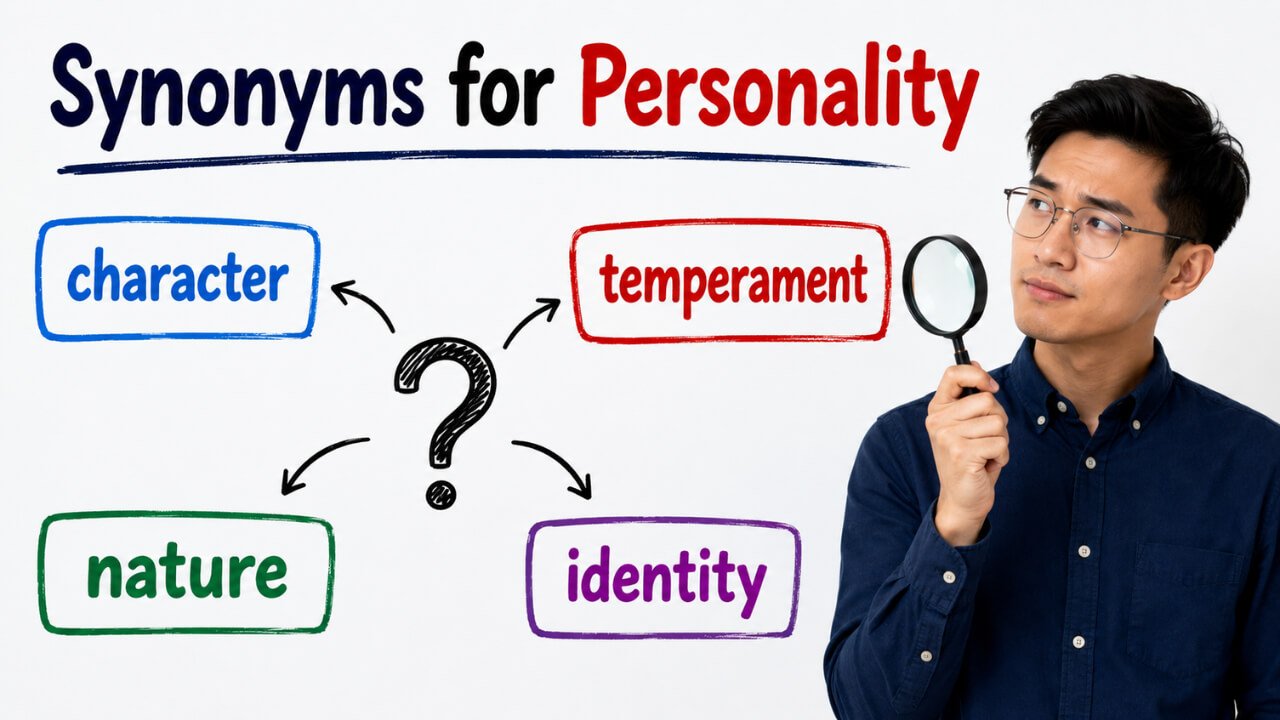
Quick Answer: Synonyms for personality include character, temperament, disposition, nature, identity, individuality, persona, demeanor, charisma, and presence. Character is the best general alternative when describing moral and personal qualities. Temperament fits emotional tendencies, while disposition describes a usual mood. Use identity for a person’s sense of self, persona for an outward image, demeanor for visible behavior, and charisma or presence when emphasizing social appeal.
Pronunciation and Word Details
Word: Personality
Pronunciation: /ˌpɜːrsəˈnæləti/
Part of Speech: Noun
Meaning: Personality is the combination of qualities, behaviors, emotions, and attitudes that makes a person distinctive.
US Pronunciation:
UK Pronunciation:
What Does “Personality” Mean?
Personality means the distinctive combination of thoughts, feelings, habits, attitudes, and behaviors that defines how a person usually acts. It is mainly used as a noun and can describe someone’s inner character, emotional tendencies, social manner, or overall presence.
The word can appear in several sentence contexts. It may describe personal qualities, as in “She has a patient personality.” It may refer to social appeal, as in “His personality attracts people.” It can also describe an identity presented to others, especially when someone behaves differently in public and private settings.
Personality may also describe the distinctive character of a place, object, or organization. A colorful room, for example, may be said to have personality because its design feels unique and expressive.
Meaning, Tone, and Context of “Personality”
Personality is a neutral and widely understood word. It appears naturally in casual conversation, formal writing, education, psychology, employment discussions, character descriptions, and relationship advice.
In everyday speech, personality usually refers to whether someone is friendly, quiet, confident, serious, humorous, or outgoing. In formal or academic contexts, it can refer to stable patterns of thought, emotion, motivation, and behavior.
The word can carry positive, negative, or neutral meaning depending on the adjective placed before it. A warm personality sounds positive, while a difficult personality suggests challenging behavior. A reserved personality is usually neutral because it simply describes someone who is less expressive.
Personality can also be emotional when it describes attraction, conflict, compatibility, or personal growth. In technical writing, more precise alternatives such as temperament, behavioral pattern, disposition, or personal identity may communicate the intended meaning more clearly.
When and How to Use “Personality”
For General Character: Use personality when describing the overall combination of someone’s qualities and behaviors.
Example: Her calm personality helps everyone feel comfortable.
For Emotional Tendencies: Use personality when referring broadly to how someone usually reacts to situations.
Example: His sensitive personality makes him deeply aware of other people’s feelings.
For Social Interaction: Use personality to describe how someone communicates and behaves around others.
Example: Her outgoing personality makes conversations feel natural.
For Individual Identity: Use personality when explaining what makes a person different from everyone else.
Example: Creative interests are an important part of his personality.
For Personal Appeal: Use personality when someone’s charm, confidence, humor, or warmth attracts attention.
Example: The speaker’s lively personality kept the audience interested.
For Visible Style: Use personality when a person expresses character through clothing, speech, decoration, or choices.
Example: The bright colors reflect her energetic personality.
For Objects or Places: Use personality figuratively when something has a distinctive and memorable quality.
Example: The small reading space has plenty of personality.
Best Synonyms for Personality
Character: The complete set of moral, emotional, and personal qualities that defines someone.
Example: Her honest character earned the trust of her colleagues.
Temperament: A person’s natural emotional pattern and typical way of reacting.
Example: His calm temperament helps him manage stressful situations.
Disposition: Someone’s usual mood, attitude, or emotional tendency.
Example: She has a cheerful disposition even during difficult days.
Nature: The basic qualities or tendencies that belong naturally to a person.
Example: Helping others is part of his generous nature.
Identity: A person’s understanding of who they are and what defines them.
Example: Her cultural background plays an important role in her identity.
Individuality: The qualities that make someone distinctive and different from others.
Example: His unusual clothing reflects his strong individuality.
Persona: The image or character that someone presents to other people.
Example: Her professional persona is confident and composed.
Demeanor: A person’s visible manner, expression, and outward behavior.
Example: His relaxed demeanor made the meeting less tense.
Charisma: A compelling personal quality that attracts and influences people.
Example: The leader’s charisma inspired confidence in the group.
Presence: The noticeable effect someone creates when entering or participating in a situation.
Example: Her confident presence immediately gained everyone’s attention.
50 Synonyms for Personality with Short Meanings
- Character: A person’s overall moral and personal qualities.
- Temperament: A natural pattern of emotional reactions.
- Disposition: A person’s usual mood or attitude.
- Nature: The basic qualities that define someone.
- Identity: A person’s sense of who they are.
- Individuality: The qualities that make someone unique.
- Persona: The image presented to other people.
- Demeanor: A person’s visible manner and behavior.
- Attitude: A settled way of thinking or feeling.
- Behavior: The way a person acts in different situations.
- Psyche: The human mind and emotional nature.
- Self: A person’s essential being and identity.
- Selfhood: The condition of having an individual identity.
- Personhood: The qualities and status of being an individual person.
- Makeup: The combination of qualities forming someone’s nature.
- Constitution: A person’s natural emotional or physical structure.
- Traits: Individual qualities that shape behavior.
- Qualities: Features that describe someone’s nature.
- Attributes: Characteristics connected with a person.
- Characteristics: Noticeable features that distinguish someone.
- Manner: A person’s usual way of acting.
- Bearing: The way someone carries and presents themselves.
- Conduct: The way someone behaves, especially in public.
- Habits: Regular actions that reveal personal tendencies.
- Outlook: A person’s general way of viewing life.
- Spirit: The emotional energy or inner quality of a person.
- Presence: The impression created by someone’s appearance and behavior.
- Charisma: A natural ability to attract and influence others.
- Charm: A pleasing quality that makes someone likable.
- Magnetism: A powerful personal attraction.
- Style: A distinctive way of behaving or expressing oneself.
- Profile: A description of someone’s qualities and tendencies.
- Image: The impression a person gives to others.
- Public Image: The identity someone presents before a wider audience.
- Personal Character: The complete pattern of individual qualities.
- Inner Nature: A person’s deeper emotional and moral qualities.
- Emotional Makeup: The feelings and emotional tendencies that shape someone.
- Mental Makeup: The thought patterns and attitudes that define a person.
- Distinctive Character: The special qualities that make someone recognizable.
- Individual Character: The particular nature belonging to one person.
- Personal Qualities: The features that describe how someone thinks and acts.
- Human Qualities: Emotional, moral, and social features of a person.
- Social Style: A person’s usual way of interacting with others.
- Behavioral Style: A consistent pattern of actions and reactions.
- Way of Being: The natural manner in which someone experiences and expresses life.
- Uniqueness: The quality of being different from everyone else.
- Essence: The central quality that defines someone.
- Inner Self: A person’s private feelings, values, and identity.
- Personal Identity: An individual understanding of who one is.
- Character Type: A recognizable pattern of qualities and behavior.
Read Also:
Synonyms for Analysis

Synonyms for Personality by Context
When Personality Means Inner Character
Character, nature, inner nature, personal character, essence, and inner self describe the deeper qualities that influence a person’s choices. These alternatives work well when discussing honesty, kindness, courage, loyalty, patience, or responsibility.
Example: Her generous character is visible in the way she treats strangers.
Example: Patience has always been part of his inner nature.
When Personality Means Emotional Temperament
Temperament, disposition, emotional makeup, constitution, and psyche focus on emotional tendencies. They describe whether someone is naturally calm, sensitive, energetic, serious, anxious, cheerful, or easily frustrated.
Example: His peaceful temperament helps him remain focused during disagreements.
Example: Her cheerful disposition improves the mood of the entire group.
When Personality Means Individual Identity
Identity, individuality, selfhood, personal identity, uniqueness, and self emphasize what makes a person distinct. These words are useful when discussing values, beliefs, experiences, personal development, or self expression.
Example: Traveling helped her develop a stronger sense of identity.
Example: His creative work celebrates individuality rather than conformity.
When Personality Means Outward Behavior
Demeanor, manner, bearing, conduct, behavior, and social style describe qualities that other people can observe. They are more precise when discussing posture, facial expression, communication, politeness, or public behavior.
Example: Her professional demeanor created a positive first impression.
Example: His respectful manner made the conversation productive.
When Personality Means Charm or Social Appeal
Charisma, charm, presence, magnetism, and spirit describe the attractive energy someone brings to social situations. These words are especially useful when personality refers to confidence, warmth, influence, or likability.
Example: Her natural charm makes new people feel welcome.
Example: The performer’s presence filled the entire room.
When Personality Means an Outward Image
Persona, image, public image, profile, and style refer to how someone appears to others. These alternatives are suitable when a person presents a particular identity in professional, creative, or public settings.
Example: His serious persona differs from his playful private nature.
Example: She maintains a calm professional image during difficult discussions.
Another Word for Personality
Character is usually the best single replacement for personality because it can describe someone’s complete set of personal, emotional, and moral qualities. However, the best alternative depends on the intended meaning. Temperament is better for emotional reactions, persona is better for an outward image, and charisma is better for social attraction.
Original: Her personality is kind and dependable.
Better Option: Her character is kind and dependable.
Original: His personality remains calm under pressure.
Better Option: His temperament remains calm under pressure.
Original: Her public personality appears serious and controlled.
Better Option: Her public persona appears serious and controlled.
Original: His personality attracts people wherever he goes.
Better Option: His charisma attracts people wherever he goes.
When Not to Use “Personality”
Personality can sound vague when a more exact word would explain the intended quality. Instead of saying someone has a good personality, identify whether the person is kind, patient, humorous, confident, thoughtful, or generous.
Avoid using personality repeatedly in the same paragraph. Alternatives such as character, temperament, manner, disposition, and demeanor can improve variety while adding precision.
Do not use personality when discussing one temporary action. A single rude response may describe behavior, but it does not necessarily define someone’s complete personality.
Weak: She has a good personality.
Better: She has a warm, patient, and considerate character.
Weak: His personality was angry during the meeting.
Better: His demeanor was tense during the meeting.
Weak: Her personality changed for a few minutes.
Better: Her mood changed for a few minutes.
Weak: The report explains his personality at work.
Better: The report explains his behavioral style at work.
Weak: His personality while speaking was confident.
Better: His manner while speaking was confident.
Words Commonly Confused With Personality
Personality vs Character: Personality includes a broad combination of behaviors, emotions, attitudes, and social qualities. Character often emphasizes moral values, integrity, and the choices a person makes.
Personality vs Temperament: Personality develops through natural tendencies, experiences, habits, and relationships. Temperament refers more specifically to natural emotional reactions.
Personality vs Identity: Personality describes how someone usually thinks, feels, and behaves. Identity describes how someone understands and defines themselves.
Personality vs Persona: Personality refers to a person’s broader nature. Persona refers to the image or role presented to other people.
Personality vs Demeanor: Personality is a complete pattern of qualities. Demeanor is the outward manner visible at a particular time.
Personality vs Attitude: Personality is broad and relatively consistent. Attitude is a way of thinking or feeling about a particular person, subject, or situation.
Personality vs Behavior: Personality describes lasting tendencies. Behavior refers to specific actions that may change according to circumstances.
Personality vs Charisma: Personality includes every kind of personal quality. Charisma refers specifically to a person’s ability to attract, influence, or inspire others.
Which Synonym Should You Choose?
Choose character when describing someone’s overall personal and moral qualities.
Choose temperament when focusing on natural emotional reactions, patience, sensitivity, calmness, or irritability.
Choose disposition when describing a person’s usual mood, such as cheerful, friendly, serious, or gloomy.
Choose identity when discussing self understanding, values, beliefs, background, or personal development.
Choose individuality when emphasizing originality, independence, and qualities that make someone different.
Choose persona when referring to an outward identity, public role, or deliberately presented image.
Choose demeanor when describing visible behavior, facial expression, posture, or manner in a particular situation.
Choose behavior when discussing actions rather than a person’s complete nature.
Choose charisma when highlighting influence, attraction, confidence, or leadership appeal.
Choose presence when describing the noticeable impression someone creates in a room, meeting, performance, or conversation.
Choose personal qualities in reports, essays, evaluations, and formal descriptions when several individual traits are being discussed.
Choose social style when explaining how someone communicates, cooperates, or builds relationships with other people.
Real Life Examples of “Personality” in Sentences
Original: Her friendly personality helps new employees feel welcome.
Better Option: Her warm demeanor helps new employees feel welcome.
Original: His personality is naturally calm during stressful situations.
Better Option: His temperament is naturally calm during stressful situations.
Original: The interview revealed several sides of her personality.
Better Option: The interview revealed several sides of her character.
Original: His personality attracts people from different backgrounds.
Better Option: His charisma attracts people from different backgrounds.
Original: Her personality appears more serious at work.
Better Option: Her professional persona appears more serious at work.
Original: Creativity is an important part of his personality.
Better Option: Creativity is an important part of his identity.
Original: Her personality makes her different from the rest of the group.
Better Option: Her individuality makes her different from the rest of the group.
Original: His confident personality was clear during the presentation.
Better Option: His confident presence was clear during the presentation.
Original: The manager has a respectful personality.
Better Option: The manager has a respectful manner.
Original: Her personality remains positive even during challenges.
Better Option: Her disposition remains positive even during challenges.
Synonym Groups and Usage Differences
Character and Nature Group
Character, nature, inner nature, essence, and personal character describe the deeper qualities that influence values and decisions. These words are appropriate when discussing honesty, kindness, courage, loyalty, or responsibility.
Example: His honest character guides every important decision he makes.
Temperament and Disposition Group
Temperament, disposition, constitution, emotional makeup, and psyche focus on emotional tendencies. Temperament is usually natural, while disposition often describes someone’s regular mood.
Example: Her patient disposition helps her manage difficult conversations.
Identity and Individuality Group
Identity, individuality, selfhood, personal identity, uniqueness, and inner self describe a person’s sense of self. Identity emphasizes who someone believes they are, while individuality highlights distinctiveness.
Example: His unusual artistic style expresses his individuality.
Demeanor and Behavior Group
Demeanor, manner, conduct, bearing, and behavior describe outward actions. Demeanor includes expression and appearance, while conduct usually refers to behavior judged by social or professional standards.
Example: Her composed demeanor reassured everyone during the emergency.
Charisma and Presence Group
Charisma, charm, magnetism, presence, and spirit refer to social impact. Charisma suggests influence, charm suggests pleasant attraction, and presence describes the strength of someone’s visible effect.
Example: The speaker’s charisma held the audience’s attention.
Persona and Image Group
Persona, image, public image, profile, and style describe how someone appears to others. A persona may be deliberately created, while an image may develop through other people’s opinions.
Example: His confident public persona hides a naturally quiet disposition.
Antonyms of Personality
Personality does not have one perfect opposite because it can refer to character, uniqueness, social appeal, or individual identity. The most useful antonym depends on the intended meaning.
Impersonality: A lack of warmth or individual character.
Sameness: The condition of having little noticeable difference.
Uniformity: Consistency that leaves little room for individuality.
Conformity: Behavior that closely follows accepted patterns.
Anonymity: The condition of having no recognized personal identity.
Blandness: A lack of distinctive or interesting qualities.
Dullness: A lack of energy, interest, or liveliness.
Coldness: A lack of emotional warmth or friendliness.
Weak Presence: A limited ability to attract notice or attention.
Lack of Character: An absence of distinctive or admirable personal qualities.
Comparison of Personality and Related Words
Personality vs Character
Personality includes emotional, social, and behavioral qualities. Character more often refers to moral strength, principles, honesty, and dependability.
Example With Personality: Her lively personality makes every gathering enjoyable.
Example With Character: Her honest character makes her a trusted adviser.
Personality vs Temperament
Personality is shaped by natural tendencies and life experiences. Temperament refers mainly to a person’s natural emotional responses.
Example With Personality: His personality became more confident over time.
Example With Temperament: His calm temperament was noticeable from an early age.
Personality vs Persona
Personality is the wider pattern of someone’s real qualities. Persona is the identity that a person presents in a particular setting.
Example With Personality: Her personality is thoughtful, humorous, and caring.
Example With Persona: Her professional persona is serious and highly controlled.
Personality vs Identity
Personality describes habitual ways of thinking, feeling, and behaving. Identity describes a person’s understanding of who they are.
Example With Personality: His quiet personality makes him a careful listener.
Example With Identity: His family history is central to his identity.
Personality vs Demeanor
Personality is broad and generally consistent. Demeanor is the outward behavior someone displays at a particular moment.
Example With Personality: She has a naturally optimistic personality.
Example With Demeanor: She maintained a calm demeanor during the discussion.
Personality vs Charisma
Personality includes positive, negative, and neutral qualities. Charisma describes a specific ability to attract attention and inspire interest.
Example With Personality: His personality is quiet but deeply thoughtful.
Example With Charisma: His charisma makes people eager to hear his ideas.
Common Phrases and Expressions With Personality
Strong Personality: A confident and forceful personal nature.
Warm Personality: A friendly, caring, and welcoming character.
Outgoing Personality: A sociable nature that enjoys interaction.
Quiet Personality: A reserved nature that is not highly expressive.
Charming Personality: A pleasant character that attracts affection.
Magnetic Personality: A personal quality that strongly draws attention.
Unique Personality: A distinctive combination of qualities.
Personality Traits: Individual characteristics that shape behavior.
Personality Type: A category based on common emotional and behavioral patterns.
Personality Profile: A description of someone’s traits, habits, and tendencies.
Common Mistakes to Avoid
Using Personality Too Broadly: Avoid saying someone has a nice or bad personality without explaining the specific traits involved. Words such as kind, selfish, patient, confident, or unreliable provide more useful information.
Confusing Personality With Mood: A mood is temporary, while personality describes broader and more consistent tendencies. Someone feeling angry for one afternoon does not automatically have an angry personality.
Confusing Personality With Behavior: Behavior refers to observable actions. Personality refers to the wider qualities that may influence those actions.
Using Persona as a Perfect Replacement: Persona usually describes a presented image rather than someone’s complete nature. Use it when discussing a public, professional, or performed identity.
Repeating the Same Word: Repeatedly using personality can make a paragraph sound dull. Replace it carefully with character, temperament, disposition, demeanor, or identity when the meaning allows.
Choosing an Overly Positive Synonym: Charisma, charm, and magnetism describe attractive qualities. They cannot replace personality when the intended meaning is neutral or negative.
Using Vague Descriptions: Instead of writing that someone has a powerful personality, explain whether the person is confident, persuasive, energetic, dominant, or inspiring.
Conclusion
Synonyms for personality help describe a person’s qualities with greater clarity and precision. Character is the strongest general replacement, while temperament and disposition explain emotional tendencies. Identity and individuality emphasize a person’s sense of self, while persona and demeanor describe outward presentation. Charisma, charm, and presence are better when discussing social appeal. The most effective choice depends on whether you are describing inner values, visible behavior, emotional reactions, uniqueness, or the impression someone creates.
FAQs About Synonyms for Personality
What Is the Best Synonym for Personality?
Character is the best general synonym because it describes a person’s overall qualities, values, and typical behavior.
Is Temperament the Same as Personality?
No. Temperament mainly refers to natural emotional reactions, while personality includes emotions, habits, attitudes, experiences, and social behavior.
Can Persona Replace Personality?
Persona can replace personality when discussing an outward or public image. It does not always describe someone’s complete or private nature.
What Is a Formal Synonym for Personality?
Personal character, disposition, behavioral style, personal qualities, and psychological makeup are suitable choices for formal writing.
What Word Describes an Attractive Personality?
Charisma, charm, magnetism, and presence describe a personality that attracts attention and creates a positive impression.
What Is Another Word for a Unique Personality?
Individuality, uniqueness, distinctive character, and individual nature can describe qualities that make someone different from others.
What Is the Difference Between Personality and Demeanor?
Personality is the broad combination of someone’s lasting qualities. Demeanor is the visible manner or behavior shown in a particular situation.
