
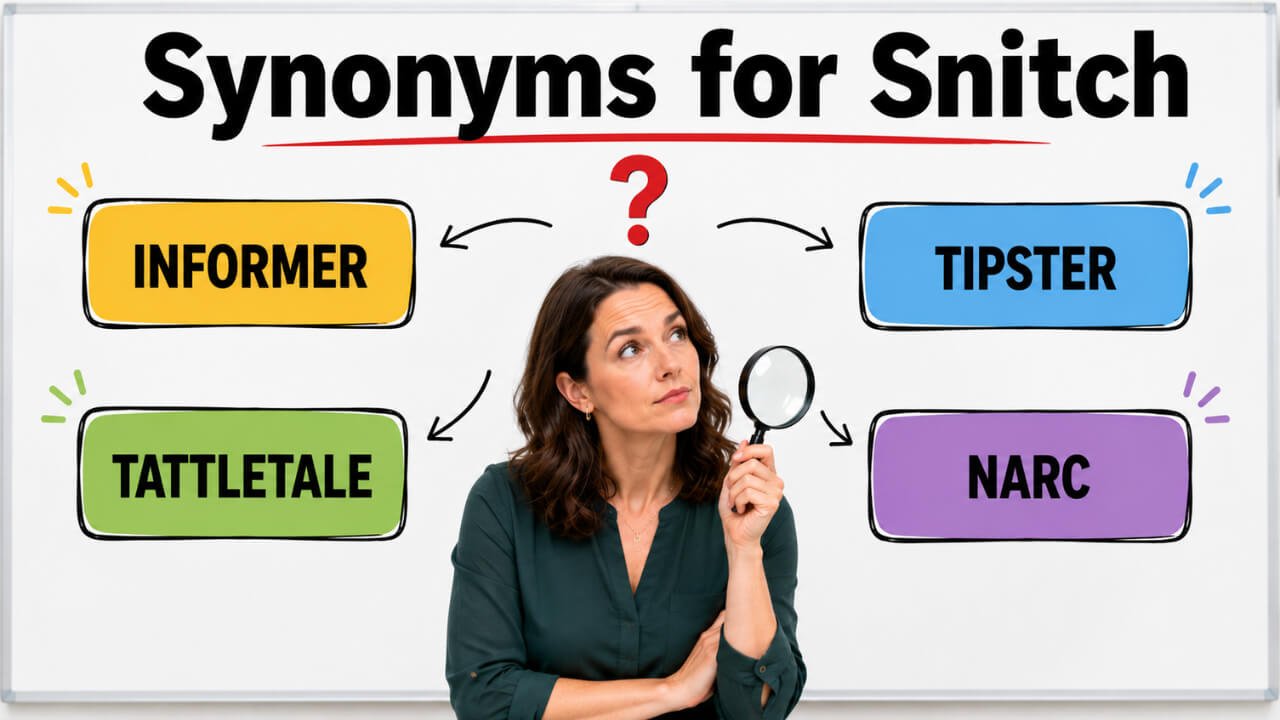
Quick Answer: Common synonyms for snitch include informer, informant, tattletale, whistleblower, tipster, squealer, rat, leaker, betrayer, and stool pigeon. The best choice depends on tone and context. Informant works well in formal or legal writing, while tattletale usually describes someone who reports minor misbehavior. Whistleblower is appropriate when a person exposes serious wrongdoing for the public good. Rat, squealer, and stool pigeon are insulting informal terms. Leaker specifically describes someone who secretly releases private information.
Pronunciation and Word Details
Word: Snitch.
Pronunciation: /snɪtʃ/.
Part of Speech: Noun and verb.
Meaning: A snitch is someone who secretly reports another person’s actions or reveals private information, while to snitch means to give such information.
US Pronunciation:
UK Pronunciation:
What Does “Snitch” Mean?
Snitch means a person who reports someone’s actions, wrongdoing, or private information to another person, especially without permission. As a verb, it means to inform on someone or reveal what that person has done.
The word is usually informal and negative. It often suggests disloyalty, betrayal, or unnecessary reporting. However, the fairness of that judgment depends on the situation.
A child might call another child a snitch for telling a teacher about a broken rule. Someone exposing serious corruption, danger, or abuse would usually be called a whistleblower rather than a snitch.
As a Noun: The group discovered that one member was a snitch.
As a Verb: He threatened to snitch on anyone who broke the agreement.
For Minor Misbehavior: The student snitched to the teacher about the hidden phone.
For Private Information: Someone snitched about their secret plan.
For Serious Wrongdoing: The employee reported the illegal activity to the authorities.
Meaning, Tone, and Context of “Snitch”
Snitch is a strongly informal and emotionally charged word. It is most common in casual conversations, dialogue, stories, and situations involving secrecy, loyalty, rules, or betrayal.
The word usually carries criticism. Calling someone a snitch suggests that the speaker believes the person should have remained silent. For this reason, it can sound insulting, judgmental, or hostile.
Snitch is generally unsuitable for neutral reports, academic writing, professional emails, and legal documents. Informant, witness, source, reporter, or whistleblower may be more accurate in those settings.
The word can also reflect a speaker’s personal opinion rather than an objective fact. One person may call someone a snitch, while another may see the same person as responsible, honest, or courageous.
Informal Tone: Who snitched on us?
Negative Tone: They treated him like a traitor because he had shared the secret.
Childhood Context: The children called her a tattletale for reporting the prank.
Legal Context: The investigators received information from a confidential informant.
Positive Context: The whistleblower exposed conduct that placed the public at risk.
When and How to Use “Snitch”
For Reporting Minor Misbehavior
Use snitch when describing someone who reports a minor rule violation, particularly when other people believe the report was unnecessary.
Example: Ben snitched to the coach about his teammate arriving late.
For Informing on Another Person
Snitch can describe secretly giving information about someone’s activities to a person in authority.
Example: One member of the group snitched on the others.
For Revealing a Secret
The word may refer to disclosing private information that someone expected to remain confidential.
Example: Do not snitch about the surprise celebration.
For Casual Conversation
Snitch appears naturally in informal speech when people discuss loyalty, secrets, school rules, friendships, or group behavior.
Example: She promised that she would not snitch.
For Fictional Dialogue
Writers can use snitch in dialogue to show anger, suspicion, fear, or conflict between characters.
Example: “There is a snitch among us,” the leader said quietly.
For Child Related Situations
Tattletale is often more specific when a child repeatedly reports small mistakes or rule violations.
Example: The children called him a tattletale because he reported every minor problem.
For Formal Reporting
Avoid snitch when writing formal descriptions of someone who provides information to investigators.
Example: The witness agreed to serve as a confidential informant.
For Exposing Serious Wrongdoing
Use whistleblower instead of snitch when someone reports dangerous, unethical, or illegal conduct for a responsible reason.
Example: The whistleblower provided evidence of financial misconduct.
Best Synonyms for Snitch
Informer
Synonym: A person who gives information about another person’s actions, often secretly.
Example: An informer told the manager who had taken the missing files.
Informant
Synonym: A person who supplies information to investigators, officials, or researchers.
Example: The investigator protected the identity of the informant.
Tattletale
Synonym: Someone, often a child, who reports another person’s minor misbehavior.
Example: The other students called her a tattletale for reporting the harmless prank.
Whistleblower
Synonym: A person who exposes serious misconduct, danger, corruption, or illegal activity.
Example: The whistleblower revealed evidence of unsafe working conditions.
Tipster
Synonym: Someone who privately provides useful information or a warning.
Example: An anonymous tipster told the authorities where the stolen items were hidden.
Squealer
Synonym: An insulting informal term for someone who informs on others.
Example: The group suspected that one of its members was a squealer.
Rat
Synonym: A strongly insulting word for someone viewed as disloyal because they informed on others.
Example: They unfairly called him a rat after he told the truth.
Leaker
Synonym: Someone who secretly releases private, restricted, or confidential information.
Example: Investigators attempted to identify the leaker.
Betrayer
Synonym: Someone who breaks another person’s trust or loyalty.
Example: He was considered a betrayer after revealing the confidential plan.
Stool Pigeon
Synonym: An informal term for someone who secretly gives information to the authorities.
Example: The gang believed that a stool pigeon had revealed their location.
50 Synonyms for Snitch with Short Meanings
- Informer: Someone who secretly reports another person’s actions.
- Informant: A person who supplies information to officials or investigators.
- Tattletale: Someone who reports minor misbehavior, especially a child.
- Telltale: A person who reveals another person’s secrets or actions.
- Stool Pigeon: Someone who secretly informs on other people.
- Stoolie: An informal term for a person who gives information to authorities.
- Whistleblower: Someone who exposes serious wrongdoing or danger.
- Tipster: A person who privately provides useful information.
- Confidential Informant: A protected source who gives information to investigators.
- Police Informant: Someone who supplies information to law enforcement officers.
- Cooperating Witness: A witness who helps an investigation by providing evidence.
- State Witness: A person who gives evidence for the prosecution.
- Cooperator: Someone who assists authorities by sharing information.
- Source: A person who provides information, often privately.
- Insider: Someone within a group who has private knowledge.
- Leaker: A person who secretly releases restricted information.
- Mole: A hidden person who passes information from inside an organization.
- Witness: Someone who sees an event and reports what happened.
- Eyewitness: A person who directly observed an event.
- Reporter: Someone who communicates an incident to another person or authority.
- Accuser: A person who claims that someone committed an offense.
- Complainant: Someone who formally reports a problem or wrongdoing.
- Betrayer: A person who breaks another person’s trust.
- Traitor: Someone who seriously violates loyalty to a person or group.
- Turncoat: A person who abandons one side and supports another.
- Rat: An insulting term for someone who informs on others.
- Squealer: Someone who reveals information under pressure or for personal benefit.
- Sneak: An informal term for someone who secretly reports others.
- Grass: An informal term for a person who informs on someone.
- Nark: An informal word for a police informer.
- Narc: An informal term sometimes used for an informer or enforcement officer.
- Fink: An insulting informal term for an informer or betrayer.
- Blabbermouth: Someone who cannot keep private information secret.
- Denouncer: A person who publicly reports or condemns another person.
- Inform: To provide information about another person’s actions.
- Report: To tell an authority about an incident or violation.
- Tell: To reveal what another person has done.
- Tell On: To report someone’s misbehavior to an authority figure.
- Rat On: To inform on someone in a disloyal or secretive way.
- Squeal: To reveal information about another person, often under pressure.
- Grass On: To report someone to the authorities.
- Nark On: To secretly give authorities information about someone.
- Shop: To report someone to the authorities in informal British usage.
- Turn In: To report or deliver someone to the authorities.
- Betray: To reveal information that breaks another person’s trust.
- Expose: To make hidden wrongdoing or information publicly known.
- Reveal: To make a secret or unknown fact known.
- Disclose: To formally or deliberately share private information.
- Leak: To secretly release confidential information.
- Blow the Whistle: To report serious misconduct or illegal activity.
Read Also:
Synonyms for Concept

Synonyms for Snitch by Context
When Snitch Means Informer
Informer, informant, confidential informant, police informant, source, and cooperator describe someone who provides information about another person.
Informant is the strongest neutral choice in legal or investigative contexts. Informer can still carry a slightly negative tone, depending on the sentence.
Example: A confidential informant gave the investigators important evidence.
Example: An informer revealed who had organized the scheme.
When Snitch Means Tattletale
Tattletale, telltale, sneak, and reporter may describe someone who reports minor rule violations or childish behavior.
Tattletale is particularly common when discussing children. It usually suggests that the reported issue was small or unimportant.
Example: The child was called a tattletale after reporting the classroom prank.
Example: He told the teacher that another student had copied his answer.
When Snitch Means Betrayer
Betrayer, traitor, turncoat, rat, fink, and squealer emphasize broken trust or loyalty.
Rat and fink are strongly insulting. Betrayer is more suitable for serious or literary writing, while traitor implies a major act of disloyalty.
Example: They viewed the informer as a betrayer of the group.
Example: The character was branded a traitor after changing sides.
When Snitch Means Whistleblower
Whistleblower, complainant, witness, reporter, and denouncer can describe someone who reports serious wrongdoing.
Whistleblower is usually more respectful than snitch because it suggests that the person acted to protect others or expose harmful conduct.
Example: The whistleblower reported evidence of corruption.
Example: A complainant submitted a formal account of the misconduct.
When Snitch Means Leaker
Leaker, insider, mole, source, blabbermouth, and betrayer can describe someone who releases private information.
Leaker is most precise when confidential documents or restricted details are shared without authorization.
Example: The organization began an investigation to identify the leaker.
Example: An insider disclosed details of the confidential meeting.
When Snitch Is Used as a Verb
Inform, report, tell on, rat on, squeal, turn in, expose, reveal, and disclose can replace the verb snitch.
The best choice depends on whether the action was responsible, disloyal, secretive, formal, or intended to protect others.
Example: She reported the safety violation to her supervisor.
Example: Someone revealed the group’s private plans.
Another Word for Snitch
Informer is often the best general replacement for snitch because it describes someone who provides information about another person. However, informant is better in formal or legal contexts, tattletale suits minor childhood behavior, and whistleblower is more accurate when serious misconduct is responsibly exposed.
Original: The group believed that Alex was a snitch.
Better Option: The group believed that Alex was an informer.
Original: The child was called a snitch for telling the teacher.
Better Option: The child was called a tattletale for telling the teacher.
Original: The snitch gave investigators evidence about the crime.
Better Option: The informant gave investigators evidence about the crime.
Original: The employee became a snitch after reporting dangerous conduct.
Better Option: The employee became a whistleblower after reporting dangerous conduct.
When Not to Use “Snitch”
Do not use snitch in formal reports, academic writing, legal documents, or professional communication unless you are quoting someone. The word is emotional and can make a neutral description sound biased.
Weak: The investigation depended on information from a snitch.
Better: The investigation depended on information from a confidential informant.
Avoid using snitch for someone who responsibly reports dangerous, abusive, unethical, or illegal behavior. Whistleblower, witness, complainant, or reporter may be fairer.
Weak: A snitch reported the serious safety violation.
Better: A whistleblower reported the serious safety violation.
Do not call someone a snitch when you do not know whether the accusation is true. The label can unfairly damage a person’s reputation.
Weak: Maria must be the snitch because she spoke to the manager.
Better: Maria may have reported the incident, but there is no clear evidence.
Avoid using the word when the person openly gives evidence as a witness. Snitch often suggests secrecy or betrayal.
Weak: The snitch described what she had seen in court.
Better: The eyewitness described what she had seen in court.
Do not use tattletale when serious harm is involved. That word can make an important report sound childish or unnecessary.
Weak: He was a tattletale for reporting the threat.
Better: He acted responsibly by reporting the threat.
Words Commonly Confused With Snitch
Snitch vs Informant: Snitch is informal and insulting, while informant is more neutral and commonly used in investigative or legal contexts.
Snitch vs Whistleblower: A snitch is often viewed as disloyal, while a whistleblower exposes serious wrongdoing, usually to protect people or the public.
Snitch vs Tattletale: Snitch can involve serious or minor information. Tattletale usually refers to someone, often a child, who reports small rule violations.
Snitch vs Witness: A snitch secretly informs on someone, while a witness gives information about something they saw or experienced.
Snitch vs Leaker: A snitch reports a person’s actions. A leaker releases confidential information, documents, or private details.
Snitch vs Traitor: A snitch informs on someone. A traitor commits a broader and often more serious act of disloyalty.
Snitch vs Spy: A snitch gives information about others, while a spy actively gathers secret information for another person, group, or government.
Snitch vs Reporter: A reporter simply communicates information. Snitch adds a negative judgment about loyalty or motive.
Snitch vs Accuser: A snitch provides information about someone, while an accuser directly claims that someone committed an offense.
Snitch vs Blabbermouth: A snitch intentionally reports someone. A blabbermouth may reveal secrets simply because they talk too much.
Which Synonym Should You Choose?
Choose informer when you need a general word for someone who gives information about another person.
Choose informant for formal reports, investigations, legal discussions, and neutral descriptions.
Choose tattletale when discussing a child or someone who repeatedly reports minor rule violations.
Choose whistleblower when a person exposes serious misconduct, corruption, danger, or illegal behavior.
Choose tipster when someone privately provides a useful warning or piece of information.
Choose leaker when confidential documents or restricted details are secretly released.
Choose witness or eyewitness when someone reports what they personally observed.
Choose complainant when someone formally reports mistreatment, misconduct, or another problem.
Choose betrayer when the main idea is broken trust rather than reporting itself.
Choose rat, fink, squealer, or stool pigeon only in informal dialogue where a strongly negative tone is intentional.
Choose report, disclose, or inform in essays, emails, professional documents, and neutral explanations.
Choose tell on in casual conversation, particularly when discussing children or minor misconduct.
Choose blow the whistle when the person responsibly reveals serious wrongdoing.
Real Life Examples of “Snitch” in Sentences
Original: Someone snitched to the teacher about the hidden notes.
Better Option: Someone told the teacher about the hidden notes.
Original: The group suspected that Daniel was a snitch.
Better Option: The group suspected that Daniel was an informer.
Original: She refused to snitch on her friend over a minor mistake.
Better Option: She refused to tell on her friend over a minor mistake.
Original: A snitch gave the investigators details about the crime.
Better Option: A confidential informant gave the investigators details about the crime.
Original: The employee was called a snitch after reporting unsafe equipment.
Better Option: The employee was called a whistleblower after reporting unsafe equipment.
Original: Someone snitched about the private meeting.
Better Option: Someone leaked information about the private meeting.
Original: The child became known as a snitch in the classroom.
Better Option: The child became known as a tattletale in the classroom.
Original: He snitched on the person who had damaged the property.
Better Option: He reported the person who had damaged the property.
Original: The gang searched for the snitch who had revealed their location.
Better Option: The gang searched for the informant who had revealed their location.
Original: She snitched about the confidential plan.
Better Option: She disclosed the confidential plan.
Synonym Groups and Usage Differences
Formal Reporting Group
Informant, confidential informant, cooperating witness, state witness, complainant, and source are suitable for formal or neutral contexts.
These terms describe people who provide information without automatically judging their motives or loyalty.
Example: The cooperating witness provided a detailed account of the incident.
Informal Insult Group
Rat, fink, squealer, stool pigeon, stoolie, grass, and nark are insulting informal terms.
They suggest that the speaker disapproves of the person for sharing information. These words should be used carefully because they express hostility rather than neutrality.
Example: The character angrily accused his partner of being a rat.
Childhood Reporting Group
Tattletale, telltale, sneak, tell on, and report are often associated with school, siblings, or minor rule breaking.
Tattletale usually implies that the complaint was unnecessary, while report is neutral.
Example: The children called him a tattletale for reporting the joke.
Betrayal Group
Betrayer, traitor, turncoat, informer, and rat focus on broken loyalty or trust.
These words differ in strength. Betrayer can describe personal disloyalty, while traitor often refers to a more serious rejection of a group, cause, or country.
Example: She felt like a betrayer after revealing her friend’s secret.
Secret Information Group
Leaker, insider, mole, source, blabbermouth, disclose, and reveal relate to private or hidden information.
A mole secretly works inside a group, while a leaker releases information. A blabbermouth reveals secrets because of careless talking.
Example: An insider leaked details from the confidential discussion.
Responsible Disclosure Group
Whistleblower, witness, complainant, reporter, and denouncer can describe people who report wrongdoing for a valid reason.
These choices are more respectful than snitch when the report protects people, prevents harm, or supports accountability.
Example: The whistleblower exposed conduct that placed employees at risk.
Antonyms of Snitch
The opposite of snitch depends on whether the word refers to loyalty, secrecy, silence, or protection.
Loyalist: Someone who remains faithful to a person or group.
Ally: A person who supports and assists another person.
Supporter: Someone who stands behind another person or cause.
Protector: A person who keeps someone safe from harm or exposure.
Confidant: A trusted person who keeps private information secret.
Secret Keeper: Someone who does not reveal confidential information.
Defender: A person who protects another person from criticism or accusation.
Guardian: Someone who watches over and protects another person.
Accomplice: A person who helps another individual and does not report the activity.
Silent Witness: Someone who observes an event but does not disclose what happened.
Loyal Friend: A person who remains supportive and protects private information.
Keeper of Confidence: Someone trusted not to reveal personal details.
Comparison: Snitch vs Related Words
Snitch vs Informer
Snitch is an informal word that expresses criticism. Informer is more descriptive, although it can still sound negative in some contexts.
Example With Snitch: They accused Leo of being a snitch.
Example With Informer: Investigators believed that Leo was the informer.
Snitch vs Informant
Snitch suggests betrayal or disloyalty. Informant is the preferred neutral word for someone who provides information during an investigation.
Example With Snitch: The group threatened the person they believed was a snitch.
Example With Informant: The identity of the informant remained confidential.
Snitch vs Whistleblower
Snitch often implies unnecessary or selfish reporting. Whistleblower suggests the responsible exposure of serious wrongdoing.
Example With Snitch: His classmates called him a snitch for reporting the prank.
Example With Whistleblower: The whistleblower exposed a serious safety problem.
Snitch vs Tattletale
Snitch may refer to many forms of informing, while tattletale usually involves minor behavior and is often associated with children.
Example With Snitch: Someone snitched about the secret meeting.
Example With Tattletale: The child was called a tattletale for reporting every small mistake.
Snitch vs Leaker
A snitch reports someone’s behavior. A leaker releases restricted information, often to people outside an organization.
Example With Snitch: The snitch told the supervisor who had broken the rule.
Example With Leaker: The leaker released confidential documents.
Snitch vs Betrayer
Snitch describes reporting or informing. Betrayer is broader and includes any serious violation of trust.
Example With Snitch: The group believed that a snitch had contacted the authorities.
Example With Betrayer: She felt like a betrayer after sharing her friend’s secret.
Snitch vs Witness
Snitch is a judgmental label. Witness is neutral and describes someone who saw or experienced an event.
Example With Snitch: They called him a snitch after he spoke to the investigator.
Example With Witness: The witness explained what he had observed.
Common Phrases and Expressions With Snitch
Snitch on Someone: To report another person’s actions or misconduct.
Snitch to the Teacher: To tell a teacher about another student’s behavior.
Snitch to the Authorities: To provide officials with information about someone.
Do Not Snitch: An informal instruction not to report or reveal information.
Caught Snitching: Discovered while informing on another person.
Known as a Snitch: Having a reputation for reporting other people.
Refuse to Snitch: To decline to give information about someone.
Snitch About a Secret: To reveal information that was meant to remain private.
Snitch for a Reward: To provide information in exchange for money or another benefit.
Snitch Behind Someone’s Back: To report a person without their knowledge.
Common Mistakes to Avoid
A common mistake is treating snitch as a neutral word. It usually communicates criticism, so it may make the writer appear biased.
Avoid calling every person who reports misconduct a snitch. Someone who reports danger, abuse, corruption, or illegal activity may be a whistleblower, witness, complainant, or responsible reporter.
Writers should not use informant and whistleblower as if they have identical meanings. An informant privately provides information, often during an investigation. A whistleblower exposes serious misconduct, commonly within an organization.
Do not confuse a snitch with a leaker. A snitch reports another person’s behavior, while a leaker releases confidential information or documents.
Avoid using tattletale for serious reports. The word is associated with minor complaints and can unfairly make a responsible action sound childish.
Do not repeat snitch too frequently in one paragraph. Use a more precise term based on the person’s role, action, and motive.
Repetitive: The snitch told the manager, and the snitch later spoke to investigators because the snitch had more information.
Improved: The informer told the manager and later provided investigators with additional information.
Writers should also avoid unnatural verb forms. Snitch is usually followed by on when identifying the person who was reported.
Incorrect: He snitched his friend.
Correct: He snitched on his friend.
Conclusion
Synonyms for snitch vary greatly in tone, meaning, and formality. Informer and informant are useful neutral choices, while tattletale describes someone who reports minor behavior. Whistleblower is more respectful when serious wrongdoing is exposed, and leaker refers to someone who releases confidential information. Rat, squealer, fink, and stool pigeon are insulting informal terms. Choosing the right alternative requires attention to the person’s motive, the seriousness of the information, and whether the sentence should sound neutral, critical, or supportive.
FAQs About Synonyms for Snitch
What Is the Best Synonym for Snitch?
Informer is the best general replacement. Informant is usually better for formal, legal, or investigative writing.
Is Whistleblower a Synonym for Snitch?
Whistleblower is a close alternative in some contexts, but it usually has a more positive meaning because it involves exposing serious wrongdoing.
What Is a Polite Word for Snitch?
Informant, reporter, source, witness, or complainant may be more polite, depending on the situation.
What Is Another Word for Snitch in School?
Tattletale is the most common alternative for someone who reports another student’s minor misbehavior.
Is Rat a Synonym for Snitch?
Yes. Rat is an insulting informal synonym for someone viewed as disloyal because they informed on others.
What Is the Difference Between an Informant and a Snitch?
Informant is a neutral or formal term. Snitch is informal and usually expresses anger or disapproval.
Can Snitch Be Used as a Verb?
Yes. As a verb, snitch means to report someone or reveal information about them, as in “He snitched on his teammate.”
