
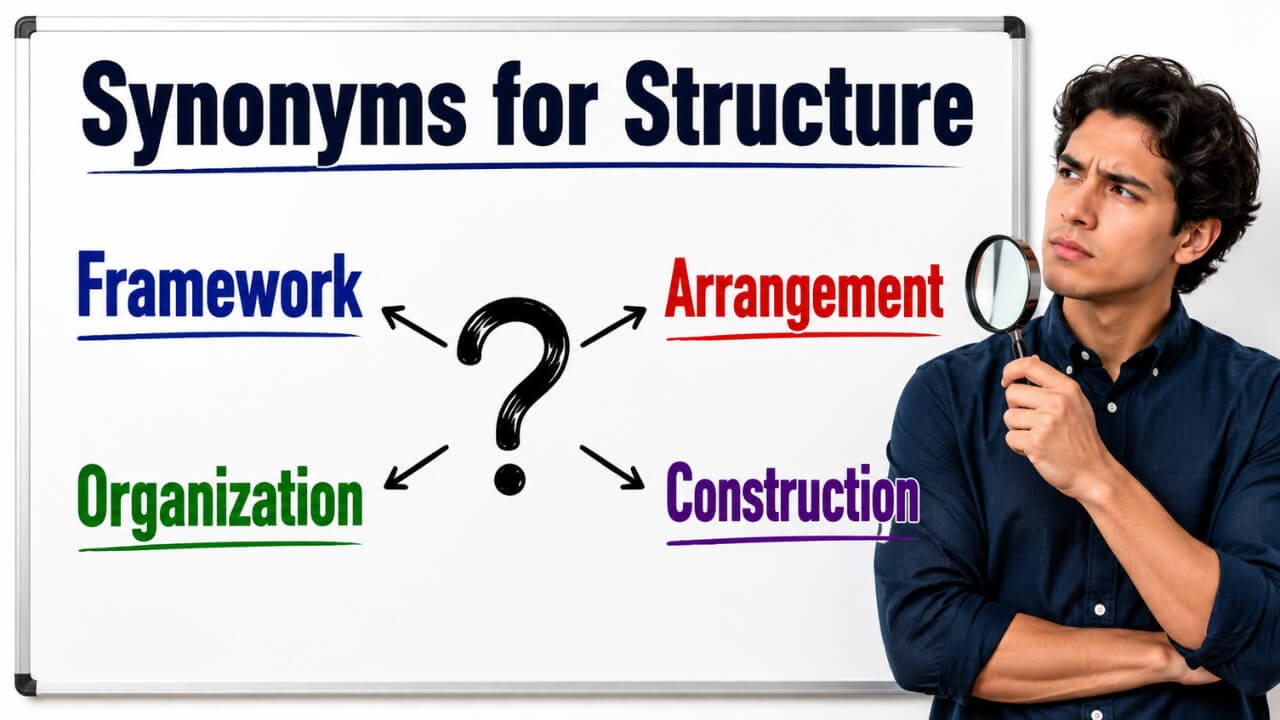
Quick Answer: The best synonyms for structure are framework, organization, arrangement, construction, system, design, layout, composition, architecture, and formation. The exact keyword synonyms for structure covers several meanings. Use framework for a supporting system, organization for an ordered arrangement, construction for a physical object, layout for visual placement, composition for writing or art, and architecture for a carefully designed building or technical system.
Pronunciation and Word Details
Word: Structure
Pronunciation: /ˈstrʌk.tʃər/
Part of Speech: Noun and verb
Meaning: The way parts are arranged, connected, built, or organized to form a complete whole.
US Pronunciation:
UK Pronunciation:
What Does “Structure” Mean?
Structure means the way different parts of something are arranged, connected, or organized. As a noun, it can describe a physical building, an organizational system, a sentence pattern, or the internal arrangement of an object.
As a verb, structure means to arrange information, activities, or parts in a clear and organized way.
In physical contexts, structure may refer to a bridge, building, frame, or supporting construction. In writing, it describes how ideas, paragraphs, and sentences are arranged. In business, it can refer to roles, levels of authority, and responsibilities. In science and technology, structure explains how parts of a system connect and function together.
Meaning, Tone, and Context of “Structure”
Structure is generally a neutral and versatile word. It can sound formal, academic, technical, or conversational depending on the sentence.
In academic writing, structure often refers to the organization of an essay, argument, sentence, or research paper. In technical writing, it may describe the arrangement of data, systems, materials, or components.
In business communication, structure can describe a company hierarchy, work process, meeting format, or reporting system. In everyday conversation, people may discuss the structure of a house, schedule, lesson, or plan.
The word is precise but broad. A more specific synonym can make the intended meaning clearer.
When and How to Use “Structure”
For Physical Construction: Use structure when referring to something built from connected parts.
Example: The steel structure remained stable during the storm.
For Organization: Use structure to explain how roles, tasks, or ideas are arranged.
Example: The department needs a clearer management structure.
For Writing: Use structure when discussing the order of sentences, paragraphs, or arguments.
Example: The essay has a logical structure that is easy to follow.
For Systems: Use structure to describe how parts of a process or system work together.
Example: The payment system has a simple and secure structure.
For Visual Arrangement: Use structure when discussing the placement and relationship of visible elements.
Example: The page structure guides readers toward the main information.
For Planning: Use structure as a verb when arranging activities or information carefully.
Example: She structured the lesson around three important questions.
Best Synonyms for Structure
Framework: A basic supporting system that holds ideas or parts together.
Example: The policy provides a clear framework for future decisions.
Organization: The orderly arrangement of people, information, or components.
Example: Better organization made the report easier to understand.
Arrangement: The way objects, ideas, or parts are placed in relation to one another.
Example: The seating arrangement encouraged open discussion.
Construction: Something that has been built or the process of building it.
Example: The wooden construction was strong enough to support the roof.
System: A connected set of parts that work together.
Example: The school introduced a new system for recording attendance.
Design: The planned appearance, purpose, or arrangement of something.
Example: The design of the building allows natural light to enter every room.
Layout: The visual placement of text, images, rooms, or other elements.
Example: The clean layout improved the readability of the document.
Composition: The way parts are combined to form a complete work.
Example: The composition of the photograph creates a sense of balance.
Architecture: The planned design and organization of a building or complex system.
Example: The platform has an architecture that supports future growth.
Formation: The process or result of forming something into a particular arrangement.
Example: The rock formation developed over thousands of years.
50 Synonyms for Structure with Short Meanings
- Framework: A supporting arrangement of connected parts.
- Organization: An orderly system or arrangement.
- Arrangement: The way parts are positioned or organized.
- Construction: A built object or the method used to build it.
- Formation: A particular shape or organized grouping.
- Composition: The way different parts form a whole.
- Design: A planned arrangement created for a purpose.
- Layout: The visual placement of elements.
- System: Connected parts working together.
- Order: A clear and organized arrangement.
- Form: The shape or general arrangement of something.
- Pattern: A repeated or recognizable arrangement.
- Configuration: A specific arrangement of parts.
- Setup: The way something is prepared or organized.
- Architecture: The design of a building or complex system.
- Skeleton: The basic supporting frame of something.
- Foundation: The base that supports a structure or idea.
- Infrastructure: The basic systems supporting an organization or community.
- Anatomy: The internal arrangement of parts in a body or system.
- Hierarchy: A system arranged by rank or level.
- Network: A connected arrangement of people, places, or parts.
- Scheme: An organized plan or system.
- Plan: A detailed arrangement for achieving a purpose.
- Format: The established form or arrangement of content.
- Outline: A basic plan showing the main parts.
- Model: A representation or example of how something works.
- Blueprint: A detailed plan for building or developing something.
- Matrix: An arrangement of connected elements in rows, levels, or systems.
- Assembly: A collection of parts joined together.
- Build: The form and construction of something.
- Shape: The visible form or outline of something.
- Makeup: The parts or qualities that form a whole.
- Constitution: The way something is formed or established.
- Edifice: A large or impressive building.
- Building: A permanent construction with walls and a roof.
- Body: A complete collection of connected parts.
- Fabric: The basic composition or underlying character of something.
- Mechanism: A system of parts that performs a function.
- Apparatus: A group of connected parts or equipment.
- Scaffolding: A temporary or supporting framework.
- Organize: To arrange parts in a clear order.
- Arrange: To place things in a planned position.
- Construct: To build something from separate parts.
- Frame: To create a supporting form or clear arrangement.
- Formulate: To develop an idea or plan carefully.
- Compose: To create a whole by combining parts.
- Systematize: To arrange something according to a system.
- Coordinate: To organize different parts so they work together.
- Classify: To arrange things into groups or categories.
- Engineer: To design or arrange something with careful planning.
Read Also:
Synonyms for Bright
Synonyms for Structure by Context
When Structure Means a Supporting Framework
Framework, skeleton, foundation, scaffolding, and infrastructure describe something that supports other parts.
Framework is the most flexible choice for ideas, policies, systems, and physical arrangements. Skeleton refers to the most basic supporting parts. Foundation describes the base upon which something is built.
Example: The legal framework protects the rights of employees.
Example: Trust is the foundation of a successful partnership.
When Structure Means Organization
Organization, order, arrangement, hierarchy, system, and configuration describe how parts are placed or connected.
Organization is useful when clarity and efficiency are important. Hierarchy refers specifically to levels of rank or authority. Configuration is common when describing equipment, technology, or technical components.
Example: The organization of the files made information easier to locate.
Example: The company hierarchy defines who reports to each manager.
When Structure Means Physical Construction
Construction, building, edifice, assembly, and architecture refer to something physically built.
Construction emphasizes the building process or the completed object. Building is the clearest everyday alternative. Edifice is more formal and usually refers to a large building. Architecture emphasizes intentional design.
Example: The stone construction has survived for centuries.
Example: The architecture combines strength with visual beauty.
When Structure Means Written Organization
Composition, format, outline, framework, form, and organization describe the arrangement of written information.
Composition is useful for complete written works. Format refers to an expected presentation style. Outline describes the main points before the full text is written.
Example: The composition of the article moves from basic definitions to detailed examples.
Example: A clear outline helps writers maintain a logical flow.
When Structure Means Visual Arrangement
Layout, design, pattern, shape, form, and composition describe visible organization.
Layout is best for pages, rooms, documents, and screens. Design includes both appearance and purpose. Composition is common in art, photography, and visual communication.
Example: The room layout creates enough space for movement.
Example: The balanced composition draws attention to the central subject.
When Structure Is Used as a Verb
Organize, arrange, construct, frame, compose, formulate, systematize, and coordinate can replace structure as an action.
Organize is the most general alternative. Arrange focuses on placement. Frame means to present an idea from a particular perspective. Systematize means to create a consistent process.
Example: Organize the presentation into three clear sections.
Example: She framed the discussion around practical solutions.
Another Word for Structure
Framework is often the best single replacement for structure because it can describe a supporting arrangement, organized system, plan, or set of guiding principles. However, the best alternative depends on the intended meaning.
Original: The course has a clear structure.
Better Option: The course has a clear framework.
Original: We changed the structure of the office.
Better Option: We changed the layout of the office.
Original: The structure was damaged by heavy rain.
Better Option: The construction was damaged by heavy rain.
Original: She structured the report around customer concerns.
Better Option: She organized the report around customer concerns.
When Not to Use “Structure”
Avoid structure when a more specific word would explain the meaning more clearly. Because structure has several meanings, it may sound vague without enough context.
Do not use structure repeatedly in the same paragraph when framework, layout, system, design, organization, or construction would improve variety and precision.
Weak: The structure of the structure affected the strength of the structure.
Better: The design of the framework affected the strength of the building.
Avoid structure when referring only to appearance. Shape, form, or design may be more accurate.
Weak: I like the structure of the vase.
Better: I like the shape of the vase.
Avoid structure when discussing the position of visual elements on a page. Layout is usually clearer.
Weak: The website structure places the main heading above the photograph.
Better: The page layout places the main heading above the photograph.
Avoid structure as a verb when the sentence requires a simpler action word.
Weak: Please structure the chairs near the front wall.
Better: Please arrange the chairs near the front wall.
Words Commonly Confused With Structure
Structure vs Framework: Structure describes the complete arrangement of parts, while framework usually refers to the basic supporting system.
Structure vs Organization: Structure is the arrangement itself, while organization can refer to either an orderly arrangement or a group of people working together.
Structure vs Construction: Structure can describe any organized whole, while construction usually refers to something built or the process of building it.
Structure vs Layout: Structure explains how major parts are connected, while layout focuses on where visible elements are placed.
Structure vs System: Structure describes arrangement, while system emphasizes how connected parts operate together.
Structure vs Form: Structure concerns the organization of parts, while form often refers to visible shape or established style.
Structure vs Architecture: Structure may refer to any arrangement, while architecture emphasizes planned design in buildings, technology, or complex systems.
Which Synonym Should You Choose?
Choose framework when describing a supporting set of rules, ideas, principles, or connected parts.
Choose organization when discussing clarity, order, management, or the arrangement of information.
Choose arrangement when explaining where objects, people, or ideas have been placed.
Choose construction when referring to a physical object or the process of building it.
Choose system when the parts work together to perform a function.
Choose design when appearance, purpose, and planning are equally important.
Choose layout when discussing the visible placement of rooms, text, images, or page elements.
Choose composition when describing writing, music, art, or photography.
Choose architecture when discussing carefully planned buildings, software, networks, or complex technical systems.
Choose hierarchy when describing levels of authority, importance, or rank.
Choose outline when preparing the main sections of an essay, report, lesson, or presentation.
Choose organize or arrange when replacing structure as a verb in everyday communication.
Real Life Examples of “Structure” in Sentences
Original: The structure of the essay is easy to follow.
Better Option: The organization of the essay is easy to follow.
Original: The structure supports the entire roof.
Better Option: The framework supports the entire roof.
Original: The manager changed the structure of the team.
Better Option: The manager changed the organization of the team.
Original: The structure of the page looks crowded.
Better Option: The layout of the page looks crowded.
Original: The company needs a more flexible structure.
Better Option: The company needs a more flexible system.
Original: The structure was built from stone and wood.
Better Option: The construction was built from stone and wood.
Original: The structure of the photograph creates balance.
Better Option: The composition of the photograph creates balance.
Original: We must structure the meeting carefully.
Better Option: We must organize the meeting carefully.
Original: The course structure includes six main units.
Better Option: The course framework includes six main units.
Original: Scientists studied the structure of the plant.
Better Option: Scientists studied the anatomy of the plant.
Synonym Groups and Usage Differences
Framework and Support Group
Framework, foundation, skeleton, scaffolding, and infrastructure describe support.
Framework is broad and can be physical or conceptual. Foundation emphasizes a base. Skeleton describes the essential supporting parts. Infrastructure refers to larger systems that allow services or organizations to function.
Example: The training program provides a framework for professional development.
Organization and Order Group
Organization, arrangement, order, configuration, hierarchy, and system describe how parts are organized.
Arrangement focuses on placement. Order emphasizes neatness or sequence. Configuration refers to a particular technical arrangement. Hierarchy describes ranked levels.
Example: The new arrangement gives every team member a clear responsibility.
Physical Construction Group
Construction, building, edifice, assembly, architecture, and build refer to physical objects.
Building is an everyday term. Edifice is formal and often describes a large structure. Assembly focuses on parts joined together. Build may describe the shape or construction quality of an object.
Example: The steel assembly forms the central support of the bridge.
Design and Layout Group
Design, layout, pattern, form, and shape relate to visible planning and appearance.
Design includes purpose and planning. Layout describes placement. Pattern refers to repeated organization. Form and shape focus more strongly on appearance.
Example: The new layout makes the small office feel more spacious.
Composition and Format Group
Composition, format, outline, model, and blueprint describe planned content or information.
Composition refers to the complete work. Format is the expected presentation. Outline lists the main sections. Blueprint offers a detailed plan for future development.
Example: The report follows a clear format with separate sections for findings and recommendations.
Action Verb Group
Organize, arrange, construct, frame, formulate, compose, coordinate, and systematize describe the act of creating order.
Organize is suitable for general use. Formulate is common with ideas and plans. Coordinate emphasizes cooperation among several parts. Systematize creates a repeatable process.
Example: The director coordinated the tasks so every department could contribute.
Antonyms of Structure
The opposite of structure depends on whether the word refers to order, physical stability, planning, or arrangement.
Disorder: A lack of organized arrangement.
Chaos: Complete confusion without clear control.
Disorganization: Poor or missing organization.
Randomness: An arrangement without a planned pattern.
Confusion: A condition in which parts or ideas are unclear.
Collapse: The failure or falling apart of a physical structure.
Destruction: Severe damage that removes an existing construction.
Shapelessness: A lack of clear or recognizable form.
Fragmentation: The division of a whole into disconnected parts.
Instability: A lack of strength, balance, or reliability.
Improvisation: Action taken without a fixed plan or established framework.
Clutter: A disorderly collection of objects or information.
Comparison of Structure vs Related Words
Structure vs Framework
Structure describes the complete arrangement of all parts. Framework usually refers to the basic support upon which other details are added.
Example With Structure: The structure of the novel includes three connected storylines.
Example With Framework: The author created a framework before developing the characters.
Structure vs Organization
Structure focuses on how parts relate to one another. Organization emphasizes order, clarity, and systematic arrangement.
Example With Structure: The sentence structure is difficult to understand.
Example With Organization: Better organization would make the paragraph clearer.
Structure vs Layout
Structure describes the broader relationship among major parts. Layout describes the visible position of specific elements.
Example With Structure: The document structure includes an introduction, analysis, and conclusion.
Example With Layout: The document layout places the title above the main image.
Structure vs System
Structure explains how something is arranged. System explains how connected parts operate to achieve a result.
Example With Structure: The management structure includes three levels of authority.
Example With System: The reporting system sends updates to every department.
Structure vs Design
Structure focuses on arrangement and support. Design includes planning, appearance, purpose, and user experience.
Example With Structure: The bridge structure distributes weight evenly.
Example With Design: The bridge design combines safety with visual elegance.
Structure vs Architecture
Structure is a broad word for any organized arrangement. Architecture refers to deliberate and often complex design.
Example With Structure: The database structure separates customer and order information.
Example With Architecture: The database architecture supports several connected applications.
Common Phrases and Expressions With Structure
Organizational Structure: The arrangement of roles and authority within a group.
Sentence Structure: The way words and phrases are arranged in a sentence.
Social Structure: The organized relationships and institutions within a society.
Physical Structure: A solid object made from connected materials or parts.
Internal Structure: The arrangement of parts inside an object or system.
Basic Structure: The simplest or most essential arrangement of parts.
Management Structure: The system of leadership, responsibility, and reporting.
Course Structure: The arrangement of lessons, units, activities, and assessments.
Data Structure: A method of organizing and storing information.
Support Structure: A framework that holds or strengthens another object.
Common Mistakes to Avoid
Using Structure Too Broadly: Structure can sound vague when the reader needs to know whether you mean a framework, layout, system, building, or organization. Select the most precise synonym whenever possible.
Repeating the Same Word: Repeated use can make writing sound mechanical. Replace structure with organization, framework, layout, design, or construction when the meaning allows it.
Choosing the Wrong Physical Synonym: A building is a complete enclosed construction, while a framework may only be the supporting part. Do not treat these words as identical in every sentence.
Confusing Structure and Layout: Use structure for the overall relationship among parts. Use layout for the visible placement of specific elements.
Using an Unnatural Verb: Structure works as a verb, but organize or arrange may sound more natural in everyday instructions.
Ignoring Context: Architecture may sound too technical for a simple arrangement. Setup may sound too casual for formal academic writing. Match the synonym to the tone and subject.
Creating Vague Sentences: Explain what kind of structure you mean. Terms such as sentence structure, organizational structure, physical structure, and management structure give readers clearer information.
Conclusion
The keyword synonyms for structure includes words for organization, support, design, construction, and arrangement. Framework is a strong general replacement, while organization works well for ordered information and roles. Use construction for physical objects, layout for visible placement, composition for writing or art, and architecture for complex planned systems. Choosing the right synonym depends on whether you are describing a building, process, document, hierarchy, visual design, or supporting system. A precise alternative makes every sentence clearer and more informative.
FAQs About Synonyms for Structure
What Is the Best Synonym for Structure?
Framework is one of the best general synonyms because it can describe physical support, organized ideas, rules, and systems.
What Is Another Word for Organizational Structure?
Hierarchy, organization, framework, management system, and reporting arrangement are useful alternatives depending on the context.
What Is a Synonym for Physical Structure?
Construction, building, framework, edifice, assembly, and architecture can describe a physical structure.
Can Structure Mean Organization?
Yes. Structure can describe the organized arrangement of roles, ideas, tasks, levels, or components.
What Is Another Word for Sentence Structure?
Sentence pattern, grammatical form, syntax, construction, and arrangement are useful alternatives.
What Is the Difference Between Structure and Layout?
Structure describes how major parts connect and relate. Layout focuses on the visible position of specific elements.
Can Structure Be Used as a Verb?
Yes. As a verb, structure means to organize, arrange, or plan something in a clear and purposeful way.
