
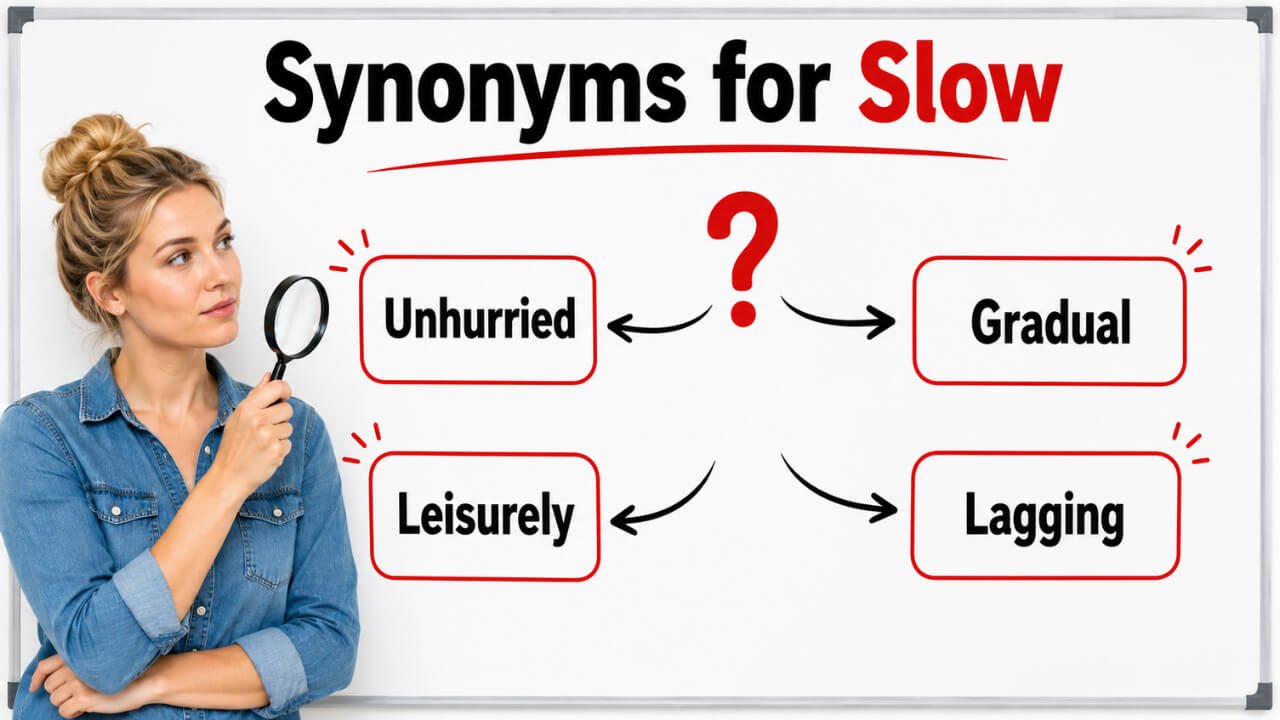
Quick Answer: Synonyms for slow include sluggish, unhurried, leisurely, gradual, delayed, late, dull, inactive, lagging, and slow moving. Use sluggish for weak speed or low energy, unhurried for calm movement, gradual for slow change, delayed for something held back, late for time, dull for slow business or activity, and lagging for slow progress or performance.
Pronunciation and Word Details
Word: Slow
Pronunciation: /sloʊ/
Part of Speech: Adjective, adverb, and verb
Meaning: Slow means moving, happening, working, or developing at a low speed or after the expected time.
US Pronunciation:
UK Pronunciation:
What Does “Slow” Mean?
Slow means not fast, not quick, or taking more time than expected. It can describe movement, progress, speed, learning, business, technology, traffic, speech, change, or reaction.
As an adjective, slow describes a person, thing, or process, such as a slow train, slow computer, slow learner, or slow response. As an adverb, it can describe how something happens, as in “Drive slow,” though “slowly” is often preferred in formal writing. As a verb, slow means to reduce speed, as in “The car began to slow near the turn.”
Meaning, Tone, and Context of “Slow”
Slow is a common, neutral word. It can sound practical, descriptive, critical, calm, or negative depending on context. In everyday speech, slow simply means not fast. In business writing, it may describe weak sales, delayed growth, or reduced activity. In technical writing, it can refer to poor performance, low speed, or delayed response.
Slow can also sound polite or positive when it means calm, careful, or relaxed. For example, a slow walk may sound peaceful. A slow internet connection, however, sounds frustrating. In academic, professional, and formal writing, more precise synonyms like gradual, delayed, sluggish, or inactive can make the meaning clearer.
When and How to Use “Slow”
For Movement: Use slow when something moves at a low speed.
Example: The slow train arrived after sunset.
For Progress: Use slow when development or improvement takes time.
Example: The project made slow progress during the first month.
For Time: Use slow when something happens later than expected.
Example: The reply was slow, but it answered the question clearly.
For Technology: Use slow when a device, system, or connection works with delay.
Example: My computer becomes slow when too many files are open.
For Business or Activity: Use slow when sales, work, or demand is weak.
Example: Business is slow during the rainy season.
For Careful Action: Use slow when something is done calmly, cautiously, or without hurry.
Example: Take a slow breath before you answer.
Best Synonyms for Slow
Sluggish: Moving or working slowly because of low energy or poor performance.
Example: The old laptop became sluggish after the update.
Unhurried: Calm and not rushed.
Example: They enjoyed an unhurried walk through the garden.
Leisurely: Relaxed and slow in a pleasant way.
Example: We had a leisurely breakfast on Sunday.
Gradual: Happening slowly over time.
Example: The company saw gradual improvement in sales.
Delayed: Happening later than planned or expected.
Example: The delayed flight upset many passengers.
Late: Arriving or happening after the expected time.
Example: His late response caused confusion.
Dull: Slow, boring, or lacking activity.
Example: The market was dull in the afternoon.
Inactive: Not busy, moving, or working.
Example: The account stayed inactive for months.
Lagging: Falling behind in speed, progress, or performance.
Example: The team is lagging behind the deadline.
Slow Moving: Moving or changing at a low speed.
Example: The slow moving traffic made everyone impatient.
50 Synonyms for Slow with Short Meanings
- Sluggish: Slow because of low energy or poor performance.
- Unhurried: Calm and not rushed.
- Leisurely: Relaxed and slow in a pleasant way.
- Gradual: Happening slowly over time.
- Delayed: Held back or happening late.
- Late: After the expected time.
- Lagging: Falling behind in progress or speed.
- Slow Moving: Moving at a low speed.
- Tardy: Late or slow to arrive.
- Dull: Slow, boring, or lacking activity.
- Inactive: Not active, busy, or moving.
- Idle: Not working or being used.
- Weak: Lacking strength, force, or speed.
- Low Speed: Moving or working at a reduced speed.
- Reduced: Lower than normal in speed or activity.
- Gentle: Soft, calm, and not fast.
- Measured: Careful, steady, and controlled.
- Steady: Regular and controlled, not rushed.
- Cautious: Slow because of care or risk.
- Careful: Done slowly to avoid mistakes.
- Patient: Willing to take time.
- Relaxed: Calm and not hurried.
- Easygoing: Casual and not rushed.
- Dragging: Moving or continuing slowly and heavily.
- Crawling: Moving extremely slowly.
- Creeping: Moving slowly and quietly.
- Plodding: Moving slowly with heavy effort.
- Lumbering: Moving slowly and awkwardly.
- Halting: Moving or speaking with pauses.
- Limping: Moving slowly with difficulty.
- Stalled: Stopped or delayed in progress.
- Postponed: Delayed until a later time.
- Deferred: Put off until later.
- Behind: Not on time or not keeping pace.
- Backward: Slow in development or progress.
- Underperforming: Performing below expected speed or quality.
- Inefficient: Not working quickly or effectively.
- Time Consuming: Taking a lot of time.
- Long Drawn: Continuing for too long.
- Prolonged: Lasting longer than expected.
- Extended: Made longer in time.
- Slow Paced: Moving or developing at a low pace.
- Low Gear: Moving with reduced speed or effort.
- Sedate: Calm, serious, and slow.
- Languid: Slow, weak, or relaxed.
- Torpid: Very slow, inactive, or lacking energy.
- Lethargic: Slow because of tiredness or low energy.
- Dormant: Temporarily inactive or not developing.
- Static: Not changing or moving.
- Motionless: Not moving at all.
Read Also:
Synonyms For Used
Synonyms for Slow by Context
When Slow Means Not Fast
Use these synonyms when slow describes movement, travel, physical speed, or general pace.
Useful Synonyms: Sluggish, slow moving, crawling, creeping, plodding, lumbering.
Example: The slow moving truck blocked the narrow road.
Example: The line was crawling forward at the ticket counter.
When Slow Means Calm or Unhurried
Use these words when slow means relaxed, peaceful, careful, or not rushed.
Useful Synonyms: Unhurried, leisurely, relaxed, easygoing, gentle, measured.
Example: They spent a leisurely afternoon near the lake.
Example: Her measured speech made the message easy to follow.
When Slow Means Gradual
Use these synonyms when slow describes change, growth, learning, improvement, or development over time.
Useful Synonyms: Gradual, steady, progressive, step by step, slow paced.
Example: The patient showed gradual recovery after treatment.
Example: The town experienced steady growth over several years.
When Slow Means Delayed
Use these words when slow means late, postponed, held back, or not happening on time.
Useful Synonyms: Delayed, late, tardy, postponed, deferred, behind.
Example: The delayed response created confusion.
Example: The project is behind schedule.
When Slow Means Weak or Inactive
Use these synonyms when slow describes poor business, low demand, weak movement, or reduced activity.
Useful Synonyms: Dull, inactive, idle, weak, sluggish, dormant.
Example: Sales were dull during the first week.
Example: The factory remained inactive after the storm.
When Slow Means Poor Performance
Use these words when slow describes technology, systems, progress, or work performance.
Useful Synonyms: Sluggish, lagging, underperforming, inefficient, stalled.
Example: The website became sluggish during heavy traffic.
Example: The team is lagging behind its target.
Another Word for Slow
Another word for slow is sluggish when something works, moves, or responds with low energy or poor speed. However, the best alternative depends on context. Use gradual for slow change, unhurried for calm action, delayed for late timing, and leisurely for relaxed pace.
Original: The computer is slow today.
Better Option: The computer is sluggish today.
Original: The changes were slow but steady.
Better Option: The changes were gradual but steady.
Original: We took a slow walk after dinner.
Better Option: We took a leisurely walk after dinner.
Original: The reply was slow.
Better Option: The reply was delayed.
When Not to Use “Slow”
Do not use slow when a more specific word would explain the meaning better. If something happens late, delayed or late is clearer. If something changes over time, gradual is more accurate. If a machine works poorly, sluggish is stronger. If the pace is calm and pleasant, leisurely sounds more positive.
Weak: The flight was slow.
Better: The flight was delayed.
Weak: The phone is slow.
Better: The phone is sluggish.
Weak: Her improvement was slow.
Better: Her improvement was gradual.
Weak: We had a slow lunch.
Better: We had a leisurely lunch.
Words Commonly Confused With Slow
Slow vs Slowly: Slow is often an adjective, while slowly is usually an adverb. “A slow car” describes the car. “The car moved slowly” describes the action.
Slow vs Sluggish: Slow means not fast. Sluggish means slow because of low energy, poor performance, or lack of force.
Slow vs Delayed: Slow means taking more time or moving at low speed. Delayed means happening later than planned.
Slow vs Gradual: Slow can describe speed or time. Gradual describes change that happens little by little.
Slow vs Late: Slow can describe pace or progress. Late means after the expected time.
Slow vs Leisurely: Slow is neutral and sometimes negative. Leisurely is positive and means relaxed and enjoyable.
Slow vs Dull: Slow describes pace or speed. Dull can describe weak activity, boring events, or low business.
Which Synonym Should You Choose?
Choose sluggish when describing a slow computer, slow system, tired movement, weak reaction, or low energy.
Choose unhurried when the pace is calm, relaxed, and not rushed.
Choose leisurely when slow feels pleasant, peaceful, or enjoyable.
Choose gradual when writing about slow change, progress, development, learning, recovery, or growth.
Choose delayed when something happens later than expected.
Choose late when the main meaning is not on time.
Choose lagging when progress, performance, speed, or results are behind the expected level.
Choose dull when business, trade, activity, or conversation feels weak or inactive.
Choose inactive when something is not working, moving, or being used.
Choose measured when slow means careful, controlled, and thoughtful.
Real Life Examples of “Slow” in Sentences
Original: The internet is slow today.
Better Option: The internet is sluggish today.
Original: The project had slow progress.
Better Option: The project had gradual progress.
Original: The bus was slow because of traffic.
Better Option: The bus was delayed because of traffic.
Original: We took a slow walk through the park.
Better Option: We took a leisurely walk through the park.
Original: His reply was slow.
Better Option: His reply was late.
Original: Sales were slow this month.
Better Option: Sales were dull this month.
Original: The old man walked slowly across the road.
Better Option: The old man moved carefully across the road.
Original: The team was slow to finish the task.
Better Option: The team was lagging behind on the task.
Original: The meeting moved at a slow pace.
Better Option: The meeting moved at a measured pace.
Original: The machine became slow after years of use.
Better Option: The machine became sluggish after years of use.
Synonym Groups and Usage Differences
Speed Group
This group includes words that describe low speed in movement, travel, or physical action.
Words: Slow, sluggish, slow moving, crawling, creeping, plodding.
Example: The traffic was crawling near the bridge.
Calm Pace Group
This group describes slow action that feels relaxed, pleasant, or controlled.
Words: Unhurried, leisurely, relaxed, easygoing, measured.
Example: She gave an unhurried explanation of the process.
Delay Group
This group describes lateness, waiting, postponement, or failure to happen on time.
Words: Delayed, late, tardy, postponed, deferred, behind.
Example: The shipment was delayed by bad weather.
Progress Group
This group works when slow refers to development, learning, improvement, or change.
Words: Gradual, steady, slow paced, long drawn, prolonged.
Example: His recovery was gradual but encouraging.
Low Activity Group
This group describes weak business, low demand, quiet periods, or reduced movement.
Words: Dull, inactive, idle, dormant, static.
Example: The office was inactive during the holiday.
Poor Performance Group
This group describes systems, teams, devices, or people not performing at the expected speed.
Words: Sluggish, lagging, underperforming, inefficient, stalled.
Example: The app was lagging after the update.
Antonyms of Slow
Fast: Moving or happening quickly.
Quick: Taking little time.
Rapid: Very fast or happening in a short time.
Swift: Smooth and fast.
Speedy: Done or moving quickly.
Prompt: Done without delay.
Immediate: Happening at once.
Hasty: Too quick, often without enough care.
Brisk: Quick, active, and energetic.
Lively: Full of activity and energy.
Efficient: Working well without wasting time.
Accelerated: Made faster or moving at a higher speed.
Comparison: Slow vs Related Words
Slow vs Sluggish
Slow means not fast. Sluggish means slow because of weakness, tiredness, low energy, or poor performance.
Example With Slow: The train was slow in the mountains.
Example With Sluggish: The computer became sluggish after the update.
Slow vs Gradual
Slow can describe speed, action, response, or progress. Gradual describes something that changes little by little over time.
Example With Slow: The car moved slowly in traffic.
Example With Gradual: The patient made gradual progress.
Slow vs Delayed
Slow means taking more time than expected or moving at low speed. Delayed means held back or happening later than planned.
Example With Slow: The service was slow at the restaurant.
Example With Delayed: The service was delayed because the kitchen was busy.
Slow vs Late
Slow describes speed or progress. Late means after the expected or proper time.
Example With Slow: The work was slow but careful.
Example With Late: The report was late.
Slow vs Leisurely
Slow can be neutral or negative. Leisurely is usually positive and means relaxed, comfortable, and unhurried.
Example With Slow: We had a slow morning.
Example With Leisurely: We had a leisurely morning.
Slow vs Dull
Slow describes low speed or reduced progress. Dull can describe low business, weak activity, or something boring.
Example With Slow: Sales were slow this week.
Example With Dull: The market was dull this week.
Common Phrases and Expressions With Slow
Slow Down: Reduce speed or become calmer.
Slow Motion: Movement shown or happening at a much lower speed.
Slow Progress: Development that takes a long time.
Slow Response: A reply or reaction that takes too long.
Slow Traffic: Traffic moving at a low speed.
Slow Start: A beginning with little speed, energy, or success.
Slow Pace: A low or relaxed speed of movement or progress.
Slow Learner: A person who needs more time to understand something.
Slow Day: A day with little activity or business.
Slow but Steady: Not fast, but continuing with regular progress.
Common Mistakes to Avoid
A common mistake is using slow when a more exact synonym would make the sentence clearer. Use delayed for lateness, gradual for change, sluggish for poor performance, and leisurely for a pleasant relaxed pace.
Another mistake is confusing slow and slowly. In formal writing, use slow as an adjective and slowly as an adverb. For example, “a slow walk” is correct, and “walk slowly” is also correct. Avoid repeating slow too often in one paragraph. Choose a synonym that matches the exact meaning of speed, delay, progress, activity, or mood.
Conclusion
Synonyms for slow help you describe speed, delay, progress, weak activity, and relaxed movement more clearly. Use sluggish for poor performance, gradual for slow change, delayed for late timing, leisurely for pleasant movement, unhurried for calm pace, and lagging for slow progress. The best synonym depends on whether the sentence is about movement, technology, business, time, learning, or development. Choosing the right word makes your writing more precise and natural.
FAQs About Synonyms for Slow
What are the best synonyms for slow?
The best synonyms for slow are sluggish, unhurried, leisurely, gradual, delayed, late, lagging, dull, inactive, and slow moving.
What is another word for slow in formal writing?
Gradual, delayed, sluggish, and reduced can work in formal writing. The best choice depends on whether you mean change, timing, performance, or speed.
What is a positive synonym for slow?
Leisurely, unhurried, relaxed, and measured are positive synonyms when slow means calm, careful, or enjoyable.
What is a synonym for slow progress?
Gradual progress, steady progress, slow paced progress, and lagging progress can describe slow progress. Use gradual when improvement is happening little by little.
What is another word for slow technology?
Sluggish is often the best word for slow technology. You can say a sluggish computer, sluggish app, sluggish system, or sluggish connection.
What is the opposite of slow?
The opposite of slow is fast. Other antonyms include quick, rapid, swift, speedy, prompt, immediate, and brisk.
Is slow always a negative word?
No. Slow can be negative when it means delayed or weak, but it can be positive when it means calm, careful, relaxed, or unhurried.
