
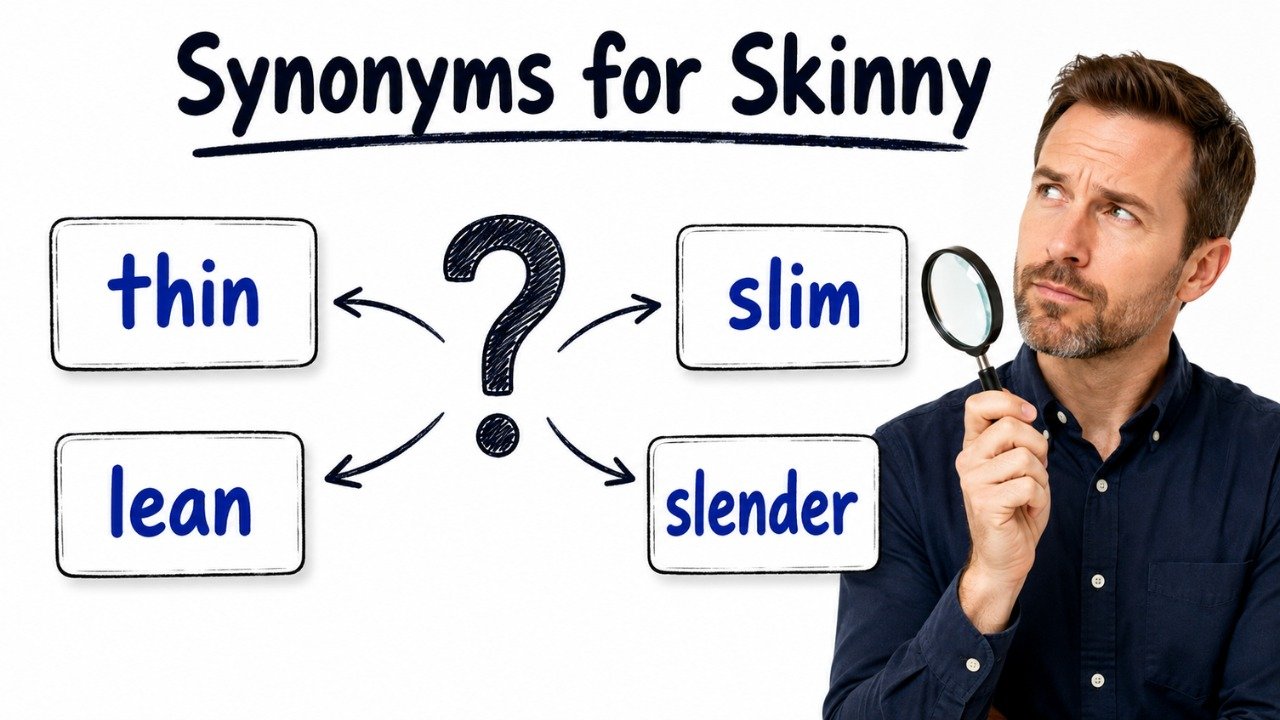
Quick Answer: The best synonyms for skinny include thin, slim, slender, lean, slight, narrow, scrawny, lanky, gaunt, and wiry. Use thin as a general and mostly neutral description. Slim and slender are more positive and polite when describing appearance. Lean suits a fit body with little excess fat, while wiry suggests thinness with strength. Lanky describes someone tall and thin. Scrawny and gaunt have negative meanings and may suggest weakness or an unhealthy appearance. Narrow is usually better for objects, spaces, and clothing.
Pronunciation and Word Details
Word: Skinny.
Pronunciation: /ˈskɪni/.
Part of Speech: Adjective and informal noun.
Meaning: Very thin, narrow, or lacking fullness, sometimes in a way that appears weak or unattractive.
US Pronunciation:
UK Pronunciation:
What Does “Skinny” Mean?
Skinny means very thin or unusually narrow. It is mainly used as an adjective to describe a person, body part, object, piece of clothing, or space.
When skinny describes a person, it usually refers to a body with very little visible fat or fullness. However, the word can sound negative, critical, or impolite because it may suggest that someone looks too thin.
Person: The skinny boy wore a loose jacket.
Body part: The chair had long, skinny legs.
Object: A skinny path ran between the buildings.
Clothing: She chose a pair of skinny trousers.
Amount: The team won by a skinny margin.
Skinny can also function as an informal noun. In the expression the skinny, it means essential facts, private details, or inside information.
Example: Give me the skinny on what happened at the meeting.
The exact meaning of skinny therefore depends on context. It may describe body shape, narrow dimensions, close fitting clothing, a small amount, or useful information.
Meaning, Tone, and Context of “Skinny”
Skinny is a common conversational word, but its tone changes according to what it describes.
Conversational tone: Skinny is widely used in everyday speech and informal writing.
Negative tone: When used for a person, it may suggest that the person looks too thin, weak, or unhealthy.
Neutral tone: It can sound neutral when describing objects such as a skinny pole, skinny path, or skinny tie.
Positive tone: In clothing descriptions, skinny may simply refer to a narrow and close fitting style.
Emotional tone: A person may feel criticized or embarrassed if someone calls their body skinny.
Informal tone: The noun meaning of skinny, referring to facts or private information, is strongly informal.
Formal context: Thin, slender, narrow, underweight, or lean may be more precise in professional and academic writing.
Medical context: Underweight is more appropriate when discussing body weight according to an assessed health standard. Skinny should not be used as a medical diagnosis.
Fashion context: Skinny commonly describes clothing that fits closely around the body, especially the legs.
Object context: Narrow, thin, fine, or tapered may describe an object more accurately than skinny.
Because skinny can carry judgment, writers should consider whether a neutral alternative would communicate the meaning more respectfully.
When and How to Use “Skinny”
For Informal Body Descriptions
Use skinny in casual conversation when the tone is not insulting and the description is relevant.
Example: The fictional character was tall and skinny.
However, slim, slender, or lean may sound more respectful when describing a real person.
For a Positive Appearance
Use slim or slender instead of skinny when you want to describe a thin appearance positively.
Example: The dress created a slim and elegant shape.
For a Fit or Athletic Body
Use lean or wiry when the person is thin but also appears strong, active, or physically fit.
Example: The runner had a lean and powerful build.
For a Tall and Thin Person
Use lanky, rangy, or willowy when height is an important part of the description.
Example: The lanky teenager had long arms and legs.
For an Unhealthy or Exhausted Appearance
Use gaunt or emaciated only when the context genuinely suggests severe thinness, illness, hunger, or exhaustion.
Example: After becoming lost for several days, the character appeared gaunt and tired.
These words are strong and should not be used casually.
For Narrow Objects
Use skinny informally for something long and narrow, although thin, narrow, fine, or slender may be more exact.
Example: A skinny branch extended over the fence.
For Close Fitting Clothing
Use skinny for clothing designed to fit closely, especially around the legs.
Example: He wore skinny trousers with a loose shirt.
For a Small Difference
Skinny can informally describe a very narrow difference, margin, or chance.
Example: The proposal passed by a skinny margin.
For Inside Information
Use the skinny informally when referring to important facts or private details.
Example: She gave us the skinny on the new project.
For Formal Writing
Replace skinny with a more precise word in reports, essays, health discussions, and professional communication.
Example: The narrow passage connected the two rooms.
Best Synonyms for Skinny
Thin
Synonym: Having little thickness, width, or body fat.
Example: The thin branches moved in the wind.
Slim
Synonym: Attractively or neatly thin.
Example: He had a slim build and wore a fitted suit.
Slender
Synonym: Gracefully thin, narrow, or delicate.
Example: The vase had a tall, slender neck.
Lean
Synonym: Thin with little excess fat, often suggesting fitness or strength.
Example: The athlete maintained a lean and muscular body.
Slight
Synonym: Small, thin, and lightly built.
Example: She had a slight frame but a confident presence.
Narrow
Synonym: Having little width from one side to the other.
Example: They followed a narrow road through the village.
Scrawny
Synonym: Unattractively thin or lacking strength.
Example: The scrawny stray dog needed food and care.
Lanky
Synonym: Tall, thin, and sometimes awkward in movement.
Example: The lanky student had difficulty finding sleeves that were long enough.
Gaunt
Synonym: Extremely thin, often because of illness, hardship, or exhaustion.
Example: The tired traveler looked pale and gaunt.
Wiry
Synonym: Thin but physically strong and energetic.
Example: The wiry climber moved quickly over the rocks.
50 Synonyms for Skinny with Short Meanings
The following words are direct synonyms or close alternatives. Some describe people, while others are more suitable for objects, clothing, health, or informal information.
- Thin: Having little thickness, width, or fullness.
- Slim: Thin in an attractive or controlled way.
- Slender: Gracefully thin and narrow.
- Lean: Thin with little excess fat.
- Slight: Small and lightly built.
- Narrow: Having limited width.
- Scrawny: Unattractively thin and weak looking.
- Lanky: Tall and noticeably thin.
- Gaunt: Extremely thin from hardship, illness, or exhaustion.
- Wiry: Thin but strong and energetic.
- Bony: So thin that the bones appear prominent.
- Angular: Having sharp body lines or visible bone structure.
- Trim: Neat, fit, and not carrying excess weight.
- Svelte: Elegantly slim and graceful.
- Petite: Small and delicately built, especially in height and frame.
- Spare: Lean and without excess flesh.
- Rangy: Tall, long limbed, and lean.
- Willowy: Tall, slender, and gracefully flexible.
- Spindly: Long, thin, and appearing weak.
- Gangly: Tall, thin, and somewhat awkward.
- Leggy: Having noticeably long and slender legs.
- Lithe: Thin, flexible, and graceful in movement.
- Sinewy: Lean, tough, and muscular.
- Rawboned: Thin with a large or clearly visible bone structure.
- Underweight: Weighing less than an assessed healthy range.
- Emaciated: Extremely thin because of severe illness or lack of food.
- Skeletal: So thin that the bones are highly visible.
- Wasted: Severely weakened and reduced in body mass.
- Cadaverous: Extremely thin, pale, and unhealthy looking.
- Scraggy: Thin, rough looking, and lacking healthy fullness.
- Stick thin: Extremely thin in appearance.
- Rail thin: Very tall or straight and extremely thin.
- Fine boned: Having a small and delicate bone structure.
- Small framed: Having a naturally small body structure.
- Lightly built: Having a thin and relatively delicate build.
- Narrow framed: Having a body structure that is not broad.
- Delicate: Fine, slight, or physically small in appearance.
- Fragile looking: Appearing thin and physically delicate.
- Reedlike: Tall, straight, and slender like a reed.
- Attenuated: Made unusually thin, narrow, or reduced.
- Slimline: Designed with a thin or narrow shape.
- Tapered: Becoming gradually narrower toward one end.
- Close fitting: Fitting tightly around the body.
- Tight fitting: Made to follow the shape of the body closely.
- Narrow cut: Designed with a slim width or fitted shape.
- Pencil slim: Extremely narrow and straight in shape.
- Low fat: Containing a reduced amount of fat.
- Low calorie: Containing relatively few calories.
- Facts: The essential truth or information about something.
- Inside information: Private or useful details not widely known.
Read Also:
Synonyms for Straightforward
Synonyms for Skinny by Context
When Skinny Means Generally Thin
Thin is the broadest and most direct replacement for skinny. Slight and lightly built are also useful when describing a person without strong judgment.
Thin: The character had a thin face and long fingers.
Slight: Despite his slight build, he carried the heavy box.
Lightly built: She was lightly built and moved with ease.
Thin can still sound sensitive when applied directly to a person, so context and tone remain important.
When Skinny Means Attractively Slim
Slim, slender, svelte, trim, and willowy describe thinness in a more positive or elegant way.
Slim: The jacket gave him a slim appearance.
Slender: The dancer had long, slender arms.
Svelte: She appeared svelte in the carefully fitted dress.
Trim: Regular exercise helped him maintain a trim figure.
These choices usually sound more complimentary than skinny.
When Skinny Means Tall and Thin
Lanky, rangy, gangly, willowy, and rail thin combine thinness with height or long limbs.
Lanky: The lanky player reached the highest shelf easily.
Rangy: The rangy horse moved across the field with long strides.
Gangly: He was a gangly teenager who had not yet grown comfortable with his height.
Willowy: The willowy performer moved gracefully across the stage.
Lanky and gangly may suggest awkwardness, while willowy is usually positive.
When Skinny Suggests Strength
Lean, wiry, sinewy, trim, and lithe describe a thin body that also appears strong, active, or flexible.
Lean: The swimmer had a lean and powerful build.
Wiry: The wiry worker lifted the equipment without difficulty.
Sinewy: His sinewy arms showed the effects of years of physical labor.
Lithe: The gymnast was lithe and controlled in every movement.
These words are often more accurate than skinny for athletes and physically active people.
When Skinny Suggests Weakness
Scrawny, bony, spindly, scraggy, and fragile looking may suggest weakness, poor condition, or lack of healthy fullness.
Scrawny: The scrawny kitten needed regular meals.
Bony: The old chair had bony looking wooden arms.
Spindly: The plant produced several spindly stems.
Fragile looking: The fragile looking structure needed extra support.
These alternatives often have negative meanings and should be used carefully for people.
When Skinny Suggests Severe Thinness
Gaunt, emaciated, skeletal, wasted, and cadaverous describe extreme thinness.
Gaunt: The character looked gaunt after weeks of hardship.
Emaciated: The rescued animal was emaciated and required professional care.
Skeletal: The old tree had a skeletal shape during winter.
Wasted: The illness left the fictional patient weak and wasted.
These words are much stronger than skinny and should only be used when the context supports them.
When Skinny Describes Objects
Thin, narrow, slender, fine, tapered, attenuated, and pencil slim work well for objects and spaces.
Narrow: A narrow bridge crossed the stream.
Slender: A slender column supported the roof.
Tapered: The tool had a tapered handle.
Pencil slim: The device had a pencil slim shape.
Narrow is best for width, while thin is better for thickness.
When Skinny Describes Clothing
Slimline, close fitting, tight fitting, narrow cut, tapered, and slim are suitable for clothing.
Slimline: The slimline jacket created a clean shape.
Close fitting: She chose close fitting trousers for the outfit.
Tapered: The trousers were tapered at the ankles.
Narrow cut: The narrow cut shirt suited his frame.
When Skinny Means Low Fat or Low Calorie
Low fat, reduced fat, light, and low calorie may replace skinny when discussing food or drinks. These terms are more precise because skinny is informal and may not explain the exact nutritional difference.
Low fat: He chose a low fat sauce.
Low calorie: The meal included several low calorie ingredients.
Light: She ordered a light meal before the journey.
When Skinny Means Inside Information
When skinny is used as a noun, facts, details, essential information, and inside information are suitable alternatives.
Facts: Tell me the facts before I make a decision.
Details: She shared the important details of the agreement.
Inside information: He appeared to have inside information about the change.
Another Word for Skinny
Thin is the best single general replacement for skinny because it can describe people, objects, materials, and spaces. However, the best alternative depends on the intended tone and meaning.
Use slim or slender for a positive description of appearance. Use lean for a fit or athletic body. Use narrow for objects and spaces. Use lanky for a tall and thin person.
Original: He was a skinny young man.
Better Option: He was a slender young man.
Original: The athlete had a skinny body.
Better Option: The athlete had a lean build.
Original: We walked through a skinny passage.
Better Option: We walked through a narrow passage.
Original: The skinny teenager had very long arms.
Better Option: The lanky teenager had very long arms.
When Not to Use “Skinny”
Skinny may sound judgmental, inaccurate, overly casual, or unclear in certain situations.
When Describing a Real Person Directly
Calling someone skinny can sound critical even when no insult is intended. Use a neutral word or avoid commenting on the person’s body.
Weak: You look really skinny in that outfit.
Better: That outfit suits you well.
When You Mean Attractively Thin
Slim or slender usually communicates positive appearance more clearly.
Weak: She had a beautiful skinny figure.
Better: She had a beautiful slender figure.
In Medical or Health Discussions
Skinny is not a medical term and does not show whether someone is healthy.
Weak: The patient is medically skinny.
Better: The patient is underweight according to the assessment.
When You Are Assuming Someone’s Health
A person’s appearance alone does not prove illness, poor nutrition, or physical weakness.
Weak: He is skinny, so he must be unhealthy.
Better: His health cannot be determined from appearance alone.
In Formal Reports
Skinny may sound too conversational for academic, scientific, technical, or professional writing.
Weak: The building has a skinny entrance.
Better: The building has a narrow entrance.
When Describing Athletic Thinness
Skinny may ignore visible strength and physical conditioning.
Weak: The runner had skinny legs.
Better: The runner had lean, powerful legs.
When a More Precise Measurement Is Available
Skinny can be vague when exact width, thickness, or dimensions matter.
Weak: The material was skinny.
Better: The material was only two millimetres thick.
When Repetition Weakens the Writing
Repeating skinny can make a paragraph sound basic and judgmental.
Weak: The skinny man wore skinny trousers and carried a skinny bag.
Better: The slender man wore tapered trousers and carried a narrow bag.
When Describing Severe Thinness
Use a stronger term only when the context genuinely supports it.
Weak: The starving character looked skinny.
Better: The starving character appeared gaunt and severely weakened.
Words Commonly Confused With Skinny
Skinny vs Thin: Skinny usually means very thin and can sound negative. Thin is broader and more neutral, although it may still be sensitive when describing a person.
Skinny vs Slim: Skinny may suggest excessive thinness. Slim usually describes an attractively or neatly thin appearance.
Skinny vs Slender: Skinny can sound critical or casual. Slender suggests graceful and proportionate thinness.
Skinny vs Lean: Skinny focuses on a lack of fullness. Lean often suggests fitness, strength, and little excess fat.
Skinny vs Scrawny: Skinny is informal and may be neutral or negative. Scrawny is clearly negative and suggests thinness with weakness.
Skinny vs Lanky: Skinny describes thinness. Lanky describes someone who is both tall and thin, often with long limbs.
Skinny vs Gaunt: Skinny means very thin. Gaunt is stronger and often suggests illness, hunger, exhaustion, or hardship.
Skinny vs Bony: Skinny describes the overall thin appearance. Bony emphasizes that the bones are visible or prominent.
Skinny vs Petite: Skinny refers to thinness. Petite usually means small in height and body frame and does not necessarily mean extremely thin.
Skinny vs Underweight: Skinny is an informal description based on appearance. Underweight is a more objective health related classification based on an assessment.
Skinny vs Narrow: Skinny can describe people or objects informally. Narrow refers specifically to limited width and is usually more precise for objects and spaces.
Skinny vs Wiry: Skinny may suggest weakness. Wiry describes someone who is thin but strong, tough, and energetic.
Which Synonym Should You Choose?
Choose thin for a broad and mostly neutral description of limited thickness, width, or body fullness.
Choose slim when describing an attractive, controlled, or neatly proportioned appearance.
Choose slender when emphasizing elegance, grace, length, or delicate narrowness.
Choose lean when describing an athletic or fit person with little excess fat.
Choose wiry when a thin person is also strong, active, and physically tough.
Choose slight when someone has a naturally small and lightly built frame.
Choose petite when describing a person who is small in height and body structure.
Choose lanky when someone is tall, thin, and long limbed.
Choose willowy when a tall and slender person appears graceful.
Choose scrawny when thinness appears weak or unattractive, but remember that the word is insulting when directed at a person.
Choose gaunt when severe thinness results from hardship, exhaustion, or illness.
Choose underweight in formal health discussions based on a proper assessment.
Choose narrow for roads, passages, gaps, strips, and other objects with limited width.
Choose tapered when an object or item of clothing gradually becomes narrower.
Choose close fitting for clothing that follows the shape of the body.
Choose low fat or low calorie when discussing the nutritional content of food.
Choose facts, details, or inside information when skinny is used as an informal noun.
Real Life Examples of “Skinny” in Sentences
Original: The skinny runner crossed the finish line first.
Better Option: The lean runner crossed the finish line first.
Original: She wore a skinny black dress to the dinner.
Better Option: She wore a slim, close fitting black dress to the dinner.
Original: A skinny road led to the farmhouse.
Better Option: A narrow road led to the farmhouse.
Original: The puppy looked skinny when it was rescued.
Better Option: The puppy looked underweight when it was rescued.
Original: He was a skinny and unusually tall teenager.
Better Option: He was a lanky teenager.
Original: The artist painted a skinny tower in the distance.
Better Option: The artist painted a slender tower in the distance.
Original: Her skinny arms were surprisingly strong.
Better Option: Her wiry arms were surprisingly strong.
Original: The plant produced skinny stems in poor light.
Better Option: The plant produced spindly stems in poor light.
Original: We won the competition by a skinny margin.
Better Option: We won the competition by a narrow margin.
Original: Tell me the skinny on the new arrangement.
Better Option: Tell me the important details of the new arrangement.
Synonym Groups and Usage Differences
Neutral Thinness Group
Thin, slight, lightly built, and small framed describe limited body size or fullness without necessarily expressing approval or criticism.
Thin is the most general term. Slight emphasizes a delicate build. Small framed refers to natural bone structure.
Example: She had a slight frame and a confident manner.
Positive Appearance Group
Slim, slender, svelte, trim, willowy, and petite usually present thinness positively.
Slim suggests controlled proportions. Slender adds elegance. Svelte is stylish and complimentary. Willowy combines height, thinness, and grace.
Example: The actor had a slender and elegant appearance.
Athletic Build Group
Lean, wiry, sinewy, lithe, and trim describe thinness combined with fitness, strength, or flexibility.
Lean is suitable for athletes. Wiry suggests compact strength. Lithe emphasizes smooth and flexible movement.
Example: The wiry climber moved confidently across the steep surface.
Tall and Thin Group
Lanky, gangly, rangy, leggy, rail thin, and willowy describe thinness connected with height or long limbs.
Lanky and gangly can suggest awkwardness. Rangy often suggests long, powerful limbs. Willowy is more graceful.
Example: The lanky student stood above the rest of the group.
Weak or Unattractive Thinness Group
Scrawny, bony, spindly, scraggy, and fragile looking suggest weakness, poor development, or lack of fullness.
These words can sound insulting when describing people and should be used with care.
Example: The neglected plant had several spindly branches.
Severe Thinness Group
Gaunt, emaciated, skeletal, wasted, and cadaverous indicate extreme thinness associated with serious hardship or poor condition.
These are strong terms and should not replace skinny in ordinary descriptions.
Example: The fictional prisoner appeared gaunt after months of hardship.
Narrow Object Group
Thin, narrow, slender, fine, tapered, pencil slim, and attenuated describe limited width or thickness.
Narrow refers to width. Thin usually refers to thickness. Tapered means becoming narrower toward one end.
Example: A slender metal rod supported the structure.
Clothing Group
Skinny, slimline, close fitting, tight fitting, narrow cut, and tapered describe clothing that follows the body closely.
Close fitting is neutral. Tight fitting emphasizes limited looseness. Tapered describes a gradual reduction in width.
Example: He chose tapered trousers for a clean and modern shape.
Information Group
Facts, details, essential information, inside information, and background describe skinny when it is used as an informal noun.
Example: She gave me the essential information before the interview.
Antonyms of Skinny
The opposite of skinny depends on whether the word describes a person, object, space, amount, or style.
Thick: Having considerable depth or distance between surfaces.
Wide: Extending a large distance from side to side.
Broad: Wide or large across.
Stocky: Short, solid, and strongly built.
Stout: Thick or heavy in body shape.
Plump: Having a pleasantly full or rounded shape.
Curvy: Having a body shape with noticeable curves.
Full figured: Having a fuller and more rounded body shape.
Heavyset: Having a broad and relatively heavy build.
Muscular: Having well developed muscles.
Bulky: Large and difficult to move because of size.
Robust: Strong, solid, and healthy looking.
Substantial: Large, solid, or considerable in size.
Ample: Generous or more than sufficient in size or amount.
Roomy: Providing plenty of space, especially in clothing or rooms.
Loose fitting: Not fitting closely around the body.
When describing people, choose respectful and relevant language rather than treating one body type as better than another.
Comparison of Skinny and Related Words
Skinny vs Thin
Skinny usually means very thin and may sound negative. Thin is broader and more neutral for people, objects, and materials.
Example With Skinny: The skinny character wore an oversized coat.
Example With Thin: A thin layer of ice covered the ground.
Skinny vs Slim
Skinny may suggest that someone is too thin. Slim normally presents thinness as attractive or desirable.
Example With Skinny: The puppy looked skinny and needed care.
Example With Slim: The suit gave him a slim appearance.
Skinny vs Slender
Skinny is casual and sometimes critical. Slender is more elegant and often describes graceful proportions.
Example With Skinny: The table stood on four skinny legs.
Example With Slender: The table stood on four slender legs.
Skinny vs Lean
Skinny focuses on limited body fat or fullness. Lean often suggests fitness, muscle, and physical conditioning.
Example With Skinny: The character was skinny after weeks without proper meals.
Example With Lean: The cyclist had a lean and powerful build.
Skinny vs Scrawny
Skinny may be neutral in some informal contexts. Scrawny is clearly negative and suggests weakness or poor development.
Example With Skinny: The fictional boy was tall and skinny.
Example With Scrawny: The scrawny plant could not support its own branches.
Skinny vs Lanky
Skinny refers mainly to thinness. Lanky describes a tall and thin person with long limbs.
Example With Skinny: He had a skinny frame.
Example With Lanky: The lanky goalkeeper easily reached the top corner.
Skinny vs Gaunt
Skinny is an ordinary informal description. Gaunt indicates severe thinness, often connected with suffering, illness, or exhaustion.
Example With Skinny: The cat was skinny when the family found it.
Example With Gaunt: The lost traveler returned looking gaunt and exhausted.
Skinny vs Wiry
Skinny may suggest a lack of strength. Wiry describes a thin person whose body is strong and tough.
Example With Skinny: The skinny man carried a small bag.
Example With Wiry: The wiry man lifted the heavy bag easily.
Skinny vs Petite
Skinny means very thin. Petite means small in height and frame and does not automatically describe weight.
Example With Skinny: The costume made the character look skinny.
Example With Petite: The shop offered clothing designed for petite customers.
Skinny vs Underweight
Skinny is a visual and informal description. Underweight refers to body weight that falls below an assessed range.
Example With Skinny: The narrator described the fictional character as skinny.
Example With Underweight: The assessment indicated that the patient was underweight.
Common Phrases and Expressions With Skinny
Skinny jeans: Trousers designed to fit closely from the hips to the ankles.
Skinny fit: A clothing shape that fits very closely around the body.
Skinny tie: A necktie with a narrow width.
Skinny legs: An informal description of very thin legs.
Skinny arms: An informal description of very thin arms.
Skinny build: A body shape with little visible fullness.
Skinny dipping: Swimming without wearing clothes.
The skinny: The essential facts or private information about something.
Get the skinny: Learn the important or hidden details.
Skinny chance: A very small possibility of success.
Skinny margin: A very narrow difference between two results.
Skinny strip: A long and narrow piece of land, fabric, or material.
Common Mistakes to Avoid
Using Skinny as a Compliment Without Considering Tone
Some people may view skinny as praise, while others may find it uncomfortable or insulting.
Mistake: You are so skinny now. You look much better.
Better Choice: You look confident and well.
Assuming Thinness Shows Health
Skinny describes appearance, not overall health. A thin person may be healthy or unhealthy, just as a larger person may be healthy or unhealthy.
Mistake: She is skinny, so she must be healthy.
Better Choice: Her health cannot be judged from her body shape alone.
Confusing Skinny With Slim
Slim is usually positive or neutral. Skinny often suggests excessive thinness.
Mistake: The advertisement described the elegant design as scrawny.
Better Choice: The advertisement described the elegant design as slim.
Confusing Skinny With Lean
Lean often includes strength and physical fitness, while skinny does not.
Mistake: The trained athlete had a weak, skinny build.
Better Choice: The trained athlete had a lean, powerful build.
Using Strong Medical Sounding Words Casually
Emaciated, gaunt, skeletal, and underweight have specific and serious implications.
Mistake: She skipped lunch and looked emaciated.
Better Choice: She looked slightly tired after missing lunch.
Using Skinny When Dimensions Are Available
Skinny is vague in technical or practical writing.
Mistake: Use a skinny board for the shelf.
Better Choice: Use a board that is ten centimetres wide.
Repeating the Same Description
Using skinny several times in one paragraph creates weak and monotonous writing.
Mistake: A skinny man walked down a skinny road carrying a skinny case.
Better Choice: A slender man walked down a narrow road carrying a slim case.
Using More Skinny Instead of Skinnier
The standard comparative form of skinny is skinnier. The standard superlative form is skinniest.
Incorrect: This branch is more skinny than the other one.
Correct: This branch is skinnier than the other one.
Incorrect: That is the most skinny tree in the garden.
Correct: That is the skinniest tree in the garden.
Forgetting the Informal Noun Meaning
Skinny can mean important or private information when used as a noun.
Example: She gave me the skinny on the situation.
In formal writing, use facts, details, or essential information instead.
Using a Person Word for an Object
Certain synonyms only work naturally for people.
Unnatural: The road was gaunt.
Natural: The road was narrow.
Using an Object Word for a Person
Narrow is usually unsuitable as a complete description of a person’s body.
Unnatural: He was a narrow man.
Natural: He was a slender man.
Conclusion
The best synonyms for skinny depend on the subject, tone, and intended meaning. Thin is the broadest alternative, while slim, slender, and svelte create a more positive description. Lean, wiry, and sinewy suit strong or athletic bodies. Lanky describes someone tall and thin, while scrawny and gaunt carry negative meanings. Narrow, tapered, and slimline work better for objects or clothing. Choosing precise synonyms for skinny helps writers communicate clearly while avoiding vague, insensitive, or misleading descriptions.
FAQs About Synonyms for Skinny
What Is the Best Synonym for Skinny?
Thin is the best general synonym. Slim, slender, lean, narrow, or lanky may be better depending on the context.
What Is a Polite Word for Skinny?
Slim and slender are usually more polite. Slight, petite, or lean may also work when they accurately describe the person.
Is Skinny a Negative Word?
Skinny can sound negative because it may suggest excessive thinness, weakness, or an unattractive appearance. Its tone depends on the context.
What Is a Positive Synonym for Skinny?
Slim, slender, svelte, trim, lean, lithe, and willowy are positive alternatives.
What Is the Difference Between Skinny and Lean?
Skinny means very thin and may suggest weakness. Lean describes a body with little excess fat and often suggests fitness or strength.
What Word Describes Someone Tall and Skinny?
Lanky is the most common word. Rangy, gangly, rail thin, and willowy may also work depending on the tone.
Can Skinny Describe Things Other Than People?
Yes. Skinny can describe narrow roads, thin objects, close fitting clothes, small margins, low calorie food, or important information in informal speech.
