
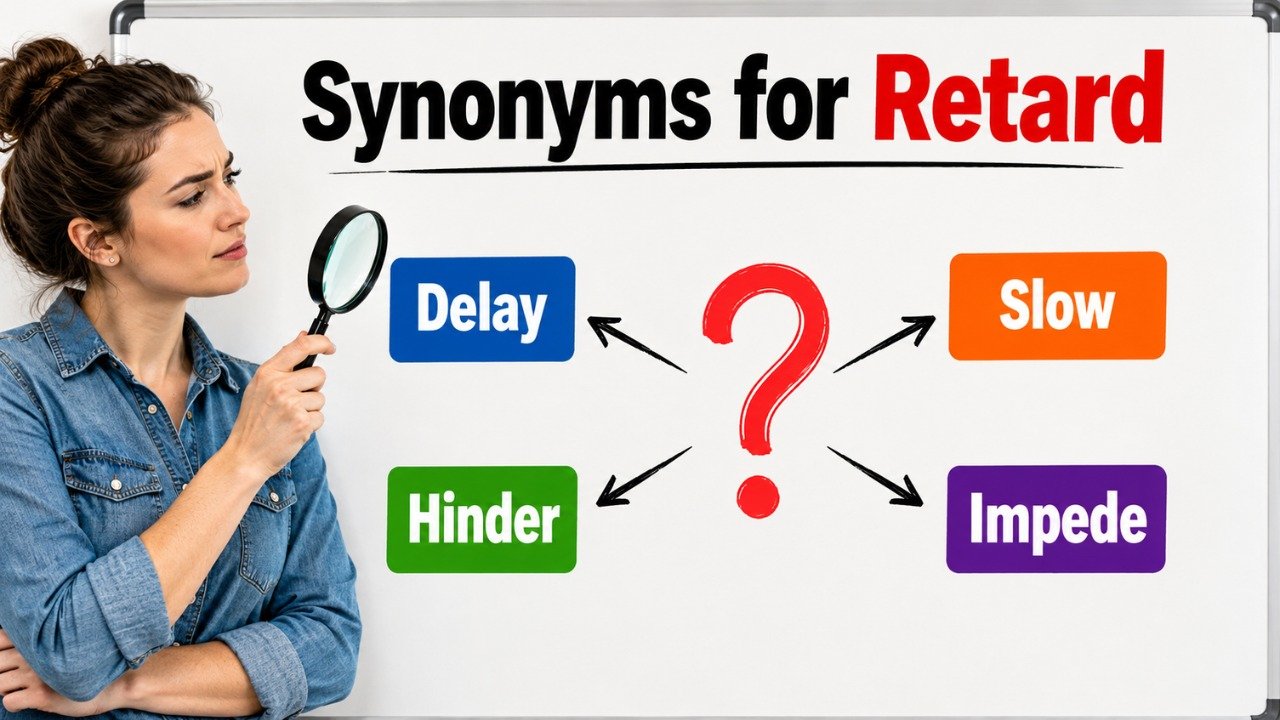
Quick Answer: The best synonyms for retard in its standard verb sense include delay, slow, hinder, impede, obstruct, hamper, inhibit, restrain, stall, and hold back. Use delay for schedules and completion times, slow for speed or gradual progress, hinder for general difficulty, and impede for formal writing. Inhibit works well for growth, development, or chemical processes. Stall suggests a temporary lack of progress, while restrain and hold back describe limiting movement, action, or advancement. The noun use of this word is offensive and should be avoided.
Pronunciation and Word Details
Word: Retard.
Pronunciation: /rɪˈtɑːrd/
Part of Speech: Verb.
Meaning: To make an action, process, movement, growth, or development slower.
US Pronunciation:
UK Pronunciation:
What Does “Retard” Mean?
Retard means to delay, slow, hinder, or prevent the normal progress of something.
As a verb, it can describe anything that reduces speed or delays development. A lack of resources may retard economic progress. Cold conditions may retard plant growth. A material may retard the spread of heat or fire.
The verb is more common in formal, scientific, technical, medical, historical, and academic writing than in everyday conversation. In ordinary speech, people usually choose delay, slow, hinder, or hold back.
The word has also been used as a noun to insult or label people with intellectual disabilities. That use is offensive, disrespectful, and inappropriate. It should not be treated as an acceptable synonym for a person or a medical condition.
Physical Movement: Friction can retard the movement of an object.
Growth: Poor nutrition may retard healthy development.
Progress: Unnecessary rules can retard innovation.
Chemical Process: Lower temperatures may retard the reaction.
Spread: The treatment may retard the spread of the disease.
Meaning, Tone, and Context of “Retard”
Retard is usually formal, technical, and somewhat old fashioned when used as a verb. It appears in discussions of science, engineering, medicine, agriculture, economics, manufacturing, and physical processes.
In scientific writing, it may describe a reduction in the speed of a reaction, movement, flame, biological process, or material change. In academic writing, it can refer to something that limits progress or development.
The word may sound unnatural in casual conversation. Most speakers would say that something slowed progress, delayed the project, or held back development.
Because the noun form has a history of offensive use, some readers may react negatively even when the verb is used correctly. A clearer synonym is often preferable when it preserves the intended meaning.
Formal Tone: Excessive regulation may retard industrial growth.
Technical Tone: The coating is designed to retard heat transfer.
Scientific Tone: Low temperatures retard bacterial activity.
Conversational Alternative: The bad weather slowed construction.
Respectful Usage: Use person first language when referring to intellectual disability and never use the word as an insult.
When and How to Use “Retard”
For Delaying Progress
Use retard when something causes a process, plan, or effort to advance more slowly.
Example: Limited funding may retard progress on the research project.
For Slowing Physical Movement
The word can describe a force or condition that reduces speed.
Example: Air resistance retards the falling object.
For Limiting Growth
Retard may describe reduced biological, agricultural, economic, or organizational growth.
Example: A lack of sunlight can retard plant growth.
For Slowing a Chemical Process
The word is common in technical descriptions of reactions and changes.
Example: Cooling the mixture will retard the chemical reaction.
For Delaying Development
Use it when circumstances prevent normal or expected development.
Example: Severe shortages may retard regional development.
For Reducing the Spread of Something
Retard may describe slowing the movement of fire, disease, decay, or another expanding process.
Example: The barrier was designed to retard the spread of smoke.
For Formal Analysis
The verb can be useful in academic or professional writing when a precise formal tone is required.
Example: Political instability can retard long term investment.
For Everyday Conversation
In casual speech, choose slow, delay, hinder, or hold back because they sound more natural.
Example: The traffic delayed our arrival.
Best Synonyms for Retard
Delay: To make something happen later than expected.
Example: Equipment failure delayed the launch.
Slow: To reduce the speed or rate of an action or process.
Example: Heavy rain slowed the construction work.
Hinder: To make progress or action more difficult.
Example: Poor communication hindered the team’s progress.
Impede: To obstruct or slow advancement, movement, or activity.
Example: Complex procedures impeded the approval process.
Obstruct: To block movement, progress, or access.
Example: Fallen branches obstructed the road.
Hamper: To make an activity difficult or less effective.
Example: A shortage of staff hampered production.
Inhibit: To limit, suppress, or slow a process, reaction, or behavior.
Example: The substance inhibits bacterial growth.
Restrain: To limit movement, action, development, or force.
Example: High costs restrained consumer demand.
Stall: To stop or delay progress temporarily.
Example: Disagreement stalled the negotiations.
Hold Back: To prevent someone or something from advancing fully.
Example: A lack of confidence held her back.
50 Synonyms for Retard with Short Meanings
- Delay: Make something happen later.
- Slow: Reduce speed or progress.
- Hinder: Make action or progress difficult.
- Impede: Slow or obstruct advancement.
- Obstruct: Block movement or progress.
- Hamper: Limit effectiveness or activity.
- Inhibit: Suppress or slow a process.
- Restrain: Keep movement or growth under control.
- Check: Slow, limit, or stop progress.
- Arrest: Stop or greatly slow development.
- Postpone: Move an event to a later time.
- Defer: Delay action or a decision.
- Stall: Cause progress to stop temporarily.
- Hold Back: Prevent full movement or advancement.
- Set Back: Delay progress through a difficulty.
- Hold Up: Cause an unwanted delay.
- Bog Down: Make progress slow and difficult.
- Encumber: Burden or obstruct movement.
- Block: Prevent movement, action, or progress.
- Prevent: Stop something from happening.
- Suppress: Limit or prevent growth or activity.
- Curb: Control or reduce something unwanted.
- Limit: Restrict the amount, speed, or extent.
- Restrict: Place boundaries on action or progress.
- Constrain: Limit freedom, development, or movement.
- Decelerate: Reduce the speed of movement.
- Brake: Cause movement to become slower.
- Slow Down: Make a process less rapid.
- Interrupt: Temporarily stop an action or process.
- Disrupt: Disturb normal progress or operation.
- Suspend: Stop an activity for a period.
- Pause: Cause a temporary stop.
- Detain: Keep someone or something from proceeding.
- Prolong: Make a process last longer.
- Protract: Extend an activity unnecessarily.
- Drag Out: Make something continue too long.
- Put Off: Delay an action until later.
- Shelve: Delay or abandon a plan temporarily.
- Thwart: Prevent a plan from succeeding.
- Frustrate: Prevent progress or achievement.
- Impair: Reduce effectiveness or normal function.
- Weaken: Reduce strength, speed, or effectiveness.
- Dampen: Reduce force, growth, or enthusiasm.
- Moderate: Reduce intensity or speed.
- Reduce: Make an amount, rate, or effect smaller.
- Depress: Lower a rate, level, or activity.
- Delay Progress: Cause advancement to occur later.
- Inhibit Growth: Limit normal expansion or development.
- Impede Development: Make development slower or harder.
- Delay Advancement: Prevent timely forward movement.
Read Also:
Synonyms for Remain

Synonyms for Retard by Context
When Retard Means Delay
Delay, postpone, defer, put off, hold up, and stall describe something happening later than planned.
Delay is the most general choice. It can apply to travel, projects, decisions, deliveries, construction, and events.
Example With Retard: The legal dispute retarded completion of the project.
Example With Delay: The legal dispute delayed completion of the project.
Postpone usually means moving a planned event or activity to a later time.
Example: The organizers postponed the meeting until Friday.
Defer is more formal and often applies to decisions, payments, action, or responsibility.
Example: The board deferred its decision until more evidence was available.
When Retard Means Slow
Slow, decelerate, brake, moderate, reduce, and slow down describe a decrease in speed or rate.
Slow is the most natural everyday replacement.
Example With Retard: Rough conditions retarded the vehicle’s movement.
Example With Slow: Rough conditions slowed the vehicle’s movement.
Decelerate is a precise technical word for reducing physical speed.
Example: The driver decelerated before entering the narrow turn.
Moderate means to reduce intensity, force, or speed without stopping something completely.
Example: The new controls moderated the flow of water.
When Retard Means Hinder Progress
Hinder, impede, hamper, obstruct, encumber, and bog down describe difficulty that prevents smooth progress.
Hinder is useful in both formal and everyday writing.
Example: A lack of reliable information hindered the investigation.
Impede is more formal and suggests that movement or advancement has been obstructed.
Example: Outdated procedures impeded economic growth.
Hamper often means reducing effectiveness rather than stopping progress completely.
Example: Poor visibility hampered the rescue effort.
When Retard Means Inhibit Growth
Inhibit, suppress, restrain, curb, check, arrest, and constrain describe limited growth, development, or activity.
Inhibit is common in science, medicine, psychology, and formal analysis.
Example: The compound inhibits the growth of harmful bacteria.
Suppress means to reduce or prevent an activity, response, or process.
Example: The treatment suppresses inflammation.
Arrest is stronger and often means stopping development almost completely.
Example: Early treatment may arrest the progression of the condition.
When Retard Means Prevent Advancement
Hold back, set back, thwart, frustrate, block, and prevent describe something that stops success or forward movement.
Hold back is natural in conversation and may apply to people, skills, progress, or development.
Example: Fear of failure held him back.
Set back suggests that progress has been lost because of a problem.
Example: The equipment failure set the project back by several weeks.
Thwart means preventing a goal, plan, or attempt from succeeding.
Example: Strong security measures thwarted the attempted theft.
When Retard Means Extend a Process
Prolong, protract, drag out, stall, and delay describe an activity lasting longer than necessary or expected.
Prolong is usually neutral or formal.
Example: Unresolved questions prolonged the discussion.
Protract often carries a negative meaning and suggests unnecessary length.
Example: The dispute was protracted by repeated appeals.
Drag out is informal and clearly negative.
Example: They dragged out the negotiations for months.
Another Word for Retard
The best single replacement for retard is usually slow. It is clear, neutral, and suitable in both formal and conversational writing. However, delay is better for time, impede is better for formal discussions of progress, and inhibit is more precise for growth, reactions, or biological processes.
Original: Cold weather may retard the growth of these plants.
Better Option: Cold weather may slow the growth of these plants.
Original: Administrative problems retarded the project.
Better Option: Administrative problems delayed the project.
Original: Poor infrastructure can retard regional development.
Better Option: Poor infrastructure can impede regional development.
Original: The substance retards bacterial activity.
Better Option: The substance inhibits bacterial activity.
When Not to Use “Retard”
When Writing Casual Conversation
The verb may sound overly formal, technical, or old fashioned in everyday speech.
Weak: Traffic retarded our journey to the airport.
Better: Traffic delayed our journey to the airport.
When a More Precise Verb Is Available
Retard can be vague because it may mean delay, slow, hinder, or inhibit.
Weak: The problem retarded the process.
Better: The equipment failure slowed the manufacturing process.
When Referring to a Person
Do not use the word as a noun or insult for a person. That use is offensive and dehumanizing.
Wrong: He called the student a retard.
Better: He used an offensive insult against the student.
When discussing disability, use accurate and respectful language such as person with an intellectual disability when that information is genuinely relevant.
When Describing a Scheduled Event
Postpone, defer, or delay usually communicates the timing more clearly.
Weak: The storm retarded the outdoor ceremony.
Better: The storm delayed the outdoor ceremony.
When Describing Complete Prevention
Retard usually means slowing rather than stopping something entirely.
Weak: The locked gate retarded entry into the building.
Better: The locked gate prevented entry into the building.
When Describing a Temporary Stop
Pause, suspend, interrupt, or stall may be more accurate.
Weak: The power failure retarded production for two hours.
Better: The power failure interrupted production for two hours.
When Reader Sensitivity Matters
Even correct verb use may distract some readers because of the word’s offensive history as a label. A neutral alternative can preserve clarity and avoid unnecessary harm.
Weak: Poverty can retard educational progress.
Better: Poverty can hinder educational progress.
Words Commonly Confused With Retard
Retard vs Delay: Retard means to slow progress or development. Delay means to make something happen later than planned.
Retard vs Slow: Retard is formal and often technical. Slow is neutral, common, and suitable in most everyday contexts.
Retard vs Hinder: Retard focuses on reduced speed or delayed development. Hinder focuses on creating difficulty or obstacles.
Retard vs Impede: Both can describe slowed progress. Impede sounds formal but is generally clearer and more common in modern writing.
Retard vs Inhibit: Retard means slow or delay. Inhibit means limit, suppress, or prevent a process, reaction, behavior, or growth.
Retard vs Obstruct: Retard suggests reduced speed. Obstruct suggests that something is physically or figuratively blocking progress.
Retard vs Prevent: Retard usually means to slow something. Prevent means to stop it from happening.
Retard vs Postpone: Retard describes slower progress. Postpone means deliberately moving an event or action to a later time.
Retard vs Restrain: Retard focuses on slowing. Restrain focuses on controlling, limiting, or holding something back.
Retard vs Stall: Retard may describe gradual slowing. Stall often describes a temporary stop or failure to make progress.
Which Synonym Should You Choose?
Choose delay when a project, journey, event, decision, or result happens later than expected.
Choose slow when describing a lower rate of movement, growth, production, or progress.
Choose hinder when a problem makes success or progress more difficult.
Choose impede in formal essays, reports, analysis, and professional writing about blocked progress.
Choose obstruct when a physical object, rule, or action blocks movement or access.
Choose hamper when something reduces efficiency or makes an activity harder to complete.
Choose inhibit in scientific, medical, psychological, and technical writing about growth, reactions, behavior, or activity.
Choose restrain when something controls force, demand, movement, or expansion.
Choose stall when progress stops temporarily because of disagreement, uncertainty, or a practical problem.
Choose hold back in casual speech when a person, fear, weakness, or condition prevents advancement.
Choose postpone when an event is formally moved to a later date.
Choose defer when a decision, payment, duty, or action is delayed intentionally.
Choose decelerate when writing precisely about physical speed.
Choose suppress when an activity, response, symptom, or process is reduced.
Choose prevent when something is stopped completely rather than merely slowed.
Real Life Examples of “Retard” in Sentences
Original: Heavy rainfall retarded construction of the bridge.
Better Option: Heavy rainfall delayed construction of the bridge.
Original: A shortage of skilled workers retarded production.
Better Option: A shortage of skilled workers slowed production.
Original: Poor communication retarded the team’s progress.
Better Option: Poor communication hindered the team’s progress.
Original: Complex regulations may retard business growth.
Better Option: Complex regulations may impede business growth.
Original: Low temperatures retard the reaction.
Better Option: Low temperatures slow the reaction.
Original: The coating retards the spread of fire.
Better Option: The coating slows the spread of fire.
Original: A lack of nutrients can retard plant development.
Better Option: A lack of nutrients can inhibit plant development.
Original: Rising costs retarded consumer demand.
Better Option: Rising costs restrained consumer demand.
Original: Repeated disagreements retarded the negotiations.
Better Option: Repeated disagreements stalled the negotiations.
Original: Fear retarded his professional advancement.
Better Option: Fear held back his professional advancement.
Synonym Groups and Usage Differences
Delay Group
Delay, postpone, defer, hold up, put off, and stall relate mainly to time.
Delay is broad and neutral. Postpone applies to planned events. Defer is formal and often intentional. Hold up usually describes an unwanted delay.
Example: A technical problem held up the final approval.
Reduced Speed Group
Slow, slow down, decelerate, brake, moderate, and reduce describe a lower speed or rate.
Slow is the most versatile choice. Decelerate is more technical. Brake usually refers to physical movement. Moderate can refer to intensity as well as speed.
Example: The driver braked as the traffic began to slow.
Obstruction Group
Hinder, impede, obstruct, hamper, block, and encumber describe barriers to progress.
Hinder and hamper suggest difficulty. Impede is formal. Obstruct and block suggest a more direct barrier.
Example: Fallen trees obstructed access to the village.
Growth Control Group
Inhibit, suppress, restrain, curb, constrain, check, and arrest describe limited growth or activity.
Inhibit and suppress are common in technical writing. Curb is often used for unwanted behavior or trends. Arrest suggests stopping development.
Example: The policy was introduced to curb excessive spending.
Lost Progress Group
Set back, stall, frustrate, thwart, disrupt, and interrupt describe damaged or interrupted advancement.
Set back suggests lost time or progress. Stall suggests a temporary stop. Thwart means preventing success.
Example: Supply shortages set the expansion plan back several months.
Extended Duration Group
Prolong, protract, drag out, delay, and detain describe something lasting longer than expected.
Prolong is formal and often neutral. Protract and drag out usually imply unnecessary delay.
Example: Repeated objections prolonged the hearing.
Antonyms of Retard
The opposite of retard depends on whether the word means slowing movement, delaying progress, or limiting development.
Accelerate: Increase speed or progress.
Advance: Move forward or improve.
Hasten: Cause something to happen sooner.
Speed: Make movement or progress faster.
Expedite: Help a process finish more quickly.
Facilitate: Make an action or process easier.
Promote: Encourage growth, progress, or development.
Encourage: Support action, confidence, or improvement.
Stimulate: Increase activity, growth, or response.
Boost: Increase speed, strength, or effectiveness.
Enhance: Improve quality, value, or performance.
Enable: Make an action or achievement possible.
Support: Help something develop or succeed.
Advance Development: Help growth move forward.
Increase: Make a rate, amount, or level greater.
Comparison: Retard vs Related Words
Retard vs Delay
Retard means to slow a process or development. Delay focuses on something happening later than expected.
Example With Retard: Limited investment retarded regional growth.
Example With Delay: Limited investment delayed the construction project.
Retard vs Slow
Retard is formal and technical. Slow is more natural and widely understood.
Example With Retard: Cold conditions retarded seed growth.
Example With Slow: Cold conditions slowed seed growth.
Retard vs Hinder
Retard emphasizes reduced speed. Hinder emphasizes difficulty or interference.
Example With Retard: Poor soil retarded the plant’s development.
Example With Hinder: Poor soil hindered the plant’s ability to absorb nutrients.
Retard vs Impede
Both words describe limited progress. Impede is often the clearer modern choice in formal writing.
Example With Retard: Weak infrastructure retarded economic expansion.
Example With Impede: Weak infrastructure impeded economic expansion.
Retard vs Inhibit
Retard means slow or delay. Inhibit means suppress, limit, or reduce activity.
Example With Retard: The cold retarded bacterial growth.
Example With Inhibit: The chemical inhibited bacterial growth.
Retard vs Obstruct
Retard describes slowing. Obstruct describes blocking a path, process, or action.
Example With Retard: High costs retarded progress.
Example With Obstruct: Legal restrictions obstructed access to the records.
Retard vs Prevent
Retard means make slower. Prevent means stop completely.
Example With Retard: The treatment retarded the spread of the infection.
Example With Prevent: The treatment prevented the infection from spreading.
Retard vs Stall
Retard may describe gradual slowing. Stall usually means progress has temporarily stopped.
Example With Retard: Funding problems retarded development.
Example With Stall: Funding problems stalled development.
Retard vs Restrain
Retard focuses on speed or progress. Restrain focuses on control or limitation.
Example With Retard: Weak demand retarded expansion.
Example With Restrain: Weak demand restrained investment.
Common Phrases and Expressions With “Retard”
Retard Growth: Make physical, biological, or economic growth slower.
Example: Poor soil quality can retard growth.
Retard Progress: Delay advancement toward a goal.
Example: Unclear instructions may retard progress.
Retard Development: Slow the development of a person, system, region, or process.
Example: A lack of investment can retard development.
Retard the Reaction: Reduce the rate of a chemical reaction.
Example: Cooling the solution will retard the reaction.
Retard the Spread: Slow the movement or expansion of something.
Example: The barrier may retard the spread of smoke.
Retard Motion: Reduce the speed of a moving object.
Example: Friction retards motion.
Retard Healing: Cause recovery or tissue repair to happen more slowly.
Example: Continued irritation may retard healing.
Retard Decay: Slow the process of deterioration.
Example: Refrigeration can retard decay.
Retard Advancement: Delay movement toward a higher level or position.
Example: Limited training may retard career advancement.
Retard Combustion: Slow the process of burning.
Example: The material is designed to retard combustion.
Common Mistakes to Avoid
Using the Word as a Noun for a Person
The noun use is offensive and should never be used as a description, joke, insult, or casual label.
Incorrect: He referred to his classmate as a retard.
Better: He used a cruel and offensive insult against his classmate.
Assuming Every Synonym Means Exactly the Same Thing
Delay relates to time, slow relates to speed, hinder relates to difficulty, and prevent relates to complete stopping.
Unclear: The barrier delayed entry.
Better: The barrier prevented entry.
Using Retard in Casual Speech
The verb may sound unusually formal or distracting in normal conversation.
Unnatural: The roadworks retarded our journey.
Natural: The roadworks delayed our journey.
Confusing Slow Progress With Complete Prevention
Retard does not normally mean that an action has been stopped entirely.
Incorrect: The locked door retarded access.
Better: The locked door prevented access.
Choosing Postpone for Gradual Processes
Postpone applies to planned actions or events, not usually to natural growth or physical movement.
Incorrect: Cold weather postponed plant growth.
Better: Cold weather slowed plant growth.
Choosing Inhibit for a Schedule Delay
Inhibit refers to limitation or suppression, not simply arriving late.
Incorrect: Heavy traffic inhibited our arrival.
Better: Heavy traffic delayed our arrival.
Repeating the Same Formal Verb
Repeated use can make writing sound stiff. Choose a precise alternative for each context.
Repetitive: The shortage retarded production, retarded delivery, and retarded sales.
Better: The shortage slowed production, delayed delivery, and reduced sales.
Ignoring the Reader’s Likely Reaction
Even grammatically correct verb use may cause confusion or discomfort. Use slow, delay, hinder, impede, or inhibit when they communicate the meaning equally well.
Conclusion
The most useful synonyms for retard are delay, slow, hinder, impede, hamper, inhibit, restrain, stall, and hold back. Choose delay for timing, slow for speed, impede for formal discussions of progress, and inhibit for growth or scientific processes. Although retard remains a valid formal verb, clearer alternatives usually sound more natural in modern writing. Its noun use as a label for a person is offensive and should always be avoided in respectful communication.
FAQs About Synonyms for Retard
What Is the Best Synonym for Retard?
Slow is the best general replacement. Delay is better for timing, while impede or inhibit may be more precise in formal contexts.
Is Retard a Formal Word?
As a verb, it is formal and often technical. It may appear in scientific, academic, engineering, agricultural, or medical writing.
Is Retard an Offensive Word?
Its verb meaning, to slow or delay, is not inherently offensive. However, using it as a noun or insult for a person is offensive and unacceptable.
What Is a Polite Alternative to Retard?
When discussing a process, use slow, delay, hinder, impede, or inhibit. When discussing a person with a disability, use accurate and respectful person first language.
What Is Another Word for Retard Growth?
Slow growth, inhibit growth, restrict growth, suppress growth, and limit development are useful alternatives.
What Is the Difference Between Retard and Delay?
Retard means to slow progress or development. Delay means to make an event, action, or result happen later.
Can Retard Mean Prevent?
It usually means slow rather than completely prevent. Use prevent, stop, or block when something cannot happen at all.
