
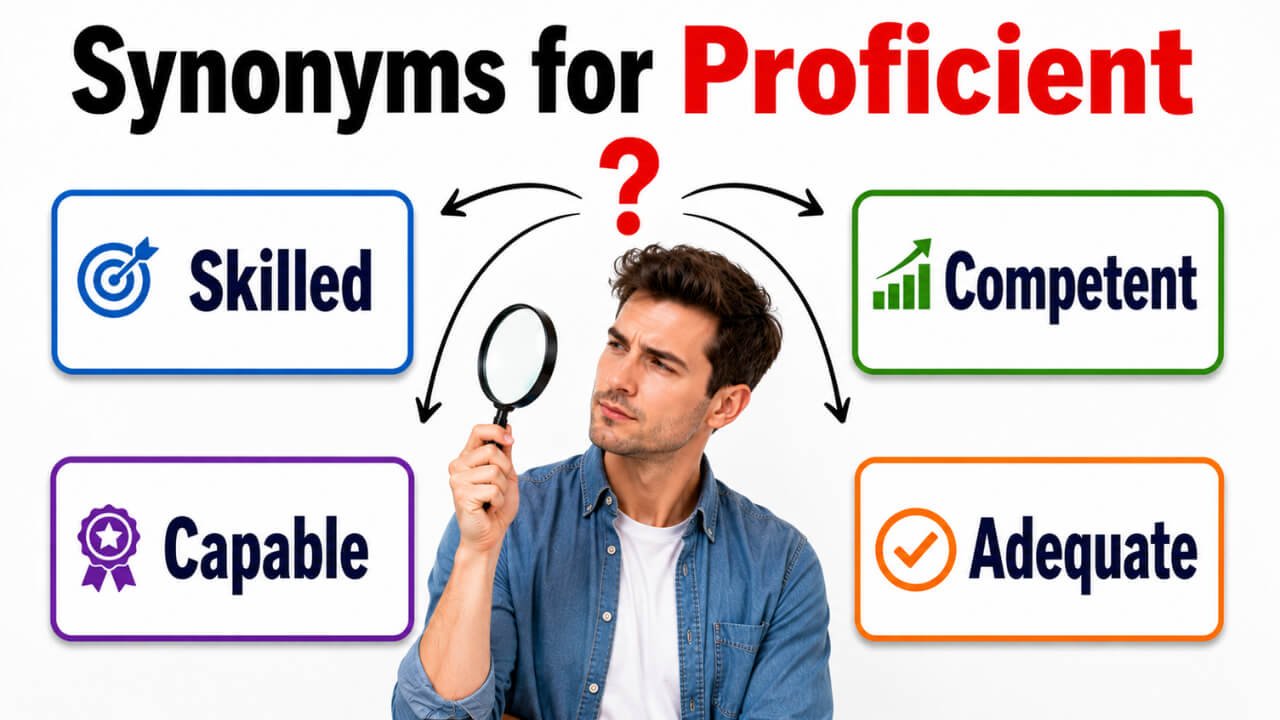
Quick Answer: The best synonyms for proficient include skilled, competent, capable, adept, accomplished, expert, experienced, qualified, practiced, and fluent. Use skilled as a clear general replacement, competent for meeting professional standards, and adept for impressive natural or learned ability. Expert and accomplished suggest advanced mastery, while experienced emphasizes time spent performing a task. Qualified works best for education or credentials. Use fluent for language ability and proficient for a strong, reliable level of knowledge or practical skill.
Pronunciation and Word Details
Word: Proficient.
Pronunciation: /prəˈfɪʃ.ənt/
Part of Speech: Adjective.
Meaning: Able to perform a task well because of developed knowledge, training, or experience.
US Pronunciation:
UK Pronunciation:
What Does “Proficient” Mean?
Proficient means skilled and capable of performing a particular activity correctly and effectively.
It is an adjective commonly used to describe someone who has developed a strong level of knowledge or practical ability. A proficient person may not be the greatest expert in a field, but they can complete relevant tasks confidently and reliably.
The word often appears with in, at, or with.
Proficient In: Commonly used before a subject, language, field, or technical area.
Example: She is proficient in financial analysis.
Proficient At: Commonly used before an activity or action.
Example: He is proficient at solving complex problems.
Proficient With: Commonly used before equipment, tools, or working methods.
Example: The designer is proficient with digital illustration tools.
Proficient can describe language ability, computer knowledge, professional skills, artistic talent, academic ability, or practical performance.
Language Context: She is proficient in Italian.
Professional Context: He is proficient in project planning.
Technical Context: The applicant is proficient in data management.
Creative Context: The artist is proficient at creating realistic portraits.
Meaning, Tone, and Context of “Proficient”
Proficient has a formal, positive, and neutral tone. It communicates developed ability without sounding overly emotional or exaggerated.
The word is common in professional profiles, employment applications, academic reports, performance evaluations, educational assessments, training materials, and formal recommendations. It can also appear in everyday conversation, although skilled and good at may sound more natural in casual speech.
Proficient usually suggests a level above basic competence. It indicates that someone can perform a task independently, accurately, and with reasonable confidence. However, it does not always mean complete mastery.
Formal Context: The candidate is proficient in written communication.
Professional Context: Applicants must be proficient in spreadsheet management.
Academic Context: Students should become proficient in mathematical reasoning.
Technical Context: The engineer is proficient in system testing and analysis.
Conversational Context: She is really good at repairing old furniture.
In casual conversation, good at or skilled may sound more relaxed than proficient. In reports and professional documents, proficient often sounds more precise and credible.
When and How to Use “Proficient”
For Professional Ability
Use proficient when describing a reliable workplace skill that someone can apply independently.
Example: She is proficient in preparing detailed financial reports.
For Technical Knowledge
Use proficient when someone can use a system, process, tool, or technical method effectively.
Example: The technician is proficient in network maintenance and fault detection.
For Language Ability
Use proficient when a person can understand and use a language effectively in speech, writing, reading, or listening.
Example: He is proficient in spoken and written German.
For Academic Skills
Use proficient when a learner has developed a strong understanding of a subject or method.
Example: Most students became proficient in solving algebraic equations.
For Creative Skills
Use proficient when someone can perform an artistic or creative activity with developed technique.
Example: She is proficient at painting natural landscapes.
For Practical Tasks
Use proficient when someone performs a physical or everyday task confidently.
Example: He became proficient at repairing household appliances.
For Employment Applications
Use proficient to communicate a strong ability without claiming complete expertise.
Example: I am proficient in research, document preparation, and client communication.
For Performance Evaluations
Use proficient when describing someone who consistently meets an expected standard.
Example: Her performance is proficient across all major areas of responsibility.
Best Synonyms for Proficient
Skilled: Having the knowledge and ability required to perform something well.
Example: She is a skilled editor who notices small errors quickly.
Competent: Able to perform a task successfully and meet an acceptable standard.
Example: He is a competent administrator with strong organizational abilities.
Capable: Having the ability or potential to complete something successfully.
Example: The team is capable of handling difficult assignments.
Adept: Very skilled and effective at performing a particular activity.
Example: She is adept at explaining technical ideas in simple language.
Accomplished: Highly trained and successful in a skill, profession, or art.
Example: He is an accomplished musician and composer.
Expert: Possessing advanced knowledge or exceptional skill in a particular subject.
Example: The company hired an expert engineer to examine the structure.
Experienced: Having developed practical knowledge through repeated involvement.
Example: She is an experienced teacher who understands different learning needs.
Qualified: Having the necessary education, training, skills, or official requirements.
Example: Only qualified technicians should repair the equipment.
Practiced: Skilled because an activity has been performed repeatedly.
Example: His practiced movements made the difficult task appear simple.
Fluent: Able to use a language or system smoothly, accurately, and naturally.
Example: She is fluent in three languages.
50 Synonyms for Proficient with Short Meanings
- Skilled: Able to perform an activity well.
- Competent: Meeting the required standard of ability.
- Capable: Having the ability to complete a task.
- Adept: Highly skilled at a particular activity.
- Accomplished: Well trained and successful in a field.
- Expert: Having advanced knowledge or ability.
- Experienced: Skilled through practical involvement over time.
- Qualified: Having the necessary training or credentials.
- Practiced: Skilled through repeated performance.
- Efficient: Performing a task well without wasted effort.
- Able: Having sufficient skill or power to act.
- Skillful: Showing developed ability and control.
- Talented: Possessing strong natural or developed ability.
- Masterful: Showing exceptional skill, confidence, and control.
- Masterly: Performed with the ability of a master.
- Professional: Showing the ability expected from a trained worker.
- Knowledgeable: Having a strong understanding of a subject.
- Trained: Taught and prepared to perform a task.
- Seasoned: Highly experienced through long practice.
- Polished: Refined and developed through careful practice.
- Effective: Producing the intended result successfully.
- Fluent: Using a language or system smoothly.
- Dexterous: Skillful with the hands or body.
- Adroit: Clever and skillful in action or thought.
- Handy: Good at practical tasks or repairs.
- Gifted: Having notable natural talent.
- Versatile: Skilled in several different activities.
- Well Versed: Having detailed knowledge of a subject.
- Conversant: Familiar and knowledgeable about a topic.
- Familiar: Having practical knowledge through experience.
- Prepared: Ready and equipped to perform successfully.
- Well Trained: Carefully taught to perform a task.
- Well Qualified: Possessing suitable skills and credentials.
- Highly Skilled: Showing an advanced degree of ability.
- Technically Skilled: Capable in a specialized technical area.
- Technically Competent: Able to meet technical requirements.
- Advanced: Operating beyond a basic or intermediate level.
- Expert Level: Showing ability associated with an expert.
- Resourceful: Skilled at finding effective solutions.
- Learned: Possessing extensive knowledge through study.
- Well Informed: Having accurate and detailed knowledge.
- Deft: Performing an action quickly and skillfully.
- Nimble: Able to think or move quickly and effectively.
- Veteran: Highly experienced in a particular activity or profession.
- Proven: Demonstrated to be capable through successful performance.
- Sharp: Quick to understand and respond effectively.
- Good At: Able to perform an activity successfully.
- Excellent At: Exceptionally capable in a particular activity.
- Well Practiced: Developed through frequent repetition.
- Fully Capable: Completely able to perform the required task.
Read Also:
Synonyms for In Order To
Synonyms for Proficient by Context
When Proficient Means Generally Skilled
Skilled, capable, competent, able, and skillful are useful when describing general ability. Skilled emphasizes developed ability, while capable emphasizes having enough ability to complete a task.
Example: She is a skilled researcher with excellent attention to detail.
Example: He is capable of managing the department independently.
When Proficient Means Professionally Competent
Competent, qualified, professional, effective, well trained, and well qualified work well in employment and workplace contexts.
Competent means that someone meets the expected standard. Qualified usually indicates that a person has suitable training, credentials, or experience.
Example: The clinic employs qualified medical technicians.
Example: She is a competent manager who handles workplace problems calmly.
When Proficient Means Highly Skilled
Adept, accomplished, expert, masterful, masterly, and highly skilled suggest a higher degree of ability.
Adept usually refers to impressive skill in a specific activity. Accomplished often describes someone with recognized success, especially in creative or professional fields.
Example: He is adept at negotiating complex agreements.
Example: She is an accomplished architect with years of practical experience.
When Proficient Means Experienced
Experienced, seasoned, veteran, practiced, well practiced, and proven describe skill developed through repeated performance.
Seasoned and veteran suggest substantial experience. Practiced focuses more directly on repetition.
Example: A seasoned instructor can adjust lessons for different students.
Example: Her practiced presentation style helped her speak confidently.
When Proficient Means Fluent
Fluent, conversant, well versed, knowledgeable, and familiar can describe language ability or strong knowledge of a subject.
Fluent is best for smooth language use. Conversant indicates useful working knowledge but may not suggest complete fluency.
Example: She is fluent in Arabic and English.
Example: The consultant is well versed in international regulations.
When Proficient Means Technically Capable
Technically skilled, technically competent, advanced, expert level, efficient, and resourceful are useful for equipment, systems, software, engineering, or specialized methods.
Example: The technician is technically competent in equipment maintenance.
Example: Advanced users can customize the system for complex projects.
When Proficient Means Skillful With the Hands
Dexterous, deft, nimble, handy, and skillful work well for manual tasks, crafts, repairs, surgery, or physical activities.
Example: The craftsperson used deft movements to shape the delicate material.
Example: He is handy with basic repair tools.
When Proficient Means Naturally Talented
Talented, gifted, sharp, and versatile may describe natural ability or quick understanding.
Example: She is a gifted writer with a strong sense of rhythm.
Example: The versatile performer can act, sing, and dance.
Another Word for Proficient
Skilled is usually the best single replacement for proficient because it works naturally in professional, academic, technical, and everyday contexts. However, the most accurate alternative depends on the degree and type of ability being described.
Original: She is proficient in business writing.
Better Option: She is skilled in business writing.
Original: He is proficient at repairing complex machinery.
Better Option: He is adept at repairing complex machinery.
Original: The applicant is proficient in workplace safety procedures.
Better Option: The applicant is competent in workplace safety procedures.
Original: She is proficient in spoken French.
Better Option: She is fluent in spoken French.
When Not to Use “Proficient”
Do not use proficient when the person has only basic knowledge. The word suggests developed and reliable ability.
Weak: After one lesson, he became proficient at playing the piano.
Better: After one lesson, he understood the basic piano exercises.
Avoid proficient when expert or accomplished is needed to describe exceptional mastery.
Weak: The award recognized her as a proficient surgeon with an international reputation.
Better: The award recognized her as an expert surgeon with an international reputation.
Do not use proficient when qualified is more accurate. A person may be proficient without holding the required credential.
Weak: Only proficient electricians may complete the certified inspection.
Better: Only qualified electricians may complete the certified inspection.
In casual speech, proficient can sometimes sound unnecessarily formal.
Weak: My brother is proficient at cooking pasta.
Better: My brother is good at cooking pasta.
Do not use proficient without explaining the relevant skill.
Weak: She is a proficient employee.
Better: She is proficient in customer service, scheduling, and record management.
Avoid repeating proficient throughout a professional profile.
Weak: I am proficient in writing, proficient in editing, and proficient in research.
Better: I am skilled in writing, experienced in editing, and proficient in research.
Words Commonly Confused With Proficient
Proficient vs Skilled: Proficient suggests reliable ability developed through training or practice. Skilled is broader and sounds natural in both formal and casual contexts.
Proficient vs Competent: Proficient often suggests ability above a basic standard. Competent means someone can perform a task successfully at an acceptable level.
Proficient vs Expert: Proficient means highly capable, but expert suggests deeper knowledge, greater authority, and advanced mastery.
Proficient vs Fluent: Proficient can describe many types of ability. Fluent is mainly used for language, communication, or smooth command of a system.
Proficient vs Experienced: Proficient describes the current level of ability. Experienced emphasizes the amount of practical involvement someone has had.
Proficient vs Qualified: Proficient refers to actual ability. Qualified means a person has the training, credentials, or requirements needed for a role.
Proficient vs Talented: Proficient often results from learning and practice. Talented can suggest natural ability, although talent may also be developed.
Proficient vs Accomplished: Proficient indicates strong skill. Accomplished suggests advanced ability combined with achievement or recognition.
Proficient vs Efficient: Proficient describes ability. Efficient describes completing work successfully while saving time, energy, or resources.
Which Synonym Should You Choose?
Choose skilled when you need a clear and flexible synonym for formal or everyday writing.
Choose competent when someone meets a required workplace, academic, or professional standard.
Choose capable when emphasizing that a person has enough ability to handle a responsibility.
Choose adept when describing someone who performs a specific activity with impressive skill.
Choose accomplished when writing about a respected artist, professional, musician, writer, or performer.
Choose expert when the person has advanced knowledge and can provide authoritative guidance.
Choose experienced when practical involvement over time is more important than formal training.
Choose qualified when education, certification, credentials, or legal requirements matter.
Choose practiced when repeated performance has made an action smooth and controlled.
Choose fluent when discussing the ability to speak, read, write, or understand a language naturally.
Choose dexterous when describing skilled hand movements, physical control, or delicate manual work.
Choose knowledgeable when the focus is understanding rather than physical performance.
Choose efficient when the person completes work effectively with little wasted time or effort.
Choose good at in relaxed conversation when proficient would sound too formal.
Choose well versed in essays, reports, and professional writing when someone understands a subject deeply.
Real Life Examples of “Proficient” in Sentences
Original: She is proficient in preparing legal documents.
Better Option: She is skilled in preparing legal documents.
Original: The mechanic is proficient at diagnosing engine problems.
Better Option: The mechanic is adept at diagnosing engine problems.
Original: He became proficient in public speaking after years of practice.
Better Option: He became an accomplished public speaker after years of practice.
Original: The assistant is proficient in managing customer records.
Better Option: The assistant is competent in managing customer records.
Original: She is proficient in written and spoken Spanish.
Better Option: She is fluent in written and spoken Spanish.
Original: The carpenter is proficient with traditional hand tools.
Better Option: The carpenter is highly skilled with traditional hand tools.
Original: Our instructor is proficient in several teaching methods.
Better Option: Our instructor is experienced in several teaching methods.
Original: He is proficient at finding practical solutions.
Better Option: He is resourceful when finding practical solutions.
Original: The applicant is proficient in laboratory safety procedures.
Better Option: The applicant is well trained in laboratory safety procedures.
Original: She is proficient at creating detailed illustrations.
Better Option: She is a talented creator of detailed illustrations.
Synonym Groups and Usage Differences
General Ability Group
Skilled, competent, capable, able, and skillful describe a person who can perform an activity successfully.
Skilled emphasizes developed ability. Competent suggests an acceptable professional standard. Capable emphasizes potential or readiness.
Example: She is a capable team leader who remains calm under pressure.
Advanced Expertise Group
Adept, accomplished, expert, masterful, masterly, and highly skilled describe advanced or impressive ability.
Expert is strongest when deep knowledge and authority matter. Masterful describes exceptional control in a particular performance.
Example: His masterful handling of the discussion prevented further conflict.
Experience Group
Experienced, seasoned, veteran, practiced, well practiced, and proven connect ability with repeated action over time.
Seasoned and veteran suggest many years of experience. Proven indicates that success has already demonstrated someone’s ability.
Example: A seasoned manager understands how to resolve workplace disagreements.
Training and Qualification Group
Qualified, trained, well trained, well qualified, professional, and prepared describe ability connected with instruction, credentials, or readiness.
Qualified is the best choice when official requirements matter.
Example: The position requires a qualified safety inspector.
Knowledge Group
Knowledgeable, learned, well informed, well versed, conversant, and familiar focus on understanding a topic.
Learned sounds formal and academic. Familiar usually indicates a lower level of knowledge than proficient.
Example: She is well versed in contract law and negotiation.
Language Ability Group
Fluent, conversant, advanced, and proficient are common terms for describing language ability.
Fluent suggests smooth and natural communication. Conversant usually means able to participate in ordinary discussion.
Example: He is conversant in Italian but not completely fluent.
Technical Skill Group
Technically skilled, technically competent, efficient, advanced, expert level, and resourceful describe specialized workplace or technical abilities.
Example: The technically skilled operator identified the equipment problem quickly.
Manual Ability Group
Dexterous, deft, nimble, handy, and skillful describe controlled physical movement or practical ability.
Dexterous is common for hands and fingers. Deft can describe both physical and mental skill.
Example: The jeweler used deft movements to repair the small clasp.
Natural Talent Group
Talented, gifted, sharp, and versatile can suggest natural ability or quick understanding.
Gifted is stronger than talented and often describes exceptional ability.
Example: The gifted student understood the advanced concept immediately.
Antonyms of Proficient
The opposites of proficient describe a lack of skill, experience, preparation, knowledge, or effectiveness.
Unskilled: Lacking developed ability or training.
Incompetent: Unable to perform a task to an acceptable standard.
Incapable: Lacking the ability needed to complete something.
Inexperienced: Having little practical involvement or knowledge.
Untrained: Not taught how to perform a task.
Inept: Lacking skill and often performing awkwardly.
Novice: A person who is new to an activity.
Beginner: Someone at the earliest stage of learning.
Amateur: A person without professional training or status.
Unqualified: Lacking the necessary training or credentials.
Inefficient: Using more time, effort, or resources than necessary.
Clumsy: Moving or acting without skill or control.
Unfamiliar: Lacking knowledge or experience of something.
Unprepared: Not ready to perform the required task.
Ineffective: Failing to produce the intended result.
Unpolished: Lacking refinement, practice, or professional quality.
Comparison: Proficient vs Related Words
Proficient vs Skilled
Proficient suggests a dependable level of developed ability. Skilled is broader and may describe anything from solid ability to advanced talent.
Example With Proficient: She is proficient in preparing research reports.
Example With Skilled: She is a skilled research writer.
Proficient vs Competent
Proficient often suggests stronger ability than merely meeting the minimum standard. Competent means that someone performs adequately and successfully.
Example With Proficient: He is proficient in advanced equipment maintenance.
Example With Competent: He is competent enough to perform routine maintenance safely.
Proficient vs Expert
Proficient means someone performs well and independently. Expert means the person has advanced knowledge, authority, or mastery.
Example With Proficient: She is proficient in tax preparation.
Example With Expert: She is an expert in international tax law.
Proficient vs Adept
Proficient sounds neutral and professional. Adept often suggests impressive ease, flexibility, or quick skill.
Example With Proficient: He is proficient in conflict resolution.
Example With Adept: He is adept at calming tense workplace discussions.
Proficient vs Experienced
Proficient focuses on how well someone performs. Experienced focuses on how much practical involvement the person has had.
Example With Proficient: She is proficient in managing large projects.
Example With Experienced: She is experienced in managing projects across several industries.
Proficient vs Qualified
Proficient describes ability, while qualified describes whether someone meets educational, professional, or legal requirements.
Example With Proficient: He is proficient at inspecting electrical systems.
Example With Qualified: He is qualified to approve the final electrical inspection.
Proficient vs Fluent
Proficient indicates strong language ability, while fluent suggests smoother, more natural, and more confident communication.
Example With Proficient: She is proficient in written Portuguese.
Example With Fluent: She is fluent in spoken Portuguese.
Proficient vs Accomplished
Proficient describes developed skill. Accomplished usually suggests high achievement, refinement, and recognition.
Example With Proficient: He is a proficient pianist.
Example With Accomplished: He is an accomplished pianist who performs at major events.
Common Phrases and Expressions With “Proficient”
Proficient In: Skilled or knowledgeable in a subject, language, or professional field.
Proficient At: Able to perform a specific action or activity successfully.
Proficient With: Skilled in using a tool, system, method, or type of equipment.
Highly Proficient: Possessing an advanced and dependable degree of ability.
Technically Proficient: Skilled in technical processes, systems, equipment, or specialized methods.
Professionally Proficient: Able to perform at a suitable professional standard.
Proficient User: Someone who can operate a system or tool confidently.
Proficient Speaker: A person who can communicate effectively in a language.
Proficient Writer: Someone who writes clearly, correctly, and effectively.
Become Proficient: Develop a strong level of skill through learning and practice.
Common Mistakes to Avoid
Using the Wrong Preposition
Use proficient in before a field, subject, or language. Use proficient at before an activity. Proficient with is natural when referring to tools or equipment.
Incorrect: She is proficient on data analysis.
Correct: She is proficient in data analysis.
Incorrect: He is proficient in repairing bicycles.
Better: He is proficient at repairing bicycles.
Treating Proficient as Equal to Expert
Proficient does not always mean complete mastery. Avoid using expert when the person only has a reliable working ability.
Inaccurate: She completed an intermediate course, so she is now an expert.
Better: She completed an intermediate course and is now proficient.
Using Proficient for Basic Knowledge
Basic familiarity is weaker than proficiency.
Unclear: He is proficient in the system because he has used it twice.
Better: He has basic familiarity with the system.
Confusing Skill With Qualification
A person can be skilled without having an official credential. Likewise, a qualified person may meet formal requirements without being exceptionally proficient.
Incorrect: His certificate proves that he is highly proficient.
Better: His certificate proves that he is qualified, while his work demonstrates his proficiency.
Writing Vague Statements
Always identify the relevant skill.
Vague: She is very proficient.
Clear: She is highly proficient in technical writing and document editing.
Repeating the Same Word
Using proficient repeatedly can make a professional profile sound mechanical.
Repetitive: He is proficient in planning, proficient in communication, and proficient in research.
Improved: He is skilled in planning, effective in communication, and proficient in research.
Using Unnatural Intensifiers
Very proficient is grammatically possible, but highly proficient often sounds more natural in formal writing.
Less Natural: She is very proficient in written communication.
Better: She is highly proficient in written communication.
Choosing a Synonym That Changes the Meaning
Do not replace proficient with fluent unless the context involves language or smooth command of a communication system.
Incorrect: He is fluent at repairing engines.
Correct: He is proficient at repairing engines.
Conclusion
Synonyms for proficient help describe different levels and types of ability more accurately. Skilled is the strongest general alternative, while competent fits professional standards and capable emphasizes readiness. Choose adept for impressive skill, experienced for practical knowledge, qualified for credentials, and fluent for language ability. Accomplished and expert express a higher level of mastery. Whether you are writing a report, professional profile, essay, or everyday sentence, select the word that best reflects the person’s training, experience, knowledge, and actual performance.
FAQs About Synonyms for Proficient
What Is the Best Synonym for Proficient?
Skilled is the best general synonym because it works in professional, academic, technical, and everyday contexts.
Is Proficient the Same as Expert?
No. Proficient means able to perform well, while expert suggests advanced knowledge, authority, or mastery.
What Is a Formal Synonym for Proficient?
Competent, accomplished, qualified, adept, and well versed are useful formal alternatives.
What Is a Casual Synonym for Proficient?
Good at, skilled, handy, and capable are natural choices for casual conversation.
Can Fluent Replace Proficient?
Fluent can replace proficient when discussing language or smooth communication. It is not suitable for every practical or technical skill.
Is Competent Stronger Than Proficient?
Usually not. Competent means meeting an acceptable standard, while proficient often suggests a stronger and more developed ability.
Which Synonym Is Best for a Professional Profile?
Skilled, experienced, qualified, proficient, and accomplished work well. The best choice depends on whether you want to emphasize ability, experience, credentials, or achievement.
