
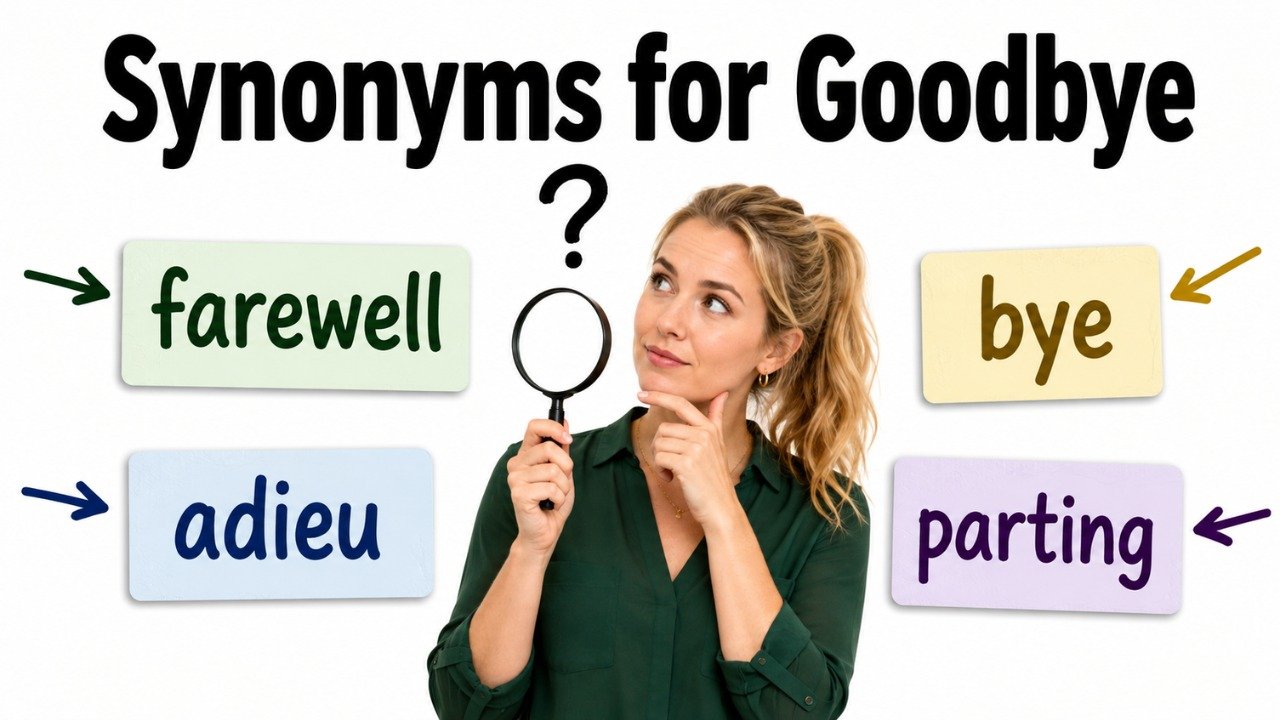
Quick Answer: The best synonyms for goodbye include farewell, bye, so long, see you later, take care, until next time, good night, all the best, adieu, and see you soon. Among these synonyms for goodbye, use farewell in formal or emotional situations, bye in casual conversation, see you later for a temporary separation, take care to show warmth, good night when leaving in the evening, and adieu for a serious or lasting departure.
Pronunciation and Word Details
Word: Goodbye.
Pronunciation: /ˌɡʊdˈbaɪ/.
Part of Speech: Interjection and noun.
Meaning: A word or expression used when leaving someone or ending a conversation.
US Pronunciation:
UK Pronunciation:
What Does “Goodbye” Mean?
Goodbye means an expression used when people separate, leave a place, or end a conversation. It can also refer to the act of parting itself.
As an interjection, goodbye is spoken directly to someone who is leaving or being left. For example, a person may say goodbye before ending a visit, leaving work, finishing a telephone conversation, or beginning a journey.
As a noun, goodbye refers to words, actions, or emotions connected with departure. A person may give a quick goodbye, avoid a painful goodbye, or prepare for a final goodbye.
The word can describe a temporary separation or a permanent ending. Its exact meaning depends on the situation, tone, relationship, and expectation of meeting again.
Meaning, Tone, and Context of “Goodbye”
Goodbye is a neutral and widely understood word. It can sound polite, warm, emotional, formal, casual, or final depending on how it is used.
In everyday conversation, goodbye is polite but sometimes more formal than bye. Friends and family members often use shorter alternatives such as bye, see you, later, or take care.
In professional settings, goodbye is appropriate when ending a meeting, leaving a workplace, speaking with a customer, or closing a formal conversation. Expressions such as all the best and thank you, goodbye can sound warmer and more professional.
In emotional contexts, goodbye may suggest sadness, loss, distance, or a major life change. A final goodbye can refer to a permanent separation, while a difficult goodbye may describe leaving a person, place, job, or stage of life.
The word is conversational rather than academic or technical. However, it may appear in essays, stories, speeches, reports, and literary analysis when discussing departure, separation, closure, or parting language.
When and How to Use “Goodbye”
For a Casual Departure
Use goodbye when leaving someone after an ordinary visit, conversation, appointment, or activity.
Example: She smiled, said goodbye, and walked toward the station.
For Ending a Conversation
Use goodbye when closing a telephone call, meeting, interview, or direct conversation.
Example: After answering the final question, he thanked the caller and said goodbye.
For a Temporary Separation
Use goodbye when people are parting but expect to meet again.
Example: We said goodbye at the office and agreed to meet the following morning.
For an Emotional Departure
Use goodbye when leaving a person, home, job, or place that has emotional importance.
Example: Saying goodbye to her childhood home was more difficult than she expected.
For a Permanent Separation
Use final goodbye when the departure is permanent or is understood to be the last meeting.
Example: The family gathered to say a final goodbye.
For a Formal Occasion
Use farewell, all the best, or goodbye when speaking at a retirement, departure ceremony, or official event.
Example: The director wished the departing employees goodbye and thanked them for their service.
For Evening Departures
Use good night when leaving someone late in the day or before going to sleep.
Example: We thanked our hosts, said good night, and returned home.
For Written Communication
Use goodbye, farewell, all the best, or take care according to the tone and relationship.
Example: She ended the personal letter with a warm goodbye.
Best Synonyms for Goodbye
Farewell
Synonym: Farewell is a formal or emotional expression used when someone is leaving, especially for a long time.
Example: The team held a farewell dinner for their retiring manager.
Bye
Synonym: Bye is the most common casual and shortened form of goodbye.
Example: He waved and called, “Bye,” as the bus pulled away.
See You Later
Synonym: See you later is a friendly expression used when people expect to meet again.
Example: I have to leave now, but I will see you later.
Take Care
Synonym: Take care is a warm farewell that expresses concern for someone’s safety or wellbeing.
Example: Take care, and let me know when you arrive safely.
So Long
Synonym: So long is an informal farewell that may suggest a longer separation.
Example: She said so long to her neighbors before moving away.
Until Next Time
Synonym: Until next time is a friendly expression that looks forward to another meeting.
Example: Until next time, thank you for a wonderful evening.
Good Night
Synonym: Good night is used when leaving in the evening or before going to sleep.
Example: The guests said good night and left after dinner.
All the Best
Synonym: All the best is a warm and polite farewell that expresses good wishes.
Example: All the best in your new position.
Adieu
Synonym: Adieu is a formal, literary, or dramatic farewell that can suggest a long or permanent separation.
Example: With one final adieu, the traveler boarded the ship.
See You Soon
Synonym: See you soon is an affectionate farewell used when another meeting is expected in the near future.
Example: Have a safe journey, and I will see you soon.
50 Synonyms for Goodbye with Short Meanings
- Farewell: A formal or emotional expression of parting.
- Bye: A short and casual form of goodbye.
- Bye Bye: A friendly and informal farewell.
- So Long: An informal goodbye, often before a longer absence.
- See You: A casual farewell suggesting another meeting.
- See You Later: A friendly goodbye before a temporary separation.
- See You Soon: A warm farewell when another meeting is expected shortly.
- Until Later: A temporary goodbye until another time.
- Until Next Time: A farewell that looks forward to another meeting.
- Take Care: A warm goodbye expressing concern and kindness.
- Be Well: A thoughtful wish for health and wellbeing.
- Stay Safe: A farewell expressing concern for someone’s safety.
- Take It Easy: A relaxed and friendly casual goodbye.
- Have a Good Day: A polite farewell wishing someone a pleasant day.
- Have a Good Evening: A courteous goodbye used later in the day.
- Have a Good Night: A polite wish when parting in the evening.
- Good Night: A farewell used at night or before sleep.
- Good Day: A polite or somewhat formal expression of departure.
- Have a Good One: A casual wish for a pleasant day or experience.
- Enjoy Your Day: A friendly farewell wishing someone a good day.
- All the Best: A warm goodbye expressing general good wishes.
- Best Wishes: A polite expression of goodwill at parting.
- Safe Travels: A farewell wishing someone a safe journey.
- Pleasant Journey: A formal wish for an enjoyable trip.
- Bon Voyage: A farewell wishing someone a good journey.
- Godspeed: A serious or traditional wish for success and safety.
- Adieu: A formal or literary farewell.
- Au Revoir: A polite farewell meaning until meeting again.
- Ciao: An informal expression used for goodbye.
- Adios: A familiar informal farewell borrowed from Spanish.
- Cheerio: A cheerful and informal farewell.
- Later: A brief casual goodbye.
- Catch You Later: A relaxed goodbye suggesting another meeting.
- Talk Soon: A friendly ending to a conversation.
- Speak Soon: A polite promise or hope to communicate again.
- Keep in Touch: A farewell requesting continued communication.
- See You Around: A casual goodbye when another meeting is possible.
- See You Again: A farewell expressing hope for another meeting.
- Until We Meet Again: An emotional farewell before a longer separation.
- Farewell for Now: A formal goodbye that suggests the separation is temporary.
- Goodbye for Now: A direct farewell before a temporary absence.
- Peace: A very casual expression of departure.
- Parting: The act or moment of separating.
- Leave Taking: The process or occasion of saying goodbye.
- Valediction: A formal statement or expression of farewell.
- Send Off: A farewell event held for someone who is leaving.
- Parting Words: The final words spoken before separation.
- Closing Words: The final remarks used to end a conversation or event.
- Final Farewell: A last or permanent expression of goodbye.
- Last Goodbye: A final parting with no expected future meeting.
Read Also:
Synonyms for Soldier

Synonyms for Goodbye by Context
When Goodbye Means a Casual Farewell
Bye, bye bye, later, see you, ciao, cheerio, and take it easy work well in relaxed conversation.
Bye is the simplest casual replacement. Later is even shorter and is common among friends. See you suggests that another meeting is expected, while take it easy adds a friendly wish.
Example: Goodbye, everyone. I will talk to you tomorrow.
Alternative: Bye, everyone. I will talk to you tomorrow.
When Goodbye Means a Formal Farewell
Farewell, good day, all the best, best wishes, and valediction suit formal or professional situations.
Farewell often appears in speeches, ceremonies, and written announcements. All the best sounds warm and professional without being overly emotional. Valediction usually refers to formal closing words rather than an everyday spoken goodbye.
Example: The director said goodbye to the retiring employee.
Alternative: The director offered a formal farewell to the retiring employee.
When Goodbye Means a Temporary Separation
See you later, until later, until next time, goodbye for now, and farewell for now make it clear that the separation is temporary.
These alternatives reassure the listener that another meeting or conversation is expected.
Example: We said goodbye after lunch and planned to meet again that evening.
Alternative: We said see you later after lunch and planned to meet again that evening.
When Goodbye Expresses Warmth and Care
Take care, be well, stay safe, all the best, and best wishes communicate kindness.
Take care is natural in spoken and written communication. Stay safe is especially suitable when the listener is traveling or facing a difficult situation. Be well sounds thoughtful and calm.
Example: Goodbye, and please call when you arrive.
Alternative: Take care, and please call when you arrive.
When Goodbye Is Used Before Travel
Safe travels, pleasant journey, bon voyage, and Godspeed are suitable when someone is beginning a trip.
Safe travels is warm and modern. Pleasant journey is more formal. Bon voyage is cheerful and familiar. Godspeed sounds serious, traditional, or ceremonial.
Example: We said goodbye to the travelers at the airport.
Alternative: We wished the travelers safe travels at the airport.
When Goodbye Is Emotional
Farewell, until we meet again, final farewell, last goodbye, and adieu are appropriate for emotional departures.
Farewell is serious and dignified. Until we meet again communicates hope. Adieu can sound literary or dramatic. Final farewell and last goodbye suggest permanent separation.
Example: She whispered goodbye before leaving her hometown.
Alternative: She whispered a final farewell before leaving her hometown.
When Goodbye Ends Written Communication
All the best, best wishes, take care, speak soon, and until next time are natural endings for personal or professional messages.
All the best is polite and flexible. Best wishes is slightly more formal. Speak soon and talk soon work when continued communication is expected.
Example: He ended the message with a friendly goodbye.
Alternative: He ended the message with “All the best.”
When Goodbye Is Said at Night
Good night and have a good night are the clearest alternatives when people part during the evening.
Good night can also be used before sleep, even when nobody is physically leaving.
Example: We said goodbye after the evening meal.
Alternative: We said good night after the evening meal.
Another Word for Goodbye
Farewell is the best single replacement for goodbye in formal, emotional, or literary contexts. However, the most natural alternative depends on the relationship, situation, time of day, and expected length of separation.
Use bye in casual conversation, take care to express warmth, see you later for a temporary departure, and good night during the evening.
Original: She said goodbye to her colleagues before leaving the office.
Better Option: She said farewell to her colleagues before leaving the office.
Original: Goodbye, I will call you tomorrow.
Better Option: See you later, I will call you tomorrow.
Original: He smiled and said goodbye before starting his journey.
Better Option: He smiled and wished everyone safe travels before starting his journey.
Original: We said goodbye after the late dinner.
Better Option: We said good night after the late dinner.
When Not to Use “Goodbye”
Goodbye is widely understood, but it may sound too formal, too final, repetitive, or emotionally distant in some situations.
When Speaking Casually With Friends
Bye, see you, later, or take care may sound more natural than goodbye.
Weak: Goodbye, I will meet you in ten minutes.
Better: See you in ten minutes.
When Another Meeting Is Expected Soon
Goodbye can sound more final than necessary. Use see you later, talk soon, or until next time.
Weak: Goodbye, I will return after lunch.
Better: See you after lunch.
When Leaving at Night
Good night is more precise than goodbye when the time of day matters.
Weak: Goodbye, everyone. Sleep well.
Better: Good night, everyone. Sleep well.
When Someone Is Beginning a Journey
Safe travels or bon voyage communicates a more specific and thoughtful wish.
Weak: Goodbye on your trip.
Better: Safe travels, and enjoy your trip.
When Writing a Professional Closing
Goodbye may sound abrupt at the end of a formal message. All the best or best wishes usually sounds more polished.
Weak: Thank you for your help. Goodbye.
Better: Thank you for your help. All the best.
When the Departure Is Deeply Emotional
Farewell, final farewell, or until we meet again may express the emotional importance more clearly.
Weak: The community gathered for a goodbye to the retiring teacher.
Better: The community gathered for a heartfelt farewell to the retiring teacher.
When Goodbye Becomes Repetitive
Repeatedly using goodbye can make writing sound plain and mechanical. Use farewell, parting, leave taking, or closing words where appropriate.
Weak: Their goodbye was brief because neither person knew how to say goodbye.
Better: Their farewell was brief because neither person knew how to express the pain of parting.
Words Commonly Confused With Goodbye
Goodbye vs Farewell: Goodbye is neutral and common in everyday communication. Farewell is more formal, emotional, or serious and may suggest a longer separation.
Goodbye vs Bye: Goodbye is the complete form and can sound more polite or formal. Bye is shorter, more casual, and common among friends, relatives, and familiar colleagues.
Goodbye vs Good Night: Goodbye can be used at any time of day. Good night is used when leaving in the evening or before going to sleep.
Goodbye vs See You Later: Goodbye simply marks a departure. See you later specifically suggests that another meeting is expected.
Goodbye vs Take Care: Goodbye focuses on ending the interaction. Take care adds a warm wish for the other person’s wellbeing.
Goodbye vs Farewell Speech: Goodbye is an expression of parting. A farewell speech is a longer address given when someone is retiring, moving, or leaving a group.
Goodbye vs Send Off: Goodbye can be a single word or action. A send off is an event or gathering arranged for someone who is leaving.
Goodbye vs Valediction: Goodbye is common spoken language. Valediction refers to formal closing words in a speech, letter, or written work.
Which Synonym Should You Choose?
Choose farewell for formal writing, retirement messages, ceremonies, emotional departures, and literary descriptions.
Choose bye for casual conversation with friends, relatives, classmates, or familiar coworkers.
Choose see you later when another meeting is expected later the same day or in the near future.
Choose see you soon when you want to sound warm and optimistic about meeting again shortly.
Choose take care when you want your farewell to express kindness, concern, and personal warmth.
Choose all the best in professional messages, emails, letters, and polite conversations.
Choose best wishes when writing a warm but slightly formal closing.
Choose good night when leaving during the evening or ending a conversation before sleep.
Choose safe travels when someone is leaving for a trip.
Choose bon voyage when you want a cheerful and recognizable travel farewell.
Choose until next time when closing a meeting, lesson, event, or recurring activity.
Choose talk soon or speak soon when you expect another conversation rather than an in person meeting.
Choose keep in touch when a person is moving away, changing jobs, or leaving a group but continued communication is desired.
Choose adieu in literary, dramatic, historical, or deeply emotional writing.
Choose final farewell or last goodbye when describing a permanent departure or final meeting.
Real Life Examples of “Goodbye” in Sentences
Original: I said goodbye to my friends before leaving the restaurant.
Better Option: I said bye to my friends before leaving the restaurant.
Original: She said goodbye and promised to return the following week.
Better Option: She said see you soon and promised to return the following week.
Original: We wished him goodbye before his international journey.
Better Option: We wished him safe travels before his international journey.
Original: The manager gave a goodbye speech for the retiring employee.
Better Option: The manager gave a farewell speech for the retiring employee.
Original: He ended the professional message with goodbye.
Better Option: He ended the professional message with all the best.
Original: They said goodbye after the evening event.
Better Option: They said good night after the evening event.
Original: She gave her neighbors a warm goodbye before moving.
Better Option: She gave her neighbors a warm farewell before moving.
Original: Goodbye, I will call you again this afternoon.
Better Option: Talk soon, I will call you again this afternoon.
Original: The family gathered to say goodbye before his departure.
Better Option: The family gathered for a heartfelt send off before his departure.
Original: He offered one last goodbye before closing the door.
Better Option: He offered one final farewell before closing the door.
Synonym Groups and Usage Differences
Casual Farewell Group
Bye, bye bye, later, see you, catch you later, ciao, and cheerio are relaxed expressions.
Bye is the most universal casual choice. Later and catch you later sound very informal. Ciao and cheerio add a light, friendly tone.
Example: I have to leave, so I will catch you later.
Temporary Separation Group
See you later, see you soon, until later, until next time, and goodbye for now suggest that the separation is not permanent.
See you soon suggests a short wait. Until next time is useful when the exact future meeting is unknown.
Example: Until next time, thank you for joining us.
Warm Wishes Group
Take care, be well, stay safe, all the best, and best wishes add kindness to a departure.
Take care is conversational. All the best works in professional and personal situations. Stay safe expresses particular concern.
Example: Take care, and let me know when you reach home.
Formal Farewell Group
Farewell, good day, valediction, pleasant journey, and Godspeed have a formal, traditional, or ceremonial quality.
Farewell is the most natural formal alternative. Valediction describes formal closing language. Godspeed is reserved for serious or meaningful departures.
Example: The speaker concluded with a respectful farewell.
Travel Farewell Group
Safe travels, bon voyage, pleasant journey, and Godspeed are connected with journeys.
Safe travels is modern and natural. Bon voyage is cheerful. Pleasant journey sounds polite and formal.
Example: We wished the visitors safe travels before they left.
Evening Farewell Group
Good night, have a good night, and have a good evening are connected with evening departures.
Good night is direct and familiar. Have a good evening may be used earlier, while have a good night suits a later departure.
Example: The host thanked everyone and wished them a good night.
Emotional Parting Group
Adieu, until we meet again, final farewell, last goodbye, and parting words express seriousness or emotional depth.
Adieu sounds literary. Until we meet again suggests hope. Final farewell and last goodbye suggest permanence.
Example: Their final farewell was quiet but deeply emotional.
Continued Communication Group
Talk soon, speak soon, keep in touch, and see you around suggest that contact may continue.
Talk soon and speak soon refer to another conversation. Keep in touch expresses a longer term desire to maintain the relationship.
Example: Keep in touch after you move to your new city.
Antonyms of Goodbye
The opposite of goodbye depends on whether goodbye refers to departure, separation, or the end of communication.
Hello: A word used when meeting or beginning a conversation.
Hi: A casual greeting used at the start of an interaction.
Welcome: A warm expression used when receiving someone.
Greeting: Words or actions used when people meet.
Arrival: The act of reaching or entering a place.
Return: The act of coming back after an absence.
Reunion: A meeting between people after a period of separation.
Introduction: The act of presenting people to one another.
Reception: The manner in which someone is received or welcomed.
Meeting: An occasion when people come together.
Beginning: The start of a conversation, relationship, visit, or event.
Homecoming: A return to one’s home or familiar community.
Comparison of Goodbye and Related Words
Goodbye vs Farewell
Goodbye is neutral and suitable for most departures. Farewell sounds more formal, emotional, or permanent.
Example With Goodbye: She said goodbye and left the meeting.
Example With Farewell: The community organized a farewell for the departing doctor.
Goodbye vs Bye
Goodbye is the complete form and may sound more polite. Bye is shorter and more conversational.
Example With Goodbye: He thanked the receptionist and said goodbye.
Example With Bye: She called out, “Bye,” as she left her friend’s house.
Goodbye vs See You Later
Goodbye does not promise another meeting. See you later suggests that the people expect to meet again.
Example With Goodbye: We said goodbye at the station.
Example With See You Later: I will see you later when the meeting ends.
Goodbye vs Take Care
Goodbye marks the end of an interaction. Take care also communicates concern for the listener.
Example With Goodbye: Goodbye, and thank you for visiting.
Example With Take Care: Take care, and drive safely.
Goodbye vs Good Night
Goodbye can be used throughout the day. Good night is connected with evening departure or sleep.
Example With Goodbye: She said goodbye after the morning appointment.
Example With Good Night: The children said good night before going to bed.
Goodbye vs All the Best
Goodbye is direct and neutral. All the best adds a positive wish and often sounds better in professional writing.
Example With Goodbye: Thank you for your time. Goodbye.
Example With All the Best: Thank you for your time. All the best with the project.
Goodbye vs Adieu
Goodbye is common and natural in everyday speech. Adieu is literary, dramatic, or deeply emotional.
Example With Goodbye: He said goodbye before leaving the room.
Example With Adieu: The character offered a final adieu before beginning the voyage.
Goodbye vs Send Off
Goodbye is a word or expression. A send off is an event, gathering, or gesture arranged for someone who is leaving.
Example With Goodbye: We gathered at the door to say goodbye.
Example With Send Off: The team organized a cheerful send off for their colleague.
Common Phrases and Expressions With “Goodbye”
Say Goodbye: To express farewell before leaving.
Wave Goodbye: To move the hand as a farewell gesture.
Kiss Goodbye: To give someone a kiss before separating.
Bid Goodbye: To say farewell, often in formal or literary language.
Final Goodbye: The last farewell before a permanent separation.
Last Goodbye: A final meeting or expression of parting.
Emotional Goodbye: A farewell involving strong feelings.
Quick Goodbye: A short farewell with little time for conversation.
Painful Goodbye: A departure that causes sadness or emotional difficulty.
Goodbye for Now: A farewell that suggests another meeting will occur.
Common Mistakes to Avoid
Using Goodbye in Every Situation
Goodbye is correct in many contexts, but it is not always the most natural expression. Match the farewell to the relationship, setting, and expected length of separation.
Unnatural: Goodbye, I will see you in five minutes.
Natural: See you in five minutes.
Confusing Goodbye With Good Night
Good night is connected with the evening or sleep. Do not use it for an ordinary daytime departure.
Incorrect: Good night, I will see you after lunch.
Correct: Goodbye, I will see you after lunch.
Using Farewell Too Casually
Farewell can sound dramatic or unusually formal in a routine conversation.
Unnatural: Farewell, I am going to the shop.
Natural: Bye, I am going to the shop.
Using Bye in a Very Formal Context
Bye may sound too casual in an official speech, formal announcement, or serious written message.
Weak: We wish our retiring director bye and good luck.
Better: We offer our retiring director a warm farewell and our best wishes.
Using See You Soon Without Expecting Another Meeting
See you soon implies that another meeting is likely. Use goodbye or farewell when the future is uncertain.
Unclear: See you soon, although we may never meet again.
Clearer: Farewell, and thank you for everything.
Repeating Goodbye Too Often
Too many uses of goodbye can make a paragraph sound flat. Replace repeated instances with farewell, parting, send off, or leave taking.
Repetitive: Their goodbye began with a speech, and the goodbye ended with tears.
Improved: Their farewell began with a speech and ended with tears.
Choosing a Phrase With the Wrong Emotional Tone
Take care sounds warm, later sounds casual, and adieu sounds dramatic. Select the phrase that matches the mood.
Unnatural: Adieu, I will call you after dinner.
Natural: Talk soon, I will call you after dinner.
Treating Parting as a Direct Spoken Farewell
Parting is usually a noun describing separation. It is not normally spoken directly in place of goodbye.
Incorrect: She smiled and said, “Parting.”
Correct: She smiled and said, “Goodbye.”
Conclusion
The best synonyms for goodbye depend on the relationship, setting, time, and length of separation. Use bye for casual departures, farewell for formal or emotional occasions, see you later for temporary separations, and take care to express warmth. Good night fits evening departures, while safe travels suits journeys. All the best works well in professional writing, and adieu adds a literary tone. Choosing the right farewell makes your message clearer, kinder, and more natural.
FAQs About Synonyms for Goodbye
What Is the Best Synonym for Goodbye?
Farewell is the best general formal synonym. Bye is the most natural casual alternative, while see you later works for temporary separations.
What Is a Formal Word for Goodbye?
Farewell is the most common formal word for goodbye. Adieu, valediction, and good day may also fit certain formal or literary contexts.
What Is a Casual Way to Say Goodbye?
Bye, later, see you, catch you later, take care, and have a good one are natural casual expressions.
What Can I Say Instead of Goodbye in a Professional Message?
All the best, best wishes, take care, and speak soon are polite alternatives. The best choice depends on your relationship with the reader.
What Is an Emotional Synonym for Goodbye?
Farewell, adieu, until we meet again, final farewell, and last goodbye can express sadness, seriousness, or emotional importance.
Is Good Night a Synonym for Goodbye?
Good night can replace goodbye when people separate during the evening or before going to sleep. It is not appropriate for most daytime departures.
What Is Another Way to Say Goodbye Before a Journey?
Safe travels, bon voyage, pleasant journey, and Godspeed are useful farewells for someone beginning a trip.
