
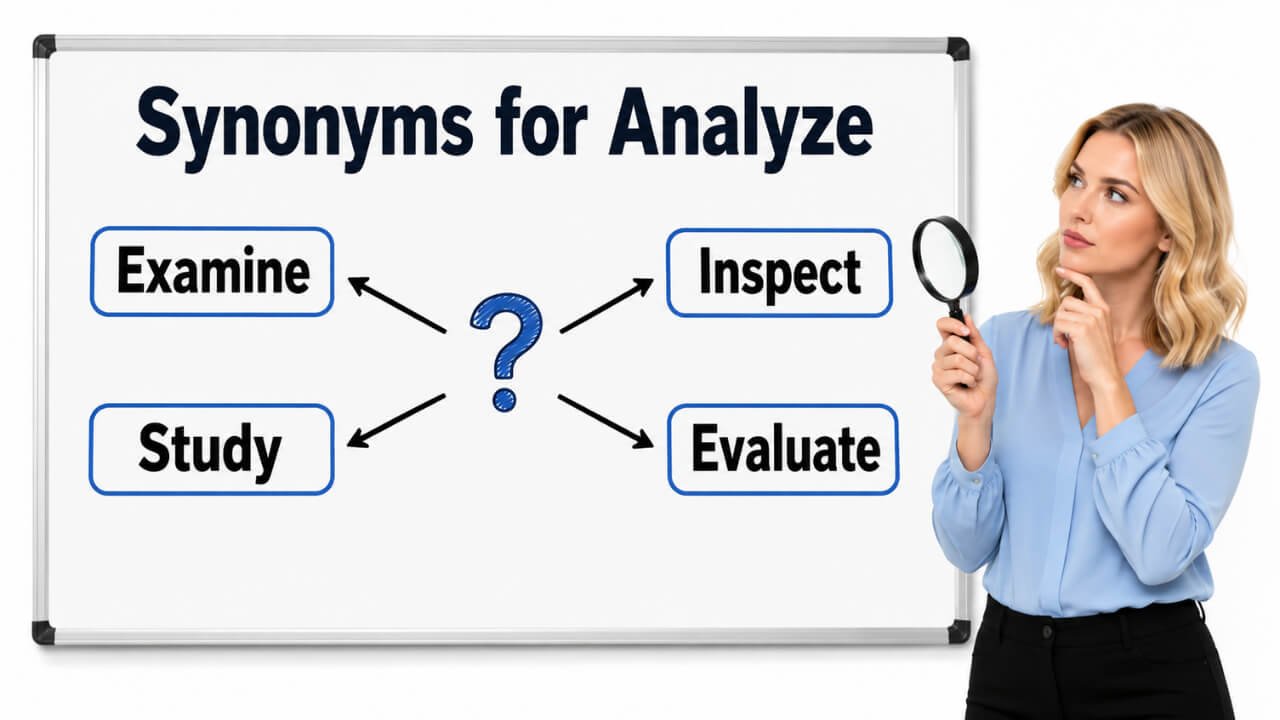
Quick Answer: Synonyms for analyze include examine, study, inspect, evaluate, assess, investigate, interpret, review, break down, scrutinize, and explore. Use examine for careful checking, evaluate for judging value or quality, assess for measuring performance or condition, investigate for finding causes or facts, interpret for explaining meaning, review for looking over information, and break down for explaining parts in a simple way.
Pronunciation and Word Details
Word: Analyze
Pronunciation: ˈænəlaɪz
Part of Speech: Verb
Meaning: Analyze means to study something carefully by looking at its parts, details, causes, meaning, or structure.
US Pronunciation:
UK Pronunciation:
What Does “Analyze” Mean?
Analyze means to examine something carefully in order to understand it better. It is a verb used when someone studies details, separates information into parts, compares evidence, or looks for meaning, causes, patterns, or results.
You can analyze data, a sentence, a problem, a poem, a business report, a situation, a test result, or a person’s behavior. In writing, analyze often means more than simply describing something. It means explaining how something works, why it matters, what it shows, or what conclusion can be drawn from it.
Analyze can also appear in different sentence patterns. You can analyze something directly, as in “Students analyze the passage.” You can analyze something for a reason, as in “The team analyzed the data for errors.” You can also analyze how, why, or whether something happened.
Meaning, Tone, and Context of “Analyze”
Analyze has a formal, academic, and professional tone, but it is still common in everyday language. It is widely used in school assignments, essays, research, science, business reports, grammar lessons, data work, problem solving, and decision making.
The word is neutral and thoughtful. It does not usually sound emotional or casual. It suggests careful thinking, close attention, and logical explanation. In academic writing, analyze often means to go beyond summary and explain meaning or importance. In business writing, it often means to study results, performance, risks, costs, or trends.
In casual speech, people may use simpler alternatives like look at, check, figure out, or break down. In formal writing, stronger options include examine, evaluate, assess, investigate, interpret, and scrutinize.
When and How to Use “Analyze”
For Data: Use analyze when studying numbers, results, statistics, patterns, or trends.
Example: The team will analyze the sales data before making a decision.
For Writing: Use analyze when explaining the meaning, structure, tone, or purpose of a text.
Example: The students analyzed the poem’s imagery and message.
For Problems: Use analyze when looking at causes, effects, and possible solutions.
Example: We need to analyze the problem before choosing a strategy.
For Evidence: Use analyze when studying facts, details, or proof carefully.
Example: The researcher analyzed the evidence to support the claim.
For Behavior: Use analyze when trying to understand actions, patterns, or motives.
Example: The manager analyzed customer behavior to improve the service.
For Grammar: Use analyze when studying sentence structure, word function, or meaning.
Example: The class analyzed the sentence to find the subject and verb.
Best Synonyms for Analyze
Examine: To look at something carefully and closely.
Example: The doctor examined the report before giving advice.
Study: To look at something deeply in order to learn or understand it.
Example: Researchers studied the results for several weeks.
Inspect: To check something carefully, often for problems or details.
Example: The engineer inspected the machine for damage.
Evaluate: To judge the value, quality, success, or importance of something.
Example: The teacher evaluated each project using clear criteria.
Assess: To estimate or judge the condition, level, amount, or quality of something.
Example: The company assessed the risk before starting the project.
Investigate: To search carefully for facts, causes, or explanations.
Example: Officials investigated the cause of the sudden delay.
Interpret: To explain the meaning of information, words, signs, or results.
Example: The analyst interpreted the chart for the team.
Review: To look over something carefully, often to check or improve it.
Example: She reviewed the report before sending it.
Scrutinize: To examine something very closely and critically.
Example: The editor scrutinized every sentence for errors.
Break Down: To separate something into smaller parts so it is easier to understand.
Example: The teacher broke down the topic into simple steps.
50 Synonyms for Analyze with Short Meanings
- Examine: Look at carefully.
- Study: Learn by careful attention.
- Inspect: Check closely for details or problems.
- Evaluate: Judge quality, value, or importance.
- Assess: Estimate condition, level, or worth.
- Investigate: Search for facts or causes.
- Interpret: Explain meaning or significance.
- Review: Look over for understanding or correction.
- Scrutinize: Examine very closely.
- Break Down: Separate into understandable parts.
- Explore: Study a topic or idea in detail.
- Probe: Investigate deeply.
- Consider: Think about carefully.
- Check: Look at to confirm accuracy.
- Test: Examine through trial or measurement.
- Measure: Find amount, level, or size.
- Compare: Look at similarities and differences.
- Contrast: Show clear differences.
- Diagnose: Identify a problem or cause.
- Dissect: Examine by separating into parts.
- Deconstruct: Break into parts to understand meaning.
- Appraise: Judge value or quality.
- Audit: Examine records, systems, or accounts.
- Research: Study carefully to find information.
- Survey: Examine broadly or collect information.
- Observe: Watch carefully for details.
- Monitor: Watch over time for changes.
- Trace: Follow the development or cause of something.
- Investigate: Examine to uncover facts.
- Question: Examine through inquiry.
- Review Critically: Study with careful judgment.
- Look Into: Examine or investigate.
- Look Over: Check or review briefly.
- Go Through: Review each part carefully.
- Work Through: Examine step by step.
- Think Through: Consider carefully from start to finish.
- Reason Through: Use logic to understand.
- Interpret Carefully: Explain meaning with attention.
- Explain: Make meaning clear.
- Clarify: Make something easier to understand.
- Decode: Work out hidden or difficult meaning.
- Unpack: Explain details or layers of meaning.
- Identify: Find and name key parts.
- Determine: Find out through study or reasoning.
- Judge: Form an opinion after thought.
- Appraise Critically: Judge with close attention.
- Examine Closely: Study in detail.
- Review Thoroughly: Check with full attention.
- Study Closely: Look at with deep focus.
- Evaluate Carefully: Judge after detailed review.
Read Also:
Synonyms for Organized
Synonyms for Analyze by Context
When Analyze Means Examine Carefully
Use these synonyms when you mean looking closely at details, parts, facts, or evidence.
Examine: The scientist examined the sample under bright light.
Inspect: The worker inspected the equipment before use.
Scrutinize: The lawyer scrutinized the contract for hidden risks.
Study: The students studied the chart to understand the trend.
When Analyze Means Judge or Measure
Use these synonyms when analyze means deciding quality, value, level, risk, or success.
Evaluate: The panel evaluated the proposal before approval.
Assess: The teacher assessed the student’s progress.
Appraise: The expert appraised the value of the old painting.
Measure: The team measured the impact of the new policy.
When Analyze Means Find Causes
Use these synonyms when you want to discover why something happened.
Investigate: The committee investigated the reason for the error.
Diagnose: The technician diagnosed the cause of the system failure.
Probe: The reporter probed the issue in more detail.
Trace: The team traced the problem back to a missing file.
When Analyze Means Explain Meaning
Use these synonyms when studying texts, results, symbols, statements, or behavior.
Interpret: The teacher interpreted the poem’s central message.
Explain: The analyst explained what the figures showed.
Clarify: The guide clarified the meaning of the difficult passage.
Decode: The students decoded the meaning of the symbol.
When Analyze Means Break Into Parts
Use these synonyms when making a topic easier by separating it into smaller pieces.
Break Down: The coach broke down the strategy for the players.
Dissect: The class dissected the argument paragraph by paragraph.
Deconstruct: The critic deconstructed the speech’s main ideas.
Unpack: The speaker unpacked the meaning of the phrase.
When Analyze Means Review Information
Use these synonyms when checking documents, notes, reports, or results.
Review: The manager reviewed the report before the meeting.
Check: She checked the figures for mistakes.
Go Through: We went through the instructions carefully.
Look Over: He looked over the plan before approving it.
Another Word for Analyze
Another word for analyze is examine because it works in many contexts and means to look at something carefully. However, the best alternative depends on the purpose. Use evaluate when judging value, assess when measuring condition or level, interpret when explaining meaning, and investigate when searching for causes or facts.
Original: The team will analyze the results.
Better Option: The team will evaluate the results.
Original: Students must analyze the poem.
Better Option: Students must interpret the poem.
Original: We need to analyze the problem.
Better Option: We need to investigate the problem.
Original: Please analyze this report.
Better Option: Please review this report carefully.
When Not to Use “Analyze”
Do not use analyze when the action is only simple checking, casual looking, or quick reading. The word can sound too formal or too strong if no deep thinking is involved.
Weak: I will analyze my phone for messages.
Better: I will check my phone for messages.
Weak: She analyzed the window to see outside.
Better: She looked through the window to see outside.
Weak: Please analyze if the door is locked.
Better: Please check if the door is locked.
Weak: He analyzed the room quickly.
Better: He looked around the room quickly.
Weak: The teacher analyzed the homework for spelling mistakes.
Better: The teacher reviewed the homework for spelling mistakes.
Use analyze when the task involves careful thought, detailed study, or explanation. Use simpler verbs like check, look at, read, or review when the action is basic.
Words Commonly Confused With Analyze
Analyze vs Examine: Analyze means to study details to understand meaning, causes, or structure. Examine means to look at something carefully and may not always involve deeper explanation.
Analyze vs Evaluate: Analyze focuses on understanding parts and meaning. Evaluate focuses on judging value, quality, success, or effectiveness.
Analyze vs Assess: Analyze studies details and relationships. Assess estimates condition, level, risk, or performance.
Analyze vs Review: Analyze is deeper and more interpretive. Review usually means looking over something to check, study, or improve it.
Analyze vs Investigate: Analyze studies information carefully. Investigate searches for facts, causes, or evidence, especially when something is unclear.
Analyze vs Interpret: Analyze examines parts and details. Interpret explains meaning, especially in texts, symbols, behavior, or data.
Analyze vs Summarize: Analyze explains how and why something works. Summarize gives the main points in a shorter form.
Which Synonym Should You Choose?
Choose examine when writing about careful checking, close observation, or detailed study.
Choose study when the focus is learning, research, or deep understanding.
Choose inspect when checking something for condition, safety, quality, or errors.
Choose evaluate when judging quality, value, success, performance, or usefulness.
Choose assess when estimating level, risk, progress, damage, ability, or condition.
Choose investigate when searching for facts, reasons, causes, or hidden details.
Choose interpret when explaining meaning in writing, art, behavior, results, or data.
Choose review when checking a document, report, plan, lesson, or result.
Choose scrutinize when the tone is critical and very careful.
Choose break down when explaining a complex idea in simple parts.
Choose look into for casual speech when you mean investigate or examine.
Choose deconstruct when writing about meaning, structure, ideas, language, or arguments in a more academic way.
Real Life Examples of “Analyze” in Sentences
Original: The students analyzed the story.
Better Option: The students interpreted the story’s main message.
Original: The manager analyzed the monthly report.
Better Option: The manager reviewed the monthly report carefully.
Original: The doctor analyzed the test results.
Better Option: The doctor examined the test results.
Original: We analyzed the problem after the meeting.
Better Option: We investigated the problem after the meeting.
Original: The company analyzed customer feedback.
Better Option: The company evaluated customer feedback.
Original: She analyzed the chart in her presentation.
Better Option: She explained the chart in her presentation.
Original: The researcher analyzed the data.
Better Option: The researcher studied the data closely.
Original: The teacher asked us to analyze the sentence.
Better Option: The teacher asked us to break down the sentence.
Original: They analyzed the risks before investing.
Better Option: They assessed the risks before investing.
Original: He analyzed every detail of the contract.
Better Option: He scrutinized every detail of the contract.
Synonym Groups and Usage Differences
Examination Group
Words like examine, inspect, scrutinize, and study closely focus on careful attention to details. Use them when the goal is to look at something with focus.
Example: The editor examined the article for unclear wording.
Judgment Group
Words like evaluate, assess, appraise, and judge focus on forming an opinion about value, quality, condition, or success.
Example: The committee evaluated the proposal before making a decision.
Investigation Group
Words like investigate, probe, look into, and trace focus on discovering facts, causes, or hidden information.
Example: The team investigated the source of the error.
Interpretation Group
Words like interpret, explain, clarify, and decode focus on meaning. Use them for texts, signs, results, behavior, and complex ideas.
Example: The professor interpreted the passage for the class.
Breakdown Group
Words like break down, dissect, deconstruct, and unpack focus on separating something into parts to understand it better.
Example: The trainer broke down the process into simple stages.
Review Group
Words like review, check, go through, and look over focus on reading or checking something again for understanding, improvement, or accuracy.
Example: She reviewed the notes before the exam.
Antonyms of Analyze
Ignore: Refuse to notice or consider.
Overlook: Miss or fail to examine.
Neglect: Fail to give proper attention.
Guess: Decide without enough study or evidence.
Assume: Accept something without careful proof.
Simplify: Make less detailed or complex.
Summarize: Give only the main points without deep explanation.
Skim: Read quickly without close study.
Glance: Look briefly without careful attention.
Disregard: Treat as unimportant.
Misinterpret: Understand meaning incorrectly.
Accept Unquestioningly: Believe without careful examination.
Comparison: Analyze vs Related Words
Analyze vs Examine
Analyze means to study parts, meaning, causes, or patterns. Examine means to look at something carefully, often to check details.
Example With Analyze: The students analyzed the character’s motives.
Example With Examine: The students examined the character’s actions.
Analyze vs Evaluate
Analyze focuses on understanding how something works or what it means. Evaluate focuses on judging its value, quality, or success.
Example With Analyze: The team analyzed the reasons behind the decline.
Example With Evaluate: The team evaluated the success of the campaign.
Analyze vs Assess
Analyze studies details and relationships. Assess judges level, condition, risk, progress, or ability.
Example With Analyze: The researcher analyzed the survey responses.
Example With Assess: The researcher assessed the level of public interest.
Analyze vs Investigate
Analyze works with information to understand it. Investigate searches for information to discover facts or causes.
Example With Analyze: The expert analyzed the report.
Example With Investigate: The expert investigated the cause of the failure.
Analyze vs Interpret
Analyze studies structure, details, and causes. Interpret explains meaning.
Example With Analyze: The class analyzed the poem’s structure.
Example With Interpret: The class interpreted the poem’s message.
Analyze vs Review
Analyze is deeper and more detailed. Review can mean checking, reading again, or looking over.
Example With Analyze: The consultant analyzed the financial data.
Example With Review: The consultant reviewed the financial data.
Analyze vs Summarize
Analyze explains how, why, and what something means. Summarize gives the main ideas briefly.
Example With Analyze: The essay analyzes the causes of the conflict.
Example With Summarize: The essay summarizes the main events of the conflict.
Common Phrases and Expressions With Analyze
Analyze Data: Study numbers or information to find meaning.
Analyze Results: Examine outcomes to understand what they show.
Analyze a Problem: Study a problem to find causes or solutions.
Analyze Evidence: Examine proof or facts carefully.
Analyze a Text: Study writing for meaning, structure, tone, or purpose.
Analyze the Situation: Think carefully about what is happening.
Analyze Performance: Study how well someone or something works.
Analyze Trends: Examine patterns or changes over time.
Analyze Behavior: Study actions to understand motives or patterns.
Analyze in Detail: Examine something closely and carefully.
Common Mistakes to Avoid
A common mistake is using analyze when you only mean check. If the task is quick and simple, check sounds more natural. For example, say “check the spelling” instead of “analyze the spelling” unless you are studying spelling patterns in detail.
Another mistake is confusing analyze with summarize. A summary tells the main points. An analysis explains meaning, structure, reasons, effects, or importance. In essays, do not only retell the content. Explain what the details show and why they matter.
Avoid repeating analyze too many times in one paragraph. Use examine, evaluate, assess, interpret, review, or investigate based on the exact meaning. Also avoid choosing a synonym that changes the purpose. Evaluate means judge, investigate means search for facts, and interpret means explain meaning. Choosing the right synonym makes your writing clearer and more professional.
Conclusion
Synonyms for analyze help you describe careful thinking, detailed study, judgment, investigation, and explanation with more accuracy. Use examine for close checking, evaluate for judging quality, assess for measuring condition or risk, investigate for finding causes, interpret for explaining meaning, and break down for making complex ideas easier. The best synonym depends on whether you are studying data, solving a problem, reviewing a report, explaining a text, or judging results.
FAQs About Synonyms for Analyze
What is the best synonym for analyze?
Examine is one of the best general synonyms for analyze because it means to look at something carefully. For judging quality, use evaluate.
What is a formal synonym for analyze?
Evaluate, assess, examine, investigate, and interpret are formal synonyms for analyze. They work well in essays, reports, research, and professional writing.
What is a simple synonym for analyze?
Study, check, review, and look at are simple alternatives. Use study when the meaning is deeper than a quick check.
What does analyze mean in writing?
In writing, analyze means to explain how something works, what it means, why it matters, or what its parts show. It is deeper than summarizing.
Is analyze the same as evaluate?
No. Analyze means to study details for understanding. Evaluate means to judge value, quality, success, or importance.
Is analyze the same as investigate?
No. Analyze means to study information carefully. Investigate means to search for facts, causes, or evidence.
What is the opposite of analyze?
The opposite of analyze can be ignore, overlook, skim, guess, assume, or neglect, depending on the context.
