
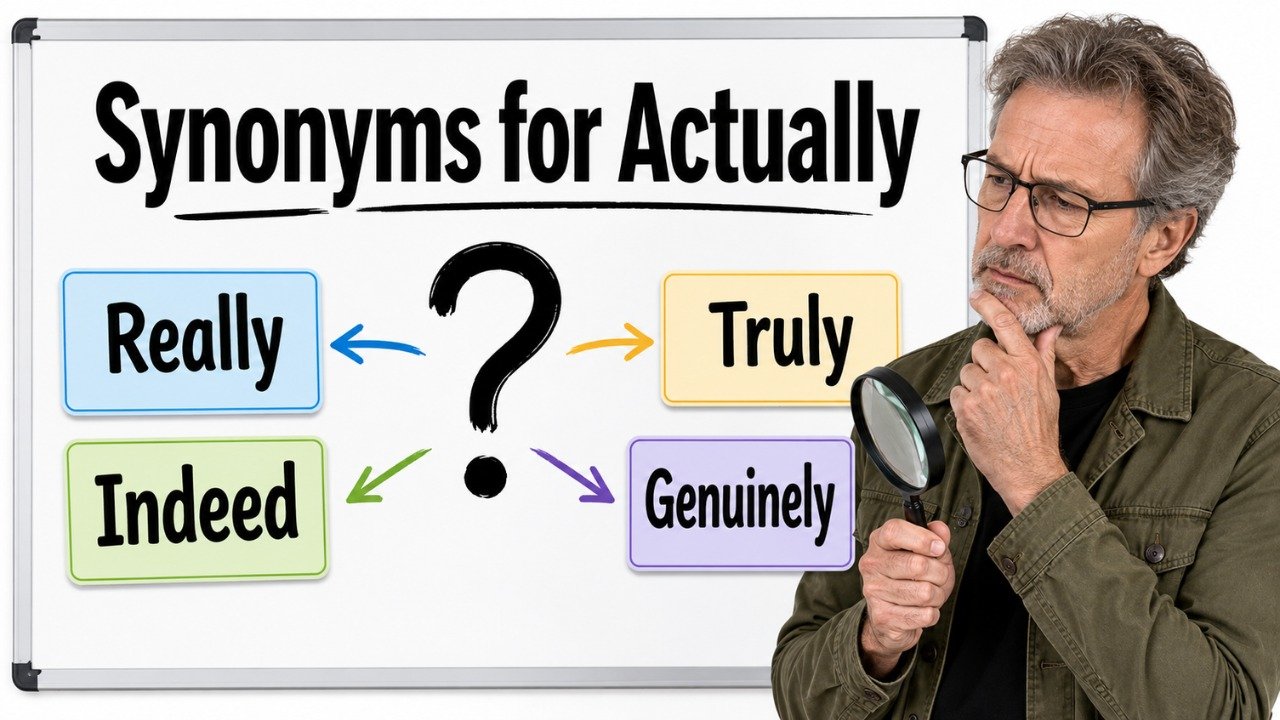
Quick Answer: The best synonyms for actually include really, truly, genuinely, indeed, in fact, in reality, as a matter of fact, technically, certainly, and to be precise. Use really in casual speech, truly for sincere emphasis, and genuinely when confirming authenticity. Indeed and in fact work well in formal writing, while in reality contrasts facts with assumptions. As a matter of fact introduces a correction or added detail. Technically suits precise qualifications, certainly expresses confidence, and to be precise clarifies an exact point. These synonyms for actually are not interchangeable in every sentence, so context determines the best choice.
Pronunciation and Word Details
Word: Actually.
Pronunciation: /ˈæk.tʃu.ə.li/
Part of Speech: Adverb.
Meaning: In reality, as a fact, or in a way that corrects what someone believed or expected.
US Pronunciation:
UK Pronunciation:
What Does “Actually” Mean?
Actually means in reality, in fact, or as something truly happened. It is an adverb used to confirm facts, correct misunderstandings, express surprise, add emphasis, or politely disagree with a statement.
The word often contrasts reality with an assumption.
Example: The task was actually easier than we expected.
In this sentence, actually shows that the real experience was different from the expectation.
Actually can also introduce a correction.
Example: The meeting is actually on Thursday, not Friday.
It may add emphasis to show that something is true.
Example: She actually completed the entire project alone.
In conversation, actually can make a disagreement sound less direct, although tone still matters.
Example: I actually prefer the second option.
The word can also express surprise when an event seems unlikely.
Example: He actually remembered every name.
Actually does not mean currently. It refers to truth or reality, while currently refers to what is happening at the present time.
Meaning, Tone, and Context of “Actually”
Actually has a neutral and conversational tone, but its effect depends on placement, context, and delivery. It appears in everyday speech, professional communication, essays, explanations, corrections, and informal writing.
Neutral Context: Actually confirms what is true.
Example: The building is actually more than a century old.
Corrective Context: It replaces an incorrect idea with accurate information.
Example: The total is actually $85, not $80.
Emphatic Context: It highlights an unexpected or important fact.
Example: The simple method actually produced the best result.
Conversational Context: It introduces a personal opinion or response.
Example: I actually enjoyed the longer version.
Formal Context: In fact, indeed, and in reality may sound more polished than actually in academic or professional writing.
Example: In fact, the results support the original conclusion.
Polite Context: Actually may soften disagreement when used carefully.
Example: I actually understood the instructions differently.
Blunt Context: Actually can sound dismissive when it directly corrects another person.
Example: Actually, you are wrong.
A more respectful sentence would explain the correction without making the other person feel embarrassed.
Better Example: I understood the rule differently. The updated instructions place the deadline on Monday.
When and How to Use “Actually”
For Confirming Reality: Use actually when you want to show what is true rather than what was assumed.
Example: The apartment is actually larger than it appears in the photographs.
For Correcting Information: Use actually to replace an incorrect detail with the correct one.
Example: The appointment is actually at 2:30, not 3:00.
For Expressing Surprise: Use actually when an outcome is unexpected.
Example: The beginner actually won the competition.
For Adding Emphasis: Use actually to make a true statement more noticeable.
Example: The new process actually saves several hours each week.
For Polite Disagreement: Use actually before a different opinion, but make sure the full sentence remains respectful.
Example: I actually think the simpler design communicates the message more clearly.
For Clarifying an Opinion: Use actually when your true preference may differ from what others expect.
Example: I actually prefer working early in the morning.
For Contrasting Appearance and Reality: Use actually when something is different from how it seems.
Example: The fabric looks delicate, but it is actually very durable.
For Reporting a Real Result: Use actually when describing what happened in practice.
Example: The final campaign actually performed better with a smaller budget.
For Questions Expressing Doubt: Actually can show that the speaker finds something surprising or difficult to believe.
Example: Did he actually finish the report in one hour?
Use this form carefully because it may suggest that you doubt another person’s ability or honesty.
Best Synonyms for Actually
Really: In reality or as a true fact, especially in casual communication.
Example: The restaurant is really quieter during the afternoon.
Truly: In a sincere, complete, or unquestionably real way.
Example: She was truly grateful for their support.
Genuinely: In an authentic, honest, or sincere manner.
Example: He was genuinely surprised by the response.
Indeed: Used to confirm or emphasize a statement, especially in formal writing.
Example: The problem is indeed more complicated than it first appeared.
In Fact: Used to introduce evidence, correction, or stronger information.
Example: The course was not difficult. In fact, it was surprisingly enjoyable.
In Reality: Used when the truth differs from an appearance, belief, or expectation.
Example: The plan sounded simple, but in reality it required careful preparation.
As a Matter of Fact: Used to correct information or add a relevant fact.
Example: As a matter of fact, I completed the application yesterday.
Technically: According to an exact rule, definition, or set of facts.
Example: Technically, the document was submitted before the deadline.
Certainly: Used to express confidence that something is true.
Example: The change will certainly affect the final result.
To Be Precise: Used to correct or clarify an exact detail.
Example: The journey took three hours, or three hours and twelve minutes to be precise.
50 Synonyms for Actually with Short Meanings
Not every alternative below can replace actually in every sentence. Some express truth, while others introduce correction, certainty, practical reality, or surprising information.
- Really: In reality or truth.
- Truly: In a completely real or sincere way.
- Genuinely: Authentically, honestly, or sincerely.
- Indeed: Used to confirm or emphasize a fact.
- In Fact: In reality, often with added evidence.
- In Reality: According to the true situation.
- In Truth: According to what is genuinely true.
- As a Matter of Fact: Used to correct or strengthen a statement.
- In Actual Fact: In the real situation rather than in theory.
- In Point of Fact: In fact, especially in formal correction.
- The Truth Is: Used to introduce the real explanation.
- The Fact Is: Used to emphasize an important reality.
- Truthfully: In an honest and accurate manner.
- Honestly: In a sincere or truthful way.
- In All Honesty: Used to introduce a sincere opinion or admission.
- To Tell the Truth: Used before an honest statement.
- Rather: Used to replace an incorrect idea with a more accurate one.
- Instead: Used to show what is true in place of an assumption.
- More Accurately: Used to give a factually better description.
- More Precisely: Used to provide greater exactness.
- Strictly Speaking: According to the exact meaning or rule.
- Technically: According to precise facts, definitions, or rules.
- To Be Exact: Used before an exact correction or detail.
- To Be Precise: Used to make a statement more specific.
- Properly Speaking: According to the correct use or definition.
- Correctly: In a way that is accurate and free from error.
- Certainly: Without doubt or with strong confidence.
- Definitely: Clearly and without uncertainty.
- Undoubtedly: In a way that cannot reasonably be doubted.
- Unquestionably: Without any serious possibility of disagreement.
- Undeniably: In a way that cannot fairly be denied.
- Assuredly: Certainly or confidently.
- Clearly: In an obvious or easily recognized way.
- Plainly: In a way that is obvious or unmistakable.
- Evidently: As shown by the available facts.
- Surely: Used to express confidence or expectation.
- Practically: In real use or ordinary experience.
- Effectively: In practical result, even if not formally stated.
- Essentially: In the most important or basic sense.
- Basically: In simple or fundamental terms.
- Fundamentally: At the deepest or most important level.
- Ultimately: When the final truth or result is considered.
- Realistically: According to practical facts and conditions.
- In Practice: In real situations rather than in theory.
- In Effect: In actual result or practical meaning.
- As Things Stand: According to the present real situation.
- As It Happens: Used to introduce a relevant or unexpected fact.
- It Turns Out: Used when the truth becomes known later.
- Surprisingly: In a way that differs from expectation.
- Believe It or Not: Used before a surprising but true statement.
Read Also:
Synonyms for Just
Synonyms for Actually by Context
When Actually Means In Reality
When actually contrasts truth with belief, appearance, or assumption, use really, in fact, in reality, in truth, or in actual fact.
Really: Natural in casual conversation.
Example: The test was really much easier than the practice questions.
In Fact: Suitable for adding evidence or a stronger fact.
Example: The room is not small. In fact, it can comfortably seat thirty people.
In Reality: Best when appearance and truth differ.
Example: The job looked simple, but in reality it involved several complex tasks.
In Truth: More formal or literary than actually.
Example: In truth, neither proposal addressed the central problem.
In Actual Fact: Strongly emphasizes the real situation.
Example: In actual fact, the process had started several weeks earlier.
When Actually Introduces a Correction
When actually corrects a fact or replaces an inaccurate statement, use rather, more accurately, more precisely, to be exact, or technically.
Rather: Replaces an incorrect description with a better one.
Example: The issue is not financial but rather organizational.
More Accurately: Introduces a factually improved description.
Example: The building is old, or more accurately, historically significant.
More Precisely: Adds exact detail.
Example: The delivery will arrive next week, or more precisely, on Tuesday morning.
To Be Exact: Gives an exact correction.
Example: The project took six months, seven months to be exact.
Technically: Applies a strict rule or definition.
Example: Technically, the application remained open until midnight.
When Actually Adds Emphasis
When actually makes a true statement stronger or more noticeable, use really, truly, indeed, certainly, or undeniably.
Really: Common and natural in speech.
Example: The training really improved her confidence.
Truly: Expresses sincere or complete emphasis.
Example: It was a truly memorable experience.
Indeed: Confirms a statement with a formal tone.
Example: The final stage was indeed the most demanding.
Certainly: Shows strong confidence.
Example: The new schedule will certainly reduce confusion.
Undeniably: Emphasizes a fact that is difficult to dispute.
Example: The team’s performance was undeniably impressive.
When Actually Expresses Surprise
When actually introduces an unexpected fact, use surprisingly, as it happens, it turns out, or believe it or not.
Surprisingly: Directly shows that the result was unexpected.
Example: Surprisingly, the least expensive option lasted the longest.
As It Happens: Introduces a relevant fact that may be unexpected.
Example: As it happens, I met the designer at a conference last month.
It Turns Out: Reveals information discovered later.
Example: It turns out that the original calculation was correct.
Believe It or Not: Informal and expressive.
Example: Believe it or not, the old printer still works.
When Actually Means In Practice
When actually contrasts theory with real results, use in practice, practically, effectively, in effect, or realistically.
In Practice: Describes what occurs in real situations.
Example: The policy sounds simple, but in practice it is difficult to enforce.
Practically: Refers to real use or practical conditions.
Example: The two systems are practically identical for ordinary users.
Effectively: Describes the real result of an action.
Example: The decision effectively ended the discussion.
In Effect: Means that something has a particular practical result.
Example: The new rule is, in effect, a complete restriction.
Realistically: Considers practical limits and facts.
Example: Realistically, the work will require at least three days.
When Actually Introduces Honesty
When actually introduces a sincere opinion or admission, use honestly, truthfully, in all honesty, or to tell the truth.
Honestly: Natural in conversation.
Example: Honestly, I found the first explanation easier to understand.
Truthfully: Emphasizes factual honesty.
Example: Truthfully, I had not expected the proposal to succeed.
In All Honesty: Introduces an open and sincere assessment.
Example: In all honesty, the team needs more time to prepare.
To Tell the Truth: Introduces a personal admission.
Example: To tell the truth, I preferred the original version.
Another Word for Actually
Really is the best general replacement for actually in casual speech because both words can confirm that something is true. However, the best alternative depends on the purpose of the sentence. Use in fact for formal emphasis, in reality for a contrast with appearances, technically for exact rules, and to be precise for a detailed correction.
Original: I actually enjoyed the lecture.
Better Option: I really enjoyed the lecture.
Original: The task was actually more complicated than expected.
Better Option: In reality, the task was more complicated than expected.
Original: The deadline is actually Friday afternoon.
Better Option: To be precise, the deadline is Friday afternoon.
Original: The policy actually allows late applications in certain cases.
Better Option: Technically, the policy allows late applications in certain cases.
When Not to Use “Actually”
Do not use actually when it adds no useful meaning. It often appears as a filler word in speech and can make writing less direct.
Weak: I actually went to the office and actually spoke with the manager.
Better: I went to the office and spoke with the manager.
Avoid actually when it makes a correction sound rude or dismissive.
Weak: Actually, your answer is wrong.
Better: I reached a different answer because the final step uses the updated formula.
Do not use actually when a more precise transition would explain the relationship between ideas.
Weak: The plan looked affordable. Actually, it required several additional payments.
Better: The plan looked affordable. In reality, it required several additional payments.
Avoid using actually to mean currently.
Weak: I am actually working in the accounting department.
Better: I am currently working in the accounting department.
Do not use actually as an automatic replacement for literally. Actually confirms truth, while literally emphasizes that words should be understood in their exact sense.
Weak: The road was actually covered in ice, not figuratively.
Better: The road was literally covered in ice.
Avoid placing actually in an unclear position.
Weak: She said she actually completed the report yesterday.
This sentence could mean that she truly completed it or that yesterday is the surprising detail.
Better: She confirmed that she completed the report yesterday.
Do not overuse actually in formal writing. In fact, indeed, evidence shows, or a direct statement may sound clearer.
Weak: The results actually show that the method is effective.
Better: The results show that the method is effective.
Words Commonly Confused With Actually
Actually vs Really: Both can confirm truth. Really is more conversational and can also express degree, while actually often contrasts reality with an assumption.
Actually vs In Fact: Actually is common in speech and correction. In fact is often more polished in formal explanations and supporting statements.
Actually vs Truly: Actually focuses on factual reality. Truly often emphasizes sincerity, completeness, or emotional depth.
Actually vs Genuinely: Actually confirms that something is true. Genuinely emphasizes authenticity or sincere feeling.
Actually vs Literally: Actually means in reality. Literally means according to the exact meaning of the words, without exaggeration or metaphor.
Actually vs Technically: Actually states the real situation broadly. Technically focuses on strict definitions, rules, or precise facts.
Actually vs Currently: Actually means in fact or in reality. Currently means at the present time.
Actually vs Presently: Actually confirms truth. Presently usually means now or soon, depending on context.
Actually vs Eventually: Actually means in reality. Eventually means at a later time or after a process.
Actually vs Factually: Actually introduces what is true. Factually describes information that is based on accurate facts.
Which Synonym Should You Choose?
Choose really in casual speech when confirming truth or emphasizing a personal reaction.
Choose truly when expressing sincerity, deep appreciation, or complete emphasis.
Choose genuinely when describing authentic emotions, honest interest, or something that is not false.
Choose in fact for essays, reports, and professional explanations that add evidence or strengthen a point.
Choose indeed for formal confirmation or emphasis.
Choose in reality when the true situation differs from an appearance, assumption, or expectation.
Choose as a matter of fact when correcting information or adding a relevant detail in conversation.
Choose technically when referring to exact rules, definitions, classifications, or requirements.
Choose to be precise when correcting a number, date, measurement, or specific detail.
Choose more accurately when replacing an unclear or partly incorrect description.
Choose certainly or definitely when expressing confidence rather than correcting a fact.
Choose surprisingly when the main purpose is to highlight an unexpected outcome.
Choose it turns out when information became clear after investigation or experience.
Choose in practice when comparing a theory, plan, or policy with real world results.
Choose honestly or in all honesty when introducing a sincere personal opinion.
In formal reports, remove actually when the sentence is already factual and clear.
Less Direct: The analysis actually shows a steady increase.
More Direct: The analysis shows a steady increase.
Real Life Examples of “Actually” in Sentences
Original: The hotel is actually closer than it appears on the map.
Better Option: In reality, the hotel is closer than it appears on the map.
Original: I actually liked the final chapter.
Better Option: I really liked the final chapter.
Original: The payment is actually due on Monday.
Better Option: To be precise, the payment is due on Monday.
Original: She was actually pleased with the result.
Better Option: She was genuinely pleased with the result.
Original: The new method actually works well.
Better Option: The new method works well in practice.
Original: He actually completed the task without assistance.
Better Option: Surprisingly, he completed the task without assistance.
Original: The problem is actually caused by a missing setting.
Better Option: In fact, the problem is caused by a missing setting.
Original: The document is actually a contract.
Better Option: Technically, the document is a contract.
Original: I actually disagree with that conclusion.
Better Option: I see the conclusion differently.
Original: The journey actually took four hours and twenty minutes.
Better Option: The journey took four hours and twenty minutes, to be exact.
Synonym Groups and Usage Differences
Truth and Reality Group
This group includes really, truly, genuinely, in fact, in reality, in truth, and in actual fact. These alternatives confirm that something is real or accurate.
Really is conversational. In fact works well in formal explanations. In reality contrasts truth with appearances. Genuinely emphasizes authenticity.
Example: The material looks fragile, but in reality it is extremely strong.
Correction and Precision Group
This group includes rather, more accurately, more precisely, technically, to be exact, and to be precise. These expressions replace inaccurate information or add a clearer detail.
Rather corrects an idea. Technically applies an exact rule. To be precise introduces specific information.
Example: The event begins in the evening, at 6:15 to be precise.
Emphasis and Certainty Group
This group includes indeed, certainly, definitely, undoubtedly, unquestionably, undeniably, and assuredly. These words emphasize confidence or confirm that a statement is true.
Indeed sounds formal. Definitely is natural in conversation. Undeniably emphasizes evidence that is difficult to dispute.
Example: The final design is undeniably more practical.
Practical Reality Group
This group includes practically, effectively, essentially, realistically, in practice, and in effect. These alternatives describe real operation, practical results, or the central truth of a situation.
Example: The change is, in effect, a complete revision of the policy.
Honest Opinion Group
This group includes honestly, truthfully, in all honesty, and to tell the truth. These expressions introduce a sincere opinion, admission, or personal response.
Example: In all honesty, I think the team should reconsider the schedule.
Surprise and Discovery Group
This group includes surprisingly, as it happens, it turns out, and believe it or not. These expressions introduce information that was unexpected or discovered later.
Example: It turns out that both calculations produced the same result.
Antonyms of Actually
Actually has no single antonym because it can express truth, reality, correction, or emphasis. The most useful opposites depend on the sentence.
Supposedly: According to a claim that may not be proven.
Allegedly: Said to be true without confirmed proof.
Apparently: Seemingly true based on available information.
Seemingly: Appearing to be true, though reality may differ.
Theoretically: According to theory rather than practical reality.
Hypothetically: Based on an imagined situation.
Falsely: In a way that is untrue.
Inaccurately: In a way that contains errors.
Mistakenly: Because of an incorrect belief or understanding.
Fictionally: In an invented rather than real manner.
Nominally: In name or official description, but not necessarily in practice.
Superficially: According to outward appearance rather than deeper reality.
Possibly: With uncertainty rather than confirmed truth.
Presumably: Based on a reasonable assumption rather than direct confirmation.
Unrealistically: Without proper attention to real conditions or limits.
Comparison: Actually vs Related Words
Actually vs Really
Actually often contrasts reality with an assumption. Really is more conversational and can express truth, intensity, or emotion.
Example With Actually: The exam was actually easier than I expected.
Example With Really: I really enjoyed the class.
Actually vs In Fact
Actually is common in speech and direct correction. In fact often introduces evidence, explanation, or stronger information in formal writing.
Example With Actually: The office is actually closed on Friday.
Example With In Fact: The office is not reducing its hours. In fact, it will remain open later.
Actually vs Truly
Actually focuses on factual truth. Truly often expresses sincerity, depth, or completeness.
Example With Actually: She actually attended the entire meeting.
Example With Truly: She was truly grateful for the invitation.
Actually vs Genuinely
Actually confirms that something happened or is true. Genuinely shows that something is authentic or sincere.
Example With Actually: He actually apologized before leaving.
Example With Genuinely: He was genuinely sorry for the mistake.
Actually vs Literally
Actually means in reality. Literally means that a statement is true according to the exact meaning of its words.
Example With Actually: The building is actually older than the town hall.
Example With Literally: The basement was literally filled with water.
Actually vs Technically
Actually describes the real situation in a general way. Technically refers to strict rules, exact definitions, or formal classifications.
Example With Actually: The store is actually open today.
Example With Technically: Technically, the return period ends at midnight.
Actually vs Currently
Actually means in fact. Currently means at the present time.
Example With Actually: She actually owns the building.
Example With Currently: She is currently managing the building.
Actually vs Eventually
Actually refers to truth or reality. Eventually refers to something that happens after time or delay.
Example With Actually: He actually accepted the proposal.
Example With Eventually: He eventually accepted the proposal after several discussions.
Actually vs Apparently
Actually presents confirmed reality. Apparently describes what seems true based on available evidence.
Example With Actually: The package actually arrived this morning.
Example With Apparently: Apparently, the package will arrive this afternoon.
Common Phrases and Expressions With “Actually”
Actually True: Confirmed as factual rather than assumed.
Example: The unusual story was actually true.
Actually Happened: Occurred in real life.
Example: The event actually happened several years ago.
Actually Exists: Is real rather than imaginary.
Example: A place with that unusual name actually exists.
Actually Means: Gives the true definition or intended message.
Example: The expression actually means something quite different.
Actually Works: Produces a successful result in practice.
Example: This simple technique actually works.
Actually Possible: Capable of happening despite doubt.
Example: Completing the task in one day is actually possible.
Actually Quite: Adds emphasis to an unexpected quality.
Example: The final explanation was actually quite clear.
Actually Rather: Introduces a somewhat surprising description.
Example: The process was actually rather enjoyable.
Did Actually: Emphasizes that an action truly occurred.
Example: She did actually send the message before leaving.
What Actually Happened: Asks for the true sequence of events.
Example: We need to understand what actually happened.
Common Mistakes to Avoid
Overusing Actually: Repeated use weakens writing and may make every statement sound defensive or surprising.
Repetitive: I actually called him, and he actually answered, and we actually discussed the problem.
Improved: I called him, he answered, and we discussed the problem.
Using Actually as a Filler: Remove it when the sentence remains clear and complete without it.
Weak: We actually need to review the report.
Better: We need to review the report.
Sounding Rude During Corrections: Beginning a reply with actually can make the listener feel dismissed.
Blunt: Actually, that is not how the system works.
Better: The system works slightly differently. Let me explain the updated process.
Confusing Actually With Currently: Actually concerns truth. Currently concerns the present time.
Incorrect: I am actually studying at home this month.
Better: I am currently studying at home this month.
Choosing the Wrong Synonym: Indeed confirms a statement, while technically introduces a strict qualification. They are not always interchangeable.
Unnatural: Indeed, the form is valid only until midnight.
Better: Technically, the form is valid only until midnight.
Using Actually Instead of Literally: Use literally when emphasizing that a statement is exact and not figurative.
Incorrect: The glass actually shattered into hundreds of pieces, and I mean that in the exact sense.
Better: The glass literally shattered into hundreds of pieces.
Creating Vague Emphasis: Actually should highlight a meaningful contrast, correction, or surprise.
Vague: The report is actually complete.
Clearer: Contrary to our earlier concern, the report is complete.
Using Actually Unnecessarily in Formal Reports: Direct factual statements are usually stronger.
Weak: The results actually indicate a decline in costs.
Better: The results indicate a decline in costs.
Placing Actually in an Ambiguous Position: Put the word near the idea it modifies, or rewrite the sentence for clarity.
Unclear: He said he actually reviewed the document yesterday.
Clearer: He confirmed yesterday that he had reviewed the document.
Conclusion
Understanding synonyms for actually helps you express truth, correction, emphasis, and surprise more precisely. Really suits casual speech, while in fact and indeed work well in formal writing. Use in reality when facts differ from appearances, technically for exact rules, and to be precise for specific details. Genuinely emphasizes sincerity, while surprisingly introduces an unexpected result. Because actually can sound repetitive or corrective, choose an alternative that matches the sentence’s tone, purpose, and level of formality.
FAQs About Synonyms for Actually
What is the best synonym for actually?
Really is the best general synonym in casual speech. In fact is often better in formal writing, while in reality suits contrasts between appearance and truth.
Can truly replace actually?
Truly can replace actually when emphasizing sincerity or truth. It does not usually work when actually introduces a correction.
Is in fact the same as actually?
The expressions are often similar. In fact is usually more formal and commonly introduces evidence or stronger supporting information.
What is a formal synonym for actually?
Indeed, in fact, in reality, in truth, and in point of fact are suitable formal alternatives.
What can replace actually in an essay?
Use in fact, indeed, in reality, more precisely, or technically, depending on whether you are adding evidence, correcting a detail, or making a qualification.
What is the difference between actually and currently?
Actually means in fact or in reality. Currently means at the present time.
Should actually be removed from formal writing?
Not always, but it should be removed when it adds no contrast, correction, or useful emphasis. A direct factual statement is often clearer.
