
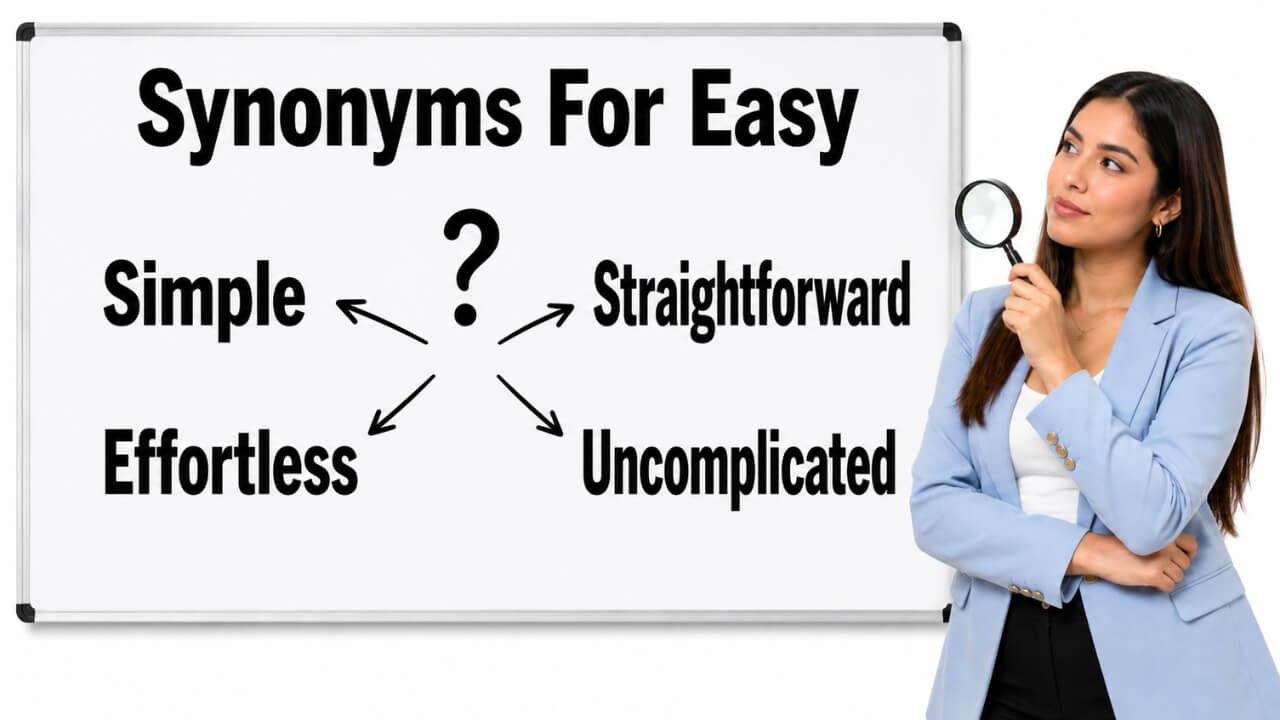
Quick Answer: The best synonyms for easy include simple, effortless, straightforward, uncomplicated, painless, manageable, accessible, smooth, light, and undemanding. Use simple for something not complex, effortless for something that needs little energy, straightforward for clear instructions or processes, manageable for tasks you can handle, and accessible for something easy to understand or use.
Pronunciation and Word Details
Word: Easy.
Pronunciation: /ˈiːzi/.
Part of Speech: Adjective.
Meaning: Not difficult, not complicated, or requiring little effort.
US Pronunciation:
UK Pronunciation:
What Does “Easy” Mean?
Easy means something is not hard to do, understand, use, handle, or complete. It is mainly used as an adjective, as in an easy question, an easy task, or an easy decision.
The word can describe difficulty, comfort, effort, mood, movement, or personality. For example, an easy lesson is simple to understand, an easy chair is comfortable, and an easy person may be relaxed or not strict.
Meaning, Tone, and Context of “Easy”
Easy is a neutral and common word. It works well in casual speech, everyday writing, instructions, learning content, and general descriptions. It is clear, direct, and widely understood.
In formal writing, words like straightforward, manageable, accessible, or uncomplicated may sound more precise. In casual conversation, easy, simple, and painless sound natural. In academic or technical contexts, accessible often means easy to understand, while user friendly means easy to operate or navigate.
When and How to Use “Easy”
For Simple Tasks: Use easy when a task does not need much skill, time, or effort.
Example: The worksheet is easy for beginners.
For Clear Instructions: Use easy when steps are simple to follow.
Example: The guide gives easy directions for setting up the account.
For Comfortable Experiences: Use easy when something feels relaxed, pleasant, or free from pressure.
Example: They had an easy conversation during lunch.
For Manageable Work: Use easy when work can be handled without serious difficulty.
Example: The project became easy after the team divided the tasks.
For Learning and Understanding: Use easy when an idea, lesson, or explanation is clear.
Example: The teacher gave an easy explanation of the grammar rule.
For Relaxed Personality: Use easy carefully when describing a person. Easygoing is often better.
Example: He has an easygoing nature and stays calm under pressure.
Best Synonyms for Easy
Simple: Not complex or difficult.
Example: The instructions are simple enough for new users.
Effortless: Done with little or no visible effort.
Example: Her presentation looked effortless and natural.
Straightforward: Clear, direct, and not confusing.
Example: The process is straightforward from start to finish.
Uncomplicated: Free from complexity or unnecessary difficulty.
Example: We need an uncomplicated solution for this issue.
Painless: Easy and not stressful or unpleasant.
Example: The registration process was quick and painless.
Manageable: Possible to control, complete, or handle.
Example: The workload is manageable with a proper schedule.
Accessible: Easy to reach, use, or understand.
Example: The article makes grammar rules accessible to beginners.
Smooth: Easy because there are no problems, delays, or interruptions.
Example: The meeting went smoothly and ended on time.
Light: Not heavy, serious, or demanding.
Example: She started the day with some light exercise.
Undemanding: Not requiring much effort, skill, or attention.
Example: The job is undemanding but still useful.
50 Synonyms for Easy with Short Meanings
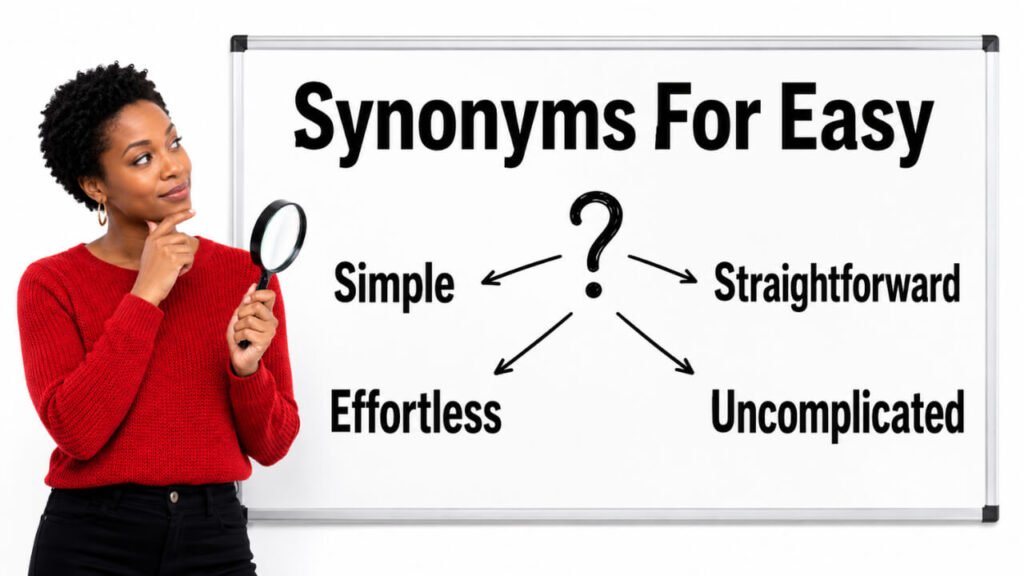
- Simple: Not difficult or complex.
- Effortless: Requiring very little effort.
- Straightforward: Clear and direct.
- Uncomplicated: Not involved or confusing.
- Painless: Easy and free from stress.
- Manageable: Possible to handle or complete.
- Accessible: Easy to understand, use, or reach.
- Smooth: Happening without problems.
- Light: Not demanding or heavy.
- Undemanding: Requiring little effort or attention.
- Clear: Easy to understand.
- Plain: Simple and direct.
- Basic: Simple at an early or low level.
- Elementary: Very simple or introductory.
- Beginner friendly: Suitable for someone new.
- Convenient: Easy to use or arrange.
- Comfortable: Physically or emotionally easy.
- Relaxed: Calm and free from pressure.
- Casual: Easy in tone, manner, or style.
- Gentle: Mild and not harsh.
- Mild: Not strong, severe, or difficult.
- Soft: Gentle, light, or not forceful.
- Trouble free: Without problems or difficulty.
- Stress free: Without worry or pressure.
- Smooth sailing: Easy because no serious problems appear.
- Feasible: Possible and practical to do.
- Achievable: Possible to complete successfully.
- Attainable: Possible to reach or get.
- Doable: Possible to do.
- Workable: Practical and possible to use.
- Practical: Easy to apply in real situations.
- Clear cut: Easy to understand or decide.
- Obvious: Easy to see or understand.
- Evident: Easy to notice or recognize.
- Readable: Easy to read and understand.
- Understandable: Easy to comprehend.
- Digestible: Easy to understand or absorb.
- Approachable: Easy to begin, use, or deal with.
- User friendly: Easy for people to operate or use.
- Intuitive: Easy to understand without much instruction.
- Low effort: Requiring little energy or work.
- Low pressure: Not stressful or demanding.
- Relaxing: Making someone feel calm and comfortable.
- Restful: Calm, peaceful, and easy on the mind.
- Leisurely: Done slowly and without pressure.
- Natural: Easy because it feels normal or familiar.
- Fluent: Smooth and easy in speech or movement.
- Free flowing: Smooth, natural, and not forced.
- Plain sailing: Easy because progress is smooth.
- No trouble: Easy and not causing difficulty.
Read Also:
Synonyms for Similar
Synonyms for Easy by Context
When Easy Means Simple
Use these synonyms when easy means not complex, not confusing, or not hard to understand.
Useful Synonyms: Simple, plain, basic, elementary, clear, uncomplicated.
Example: The lesson is simple enough for beginners.
Example: The rule is clear once you see it in a sentence.
When Easy Means Effortless
Use these words when something needs little work, energy, or force.
Useful Synonyms: Effortless, light, low effort, undemanding, painless.
Example: The tool made the task effortless.
Example: The exercise is light but still helpful.
When Easy Means Understandable
Use these synonyms when talking about reading, learning, teaching, or explaining.
Useful Synonyms: Accessible, readable, understandable, digestible, clear.
Example: The guide makes difficult grammar points accessible.
Example: Her explanation was readable and practical.
When Easy Means Manageable
Use these choices when something can be handled, controlled, or completed.
Useful Synonyms: Manageable, doable, feasible, achievable, workable.
Example: The deadline is manageable with a clear plan.
Example: The goal is achievable if you work consistently.
When Easy Means Comfortable
Use these words when easy describes comfort, calmness, or lack of pressure.
Useful Synonyms: Comfortable, relaxed, gentle, mild, restful.
Example: The room had a comfortable atmosphere.
Example: Their conversation felt relaxed and natural.
When Easy Means Smooth
Use these alternatives when a process has no major problems or delays.
Useful Synonyms: Smooth, trouble free, stress free, smooth sailing, plain sailing.
Example: The interview was smooth from beginning to end.
Example: The transfer was trouble free and fast.
Another Word for Easy
The best single replacement for easy is usually simple. However, the best choice depends on the context. Use simple for low complexity, effortless for low effort, straightforward for clear processes, and manageable for tasks that can be handled.
Original: The form is easy to complete.
Better Option: The form is straightforward to complete.
Original: The lesson was easy for the students.
Better Option: The lesson was simple for the students.
Original: The new schedule is easy to handle.
Better Option: The new schedule is manageable.
Original: The explanation was easy to understand.
Better Option: The explanation was accessible.
When Not to Use “Easy”
Do not use easy when the meaning needs more precision. It can sound too general in formal writing, reports, instructions, or academic explanations. A stronger synonym can make your sentence clearer.
Weak: The software is easy.
Better: The software is user friendly and intuitive.
Weak: The problem is easy.
Better: The problem is straightforward once you understand the formula.
Weak: The article is easy.
Better: The article is readable and accessible for beginners.
Weak: The project is easy.
Better: The project is manageable with a clear timeline.
Weak: The process was easy.
Better: The process was smooth and trouble free.
Words Commonly Confused With Easy
Easy vs Simple: Easy means not difficult to do, while simple means not complex. A task can be simple in design but still difficult to complete.
Easy vs Effortless: Easy means low difficulty, while effortless suggests something looks or feels almost without effort.
Easy vs Straightforward: Easy is general, while straightforward means clear, direct, and not confusing.
Easy vs Manageable: Easy means not hard, while manageable means possible to handle even if some effort is needed.
Easy vs Accessible: Easy is broad, while accessible often means easy to understand, reach, use, or enter.
Easy vs Comfortable: Easy can describe difficulty or comfort, while comfortable focuses on physical or emotional ease.
Which Synonym Should You Choose?
Choose simple when writing about something that is not complex.
Choose effortless when something requires almost no visible effort.
Choose straightforward when describing instructions, steps, methods, or processes.
Choose uncomplicated when you want a formal alternative for something not complex.
Choose painless when something is easy and not stressful.
Choose manageable when a task is possible to handle, even if it still needs work.
Choose accessible when writing about learning, explanations, reading, tools, or information.
Choose smooth when describing a process that happens without problems.
Choose light when the activity is not heavy, serious, or demanding.
Choose undemanding when something does not require much time, focus, or effort.
Real Life Examples of “Easy” in Sentences
Original: The test was easy.
Better Option: The test was simple.
Original: The instructions are easy to follow.
Better Option: The instructions are straightforward.
Original: The app is easy to use.
Better Option: The app is user friendly.
Original: The article is easy to read.
Better Option: The article is readable and clear.
Original: The task was easy after practice.
Better Option: The task became manageable after practice.
Original: The process was easy for everyone.
Better Option: The process was smooth for everyone.
Original: The explanation made the topic easy.
Better Option: The explanation made the topic accessible.
Original: The workout was easy today.
Better Option: The workout was light today.
Original: The meeting was easy and calm.
Better Option: The meeting was relaxed and calm.
Original: The solution is easy to apply.
Better Option: The solution is practical and workable.
Synonym Groups and Usage Differences
Simplicity Group
Words in this group describe something that is not complex or confusing. Use them for lessons, rules, ideas, systems, and instructions.
Synonyms: Simple, plain, basic, elementary, uncomplicated.
Example: The basic method works well for new learners.
Effort Group
These synonyms focus on low energy, low work, or low difficulty. They are useful for tasks, movement, performance, and daily activities.
Synonyms: Effortless, light, low effort, undemanding, painless.
Example: The new method made the work almost effortless.
Clarity Group
This group is best for writing, teaching, explaining, reading, and communication.
Synonyms: Clear, readable, understandable, accessible, digestible.
Example: The chapter gives a clear explanation of sentence structure.
Manageability Group
These words show that something can be handled, completed, or controlled.
Synonyms: Manageable, doable, feasible, achievable, workable.
Example: The plan is workable if each step is completed on time.
Comfort Group
This group describes something calm, pleasant, gentle, or free from pressure.
Synonyms: Comfortable, relaxed, restful, gentle, mild.
Example: The quiet room created a restful learning space.
Smooth Progress Group
Use this group when something happens without problems, confusion, or delay.
Synonyms: Smooth, trouble free, stress free, plain sailing, smooth sailing.
Example: The first week of training was smooth sailing.
Antonyms of Easy
Difficult: Hard to do, understand, or complete.
Hard: Requiring strong effort, skill, or patience.
Complex: Made of many connected or difficult parts.
Complicated: Confusing because of too many details.
Demanding: Requiring a lot of time, effort, or attention.
Challenging: Difficult but often useful for growth or learning.
Stressful: Causing worry, pressure, or tension.
Confusing: Hard to understand clearly.
Inaccessible: Difficult to reach, use, or understand.
Uncomfortable: Not physically or emotionally easy.
Strict: Not relaxed or flexible.
Rough: Not smooth, calm, or trouble free.
Comparison: Easy vs Related Words
Easy vs Simple
Easy focuses on low difficulty. Simple focuses on low complexity.
Example With Easy: The task is easy to complete.
Example With Simple: The task has a simple structure.
Easy vs Effortless
Easy means something is not hard. Effortless means it seems to require almost no effort.
Example With Easy: The dance step is easy to learn.
Example With Effortless: Her dance looked effortless on stage.
Easy vs Straightforward
Easy is broad. Straightforward means clear, direct, and not confusing.
Example With Easy: The form is easy.
Example With Straightforward: The form is straightforward and takes only a few minutes.
Easy vs Manageable
Easy means not difficult. Manageable means possible to handle, even when some effort is required.
Example With Easy: The homework is easy.
Example With Manageable: The homework is manageable if you start early.
Easy vs Accessible
Easy can describe many things. Accessible is often used for information, tools, places, and learning materials.
Example With Easy: The grammar lesson is easy.
Example With Accessible: The grammar lesson is accessible to new learners.
Easy vs Comfortable
Easy can describe difficulty or comfort. Comfortable mainly describes physical ease or emotional ease.
Example With Easy: The chair is easy to move.
Example With Comfortable: The chair is comfortable to sit in.
Common Phrases and Expressions With Easy
Easy Answer: An answer that is simple or obvious.
Easy Choice: A decision that is not difficult to make.
Easy Task: A job that requires little effort.
Easy Way: A simple method for doing something.
Easy to Understand: Clear and not confusing.
Easy to Use: Simple to operate or handle.
Easy Reading: Text that is simple and comfortable to read.
Easy Life: A life with little difficulty or pressure.
Easy Money: Money gained with little effort, often used cautiously.
Easy Does It: A phrase meaning move slowly, carefully, or gently.
Common Mistakes to Avoid
Using easy too often can make writing sound repetitive. Replace it with a more specific synonym when the sentence needs detail.
Avoid using easy when you mean simple. Simple describes structure, while easy describes difficulty.
Do not use effortless for something that still requires real work. Manageable is better when effort is needed but the task can still be handled.
Avoid calling a person easy if the meaning is relaxed or calm. Easygoing is usually clearer and more respectful.
Do not use accessible for every meaning of easy. It works best when talking about understanding, entry, use, reach, or availability.
Avoid vague sentences like The system is easy. A clearer sentence is The system is user friendly and straightforward.
Conclusion
The best synonyms for easy depend on what you want to describe. Use simple for low complexity, effortless for low effort, straightforward for clear steps, manageable for tasks you can handle, and accessible for information that is easy to understand or use. Words like painless, smooth, light, and undemanding add more specific meaning. Choosing the right synonym makes your writing clearer, stronger, and more natural.
FAQs About Synonyms for Easy
What are the best synonyms for easy?
The best synonyms for easy are simple, effortless, straightforward, uncomplicated, painless, manageable, accessible, and smooth.
What is another word for easy in formal writing?
A good formal word for easy is straightforward, uncomplicated, manageable, or accessible, depending on the sentence.
What is a better word than easy?
Simple is often the best general replacement, but effortless, straightforward, and manageable may be better in specific contexts.
What is a synonym for easy to understand?
Good synonyms for easy to understand include clear, accessible, readable, understandable, and digestible.
What is a synonym for easy to use?
Useful synonyms for easy to use include user friendly, intuitive, accessible, straightforward, and convenient.
What is the difference between easy and simple?
Easy means not difficult to do. Simple means not complex. Something can be simple in design but still hard to complete.
What is the opposite of easy?
Common antonyms of easy include difficult, hard, complex, complicated, demanding, challenging, and stressful.
