
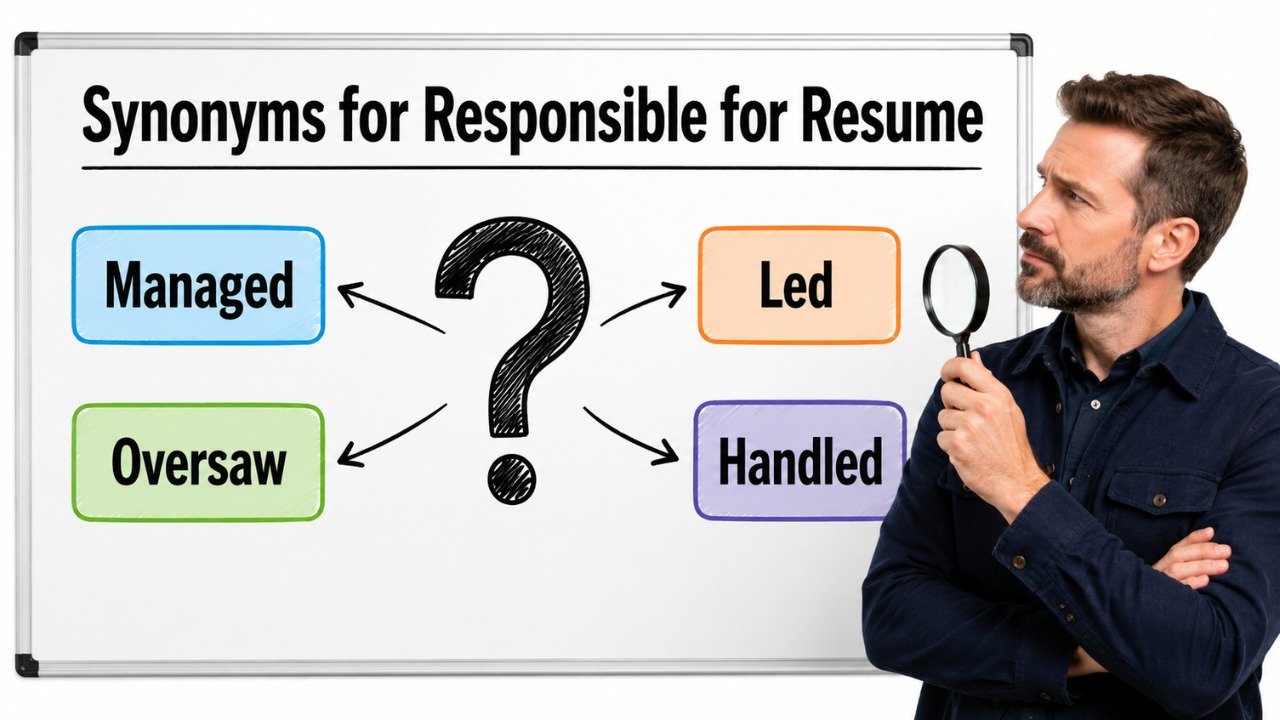
Quick Answer: The best synonyms for responsible for resume writing include managed, led, oversaw, coordinated, directed, handled, administered, supervised, executed, and delivered. Use managed when you controlled projects or operations, led when you guided people or initiatives, oversaw when you monitored work, coordinated when you organized moving parts, handled for general duties, administered for formal processes, supervised for employees, executed for plans, and delivered when emphasizing completed results.
Pronunciation and Word Details
Word: Responsible
Pronunciation: /rɪˈspɑːn.sə.bəl/
Part of Speech: Adjective
Meaning: Having the duty, authority, or obligation to manage, complete, or take care of something.
US Pronunciation:
UK Pronunciation:
What Does “Responsible for” Mean?
Responsible for means having the duty, authority, or obligation to perform, manage, supervise, or complete something.
Responsible is an adjective, while responsible for functions as a phrase that connects a person with a task, duty, result, process, or area of ownership.
In everyday sentences, it can simply describe an obligation.
Example: She is responsible for preparing the weekly schedule.
On a resume, however, responsible for often introduces duties without explaining the level of ownership or achievement. Stronger action verbs can make the same information clearer and more specific.
General: Responsible for customer inquiries.
Stronger: Handled customer inquiries.
Leadership: Responsible for a team of six employees.
Stronger: Supervised a team of six employees.
Project Context: Responsible for implementing the new process.
Stronger: Implemented the new process.
The best replacement depends on what you actually did.
Meaning, Tone, and Context of “Responsible for”
Responsible for has a neutral and professional tone. It is grammatically correct in resumes, reports, job descriptions, emails, and everyday communication.
On a resume, however, the phrase can sound passive because it describes an assigned duty rather than showing direct action.
Compare these sentences.
Neutral: Responsible for managing daily operations.
Stronger: Managed daily operations.
The second version immediately tells the reader what the person did.
Responsible for is especially common when discussing duties, accountability, supervision, ownership, administration, and operational responsibilities.
For resumes, stronger verbs are generally more useful because they can communicate leadership, execution, coordination, management, achievement, or ownership with greater precision.
When and How to Use “Responsible for”
For General Duties
Use responsible for when simply explaining what someone is expected to do.
Example: The assistant is responsible for maintaining accurate records.
For resumes, a direct action verb is often stronger.
Resume Version: Maintained accurate records.
For Management
Use managed when you controlled operations, projects, resources, budgets, schedules, or processes.
Example: Managed daily office operations and administrative workflows.
For Leadership
Use led when you guided a team, project, program, initiative, or change.
Example: Led a team responsible for improving customer response times.
For Supervision
Use supervised when you directly monitored employees or their work.
Example: Supervised eight employees across two departments.
For Coordination
Use coordinated when you organized people, schedules, events, departments, or activities.
Example: Coordinated training sessions for new employees.
For Oversight
Use oversaw when you monitored an operation or project at a higher level.
Example: Oversaw monthly reporting and compliance activities.
For Execution
Use executed when you carried out a strategy, campaign, plan, or process.
Example: Executed a new onboarding process for incoming employees.
For Results
Use delivered when you want to emphasize completed work or measurable outcomes.
Example: Delivered monthly performance reports ahead of schedule.
Best Synonyms for Responsible for
Managed: Took control of a project, process, resource, team, or operation.
Example: Managed daily operations for a busy service department.
Led: Guided a team, project, initiative, or organizational effort.
Example: Led a team of ten employees through a major process change.
Oversaw: Monitored and directed work from a position of responsibility.
Example: Oversaw inventory control and monthly reporting.
Coordinated: Organized different people, activities, schedules, or resources.
Example: Coordinated meetings, deadlines, and project documentation.
Directed: Provided guidance and authority over people, activities, or operations.
Example: Directed daily workflow across three operational teams.
Handled: Took care of a specific task, responsibility, or situation.
Example: Handled customer inquiries and service requests.
Administered: Managed formal procedures, programs, records, or systems.
Example: Administered employee records and benefit documentation.
Supervised: Monitored employees and guided their work.
Example: Supervised a team of six customer service representatives.
Executed: Carried out a plan, strategy, process, or assignment.
Example: Executed monthly reporting procedures with consistent accuracy.
Delivered: Completed and provided a result, service, project, or outcome.
Example: Delivered weekly performance reports to senior leadership.
50 Synonyms for Responsible for Resume with Short Meanings
- Managed: Controlled a project, process, team, or operation.
- Led: Guided people, projects, or initiatives.
- Oversaw: Monitored work or operations at a supervisory level.
- Coordinated: Organized people, schedules, activities, or resources.
- Directed: Guided operations or people with authority.
- Handled: Took care of assigned duties or situations.
- Administered: Managed formal procedures, programs, or systems.
- Supervised: Monitored and guided employees or work.
- Executed: Carried out a plan, task, or strategy.
- Delivered: Completed and provided expected results.
- Operated: Ran equipment, systems, processes, or services.
- Maintained: Kept systems, records, or processes working properly.
- Organized: Arranged activities, information, or resources efficiently.
- Implemented: Put a plan, procedure, or system into action.
- Developed: Created or improved a process, program, or resource.
- Managed operations: Controlled ongoing business activities.
- Monitored: Observed progress, quality, performance, or compliance.
- Controlled: Regulated processes, resources, budgets, or activities.
- Facilitated: Helped a process, meeting, or activity progress smoothly.
- Planned: Designed steps, schedules, or strategies before execution.
- Prepared: Created documents, reports, materials, or resources.
- Produced: Created a finished result, report, product, or output.
- Completed: Finished an assigned task or project.
- Processed: Managed information, transactions, forms, or requests.
- Reviewed: Examined information for quality, accuracy, or compliance.
- Assessed: Evaluated situations, results, risks, or performance.
- Maintained oversight of: Monitored an area while retaining accountability.
- Managed delivery of: Controlled the completion of a service or project.
- Coordinated delivery of: Organized activities needed to complete work.
- Directed implementation of: Guided the introduction of a new process or plan.
- Led implementation of: Took primary responsibility for introducing a change.
- Managed execution of: Controlled how a plan or project was carried out.
- Supervised execution of: Monitored the completion of planned activities.
- Supported: Assisted a team, process, operation, or initiative.
- Facilitated delivery of: Helped ensure a service or project was completed.
- Conducted: Performed an activity, review, meeting, or investigation.
- Performed: Carried out a specific task or function.
- Completed management of: Finished responsibility for a defined management activity.
- Owned: Took direct accountability for a task, result, or process.
- Drove: Actively advanced a project, change, or result.
- Championed: Strongly supported and advanced an initiative.
- Spearheaded: Took a leading role in starting or driving an initiative.
- Established: Created a process, system, standard, or program.
- Maintained responsibility for: Continued to manage a defined area of work.
- Managed accountability for: Held responsibility for a result or process.
- Directed operations: Guided ongoing business activities.
- Governed: Controlled policies, standards, processes, or decisions.
- Scheduled: Organized timing for people, tasks, meetings, or resources.
- Tracked: Followed progress, performance, inventory, or results.
- Resolved: Took ownership of problems and brought them to a solution.
Read Also:
Synonyms for Utilized
Synonyms for Responsible for Resume by Context
When Responsible for Means Managed
Use managed, controlled, administered, operated, or directed when you had authority over a process, resource, department, or operation.
Managed: Best when you controlled ongoing responsibilities.
Example: Managed inventory records across three locations.
Administered: Best for formal programs or procedures.
Example: Administered employee benefit records and enrollment procedures.
Operated: Best when running a system, facility, process, or equipment.
Example: Operated scheduling and reporting systems for the department.
When Responsible for Means Led
Use led, directed, spearheaded, drove, or championed when you guided people or initiatives.
Led: A strong general leadership verb.
Example: Led a five person project team through system implementation.
Directed: Suggests authority and decision making.
Example: Directed workflow across multiple operational functions.
Spearheaded: Emphasizes taking the lead in starting an initiative.
Example: Spearheaded a process improvement initiative that reduced delays.
Drove: Emphasizes actively pushing progress or results.
Example: Drove improvements in reporting accuracy and turnaround time.
When Responsible for Means Supervised
Use supervised, oversaw, monitored, or governed when your role involved watching work, people, standards, or results.
Supervised: Best for direct employee oversight.
Example: Supervised seven administrative employees.
Oversaw: Best for broader responsibility.
Example: Oversaw monthly financial reporting procedures.
Monitored: Best when tracking quality, performance, or compliance.
Example: Monitored service quality and customer response times.
When Responsible for Means Organized
Use coordinated, organized, planned, scheduled, or facilitated when you arranged resources or activities.
Coordinated: Best when several moving parts were involved.
Example: Coordinated training schedules across four departments.
Organized: Best for arranging information, activities, or events.
Example: Organized quarterly meetings for department leaders.
Scheduled: Best when timing was the main responsibility.
Example: Scheduled appointments for a high volume service team.
Facilitated: Best when you helped an activity run effectively.
Example: Facilitated weekly project planning meetings.
When Responsible for Means Completed
Use executed, performed, conducted, completed, delivered, or implemented when you directly carried out work.
Executed: Best for plans and strategies.
Example: Executed a revised customer service process.
Conducted: Best for meetings, assessments, research, interviews, or reviews.
Example: Conducted monthly quality reviews.
Implemented: Best when putting something new into practice.
Example: Implemented a new record management process.
Delivered: Best for completed outputs and outcomes.
Example: Delivered accurate reports within required deadlines.
When Responsible for Means Created
Use developed, produced, established, or prepared when your responsibility involved creating something.
Developed: Best for systems, strategies, programs, or processes.
Example: Developed a standardized employee training process.
Produced: Best for reports, materials, content, or outputs.
Example: Produced weekly operational performance reports.
Established: Best when creating something intended to continue.
Example: Established procedures for handling customer complaints.
Another Word for Responsible for Resume
Managed is one of the strongest general replacements for responsible for on a resume when you genuinely controlled a process, responsibility, project, or operation. However, the best alternative depends on the work performed.
Use led for leadership, supervised for employees, coordinated for organization, implemented for changes, handled for routine responsibilities, and delivered for results.
Original: Responsible for daily office operations.
Better Option: Managed daily office operations.
Original: Responsible for a team of customer service employees.
Better Option: Supervised a team of customer service employees.
Original: Responsible for scheduling weekly training sessions.
Better Option: Coordinated weekly training sessions.
Original: Responsible for introducing a new reporting process.
Better Option: Implemented a new reporting process.
When Not to Use “Responsible for”
Responsible for is not wrong, but it can weaken resume statements when a direct action verb would communicate the same information more clearly.
Avoid using it repeatedly at the beginning of multiple bullet points. This creates passive sounding language and makes different achievements appear similar.
Weak: Responsible for managing customer accounts.
Better: Managed customer accounts.
Do not use responsible for when you can name the exact action.
Weak: Responsible for creating weekly reports.
Better: Produced weekly reports.
Avoid using a powerful synonym that exaggerates your level of authority.
Weak: Directed the department’s operations.
If you only assisted the manager, directed may overstate your role.
Better: Supported daily department operations.
Do not use led when you did not actually guide people or an initiative.
Weak: Led payroll processing.
Better: Processed payroll records accurately.
Use the verb that truthfully describes your contribution.
Words Commonly Confused With Responsible for
Responsible for vs Managed: Responsible for describes a duty. Managed shows that you actively controlled or handled that duty.
Responsible for vs Led: Responsible for can describe any obligation. Led specifically indicates leadership over people, projects, or initiatives.
Responsible for vs Oversaw: Oversaw suggests monitoring and higher level responsibility rather than performing every task personally.
Responsible for vs Supervised: Supervised usually refers to directly monitoring employees or their work.
Responsible for vs Coordinated: Coordinated emphasizes organizing multiple people, schedules, resources, or activities.
Responsible for vs Handled: Handled is a broad action verb that works well for routine duties, requests, accounts, cases, or issues.
Responsible for vs Implemented: Implemented means putting a new plan, process, policy, or system into practice.
Responsible for vs Owned: Owned indicates direct accountability for an outcome, process, or area. It is stronger and should only be used when that level of ownership is accurate.
Which Synonym Should You Choose?
Choose managed when you controlled projects, budgets, processes, accounts, resources, or operations.
Choose led when you guided a team, project, program, initiative, or organizational change.
Choose supervised when you directly monitored employees.
Choose oversaw when you had broader responsibility for a function without completing every task personally.
Choose coordinated when you organized schedules, activities, events, teams, or resources.
Choose handled when describing general operational duties, customers, requests, accounts, or issues.
Choose administered for formal systems, programs, records, policies, or procedures.
Choose implemented when you introduced a new system, strategy, process, or policy.
Choose executed when you carried out a defined plan, strategy, campaign, or process.
Choose delivered when you want to emphasize completed work, services, reports, or results.
Choose developed when you created or improved a process, system, program, strategy, or resource.
Choose monitored when you tracked performance, compliance, quality, inventory, or progress.
Choose prepared or produced when describing reports, documents, materials, or other outputs.
Choose resolved when your work involved fixing problems, complaints, disputes, or service issues.
In formal resume writing, strong action verbs usually communicate experience more effectively than responsible for.
In professional emails and reports, responsible for remains natural when describing assigned duties or areas of accountability.
In casual conversation, responsible for is often clearer and more natural than formal alternatives such as administered or governed.
Real Life Examples of “Responsible for” in Resume Sentences
Original: Responsible for managing daily administrative operations.
Better Option: Managed daily administrative operations.
Original: Responsible for supervising six employees.
Better Option: Supervised six employees and coordinated daily assignments.
Original: Responsible for preparing monthly performance reports.
Better Option: Produced monthly performance reports.
Original: Responsible for organizing employee training sessions.
Better Option: Coordinated employee training sessions.
Original: Responsible for monitoring inventory levels.
Better Option: Monitored inventory levels and maintained accurate records.
Original: Responsible for implementing updated procedures.
Better Option: Implemented updated operational procedures.
Original: Responsible for handling customer complaints.
Better Option: Resolved customer complaints and service concerns.
Original: Responsible for overseeing project deadlines.
Better Option: Oversaw project schedules and delivery deadlines.
Original: Responsible for developing training materials.
Better Option: Developed training materials for new employees.
Original: Responsible for delivering weekly status reports.
Better Option: Delivered weekly status reports to department leadership.
Synonym Groups and Usage Differences
Leadership Group
Led, directed, spearheaded, championed, and drove are strong choices for leadership responsibilities.
Led is the broadest option. Directed implies greater authority. Spearheaded emphasizes initiating an effort. Championed suggests strong advocacy. Drove highlights active progress.
Example: Led a cross functional initiative to improve reporting accuracy.
Management Group
Managed, administered, controlled, operated, and governed describe various forms of operational responsibility.
Managed works in many contexts. Administered fits programs and procedures. Operated often refers to systems or facilities. Governed suggests authority over rules or standards.
Example: Managed daily operational processes for the department.
Supervision Group
Supervised, oversaw, monitored, and tracked are useful when responsibilities involve observation or accountability.
Supervised usually involves people. Oversaw is broader. Monitored focuses on observing performance. Tracked focuses on following progress or data.
Example: Supervised new employees during their initial training period.
Coordination Group
Coordinated, organized, scheduled, planned, and facilitated emphasize arranging people, activities, and resources.
Coordinated is useful when several elements must work together. Scheduled focuses on timing. Facilitated emphasizes helping a process move forward.
Example: Coordinated project schedules across several departments.
Execution Group
Executed, implemented, conducted, performed, and completed focus on doing the work.
Executed often applies to strategies and plans. Implemented applies to something newly introduced. Conducted fits reviews, meetings, interviews, and assessments.
Example: Implemented procedures that improved record consistency.
Creation Group
Developed, produced, prepared, and established highlight creating something useful.
Developed is strong for processes and resources. Produced works well for outputs. Prepared fits documents and materials. Established suggests creating something lasting.
Example: Developed a standardized process for employee onboarding.
Results Group
Delivered, resolved, improved, drove, and completed emphasize outcomes rather than assigned duties.
These verbs can strengthen a resume when they accurately describe what was accomplished.
Example: Delivered all scheduled reports within required deadlines.
Antonyms of Responsible for
There is no perfect single antonym of responsible for because the phrase can describe duty, control, accountability, or involvement. Useful opposites depend on context.
Exempt from: Not required to perform a particular duty.
Free from: Not carrying a stated obligation.
Uninvolved in: Having no participation in an activity.
Excluded from: Not included in a responsibility or process.
Released from: Formally removed from a duty.
Unaccountable for: Not answerable for a particular result.
Delegated away: Transferred to another person’s responsibility.
Unassigned: Not given a particular responsibility.
Removed from: No longer involved in a duty or function.
Relieved of: Freed from an assigned responsibility.
Comparison: Responsible for vs Related Words
Responsible for vs Managed
Responsible for states an obligation. Managed shows active control over the responsibility.
Example With Responsible for: Responsible for daily office operations.
Example With Managed: Managed daily office operations.
Managed is usually stronger on a resume when control was genuinely part of the role.
Responsible for vs Led
Responsible for can describe any task, while led indicates guidance and leadership.
Example With Responsible for: Responsible for the project team.
Example With Led: Led the project team through system implementation.
Use led when you actually guided the team or initiative.
Responsible for vs Oversaw
Responsible for states ownership of a duty. Oversaw emphasizes monitoring and supervisory responsibility.
Example With Responsible for: Responsible for inventory operations.
Example With Oversaw: Oversaw inventory operations across three locations.
Responsible for vs Coordinated
Responsible for is broad, while coordinated specifically describes organizing different activities or resources.
Example With Responsible for: Responsible for employee training schedules.
Example With Coordinated: Coordinated employee training schedules across four departments.
Responsible for vs Supervised
Responsible for may include general accountability. Supervised means directly monitoring people or their work.
Example With Responsible for: Responsible for five employees.
Example With Supervised: Supervised five employees and assigned daily tasks.
Responsible for vs Handled
Responsible for describes duty, while handled describes direct involvement in completing the work.
Example With Responsible for: Responsible for client inquiries.
Example With Handled: Handled client inquiries and service requests.
Responsible for vs Implemented
Responsible for does not show what action occurred. Implemented specifically means introducing and putting something into practice.
Example With Responsible for: Responsible for the new reporting procedure.
Example With Implemented: Implemented a new reporting procedure.
Responsible for vs Delivered
Responsible for focuses on obligation. Delivered emphasizes the finished result.
Example With Responsible for: Responsible for monthly reports.
Example With Delivered: Delivered monthly performance reports within required deadlines.
Common Phrases and Expressions With “Responsible for”
Responsible for Managing: Having a duty to control a process, operation, or resource.
Responsible for Leading: Having a duty to guide people or initiatives.
Responsible for Overseeing: Having accountability for monitoring an area of work.
Responsible for Coordinating: Having a duty to organize activities or resources.
Responsible for Maintaining: Having a duty to keep something accurate, functional, or current.
Responsible for Implementing: Having a duty to put a process, policy, or plan into practice.
Responsible for Preparing: Having a duty to create documents, reports, or materials.
Responsible for Delivering: Having accountability for producing a required result.
Responsible for Supervising: Having a duty to monitor employees or work.
Responsible for Ensuring: Having accountability for making sure a condition or standard is met.
Common Mistakes to Avoid
One major resume mistake is beginning too many bullet points with responsible for. Repetition makes different responsibilities sound alike and may hide the actual actions you performed.
Repetition: Replace repeated uses with accurate action verbs such as managed, coordinated, implemented, supervised, or delivered.
Wrong Synonym Choice: Do not choose a stronger verb simply because it sounds impressive. Led, directed, governed, and spearheaded suggest significant authority and should only be used when accurate.
Unnatural Phrasing: Avoid replacing responsible for mechanically. The entire sentence may need restructuring.
Weak: Managed responsibility for preparing reports.
Better: Prepared monthly reports.
Vague Usage: Responsible for numerous tasks tells the reader very little. Name the actual responsibilities.
Wrong Focus: Do not describe only what you were assigned to do when you can also explain what you achieved.
Duty Focus: Managed customer records.
Result Focus: Managed customer records and improved document accuracy.
Confusing Management With Support: Managed implies control. If you assisted rather than controlled an activity, supported, assisted, maintained, prepared, or coordinated may be more accurate.
Exaggerating Leadership: Do not use led merely because you worked on a project. Use contributed to or supported when leadership was not part of your role.
Conclusion
The best synonyms for responsible for resume writing depend on the action you actually performed. Use managed for operational control, led for leadership, supervised for employees, coordinated for organization, oversaw for higher level monitoring, implemented for new processes, handled for general duties, and delivered for completed results. Replacing repetitive responsible for statements with precise action verbs can make experience easier to understand while keeping every claim accurate, professional, and specific to your real responsibilities.
FAQs About Synonyms for Responsible for Resume
What Is the Best Synonym for Responsible for on a Resume?
Managed is a strong general alternative when you genuinely controlled a process, project, resource, or operation. The best verb still depends on the specific responsibility.
What Can I Say Instead of Responsible for on a Resume?
You can use managed, led, oversaw, coordinated, supervised, administered, handled, executed, implemented, or delivered when those verbs accurately describe your work.
Is Responsible for Bad on a Resume?
No. It is grammatically correct, but repeated use can sound passive and vague. Direct action verbs usually make responsibilities clearer.
What Is a Stronger Word Than Responsible for?
Led, managed, directed, spearheaded, implemented, and delivered can sound stronger, but each one describes a different type of action and should be used accurately.
What Should I Use Instead of Responsible for Managing?
In many cases, simply use managed. For example, change “Responsible for managing inventory” to “Managed inventory.”
What Is Another Word for Responsible for a Team?
Use led when you guided the team, supervised when you directly monitored employees, managed when you controlled team operations, or oversaw when your responsibility was broader.
How Do I Replace Responsible for Without Exaggerating My Resume?
Choose the verb that reflects your actual involvement. Use supported or assisted if you helped, coordinated if you organized, managed if you controlled, and led only when you truly provided leadership.
