
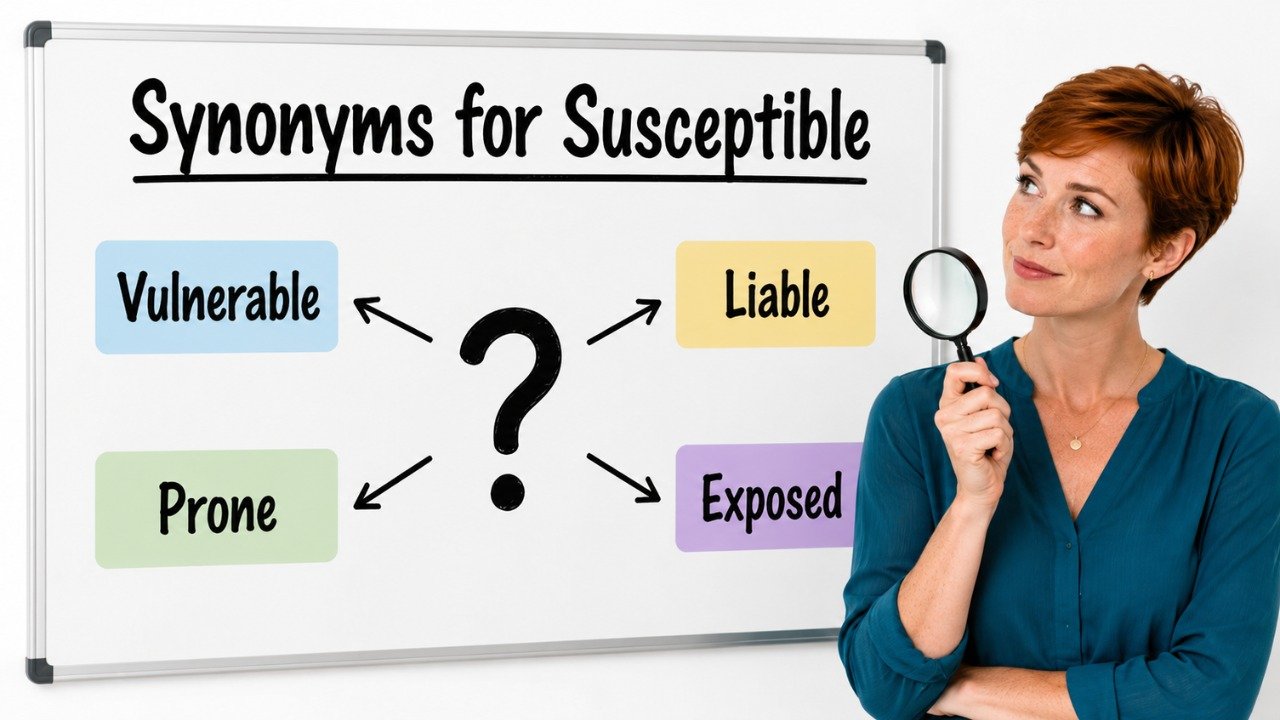
Quick Answer: The best synonyms for susceptible include vulnerable, prone, sensitive, receptive, impressionable, exposed, at risk, liable, predisposed, and suggestible. Use vulnerable when someone or something can easily be harmed, prone when a condition is likely to occur repeatedly, sensitive when something reacts strongly, and receptive when someone is open to an idea. Impressionable and suggestible work well for people who are easily influenced, while predisposed is useful in formal, medical, scientific, and analytical contexts.
Pronunciation and Word Details
Word: Susceptible
Pronunciation: /səˈseptəbəl/
Part of Speech: Adjective
Meaning: Likely or able to be affected, harmed, influenced, persuaded, or changed by something.
US Pronunciation:
UK Pronunciation:
What Does “Susceptible” Mean?
Susceptible means likely or able to be affected by a particular condition, influence, problem, disease, emotion, or external force.
As an adjective, susceptible often appears with the word “to.” A person may be susceptible to infection, persuasion, criticism, stress, or pressure. A material may be susceptible to heat, moisture, damage, or corrosion.
The word can describe physical vulnerability, emotional sensitivity, mental influence, medical risk, or the likelihood that something will experience a particular effect.
Physical Meaning: Something susceptible can be easily affected or damaged by external conditions.
Medical Meaning: A susceptible person may have a greater chance of developing an infection, illness, or other condition.
Emotional Meaning: Someone susceptible may react strongly to criticism, praise, pressure, or emotional situations.
Influence Meaning: A susceptible person may be easily persuaded or influenced by other people or ideas.
Formal Meaning: In technical or academic contexts, susceptible can simply mean capable of being affected by something.
For example, “Young plants are susceptible to frost” means that frost can easily harm them. “He is susceptible to persuasion” means that other people can influence his decisions relatively easily.
Meaning, Tone, and Context of “Susceptible”
Susceptible is generally a neutral to formal adjective. It appears naturally in everyday communication, academic writing, medical discussion, scientific explanation, reports, essays, and professional documents.
Neutral Tone: Susceptible can objectively describe something that is likely to be affected.
Formal Tone: The word works especially well in analytical, scientific, medical, and academic contexts.
Medical Context: Susceptible commonly describes people or organisms that may be more likely to develop a disease or infection.
Scientific Context: Materials, organisms, systems, and environments can be susceptible to physical or chemical effects.
Emotional Context: A person can be susceptible to criticism, praise, stress, or emotional pressure.
Influence Context: The word may describe someone who can be easily persuaded, convinced, or manipulated.
Negative Context: Susceptible can sometimes imply weakness or lack of resistance, especially when discussing influence or pressure.
Positive or Neutral Context: When used with ideas or suggestions, susceptible can simply mean receptive or open, depending on the sentence.
The most accurate synonym depends on what is causing the effect. Vulnerable emphasizes possible harm, prone emphasizes likelihood, sensitive emphasizes strong reaction, receptive emphasizes openness, and impressionable emphasizes ease of influence.
When and How to Use “Susceptible”
For Physical Harm: Use susceptible when an object, material, organism, or environment can easily be damaged by a particular condition.
Example: The delicate fabric is susceptible to damage from excessive heat.
For Illness or Infection: Use susceptible when someone or something has a greater possibility of being affected by disease.
Example: Young seedlings can be susceptible to certain plant diseases.
For Emotional Influence: Use susceptible when a person reacts strongly to emotional pressure, praise, criticism, or stress.
Example: He becomes more susceptible to criticism when he is tired.
For Persuasion: Use susceptible when someone can be easily influenced by arguments, suggestions, or other people.
Example: Inexperienced buyers may be more susceptible to persuasive language.
For Environmental Effects: Use susceptible when something is likely to be affected by temperature, moisture, weather, or other external conditions.
Example: The region is susceptible to flooding after prolonged rainfall.
For Academic Writing: Susceptible works well when explaining risk, vulnerability, influence, or likelihood in a precise way.
Example: The study examined which systems were most susceptible to external pressure.
For Formal Reports: Use susceptible when a professional or analytical tone is needed.
Example: Older equipment may be susceptible to failure under heavy use.
Best Synonyms for Susceptible
Vulnerable: Easily harmed, damaged, attacked, or negatively affected.
Example: Young plants are vulnerable to sudden temperature changes.
Prone: Likely to experience a particular problem, condition, or behavior.
Example: This area is prone to flooding during periods of heavy rain.
Sensitive: Easily affected by physical, emotional, or environmental conditions.
Example: Her skin is sensitive to strong sunlight.
Receptive: Willing or able to accept ideas, suggestions, or influences.
Example: The audience was receptive to the new proposal.
Impressionable: Easily influenced because of limited experience or strong emotional responsiveness.
Example: Young readers can be impressionable when encountering persuasive messages.
Exposed: Not adequately protected from a danger, influence, or harmful condition.
Example: The plants were exposed to freezing temperatures overnight.
At Risk: In a position where harm, loss, or difficulty is more likely.
Example: Homes near the river are at risk of flooding.
Liable: Likely to experience or do something, especially something undesirable.
Example: The old machine is liable to overheat when used continuously.
Predisposed: Having an increased tendency toward a condition, reaction, or behavior.
Example: Some individuals may be predisposed to certain sensitivities.
Suggestible: Easily influenced by suggestions, ideas, or opinions.
Example: A highly suggestible person may accept an idea without examining it carefully.
50 Synonyms for Susceptible with Short Meanings
- Vulnerable: Easily harmed or negatively affected.
- Prone: Likely to experience a particular condition or problem.
- Sensitive: Easily affected or strongly reactive.
- Receptive: Open to ideas, suggestions, or influences.
- Impressionable: Easily influenced by people or experiences.
- Exposed: Lacking protection from possible harm.
- At Risk: More likely than usual to experience harm or difficulty.
- Liable: Likely to experience a particular result or condition.
- Predisposed: Having an existing tendency toward something.
- Subject To: Likely or able to experience a particular effect.
- Open: Willing or able to receive an influence or idea.
- Responsive: Readily reacting to a stimulus, influence, or condition.
- Amenable: Willing to accept an idea, suggestion, or proposal.
- Persuadable: Capable of being convinced or persuaded.
- Influenceable: Able to be affected by another person’s ideas or actions.
- Suggestible: Easily influenced by suggestions or opinions.
- Malleable: Easily shaped or influenced, especially in a figurative sense.
- Pliable: Easily changed, shaped, or influenced.
- Defenseless: Lacking adequate protection against harm.
- Unprotected: Not sufficiently guarded against danger or damage.
- Fragile: Easily damaged, weakened, or disturbed.
- Weak: Lacking sufficient strength or resistance.
- Reactive: Quick to respond to an external stimulus or condition.
- Delicate: Easily affected, damaged, or disturbed.
- Easily Affected: Readily changed or influenced by something.
- Easily Influenced: Readily affected by another person’s ideas or behavior.
- Easily Persuaded: Readily convinced to accept an idea or action.
- Easily Harmed: Vulnerable to injury, loss, or damage.
- Easily Damaged: Likely to suffer physical or structural harm.
- Open to Influence: Willing or likely to be affected by outside ideas.
- Open to Persuasion: Willing or likely to be convinced.
- Receptive To: Ready to accept or respond to something.
- Responsive To: Able or likely to react to a particular influence.
- Sensitive To: Easily affected by a specific condition or substance.
- Vulnerable To: Easily harmed or affected by something specific.
- Prone To: Having a tendency to experience something.
- Exposed To: In contact with a possible danger or influence.
- At Risk Of: Facing an increased possibility of harm or difficulty.
- Predisposed To: Naturally or previously inclined toward a condition.
- Liable To: Likely to experience or do something.
- Subject to Influence: Capable of being affected by another force or opinion.
- Capable of Being Affected: Able to experience change because of an outside factor.
- Readily Affected: Quickly or easily changed by something.
- Readily Influenced: Easily guided by another person’s ideas or actions.
- Readily Persuaded: Easily convinced to accept a suggestion or position.
- Easily Swayed: Quickly persuaded to change an opinion or decision.
- Open to Suggestion: Willing to consider or accept another person’s idea.
- Likely to Be Affected: Having a greater possibility of experiencing an effect.
- Easily Moved: Readily affected emotionally or mentally.
- Readily Receptive: Quick to accept ideas, influences, or suggestions.
Read Also:
Synonyms for Box

Synonyms for Susceptible by Context
When Susceptible Means Vulnerable to Harm
Vulnerable, exposed, defenseless, unprotected, fragile, delicate, and at risk are useful when someone or something can easily experience harm.
Vulnerable Example: Newly planted trees are vulnerable to severe frost.
Exposed Example: The equipment remained exposed to moisture throughout the night.
At Risk Example: Buildings near unstable ground may be at risk of structural damage.
Vulnerable is usually the strongest general synonym when the emphasis is on possible harm. Exposed emphasizes a lack of protection, while at risk emphasizes increased probability.
When Susceptible Means Prone to a Condition
Prone, liable, predisposed, subject to, and at risk of work well when something has an increased tendency to experience a condition.
Prone Example: This valley is prone to thick fog during colder months.
Predisposed Example: Some people may be predisposed to particular reactions.
Liable Example: The material is liable to crack when placed under extreme pressure.
Prone is natural in both everyday and formal writing. Predisposed sounds more technical and often suggests an existing tendency.
When Susceptible Means Easily Influenced
Impressionable, suggestible, persuadable, influenceable, malleable, pliable, and easily swayed are useful when talking about people, opinions, or decisions.
Impressionable Example: Younger audiences may be more impressionable when exposed to repeated messages.
Suggestible Example: The character was highly suggestible and accepted almost every suggestion.
Easily Swayed Example: He was easily swayed by confident arguments.
Impressionable often suggests that experience or age affects someone’s judgment. Suggestible emphasizes responsiveness to suggestions, while easily swayed emphasizes changing one’s opinion.
When Susceptible Means Sensitive
Sensitive, reactive, responsive, delicate, and readily affected fit situations involving strong physical or emotional reactions.
Sensitive Example: This material is sensitive to changes in humidity.
Reactive Example: Her skin is highly reactive to certain ingredients.
Responsive Example: The system is responsive to even small changes in temperature.
Sensitive is the best general alternative when something reacts easily without necessarily being weak.
When Susceptible Means Receptive
Receptive, open, amenable, responsive, and open to suggestion work when susceptible means willing or able to receive ideas or influence.
Receptive Example: The group was receptive to constructive feedback.
Amenable Example: She was amenable to changing the schedule.
Open Example: He remained open to alternative approaches.
These words usually have a more positive tone than susceptible because they can suggest willingness rather than weakness.
Another Word for Susceptible
The best single replacement for susceptible is often vulnerable when the sentence concerns possible harm. However, the best alternative depends on context. Prone is better for recurring conditions, sensitive for strong reactions, receptive for openness to ideas, and impressionable for ease of influence.
Original: The plants are susceptible to cold weather.
Better Option: The plants are vulnerable to cold weather.
Original: She is susceptible to headaches during stressful periods.
Better Option: She is prone to headaches during stressful periods.
Original: He is susceptible to other people’s opinions.
Better Option: He is easily influenced by other people’s opinions.
Original: The material is susceptible to moisture.
Better Option: The material is sensitive to moisture.
When Not to Use “Susceptible”
Susceptible can sound too formal, vague, or negative when a more precise word would explain the situation better.
Do not use susceptible when you simply mean willing to listen. Receptive or open may sound more positive and natural.
Weak: She was susceptible to the team’s suggestions.
Better: She was receptive to the team’s suggestions.
Do not use susceptible when describing a repeated tendency if prone gives the meaning more directly.
Weak: The machine is susceptible to overheating after long periods of use.
Better: The machine is prone to overheating after long periods of use.
Avoid susceptible when sensitive more clearly describes a physical reaction.
Weak: His skin is susceptible to strong fragrances.
Better: His skin is sensitive to strong fragrances.
Do not use susceptible when the main idea is lack of protection.
Weak: The uncovered equipment was susceptible to rain.
Better: The uncovered equipment was exposed to rain.
Avoid using susceptible repeatedly in the same paragraph. Replace it with vulnerable, prone, sensitive, at risk, predisposed, or receptive when the context allows.
Weak: The plants are susceptible to frost and susceptible to strong winds, while the soil is susceptible to erosion.
Better: The plants are vulnerable to frost and strong winds, while the soil is prone to erosion.
Words Commonly Confused With Susceptible
Susceptible vs Vulnerable: Susceptible means likely or able to be affected, while vulnerable strongly emphasizes the possibility of harm, damage, or attack.
Susceptible vs Prone: Susceptible can describe many kinds of effects, while prone usually describes a tendency to experience a recurring problem, condition, or behavior.
Susceptible vs Sensitive: Susceptible suggests that something can be affected, while sensitive emphasizes a strong or immediate reaction.
Susceptible vs Receptive: Susceptible may suggest easy influence or limited resistance. Receptive usually has a more positive meaning and suggests willingness to consider ideas.
Susceptible vs Impressionable: Susceptible is broad and can describe physical or mental effects. Impressionable specifically refers to people who are easily influenced.
Susceptible vs Predisposed: Susceptible means likely to be affected, while predisposed suggests that an existing characteristic or tendency makes the effect more likely.
Susceptible vs Liable: Susceptible emphasizes vulnerability to an influence or condition. Liable often means likely to experience or do something, especially something undesirable.
Which Synonym Should You Choose?
Choose vulnerable when someone or something can easily be harmed, damaged, or negatively affected.
Choose prone when describing a repeated tendency, such as being prone to headaches, errors, flooding, or mechanical failure.
Choose sensitive when something reacts strongly to substances, emotions, temperature, light, pressure, or environmental conditions.
Choose receptive when someone is willing to consider ideas, suggestions, feedback, or change.
Choose impressionable when describing a person whose opinions or behavior can be easily shaped by others.
Choose suggestible when a person readily accepts suggestions or outside influence.
Choose predisposed in medical, scientific, academic, and formal writing when an existing tendency increases the likelihood of a condition.
Choose at risk when the main point is increased possibility of harm or loss.
Choose exposed when protection is missing and direct contact with danger is possible.
Choose liable when describing something that is likely to happen, particularly an unwanted result.
Choose amenable in professional communication when someone is willing to consider a proposal or change.
Choose easily swayed in casual conversation when someone changes opinions readily because of persuasion.
Real Life Examples of “Susceptible” in Sentences
Original: Young plants are susceptible to frost.
Better Option: Young plants are vulnerable to frost.
Original: She is susceptible to headaches when she misses sleep.
Better Option: She is prone to headaches when she misses sleep.
Original: The material is susceptible to moisture.
Better Option: The material is sensitive to moisture.
Original: New employees may be susceptible to pressure from more experienced colleagues.
Better Option: New employees may be vulnerable to pressure from more experienced colleagues.
Original: He is susceptible to persuasive arguments.
Better Option: He is easily swayed by persuasive arguments.
Original: The region is susceptible to flooding after prolonged rain.
Better Option: The region is prone to flooding after prolonged rain.
Original: Some people are more susceptible to certain environmental conditions.
Better Option: Some people are more sensitive to certain environmental conditions.
Original: The audience appeared susceptible to the speaker’s suggestions.
Better Option: The audience appeared receptive to the speaker’s suggestions.
Original: The old structure is susceptible to damage during severe storms.
Better Option: The old structure is vulnerable to damage during severe storms.
Original: Children can be susceptible to strong outside influences.
Better Option: Children can be impressionable when exposed to strong outside influences.
Synonym Groups and Usage Differences
Vulnerability Group
Vulnerable, exposed, defenseless, unprotected, at risk, and fragile emphasize limited protection from harm.
Vulnerable is the broadest choice. Exposed focuses on contact with danger, while defenseless emphasizes the inability to protect oneself.
Example: The coastal buildings are vulnerable to severe weather.
Tendency Group
Prone, liable, predisposed, subject to, and at risk of describe an increased likelihood of experiencing something.
Prone is common and natural. Predisposed sounds more formal and suggests an existing tendency. Liable often describes an undesirable possibility.
Example: The device is prone to overheating when ventilation is blocked.
Sensitivity Group
Sensitive, reactive, responsive, delicate, and readily affected describe something that reacts easily to external conditions.
Sensitive can apply to physical, emotional, environmental, and technical situations.
Example: The coating is sensitive to extreme temperature changes.
Influence Group
Impressionable, suggestible, persuadable, influenceable, easily swayed, malleable, and pliable describe people or opinions that can be shaped by outside influences.
Impressionable often refers to people with developing opinions. Malleable and pliable are more figurative and suggest that attitudes or behavior can be shaped.
Example: The inexperienced student was easily swayed by confident opinions.
Openness Group
Receptive, open, amenable, responsive, and open to suggestion emphasize willingness to receive ideas or consider alternatives.
These words usually sound more positive than susceptible.
Example: The manager was receptive to suggestions for improving the process.
Risk Group
At risk, vulnerable, exposed, susceptible, prone, and predisposed emphasize different types of probability or danger.
At risk focuses on likelihood, vulnerable on weakness, and predisposed on an existing tendency.
Example: Older equipment may be at risk of failure under excessive pressure.
Antonyms of Susceptible
The opposite of susceptible depends on whether the word refers to disease, physical harm, emotional influence, persuasion, or environmental effects.
Resistant: Able to withstand an influence, condition, or harmful effect.
Immune: Protected from or unaffected by a particular disease or influence in the relevant context.
Protected: Guarded against harm, damage, or danger.
Safeguarded: Given protection against a specific risk.
Resilient: Able to recover from pressure, difficulty, or damage.
Impervious: Not easily affected or influenced by something.
Unaffected: Not changed or harmed by an influence or condition.
Insensitive: Not easily affected by a particular stimulus or influence.
Strong: Able to withstand pressure, damage, or influence.
Secure: Protected from significant danger or harm.
Independent Minded: Unlikely to be easily influenced by other people’s opinions.
Firm: Strong and unlikely to change because of pressure or persuasion.
Comparison: Susceptible vs Related Words
Susceptible vs Vulnerable
Susceptible means likely or able to be affected. Vulnerable more strongly emphasizes exposure to harm, weakness, or danger.
Example With Susceptible: The plants are susceptible to fungal disease.
Example With Vulnerable: The young plants are vulnerable to severe frost.
Susceptible vs Prone
Susceptible is broader and can describe physical, emotional, medical, or mental effects. Prone usually emphasizes an established tendency toward something.
Example With Susceptible: The material is susceptible to moisture damage.
Example With Prone: The machine is prone to overheating.
Susceptible vs Sensitive
Susceptible describes the possibility of being affected. Sensitive emphasizes how strongly or quickly something reacts.
Example With Susceptible: The surface is susceptible to chemical damage.
Example With Sensitive: The surface is sensitive to temperature changes.
Susceptible vs Receptive
Susceptible can imply that someone is easily influenced. Receptive usually suggests voluntary openness and has a more positive tone.
Example With Susceptible: He was susceptible to persuasive claims.
Example With Receptive: He was receptive to constructive advice.
Susceptible vs Impressionable
Susceptible has a broad range of meanings. Impressionable specifically describes a person whose ideas, attitudes, or behavior can be easily shaped.
Example With Susceptible: She was susceptible to outside pressure.
Example With Impressionable: The impressionable student quickly adopted the group’s opinions.
Susceptible vs Predisposed
Susceptible means capable of being affected. Predisposed suggests that an existing characteristic or tendency makes a particular outcome more likely.
Example With Susceptible: Some plants are susceptible to this condition.
Example With Predisposed: Certain plants are predisposed to developing the condition in humid environments.
Susceptible vs Exposed
Susceptible refers to vulnerability or likelihood. Exposed means directly placed in contact with a possible danger or influence.
Example With Susceptible: The wooden surface is susceptible to water damage.
Example With Exposed: The wooden surface was exposed to rain for several hours.
Common Phrases and Expressions With Susceptible
Susceptible to Disease: Likely to be affected by a particular illness or condition.
Susceptible to Infection: More likely to develop an infection after exposure.
Susceptible to Influence: Easily affected by another person’s ideas, behavior, or opinions.
Susceptible to Pressure: Likely to change or react because of external demands.
Susceptible to Damage: Easily harmed by physical or environmental conditions.
Susceptible to Criticism: Easily affected emotionally by negative comments or judgment.
Susceptible to Change: Capable of being altered by circumstances or outside forces.
Susceptible to Persuasion: Likely to be convinced by arguments or suggestions.
Susceptible to Error: Likely to produce or experience mistakes under certain conditions.
Susceptible to Stress: Easily affected by physical, emotional, or environmental strain.
Common Mistakes to Avoid
A common mistake is using susceptible as though it only means weak. The word actually means likely or able to be affected, so vulnerability is only one part of its meaning.
Do not automatically replace susceptible with vulnerable. Vulnerable works best when harm or danger is involved, but it may sound inaccurate when the sentence is about openness to ideas.
Less Accurate: The committee was vulnerable to new suggestions.
Better: The committee was receptive to new suggestions.
Another mistake is confusing susceptible with sensitive. Sensitive emphasizes reaction, while susceptible emphasizes likelihood of being affected.
Less Precise: The region is sensitive to flooding.
Better: The region is susceptible to flooding.
Avoid confusing prone with susceptible in every context. Prone works especially well for repeated or characteristic tendencies.
Less Natural: The device is susceptible to overheating every afternoon.
Better: The device is prone to overheating after extended use.
Do not use impressionable for objects, materials, or physical conditions. Impressionable generally describes people whose beliefs or behavior are easily influenced.
Incorrect: The metal is impressionable to moisture.
Correct: The metal is susceptible to moisture damage.
Be careful with receptive because it often has a positive tone. Someone receptive to advice is willingly open to it, while someone susceptible to influence may have difficulty resisting it.
Avoid vague phrases such as “susceptible to things” when the specific influence can be named.
Vague: This material is susceptible to many things.
Clearer: This material is susceptible to heat, moisture, and chemical damage.
Repetition can also weaken writing. If susceptible appears several times in the same section, choose more precise alternatives such as vulnerable, prone, sensitive, exposed, predisposed, or receptive.
Conclusion
Knowing the best synonyms for susceptible helps you express risk, sensitivity, influence, and vulnerability more precisely. Use vulnerable when harm is possible, prone for recurring tendencies, sensitive for strong reactions, receptive for openness, and impressionable or suggestible when someone is easily influenced. Predisposed works especially well in formal and analytical contexts, while exposed and at risk emphasize danger. Choosing the synonym that matches the exact situation makes sentences clearer, more natural, and more informative for readers.
FAQs About Synonyms for Susceptible
What is the best synonym for susceptible?
Vulnerable is one of the best general synonyms when susceptible refers to possible harm. Prone, sensitive, receptive, and predisposed are better in other contexts.
Is vulnerable the same as susceptible?
Not completely. Susceptible means likely or able to be affected, while vulnerable more strongly suggests possible harm, weakness, or danger.
What is another word for susceptible to illness?
Vulnerable, prone, predisposed, and at risk can work depending on the sentence. Predisposed is especially useful when an existing tendency increases the likelihood of a condition.
What is a synonym for susceptible to influence?
Impressionable, suggestible, persuadable, influenceable, and easily swayed are useful choices for someone who can be readily influenced.
Can receptive be a synonym for susceptible?
Yes, when susceptible means open to an idea, suggestion, or influence. Receptive usually has a more positive tone because it suggests willingness rather than weakness.
What is the difference between susceptible and prone?
Susceptible means able or likely to be affected, while prone usually describes an established tendency to experience a particular condition, problem, or behavior.
What is the opposite of susceptible?
Common antonyms include resistant, immune, protected, resilient, impervious, unaffected, and secure. The best opposite depends on what type of influence or harm is being discussed.
