
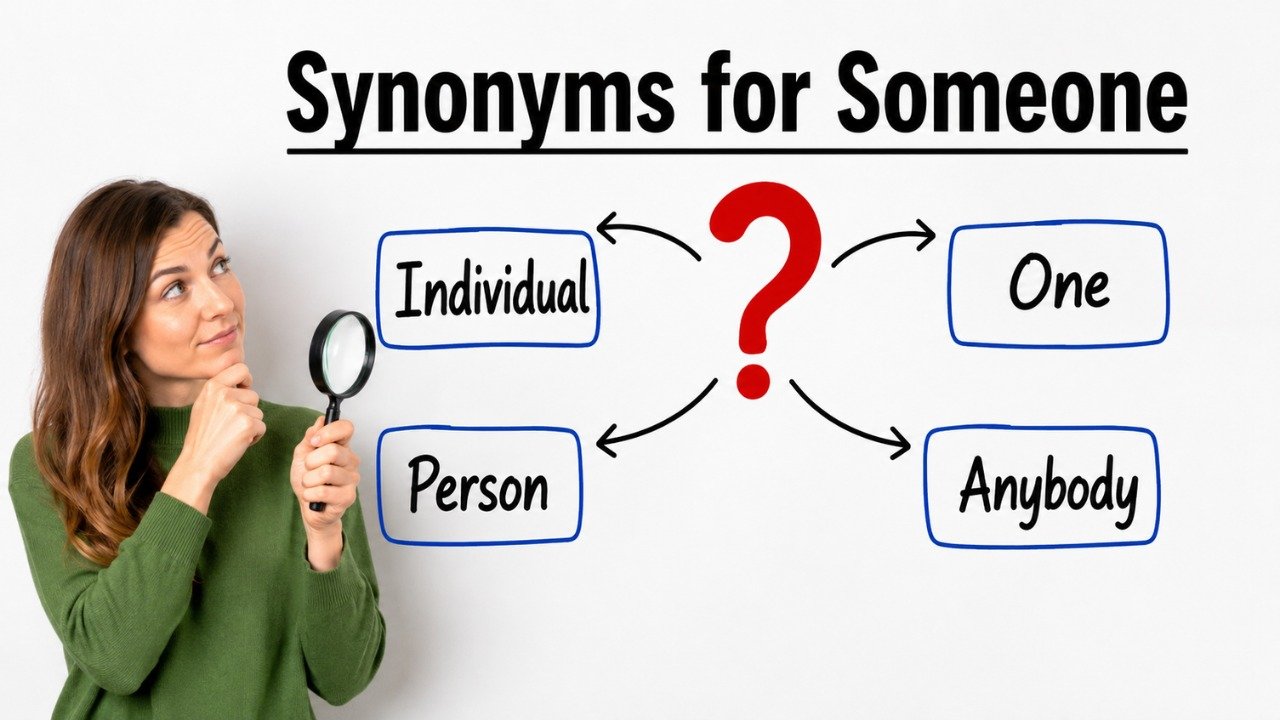
Quick Answer: The best synonyms for someone include somebody, a person, an individual, one, a certain person, a particular person, an unnamed person, a member, a party, and a figure. Use somebody in casual speech, a person in neutral writing, and an individual in formal reports or academic contexts. A certain person suggests that the speaker knows the identity but does not reveal it. An unnamed person suits privacy or reporting contexts, while member, party, and figure work when the person has a specific role.
Pronunciation and Word Details
Word: Someone.
Pronunciation: /ˈsʌmwʌn/
Part of Speech: Indefinite pronoun.
Meaning: An unspecified or unidentified person.
US Pronunciation:
UK Pronunciation:
What Does “Someone” Mean?
Someone means an unspecified, unknown, or unidentified person. It is an indefinite pronoun used when the speaker does not know, does not mention, or does not consider it necessary to identify the person.
Someone is grammatically singular.
Example: Someone is waiting outside.
In this sentence, the speaker knows that one person is waiting but does not identify that person.
Someone can refer to a person whose identity is completely unknown.
Example: Someone left a bag near the door.
It can also refer to a known person whose name is intentionally withheld.
Example: Someone in the office shared the confidential information.
The word often appears in statements, requests, questions, warnings, emotional expressions, and general observations. It can refer to any person without describing age, gender, profession, or relationship.
Someone may also describe an important or successful person in the expression “be someone.”
Example: She always believed that she would become someone.
Here, someone means a recognized, respected, or important person rather than an unidentified individual.
Meaning, Tone, and Context of “Someone”
Someone is neutral, common, polite, and natural in both speech and writing. It appears frequently in everyday conversation, emails, stories, instructions, essays, workplace communication, and general explanations.
In casual speech, someone and somebody are usually interchangeable.
Example: Someone called while you were away.
Example: Somebody called while you were away.
Someone may sound slightly more neutral than somebody, but the difference is small. Both words are widely accepted.
In formal writing, a person or an individual may be more precise. Reports, policies, academic papers, and official documents often replace someone with a role based noun such as applicant, participant, employee, witness, or customer.
Example: Someone who submits the form will receive a response.
More Precise: Each applicant who submits the form will receive a response.
Someone can carry emotional meaning when it refers to companionship, support, affection, or personal importance.
Example: Everyone needs someone to trust.
In stories and descriptive writing, someone can create mystery or suspense because the person remains unidentified.
Example: Someone was moving quietly in the hallway.
The word is not strongly formal, casual, emotional, or technical by itself. Its tone depends mainly on the sentence and situation.
When and How to Use “Someone”
For an Unknown Person
Use someone when you know that a person performed an action but do not know who that person was.
Example: Someone opened the window during the night.
For an Unspecified Person
Use someone when the exact identity is not important to the meaning.
Example: We need someone to welcome the guests.
For a Known but Unnamed Person
Use someone when you know the identity but do not want to reveal it.
Example: Someone on the committee disagreed with the final decision.
For Requests and Assistance
Use someone when asking for help from any suitable person.
Example: Could someone explain these instructions?
For General Situations
Use someone when discussing a situation that could involve an unspecified person.
Example: If someone loses a key, they should contact the manager.
For Personal Support
Use someone when referring to a person who provides comfort, advice, or companionship.
Example: He needed someone to listen without judging him.
For Mystery or Suspense
Use someone when a person’s identity is intentionally hidden.
Example: Someone was watching the empty house from across the street.
For Formal Writing
Use someone only when a general human reference is appropriate. Choose a person, an individual, or a role based noun when greater precision is needed.
Example: Someone may request a copy of the record.
More Formal: An individual may request a copy of the record.
For Importance or Recognition
Use someone in the expression “be someone” to describe a person who is respected, successful, or socially important.
Example: He moved to the city hoping to become someone.
Best Synonyms for Someone
Somebody: An unspecified or unidentified person.
Example: Somebody left a message for you.
A Person: One human being whose identity is unknown or unmentioned.
Example: A person was standing near the entrance.
An Individual: A single person, especially in formal or professional writing.
Example: Each individual must provide proof of identity.
One: An unspecified person, often used in formal or general statements.
Example: One should always check the facts before making a claim.
A Certain Person: A person known to the speaker but not directly identified.
Example: A certain person has been asking about the vacant position.
A Particular Person: One specific person rather than people generally.
Example: The message was intended for a particular person.
An Unnamed Person: A person whose name has not been provided.
Example: An unnamed person reported the problem yesterday.
A Member: A person belonging to a group, organization, or community.
Example: A member of the team raised an important concern.
A Party: A person or group involved in an agreement, dispute, or transaction.
Example: Each party must sign the document.
A Figure: A person who is noticeable, important, mysterious, or publicly recognized.
Example: A shadowy figure appeared near the gate.
50 Synonyms for Someone with Short Meanings
- Somebody: An unspecified or unidentified person.
- A Person: One human being whose identity is not stated.
- An Individual: A single person, especially in formal writing.
- One: An unspecified person in a general statement.
- A Certain Person: A person known but not directly named.
- A Particular Person: One specific person rather than anyone generally.
- An Unnamed Person: A person whose name has not been revealed.
- An Unidentified Person: A person whose identity is unknown.
- An Unknown Person: A person whom others do not recognize.
- An Unspecified Person: A person who has not been clearly identified.
- An Anonymous Person: A person whose identity is intentionally concealed.
- A Known Person: A person recognized by the speaker or listener.
- One Person: A single human being.
- A Single Person: Exactly one individual.
- Another Person: A different individual.
- The Person: The particular individual being discussed.
- The Individual: The specific person involved in a matter.
- A Certain Individual: A specific but unnamed person.
- A Particular Individual: One clearly intended person.
- A Human Being: A person considered as a member of humanity.
- A Member: A person belonging to a group.
- A Participant: A person taking part in an activity.
- A Guest: A person invited to a place or event.
- A Visitor: A person who comes to a place temporarily.
- A Caller: A person who makes a telephone call or visits.
- A Client: A person receiving professional services.
- A Customer: A person purchasing goods or services.
- An Applicant: A person requesting a position or opportunity.
- A Candidate: A person being considered for a role or selection.
- An Employee: A person who works for an organization.
- A Colleague: A person who works with another person.
- A Friend: A person with whom someone has a close relationship.
- An Acquaintance: A person known but not closely.
- A Stranger: A person who is not known.
- A Resident: A person living in a particular place.
- A Citizen: A legally recognized member of a country or community.
- A Witness: A person who sees or knows about an event.
- A Speaker: A person who speaks or gives a presentation.
- A Reader: A person who reads written material.
- A User: A person who uses a product, service, or system.
- A Person Involved: Someone connected with an event or situation.
- A Person Concerned: Someone directly affected by a matter.
- A Responsible Person: Someone expected to manage or handle something.
- An Interested Person: Someone who cares about or is connected to a subject.
- A Suitable Person: Someone with the qualities needed for a task.
- The Right Person: Someone especially appropriate for a role or situation.
- A Party: A person or group involved in a formal matter.
- A Figure: A noticeable, important, or mysterious person.
- A Character: A person represented in a story or described informally.
- A Soul: A person, especially in emotional or literary language.
Read Also:
Synonyms for Colony
Synonyms for Someone by Context
When Someone Means an Unknown Person
Somebody, an unknown person, an unidentified person, a stranger, and an unnamed person work when the person’s identity is not known.
Somebody is the most natural choice in ordinary conversation.
Example With Someone: Someone knocked on the door.
Example With Somebody: Somebody knocked on the door.
An unidentified person is more formal and often appears in reports or official descriptions.
Example: An unidentified person entered the building shortly before closing.
A stranger emphasizes that the person is not known to another person.
Example: A stranger offered to carry the heavy bag.
When Someone Means a Known but Unnamed Person
A certain person, a particular person, an unnamed person, and a certain individual fit situations in which the speaker knows who the person is but chooses not to give the name.
Example With Someone: Someone in this room knows the answer.
Example With A Certain Person: A certain person in this room knows the answer.
A certain person may suggest secrecy, humor, criticism, or indirect reference.
Example: A certain person forgot to lock the door again.
A particular person emphasizes that one specific individual is intended.
Example: The invitation was written for a particular person.
When Someone Means Any Suitable Person
A person, an individual, a participant, an applicant, a candidate, or a member may replace someone when the person must meet a need or perform a role.
Example With Someone: We need someone with strong writing skills.
Example With A Candidate: We need a candidate with strong writing skills.
Use the exact role whenever possible because it makes the sentence clearer.
General: Someone will review the application.
Specific: An administrator will review the application.
When Someone Means a Person in Formal Writing
An individual, a person, a party, a participant, and a person concerned are useful in academic, professional, legal, and administrative contexts.
Example With Someone: Someone affected by the policy may submit a response.
Example With An Individual: An individual affected by the policy may submit a response.
Party is useful when the person is involved in an agreement, case, dispute, or transaction.
Example: Each party must keep a copy of the agreement.
Participant works when the person is involved in a study, event, discussion, or activity.
Example: Each participant completed a short questionnaire.
When Someone Means a Person in a Relationship
A friend, colleague, acquaintance, guest, visitor, client, or customer may replace someone when the relationship or role is known.
Example With Someone: Someone from work called this morning.
Example With A Colleague: A colleague called this morning.
Example With Someone: She brought someone to the dinner.
Example With A Guest: She brought a guest to the dinner.
These alternatives add useful information that someone leaves unclear.
When Someone Means an Important Person
A figure, a notable person, an important person, or a recognized individual may work when someone means a person of status or influence.
Example With Someone: He wanted to become someone in the literary world.
Better Option: He wanted to become a recognized figure in the literary world.
Figure often appears with an adjective that explains the person’s importance.
Example: She became a respected figure in the community.
When Someone Has an Emotional Meaning
A friend, companion, loved one, trusted person, or a soul may fit when someone refers to emotional closeness or human connection.
Example With Someone: Everyone needs someone during difficult times.
Better Option: Everyone needs a trusted person during difficult times.
Soul has a literary or emotional tone.
Example: Not a soul was visible on the empty road.
Another Word for Someone
Somebody is the closest direct replacement for someone in everyday conversation. The two words usually have the same meaning and can often be exchanged without changing the sentence.
However, the best alternative depends on context. Use a person for neutral writing, an individual for formal writing, and a role based word when the person’s function is known.
Original: Someone left their notebook on the table.
Better Option: Somebody left their notebook on the table.
Original: Someone must complete the form before entering.
Better Option: Each visitor must complete the form before entering.
Original: Someone affected by the change may submit a complaint.
Better Option: An individual affected by the change may submit a complaint.
Original: We need someone to manage the project.
Better Option: We need a coordinator to manage the project.
When Not to Use “Someone”
Do not use someone when the person’s role is known and relevant. A precise noun usually gives the reader more information.
Weak: Someone will examine the patient.
Better: A doctor will examine the patient.
Avoid someone when it creates uncertainty about responsibility.
Weak: Someone should check the final report.
Better: The editor should check the final report.
Do not repeat someone several times in the same paragraph when different roles are involved.
Weak: Someone welcomed the guests, someone collected the forms, and someone explained the schedule.
Better: A receptionist welcomed the guests, an assistant collected the forms, and the coordinator explained the schedule.
Someone may be too conversational for highly formal policies, contracts, reports, or academic writing.
Weak: Someone who violates the agreement may lose access.
Better: Any individual who violates the agreement may lose access.
Avoid using someone when you actually mean anyone. Someone usually suggests that a person exists or is expected, while anyone means any person without restriction.
Weak: Does someone have permission to enter this area?
Better: Does anyone have permission to enter this area?
Do not use someone when you mean everyone.
Weak: Someone must follow the safety rules.
Better: Everyone must follow the safety rules.
Someone can also sound vague in emotional or descriptive writing when the relationship matters.
Weak: She spoke to someone about her worries.
Better: She spoke to a trusted friend about her worries.
Words Commonly Confused With Someone
Someone vs Somebody: Both mean an unspecified person. Someone may sound slightly more neutral, while somebody may feel slightly more conversational, but they are usually interchangeable.
Someone vs Anyone: Someone refers to an unspecified person who probably exists or is expected. Anyone refers to any person at all and is common in questions, negative statements, and conditional sentences.
Someone vs Everyone: Someone means one unspecified person. Everyone means every person in a group.
Someone vs No One: Someone indicates that a person exists. No one means that not a single person exists or acts.
Someone vs One: Someone refers to an unidentified person in a particular situation. One is more formal and often expresses a general rule about people.
Someone vs A Person: Someone is an indefinite pronoun. A person is a noun phrase and may sound clearer or more formal in some sentences.
Someone vs An Individual: Someone is neutral and conversational. An individual is more formal and often appears in reports, policies, research, and official writing.
Someone vs A Stranger: Someone may be known or unknown. A stranger is specifically a person who is not known.
Someone vs Somebody Else: Someone means an unspecified person. Somebody else means a different person from the one already mentioned.
Someone vs Anyone Else: Someone else suggests that another particular person exists. Anyone else means any other person without specifying who.
Which Synonym Should You Choose?
Choose somebody in casual speech, friendly messages, dialogue, and relaxed conversation.
Choose a person in neutral explanations when you want a clear and simple noun phrase.
Choose an individual in formal reports, policies, essays, academic writing, and professional communication.
Choose one in general statements, formal advice, and traditional expressions.
Choose a certain person when the identity is known but intentionally hidden.
Choose a particular person when one specific individual is intended.
Choose an unnamed person when a report does not reveal the person’s name.
Choose an unidentified person when the person’s identity is unknown.
Choose a stranger when the person is not known to another person.
Choose a member when the person belongs to a group, committee, organization, or community.
Choose a participant when the person takes part in an activity, event, discussion, or study.
Choose an applicant in hiring, admission, or application contexts.
Choose a candidate when someone is being considered for a position, award, or selection.
Choose a client or customer when describing a business or service relationship.
Choose a colleague in workplace emails and professional conversations.
Choose a witness when the person observed an event.
Choose a party in contracts, disputes, agreements, and formal transactions.
Choose a figure when describing a notable, mysterious, historical, or influential person.
Choose a trusted person, friend, or companion when emotional support or closeness matters.
Real Life Examples of “Someone” in Sentences
Original: Someone called while you were outside.
Better Option: Somebody called while you were outside.
Original: Someone must sign the delivery form.
Better Option: A recipient must sign the delivery form.
Original: Someone from the team will contact you.
Better Option: A team member will contact you.
Original: We need someone to lead the discussion.
Better Option: We need a moderator to lead the discussion.
Original: Someone reported a problem with the entrance.
Better Option: A visitor reported a problem with the entrance.
Original: Someone affected by the decision may appeal.
Better Option: An individual affected by the decision may appeal.
Original: She was speaking with someone from work.
Better Option: She was speaking with a colleague.
Original: Someone witnessed the accident.
Better Option: A witness observed the accident.
Original: He wanted someone to listen to him.
Better Option: He wanted a trusted friend to listen to him.
Original: Someone was standing beneath the streetlight.
Better Option: An unidentified figure was standing beneath the streetlight.
Synonym Groups and Usage Differences
Direct Indefinite Pronoun Group
Someone and somebody are direct indefinite pronouns for an unspecified person.
Somebody is usually the closest synonym. Both words take singular verbs.
Example: Somebody is waiting at the front desk.
Neutral Person Group
A person, one person, a single person, another person, and a human being refer directly to an individual.
A person is neutral and flexible. One person emphasizes number. A human being emphasizes shared humanity.
Example: One person can make a meaningful difference.
Formal Individual Group
An individual, a particular individual, a certain individual, a party, and a person concerned work in formal contexts.
Individual is common in reports and policies. Party is used in agreements and disputes. Person concerned refers to someone directly affected.
Example: Each individual must read the conditions before signing.
Unknown Identity Group
An unknown person, an unidentified person, an unnamed person, an anonymous person, and a stranger describe missing or hidden identity.
Unidentified means the identity is not known. Unnamed means the name is not provided. Anonymous means the identity is deliberately concealed.
Example: An anonymous person sent the information without giving a name.
Role Based Group
Member, participant, visitor, applicant, candidate, employee, client, customer, witness, speaker, reader, and user identify someone by function.
These alternatives are clearer than someone when the role matters.
Example: Each participant received a written explanation of the activity.
Relationship Group
Friend, colleague, acquaintance, guest, and stranger describe how one person relates to another.
Friend suggests closeness. Acquaintance suggests limited familiarity. Stranger indicates no prior relationship.
Example: A colleague introduced her to an acquaintance from another department.
Descriptive and Literary Group
Figure, character, soul, and human being can replace someone in descriptive, emotional, or literary writing.
Figure often describes a person seen from a distance. Character may describe a person in a story. Soul can mean person in emotional expressions.
Example: A solitary figure waited beside the road.
Antonyms of Someone
Someone does not have one perfect antonym because its opposite changes according to meaning. The closest opposites describe the absence of a person or a reference to all people.
No One: Not a single person.
Nobody: No person at all.
None: Not one person from a group.
No Person: A formal way to state that nobody is included.
Everyone: Every person in a group rather than one unspecified person.
Everybody: All people in a group.
All People: Every person without exception.
The Entire Group: All members collectively rather than one unidentified member.
Absence: The condition of no person being present.
Emptiness: A state in which no one occupies a place.
Comparison: Someone vs Related Words
Someone vs Somebody
Someone and somebody both refer to an unspecified person. They are usually interchangeable, although somebody can sound slightly more conversational.
Example With Someone: Someone is waiting for you.
Example With Somebody: Somebody is waiting for you.
Someone vs Anyone
Someone often suggests that a person exists or is expected. Anyone means any person without restriction.
Example With Someone: Someone has taken my seat.
Example With Anyone: Anyone may apply for the position.
Someone vs Everyone
Someone refers to one unspecified person. Everyone includes every member of a group.
Example With Someone: Someone forgot to close the window.
Example With Everyone: Everyone remembered to bring the required form.
Someone vs No One
Someone means that at least one person exists or acts. No one means that not a single person does.
Example With Someone: Someone answered the question.
Example With No One: No one answered the question.
Someone vs A Person
Someone is an indefinite pronoun and feels natural in everyday language. A person is a noun phrase that may sound more direct or formal.
Example With Someone: Someone was waiting near the gate.
Example With A Person: A person was waiting near the gate.
Someone vs An Individual
Someone is broad and neutral. An individual is more formal and emphasizes one person separately from a group.
Example With Someone: Someone may request further information.
Example With An Individual: An individual may request further information.
Someone vs A Stranger
Someone may refer to a known or unknown person. A stranger is specifically a person who is not known.
Example With Someone: Someone sent her a letter.
Example With A Stranger: A stranger asked her for directions.
Someone vs A Certain Person
Someone does not show whether the speaker knows the identity. A certain person usually suggests that the identity is known but deliberately unstated.
Example With Someone: Someone moved the files.
Example With A Certain Person: A certain person moved the files without permission.
Someone vs One
Someone refers to a person in a particular situation. One often represents people generally in formal statements.
Example With Someone: Someone left a coat on the chair.
Example With One: One should consider the consequences before acting.
Common Phrases and Expressions With Someone
Someone Else: A different person.
Example: Ask someone else to review the document.
Someone Special: A person who has unusual emotional importance.
Example: She bought the gift for someone special.
Someone New: A person not previously known or involved.
Example: The group welcomed someone new this week.
Someone Close: A person with a strong personal relationship.
Example: He discussed the problem with someone close to him.
Someone In Charge: A person who has authority or responsibility.
Example: Please ask someone in charge for assistance.
Someone You Know: A familiar person.
Example: The description may remind you of someone you know.
Someone To Talk To: A person who can listen or offer support.
Example: She needed someone to talk to after the difficult meeting.
Someone Like You: A person with similar qualities or experiences.
Example: This role requires someone like you.
Someone Out There: An unspecified person who exists somewhere.
Example: Someone out there may have the answer.
Be Someone: Become important, successful, or respected.
Example: He was determined to be someone in his chosen profession.
Common Mistakes to Avoid
One common mistake is using a plural verb with someone. Someone is grammatically singular.
Incorrect: Someone are waiting outside.
Correct: Someone is waiting outside.
Modern English commonly uses singular they, them, and their after someone when gender is unknown or irrelevant.
Natural: Someone left their umbrella on the chair.
Avoid awkward combinations such as “someone person.”
Incorrect: Someone person called earlier.
Correct: Someone called earlier.
Correct: A person called earlier.
Do not confuse someone with anyone. Someone usually suggests that a person exists or is expected. Anyone refers to any person without restriction.
Less Natural: If someone has a question, may they ask now?
Better: If anyone has a question, they may ask now.
Be careful with negative sentences. Anyone is often more natural than someone after not.
Less Natural: I did not see someone outside.
Better: I did not see anyone outside.
Do not use someone when everyone is intended.
Incorrect: Someone must wear a badge inside the building.
Correct: Everyone must wear a badge inside the building.
Avoid vague references when responsibility matters.
Vague: Someone needs to send the report.
Clear: The project manager needs to send the report.
Do not repeat someone excessively.
Repetitive: Someone entered the room, someone opened the drawer, and someone removed the file.
Better: A visitor entered the room, opened the drawer, and removed the file.
Use the possessive form someone’s with an apostrophe.
Incorrect: Someones bag is on the floor.
Correct: Someone’s bag is on the floor.
Do not write some one as two words when you mean an unspecified person.
Incorrect: Some one is calling your name.
Correct: Someone is calling your name.
Choose role based alternatives whenever they improve accuracy. Applicant, customer, employee, witness, and participant often communicate more than the general word someone.
Conclusion
The most useful synonyms for someone depend on how much you know about the person and why they are being mentioned. Somebody is the closest everyday replacement, while a person is neutral and an individual suits formal writing. A certain person suggests a known but unnamed identity. Member, participant, applicant, colleague, witness, and guest add role specific detail. Choosing precise synonyms for someone helps reduce vagueness, clarify relationships, and make conversations, essays, reports, and professional messages easier to understand.
FAQs About Synonyms for Someone
What Is the Closest Synonym for Someone?
Somebody is the closest direct synonym. Both words refer to an unspecified or unidentified person and are usually interchangeable.
Is Someone More Formal Than Somebody?
Someone may sound slightly more neutral, while somebody can feel slightly more conversational. The difference is small, and both are acceptable in most contexts.
What Is a Formal Synonym for Someone?
An individual is a strong formal alternative. A person, a party, a participant, or a person concerned may also work depending on context.
Can Anyone Replace Someone?
Not always. Someone suggests that a person exists or is expected, while anyone means any person without restriction.
Is Someone Singular or Plural?
Someone is grammatically singular and takes a singular verb. Singular they is commonly used when the person’s gender is unknown.
What Can Replace Someone in an Essay?
A person or an individual works in general discussion. A precise role such as participant, applicant, reader, citizen, or employee is better when the context allows it.
What Is the Opposite of Someone?
No one and nobody are the closest opposites when the meaning is the absence of any person. Everyone is a contrasting term because it refers to all people rather than one unspecified person.
