
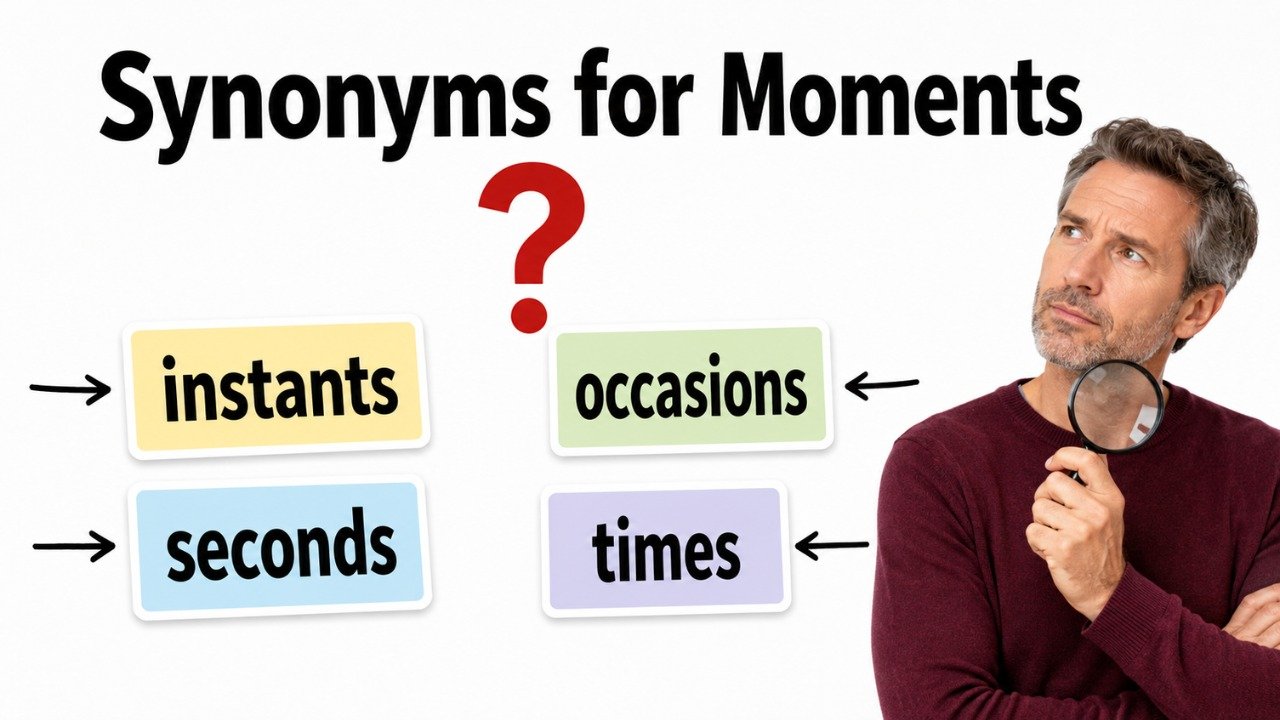
Quick Answer: The best synonyms for moments include instants, seconds, times, occasions, intervals, experiences, memories, episodes, milestones, and opportunities. Use instants for extremely brief points in time, seconds for short measurable periods, and times for general references to when something happened. Occasions works best for particular events, while experiences and memories suit meaningful parts of life. Choose intervals for pauses or spaces between events, milestones for important stages, and opportunities when a moment offers a chance to act.
Pronunciation and Word Details
Word: Moments.
Pronunciation: /ˈmoʊmənts/
Part of Speech: Plural noun.
Meaning: Brief periods, particular points in time, important occasions, or experiences that are remembered.
US Pronunciation:
UK Pronunciation:
What Does “Moments” Mean?
Moments means brief periods of time, particular points when something happens, or meaningful experiences in a person’s life.
Moments is the plural form of moment. As a noun, it can refer to periods that are extremely short.
Example: She closed her eyes for a few moments.
It can also describe specific points in time.
Example: Those were the moments when the plan began to succeed.
In emotional or personal writing, moments often means meaningful experiences that people remember.
Example: They shared many joyful moments during the trip.
The word can refer to important events or turning points.
Example: The announcement was one of the defining moments of his career.
Moments may also describe brief pauses, opportunities, scenes, or stages within a larger event.
Example: There were several quiet moments during the ceremony.
The exact meaning depends on context. A few moments usually means a short period. Special moments means meaningful experiences. Critical moments refers to important points when the outcome may change. Spare moments means small amounts of available time.
Meaning, Tone, and Context of “Moments”
Moments is a neutral and flexible word. It is common in casual conversation, formal writing, storytelling, essays, speeches, reports, emails, and personal descriptions.
In everyday speech, moments often refers to a short amount of time.
Example: Give me a few moments to finish this task.
In emotional writing, the word can sound warm, personal, reflective, or sentimental.
Example: She treasured the moments spent with her family.
In formal or analytical writing, moments may describe important stages, decisions, discoveries, or historical events.
Example: The agreement marked one of the most important moments in the negotiations.
In reports and professional writing, more precise alternatives such as intervals, instances, stages, or critical points may be better. These words explain whether the writer means duration, occurrence, development, or importance.
Moments can also have a dramatic tone when paired with words such as final, decisive, tense, dangerous, or unforgettable.
Example: The final moments of the competition were tense.
The word is broad, so context matters. Instants emphasizes brevity, occasions emphasizes events, memories emphasizes recollection, and milestones emphasizes progress or achievement.
When and How to Use “Moments”
For Brief Periods: Use moments when referring to a short amount of time without giving an exact measurement.
Example: The room became silent for several moments.
For Exact Points in Time: Use moments when identifying particular times when something happened.
Example: These were the moments that changed the direction of the project.
For Meaningful Experiences: Use moments for personal experiences that carry emotional value.
Example: The family created many happy moments during the celebration.
For Important Events: Use moments when an event has lasting importance or influence.
Example: The decision became one of the most significant moments in the organization’s history.
For Short Pauses: Use moments for brief breaks in speech, activity, or movement.
Example: A few quiet moments passed before anyone responded.
For Opportunities: Use moment when a particular time creates a chance to act.
Example: She recognized that this was her moment to speak.
For Dramatic Scenes: Use moments when describing tense, exciting, emotional, or decisive parts of a story.
Example: The final moments of the race kept everyone watching closely.
For Reflection: Use moments when discussing brief periods of thought, peace, or awareness.
Example: He enjoyed a few peaceful moments before beginning work.
For Progress: Use important moments when describing major stages in personal or professional development.
Example: Completing the first project was one of the proudest moments of her career.
For Available Time: Use spare moments or free moments for small periods when someone is not busy.
Example: She reads in her spare moments during the afternoon.
Best Synonyms for Moments
Synonym: Instants.
Meaning: Extremely brief points in time.
Example: For a few instants, no one knew how to respond.
Synonym: Seconds.
Meaning: Very short and measurable periods of time.
Example: The lights disappeared for several seconds.
Synonym: Times.
Meaning: Particular points or periods when events happen.
Example: Those were difficult times for the entire community.
Synonym: Occasions.
Meaning: Particular events or situations.
Example: We have met on several occasions.
Synonym: Intervals.
Meaning: Periods between two events or activities.
Example: The audience rested during the short intervals.
Synonym: Experiences.
Meaning: Events that a person lives through or participates in.
Example: Their travels gave them many memorable experiences.
Synonym: Memories.
Meaning: Past experiences that a person remembers.
Example: The photographs brought back happy memories.
Synonym: Episodes.
Meaning: Separate events or periods within a larger story or experience.
Example: The book describes several important episodes from her childhood.
Synonym: Milestones.
Meaning: Important points that show progress or achievement.
Example: Graduation and starting work were major milestones in his life.
Synonym: Opportunities.
Meaning: Suitable times or situations for taking action.
Example: The event created valuable opportunities for discussion.
50 Synonyms for Moments with Short Meanings
- Instants: Extremely brief points in time.
- Seconds: Short measurable periods of time.
- Minutes: Brief periods lasting sixty seconds each.
- Times: Particular points or periods when events occur.
- Points in Time: Specific positions within a sequence of events.
- Occasions: Particular events, situations, or opportunities.
- Instances: Individual examples or occurrences.
- Intervals: Periods between two events or actions.
- Periods: Lengths or divisions of time.
- Spans: Continuous lengths of time.
- Stretches: Unbroken periods of time or activity.
- Pauses: Brief stops in speech or activity.
- Breaks: Short periods when activity stops.
- Interludes: Short periods between larger events.
- Beats: Brief pauses or units in speech, drama, or storytelling.
- Episodes: Separate events or periods within a larger experience.
- Events: Things that happen at particular times.
- Experiences: Events that people personally live through.
- Encounters: Meetings or experiences involving people or situations.
- Memories: Past experiences that are remembered.
- Recollections: Memories brought back into the mind.
- Highlights: The most enjoyable or important parts of an experience.
- Milestones: Important points marking progress or achievement.
- Turning Points: Times when a major change begins.
- Junctures: Important stages when decisions or changes occur.
- Stages: Particular parts of a process or development.
- Phases: Distinct periods within a longer process.
- Steps: Individual parts within a sequence or journey.
- Opportunities: Suitable times for taking action.
- Chances: Possibilities or occasions to do something.
- Openings: Favorable situations that allow action or progress.
- Situations: Sets of conditions existing at particular times.
- Circumstances: Conditions affecting an event or decision.
- Scenes: Particular events or remembered parts of an experience.
- Snapshots: Brief views or impressions of a time or situation.
- Glimpses: Short views or brief experiences.
- Flashes: Extremely brief appearances, thoughts, or experiences.
- Fragments: Small parts of a larger experience or memory.
- Snatches: Brief pieces of time, sound, conversation, or experience.
- Breaths: Very short periods expressed figuratively.
- Heartbeats: Extremely brief periods expressed emotionally.
- Brief Spells: Short periods during which something happens.
- Short Periods: Limited amounts of time.
- Brief Intervals: Small spaces of time between events.
- Passing Seconds: Seconds that move by quickly.
- Fleeting Instants: Very short points that disappear quickly.
- Critical Points: Important times when an outcome may change.
- Decisive Occasions: Events when an important decision or result occurs.
- Memorable Experiences: Events that remain strongly in the mind.
- Special Occasions: Meaningful events that receive particular attention.
Read Also:
Synonyms for Goodbye

Synonyms for Moments by Context
When Moments Means Brief Periods of Time
Use instants, seconds, minutes, intervals, brief spells, or short periods when discussing limited amounts of time.
Instants suggests an extremely short duration.
Example: For a few instants, the entire hall was silent.
Seconds is more measurable and precise.
Example: The screen went dark for several seconds.
Minutes describes a longer and more clearly measured period.
Example: We waited for a few minutes before the doors opened.
Brief spells can describe short periods of a condition, mood, or activity.
Example: The afternoon included brief spells of rain.
Short periods is a clear and neutral option for general writing.
Example: Employees may rest for short periods during the shift.
When Moments Means Specific Points in Time
Use times, points in time, instances, junctures, stages, or phases when referring to identifiable positions within a sequence.
Times is broad and natural.
Example: There were times when progress seemed impossible.
Points in time is useful when precision matters.
Example: Measurements were taken at three points in time.
Instances refers to separate occurrences.
Example: The report identified several instances of delayed delivery.
Junctures describes important or sensitive points during a process.
Example: The team reviewed its priorities at several critical junctures.
Stages and phases work well for development, research, projects, and personal growth.
Example: Different skills are needed at each stage of the process.
When Moments Means Important Occasions
Use occasions, events, milestones, highlights, turning points, or decisive occasions when describing meaningful or influential events.
Occasions is suitable for ceremonies, meetings, celebrations, and repeated events.
Example: They had spoken on several formal occasions.
Events is a neutral and general alternative.
Example: The festival included several memorable events.
Milestones refers to achievements or stages of progress.
Example: Completing the training was an important milestone.
Highlights describes the best or most enjoyable parts of an experience.
Example: The evening performance was one of the highlights of the trip.
Turning points describes moments that cause major change.
Example: The conversation became a turning point in their relationship.
When Moments Means Personal Experiences
Use experiences, encounters, memories, recollections, scenes, or snapshots when discussing parts of life that a person lives through or remembers.
Experiences emphasizes participation.
Example: The journey provided many valuable experiences.
Encounters usually involves meeting a person, challenge, place, or situation.
Example: Her encounters with local artists influenced her work.
Memories emphasizes what is remembered rather than the original event.
Example: The house was filled with childhood memories.
Recollections is more formal and often refers to remembered details.
Example: His recollections of the event remained clear.
Snapshots can describe brief impressions of life, culture, or history.
Example: The stories offer snapshots of village life.
When Moments Means Brief Pauses
Use pauses, breaks, intervals, interludes, or beats when activity stops for a short time.
Pauses is best for speech, movement, thought, or performance.
Example: Her speech included several thoughtful pauses.
Breaks is useful for work, study, travel, or physical activity.
Example: Take regular breaks during long periods of work.
Intervals refers to spaces between activities or performances.
Example: Refreshments were served during the intervals.
Interludes describes short periods between larger events and may sound literary or artistic.
Example: A peaceful interlude followed the tense discussion.
Beats is common in storytelling, acting, and conversation.
Example: The speaker allowed a beat before revealing the result.
When Moments Means Opportunities
Use opportunities, chances, openings, occasions, or suitable times when a moment creates the possibility of action.
Opportunities is the strongest general option.
Example: The workshop created opportunities for collaboration.
Chances sounds natural in everyday conversation.
Example: We had several chances to ask questions.
Openings often suggests favorable situations for advancement or action.
Example: The change created an opening for a new approach.
Occasions may describe opportunities that happen at particular times.
Example: There were several occasions when she could have raised the issue.
When Moments Means Dramatic or Decisive Points
Use critical points, turning points, decisive occasions, junctures, climactic scenes, or final seconds when importance and tension are central.
Critical points refers to times when decisions or results may change.
Example: Careful judgment is essential at critical points in the process.
Turning points suggests lasting change.
Example: The discovery became a turning point in the investigation.
Decisive occasions emphasizes a clear result or decision.
Example: The final vote was a decisive occasion for the committee.
Final seconds creates urgency and is common in competitions or emergencies.
Example: The result changed during the final seconds of the match.
Another Word for Moments
The best single replacement for moments is often times because it can refer to particular points, periods, or experiences. However, the most accurate alternative depends on what moments means in the sentence.
Use instants for extreme brevity, occasions for events, memories for remembered experiences, intervals for pauses, and milestones for important stages.
Original: She waited for a few moments before answering.
Better Option: She waited for a few seconds before answering.
Original: They shared many joyful moments during the journey.
Better Option: They shared many joyful experiences during the journey.
Original: These moments changed the direction of the project.
Better Option: These turning points changed the direction of the project.
Original: There were quiet moments between the speeches.
Better Option: There were quiet intervals between the speeches.
When Not to Use “Moments”
Do not use moments when a more precise word would explain the length, type, or importance of the time more clearly.
Use seconds or minutes when the duration can be measured.
Weak: The alarm sounded for several moments.
Better: The alarm sounded for several seconds.
Use occasions when referring to separate events.
Weak: We have discussed this issue in several moments.
Better: We have discussed this issue on several occasions.
Use instances when identifying examples or occurrences in formal writing.
Weak: The report found four moments of incorrect data entry.
Better: The report found four instances of incorrect data entry.
Use milestones when describing important achievements.
Weak: Graduation was one of the major moments in her education.
Better: Graduation was one of the major milestones in her education.
Use memories when discussing past experiences recalled later.
Weak: The photographs brought back happy moments.
Better: The photographs brought back happy memories.
Avoid moments when the sentence requires an exact date or time.
Weak: The meeting begins at a later moment.
Better: The meeting begins at three in the afternoon.
Do not use moments for long historical periods.
Weak: The region changed greatly during several historical moments.
Better: The region changed greatly during several historical periods.
Moments may also sound overly emotional in a technical report. Choose points, intervals, stages, or instances for greater precision.
Weak: Samples were tested at several moments.
Better: Samples were tested at several intervals.
Words Commonly Confused With Moments
Moments vs Instants: Moments may be brief, meaningful, or important. Instants specifically emphasizes extremely short points in time.
Moments vs Minutes: Moments describes an indefinite short time. Minutes refers to exact units of sixty seconds.
Moments vs Times: Moments often suggests brief or meaningful points. Times is broader and may refer to occasions, periods, or eras.
Moments vs Occasions: Moments can be parts of an event or experience. Occasions are distinct events or situations.
Moments vs Memories: Moments are experiences as they happen. Memories are mental records of experiences after they have happened.
Moments vs Instances: Moments refers to points in time or experiences. Instances refers to individual examples or occurrences.
Moments vs Intervals: Moments may be any brief periods. Intervals are specifically spaces between two events or activities.
Moments vs Events: A moment may be a brief part of an event. An event is a complete occurrence that may last much longer.
Moment vs Momentum: A moment is a brief time or particular point. Momentum is the force or progress that keeps movement or development continuing.
Moments vs Milestones: Moments may be ordinary or important. Milestones are important points that mark progress or achievement.
Which Synonym Should You Choose?
Choose instants when emphasizing that the time was extremely brief.
Choose seconds when a short period can be measured more precisely.
Choose minutes when the period is longer and has a clear duration.
Choose times in casual speech when referring broadly to occasions or periods.
Choose occasions for meetings, ceremonies, celebrations, or events that happen separately.
Choose instances in formal writing, reports, and essays when identifying individual examples.
Choose intervals in technical writing when describing measured spaces between observations, tests, or activities.
Choose experiences when discussing events a person has lived through.
Choose memories when the focus is on recalling past experiences.
Choose episodes when describing separate events within a longer story, condition, or period.
Choose milestones for achievements and major stages of progress.
Choose turning points for moments that cause an important change.
Choose junctures in formal essays or reports for important stages requiring decisions.
Choose pauses for short stops in speech, movement, or thought.
Choose breaks for casual conversation about stopping work or activity.
Choose interludes for short peaceful or contrasting periods between major events.
Choose highlights when describing the best or most memorable parts of an event.
Choose opportunities in emails and professional writing when a moment creates a chance for action.
Choose chances in casual conversation when discussing possibilities.
Choose snapshots when describing brief views of a time, place, culture, or experience.
Real Life Examples of “Moments” in Sentences
Original: She waited a few moments before opening the letter.
Better Option: She waited a few seconds before opening the letter.
Original: The family shared many happy moments during the holiday.
Better Option: The family shared many happy experiences during the holiday.
Original: These moments shaped his early career.
Better Option: These experiences shaped his early career.
Original: There were several tense moments during the discussion.
Better Option: There were several tense points during the discussion.
Original: The final moments of the performance were unforgettable.
Better Option: The final scenes of the performance were unforgettable.
Original: Graduation was one of the proudest moments of her life.
Better Option: Graduation was one of the proudest milestones of her life.
Original: He used his free moments to review the report.
Better Option: He used his spare time to review the report.
Original: The report describes several moments when communication failed.
Better Option: The report describes several instances when communication failed.
Original: Quiet moments separated the two presentations.
Better Option: Quiet intervals separated the two presentations.
Original: The conversation created several moments for honest discussion.
Better Option: The conversation created several opportunities for honest discussion.
Synonym Groups and Usage Differences
Brief Time Group
Instants, seconds, minutes, brief spells, short periods, and passing seconds describe limited amounts of time.
Instants is the shortest and least measurable option. Seconds and minutes are exact units. Brief spells often describes a temporary condition.
Example: The lights disappeared for a few seconds.
Particular Time Group
Times, points in time, instances, stages, and phases identify positions within a sequence or process.
Times is broad and conversational. Points in time is precise. Stages and phases describe development.
Example: The research team recorded results at several points in time.
Occasion Group
Occasions, events, encounters, situations, and circumstances refer to separate happenings or sets of conditions.
Occasions works well for planned or repeated events. Encounters often involves meetings. Circumstances focuses on surrounding conditions.
Example: They had met on several previous occasions.
Memory Group
Memories, recollections, snapshots, fragments, and scenes describe remembered experiences.
Memories is the broadest word. Recollections sounds more formal. Fragments suggests incomplete memories.
Example: The song brought back vivid memories of childhood.
Importance Group
Milestones, highlights, turning points, junctures, and critical points describe moments with unusual significance.
Milestones marks progress. Highlights identifies the best parts. Turning points creates change. Critical points may determine an outcome.
Example: Opening the new office was a major milestone for the team.
Pause Group
Pauses, breaks, intervals, interludes, and beats describe temporary stops or spaces between actions.
Pauses often occurs in speech. Breaks is common in work and study. Beats is useful in drama and storytelling.
Example: The speaker used a brief pause to emphasize the main idea.
Opportunity Group
Opportunities, chances, openings, and occasions refer to suitable times for action.
Opportunities is neutral and professional. Chances is casual. Openings often suggests a favorable possibility.
Example: The meeting provided several opportunities to clarify the proposal.
Emotional Experience Group
Experiences, memories, highlights, precious memories, and special occasions carry personal or emotional meaning.
Experiences emphasizes what happened. Memories emphasizes what is recalled. Special occasions refers to meaningful events.
Example: They treasured the memories created during the journey.
Antonyms of Moments
Moments has no single direct antonym because it has several meanings. Its opposites depend on whether it refers to brief time, important occasions, or remembered experiences.
Eternities: Periods that seem endless.
Ages: Very long periods of time.
Long Periods: Extended amounts of time.
Continuous Time: Time without interruption or separate points.
Permanence: A state that continues without ending.
Timelessness: A condition that appears unaffected by time.
Continuity: Unbroken continuation without separate pauses.
Duration: The full length of time something continues.
Routine: Ordinary and repeated activity rather than a special occasion.
Ordinariness: A lack of unusual importance or distinction.
Insignificance: A lack of importance or influence.
Stagnation: A long period without movement, progress, or change.
Endlessness: The quality of continuing without a visible end.
Whole Eras: Very long and significant historical periods.
Extended Stretches: Long continuous periods rather than brief moments.
Comparison: Moments vs Related Words
Moments vs Instants
Moments can be brief, emotional, memorable, or important. Instants refers specifically to extremely short points in time.
Example With Moments: They shared several quiet moments before the ceremony.
Example With Instants: For a few instants, the room was completely dark.
Moments vs Seconds
Moments describes an indefinite short period. Seconds gives a precise unit of measurement.
Example With Moments: Please wait a few moments.
Example With Seconds: Please wait thirty seconds.
Moments vs Times
Moments often refers to brief or meaningful points. Times can refer to broader periods, repeated occasions, or historical conditions.
Example With Moments: The final moments of the speech were emotional.
Example With Times: The community experienced difficult times after the storm.
Moments vs Occasions
Moments may be small parts of an experience. Occasions are complete events or situations.
Example With Moments: The celebration included several touching moments.
Example With Occasions: They have worked together on several occasions.
Moments vs Memories
Moments happen in the present or refer to past experiences themselves. Memories are the mental recollections of those experiences.
Example With Moments: They enjoyed many peaceful moments by the lake.
Example With Memories: They carried happy memories of the lake home with them.
Moments vs Instances
Moments focuses on time or experience. Instances focuses on individual examples or occurrences.
Example With Moments: There were tense moments during the meeting.
Example With Instances: The report listed three instances of incorrect billing.
Moments vs Intervals
Moments can refer to any brief periods. Intervals are spaces between two activities, observations, or events.
Example With Moments: A few quiet moments followed the announcement.
Example With Intervals: The machine was checked at regular intervals.
Moments vs Events
A moment is usually brief or part of a larger experience. An event is a complete occurrence that may last for hours or days.
Example With Moments: The event included several memorable moments.
Example With Events: The program includes five public events.
Moments vs Milestones
Moments may be ordinary, emotional, or important. Milestones specifically mark progress, achievement, or development.
Example With Moments: They celebrated many joyful moments together.
Example With Milestones: The first successful test was an important milestone.
Moments vs Turning Points
Moments may have little lasting effect. Turning points cause or represent major changes.
Example With Moments: The journey included several difficult moments.
Example With Turning Points: The new discovery became a turning point in the project.
Common Phrases and Expressions With Moments
A Few Moments: A short and indefinite period of time.
For a Moment: During a very brief period.
At That Moment: At a particular point in time.
Special Moments: Meaningful or emotionally important experiences.
Precious Moments: Experiences considered valuable and worth remembering.
Quiet Moments: Short periods of silence, peace, or reflection.
Final Moments: The last parts of an event, process, or life.
Critical Moments: Important points when an outcome may change.
Defining Moments: Events that strongly shape a person, period, or situation.
Memorable Moments: Experiences that are easy or pleasant to remember.
Proud Moments: Experiences that create satisfaction or pride.
Spare Moments: Small amounts of free time.
Tense Moments: Brief periods involving anxiety or uncertainty.
Unforgettable Moments: Experiences that remain strongly in memory.
Moments of Truth: Times when reality, ability, or character is tested.
Common Mistakes to Avoid
A common mistake is using moments when an exact unit of time is needed.
Vague: The test lasted several moments.
Better: The test lasted three minutes.
Do not use moments for separate examples in formal analysis. Instances is usually clearer.
Weak: The review found several moments of incorrect calculation.
Better: The review found several instances of incorrect calculation.
Avoid confusing moments with memories. A moment is an event or point in time, while a memory is the recollection of that event.
Incorrect: The photograph brought back many moments.
Better: The photograph brought back many memories.
Do not use occasions when you mean very short periods.
Incorrect: She paused for a few occasions.
Correct: She paused for a few moments.
Avoid repeating moments several times in one paragraph. Use experiences, occasions, instances, highlights, or periods where appropriate.
Repetitive: The trip included exciting moments, peaceful moments, and surprising moments.
Better: The trip included exciting experiences, peaceful intervals, and surprising encounters.
Use the correct singular and plural forms.
Incorrect: We waited for a moment before the doors opened, although the delay lasted several moment.
Correct: We waited for a moment before the doors opened, although the delay lasted several moments.
Remember that moment is countable when it refers to points in time or experiences.
Correct: It was a memorable moment.
Correct: They shared several memorable moments.
Avoid using at the moment when currently would be clearer in very formal writing.
Casual: The manager is unavailable at the moment.
Formal: The manager is currently unavailable.
Do not use moment and momentum interchangeably. They have different meanings.
Incorrect: The campaign gained moment after the announcement.
Correct: The campaign gained momentum after the announcement.
Use milestone only for an important achievement or stage. It is not a replacement for every moment.
Incorrect: She waited for a milestone before answering.
Correct: She waited for a moment before answering.
Conclusion
The most useful synonyms for moments include instants, seconds, times, occasions, intervals, experiences, memories, milestones, and opportunities. Choose instants or seconds for brief time, occasions for separate events, and intervals for pauses. Experiences and memories suit personal contexts, while milestones and turning points describe important stages or changes. In reports, instances and points in time provide greater precision. Understanding these distinctions helps you use synonyms for moments naturally and select the clearest word for every sentence.
FAQs About Synonyms for Moments
What Is the Best Synonym for Moments?
Times is a broad general synonym. Instants, occasions, experiences, and memories may be more accurate depending on the context.
What Is Another Word for Brief Moments?
Instants, seconds, brief intervals, passing seconds, and fleeting instants are useful alternatives for brief moments.
What Is a Synonym for Special Moments?
Special occasions, memorable experiences, highlights, precious memories, and meaningful events can replace special moments.
Are Moments and Memories the Same?
No. Moments are points in time or experiences, while memories are the mental recollections of those experiences.
What Is a Formal Synonym for Moments?
Instances, intervals, points in time, junctures, stages, and occasions are suitable formal alternatives.
What Is Another Word for Important Moments?
Milestones, turning points, critical points, defining events, and decisive occasions are strong alternatives.
Can Instances Replace Moments?
Instances can replace moments when the sentence refers to separate examples or occurrences. It is less suitable for emotional experiences or brief periods of time.
