
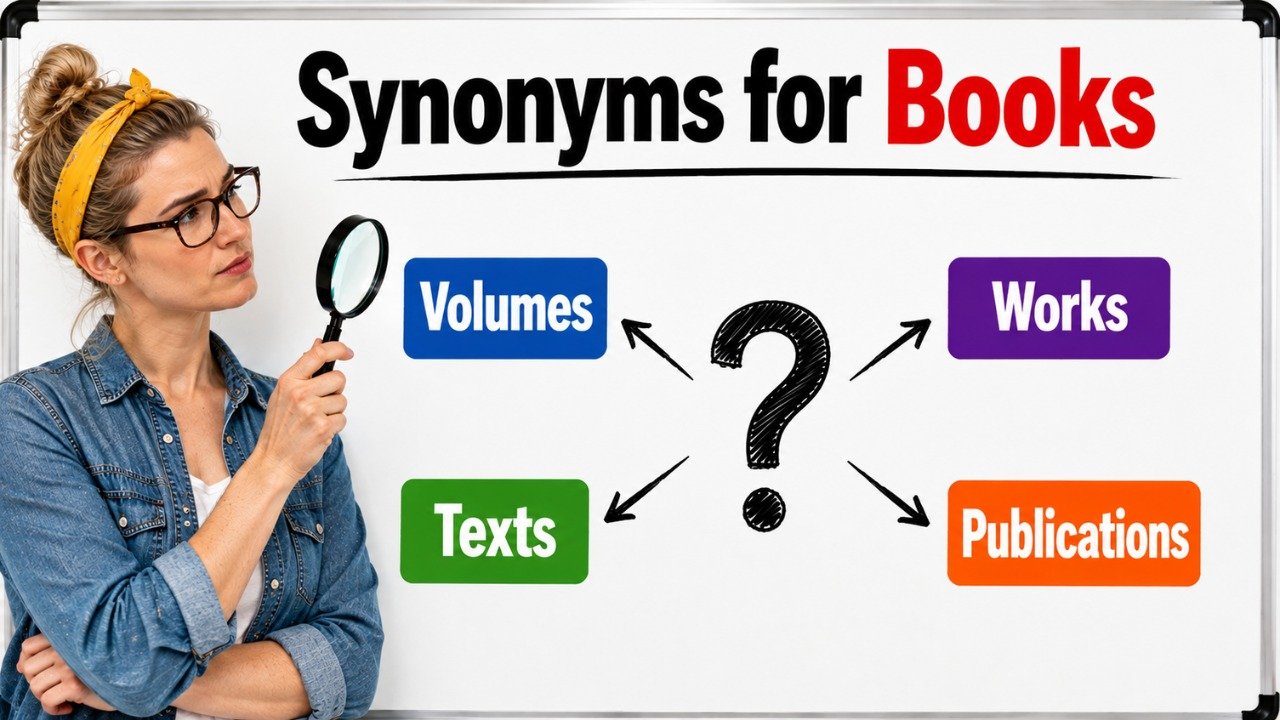
Quick Answer: The best synonyms for books include volumes, works, publications, texts, titles, writings, literature, manuals, records, and reading material. Use volumes for individual physical books, works for creative or scholarly writing, and publications for formally released material. Texts is best in academic contexts, while titles refers to named books in a collection or catalog. Literature describes written works collectively. Manuals suits instructional books, and records fits financial or official books. When books is a verb, use reserves for rooms or tickets and schedules for appointments or events.
Pronunciation and Word Details
Word: Books.
Pronunciation: /bʊks/
Part of Speech: Plural noun and third person singular verb.
Meaning: Written or printed works for reading, records containing information, or the act of reserving or scheduling something.
US Pronunciation:
UK Pronunciation:
What Does “Books” Mean?
Books most commonly means written works consisting of pages or digital content organized for reading. The word is the plural form of book and may refer to novels, textbooks, manuals, reference works, biographies, collections, and many other kinds of writing.
As a plural noun, books can describe physical objects.
Example: The books are arranged on the wooden shelf.
It can also refer to the ideas or information contained in written works rather than the physical objects themselves.
Example: She reads books about language, history, and science.
In academic settings, books may mean texts used for study, research, or instruction. In publishing, the word may refer to titles, works, editions, or publications.
Books can also mean financial, business, or official records. In the expression “the books,” it often refers to accounts, ledgers, or documents used to record transactions.
Example: The accountant reviewed the books before preparing the report.
As a verb, books means reserves, arranges, schedules, or secures something in advance.
Example: He books a table before every important dinner.
The verb may also describe arranging a performer, speaker, service, appointment, or event.
Example: The organizer books local musicians for the celebration.
In an official context, books can mean records a person’s details or formally registers an incident. The intended meaning depends on the surrounding sentence.
Meaning, Tone, and Context of “Books”
Books is a common, neutral, and widely understood word. It works naturally in casual conversation, academic writing, professional communication, educational material, and literary discussion.
When referring to reading materials, books has a broad and neutral tone. It does not specify whether the works are fictional, factual, printed, digital, academic, or recreational. More precise synonyms may therefore be useful when the type of material matters.
In casual speech, books often means any written works someone reads.
Example: I packed three books for the journey.
In literary discussion, works, writings, novels, or literature may sound more precise.
Example: Her early works explore family, memory, and personal identity.
In academic contexts, texts, textbooks, monographs, reference works, and publications are often more suitable because they identify the purpose or format of the material.
When books refers to financial information, it has a professional or technical meaning. Accounts, records, and ledgers are usually clearer alternatives.
As a verb, books is neutral and conversational. It commonly describes making a reservation, arranging an appointment, or scheduling a service.
Example: She books her appointments several weeks in advance.
The word may become more formal when it refers to engaging a professional or recording information officially.
When and How to Use “Books”
For General Reading Materials
Use books when referring broadly to written works intended for reading.
Example: The room contains books on art, travel, nature, and history.
For Physical Copies
Use books when the sentence focuses on objects with pages, covers, and bindings.
Example: He placed the books carefully inside the box.
For Literary Works
Use books when discussing stories, novels, biographies, essays, or other complete written works.
Example: Her books often explore friendship and personal growth.
For Academic Study
Use books when referring generally to educational material, but choose textbooks, texts, or reference works when greater precision is needed.
Example: Students may borrow the required books from the library.
For a Collection or Catalog
Use books when speaking about multiple titles owned, listed, sold, or organized together.
Example: The catalog contains books for readers of all ages.
For Financial Records
Use books when referring to records of money, sales, costs, or transactions.
Example: The manager checks the books at the end of each month.
For Reservations
Use books as a verb when someone reserves a room, table, seat, ticket, or service.
Example: She books a quiet room whenever she travels for work.
For Appointments
Use books when someone arranges a meeting, visit, consultation, or service for a particular time.
Example: He books a dental appointment every six months.
For Events and Performers
Use books when an organizer arranges for a speaker, artist, musician, or service provider to appear at an event.
Example: The committee books a guest speaker for the annual gathering.
For Official Recording
Use books when an authority formally records a person, event, or incident.
Example: The officer books the individual after confirming the details.
Best Synonyms for Books
Volumes: Individual books, especially when discussing physical copies or works in a collection.
Example: Several leather bound volumes were displayed behind the desk.
Works: Creative, literary, academic, or scholarly pieces produced by an author.
Example: The course examines the major works of several modern writers.
Publications: Written materials formally prepared and released for readers.
Example: The researcher consulted recent publications on language development.
Texts: Written works studied, analyzed, or used for instruction.
Example: Students compared two historical texts during the lesson.
Titles: Named books or works available in a collection, list, or catalog.
Example: The reading list contains ten useful titles for beginners.
Writings: Written material created by a particular person or about a subject.
Example: Her early writings reveal a strong interest in nature.
Literature: Written works considered collectively, especially works with artistic or cultural value.
Example: The class explored literature from several historical periods.
Manuals: Books containing practical instructions, explanations, or procedures.
Example: The technicians followed the safety manuals carefully.
Records: Written accounts containing financial, official, or historical information.
Example: The company keeps accurate records of every transaction.
Reading Material: Written content provided or selected for reading.
Example: The teacher prepared suitable reading material for the class.
50 Synonyms for Books with Short Meanings
- Volumes: Individual books, especially physical works in a collection.
- Works: Complete creative, academic, or literary pieces.
- Publications: Materials formally produced and released for readers.
- Texts: Written works used for reading, study, or analysis.
- Titles: Named books listed in a catalog or collection.
- Writings: Written pieces created by an author or group.
- Literature: Written works considered collectively.
- Reading Material: Content intended to be read.
- Printed Works: Written material produced in printed form.
- Manuscripts: Original written or typed versions of works.
- Novels: Long fictional stories published as books.
- Nonfiction Works: Books based on facts, real events, or information.
- Textbooks: Books created for formal study or instruction.
- Manuals: Books containing directions or practical information.
- Guides: Books that provide advice, explanations, or instructions.
- Handbooks: Compact reference books covering a particular subject.
- Reference Works: Books used to find facts or detailed information.
- Anthologies: Collections of selected writings in one volume.
- Collections: Groups of related written works gathered together.
- Editions: Particular published versions of books.
- Copies: Individual examples of a published book.
- Paperbacks: Books with flexible paper or card covers.
- Hardcovers: Books with firm and durable covers.
- Digital Books: Books created or provided in electronic form.
- Audiobooks: Recorded readings of books for listening.
- Storybooks: Books containing stories, often for younger readers.
- Journals: Written records or specialized periodical works.
- Diaries: Personal books containing dated thoughts and experiences.
- Notebooks: Bound pages used for writing notes or ideas.
- Ledgers: Books used to record financial transactions.
- Records: Written accounts of facts, activities, or transactions.
- Accounts: Financial or descriptive records of events and activities.
- Registers: Official books containing names, events, or details.
- Catalogs: Organized lists of books, products, or materials.
- Chronicles: Detailed written accounts of events over time.
- Archives: Collections of preserved documents and records.
- Documents: Written materials containing information or evidence.
- Tomes: Large, serious, or scholarly books.
- Booklets: Small books with relatively few pages.
- Pamphlets: Short printed works covering a particular subject.
- Readers: Books containing selected texts for learning or practice.
- Treatises: Formal and detailed written studies of subjects.
- Monographs: Scholarly books focused on one specialized topic.
- Codices: Ancient or historical books made from bound pages.
- Compilations: Works formed by gathering material from several sources.
- Reserves: Arranges for something to be kept or provided later.
- Schedules: Arranges an appointment, service, or event for a set time.
- Arranges: Organizes a service, appearance, meeting, or activity.
- Secures: Obtains a place, service, or ticket in advance.
- Engages: Hires or arranges for someone to provide a service.
Read Also:
Synonyms for Spontaneous
Synonyms for Books by Context
When Books Means Physical Reading Materials
Volumes, copies, paperbacks, hardcovers, printed works, digital books, and audiobooks describe books according to their form or format.
Volumes is a useful formal synonym when referring to separate physical books in a larger collection.
Example With Books: The shelf contains several books about regional history.
Example With Volumes: The shelf contains several volumes about regional history.
Copies is more appropriate when discussing the number of identical books available.
Example With Books: The teacher ordered thirty books for the students.
Example With Copies: The teacher ordered thirty copies for the students.
Paperbacks and hardcovers identify the type of cover, while digital books and audiobooks describe electronic and recorded formats.
When Books Means Literary or Creative Works
Works, writings, literature, novels, anthologies, collections, and manuscripts are suitable when discussing creative or literary material.
Works is broad and may include books, essays, plays, poems, or other creations by an author.
Example With Books: The professor discussed the author’s later books.
Example With Works: The professor discussed the author’s later works.
Novels is more specific because it refers only to long fictional narratives.
Example With Books: She has written four books about imagined families.
Example With Novels: She has written four novels about imagined families.
Literature refers to written works collectively and is often used in educational or cultural discussion.
Example: The course introduces students to modern literature.
When Books Means Academic Resources
Texts, textbooks, monographs, treatises, manuals, handbooks, guides, readers, and reference works fit educational or scholarly contexts.
Texts is useful when students read, discuss, interpret, or analyze particular written works.
Example With Books: The students analyzed several books during the course.
Example With Texts: The students analyzed several texts during the course.
Textbooks are specifically designed for instruction. Monographs explore one specialized academic subject in depth.
Example: The researcher published a monograph on language change.
Manuals, guides, and handbooks provide practical information. Reference works help readers locate facts rather than read continuously from beginning to end.
When Books Means Published Material
Publications, titles, editions, printed works, manuscripts, and compilations are common in publishing, libraries, catalogs, and formal writing.
Titles refers to distinct named works rather than physical copies.
Example With Books: The collection includes more than two hundred books.
Example With Titles: The collection includes more than two hundred titles.
Editions refers to particular published versions of the same work.
Example: The revised edition contains a new introduction and updated examples.
Publications is a broad formal term that can include books, reports, journals, and other released material.
When Books Means Financial or Official Records
Records, accounts, ledgers, registers, documents, archives, and catalogs may replace books when the word refers to organized information.
Ledgers is the most precise choice for books containing financial transactions.
Example With Books: The accountant examined the books for missing payments.
Example With Ledgers: The accountant examined the ledgers for missing payments.
Accounts refers to financial information collectively.
Example: The auditor reviewed the annual accounts.
Registers are official lists of names, events, or details. Archives contain preserved records from an earlier period.
When Books Means Reserves Something
Reserves, secures, and arranges are useful when books is a verb describing an advance reservation.
Reserves is usually the closest replacement for rooms, seats, tables, tickets, or services.
Example With Books: She books a table near the window.
Example With Reserves: She reserves a table near the window.
Secures emphasizes successfully obtaining limited availability.
Example: He secures a seat several weeks before the event.
When Books Means Schedules or Engages Someone
Schedules, arranges, and engages are suitable when books refers to appointments, events, performers, speakers, or professionals.
Schedules is best for appointments and meetings.
Example With Books: The assistant books all client meetings.
Example With Schedules: The assistant schedules all client meetings.
Engages is more formal and usually refers to hiring a performer, speaker, or professional.
Example: The organizers engaged a musician for the evening program.
Another Word for Books
Volumes is the best general replacement for books when referring to separate physical written works. However, the most accurate alternative depends on the context.
Use works for an author’s creative output, texts for study materials, titles for items in a catalog, records for financial books, and reserves when books functions as a verb.
Original: The shelf holds several books about architecture.
Better Option: The shelf holds several volumes about architecture.
Original: The course includes books from different historical periods.
Better Option: The course includes texts from different historical periods.
Original: The writer’s books have been translated into several languages.
Better Option: The writer’s works have been translated into several languages.
Original: She books a room before every business trip.
Better Option: She reserves a room before every business trip.
When Not to Use “Books”
Books can sound vague when the exact type of writing matters. A sentence becomes clearer when it identifies whether the material consists of novels, textbooks, manuals, records, journals, or reference works.
Weak: Students must bring their books to the laboratory.
Better: Students must bring their laboratory manuals to the laboratory.
Avoid books when referring to one particular published name in a catalog. Title is often more precise.
Weak: The catalog added twenty new books this month.
Better: The catalog added twenty new titles this month.
Do not use books as a replacement for every kind of written material. An article, letter, report, essay, journal entry, or document is not necessarily a book.
Weak: She attached several books to the email.
Better: She attached several documents to the email.
Books may also be too general in literary analysis.
Weak: The essay compares two books by the same writer.
Better: The essay compares two novels by the same writer.
When discussing finance, books can sound informal or ambiguous unless the expression is already clear.
Weak: The team corrected several errors in the books.
Better: The team corrected several errors in the financial records.
As a verb, books should not be used when no reservation, arrangement, or official recording occurs.
Weak: She books the report before lunch.
Better: She completes the report before lunch.
Avoid using books when schedules is more accurate for an appointment.
Weak: The receptionist books the meeting on the calendar.
Better: The receptionist schedules the meeting on the calendar.
Do not replace books with a synonym mechanically. Volumes does not naturally describe reservations, while reserves does not describe reading materials.
Words Commonly Confused With Books
Books vs Novels: Books is a broad category that includes fiction, nonfiction, textbooks, manuals, and reference works. Novels are specifically long fictional narratives.
Books vs Texts: Books refers broadly to complete written works. Texts often refers to material selected for study, interpretation, or academic discussion.
Books vs Volumes: Books is the everyday general term. Volumes sounds more formal and may refer to separate parts of a larger work or collection.
Books vs Publications: Books are one kind of publication. Publications may also include journals, reports, newsletters, and other formally released material.
Books vs Titles: Books may refer to physical copies. Titles refers to distinct named works regardless of how many copies exist.
Books vs Copies: Books may refer to different works or physical objects. Copies refers to multiple examples of the same work.
Books vs Literature: Books are physical or digital works. Literature refers collectively to written works, especially those valued for artistic, intellectual, or cultural qualities.
Books vs Textbooks: Books is a broad term. Textbooks are specifically designed to teach a subject within a structured course.
Books vs Records: Books may contain stories or information for reading. Records contain organized facts, transactions, events, or evidence.
Books vs Reserves: Books as a noun refers to written works or records. Books as a verb can mean reserves something in advance.
Which Synonym Should You Choose?
Choose volumes when referring to individual physical books, especially in a formal description or collection.
Choose works when discussing the creative or scholarly output of an author.
Choose publications in reports, professional writing, or publishing contexts when the material has been formally released.
Choose texts in essays and academic discussion when books are being studied, interpreted, or compared.
Choose titles when referring to named works in a list, catalog, collection, or reading program.
Choose writings when discussing material created by a particular author without limiting the category to complete books.
Choose literature when referring collectively to written works with cultural, artistic, or academic importance.
Choose novels when every item being discussed is a long fictional story.
Choose textbooks for books created to support formal teaching and study.
Choose manuals when the books contain instructions, procedures, or technical guidance.
Choose guides for practical advice presented in an accessible way.
Choose reference works when readers use the books to locate facts or explanations.
Choose copies when discussing the number of identical physical or digital examples available.
Choose records in reports, emails, and professional communication when books means organized information.
Choose accounts when discussing financial records collectively.
Choose ledgers when referring specifically to books that record transactions.
Choose reserves in everyday conversation when someone books a room, table, seat, ticket, or service.
Choose schedules for meetings, consultations, appointments, and events placed at a particular time.
Choose arranges when the emphasis is on organizing a service, appearance, or activity.
Choose engages in formal writing when an organization hires a speaker, performer, or professional.
Real Life Examples of “Books” in Sentences
Original: She keeps her favorite books beside the bed.
Better Option: She keeps her favorite volumes beside the bed.
Original: The course examines five books from the same period.
Better Option: The course examines five texts from the same period.
Original: The library added several new books this month.
Better Option: The library added several new titles this month.
Original: His books focus on language and memory.
Better Option: His works focus on language and memory.
Original: The instructor recommended two books for additional study.
Better Option: The instructor recommended two reference works for additional study.
Original: The accountant checked the books before closing the office.
Better Option: The accountant checked the financial records before closing the office.
Original: She books a room near the conference location.
Better Option: She reserves a room near the conference location.
Original: The receptionist books appointments every morning.
Better Option: The receptionist schedules appointments every morning.
Original: The organizer books a speaker for the annual event.
Better Option: The organizer engages a speaker for the annual event.
Original: The shop has ten books by the same author.
Better Option: The shop has ten titles by the same author.
Synonym Groups and Usage Differences
Physical Book Group
Volumes, copies, paperbacks, hardcovers, printed works, digital books, and audiobooks describe books according to form, quantity, or format.
Volumes sounds formal and is useful for collections. Copies emphasizes quantity. Paperbacks and hardcovers describe physical binding. Digital books and audiobooks describe electronic formats.
Example: The collection contains printed volumes, digital books, and recorded audiobooks.
Literary Work Group
Works, writings, literature, novels, manuscripts, anthologies, collections, and compilations describe creative or literary content.
Works is broad and formal. Writings emphasizes authorship. Literature refers to written works collectively. Novels identifies fiction. Anthologies and collections contain several pieces in one publication.
Example: The anthology gathers early writings and several previously unpublished works.
Academic Resource Group
Texts, textbooks, readers, monographs, treatises, handbooks, manuals, guides, and reference works are useful in educational and scholarly contexts.
Texts are studied or analyzed. Textbooks support structured learning. Monographs and treatises examine subjects deeply. Handbooks and manuals provide practical information.
Example: Students used textbooks, reference works, and selected texts throughout the course.
Publishing Group
Publications, titles, editions, manuscripts, copies, and printed works relate to producing, identifying, and distributing books.
A title is a distinct named work. An edition is a particular published version. A manuscript is the version prepared before final publication. A copy is one example of the completed work.
Example: The revised edition became one of the publisher’s most requested titles.
Record Group
Records, accounts, ledgers, registers, archives, documents, chronicles, and catalogs organize information rather than literary content.
Ledgers and accounts are associated with finance. Registers contain official entries. Archives preserve historical records. Chronicles describe events in time order.
Example: The archive contains registers, documents, and detailed chronicles of local events.
Reservation Group
Reserves, secures, arranges, schedules, and engages replace books when it functions as a verb.
Reserves is best for places and services. Schedules fits appointments and events. Secures emphasizes successful access. Engages refers to hiring someone for a service or appearance.
Example: The coordinator schedules the event, reserves the venue, and engages the speakers.
Antonyms of Books
Books has no single universal antonym because it has several meanings. The most useful opposite depends on whether books refers to written works, recorded information, reservations, or scheduled arrangements.
Opposites of Written Books
Speech: Spoken communication rather than written material.
Conversation: An exchange of spoken ideas rather than a published work.
Oral Account: Information communicated by speaking instead of writing.
Unwritten Material: Ideas or information that have not been recorded in book form.
Blank Pages: Pages that contain no written or printed content.
Opposites of Records or Accounts
Omission: Information that has been left unrecorded.
Erasure: The removal of written or recorded information.
Disorder: A lack of organized records or arrangement.
Unrecorded Information: Facts or events that have not been entered into official records.
Opposites of Books as a Verb
Cancels: Ends a reservation, appointment, or arrangement.
Releases: Makes a reserved place or service available again.
Withdraws: Removes a request, reservation, or arrangement.
Dismisses: Decides not to engage or hire someone.
Leaves Unscheduled: Does not assign an event or appointment a specific time.
Comparison Between Books and Related Words
Books vs Volumes
Books is the ordinary general term. Volumes is more formal and may emphasize individual physical works or separate parts of a larger set.
Example With Books: The table was covered with books about local history.
Example With Volumes: The table was covered with scholarly volumes about local history.
Books vs Novels
Books includes fiction, nonfiction, manuals, textbooks, and other complete works. Novels refers only to long fictional narratives.
Example With Books: She reads books about science and history.
Example With Novels: She reads novels about imagined families and distant places.
Books vs Texts
Books refers broadly to written works. Texts is especially useful when the works are being studied, interpreted, compared, or taught.
Example With Books: The students brought their books to class.
Example With Texts: The students analyzed the assigned texts in class.
Books vs Publications
Books is one category of written material. Publications includes books as well as reports, journals, magazines, and other released content.
Example With Books: The author donated several books to the collection.
Example With Publications: The researcher reviewed recent publications on the subject.
Books vs Titles
Books may refer to physical copies. Titles refers to distinct named works.
Example With Books: The shelf holds fifty books.
Example With Titles: The catalog lists fifty titles.
Books vs Copies
Books may be different works. Copies are separate examples of the same work.
Example With Books: The store received several new books.
Example With Copies: The store received twenty copies of the new guide.
Books vs Literature
Books refers to individual written works or physical objects. Literature refers collectively to written material, particularly works with artistic or cultural importance.
Example With Books: The class read six books during the term.
Example With Literature: The class studied regional literature during the term.
Books vs Records
Books often refers to reading material. Records refers to organized information about activities, facts, transactions, or events.
Example With Books: The children selected books from the reading corner.
Example With Records: The administrator updated the attendance records.
Books vs Reserves
Books can be a plural noun or a verb. Reserves replaces books only when the verb means arranging something in advance.
Example With Books: She books a table for the evening.
Example With Reserves: She reserves a table for the evening.
Books vs Schedules
Books may refer to arranging a room, seat, service, appointment, or performer. Schedules specifically emphasizes assigning a time to an appointment or event.
Example With Books: The assistant books a consultation for Friday.
Example With Schedules: The assistant schedules a consultation for Friday.
Common Phrases and Expressions With Books
Hit the Books: Begin studying seriously.
Example: She plans to hit the books before the final examination.
By the Book: According to established rules or procedures.
Example: The inspector completed every step by the book.
An Open Book: A person whose thoughts or feelings are easy to understand.
Example: He is an open book and rarely hides his opinion.
Read Someone Like a Book: Understand someone’s feelings or intentions easily.
Example: Her closest friend can read her like a book.
One for the Books: An event that is unusual, memorable, or remarkable.
Example: The unexpected victory was one for the books.
Close the Books: Finish recording accounts for a particular period.
Example: The finance team will close the books at the end of the month.
Balance the Books: Make sure financial records are accurate and equal.
Example: The accountant stayed late to balance the books.
Keep the Books: Maintain financial accounts and transaction records.
Example: A trained assistant keeps the books for the small business.
Cook the Books: Dishonestly alter financial records.
Example: The investigation found evidence that someone had cooked the books.
Bring Someone to Book: Hold someone responsible for wrongdoing.
Example: The committee promised to bring those responsible to book.
Common Mistakes to Avoid
A common mistake is assuming that every written item is a book. Articles, reports, letters, essays, and individual documents are written materials, but they are not normally called books.
Incorrect: She attached three books to the message.
Correct: She attached three documents to the message.
Do not confuse books with book’s. Books is the plural form. Book’s is possessive or a shortened form of “book is” or “book has.”
Plural: The books are on the desk.
Possessive: The book’s cover is damaged.
Avoid incorrect subject and verb agreement. Because books is plural when used as a noun, it normally takes a plural verb.
Incorrect: These books is useful.
Correct: These books are useful.
Do not use novels as a synonym when some of the works are factual.
Incorrect: The shelf contains novels about mathematics and grammar.
Correct: The shelf contains books about mathematics and grammar.
Avoid using volumes in casual sentences where it sounds unnecessarily formal.
Unnatural: I packed two volumes to read on the bus.
Natural: I packed two books to read on the bus.
Do not use titles when discussing physical quantity unless you mean distinct works.
Unclear: The classroom has thirty titles of the same textbook.
Clear: The classroom has thirty copies of the same textbook.
Avoid using literature for every group of books. Literature often suggests artistic, cultural, or academic written works rather than practical manuals or account books.
Weak: The mechanic consulted the repair literature.
Better: The mechanic consulted the repair manual.
Do not confuse books as a noun with books as a verb.
Noun: The books are arranged alphabetically.
Verb: She books her appointments online.
Choose a verb synonym according to what is arranged. Reserve a room or table, schedule an appointment, arrange a service, and engage a performer.
Avoid repetition when the same word appears several times in one paragraph.
Weak: The library has books for children, books for students, and books for researchers.
Better: The library has storybooks for children, textbooks for students, and reference works for researchers.
Finally, do not replace books mechanically. The correct synonym depends on whether the sentence refers to physical objects, literary works, academic texts, financial records, reservations, or scheduled events.
Conclusion
The most useful synonyms for books depend on meaning and context. Volumes suits physical works, while works and writings describe an author’s creative output. Texts, textbooks, manuals, and reference works are more precise in educational writing. Titles fits catalogs, and records, accounts, or ledgers fits financial information. When books is a verb, reserves is best for rooms and seats, while schedules suits appointments. Choosing among these synonyms for books makes sentences clearer, more accurate, and easier to understand.
FAQs About Synonyms for Books
What Is the Best General Synonym for Books?
Volumes is a strong general alternative for physical books. Works is better when discussing an author’s creative or scholarly output.
Can Novels Be Used as a Synonym for Books?
Novels can replace books only when all the works are long fictional stories. It should not describe textbooks, biographies, manuals, or factual works.
What Is a Formal Synonym for Books?
Volumes, works, publications, and texts are useful formal alternatives. The best choice depends on whether the context is literary, academic, or related to publishing.
What Is Another Word for Academic Books?
Texts, textbooks, monographs, treatises, reference works, and scholarly publications are useful alternatives for academic books.
What Is Another Word for Financial Books?
Records, accounts, and ledgers are the clearest alternatives. Ledgers is especially precise for books containing financial transactions.
What Is a Synonym for Books as a Verb?
Reserves is the closest synonym when books means arranging a room, table, ticket, or service. Schedules is better for appointments and meetings.
Are Books and Titles the Same?
Not exactly. Books may refer to physical copies, while titles refers to distinct named works. Ten copies of one book represent one title.
