
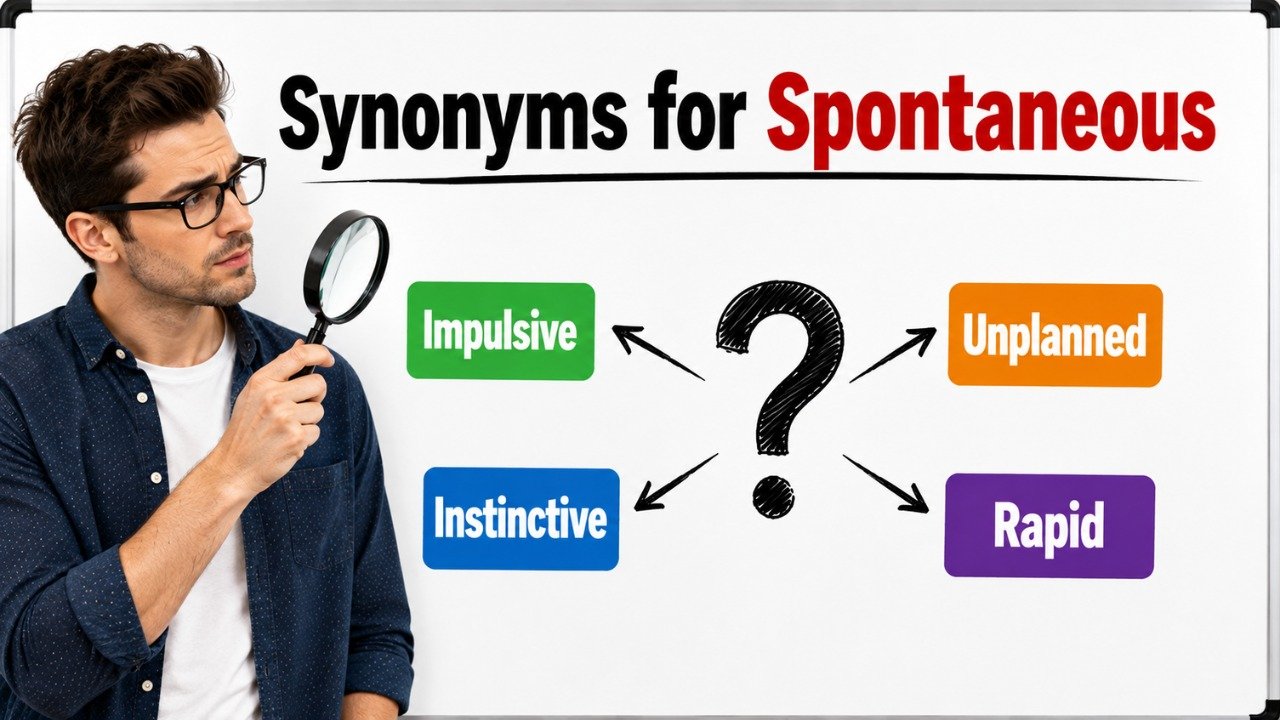
Quick Answer: The best synonyms for spontaneous include unplanned, impromptu, unscripted, instinctive, natural, impulsive, unexpected, unprompted, voluntary, and extemporaneous. Use unplanned for actions arranged without preparation, impromptu for speeches or performances created at the moment, and unscripted for genuine conversations or reactions. Instinctive suits behavior guided by feeling, while natural describes relaxed and genuine behavior. Impulsive suggests limited thought, unexpected emphasizes surprise, and unprompted describes something done without being requested.
Pronunciation and Word Details
Word: Spontaneous.
Pronunciation: /spɒnˈteɪniəs/
Part of Speech: Adjective.
Meaning: Happening naturally, suddenly, or without prior planning, preparation, or outside encouragement.
US Pronunciation:
UK Pronunciation:
What Does “Spontaneous” Mean?
Spontaneous means happening naturally or suddenly without being planned, prepared, forced, or requested in advance.
It is an adjective that can describe actions, decisions, reactions, events, conversations, performances, and natural processes. The exact meaning depends on what the word modifies.
A spontaneous decision is made at the moment rather than planned earlier. A spontaneous reaction happens immediately and naturally. A spontaneous person often enjoys acting freely without following a strict schedule.
The word can also describe something that arises without outside pressure.
Example: The audience gave the speaker spontaneous applause.
In this sentence, the applause began naturally because the audience felt impressed. Nobody instructed the audience to clap.
Spontaneous does not always mean careless. A spontaneous action may be sensible, kind, creative, or enjoyable even though it was not planned.
Example: They took a spontaneous walk after dinner.
The walk was unplanned, but it was not necessarily irresponsible.
In scientific and technical contexts, spontaneous may describe a process that occurs naturally under particular conditions without continuous external assistance.
Example: The reaction can occur spontaneously under the right conditions.
Meaning, Tone, and Context of “Spontaneous”
Spontaneous usually has a positive, lively, and natural tone. It often suggests freedom, authenticity, creativity, excitement, or emotional sincerity.
In everyday conversation, the word commonly describes trips, decisions, invitations, celebrations, gestures, and changes of plan.
Example: We made a spontaneous decision to visit the coast.
In professional or formal writing, spontaneous may describe an unplanned response, an immediate reaction, or a naturally developing event.
Example: The announcement produced a spontaneous expression of support.
In creative contexts, spontaneous can describe speech, art, music, movement, or performance created without a detailed script or rehearsal.
Example: Her spontaneous performance delighted the audience.
In descriptions of personality, spontaneous often refers to someone who is flexible, adventurous, and willing to act without extensive preparation.
Example: His spontaneous nature makes every journey interesting.
However, the tone can become negative when spontaneity leads to poor judgment. In such cases, impulsive, rash, or unpremeditated may communicate the meaning more accurately.
Example: His impulsive purchase created financial problems.
Spontaneous is generally neutral or positive. Impulsive often carries a more critical tone because it suggests acting without considering the consequences.
The word is suitable for casual speech, professional communication, essays, reports, descriptions, narratives, and academic explanations. Its level of formality depends mainly on the surrounding sentence.
When and How to Use “Spontaneous”
For Unplanned Decisions
Use spontaneous when a decision is made naturally at the moment rather than arranged earlier.
Example: We made a spontaneous decision to have dinner outside.
The word adds a sense of freedom and enjoyment. Unplanned is more neutral, while impulsive may suggest poor judgment.
For Unexpected Activities
Use spontaneous for trips, meetings, celebrations, or activities that occur without advance scheduling.
Example: Their spontaneous picnic became the highlight of the weekend.
Impromptu is another strong choice for an activity organized with little or no preparation.
For Natural Reactions
Spontaneous can describe an immediate emotional or physical response.
Example: Her spontaneous laughter made everyone relax.
Natural, instinctive, and automatic may also work, depending on the type of reaction.
For Genuine Behavior
Use spontaneous when someone behaves freely rather than following a script or carefully controlling every response.
Example: The interview felt warm and spontaneous.
Unscripted emphasizes the absence of prepared wording, while natural emphasizes comfort and authenticity.
For Speeches and Performances
Spontaneous can describe a speech, performance, answer, or creative act produced without rehearsal.
Example: He gave a spontaneous speech at the celebration.
Impromptu and extemporaneous are more precise choices for speaking without a prepared script.
For Kind Gestures
Use spontaneous when someone shows affection, appreciation, or generosity without being asked.
Example: Her spontaneous offer of assistance was deeply appreciated.
Unprompted and voluntary emphasize that the action was not requested or demanded.
For Sudden Events
Spontaneous may describe something that begins unexpectedly and without an obvious plan.
Example: A spontaneous celebration started in the town square.
Sudden emphasizes speed, while unexpected emphasizes surprise.
For Scientific Processes
In scientific writing, spontaneous can describe a process that can occur naturally under suitable conditions.
Example: The change was spontaneous under the conditions of the experiment.
Self generated or naturally occurring may sometimes provide a clearer explanation for general readers.
For Describing Personality
Use spontaneous to describe a person who enjoys flexibility and making decisions without excessive planning.
Example: She is spontaneous and always open to new experiences.
Be careful not to treat spontaneous as an exact synonym for irresponsible. A spontaneous person can still make thoughtful decisions.
Best Synonyms for Spontaneous
Unplanned: Not arranged or decided in advance.
Example: Their unplanned visit turned into a wonderful evening.
Impromptu: Created, arranged, or performed without preparation.
Example: The manager gave an impromptu speech after the ceremony.
Unscripted: Not written or prepared beforehand.
Example: Their unscripted conversation felt honest and engaging.
Instinctive: Guided by a natural feeling rather than careful thought.
Example: Her instinctive response was to protect the child.
Natural: Genuine, relaxed, or arising without force.
Example: His natural reaction was to smile.
Impulsive: Done suddenly without fully considering the consequences.
Example: She made an impulsive decision to buy the expensive coat.
Unexpected: Not anticipated or predicted.
Example: An unexpected celebration began after the announcement.
Unprompted: Done without being requested, encouraged, or reminded.
Example: He offered an unprompted apology.
Voluntary: Done freely by personal choice rather than obligation.
Example: The workers made a voluntary contribution to the fund.
Extemporaneous: Spoken or performed with little preparation while still following a general idea.
Example: She delivered an extemporaneous response to the difficult question.
50 Synonyms for Spontaneous with Short Meanings
- Unplanned: Not arranged or decided beforehand.
- Impromptu: Done or performed without preparation.
- Unscripted: Not based on prepared words or actions.
- Unrehearsed: Not practiced before being performed.
- Extemporaneous: Spoken or created with little preparation.
- Improvised: Created using available ideas or materials at the moment.
- Offhand: Made casually without prior thought or preparation.
- Ad lib: Spoken or performed freely without a fixed script.
- Spur of the moment: Decided suddenly at the time of action.
- Instinctive: Guided by natural feeling or instinct.
- Intuitive: Understood or performed through immediate inner awareness.
- Natural: Genuine and not forced or artificial.
- Genuine: Sincere, real, and honestly expressed.
- Unaffected: Natural and free from artificial behavior.
- Unforced: Happening easily without pressure or effort.
- Uninhibited: Free from nervousness or excessive restraint.
- Impulsive: Done suddenly without enough consideration.
- Impetuous: Acting quickly with strong energy and little thought.
- Sudden: Happening quickly and without warning.
- Unexpected: Not anticipated in advance.
- Unforeseen: Not predicted or expected.
- Unanticipated: Not considered likely before it happened.
- Abrupt: Beginning suddenly or unexpectedly.
- Immediate: Happening without delay.
- Automatic: Occurring with little or no conscious thought.
- Reflexive: Produced as an immediate natural response.
- Involuntary: Happening without conscious control.
- Voluntary: Done freely without being required.
- Unprompted: Done without a request or reminder.
- Unsolicited: Offered without being asked for.
- Self initiated: Started through a person’s own choice.
- Self generated: Produced from within rather than externally caused.
- Self directed: Guided by personal choice and initiative.
- Free: Unrestricted by a fixed plan or demand.
- Free flowing: Developing naturally without rigid control.
- Casual: Relaxed and not formally arranged.
- Informal: Relaxed and free from strict formality.
- Random: Occurring without an obvious pattern or plan.
- Accidental: Happening unintentionally rather than by design.
- Chance: Occurring without deliberate arrangement.
- Unpredictable: Difficult to anticipate or plan for.
- Unscheduled: Not included in an existing plan or timetable.
- Unpremeditated: Not considered or planned beforehand.
- Uncalculated: Done without careful planning or strategic thought.
- Uncontrived: Natural and not deliberately manufactured.
- Candid: Honest and naturally expressed.
- Heartfelt: Sincere and arising from genuine emotion.
- Enthusiastic: Showing natural and energetic interest.
- Lively: Full of natural energy and animation.
- Organic: Developing naturally rather than through rigid planning.
Read Also:
Synonyms for Retard
Synonyms for Spontaneous by Context
When Spontaneous Means Unplanned
Use unplanned, unscheduled, spur of the moment, impromptu, unforeseen, or unanticipated when something was not arranged beforehand.
Example: Their unplanned road trip became an unforgettable experience.
Unplanned is the clearest neutral choice. Spur of the moment sounds more conversational and emphasizes a sudden decision.
Example: We booked the trip on the spur of the moment.
Impromptu often describes events, speeches, performances, and gatherings arranged with little preparation.
Example: The team held an impromptu celebration after completing the project.
When Spontaneous Means Natural
Use natural, genuine, unaffected, unforced, candid, uncontrived, or organic when behavior feels sincere rather than artificial.
Example: Her natural smile made the photograph more memorable.
Genuine highlights sincerity. Unaffected describes behavior that is simple and free from pretension.
Example: His unaffected manner helped the guests feel comfortable.
Uncontrived is useful when a conversation, performance, or scene feels natural rather than carefully manufactured.
Example: The dialogue felt warm and uncontrived.
When Spontaneous Means Instinctive
Use instinctive, intuitive, automatic, reflexive, or immediate when an action occurs through natural feeling rather than deliberate reasoning.
Example: His instinctive reaction was to step back from danger.
Automatic may describe a familiar response that happens with little conscious thought.
Example: Her automatic response was to check whether everyone was safe.
Reflexive is especially suitable for immediate physical or habitual reactions.
Example: He made a reflexive movement to catch the falling cup.
When Spontaneous Means Impulsive
Use impulsive, impetuous, sudden, unpremeditated, or uncalculated when someone acts quickly without extensive thought.
Example: She made an impulsive purchase that exceeded her budget.
Impulsive often has a negative tone. Spontaneous is usually warmer and more positive.
Example: Their spontaneous dinner was enjoyable.
Example: His impulsive spending caused financial stress.
Impetuous is stronger and suggests energetic but poorly considered action.
Example: The impetuous decision created several avoidable problems.
When Spontaneous Means Unprompted
Use unprompted, voluntary, unsolicited, self initiated, or self directed when an action begins without a request or command.
Example: The student offered an unprompted explanation.
Voluntary emphasizes freedom of choice.
Example: Participation in the additional workshop was voluntary.
Unsolicited is often used for advice, comments, offers, and submissions that were not requested.
Example: She received unsolicited advice from several guests.
When Spontaneous Means Unrehearsed
Use unrehearsed, unscripted, improvised, impromptu, extemporaneous, or ad lib for speeches, performances, conversations, and creative work.
Example: His unrehearsed remarks were sincere and memorable.
Unscripted means the exact words were not prepared. Extemporaneous means a speaker talks without reading a complete script, sometimes using general notes or prior knowledge.
Example: The speaker delivered an extemporaneous answer.
Improvised emphasizes creating or adapting something at the moment.
Example: The actors improvised a humorous ending.
When Spontaneous Means Unexpected
Use unexpected, unforeseen, unanticipated, sudden, abrupt, chance, or unpredictable when surprise is the central meaning.
Example: An unexpected burst of applause interrupted the speech.
Sudden focuses on speed. Unexpected focuses on the lack of anticipation.
Example: A sudden noise startled the audience.
Example: The unexpected announcement changed the mood of the meeting.
When Spontaneous Means Naturally Developing
Use organic, free flowing, self generated, natural, or unforced when something develops without rigid control.
Example: The discussion developed in an organic way.
Free flowing works well for conversations, ideas, movement, and creative processes.
Example: The workshop encouraged free flowing conversation.
Another Word for Spontaneous
The best general replacement for spontaneous is unplanned. It clearly communicates that something was not arranged or prepared in advance.
However, the most accurate alternative depends on the context. Impromptu suits an event or speech, natural suits genuine behavior, instinctive describes an immediate reaction, and unprompted describes an action completed without being requested.
Original: We took a spontaneous trip to the countryside.
Better Option: We took an unplanned trip to the countryside.
Original: She gave a spontaneous speech at the dinner.
Better Option: She gave an impromptu speech at the dinner.
Original: His spontaneous reaction was to help.
Better Option: His instinctive reaction was to help.
Original: The child offered a spontaneous apology.
Better Option: The child offered an unprompted apology.
When Not to Use “Spontaneous”
Do not use spontaneous when a more precise word would explain the action better.
If an event was simply not on the schedule, unscheduled may be clearer.
Weak: The director attended a spontaneous meeting listed nowhere on the calendar.
Better: The director attended an unscheduled meeting.
Avoid spontaneous when you intend to criticize someone for acting without considering the consequences. Impulsive or reckless may better express the negative meaning.
Weak: He made a spontaneous investment without reviewing the risks.
Better: He made an impulsive investment without reviewing the risks.
Do not use spontaneous for every unexpected event. Unexpected or unforeseen may be more accurate when no person made a free choice.
Weak: The building experienced a spontaneous power failure.
Better: The building experienced an unexpected power failure.
Avoid using spontaneous when the action was automatic or physically uncontrollable.
Weak: She made a spontaneous movement when the doctor tested her reflexes.
Better: She made an involuntary movement when the doctor tested her reflexes.
Do not describe a prepared performance as spontaneous merely because it appears relaxed.
Weak: The carefully rehearsed presentation was entirely spontaneous.
Better: The carefully rehearsed presentation appeared natural and relaxed.
Repeated use can also weaken a paragraph.
Weak: They planned a spontaneous dinner, took a spontaneous walk, and had a spontaneous conversation.
Better: They arranged an impromptu dinner, took an unplanned walk, and enjoyed a natural conversation.
Words Commonly Confused With Spontaneous
Spontaneous vs Impulsive: Spontaneous usually describes a free and unplanned action without necessarily implying poor judgment. Impulsive suggests acting quickly without adequately considering the consequences.
Spontaneous vs Random: Spontaneous describes something that happens naturally or without planning. Random describes something without a clear pattern, method, or deliberate selection.
Spontaneous vs Unexpected: Spontaneous emphasizes the absence of planning or external prompting. Unexpected emphasizes that someone did not anticipate the event.
Spontaneous vs Instinctive: Spontaneous can describe any natural or unplanned action. Instinctive specifically describes behavior guided by instinct rather than conscious reasoning.
Spontaneous vs Automatic: Spontaneous may involve a conscious choice made at the moment. Automatic describes something happening with little conscious control or through habit.
Spontaneous vs Involuntary: Spontaneous can be voluntary and freely chosen. Involuntary means the person cannot consciously control the action.
Spontaneous vs Impromptu: Spontaneous has a broad meaning and can describe actions, reactions, or events. Impromptu usually describes a speech, performance, meeting, or activity created without preparation.
Spontaneous vs Unplanned: Unplanned simply means not arranged in advance. Spontaneous often adds a sense of natural energy, freedom, or immediate emotion.
Spontaneous vs Voluntary: Spontaneous means unplanned or naturally arising. Voluntary means chosen freely rather than required.
Spontaneous vs Unscripted: Spontaneous describes natural action generally. Unscripted specifically means that exact words or actions were not written in advance.
Which Synonym Should You Choose?
Choose unplanned when you need a clear and neutral word for an activity, decision, or event that was not arranged in advance.
Choose impromptu for speeches, celebrations, meetings, performances, and gatherings created with little preparation.
Choose unscripted for conversations, interviews, reactions, or performances that do not follow prepared wording.
Choose unrehearsed when a speech or performance was not practiced beforehand.
Choose instinctive for reactions guided by natural feeling, experience, or self protection.
Choose natural when describing relaxed, genuine, and comfortable behavior.
Choose impulsive when the action was completed quickly without enough consideration of the consequences.
Choose unexpected when the main idea is surprise rather than lack of planning.
Choose unforeseen in formal reports, essays, and professional writing about events that could not be predicted.
Choose unprompted when someone speaks, apologizes, helps, or responds without being requested.
Choose voluntary when an action is freely chosen rather than required.
Choose extemporaneous in formal or academic writing about a speech delivered without a complete prepared script.
Choose improvised when someone creates, adapts, or performs something using ideas and resources available at the moment.
Choose organic when a conversation, relationship, strategy, or creative process develops naturally.
Choose casual when an event is relaxed and arranged without much formality.
For professional emails, unplanned, unexpected, unscheduled, and unanticipated are usually clearer than spontaneous.
For essays, choose a synonym that identifies the exact idea. Use instinctive for natural reactions, impromptu for performances, and unprompted for voluntary responses.
For casual conversation, spontaneous, spur of the moment, natural, and unexpected usually sound comfortable and clear.
Real Life Examples of “Spontaneous” in Sentences
Original: We made a spontaneous decision to drive to the lake.
Better Option: We made a spur of the moment decision to drive to the lake.
Original: She gave a spontaneous speech after receiving the award.
Better Option: She gave an impromptu speech after receiving the award.
Original: His spontaneous reaction was to catch the falling box.
Better Option: His instinctive reaction was to catch the falling box.
Original: The children began a spontaneous game in the garden.
Better Option: The children began an unplanned game in the garden.
Original: Her spontaneous smile made the photograph feel genuine.
Better Option: Her natural smile made the photograph feel genuine.
Original: The audience responded with spontaneous applause.
Better Option: The audience responded with unprompted applause.
Original: They enjoyed a spontaneous conversation during the journey.
Better Option: They enjoyed an unscripted conversation during the journey.
Original: He made a spontaneous purchase at the market.
Better Option: He made an impulsive purchase at the market.
Original: A spontaneous celebration followed the final announcement.
Better Option: An unexpected celebration followed the final announcement.
Original: The performers created a spontaneous ending for the scene.
Better Option: The performers improvised an ending for the scene.
Synonym Groups and Usage Differences
Planning Group
Unplanned, unscheduled, spur of the moment, impromptu, and unpremeditated describe actions or events that were not arranged beforehand.
Unplanned is neutral and broad. Impromptu often describes an event or performance, while unpremeditated is more formal and emphasizes the absence of previous intention.
Example: The group arranged an impromptu lunch after the meeting.
Natural Behavior Group
Natural, genuine, unaffected, unforced, candid, and uncontrived describe sincere behavior that does not appear artificial.
Natural is the broadest option. Candid highlights honest expression, while unaffected suggests simplicity and freedom from pretension.
Example: Her candid response encouraged a more honest discussion.
Immediate Reaction Group
Instinctive, intuitive, automatic, reflexive, immediate, and involuntary describe actions that happen with little deliberate thought.
Instinctive is useful for protective or emotional reactions. Reflexive often describes an immediate response, while involuntary means the action is outside conscious control.
Example: His instinctive response was to move away from the danger.
Sudden Event Group
Sudden, unexpected, unforeseen, unanticipated, abrupt, and unpredictable emphasize surprise or rapid occurrence.
Sudden focuses on how quickly something begins. Unexpected and unforeseen focus on the lack of anticipation.
Example: An unexpected change in the schedule delayed the event.
Creative Performance Group
Impromptu, unrehearsed, unscripted, improvised, extemporaneous, and ad lib describe creative work produced without complete preparation.
Impromptu is common for speeches and performances. Improvised emphasizes creating material at the moment, while unscripted means no exact wording was prepared.
Example: The actor delivered an improvised response that made the audience laugh.
Free Choice Group
Voluntary, unprompted, unsolicited, self initiated, and self directed describe actions that come from personal choice rather than outside instruction.
Voluntary emphasizes freedom from obligation. Unprompted means no reminder or request was needed.
Example: The employee made a voluntary contribution to the project.
Impulsive Action Group
Impulsive, impetuous, uncalculated, and unpremeditated describe actions taken without detailed consideration.
Impulsive is the most common choice and can be neutral or negative. Impetuous is stronger and often suggests excessive speed or emotion.
Example: His impetuous reply made the disagreement worse.
Natural Development Group
Organic, free flowing, self generated, natural, and unforced describe a process that develops without rigid control.
Organic is useful for discussions, relationships, strategies, and creative work. Free flowing emphasizes smooth movement or expression.
Example: The conversation developed in an organic and productive way.
Antonyms of Spontaneous
The antonyms of spontaneous change according to whether the word means unplanned, natural, voluntary, or immediate.
Planned: Arranged or decided in advance.
Prepared: Made ready before an event or action.
Scheduled: Officially assigned a particular date or time.
Rehearsed: Practiced before a performance or presentation.
Scripted: Written or carefully arranged beforehand.
Premeditated: Considered and planned before being carried out.
Deliberate: Done consciously and intentionally.
Calculated: Carefully planned to produce a particular result.
Forced: Produced through pressure rather than natural willingness.
Prompted: Caused by a reminder, request, or suggestion.
Solicited: Requested or invited in advance.
Controlled: Closely directed or restrained.
Artificial: Made to appear natural but lacking genuine expression.
Contrived: Deliberately created in a way that feels unnatural.
Predictable: Easy to anticipate because it follows an expected pattern.
Comparison: Spontaneous vs Related Words
Spontaneous vs Unplanned
Spontaneous suggests natural, free, or immediate action. Unplanned simply states that no preparation or arrangement occurred.
Example With Spontaneous: They took a spontaneous walk along the beach.
Example With Unplanned: An unplanned meeting delayed the afternoon schedule.
Spontaneous vs Impromptu
Spontaneous can describe many actions, feelings, and events. Impromptu usually describes something created or arranged without preparation.
Example With Spontaneous: Her spontaneous laughter filled the room.
Example With Impromptu: She gave an impromptu performance after dinner.
Spontaneous vs Impulsive
Spontaneous often has a positive or neutral meaning. Impulsive usually suggests acting without considering possible consequences.
Example With Spontaneous: We enjoyed a spontaneous picnic in the park.
Example With Impulsive: He made an impulsive purchase that he later regretted.
Spontaneous vs Instinctive
Spontaneous means unplanned or naturally occurring. Instinctive means guided by an immediate natural feeling rather than reasoning.
Example With Spontaneous: She made a spontaneous offer to help.
Example With Instinctive: Her instinctive response was to protect the injured animal.
Spontaneous vs Unexpected
Spontaneous emphasizes how something begins or arises. Unexpected emphasizes that the event was not anticipated.
Example With Spontaneous: The crowd began a spontaneous celebration.
Example With Unexpected: An unexpected visitor arrived during dinner.
Spontaneous vs Natural
Spontaneous focuses on the absence of planning or prompting. Natural focuses on genuineness, ease, and freedom from artificial behavior.
Example With Spontaneous: He made a spontaneous comment during the discussion.
Example With Natural: His natural speaking style made the presentation engaging.
Spontaneous vs Unprompted
Spontaneous can describe any naturally arising action. Unprompted specifically means no request, reminder, or encouragement caused the action.
Example With Spontaneous: She gave him a spontaneous hug.
Example With Unprompted: He offered an unprompted apology.
Spontaneous vs Involuntary
Spontaneous actions may be freely chosen. Involuntary actions happen without conscious control.
Example With Spontaneous: They made a spontaneous decision to stay longer.
Example With Involuntary: His hand made an involuntary movement.
Spontaneous vs Unscripted
Spontaneous is broader and can describe behavior, decisions, or events. Unscripted refers to words or actions that do not follow a prepared script.
Example With Spontaneous: The evening ended with a spontaneous dance.
Example With Unscripted: Their unscripted interview revealed genuine emotion.
Common Phrases and Expressions With Spontaneous
Spontaneous Decision: A choice made without advance planning.
Spontaneous Reaction: An immediate and natural response.
Spontaneous Gesture: An unplanned action that expresses emotion or kindness.
Spontaneous Conversation: A natural discussion that was not prepared or formally arranged.
Spontaneous Trip: A journey decided upon with little or no advance planning.
Spontaneous Applause: Clapping that begins naturally without instruction.
Spontaneous Celebration: An unplanned gathering or expression of happiness.
Spontaneous Performance: A creative act presented without full preparation or rehearsal.
Spontaneous Recovery: Improvement that occurs naturally without a clearly identified intervention.
Spontaneous Combustion: Burning that begins without direct contact with an external flame.
Common Mistakes to Avoid
A common mistake is treating spontaneous and impulsive as exact synonyms. Spontaneous can describe an enjoyable or harmless unplanned action. Impulsive often suggests insufficient thought and possible negative consequences.
Incorrect Choice: Their impulsive picnic was relaxing and carefully enjoyed.
Better Choice: Their spontaneous picnic was relaxing and enjoyable.
Another mistake is using random when unplanned is intended. Random means lacking a clear pattern or deliberate selection. It does not always mean spontaneous.
Unclear: We had a random dinner with our neighbors.
Clearer: We had an impromptu dinner with our neighbors.
Do not confuse spontaneous with involuntary. A spontaneous decision can be consciously chosen, while an involuntary movement happens without conscious control.
Avoid using spontaneous for events that were carefully prepared but merely appeared relaxed.
Unclear: She delivered a spontaneous speech that she had rehearsed for two weeks.
Clearer: She delivered a natural sounding speech that she had rehearsed for two weeks.
Repetition is another common problem. Using spontaneous several times in one paragraph makes the writing sound limited.
Repetitive: We planned a spontaneous visit, enjoyed a spontaneous lunch, and had a spontaneous discussion.
Improved: We made an unplanned visit, enjoyed an impromptu lunch, and had a natural discussion.
Writers should also avoid vague usage.
Vague: Something spontaneous happened during the event.
Specific: The audience began an unexpected round of applause during the event.
Choose a synonym according to the precise meaning. Use impromptu for performances, instinctive for natural reactions, unprompted for actions completed without a request, and unexpected for surprising events.
Conclusion
The best synonyms for spontaneous depend on the intended meaning. Use unplanned for activities without preparation, impromptu for speeches or events, and unscripted for natural conversations. Instinctive describes an immediate reaction, while unprompted suits an action completed without being requested. Impulsive is better when limited thought creates risk, and unexpected emphasizes surprise. Understanding these differences helps you choose accurate synonyms for spontaneous in conversation, essays, reports, descriptions, and professional writing.
FAQs About Synonyms for Spontaneous
What Is the Best Synonym for Spontaneous?
Unplanned is the best general synonym. Impromptu, instinctive, natural, and unprompted may be more accurate in specific contexts.
Is Impulsive the Same as Spontaneous?
No. Spontaneous is often positive or neutral, while impulsive can suggest acting without considering the consequences.
What Is a Formal Synonym for Spontaneous?
Extemporaneous, unpremeditated, unanticipated, and self initiated are useful formal alternatives, depending on the sentence.
What Is a Synonym for a Spontaneous Speech?
Impromptu and extemporaneous are the strongest choices for a speech delivered without a complete prepared script.
What Is a Positive Synonym for Spontaneous?
Natural, genuine, free flowing, lively, and unforced are positive alternatives that emphasize authenticity and energy.
What Is a Synonym for a Spontaneous Reaction?
Instinctive, automatic, immediate, reflexive, and natural can describe a reaction that occurs without deliberate thought.
Can Unplanned Replace Spontaneous?
Yes. Unplanned works well when the main meaning is that an activity or event was not arranged in advance.
