
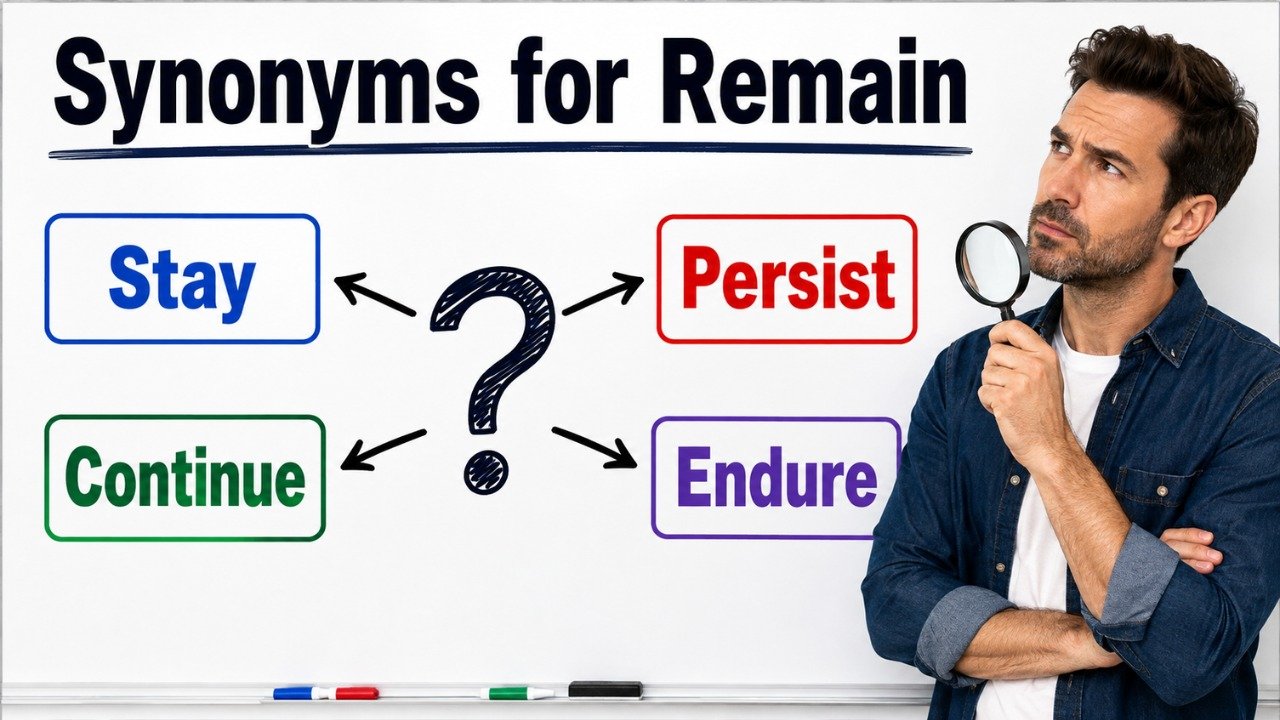
Quick Answer: The best synonyms for remain include stay, continue, persist, endure, last, survive, linger, reside, wait, and exist. Use stay when someone or something does not leave a place. Choose continue when an action or condition does not stop. Persist suits problems, beliefs, or conditions that continue despite resistance. Endure and last describe something existing over time, while survive means continuing after danger or difficulty. Linger suggests staying longer than expected, and reside is a formal choice for living in a place.
Pronunciation and Word Details
Word: Remain.
Pronunciation: /rɪˈmeɪn/
Part of Speech: Verb.
Meaning: To stay in the same place or condition, continue to exist, or be left after other things have gone.
US Pronunciation:
UK Pronunciation:
What Does “Remain” Mean?
Remain means to stay in a place, continue in a particular condition, keep existing, or be left after other people or things have gone.
Remain is mainly used as an intransitive verb. This means it normally does not take a direct object. It is often followed by an adjective, noun phrase, or phrase describing a place or condition.
When followed by an adjective, remain means to continue in a particular state.
Example: Please remain calm during the inspection.
When followed by a place phrase, remain means to stay somewhere rather than leave.
Example: Two employees remained in the office after the meeting.
Remain can also mean to continue to exist over time.
Example: Several ancient traditions remain today.
Another common meaning is to be left after the rest has been used, removed, completed, or destroyed.
Example: Only three tickets remain.
Remain may also refer to unfinished work, unanswered questions, or unresolved problems.
Example: Several important issues remain.
The word changes slightly in meaning according to its subject and sentence context. A person can remain in a room, a problem can remain unresolved, a tradition can remain popular, and a small amount of food can remain after dinner.
Meaning, Tone, and Context of “Remain”
Remain has a neutral to formal tone. It is common in everyday speech, but it appears especially often in reports, essays, instructions, announcements, professional emails, academic writing, and formal conversation.
In casual speech, stay is often more natural when referring to a person or place.
Formal: All visitors must remain inside the waiting area.
Casual: All visitors must stay inside the waiting area.
Remain sounds natural when describing a continuing state, especially with adjectives such as calm, silent, open, stable, unchanged, uncertain, strong, or committed.
Example: The building will remain open until six.
The word is also useful in analytical writing because it expresses continuity without sounding emotional.
Example: The results remain uncertain despite further testing.
Remain can sound serious when it refers to unresolved problems, continuing danger, or limited resources.
Example: Food supplies remain critically low.
In technical, academic, and professional contexts, remain often indicates that a condition has not changed after an event, process, or examination.
Example: The temperature remained constant throughout the experiment.
Remain is usually more formal than stay, less forceful than persist, and more neutral than survive. Choosing the correct alternative depends on whether the sentence emphasizes place, condition, time, resistance, survival, or what is left.
When and How to Use “Remain”
For Staying in a Place: Use remain when a person or thing does not leave a particular location.
Example: Please remain in your seat until the doors open.
For Continuing in a Condition: Use remain before an adjective when a state does not change.
Example: The patient remained stable throughout the night.
For Continuing to Exist: Use remain when something is still present after a long period.
Example: Several original features remain inside the building.
For What Is Left: Use remain when part of an amount, group, or supply is still available.
Example: Only a few copies remain.
For Unfinished Work: Use remain when tasks, questions, or problems have not yet been completed or resolved.
Example: Three sections of the report remain unfinished.
For Continuing Importance: Use remain when a person, subject, or idea keeps its value or relevance.
Example: Clear communication remains essential in every workplace.
For Continuing Uncertainty: Use remain with adjectives such as unclear, unknown, uncertain, or doubtful.
Example: The cause of the failure remains unknown.
For Maintaining a Position: Use remain when someone continues to hold a role, opinion, or status.
Example: She will remain chair of the committee.
For Formal Instructions: Use remain when giving official directions or safety information.
Example: Passengers should remain behind the marked line.
For Lasting Effects: Use remain when a feeling, memory, influence, or result continues over time.
Example: The experience remained fresh in his memory.
Best Synonyms for Remain
Stay: To continue in the same place or condition.
Example: Please stay near the entrance until your name is called.
Continue: To keep happening, existing, or being in a particular state.
Example: The discussion will continue after lunch.
Persist: To continue despite difficulty, resistance, or attempts to stop something.
Example: The symptoms may persist for several days.
Endure: To continue to exist through hardship, pressure, or a long period.
Example: Their friendship endured through many challenges.
Last: To continue for a particular length of time.
Example: The meeting should last about an hour.
Survive: To continue to live or exist after danger, damage, or difficulty.
Example: Only a few records survived the fire.
Linger: To stay longer than expected or continue after the main event has ended.
Example: The smell of smoke lingered in the hallway.
Reside: To live or be situated in a particular place.
Example: The family resides in a quiet coastal town.
Wait: To stay in a place until something happens or someone arrives.
Example: Please wait outside the office.
Exist: To be present, real, or still in existence.
Example: Similar customs still exist in several regions.
50 Synonyms for Remain with Short Meanings
- Stay: To continue in the same place or condition.
- Continue: To keep happening, existing, or being.
- Persist: To continue despite difficulty or opposition.
- Endure: To continue through hardship or pressure.
- Last: To continue for a period of time.
- Survive: To continue after danger, damage, or loss.
- Linger: To stay or continue longer than expected.
- Abide: To stay or continue in a place or state.
- Reside: To live in a particular place.
- Exist: To continue to be present or real.
- Wait: To stay until something happens.
- Stand: To continue in a position, state, or condition.
- Live On: To continue living or existing.
- Carry On: To continue an action or activity.
- Go On: To continue happening or existing.
- Keep Going: To continue without stopping.
- Hold On: To continue or maintain a position.
- Stay Put: To remain in the same place.
- Stick Around: To stay somewhere for a period.
- Hang Around: To remain nearby without leaving.
- Tarry: To stay longer than expected.
- Dwell: To live or remain in a place.
- Lodge: To stay temporarily in a place.
- Stay Behind: To not leave with other people.
- Be Left: To continue to exist after others are gone.
- Be Left Over: To remain after the rest has been used.
- Be Present: To continue to exist in a place or situation.
- Be Available: To remain ready for use or selection.
- Continue to Be: To keep the same identity or condition.
- Stay Unchanged: To continue without becoming different.
- Keep Unchanged: To maintain the same form or condition.
- Hold Steady: To continue at the same level or position.
- Stay Still: To continue without moving.
- Keep Still: To avoid movement and remain in position.
- Stay in Place: To continue occupying the same location.
- Continue As: To keep the same role, identity, or function.
- Keep Being: To continue in a particular state.
- Maintain the Same State: To continue without a change in condition.
- Retain Its Position: To continue occupying the same place or rank.
- Be Situated: To exist or remain in a particular location.
- Be Located: To remain positioned in a particular place.
- Occupy: To continue using or filling a place.
- Rest: To remain supported or positioned somewhere.
- Subsist: To continue living or existing.
- Prevail: To continue to exist or remain influential.
- Outlast: To remain after something else has ended.
- Stand Firm: To remain in the same position or belief.
- Be Outstanding: To remain unfinished, unpaid, or unresolved.
- Be Pending: To remain undecided or incomplete.
- Be Unresolved: To remain without a final solution.
Read Also:
Synonyms for Selection

Synonyms for Remain by Context
When Remain Means Stay in a Place
Use stay, wait, abide, linger, reside, dwell, stay put, or stick around when someone or something does not leave a location.
Stay is the most common and natural choice in everyday conversation.
Remain: Please remain in the waiting room.
Stay: Please stay in the waiting room.
Wait is best when someone stays because a future event is expected.
Example: Wait here until the manager arrives.
Linger suggests staying longer than expected, sometimes because a person is unwilling to leave.
Example: Several guests lingered after the celebration.
Reside and dwell refer mainly to living in a place. Reside is more formal, while dwell may sound literary or traditional.
Example: The applicant currently resides in the capital.
Stay put and stick around are conversational choices.
Example: Stay put while I get the first aid kit.
Example: Stick around after the meeting if you have questions.
When Remain Means Continue in a Condition
Use stay, continue, keep, hold steady, stay unchanged, or continue to be when a person or thing maintains the same state.
Stay is natural with common adjectives such as calm, quiet, healthy, warm, and positive.
Example: Try to stay calm while we solve the problem.
Continue is useful when the state or activity extends over time.
Example: Demand continues to be strong.
Hold steady is suitable for prices, measurements, rates, and levels.
Example: Fuel prices held steady during the month.
Stay unchanged emphasizes the absence of any difference.
Example: The basic design stayed unchanged for many years.
Continue to be is useful in formal writing, although it can sound wordier than remain.
Example: Reliable evidence continues to be limited.
When Remain Means Continue to Exist
Use exist, persist, endure, last, survive, live on, prevail, or subsist when something continues over time.
Exist is a neutral choice for facts, customs, objects, problems, or conditions that are still present.
Example: Several unanswered questions still exist.
Persist often describes problems, symptoms, beliefs, or conditions that continue despite efforts to remove them.
Example: The technical problem persisted after the update.
Endure suggests strength or the ability to continue through time and difficulty.
Example: The values taught by her parents endured throughout her life.
Last focuses on duration.
Example: The effects may last for several hours.
Survive emphasizes continuing after danger, destruction, competition, or hardship.
Example: Very few documents survived the flood.
Live on is often used for memories, traditions, ideas, and influence.
Example: His generosity lives on through the community project.
When Remain Means Be Left
Use be left, be left over, survive, be available, or be present when part of an amount or group has not been removed or used.
Be left is the clearest everyday alternative.
Example: Only two seats are left.
Be left over is especially common for food, materials, money, and unused supplies.
Example: Some paint was left over after the repairs.
Be available works well when something can still be purchased, selected, or used.
Example: A few appointments are still available.
Survive may be used when something remains after damage, destruction, or historical change.
Example: Three sections of the original wall survived.
When Remain Means Stay Unresolved
Use be pending, be outstanding, be unresolved, continue, or persist for decisions, payments, questions, disputes, and unfinished tasks.
Pending is appropriate for decisions, applications, cases, and requests awaiting action.
Example: The application is still pending.
Outstanding often describes unpaid money, unfinished work, or unresolved matters.
Example: Two outstanding payments must be settled.
Unresolved directly states that no solution has been reached.
Example: The main disagreement remains unresolved.
Persist is useful when a difficulty continues despite attempts to solve it.
Example: Several concerns persisted after the meeting.
When Remain Means Keep a Role or Position
Use continue as, stay on, hold the position, stand, or retain the position when someone keeps a title, duty, belief, or rank.
Continue as is a direct replacement in professional writing.
Example: She will continue as department head.
Stay on is more conversational and often refers to employment or participation.
Example: He agreed to stay on for another month.
Stand is suitable for decisions, records, rules, and statements that continue to be accepted.
Example: The original decision still stands.
Retain the position emphasizes keeping a rank, role, or place.
Example: The team retained its position at the top of the table.
Another Word for Remain
The best single replacement for remain is usually stay. Both words can mean continuing in the same place or condition. However, stay is more conversational, while remain often sounds more formal.
The best alternative depends on context. Use continue for an action or state, persist for a continuing problem, last for duration, survive after danger, and be left when describing an unused amount.
Original: Please remain near the entrance.
Better Option: Please stay near the entrance.
Original: The symptoms may remain for several days.
Better Option: The symptoms may persist for several days.
Original: Only four tickets remain.
Better Option: Only four tickets are left.
Original: The tradition has remained for centuries.
Better Option: The tradition has endured for centuries.
When Not to Use “Remain”
Do not use remain when a more precise verb would explain the situation more clearly. Remain has several meanings, so it may sound vague without enough context.
Use stay for simple, casual instructions involving place.
Weak: Remain here while I answer the door.
Better: Stay here while I answer the door.
Use last when duration is the main idea.
Weak: The pain may remain for two hours.
Better: The pain may last for two hours.
Use persist when an unwanted condition continues despite efforts to stop it.
Weak: The error remained after several repairs.
Better: The error persisted after several repairs.
Use survive when something continues after danger or destruction.
Weak: Only one original window remained after the fire.
Better: Only one original window survived the fire.
Use be left when describing a remaining quantity in everyday conversation.
Weak: Three slices of bread remain.
Better: Three slices of bread are left.
Avoid using remain as a transitive verb. It does not normally take a direct object.
Weak: She remained the documents in the folder.
Better: She kept the documents in the folder.
Do not use remain when retain is required. Retain means to keep possession, control, or a feature.
Weak: The material remains heat after sunset.
Better: The material retains heat after sunset.
Avoid unnecessary repetition with still when the sentence already clearly expresses continuation.
Weak: Several problems still remain unresolved.
Better: Several problems remain unresolved.
Using still remain is not always grammatically wrong, but it can be wordy. Keep still when you need extra emphasis or contrast.
Words Commonly Confused With Remain
Remain vs Stay: Both can mean not leaving a place or continuing in a condition. Stay is more conversational, while remain is often more formal.
Remain vs Continue: Remain usually describes staying in a place or state. Continue more often describes an action, process, or event that keeps happening.
Remain vs Persist: Remain is neutral and broad. Persist often suggests that something continues despite difficulty, resistance, or efforts to stop it.
Remain vs Retain: Remain means to stay or continue to exist. Retain means to keep possession, control, memory, or a particular quality.
Remain vs Reside: Remain means to stay temporarily or continue in a state. Reside specifically means to live in a place.
Remain vs Wait: Remain means not leaving. Wait means staying because someone or something is expected.
Remain vs Last: Remain emphasizes continued presence or condition. Last emphasizes the length of time something continues.
Remain vs Survive: Remain can describe anything still present. Survive emphasizes continuing after danger, damage, hardship, or destruction.
Remain vs Remainder: Remain is normally a verb. Remainder is a noun referring to what is left after other parts have been removed.
Remain vs Remaining: Remain is a verb. Remaining can be an adjective describing what is still left.
Which Synonym Should You Choose?
Choose stay for everyday conversation about a person or thing not leaving a place.
Choose continue in reports, essays, and professional writing when an action, process, trend, or condition does not stop.
Choose persist when describing symptoms, problems, beliefs, rumors, errors, or difficulties that continue despite resistance.
Choose endure when emphasizing strength, permanence, or survival through hardship.
Choose last when the sentence focuses on duration, time, or how long something continues.
Choose survive when something continues to exist after danger, damage, destruction, or intense competition.
Choose linger when a person, smell, feeling, memory, or effect stays longer than expected.
Choose reside in formal documents when stating where a person lives.
Choose wait when a person stays because an event, decision, or arrival is expected.
Choose exist when discussing something that is still present, real, or known.
Choose be left for casual speech about quantities, supplies, time, money, or opportunities.
Choose be pending in formal emails and reports for decisions, requests, cases, and applications awaiting action.
Choose be outstanding for unpaid bills, unfinished tasks, and unresolved matters.
Choose hold steady for data, prices, rates, temperatures, and measurements that do not change.
Choose stand firm when discussing a person who does not change a belief, decision, or position.
Choose live on when describing a memory, tradition, reputation, lesson, or influence that continues after someone or something has gone.
Real Life Examples of “Remain” in Sentences
Original: Please remain seated until the vehicle stops.
Better Option: Please stay seated until the vehicle stops.
Original: Several questions remain after the investigation.
Better Option: Several questions are still unresolved after the investigation.
Original: The weather remained warm throughout the afternoon.
Better Option: The weather stayed warm throughout the afternoon.
Original: Only a small amount of water remains.
Better Option: Only a small amount of water is left.
Original: The problem remained despite repeated repairs.
Better Option: The problem persisted despite repeated repairs.
Original: Their friendship remained through years of separation.
Better Option: Their friendship endured through years of separation.
Original: The effects may remain for several hours.
Better Option: The effects may last for several hours.
Original: A few sections of the old building remain.
Better Option: A few sections of the old building survive.
Original: The pleasant smell remained in the kitchen.
Better Option: The pleasant smell lingered in the kitchen.
Original: She will remain director until a replacement is appointed.
Better Option: She will continue as director until a replacement is appointed.
Synonym Groups and Usage Differences
Place and Position Group
Stay, wait, abide, reside, dwell, stay put, stick around, and hang around describe remaining in a location.
Stay is the most flexible option. Wait adds the idea of expecting something. Reside and dwell usually refer to living somewhere. Stick around and hang around are informal.
Example: Please stay in the reception area until your appointment begins.
Continuation Group
Continue, carry on, go on, keep going, and continue to be describe something that does not stop.
Continue is suitable for both formal and everyday writing. Carry on and go on sound more conversational. Keep going often expresses effort or encouragement.
Example: The classes will continue during the renovation.
Persistence Group
Persist, endure, stand firm, hold on, and prevail describe continuation despite difficulty, opposition, or pressure.
Persist often describes problems or determined actions. Endure emphasizes strength over time. Stand firm relates to beliefs and decisions. Prevail can suggest continued influence or eventual success.
Example: The shortage persisted throughout the winter.
Duration Group
Last, endure, live on, and survive describe something continuing through time.
Last is the clearest choice when duration matters. Endure suggests lasting through difficulty. Live on is common for memories and traditions. Survive emphasizes continuing after danger.
Example: The protective coating should last several years.
What Is Left Group
Be left, be left over, be available, survive, and be present describe something that has not been used, removed, or destroyed.
Be left is the most natural everyday phrase. Be left over usually refers to unused quantities. Be available suggests that something can still be chosen or used.
Example: Only two rooms are available for the weekend.
Unchanged State Group
Stay, hold steady, stay unchanged, continue as, and maintain the same state describe a condition that does not change.
Stay works with common adjectives. Hold steady suits measurements and levels. Stay unchanged emphasizes complete consistency.
Example: The unemployment rate held steady during the quarter.
Unfinished Matters Group
Be pending, be outstanding, be unresolved, and persist describe matters that have not been completed or settled.
Pending is common for formal decisions and applications. Outstanding may refer to work or payments. Unresolved directly expresses the absence of a solution.
Example: Several payment requests are still pending.
Living and Existing Group
Exist, reside, dwell, subsist, live on, and survive refer to continuing life or presence.
Exist is broad and neutral. Reside and dwell focus on location. Subsist can describe continuing to live with limited resources. Survive suggests overcoming serious difficulty.
Example: Small communities continue to subsist on local agriculture.
Antonyms of Remain
The opposite of remain depends on whether the word means staying, continuing, existing, or being left.
Leave: To go away from a place.
Depart: To leave, especially in a formal context.
Go: To move away from a place.
Move: To change position or location.
Exit: To leave a room, building, or area.
Disappear: To stop being visible or present.
Vanish: To disappear suddenly or completely.
Cease: To stop happening or existing.
End: To reach a conclusion.
Stop: To no longer continue.
Change: To become different.
Expire: To end after a period of validity or life.
Perish: To die or be destroyed.
Collapse: To fail or fall apart completely.
Dissolve: To disappear, end, or break apart.
Finish: To complete something that was unfinished.
Resolve: To settle a problem, question, or disagreement.
Be Removed: To be taken away from a place.
Be Used: To no longer be available because it has been consumed.
Be Completed: To no longer remain unfinished.
Comparison: Remain vs Related Words
Remain vs Stay
Remain and stay can both mean continuing in the same place or condition. Remain is often more formal, while stay is more common in conversation.
Example With Remain: Visitors must remain outside the restricted area.
Example With Stay: Please stay outside while the floor dries.
Remain vs Continue
Remain usually describes a person or thing staying in a state, position, or place. Continue commonly describes an activity, process, or event that keeps happening.
Example With Remain: The office will remain closed until Monday.
Example With Continue: Repairs will continue until Monday.
Remain vs Persist
Remain simply means to continue to exist or stay unchanged. Persist suggests continuation despite difficulty, resistance, or attempts to stop something.
Example With Remain: A small stain remained on the fabric.
Example With Persist: The stain persisted after repeated washing.
Remain vs Last
Remain emphasizes presence or condition. Last focuses on duration.
Example With Remain: The road remained wet after the storm.
Example With Last: The storm lasted three hours.
Remain vs Survive
Remain means to continue to be present. Survive means to continue after serious danger, damage, hardship, or destruction.
Example With Remain: Several original paintings remain in the collection.
Example With Survive: Several original paintings survived the fire.
Remain vs Linger
Remain is a neutral word for staying or continuing. Linger suggests staying longer than expected or continuing faintly after something has ended.
Example With Remain: The guests remained in the garden.
Example With Linger: A few guests lingered in the garden after sunset.
Remain vs Reside
Remain means to stay temporarily or continue in a condition. Reside means to live permanently or for an extended period in a place.
Example With Remain: He remained at the hotel until morning.
Example With Reside: He resides in a nearby village.
Remain vs Retain
Remain is an intransitive verb describing continued presence or condition. Retain is a transitive verb meaning to keep something.
Example With Remain: The room remained warm.
Example With Retain: The walls retained heat throughout the night.
Remain vs Be Left
Remain is slightly more formal and works well in written communication. Be left is common in everyday speech when discussing an amount or number.
Example With Remain: Only five applications remain.
Example With Be Left: Only five applications are left.
Remain vs Exist
Remain suggests that something continues after time, change, or removal. Exist simply states that something is real or present.
Example With Remain: Few traces of the original design remain.
Example With Exist: No reliable records of the event exist.
Common Phrases and Expressions With Remain
Remain Calm: Continue to be peaceful and controlled.
Remain Silent: Continue without speaking.
Remain Seated: Stay in a sitting position.
Remain Open: Continue to operate or accept access.
Remain Closed: Continue to be unavailable or inaccessible.
Remain Unchanged: Continue without becoming different.
Remain in Place: Stay in the same location or position.
Remain Behind: Stay after other people have left.
Remain Committed: Continue to support a goal, belief, or responsibility.
Remain Uncertain: Continue to be unknown or undecided.
Remain Stable: Continue without significant change or difficulty.
Remain Anonymous: Continue without having one’s identity revealed.
Remain Available: Continue to be ready for use or selection.
Remain Relevant: Continue to have value or importance.
Remain to Be Seen: Continue to be unknown until future events provide an answer.
Common Mistakes to Avoid
A common mistake is using remain with a direct object. Remain is normally an intransitive verb.
Incorrect: She remained the old furniture in the house.
Correct: She kept the old furniture in the house.
Do not confuse remain with retain. Remain describes the subject’s continuing condition. Retain describes keeping something.
Incorrect: The bottle remains cold for several hours.
Correct: The bottle retains cold temperatures for several hours.
The incorrect sentence may be grammatical if the bottle itself stays cold, but retain is required when the subject keeps a property, substance, or object.
Avoid placing an adverb where an adjective is required after remain. As a linking verb, remain normally connects the subject to an adjective.
Incorrect: The audience remained quietly.
Correct: The audience remained quiet.
Use quietly when describing an action.
Correct: The audience waited quietly.
Check subject and verb agreement.
Incorrect: One question remain unanswered.
Correct: One question remains unanswered.
Incorrect: Several questions remains unanswered.
Correct: Several questions remain unanswered.
Use remained for the past tense.
Incorrect: The store remain closed yesterday.
Correct: The store remained closed yesterday.
Avoid unnecessary repetition with still remain unless extra emphasis is needed.
Wordy: The original problems still remain.
Better: The original problems remain.
Do not use continue when stay is needed for a location.
Unnatural: Please continue in this room.
Better: Please remain in this room.
Do not use stay when a more precise verb would improve formal analysis.
Vague: The problem stayed after the repairs.
Better: The problem persisted after the repairs.
Remember that remain to be seen is a fixed expression. Do not use remain to be freely in every sentence.
Unnatural: The door remains to be open.
Correct: The door remains open.
Correct Fixed Expression: Whether the plan will succeed remains to be seen.
Avoid confusing remain with remainder. Remain is a verb, while remainder is a noun.
Incorrect: The remain of the food was stored.
Correct: The remainder of the food was stored.
Conclusion
The most useful synonyms for remain include stay, continue, persist, endure, last, survive, linger, exist, and be left. Choose stay for places and conditions, continue for ongoing actions, and persist for problems that do not disappear. Use last for duration, survive after danger, and linger for effects that continue longer than expected. When discussing quantities, be left is usually the most natural alternative. Understanding these differences makes synonyms for remain clearer, more accurate, and easier to use.
FAQs About Synonyms for Remain
What Is the Best Synonym for Remain?
Stay is the best general synonym for remain, especially when referring to a place or condition. Continue, persist, and be left may be more accurate in other contexts.
Is Stay the Same as Remain?
Stay and remain often have the same meaning. Stay is more common in casual speech, while remain usually sounds more formal.
What Is a Formal Synonym for Remain?
Continue, persist, endure, reside, exist, and be outstanding are useful formal alternatives, depending on the sentence.
What Is a Synonym for Remain in a Place?
Stay, wait, abide, linger, reside, dwell, and stay put can all describe remaining in a place.
What Is a Synonym for Remain Unchanged?
Stay unchanged, hold steady, continue as before, remain constant, and maintain the same state are suitable alternatives.
What Is the Difference Between Remain and Retain?
Remain means to stay or continue to exist. Retain means to keep possession, control, memory, or a particular quality.
What Is Another Way to Say Only a Few Remain?
You can say only a few are left, only a few are still available, or only a few continue to exist.
