
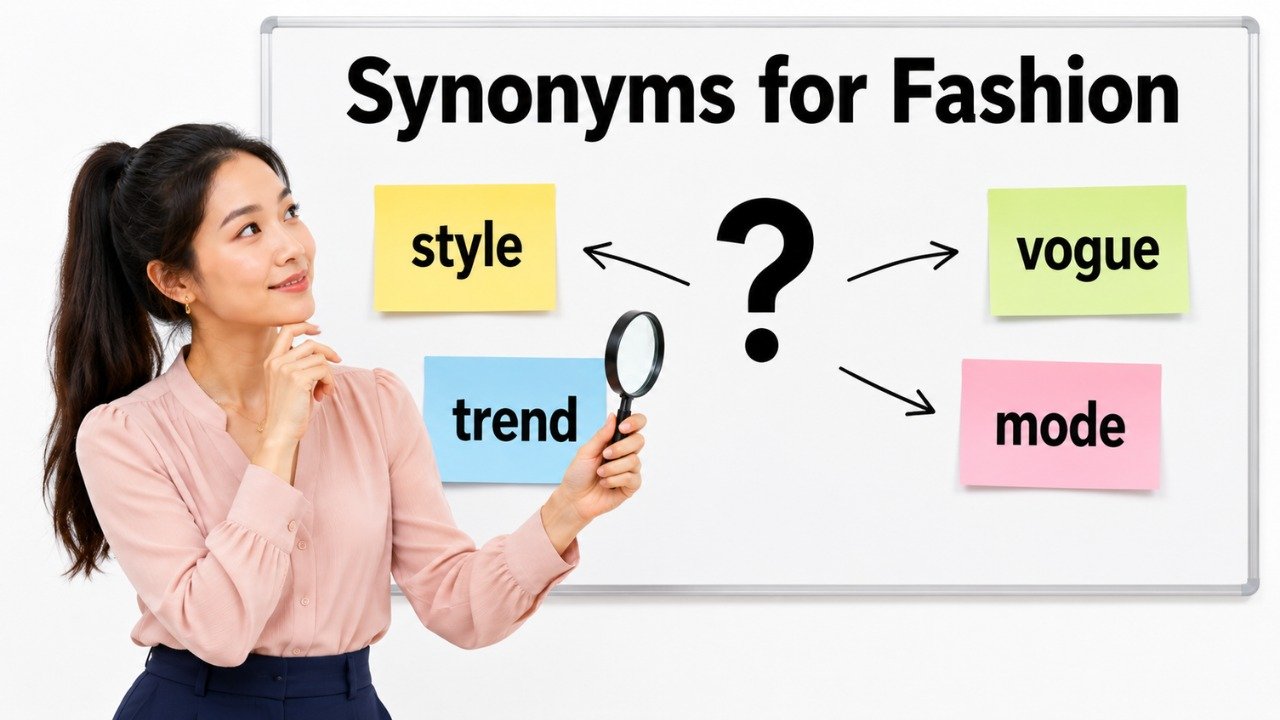
Quick Answer: The best synonyms for fashion include style, trend, mode, vogue, look, attire, dress, aesthetic, manner, and shape. Use style for a person’s distinctive appearance, trend for something currently popular, and vogue for widespread popularity during a particular period. Attire and dress are suitable when referring specifically to clothing. Aesthetic describes the visual character of clothing or design. Manner works when fashion means a way of doing something, while shape is useful when fashion is a verb meaning to create or form an object.
Pronunciation and Word Details
Word: Fashion.
Pronunciation: /ˈfæʃən/
Part of Speech: Noun and verb.
Meaning: A popular or personal style of clothing, appearance, behavior, or design, or the act of creating and shaping something.
US Pronunciation:
UK Pronunciation:
What Does “Fashion” Mean?
Fashion means a popular or distinctive style, especially in clothing, appearance, accessories, and personal presentation. It can describe what many people currently consider attractive, stylish, or socially acceptable.
As a noun, fashion often refers to clothing styles that become popular during a particular period. For example, a particular color, fabric, shape, or type of outfit may come into fashion and later lose popularity.
Fashion can also describe a personal way of dressing. In this sense, it is closely related to style, taste, appearance, and aesthetic. Someone may follow current fashion while still maintaining an individual style.
The word also has a broader meaning that is not connected to clothing. It can mean a manner, method, or way of doing something. For example, completing a task in an orderly fashion means completing it in an organized manner.
As a verb, fashion means to create, form, mold, or shape something, usually with care or skill. A craftsperson might fashion a bowl from clay, while a writer might fashion an argument from several ideas.
Meaning, Tone, and Context of “Fashion”
Fashion is generally a neutral word, but its tone changes according to context. In conversations about clothing and appearance, it can sound modern, creative, stylish, or expressive. In essays and reports, it can describe cultural preferences, consumer behavior, artistic movements, or changing social standards.
When fashion refers to popular clothing, it often suggests change. What is fashionable during one period may become outdated during another. The word can therefore communicate popularity, modernity, influence, and temporary public taste.
When fashion refers to personal appearance, it may have a positive and expressive tone. It can describe how people communicate identity, mood, profession, culture, or artistic preference through clothing and presentation.
In formal writing, fashion may mean a manner or method. Expressions such as “in an organized fashion” or “in a similar fashion” are appropriate in reports, essays, instructions, and professional communication.
As a verb, fashion has a slightly formal or literary tone. It suggests that something was carefully made, shaped, or developed rather than produced without thought.
When and How to Use “Fashion”
For Clothing and Appearance
Use fashion when discussing clothing, accessories, grooming, or appearance that reflects a popular or recognizable style.
Example: The exhibition explored changes in fashion during the previous century.
For Current Popularity
Use fashion when describing something that has become widely accepted or admired during a particular period.
Example: Loose clothing has returned to fashion among younger shoppers.
For Personal Expression
Use fashion when explaining how someone communicates personality, taste, or identity through appearance.
Example: She uses fashion as a form of creative expression.
For Cultural Discussion
Use fashion when examining how clothing and appearance relate to social values, traditions, professions, or historical periods.
Example: Fashion often reflects wider changes in culture and daily life.
For a Manner or Method
Use fashion to describe the way in which an action is performed.
Example: The records were arranged in a systematic fashion.
For Similarity
Use the phrase “in a similar fashion” when two actions, processes, or events happen in comparable ways.
Example: The second group responded in a similar fashion.
For Creating an Object
Use fashion as a verb when someone forms or constructs something from a particular material.
Example: The artist fashioned a small figure from wood.
For Developing an Idea
Fashion can describe carefully creating an argument, plan, explanation, or solution.
Example: The committee fashioned a practical solution from several proposals.
Best Synonyms for Fashion
Style: A distinctive way of dressing, designing, behaving, or presenting something.
Example: Her personal style combines simple clothing with elegant accessories.
Trend: A direction of change or a style that is becoming popular.
Example: Natural fabrics have become a noticeable trend.
Mode: A particular style, form, or way of doing something.
Example: This mode of dress became popular during the summer.
Vogue: The condition of being fashionable or widely admired.
Example: Bright patterns are currently in vogue.
Look: The overall visual appearance created by clothing, hair, and accessories.
Example: A simple jacket completed the professional look.
Attire: Clothing, especially clothing worn for a particular event or purpose.
Example: Formal attire is expected at the ceremony.
Dress: Clothing in general or a particular manner of wearing clothes.
Example: Traditional dress remains important during cultural celebrations.
Aesthetic: A recognizable visual style or set of artistic qualities.
Example: The collection has a clean and minimal aesthetic.
Manner: A particular way in which something is done.
Example: The problem was handled in a calm manner.
Shape: To create, form, or influence something.
Example: The craftsperson shaped the metal into a decorative bowl.
50 Synonyms for Fashion with Short Meanings
- Style: A distinctive way of dressing or presenting something.
- Trend: A style or direction that is becoming popular.
- Mode: A particular form, style, or way of doing something.
- Vogue: Widespread popularity during a certain period.
- Look: The complete visual appearance of a person or object.
- Appearance: The way someone or something looks.
- Attire: Clothing worn for a particular event or purpose.
- Clothing: Items worn to cover or decorate the body.
- Dress: Clothing or a particular style of wearing it.
- Apparel: Clothing considered collectively.
- Outfit: A complete set of clothes worn together.
- Ensemble: A coordinated combination of clothing and accessories.
- Wardrobe: A person’s collection of clothes.
- Costume: Clothing associated with a role, culture, or period.
- Garments: Individual items of clothing.
- Wear: Clothing intended for a particular activity or occasion.
- Couture: Carefully designed and skillfully made clothing.
- Tailoring: The design, cutting, and fitting of clothing.
- Styling: The process of arranging an attractive appearance.
- Design: The planned appearance and structure of something.
- Aesthetic: A particular set of visual qualities or preferences.
- Taste: A person’s judgment about what is attractive or suitable.
- Elegance: Graceful and refined appearance or style.
- Chic: Stylish and fashionable elegance.
- Glamour: Attractive and impressive beauty or style.
- Flair: A natural ability to create a distinctive appearance.
- Panache: Confident and noticeable style.
- Presentation: The way someone or something is displayed.
- Image: The appearance or impression presented to others.
- Adornment: Something added to improve or decorate an appearance.
- Ornamentation: Decorative details added to clothing or objects.
- Custom: A traditional or accepted way of behaving or dressing.
- Convention: A commonly accepted style or practice.
- Practice: A usual or established way of doing something.
- Manner: The way in which an action is performed.
- Way: A method, style, or manner of doing something.
- Method: An organized procedure for completing an action.
- Approach: A particular way of dealing with something.
- Form: The shape, structure, or manner of something.
- Pattern: A repeated or recognizable style of behavior or design.
- Technique: A skillful way of performing or creating something.
- Expression: The communication of personality, ideas, or feelings.
- Popular Style: A look widely accepted during a certain period.
- Current Trend: A style that is popular at the present time.
- Prevailing Taste: The preferences commonly shared by a group.
- Clothing Style: A recognizable way of selecting and wearing clothes.
- Personal Style: An individual’s distinctive appearance or taste.
- Create: To bring something new into existence.
- Shape: To give something a particular form.
- Mold: To form or influence something into a desired shape.
Read Also:
Synonyms for Spearheaded

Synonyms for Fashion by Context
When Fashion Means Clothing Style
Style, dress, attire, clothing style, apparel, couture, and look are useful when fashion refers to the way people dress.
Style is usually the most flexible choice because it may describe either an individual appearance or a broader design category.
Example With Fashion: Her fashion reflects her creative personality.
Example With Style: Her style reflects her creative personality.
Attire is more specific because it refers to the clothes worn for a particular setting or occasion.
Example With Fashion: Appropriate fashion is required for the formal event.
Example With Attire: Appropriate attire is required for the formal event.
When Fashion Means a Popular Trend
Trend, vogue, mode, current trend, and prevailing taste are suitable when fashion refers to something widely popular.
Trend emphasizes movement or change. Vogue emphasizes current popularity and often sounds more polished or formal.
Example With Fashion: Floral patterns have returned to fashion.
Example With Trend: Floral patterns have become a popular trend.
Example With Vogue: Floral patterns are once again in vogue.
When Fashion Means Personal Appearance
Look, appearance, presentation, image, aesthetic, and personal style work well when discussing someone’s complete visual identity.
Look is conversational and direct. Aesthetic is more useful when describing a consistent artistic or visual character.
Example With Look: Her professional look was simple but memorable.
Example With Aesthetic: Her professional aesthetic was simple but memorable.
When Fashion Means Elegance or Stylishness
Chic, elegance, glamour, flair, and panache describe attractive or impressive style.
Chic suggests modern elegance. Glamour suggests beauty and visual excitement. Panache suggests bold confidence.
Example With Chic: The room was decorated with quiet chic.
Example With Glamour: The event combined elegance with glamour.
Example With Panache: He carried the unusual outfit with panache.
When Fashion Means a Manner or Method
Manner, way, method, approach, form, and practice are appropriate when fashion describes how an action is completed.
Manner is usually the closest replacement in formal writing.
Example With Fashion: The applications were processed in an efficient fashion.
Example With Manner: The applications were processed in an efficient manner.
Method is better when the sentence describes a planned procedure.
Example With Method: The researchers used a reliable method to organize the results.
When Fashion Means To Create or Shape
Create, shape, form, mold, design, and construct are useful when fashion functions as a verb.
Shape is best when a material is given a particular physical form. Create is broader and can refer to both physical objects and ideas.
Example With Fashion: She fashioned the wire into a small flower.
Example With Shape: She shaped the wire into a small flower.
Example With Create: The group created a practical plan from several suggestions.
Another Word for Fashion
Style is usually the best single replacement for fashion when the word refers to clothing, appearance, or personal expression. However, the strongest alternative depends on the intended meaning.
Use trend when discussing temporary popularity, attire when focusing on clothing, manner when describing how something is done, and shape when fashion is used as a verb.
Original: Her fashion is simple, elegant, and practical.
Better Option: Her style is simple, elegant, and practical.
Original: This fashion became popular during the colder months.
Better Option: This trend became popular during the colder months.
Original: The work was completed in an organized fashion.
Better Option: The work was completed in an organized manner.
Original: The sculptor fashioned the figure from soft clay.
Better Option: The sculptor shaped the figure from soft clay.
When Not to Use “Fashion”
Fashion should not be used when a more exact word would make the sentence clearer. Because the word has several meanings, it can sound vague when the reader cannot tell whether it refers to clothing, popularity, appearance, method, or creation.
Avoid using fashion repeatedly in descriptions of clothing. More specific alternatives such as style, outfit, attire, tailoring, or aesthetic create greater variety and precision.
Weak: Her fashion was fashionable and followed every fashion.
Better: Her style was modern and followed every major trend.
Do not use fashion when the sentence refers to one complete set of clothing. Outfit or ensemble is more accurate.
Weak: She chose a comfortable fashion for the journey.
Better: She chose a comfortable outfit for the journey.
Avoid fashion when referring only to the physical items someone owns. Wardrobe or clothing is clearer.
Weak: His fashion contains several formal jackets.
Better: His wardrobe contains several formal jackets.
Do not use fashion for a structured process when method or procedure would be more precise.
Weak: The team developed a fashion for checking the information.
Better: The team developed a method for checking the information.
Fashion as a verb can sound formal in everyday conversation. Make, form, shape, or create may sound more natural.
Weak: We fashioned a simple shelf for the room.
Better: We made a simple shelf for the room.
Fashion may also be unsuitable when discussing a permanent artistic identity. Style or aesthetic often communicates lasting qualities more clearly than fashion, which can suggest temporary popularity.
Weak: The building has a traditional fashion.
Better: The building has a traditional architectural style.
Words Commonly Confused With Fashion
Fashion vs Style: Fashion often refers to popular or changing preferences, while style can describe a lasting and individual way of dressing, designing, or expressing ideas.
Fashion vs Trend: Fashion is a broad field involving clothing, appearance, and popular taste. A trend is a specific direction or preference that gains popularity within that field.
Fashion vs Clothing: Fashion concerns style, design, popularity, and presentation. Clothing refers to the physical items people wear.
Fashion vs Outfit: Fashion is a broad concept, while an outfit is a specific combination of clothes worn at one time.
Fashion vs Attire: Fashion describes style or popularity. Attire refers to clothing, especially clothing selected for a particular setting.
Fashion vs Vogue: Fashion can describe personal style or the wider world of clothing. Vogue means that something is currently popular or admired.
Fashion vs Aesthetic: Fashion often changes with public taste. An aesthetic is a consistent visual character that may remain recognizable over time.
Fashion vs Design: Fashion may refer to popular appearance or clothing styles. Design describes the process or plan used to create an item.
Fashion vs Manner: Fashion can mean the way something is done, but manner is usually clearer when no clothing meaning is intended.
Fashion vs Fashionable: Fashion is usually a noun or verb. Fashionable is an adjective describing something that is currently stylish or popular.
Which Synonym Should You Choose?
Choose style when discussing a person’s distinctive appearance, taste, writing, art, or design.
Choose trend when describing a popular direction that may continue developing or changing.
Choose vogue when you want a polished expression for something that is currently popular.
Choose look in casual speech when referring to someone’s complete visual appearance.
Choose attire in formal writing when discussing clothing required for an occasion, workplace, or event.
Choose outfit when referring to a complete set of clothes worn together.
Choose ensemble when the clothing and accessories have been carefully coordinated.
Choose aesthetic when describing the overall visual character of clothing, art, decoration, or design.
Choose dress when discussing traditional, cultural, ceremonial, or formal clothing.
Choose apparel when writing generally about clothing as a category.
Choose manner in reports, essays, and professional communication when fashion means a way of doing something.
Choose method when the sentence describes an organized process or procedure.
Choose approach when discussing a general strategy for handling a task or problem.
Choose shape when fashion is a verb and a material is physically formed.
Choose create when something new is developed from ideas, materials, or plans.
Choose mold when gradual pressure or influence gives something a particular form.
Real Life Examples of “Fashion” in Sentences
Original: She has always been interested in fashion.
Better Option: She has always been interested in clothing style and design.
Original: This fashion became popular during the warmer months.
Better Option: This trend became popular during the warmer months.
Original: His fashion is practical but distinctive.
Better Option: His personal style is practical but distinctive.
Original: The guests arrived in formal fashion.
Better Option: The guests arrived in formal attire.
Original: The room was decorated in a modern fashion.
Better Option: The room was decorated with a modern aesthetic.
Original: The task was completed in a careful fashion.
Better Option: The task was completed in a careful manner.
Original: Both departments responded in the same fashion.
Better Option: Both departments responded in the same way.
Original: The artist fashioned a bird from folded paper.
Better Option: The artist shaped a bird from folded paper.
Original: The group fashioned a plan from the available information.
Better Option: The group created a plan from the available information.
Original: Dark colors are returning to fashion.
Better Option: Dark colors are returning to vogue.
Synonym Groups and Usage Differences
Clothing Group
Style, attire, dress, apparel, outfit, ensemble, garments, wardrobe, and wear all relate to clothing, but they are not interchangeable in every sentence.
Style describes the character of clothing. Attire and dress refer to what someone wears. Outfit and ensemble describe a coordinated set. Wardrobe refers to the full collection of clothes owned by a person.
Example: Her wardrobe includes several outfits that reflect her personal style.
Trend Group
Trend, vogue, mode, popular style, current trend, and prevailing taste describe what is widely accepted or admired.
Trend emphasizes change and development. Vogue emphasizes present popularity. Prevailing taste refers to the preferences commonly shared by a group or society.
Example: Natural colors became a major trend and remained in vogue throughout the season.
Appearance Group
Look, appearance, presentation, image, styling, and aesthetic describe how someone or something appears.
Look is casual and broad. Presentation often suggests deliberate arrangement. Image can include the impression created in other people’s minds. Aesthetic describes visual unity.
Example: Careful styling gave the entire presentation a polished aesthetic.
Elegance Group
Elegance, chic, glamour, flair, and panache describe attractive style with different emotional qualities.
Elegance is graceful and refined. Chic is modern and stylish. Glamour is striking and impressive. Flair suggests natural creative ability. Panache communicates bold confidence.
Example: She combined elegance with enough flair to make the outfit memorable.
Manner Group
Manner, way, method, approach, practice, form, and technique describe how something is done.
Manner and way are broad. Method implies planning. Approach describes a general strategy. Technique usually involves learned skill.
Example: The designer developed a careful technique for working with delicate fabric.
Creation Group
Create, shape, mold, form, design, and fashion describe making or developing something.
Create is the broadest term. Shape emphasizes giving form. Mold suggests gradual formation. Design emphasizes planning. Fashion suggests skilled or thoughtful construction.
Example: The maker designed the object carefully and shaped it from a single piece of wood.
Antonyms of Fashion
The opposite of fashion depends on which meaning is intended. When fashion means popular style, its opposites relate to being outdated, plain, or unfashionable. When fashion means creating something, its opposites relate to damaging, destroying, or taking something apart.
Unfashionableness: The quality of not being stylish or popular.
Outdatedness: The condition of no longer being current.
Old Fashionedness: Attachment to styles associated with an earlier period.
Plainness: A lack of decorative or distinctive style.
Neglect: A lack of care given to appearance or presentation.
Disorder: The absence of an organized manner or arrangement.
Carelessness: A lack of thought or attention in how something is done.
Destruction: The act of damaging something so that it no longer exists in its original form.
Dismantling: The process of taking a constructed object apart.
Deformation: A damaging change to the natural or intended shape of something.
Comparison Between Fashion and Related Words
Fashion vs Style
Fashion often reflects what is popular during a certain period. Style may be personal, distinctive, and long lasting.
Example With Fashion: Wide trousers have returned to fashion.
Example With Style: Wide trousers are an important part of her personal style.
Fashion vs Trend
Fashion is the broader concept. A trend is one specific change or direction within fashion, design, culture, or behavior.
Example With Fashion: He studies fashion and clothing design.
Example With Trend: He noticed a growing trend toward simpler clothing.
Fashion vs Vogue
Fashion can refer to clothing, personal style, or a manner of doing something. Vogue refers specifically to current popularity.
Example With Fashion: Her interest in fashion began at an early age.
Example With Vogue: Decorative stitching is currently in vogue.
Fashion vs Clothing
Fashion describes style, popularity, appearance, and creative design. Clothing refers to the actual items worn on the body.
Example With Fashion: Fashion changes as public preferences develop.
Example With Clothing: Warm clothing is necessary during cold weather.
Fashion vs Attire
Fashion is a broad concept connected to style and popularity. Attire means clothing chosen for a particular setting or purpose.
Example With Fashion: The article discussed changes in workplace fashion.
Example With Attire: Professional attire is required for the meeting.
Fashion vs Outfit
Fashion refers to trends or styles in general. An outfit is a particular set of clothes worn together.
Example With Fashion: She enjoys learning about historical fashion.
Example With Outfit: She selected a comfortable outfit for the journey.
Fashion vs Aesthetic
Fashion may change rapidly according to public taste. An aesthetic is a unified visual identity based on particular colors, forms, textures, or ideas.
Example With Fashion: The color became popular in fashion.
Example With Aesthetic: The muted colors support the calm aesthetic of the collection.
Fashion vs Manner
Fashion can mean a way of performing an action, but manner is more direct and less likely to be misunderstood.
Example With Fashion: The documents were arranged in an orderly fashion.
Example With Manner: The documents were arranged in an orderly manner.
Fashion vs Design
Fashion describes clothing styles, trends, and appearance. Design refers to the planning and creation of an item or visual concept.
Example With Fashion: She follows changes in fashion.
Example With Design: She created the design for the new jacket.
Fashion vs Shape
Fashion as a verb means to create something carefully. Shape focuses more directly on giving material a particular physical form.
Example With Fashion: He fashioned a handle from a piece of wood.
Example With Shape: He shaped the wood into a smooth handle.
Common Phrases and Expressions With Fashion
Fashion Trend: A clothing style or preference that is gaining popularity.
Fashion Sense: The ability to choose clothing that looks attractive and appropriate.
Fashion Style: A recognizable way of designing or wearing clothing.
High Fashion: Exclusive, artistic, or highly refined clothing design.
In Fashion: Currently popular or socially admired.
Out of Fashion: No longer popular or widely worn.
Latest Fashion: A recently introduced style that has gained attention.
Fashion Statement: Clothing or an accessory chosen to express a strong identity or idea.
In a Similar Fashion: In a comparable way or manner.
After a Fashion: In an imperfect, limited, or unusual way.
Common Mistakes to Avoid
One common mistake is treating fashion and clothing as exact synonyms. Clothing refers to physical garments, while fashion includes style, popularity, design, behavior, and cultural influence.
Another mistake is confusing fashion with style. Fashion often changes according to public taste. Style may remain personal and consistent even when trends change.
Avoid using fashion when referring to one set of clothes.
Incorrect: She purchased a new fashion for the celebration.
Correct: She purchased a new outfit for the celebration.
Do not confuse fashion with fashionable. Fashion is usually a noun or verb, while fashionable is an adjective.
Incorrect: The jacket looks very fashion.
Correct: The jacket looks very fashionable.
Avoid unnecessary repetition.
Weak: The fashion expert explained why the fashion had become fashionable.
Better: The style expert explained why the trend had become popular.
Do not use trend when discussing a lasting personal identity unless change or popularity is part of the meaning.
Weak: Her trend is simple and elegant.
Better: Her style is simple and elegant.
Be careful when using fashion to mean manner. Although expressions such as “in an orderly fashion” are correct, manner or way may be clearer in direct professional writing.
Less Direct: The requests were handled in a timely fashion.
More Direct: The requests were handled promptly.
Use fashion as a verb only when the act of making, shaping, or developing something is clear.
Unclear: They fashioned the issue.
Clear: They fashioned a solution to the issue.
Avoid combining fashion with adjectives that repeat the same meaning.
Repetitive: The popular fashion trend attracted attention.
Better: The fashion trend attracted attention.
Finally, choose synonyms according to context rather than replacing fashion mechanically. Attire cannot replace fashion when discussing popularity, and trend cannot replace fashion when the word means a method or manner.
Conclusion
The best synonyms for fashion depend on the meaning you want to express. Style is the strongest general alternative for personal appearance, while trend and vogue describe current popularity. Attire, dress, outfit, and apparel refer more directly to clothing. Aesthetic and look describe visual character, while manner and method fit sentences about how something is done. When fashion is a verb, shape, create, form, and mold are useful choices. Understanding these differences makes writing clearer, more natural, and more precise.
FAQs About Synonyms for Fashion
What Is the Best Synonym for Fashion?
Style is the best general synonym when fashion refers to appearance or clothing. Trend is better when the meaning involves current popularity.
Are Fashion and Style the Same?
Not completely. Fashion often reflects popular and changing preferences, while style can be personal, distinctive, and long lasting.
What Is a Formal Synonym for Fashion?
Attire is a formal alternative when referring to clothing. Vogue works for popularity, while manner is suitable when fashion means a way of doing something.
Can Trend Replace Fashion?
Trend can replace fashion when discussing something that is becoming popular. It cannot replace fashion when the word means clothing generally, a manner, or the act of creating something.
What Is Another Word for Personal Fashion?
Personal style is the clearest alternative. Look, aesthetic, image, and presentation may also work depending on the sentence.
What Does Fashion Mean as a Verb?
As a verb, fashion means to create, form, shape, or mold something, usually with care or skill.
What Is the Opposite of Fashion?
Unfashionableness, outdatedness, and plainness can be opposites when fashion means popular style. Destruction or dismantling may be opposites when fashion means creating or shaping something.
