
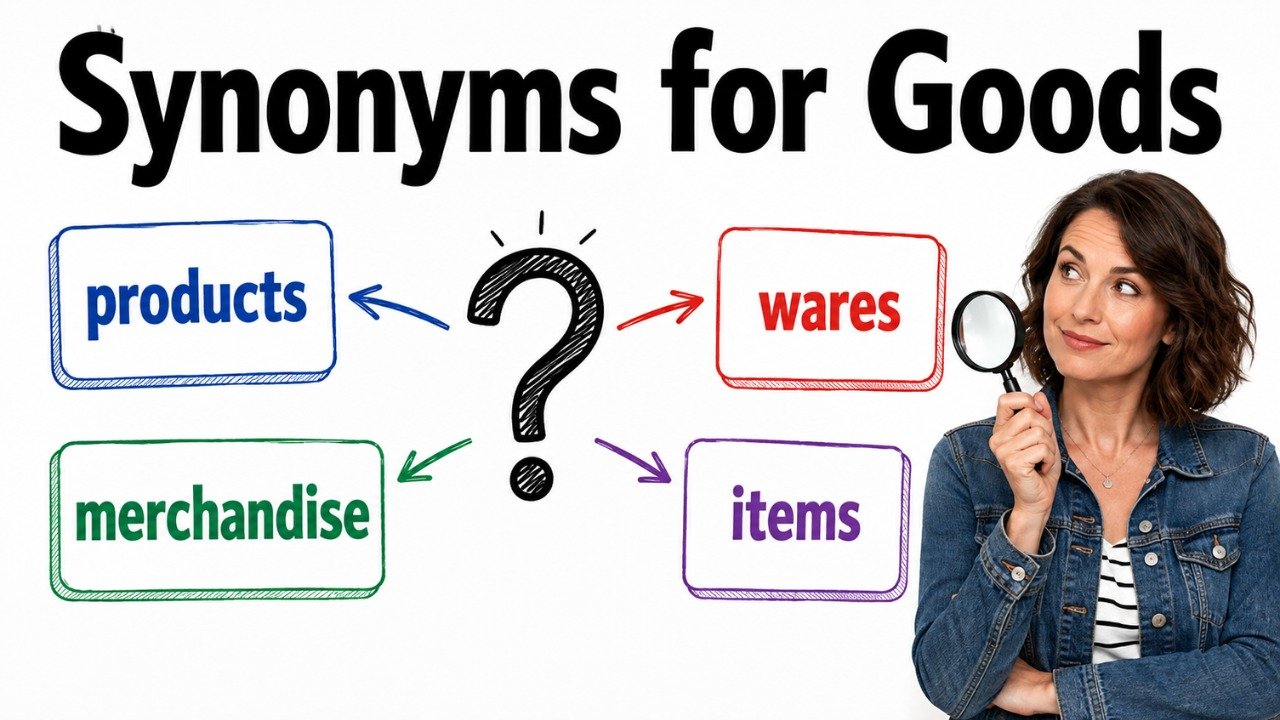
Quick Answer: The best synonyms for goods include products, merchandise, items, wares, commodities, stock, inventory, property, belongings, and cargo. Products is the strongest general alternative for things made or offered for sale. Merchandise works best in retail and commercial contexts, while items is natural in everyday speech. Commodities suits economics and bulk trade. Stock and inventory describe goods kept by a business. Property and belongings refer to owned possessions, while cargo is best for goods being transported. The right choice among synonyms for goods depends on whether the sentence concerns selling, ownership, storage, production, or shipping.
Pronunciation and Word Details
Word: Goods.
Pronunciation: /ɡʊdz/
Part of Speech: Plural noun.
Meaning: Physical products, merchandise, possessions, or movable items that can be owned, bought, sold, stored, or transported.
US Pronunciation:
UK Pronunciation:
What Does “Goods” Mean?
Goods means physical things that people or businesses produce, own, buy, sell, store, or transport. It is usually a plural noun and commonly refers to products or merchandise.
The word is widely used in business, economics, retail, law, shipping, manufacturing, and everyday conversation. Its exact meaning changes according to the context.
In commercial writing, goods are physical products available for sale. In economics, goods are useful objects that satisfy needs or wants. In shipping, goods are items being transported. In legal language, goods can refer to movable personal property.
Commercial Context: The store sells household goods at reasonable prices.
Economic Context: Goods and services are exchanged in an economy.
Shipping Context: The goods arrived at the warehouse yesterday.
Legal Context: The agreement covers the ownership and delivery of goods.
Personal Context: They packed their goods before moving to a new home.
Goods normally takes a plural verb.
Correct: The goods are ready for delivery.
Incorrect: The goods is ready for delivery.
The singular form good is possible in economics and formal commercial language.
Example: Electricity may be treated as an economic good in some discussions.
In everyday writing, product or item usually sounds more natural when referring to one object.
Natural Example: This product is available in three sizes.
Meaning, Tone, and Context of “Goods”
Goods has a neutral, practical, and commercial tone. It is neither strongly formal nor strongly casual. However, it appears more frequently in business, trade, economics, law, shipping, and retail than in ordinary personal conversation.
The word often emphasizes that physical objects have economic value, practical use, or ownership. It can refer to one category of products or many different objects considered together.
Neutral Use: The company delivers goods throughout the region.
Formal Use: Payment must be completed before the goods are released.
Commercial Use: Demand for seasonal goods increased during the month.
Economic Use: Consumers choose between different goods and services.
Legal Use: Ownership of the goods passes to the buyer after payment.
Shipping Use: The goods were damaged during transportation.
Conversational Use: We loaded all our goods into the vehicle.
In casual conversation, items, things, belongings, or products may sound more natural. Merchandise is common in retail. Commodities is more technical and often refers to raw materials or standardized products traded in large quantities.
Goods can sound broad when the exact type of product is important. A more precise alternative often makes the sentence clearer.
When and How to Use “Goods”
For Products Offered for Sale
Use goods when discussing physical products that a business sells or distributes.
Example: The shop offers locally produced goods.
For Retail Merchandise
Goods can refer collectively to everything available in a store.
Example: Customers examined the goods before making their purchases.
For Manufacturing
Use goods for objects created through a production process.
Example: The factory produces finished goods for the domestic market.
For Economics
In economics, goods are physical or useful things that satisfy human needs and wants.
Example: The price of essential goods increased during the year.
For Business Inventory
Goods may describe products stored by a company before they are sold.
Example: The warehouse contains enough goods to meet current demand.
For Transportation
Use goods for products or materials being moved from one place to another.
Example: The goods were transported safely across the country.
For International Trade
Goods is common when discussing imports, exports, tariffs, customs, and trade agreements.
Example: The country exports agricultural goods to several markets.
For Personal Property
Goods may refer to objects owned by a person, especially in formal or traditional language.
Example: The family recovered most of its stolen goods.
For Legal Writing
In legal and contractual language, goods often means movable physical property.
Example: The contract explains when ownership of the goods transfers to the buyer.
For Quality Descriptions
Goods can be modified by words that describe their condition, origin, value, or purpose.
Example: The retailer replaced the damaged goods without delay.
Best Synonyms for Goods
Products
Synonym: Things that are made, grown, or developed for use or sale.
Example: The business introduced several new products this year.
Merchandise
Synonym: Products that are bought and sold, especially in retail.
Example: The store displayed its merchandise near the entrance.
Items
Synonym: Individual objects considered separately or as part of a group.
Example: Several items were missing from the order.
Wares
Synonym: Products offered for sale, often by a seller or small business.
Example: Local sellers displayed their wares at the market.
Commodities
Synonym: Basic products or raw materials that can be bought, sold, or traded.
Example: The company trades agricultural commodities.
Stock
Synonym: Goods that a business currently has available for sale.
Example: The most popular design is no longer in stock.
Inventory
Synonym: The complete supply of products or materials held by a business.
Example: The manager checked the inventory before placing another order.
Property
Synonym: Things that are legally owned by a person or organization.
Example: The damaged property was carefully documented.
Belongings
Synonym: Personal objects owned and used by someone.
Example: She packed her belongings into several boxes.
Cargo
Synonym: Goods carried by a vehicle, ship, aircraft, or other form of transportation.
Example: The cargo reached its destination safely.
50 Synonyms for Goods with Short Meanings
- Products: Things made, grown, or developed for use or sale.
- Merchandise: Products that are bought and sold by a business.
- Items: Individual objects within a collection or group.
- Wares: Products displayed or offered for sale.
- Commodities: Basic products or raw materials traded in markets.
- Articles: Separate physical objects or products.
- Materials: Physical substances used for production or practical purposes.
- Supplies: Goods kept for a particular activity or need.
- Stock: Products currently available for sale or use.
- Inventory: The total amount of goods held by a business.
- Property: Objects or assets legally owned by someone.
- Possessions: Things that belong to a person or organization.
- Belongings: Personal objects owned by an individual.
- Assets: Valuable property or resources owned by a person or business.
- Personal Effects: Personal possessions carried or used by someone.
- Chattels: Movable personal property in legal language.
- Movables: Property that can be moved from one location to another.
- Cargo: Goods transported by a vehicle, ship, or aircraft.
- Freight: Goods transported commercially, especially in large quantities.
- Shipment: A group of goods sent from one place to another.
- Consignment: Goods delivered or sent to a person or business.
- Load: A quantity of goods carried at one time.
- Produce: Things that are grown, created, or manufactured.
- Purchases: Goods that someone has bought.
- Manufactured Products: Goods created through an industrial production process.
- Consumer Products: Goods purchased for personal or household use.
- Retail Products: Goods sold directly to customers.
- Commercial Products: Goods created or offered for business purposes.
- Trade Goods: Products exchanged or sold through commercial activity.
- Sale Items: Products offered to customers for purchase.
- Store Stock: Goods currently held and sold by a store.
- Marketable Products: Goods suitable and ready to be sold.
- Tradable Items: Products that can be exchanged or sold.
- Articles of Commerce: Goods involved in business and trade.
- Household Goods: Objects used within a home.
- Durable Goods: Products designed to last for a long period.
- Nondurable Goods: Products that are consumed or replaced relatively quickly.
- Finished Goods: Completed products ready for sale or distribution.
- Packaged Goods: Products prepared and placed in packaging for sale.
- Export Goods: Products sent to another country for sale.
- Imported Goods: Products brought into a country from another country.
- Raw Materials: Basic substances used to produce finished products.
- Provisions: Supplies of food or other necessities.
- Equipment: Useful objects needed for a task or activity.
- Apparatus: A collection of equipment designed for a specific purpose.
- Gear: Equipment or supplies used for a particular activity.
- Tools: Objects used to perform practical tasks.
- Valuables: Possessions that have significant financial or personal value.
- Tangible Property: Physical property that can be seen and touched.
- Material Possessions: Physical objects owned by a person or organization.
Read Also:
Synonyms for Reminisce

Synonyms for Goods by Context
When Goods Means Products for Sale
Products, merchandise, wares, sale items, retail products, and commercial products are useful when discussing objects offered to customers.
Products is the broadest and most natural choice. Merchandise emphasizes retail activity. Wares often creates a traditional or descriptive tone.
Example With Goods: The store sells handmade goods.
Example With Products: The store sells handmade products.
Example With Merchandise: The retailer displayed its handmade merchandise.
Example With Wares: The craft workers arranged their handmade wares on the tables.
When Goods Means Business Stock
Stock, inventory, store stock, supplies, and finished goods describe products held by a business.
Stock usually refers to goods available for sale. Inventory may mean the goods themselves or the detailed record of those goods.
Example With Goods: The business has enough goods for the coming month.
Example With Stock: The business has enough stock for the coming month.
Example With Inventory: The current inventory should meet demand for the coming month.
When Goods Means Basic Trade Products
Commodities, raw materials, produce, trade goods, and articles of commerce work in economic and trading contexts.
Commodities often refers to standardized products such as crops, metals, or energy resources. Raw materials are used to manufacture other products.
Example With Goods: The region exports agricultural goods.
Example With Commodities: The region exports agricultural commodities.
Example With Produce: The region exports fresh produce.
When Goods Means Transported Products
Cargo, freight, shipment, consignment, and load are suitable when products are being moved.
Cargo refers to the goods carried. Freight can refer to the transported goods or the commercial transportation process. A shipment is a particular group of goods being sent.
Example With Goods: The goods arrived by ship.
Example With Cargo: The cargo arrived by ship.
Example With Shipment: The shipment arrived at the distribution center.
Example With Freight: The freight was delivered without damage.
When Goods Means Personal Possessions
Belongings, possessions, personal effects, valuables, and material possessions describe objects owned by individuals.
Belongings is natural and personal. Possessions is broader and slightly more formal. Personal effects is commonly used in formal records, travel, and legal contexts.
Example With Goods: They packed their goods before moving.
Example With Belongings: They packed their belongings before moving.
Example With Personal Effects: Their personal effects were placed in secure storage.
When Goods Means Legal Property
Property, chattels, movables, tangible property, and assets are useful in legal and financial writing.
Chattels and movables refer specifically to property that can be physically moved. Assets is broader because it may include both physical and nonphysical value.
Example With Goods: The buyer becomes responsible for the goods after delivery.
Example With Property: The buyer becomes responsible for the property after delivery.
Example With Chattels: The agreement identifies the chattels included in the sale.
When Goods Means Useful Supplies
Supplies, equipment, gear, tools, materials, and provisions are suitable when objects serve a practical purpose.
Supplies are consumed or used during an activity. Equipment and gear usually last longer. Provisions most often refers to necessary food or resources.
Example With Goods: The team carried essential goods for the journey.
Example With Supplies: The team carried essential supplies for the journey.
Example With Provisions: The team carried enough provisions for the journey.
Another Word for Goods
Products is usually the best single replacement for goods because it is clear, modern, and suitable for most commercial contexts. However, merchandise is stronger for retail, belongings is better for personal possessions, and cargo is more precise for transported goods.
Original: The company sells electrical goods.
Better Option: The company sells electrical products.
Original: The shop displayed its goods near the entrance.
Better Option: The shop displayed its merchandise near the entrance.
Original: The family packed its goods into a vehicle.
Better Option: The family packed its belongings into a vehicle.
Original: The goods were unloaded at the port.
Better Option: The cargo was unloaded at the port.
The best alternative depends on whether the sentence focuses on commerce, ownership, storage, production, or transportation.
When Not to Use “Goods”
Avoid goods when a more precise noun would help the reader understand what is being discussed. The word can sound vague when the exact product category, purpose, or ownership is important.
When Referring to Services
Goods refers mainly to physical or usable products. It should not replace services when describing work, assistance, or professional activity.
Weak: The business provides legal goods to its clients.
Better: The business provides legal services to its clients.
When Referring to One Everyday Object
Although good can be singular in economics, product or item usually sounds more natural for one physical object.
Weak: I purchased a good from the store.
Better: I purchased a product from the store.
When Discussing Personal Objects
Belongings or possessions may sound warmer and more natural than goods.
Weak: She placed her personal goods in the suitcase.
Better: She placed her belongings in the suitcase.
When Shipping Details Matter
Cargo, freight, consignment, or shipment may provide a clearer meaning.
Weak: The goods will arrive on Monday.
Better: The shipment will arrive on Monday.
When the Product Type Is Known
Name the exact category instead of using a broad term.
Weak: The business sells goods for kitchens.
Better: The business sells kitchen equipment and household products.
When Repetition Makes the Writing Vague
Replace repeated uses of goods with accurate alternatives.
Weak: The goods were stored beside other goods before the goods were delivered.
Better: The products were stored beside the remaining inventory before the shipment was delivered.
When Discussing Nonphysical Assets
Goods usually suggests physical objects. It may not accurately describe rights, ideas, information, or other intangible assets.
Weak: Knowledge is one of the company’s physical goods.
Better: Knowledge is one of the company’s valuable intangible assets.
Words Commonly Confused With Goods
Goods vs Products: Goods is a broad commercial or economic term for physical things. Products usually refers to specific things that have been made, developed, or grown for use or sale.
Goods vs Merchandise: Goods can refer to any movable products or possessions. Merchandise specifically emphasizes products bought and sold through retail or trade.
Goods vs Items: Goods suggests commercial value or ownership. Items simply refers to individual objects and is more common in everyday language.
Goods vs Commodities: Goods includes many types of products. Commodities usually refers to basic, standardized, or bulk products traded in markets.
Goods vs Property: Goods generally means movable physical objects. Property is broader and may include land, buildings, possessions, and legal ownership rights.
Goods vs Belongings: Goods often has a commercial tone. Belongings refers to personal objects owned and used by an individual.
Goods vs Cargo: Goods can be located anywhere. Cargo specifically means goods being transported by a vehicle, ship, or aircraft.
Goods vs Freight: Goods describes the products themselves. Freight often refers to commercially transported goods or the process and cost of transporting them.
Goods vs Stock: Goods can refer to any products. Stock means products currently held by a business for sale or future use.
Goods vs Inventory: Goods are the physical products. Inventory can mean the complete stock or the organized record of that stock.
Goods vs Supplies: Goods may be sold or owned generally. Supplies are products kept for a particular need, activity, or operation.
Goods vs Services: Goods are usually physical or usable products. Services are actions, skills, or work performed for another person.
Which Synonym Should You Choose?
Choose products when writing generally about things that are made, grown, developed, or sold.
Choose merchandise when discussing products displayed, promoted, or sold by a retailer.
Choose items in casual conversation or when referring to individual objects in an order, list, or collection.
Choose wares for descriptive writing about products displayed by sellers, craft workers, or market traders.
Choose commodities for economics, finance, agriculture, raw materials, and large scale trade.
Choose stock when referring to products currently available for sale.
Choose inventory when discussing all products held by a business or the record used to track them.
Choose property in legal, insurance, ownership, or damage related writing.
Choose belongings or possessions when discussing objects owned by a person.
Choose personal effects in formal writing about personal possessions, travel, storage, or legal matters.
Choose cargo when referring to goods carried by a ship, aircraft, vehicle, or train.
Choose freight when discussing the commercial transportation of goods.
Choose shipment when referring to one group of products being sent or delivered.
Choose consignment when goods are formally delivered, entrusted, or sent to another party.
Choose supplies when discussing materials needed for work, travel, education, or daily activities.
Choose equipment or gear when the objects are used repeatedly for a specific activity.
Choose raw materials when describing substances used to manufacture other products.
Choose finished goods when discussing completed products that are ready for sale.
Choose assets when emphasizing the financial value of owned property.
Choose chattels or movables in technical legal writing about movable personal property.
Real Life Examples of “Goods” in Sentences
Original: The company produces household goods.
Better Option: The company produces household products.
Original: The store displayed the goods near the entrance.
Better Option: The store displayed the merchandise near the entrance.
Original: Several goods were missing from the package.
Better Option: Several items were missing from the package.
Original: The warehouse contains imported goods.
Better Option: The warehouse contains imported stock.
Original: The goods were transported across the ocean.
Better Option: The cargo was transported across the ocean.
Original: She packed all her goods before moving.
Better Option: She packed all her belongings before moving.
Original: The seller offered handmade goods at the market.
Better Option: The seller offered handmade wares at the market.
Original: The country trades basic goods with neighboring regions.
Better Option: The country trades basic commodities with neighboring regions.
Original: The damaged goods were removed from the shelves.
Better Option: The damaged merchandise was removed from the shelves.
Original: The business counted its goods at the end of the month.
Better Option: The business counted its inventory at the end of the month.
Synonym Groups and Usage Differences
General Product Group
Products, items, articles, and manufactured products are broad alternatives for physical objects made or provided for use.
Products is the most flexible choice in modern commercial writing. Items is better when counting or listing separate objects.
Example: The business added five new products to its catalog.
Retail Group
Merchandise, wares, sale items, retail products, and store stock describe goods offered directly to customers.
Merchandise is common in professional retail language. Wares gives the sentence a more descriptive or traditional style.
Example: The shop arranged its merchandise by category.
Trade and Economics Group
Commodities, trade goods, commercial products, marketable products, and articles of commerce emphasize economic exchange.
Commodities usually refers to basic or standardized products. Articles of commerce has a formal and legal tone.
Example: Demand for agricultural commodities increased.
Storage Group
Stock, inventory, supplies, and finished goods describe products kept for future sale or use.
Stock emphasizes availability. Inventory emphasizes the total quantity or organized record.
Example: The manager reviewed the inventory before ordering more stock.
Transportation Group
Cargo, freight, shipment, consignment, and load refer to goods being moved or delivered.
Cargo identifies what is carried. Shipment identifies a particular group being sent. Freight has a commercial transportation focus.
Example: The shipment arrived at the warehouse without damage.
Personal Property Group
Belongings, possessions, personal effects, valuables, and material possessions describe things owned by a person.
Belongings sounds natural and personal. Personal effects is more formal. Valuables emphasizes financial or emotional worth.
Example: Travelers should keep their valuables in a secure place.
Legal Property Group
Property, chattels, movables, tangible property, and assets are common in legal, insurance, and financial contexts.
Chattels refers to movable personal property. Assets is broader and can include nonphysical value.
Example: The policy protects tangible property against certain types of damage.
Practical Supplies Group
Supplies, materials, equipment, apparatus, gear, tools, and provisions describe goods used for specific purposes.
Supplies may be consumed quickly. Equipment and tools are usually used repeatedly. Provisions are necessary resources, especially food.
Example: The workers collected the tools and materials needed for the task.
Antonyms of Goods
The opposite of goods depends on whether the word refers to products, possessions, assets, or available stock.
Services: Work or activities provided instead of physical products.
Intangibles: Things that have value but no physical form.
Liabilities: Financial or legal obligations instead of owned assets.
Debts: Money or value owed to another party.
Shortages: Situations in which necessary goods are unavailable.
Deficits: Amounts by which available resources fall below what is needed.
Waste: Material that has lost its intended usefulness.
Refuse: Unwanted material that has been thrown away.
Losses: Property, stock, or financial value that is no longer retained.
Emptiness: The absence of objects, stock, or possessions.
Scarcity: A limited supply of desired goods or resources.
Nonmaterial Value: Value based on ideas, skills, relationships, or experiences rather than possessions.
Comparison of Goods and Related Words
Goods vs Products
Goods is a broad economic and commercial term. Products usually refers to specific things created, grown, or developed for use or sale.
Example With Goods: The country exports manufactured goods.
Example With Products: The company exports several manufactured products.
Goods vs Merchandise
Goods may include products, materials, possessions, or transported objects. Merchandise specifically refers to products involved in retail or trade.
Example With Goods: The goods were stored in the warehouse.
Example With Merchandise: The merchandise was arranged for the store opening.
Goods vs Items
Goods emphasizes economic value, ownership, or trade. Items emphasizes separate objects in a list, order, or collection.
Example With Goods: The retailer sells affordable goods.
Example With Items: Three items were removed from the order.
Goods vs Commodities
Goods includes finished products, possessions, supplies, and materials. Commodities usually refers to basic products that can be traded in standardized markets.
Example With Goods: Demand for imported goods increased.
Example With Commodities: Prices for agricultural commodities increased.
Goods vs Stock
Goods may refer to products in any location or stage. Stock specifically means products held and available for sale or use.
Example With Goods: The goods arrived at the store.
Example With Stock: The new stock will be available tomorrow.
Goods vs Inventory
Goods are the actual physical products. Inventory can mean the complete collection of stock or the detailed record used to track it.
Example With Goods: The goods were placed on shelves.
Example With Inventory: The manager updated the inventory after the delivery.
Goods vs Property
Goods usually refers to movable physical items. Property is broader and can include land, buildings, personal possessions, and legal rights.
Example With Goods: The agreement covers the delivery of goods.
Example With Property: The policy covers damage to personal property.
Goods vs Belongings
Goods often sounds commercial or formal. Belongings sounds personal and refers to objects owned by an individual.
Example With Goods: The stolen goods were recovered.
Example With Belongings: She collected her belongings before leaving.
Goods vs Cargo
Goods can be bought, sold, stored, or owned. Cargo specifically refers to goods while they are being transported.
Example With Goods: The goods were prepared for transportation.
Example With Cargo: The cargo was loaded onto the vessel.
Goods vs Services
Goods are usually physical products that can be owned or transferred. Services are actions, skills, or assistance provided to customers.
Example With Goods: The business sells cleaning goods.
Example With Services: The business provides professional cleaning services.
Common Phrases and Expressions With Goods
Goods and Services: Physical products and activities provided within an economy.
Consumer Goods: Products purchased by individuals for personal or household use.
Durable Goods: Products designed to remain useful for a long period.
Nondurable Goods: Products that are consumed or replaced relatively quickly.
Finished Goods: Completed products ready to be sold or distributed.
Household Goods: Objects and equipment used in a home.
Imported Goods: Products brought into a country from another location.
Export Goods: Products sent from one country to another for sale.
Damaged Goods: Products that have been broken, harmed, or reduced in quality.
Stolen Goods: Property taken from its owner without permission.
Luxury Goods: Expensive products that are not essential for basic living.
Essential Goods: Products necessary for everyday life or basic needs.
Manufactured Goods: Products created through industrial or production processes.
Goods in Transit: Products currently being transported between locations.
Perishable Goods: Products that can spoil or lose quality within a short period.
Common Mistakes to Avoid
Using a Singular Verb With Goods
Goods is plural and normally takes a plural verb.
Incorrect: The goods is ready for delivery.
Correct: The goods are ready for delivery.
Using Good as an Everyday Singular Noun
The singular good is used in economics and formal classifications, but product or item usually sounds more natural in ordinary writing.
Awkward: I bought a good from the market.
Natural: I bought an item from the market.
Confusing Goods With Services
Goods generally refers to physical products. Services refers to work or assistance.
Incorrect: The consultant sells financial goods.
Correct: The consultant provides financial services.
Using Merchandise as a Plural Count Noun
Merchandise is normally an uncountable noun. Do not usually write merchandises.
Incorrect: The store received several new merchandises.
Correct: The store received several new items of merchandise.
Using Commodities for Every Product
Commodities usually refers to basic, standardized, or bulk products. It may sound unnatural for unique retail products.
Weak: The artist sells handmade decorative commodities.
Better: The artist sells handmade decorative products.
Confusing Stock With Inventory
Stock usually refers to products held for sale. Inventory can mean the goods or the formal record used to count and manage them.
Weak: The manager wrote the stock in a report.
Better: The manager recorded the inventory in a report.
Using Cargo When Nothing Is Being Transported
Cargo should describe goods carried or prepared for transportation.
Weak: The store displayed its cargo on shelves.
Better: The store displayed its merchandise on shelves.
Using Goods for Personal Belongings in Casual Speech
Goods may sound impersonal when discussing someone’s personal possessions.
Weak: She gathered her goods from the bedroom.
Better: She gathered her belongings from the bedroom.
Repeating Goods Too Often
Using goods in every sentence can make commercial writing vague and repetitive.
Weak: The business ordered goods, stored the goods, and later sold the goods.
Better: The business ordered products, placed them in inventory, and later sold the merchandise.
Choosing a Synonym That Changes the Meaning
Products, supplies, assets, cargo, and belongings are related to goods, but they are not interchangeable in every sentence.
Weak: The ship carried personal belongings for several factories.
Better: The ship carried manufactured goods for several factories.
Using Vague Product Descriptions
Goods may not provide enough information when readers need to know the exact category.
Weak: The company sells useful goods.
Better: The company sells household equipment and cleaning supplies.
Conclusion
The most useful synonyms for goods include products, merchandise, items, wares, commodities, stock, inventory, property, belongings, and cargo. Choose products for general commercial writing, merchandise for retail, commodities for economics, and inventory for stored business stock. Cargo and freight suit transportation, while belongings and possessions describe personal property. Understanding these distinctions makes writing clearer and more precise. The best choice among synonyms for goods depends on whether the sentence focuses on production, trade, ownership, storage, sale, or delivery.
FAQs About Synonyms for Goods
What Is the Best Synonym for Goods?
Products is the best general synonym for goods. Merchandise is better for retail, while items works well in everyday language.
Is Merchandise Another Word for Goods?
Yes. Merchandise means goods that are bought and sold, especially in stores or other retail settings.
What Is a Formal Synonym for Goods?
Commodities, articles of commerce, tangible property, and chattels are formal alternatives. The correct choice depends on the business, economic, or legal context.
What Is Another Word for Goods in Business?
Products, merchandise, stock, and inventory are common business alternatives. Stock and inventory are especially useful for goods held by a company.
What Is Another Word for Personal Goods?
Belongings, possessions, personal effects, and material possessions are suitable alternatives for objects owned by a person.
What Is Another Word for Transported Goods?
Cargo, freight, shipment, and consignment are useful alternatives. Cargo describes what is carried, while shipment refers to a particular group of goods being sent.
What Is the Difference Between Goods and Products?
Goods is a broad term used in trade, economics, ownership, and shipping. Products usually refers more specifically to things made, grown, or developed for use or sale.
