
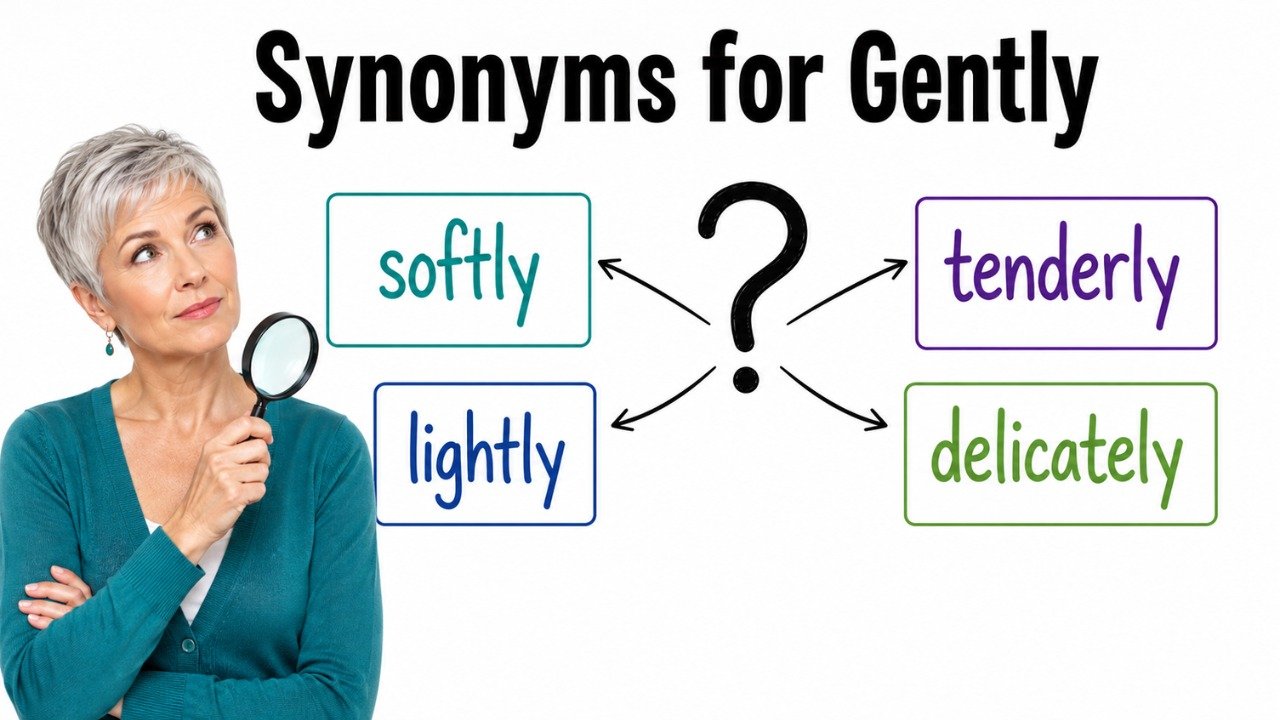
Quick Answer: The best synonyms for gently include softly, lightly, tenderly, carefully, mildly, delicately, quietly, gradually, kindly, and calmly. Use softly for sound, speech, or touch. Choose lightly when little pressure or force is involved, and carefully when an action requires attention. Tenderly works best for affection and emotional warmth, while delicately suits fragile objects or sensitive situations. Gradually describes slow change, mildly describes limited intensity, and kindly is best when gently refers to considerate behavior.
Pronunciation and Word Details
Word: Gently.
Pronunciation: /ˈdʒentli/.
Part of Speech: Adverb.
Meaning: In a soft, careful, mild, kind, or gradual manner.
US Pronunciation:
UK Pronunciation:
What Does “Gently” Mean?
Gently means doing something with little force, great care, kindness, softness, or calm control.
Gently is an adverb. It describes how an action happens and usually modifies a verb. For example, someone may speak gently, touch something gently, move gently, correct someone gently, or introduce a change gently.
The exact meaning depends on the sentence. When a person closes a door gently, the word means without force or noise. When someone speaks gently, it means in a soft and calm voice. When a nurse treats a patient gently, it suggests care and kindness.
Gently can also describe gradual movement or change. A road may rise gently, the wind may blow gently, or a color may fade gently into another shade.
Physical Action: She placed the glass gently on the table.
Speech: He gently explained the mistake.
Kindness: The teacher gently encouraged the nervous student.
Gradual Change: The path rises gently toward the hill.
Meaning, Tone, and Context of “Gently”
Gently usually has a calm, positive, and considerate tone. It suggests softness, control, care, or kindness rather than force, roughness, or sudden action.
The word is common in both casual conversation and formal writing. It appears naturally in instructions, stories, descriptions, health related guidance, workplace communication, and everyday speech.
In emotional situations, gently can make advice, correction, or criticism sound more polite. Saying that someone was gently reminded suggests that the reminder was respectful rather than harsh.
In physical descriptions, gently often means with little pressure or movement. It can describe touching, holding, pressing, stirring, lowering, closing, or placing something.
In nature writing, gently can describe smooth and peaceful movement. Rain may fall gently, leaves may move gently, and waves may reach the shore gently.
In technical instructions, gently usually means using limited force to prevent damage. However, carefully or gradually may sometimes provide greater precision.
Tone: Soft, calm, kind, and controlled.
Formality: Suitable for casual, professional, descriptive, and instructional writing.
Common Uses: Touch, speech, movement, guidance, correction, weather, change, and handling delicate objects.
Emotional Effect: It often makes an action sound caring, peaceful, or respectful.
When and How to Use “Gently”
For Soft Physical Contact
Use gently when an action involves little pressure or force.
Example: Press the surface gently with your fingertips.
For Careful Handling
Use gently when an object may break, bend, spill, or become damaged.
Example: Lift the lid gently to avoid cracking it.
For Quiet Speech
Use gently when someone speaks in a soft, calm, and reassuring voice.
Example: She gently told the child that everything would be fine.
For Kind Correction
Use gently when criticism, advice, or correction is delivered respectfully.
Example: The manager gently pointed out the error in the report.
For Affection
Use gently when an action communicates love, comfort, or emotional warmth.
Example: He gently held his grandmother’s hand.
For Calm Movement
Use gently when movement is smooth, controlled, and not sudden.
Example: The boat moved gently across the lake.
For Mild Effects
Use gently when an action or product has a limited and controlled effect.
Example: The warm water gently relaxed her tired muscles.
For Gradual Change
Use gently when a surface, path, color, sound, or condition changes slowly.
Example: The road curves gently toward the village.
For Peaceful Natural Motion
Use gently to describe wind, rain, waves, leaves, or light movement.
Example: A cool breeze moved gently through the trees.
For Polite Suggestions
Use gently when introducing an idea without sounding forceful or demanding.
Example: She gently suggested that the plan needed more discussion.
Best Synonyms for Gently
Softly: In a quiet, smooth, or low intensity manner.
Example: She spoke softly to the sleeping child.
Lightly: With little pressure, weight, or force.
Example: Tap the screen lightly with one finger.
Tenderly: With affection, sympathy, or emotional warmth.
Example: He tenderly comforted his worried friend.
Carefully: With attention intended to prevent harm or mistakes.
Example: She carefully carried the fragile vase upstairs.
Mildly: With limited strength, intensity, or severity.
Example: He was mildly surprised by the announcement.
Delicately: With great care, skill, or sensitivity.
Example: The artist delicately repaired the damaged edge.
Quietly: With little or no sound.
Example: The visitors quietly entered the room.
Gradually: In slow stages rather than suddenly.
Example: The sky gradually became darker.
Kindly: In a considerate, helpful, or friendly way.
Example: She kindly explained the instructions again.
Calmly: Without anger, panic, or emotional disturbance.
Example: He calmly answered every question.
50 Synonyms for Gently with Short Meanings
- Softly: In a quiet, smooth, or tender manner.
- Lightly: With little pressure, weight, or force.
- Tenderly: With affection, sympathy, or loving care.
- Carefully: With close attention to safety or accuracy.
- Mildly: With limited intensity, strength, or severity.
- Delicately: With great care, sensitivity, or precision.
- Quietly: With little sound or disturbance.
- Gradually: In slow and steady stages.
- Kindly: In a considerate and friendly manner.
- Calmly: Without anger, fear, or sudden emotion.
- Smoothly: In an even and controlled way.
- Slowly: At a low speed or unhurried pace.
- Cautiously: With care to avoid danger or mistakes.
- Politely: In a respectful and well mannered way.
- Lovingly: With love, warmth, or affection.
- Affectionately: In a way that shows fondness or care.
- Compassionately: With sympathy for another person’s suffering.
- Considerately: With thought for another person’s needs or feelings.
- Thoughtfully: With careful attention and kindness.
- Patiently: Without irritation while allowing enough time.
- Reassuringly: In a way that reduces fear or worry.
- Soothingly: In a way that calms discomfort or emotion.
- Comfortingly: In a manner that provides relief or support.
- Gracefully: With smooth, controlled, and attractive movement.
- Silently: Without making any sound.
- Faintly: With very little strength, sound, light, or color.
- Dimly: With limited brightness or clarity.
- Subtly: In a restrained or not immediately obvious manner.
- Moderately: Without excessive force, speed, or intensity.
- Slightly: To a small degree or extent.
- Easily: Without force, difficulty, or resistance.
- Evenly: In a balanced and consistent manner.
- Steadily: In a controlled and regular way.
- Leisurely: Without hurry or pressure.
- Peacefully: In a calm and undisturbed manner.
- Serenely: With complete calmness and peace.
- Warmly: With friendliness, affection, or sincere kindness.
- Respectfully: With consideration and proper regard.
- Tactfully: In a careful way that avoids causing offense.
- Sensitively: With awareness of feelings or delicate conditions.
- Leniently: Without excessive strictness or severity.
- Mercifully: With kindness instead of harsh punishment.
- Humanely: With compassion and concern for suffering.
- Carefully controlled: With deliberate limits on force or movement.
- With care: In a manner intended to prevent harm or error.
- With a light touch: Using little pressure or influence.
- Without force: In a manner that avoids pressure or violence.
- At a slow pace: Moving or changing without sudden speed.
- In a low voice: Speaking quietly and softly.
- With tenderness: Acting with affection, sympathy, or emotional care.
Read Also:
Synonyms for Skinny
Synonyms for Gently by Context
When Gently Means Softly
When gently describes sound, speech, or touch, softly is often the closest synonym. It suggests low volume, smoothness, or little pressure.
Other useful options include quietly, faintly, soothingly, and in a low voice.
Example With Gently: She gently called his name.
Example With Softly: She softly called his name.
Example With Quietly: She quietly called him from the doorway.
When Gently Means Lightly
When gently describes pressure, weight, or physical contact, lightly is usually the best choice.
Other alternatives include slightly, easily, with a light touch, and without force.
Example With Gently: Brush the dust away gently.
Example With Lightly: Brush the dust away lightly.
Example With a Light Touch: Clean the surface with a light touch.
When Gently Means Carefully
When gently describes the safe handling of a fragile object or sensitive task, carefully gives the clearest meaning.
Other useful words include delicately, cautiously, steadily, and with care.
Example With Gently: She gently removed the old photograph.
Example With Carefully: She carefully removed the old photograph.
Example With Delicately: She delicately lifted the photograph from the box.
When Gently Means Tenderly
When gently expresses love, sympathy, or comfort, tenderly is a more emotionally specific replacement.
Related alternatives include lovingly, affectionately, compassionately, warmly, and with tenderness.
Example With Gently: He gently placed his hand on her shoulder.
Example With Tenderly: He tenderly placed his hand on her shoulder.
Example With Compassion: He compassionately listened to her concerns.
When Gently Means Kindly
When gently describes respectful advice, correction, or behavior, kindly may be the best substitute.
Other useful alternatives include considerately, thoughtfully, politely, tactfully, and respectfully.
Example With Gently: She gently corrected his pronunciation.
Example With Kindly: She kindly corrected his pronunciation.
Example With Tactfully: She tactfully explained how the word should be pronounced.
When Gently Means Calmly
When gently describes controlled behavior or speech during a difficult situation, calmly is usually more precise.
Related words include peacefully, patiently, serenely, and reassuringly.
Example With Gently: He gently responded to the complaint.
Example With Calmly: He calmly responded to the complaint.
Example With Patiently: He patiently answered each concern.
When Gently Means Gradually
When gently describes a slow change in direction, height, color, temperature, or intensity, gradually is the clearest synonym.
Other alternatives include slowly, steadily, evenly, and at a slow pace.
Example With Gently: The road rises gently toward the hills.
Example With Gradually: The road gradually rises toward the hills.
Example With Steadily: The temperature steadily increased throughout the morning.
When Gently Means Mildly
When gently describes a weak or limited effect, mildly may communicate the intended level of intensity more clearly.
Related choices include moderately, slightly, subtly, and faintly.
Example With Gently: The cream gently warms the skin.
Example With Mildly: The cream mildly warms the skin.
Example With Slightly: The cream slightly warms the skin.
When Gently Means Smoothly
When gently describes flowing, controlled movement, smoothly may be the best replacement.
Other useful alternatives include gracefully, evenly, steadily, and easily.
Example With Gently: The curtain moved gently in the breeze.
Example With Smoothly: The curtain moved smoothly in the breeze.
Example With Gracefully: The dancer moved gracefully across the floor.
Another Word for Gently
Softly is often the best general replacement for gently, especially when describing speech, sound, touch, or peaceful movement. However, the best synonym depends on what makes the action gentle.
Use lightly for pressure, carefully for fragile objects, tenderly for affection, kindly for respectful behavior, and gradually for slow change.
Original: She gently closed the bedroom door.
Better Option: She softly closed the bedroom door.
Original: Press the fabric gently with your hand.
Better Option: Press the fabric lightly with your hand.
Original: He gently lifted the injured bird.
Better Option: He carefully lifted the injured bird.
Original: The path slopes gently toward the river.
Better Option: The path gradually slopes toward the river.
When Not to Use “Gently”
Do not use gently when a more specific adverb would explain the action more clearly. Gently can refer to softness, care, kindness, low force, or gradual change, so its meaning may sometimes feel vague.
Weak: She handled the chemical container gently.
Better: She handled the chemical container carefully.
Avoid gently when speed is the main idea. Slowly is clearer when an action happens at a low speed but does not require softness.
Weak: The long vehicle moved gently through heavy traffic.
Better: The long vehicle moved slowly through heavy traffic.
Do not use gently when silence is the most important detail. Quietly or silently provides greater accuracy.
Weak: He gently entered the room without making a sound.
Better: He silently entered the room.
Avoid gently when describing affection if emotional warmth needs stronger emphasis.
Weak: She gently embraced her daughter after the long separation.
Better: She tenderly embraced her daughter after the long separation.
Do not use gently for forceful, urgent, or aggressive actions.
Weak: The officer gently shouted the emergency warning.
Better: The officer firmly shouted the emergency warning.
Avoid repeating gently several times in the same paragraph.
Weak: She gently opened the box, gently removed the paper, and gently lifted the glass.
Better: She carefully opened the box, slowly removed the paper, and delicately lifted the glass.
Do not assume that every synonym for gently is interchangeable. Kindly describes behavior, while lightly describes physical pressure.
Weak: Tap the button kindly.
Better: Tap the button lightly.
Words Commonly Confused With Gently
Gently vs Softly: Gently is broader and may describe care, kindness, low force, or gradual change. Softly mainly describes quiet sound, smooth touch, or reduced intensity.
Gently vs Lightly: Gently can include emotional kindness or careful behavior. Lightly mainly refers to small pressure, limited weight, or slight intensity.
Gently vs Carefully: Gently emphasizes softness or limited force. Carefully emphasizes attention, safety, and avoiding mistakes.
Gently vs Slowly: Gently describes the quality of an action, while slowly describes its speed. An action can happen slowly without being gentle.
Gently vs Tenderly: Gently may describe any soft or careful action. Tenderly specifically communicates affection, sympathy, or emotional warmth.
Gently vs Quietly: Gently describes softness or care, while quietly focuses on making little sound or disturbance.
Gently vs Mildly: Gently often describes how an action is performed. Mildly usually describes a limited degree of feeling, strength, or effect.
Gently vs Delicately: Gently is a common and flexible word. Delicately suggests greater precision, sensitivity, skill, or concern for fragility.
Gently vs Gradually: Gently can describe a smooth change, but gradually specifically means that something happens in stages over time.
Gently vs Kindly: Gently may refer to physical or emotional softness. Kindly refers mainly to considerate, friendly, or helpful behavior.
Which Synonym Should You Choose?
Choose softly when describing a quiet voice, sound, touch, or smooth movement.
Choose lightly when only a small amount of pressure, force, weight, or contact is needed.
Choose carefully when safety, accuracy, or protection from damage is the main concern.
Choose tenderly when describing affection, comfort, sympathy, or emotional warmth.
Choose delicately when handling something fragile or completing a sensitive task that requires precision.
Choose quietly when the lack of noise is more important than softness.
Choose gradually when describing slow change in temperature, direction, color, height, or intensity.
Choose mildly when describing a limited reaction, effect, flavor, emotion, or level of severity.
Choose kindly when referring to polite, friendly, or considerate treatment.
Choose calmly when a person remains controlled during conflict, pressure, or uncertainty.
Choose tactfully in professional emails, workplace discussions, and sensitive conversations where offense should be avoided.
Choose respectfully when speaking to someone whose position, feelings, or boundaries deserve particular consideration.
Choose cautiously in reports or instructions when a person must avoid danger, risk, or error.
Choose subtly in essays and descriptive writing when a change or influence is restrained and not obvious.
Choose smoothly when describing controlled movement, transition, or operation.
Choose patiently when the gentle behavior involves allowing time without frustration.
Real Life Examples of “Gently” in Sentences
Original: She gently placed the baby in the bed.
Better Option: She tenderly placed the baby in the bed.
Original: He gently pressed the button.
Better Option: He lightly pressed the button.
Original: The nurse gently cleaned the wound.
Better Option: The nurse carefully cleaned the wound.
Original: She gently explained why the request could not be approved.
Better Option: She tactfully explained why the request could not be approved.
Original: The wind gently moved the branches.
Better Option: The wind softly moved the branches.
Original: The road gently curves around the lake.
Better Option: The road gradually curves around the lake.
Original: He gently answered the angry customer.
Better Option: He calmly answered the angry customer.
Original: She gently reminded me about the deadline.
Better Option: She kindly reminded me about the deadline.
Original: The light gently faded from the sky.
Better Option: The light gradually faded from the sky.
Original: He gently lifted the damaged frame.
Better Option: He delicately lifted the damaged frame.
Synonym Groups and Usage Differences
Softness Group
Softly, lightly, faintly, quietly, and slightly describe reduced force, sound, pressure, or intensity.
Softly is the most flexible option for quiet speech and smooth contact. Lightly is more precise for pressure. Faintly describes something that is barely noticeable.
Example: She lightly touched the painted surface to check whether it was dry.
Care Group
Carefully, delicately, cautiously, steadily, and with care describe actions performed with attention and control.
Carefully is the broadest choice. Delicately suits fragile objects and precise work, while cautiously suggests possible danger or risk.
Example: The technician carefully removed the damaged part.
Affection Group
Tenderly, lovingly, affectionately, warmly, and with tenderness express emotional closeness or care.
Tenderly often combines affection with softness. Lovingly gives greater emphasis to love, while warmly can describe friendly speech or behavior.
Example: She tenderly comforted her younger brother.
Kindness Group
Kindly, considerately, thoughtfully, compassionately, and humanely describe actions guided by concern for others.
Kindly is natural in everyday speech. Considerately emphasizes awareness of another person’s needs. Compassionately suits situations involving pain or difficulty.
Example: The receptionist kindly helped the visitor complete the form.
Calmness Group
Calmly, peacefully, serenely, patiently, and reassuringly describe behavior without panic, anger, or disturbance.
Calmly is suitable for difficult discussions. Reassuringly describes speech or behavior that reduces worry.
Example: The doctor reassuringly explained the next steps.
Gradual Change Group
Gradually, slowly, steadily, evenly, and at a slow pace describe movement or change that does not happen suddenly.
Gradually focuses on stages of change. Steadily emphasizes consistency, while evenly suggests balance or equal distribution.
Example: The room gradually became warmer after sunrise.
Mildness Group
Mildly, moderately, slightly, subtly, and faintly describe a low degree of strength or intensity.
Mildly suits reactions, weather, flavors, and effects. Subtly describes something restrained or not immediately obvious.
Example: The speaker subtly changed the direction of the conversation.
Smooth Movement Group
Smoothly, gracefully, easily, leisurely, and steadily describe controlled or untroubled motion.
Smoothly emphasizes the absence of interruption. Gracefully adds elegance, while leisurely suggests a relaxed pace.
Example: The boat moved smoothly across the calm water.
Politeness Group
Politely, respectfully, tactfully, considerately, and thoughtfully describe communication that protects dignity and feelings.
Politely is the broadest option. Tactfully is best for sensitive information, while respectfully emphasizes proper regard for another person.
Example: She tactfully raised the concern during the meeting.
Antonyms of Gently
The opposite of gently depends on whether the word refers to touch, speech, behavior, movement, or intensity.
Roughly: With force, unevenness, or a lack of care.
Harshly: In a severe, unkind, or unpleasant manner.
Forcefully: With strong physical or emotional power.
Violently: With extreme force intended or likely to cause harm.
Loudly: With a high level of sound.
Abruptly: Suddenly and without smoothness or warning.
Carelessly: Without enough attention to safety or accuracy.
Recklessly: Without proper concern for danger or consequences.
Cruelly: In a way that causes suffering or shows no compassion.
Aggressively: In a forceful, hostile, or confrontational manner.
Firmly: With strength, control, or determination.
Quickly: At a fast speed.
Suddenly: Without gradual development or warning.
Severely: With great intensity, strictness, or seriousness.
Impatiently: With irritation caused by delay or difficulty.
Insensitive: Without proper awareness of another person’s feelings.
Clumsily: Without smooth control, care, or skill.
Sharply: In a sudden, strong, or severe manner.
Sternly: In a serious, strict, and demanding manner.
Heavily: With considerable weight, pressure, or force.
Comparison: Gently vs Related Words
Gently vs Softly
Gently has a broad meaning that can include softness, care, kindness, or gradual change. Softly mainly refers to low sound, smooth touch, or reduced force.
Example With Gently: She gently guided the child toward the door.
Example With Softly: She softly called the child’s name.
Gently vs Lightly
Gently describes an action performed without roughness. Lightly specifically means with little pressure, weight, or intensity.
Example With Gently: He gently held the injured hand.
Example With Lightly: He lightly touched the injured hand.
Gently vs Carefully
Gently focuses on softness and limited force. Carefully focuses on attention and the prevention of harm or mistakes.
Example With Gently: She gently lowered the bag onto the floor.
Example With Carefully: She carefully checked the bag for damage.
Gently vs Tenderly
Gently can describe a neutral physical action. Tenderly adds affection, sympathy, or emotional warmth.
Example With Gently: He gently adjusted the blanket.
Example With Tenderly: He tenderly comforted his frightened daughter.
Gently vs Quietly
Gently describes the manner of an action, while quietly emphasizes little or no sound.
Example With Gently: She gently placed the cup on the table.
Example With Quietly: She quietly left the room.
Gently vs Slowly
Gently relates to softness or control. Slowly relates only to speed.
Example With Gently: He gently pushed the door open.
Example With Slowly: He slowly walked toward the entrance.
Gently vs Mildly
Gently often modifies a physical or verbal action. Mildly usually describes a limited degree of emotion, reaction, or effect.
Example With Gently: The therapist gently moved his arm.
Example With Mildly: He was mildly concerned about the delay.
Gently vs Delicately
Gently is broad and conversational. Delicately suggests careful skill, precision, sensitivity, or fragility.
Example With Gently: She gently touched the flower.
Example With Delicately: She delicately arranged the flower petals.
Gently vs Gradually
Gently can suggest a smooth change, but gradually directly describes something developing in stages.
Example With Gently: The land rises gently beyond the field.
Example With Gradually: The temperature gradually increased during the afternoon.
Gently vs Kindly
Gently can describe physical movement, speech, or behavior. Kindly mainly describes friendly and considerate treatment.
Example With Gently: She gently moved the chair aside.
Example With Kindly: She kindly offered the visitor a seat.
Common Phrases and Expressions With Gently
Speak Gently: Talk in a soft, calm, or considerate voice.
Touch Gently: Make physical contact with little pressure.
Press Gently: Apply a small and controlled amount of force.
Handle Gently: Treat an object carefully to avoid damage.
Stir Gently: Mix something slowly without excessive force.
Gently Remind: Give a polite reminder without sounding demanding.
Gently Encourage: Support someone calmly and positively.
Gently Guide: Direct a person or object with care and limited force.
Gently Sloping: Rising or falling gradually rather than steeply.
Gently Flowing: Moving in a smooth, calm, and controlled manner.
Common Mistakes to Avoid
Repeating Gently Too Often
Using gently repeatedly can make writing sound weak or monotonous. Replace it with a synonym that explains the exact type of softness or care.
Repetitive: She gently opened the box, gently moved the paper, and gently removed the ring.
Improved: She carefully opened the box, slowly moved the paper, and delicately removed the ring.
Confusing Softness With Slowness
An action can be gentle without being slow, and it can be slow without being gentle.
Unclear: The vehicle gently traveled along the road.
Better: The vehicle slowly traveled along the road.
Using Gently When Carefully Is More Accurate
Instructions involving safety or fragile equipment often require carefully rather than gently.
Weak: Gently inspect the electrical connection.
Better: Carefully inspect the electrical connection.
Choosing an Emotional Synonym for a Physical Action
Tenderly and lovingly express emotion, so they may sound unnatural in mechanical instructions.
Unnatural: Tenderly tighten the screw.
Better: Carefully tighten the screw.
Choosing Lightly for Kind Behavior
Lightly usually refers to pressure, weight, or seriousness. It does not normally replace gently when kindness is intended.
Unnatural: She lightly corrected the nervous student.
Better: She kindly corrected the nervous student.
Using Quietly When Sound Is Not Relevant
Quietly should describe low sound or little disturbance. It may not fit actions focused on pressure or care.
Weak: Quietly press the surface with your thumb.
Better: Lightly press the surface with your thumb.
Making Instructions Too Vague
Gently may not explain how much pressure, time, or movement is required. Add specific instructions when precision matters.
Vague: Move the control gently.
Clearer: Move the control slowly with light pressure.
Using Too Many Adverbs Together
Several adverbs can make a sentence wordy and unnatural.
Wordy: She gently, softly, and carefully placed the glass down.
Better: She carefully placed the glass down.
Confusing Mildly With Gently
Mildly usually describes degree, while gently describes manner.
Incorrect: She mildly placed the book on the desk.
Correct: She gently placed the book on the desk.
Using Gently for Strong Commands
Gently does not suit actions that require urgency, authority, or significant force.
Weak: He gently ordered everyone to leave during the emergency.
Better: He firmly ordered everyone to leave during the emergency.
Conclusion
The best synonyms for gently depend on the action being described. Softly suits quiet speech and smooth touch, while lightly expresses limited pressure. Carefully and delicately are better for fragile objects, and tenderly communicates affection. Choose kindly or tactfully for considerate communication, calmly for controlled behavior, and gradually for slow change. Understanding these synonyms for gently helps you describe actions with greater accuracy, avoid repetition, and communicate the right level of softness, care, kindness, or control.
FAQs About Synonyms for Gently
What Is the Best Synonym for Gently?
Softly is the best general synonym, especially for speech, sound, touch, and smooth movement.
What Is Another Word for Gently Touching Something?
Lightly is usually the best choice. Tenderly works when the touch communicates affection.
What Is a Formal Synonym for Gently?
Carefully, delicately, tactfully, considerately, and gradually are useful formal alternatives, depending on the context.
Is Softly the Same as Gently?
The words are similar, but gently has a broader meaning. It may describe kindness, care, low force, or gradual change, while softly mainly refers to sound or touch.
What Is the Opposite of Gently?
Common opposites include roughly, harshly, forcefully, violently, carelessly, and abruptly.
Can Carefully Replace Gently?
Carefully can replace gently when the main idea is preventing damage, danger, or mistakes. It may not fit when gently means kindly or quietly.
Which Synonym for Gently Describes Kind Speech?
Kindly, softly, tactfully, respectfully, and reassuringly can all describe gentle speech. The best choice depends on whether the focus is friendliness, volume, sensitivity, respect, or comfort.
