
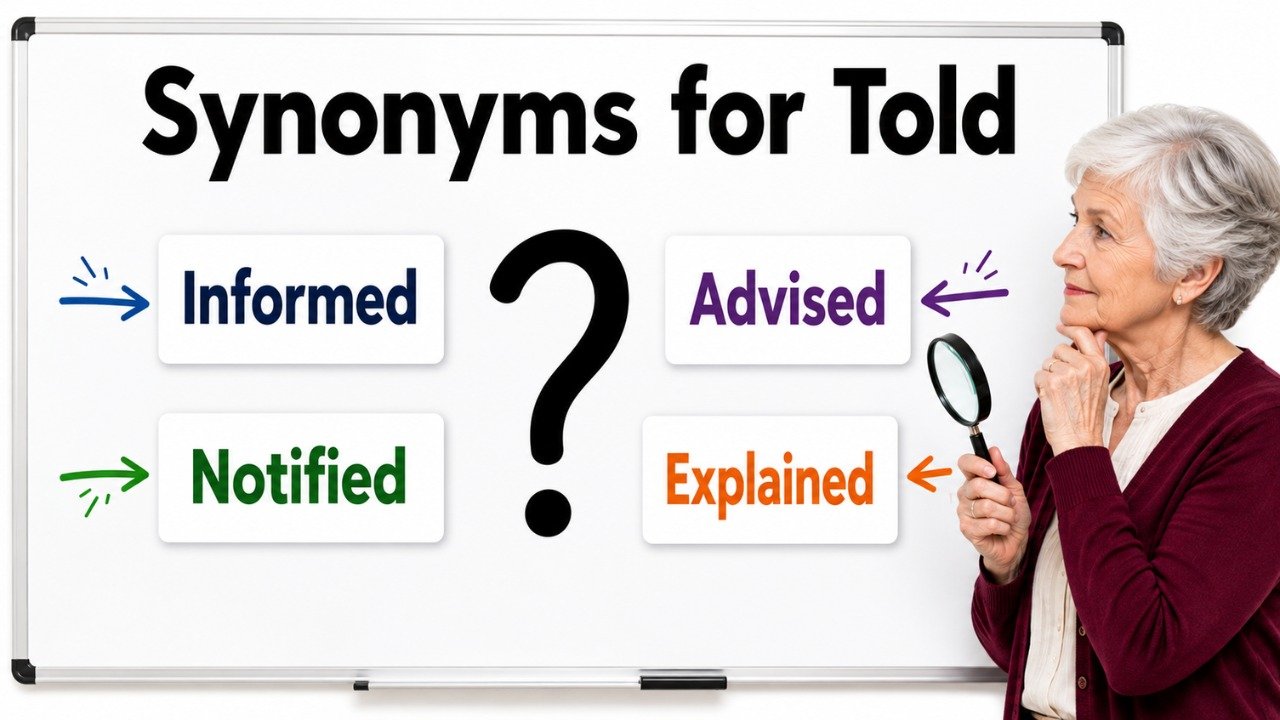
Quick Answer: Common synonyms for told include informed, advised, instructed, notified, explained, reported, revealed, warned, narrated, and ordered. Use informed or notified when sharing information, advised when offering guidance, instructed when explaining what someone should do, ordered for a strong command, warned for danger, revealed for private information, narrated for a story, and reported for formal facts. These synonyms for told help make writing clearer by showing exactly how, why, and with what tone information was communicated.
Pronunciation and Word Details
Word: Told.
Pronunciation: /toʊld/
Part of Speech: Verb.
Meaning: The past tense and past participle of tell, meaning to communicate information, give instructions, describe something, or reveal facts to someone.
US Pronunciation:
UK Pronunciation:
What Does “Told” Mean?
Told means communicated information, instructions, facts, opinions, or a story to another person. It is the past tense and past participle form of the verb tell.
The word usually appears with a person or group receiving the information.
Example: She told me the answer.
In this sentence, me identifies the person who received the answer. Unlike said, told usually requires an object that shows who received the message.
Told can describe several kinds of communication. It may refer to giving information, explaining a situation, issuing an instruction, sharing a secret, warning someone, or narrating a story.
Information: The doctor told us the results.
Instruction: The teacher told the students to open their books.
Warning: They told him not to touch the wire.
Storytelling: My grandfather told us a fascinating story.
Disclosure: She told her friend the truth.
The exact meaning depends on what was communicated and how strongly it was expressed.
Meaning, Tone, and Context of “Told”
Told is a neutral and highly common word. It appears naturally in casual conversations, personal writing, stories, news reports, emails, essays, and professional communication.
Its tone changes according to context. In one sentence, it may sound friendly and conversational. In another, it may suggest authority, pressure, or seriousness.
Neutral Tone: She told me when the meeting would begin.
Friendly Tone: He told us a funny story after dinner.
Formal Tone: The manager told the committee about the revised policy.
Strong Tone: The officer told everyone to leave immediately.
Emotional Tone: She finally told her family how she felt.
Although told is correct in many situations, it can sometimes sound vague. A more precise synonym can explain whether someone informed, warned, advised, ordered, revealed, or narrated something.
In formal reports, informed, notified, explained, reported, or confirmed may sound more specific. In storytelling, narrated, recounted, or related can add greater detail. In instructions, directed, advised, or ordered can show the level of authority involved.
When and How to Use “Told”
For Sharing Information
Use told when someone communicated facts, news, or general information.
Example: Maria told us that the office would close early.
For Giving Instructions
Use told when someone explained what another person needed to do.
Example: The instructor told the class to complete the first exercise.
For Giving an Order
Told can express authority when a person demands that someone perform an action.
Example: The supervisor told the workers to stop immediately.
For Offering Advice
Use told when referring generally to advice that someone gave.
Example: My brother told me to check the details before signing.
For Giving a Warning
Told can introduce a warning about danger, risk, or possible consequences.
Example: We told them not to walk near the damaged bridge.
For Sharing a Secret
Use told when someone revealed private or sensitive information.
Example: She told her closest friend the secret.
For Explaining a Situation
Told can describe communication that helped another person understand an event or problem.
Example: He told the technician what had happened to the computer.
For Narrating a Story
Use told when someone described events in a story or personal experience.
Example: The traveler told an exciting story about the journey.
For Reporting Speech
Told is frequently used when reporting what one person communicated to another.
Example: James told me that he would arrive before noon.
Best Synonyms for Told
Informed
Synonym: Informed means gave someone facts or important information.
Example: The receptionist informed us that the appointment had been delayed.
Advised
Synonym: Advised means offered guidance or recommended an action.
Example: The consultant advised the team to review the contract carefully.
Instructed
Synonym: Instructed means gave clear directions about what to do.
Example: The coach instructed the players to remain focused.
Notified
Synonym: Notified means officially made someone aware of something.
Example: The company notified customers about the schedule change.
Explained
Synonym: Explained means made an idea, situation, or process easier to understand.
Example: The guide explained how the security system worked.
Reported
Synonym: Reported means formally communicated facts, results, or events.
Example: The researcher reported the findings to the committee.
Revealed
Synonym: Revealed means made previously hidden or unknown information known.
Example: She revealed the reason for her sudden decision.
Warned
Synonym: Warned means informed someone about a danger or possible problem.
Example: The guard warned visitors about the slippery floor.
Narrated
Synonym: Narrated means told a story or described a sequence of events.
Example: The author narrated the events from the child’s perspective.
Ordered
Synonym: Ordered means gave a strong and authoritative command.
Example: The captain ordered the crew to return to their positions.
50 Synonyms for Told with Short Meanings
- Informed: Gave someone facts or information.
- Notified: Officially made someone aware.
- Advised: Offered guidance about what to do.
- Instructed: Gave clear directions or teaching.
- Ordered: Gave an authoritative command.
- Commanded: Directed someone with strong authority.
- Directed: Guided someone toward an action.
- Warned: Communicated danger or possible harm.
- Reminded: Helped someone remember something.
- Assured: Spoke confidently to remove doubt.
- Explained: Made something easier to understand.
- Reported: Communicated facts or events formally.
- Announced: Made information publicly known.
- Declared: Stated something clearly and firmly.
- Stated: Expressed information in definite words.
- Mentioned: Referred to something briefly.
- Revealed: Made hidden information known.
- Disclosed: Shared information that had been private.
- Shared: Communicated information or feelings with others.
- Communicated: Passed information from one person to another.
- Conveyed: Expressed or delivered a message.
- Related: Told details about an event or experience.
- Narrated: Told a story in an organized way.
- Recounted: Described past events in detail.
- Described: Explained what someone or something was like.
- Briefed: Gave important information or instructions.
- Updated: Provided the newest information.
- Alerted: Made someone aware of a risk or issue.
- Apprised: Formally informed someone about a situation.
- Confirmed: Stated that something was true or certain.
- Admitted: Acknowledged something reluctantly or honestly.
- Confessed: Revealed a private truth or wrongdoing.
- Acknowledged: Accepted or recognized a fact openly.
- Answered: Responded to a question.
- Replied: Gave a spoken or written response.
- Responded: Reacted by communicating an answer.
- Testified: Gave formal evidence or a statement.
- Promised: Gave an assurance about a future action.
- Urged: Strongly encouraged someone to act.
- Encouraged: Gave support or confidence through words.
- Requested: Politely asked someone to do something.
- Asked: Used words to seek information or action.
- Suggested: Presented an idea for consideration.
- Recommended: Advised that a choice was suitable.
- Cautioned: Warned someone to be careful.
- Counseled: Gave thoughtful advice or guidance.
- Forewarned: Warned someone before a possible event.
- Made Known: Caused information to become understood.
- Let Know: Informed someone in casual language.
- Said To: Communicated words directly to another person.
Read Also:
Synonyms for Actually

Synonyms for Told by Context
When Told Means Informed
When told means giving facts or news, useful synonyms include informed, notified, briefed, updated, apprised, and alerted.
Informed: Best for neutral or professional communication.
Example: The administrator informed employees about the new schedule.
Notified: Best for official information or formal notices.
Example: Residents were notified about the planned repairs.
Briefed: Best when someone receives essential details before an event or task.
Example: The team was briefed before the presentation.
Updated: Best when providing the newest information.
Example: She updated us on the progress of the project.
Apprised: Best for formal writing and professional situations.
Example: The director apprised the board of recent developments.
When Told Means Instructed
When told means directing someone to act, useful synonyms include instructed, directed, ordered, commanded, advised, and urged.
Instructed: Suggests clear and organized directions.
Example: The trainer instructed everyone to follow the safety procedure.
Directed: Suggests guidance toward a particular task or place.
Example: The receptionist directed us to the second floor.
Ordered: Shows strong authority and little choice.
Example: The judge ordered the documents to be released.
Advised: Suggests helpful guidance rather than force.
Example: The doctor advised him to get more rest.
Urged: Suggests strong encouragement without a direct command.
Example: Her family urged her to reconsider the offer.
When Told Means Narrated
When told means sharing a story or describing events, useful synonyms include narrated, recounted, related, described, and explained.
Narrated: Best for an organized story or sequence of events.
Example: She narrated the documentary in a calm voice.
Recounted: Best for describing a past experience in detail.
Example: He recounted everything that happened during the journey.
Related: Best for formally telling an experience or series of events.
Example: The witness related the events as clearly as possible.
Described: Best when explaining what something looked or felt like.
Example: She described the room as bright and spacious.
When Told Means Revealed
When told means making private or hidden information known, useful synonyms include revealed, disclosed, admitted, confessed, and shared.
Revealed: Suggests that unknown information became known.
Example: The report revealed several unexpected problems.
Disclosed: Often refers to private, official, or sensitive information.
Example: The applicant disclosed all relevant financial details.
Admitted: Suggests accepting a fact that may be uncomfortable.
Example: He admitted that he had made the mistake.
Confessed: Suggests revealing wrongdoing, guilt, or a deeply personal truth.
Example: She confessed that she had hidden the letter.
When Told Means Said
When told refers generally to spoken communication, useful synonyms include stated, declared, mentioned, answered, and replied.
Stated: Best for clear, direct, or formal wording.
Example: The witness stated that the door had been open.
Declared: Best for a strong, confident, or public statement.
Example: The leader declared that the plan would continue.
Mentioned: Best for a brief or casual reference.
Example: He mentioned that he might arrive late.
Replied: Best when someone answers another person.
Example: She replied that she needed more time.
Another Word for Told
Informed is often the best single replacement for told when the sentence describes giving someone information. However, the best alternative depends on whether the speaker gave advice, instructions, a warning, an order, or a personal story.
Original: The manager told us about the updated procedure.
Better Option: The manager informed us about the updated procedure.
Original: The teacher told the students how to solve the problem.
Better Option: The teacher instructed the students on how to solve the problem.
Original: She told him that the road was dangerous.
Better Option: She warned him that the road was dangerous.
Original: My grandfather told us about his childhood.
Better Option: My grandfather recounted stories from his childhood.
When Not to Use “Told”
Told is useful, but it may sound repetitive, vague, or less accurate when a sentence needs to show the exact purpose or tone of the communication.
When the Communication Was Official
Use notified or informed when the message was formal or official.
Weak: The office told employees about the closure.
Better: The office notified employees about the closure.
When Clear Instructions Were Given
Use instructed or directed when someone explained exactly what another person needed to do.
Weak: The trainer told us how to use the equipment.
Better: The trainer instructed us on how to use the equipment.
When There Was a Serious Danger
Use warned, cautioned, or alerted to make the risk clear.
Weak: The guide told us about the unstable path.
Better: The guide warned us about the unstable path.
When Someone Shared a Detailed Story
Use narrated, recounted, or related for a more descriptive sentence.
Weak: She told her experience during the interview.
Better: She recounted her experience during the interview.
When Someone Revealed Private Information
Use revealed, disclosed, admitted, or confessed when secrecy matters.
Weak: He told everyone the hidden reason.
Better: He revealed the hidden reason to everyone.
When Told Becomes Repetitive
Repeated use of told can make a paragraph sound plain and monotonous.
Weak: She told me the news, told me the reason, and told me what to do next.
Better: She shared the news, explained the reason, and advised me about what to do next.
Words Commonly Confused With Told
Told vs Said: Told usually identifies the person who received the message, while said focuses on the words that were spoken. Write she told me, but write she said something to me.
Told vs Informed: Told is general and conversational. Informed specifically means giving someone facts or news and often sounds more professional.
Told vs Asked: Told usually gives information or direction. Asked seeks information, permission, or action from another person.
Told vs Instructed: Told may refer to any kind of communication. Instructed specifically means giving clear directions or teaching someone how to do something.
Told vs Explained: Told communicates information, while explained makes an idea, reason, or process easier to understand.
Told vs Ordered: Told may be neutral, but ordered shows authority and indicates that compliance is expected.
Told vs Warned: Told communicates a message generally. Warned specifically communicates danger, risk, or negative consequences.
Told vs Revealed: Told may involve ordinary information. Revealed suggests that the information was previously unknown, hidden, or secret.
Which Synonym Should You Choose?
Choose informed when someone gave facts, news, or useful information in a neutral or professional setting.
Choose notified when the communication was official, formal, or connected to an important change.
Choose advised when someone offered guidance without forcing the listener to act.
Choose instructed when someone gave clear steps, teaching, or directions.
Choose directed when someone guided another person toward a task, location, or action.
Choose ordered or commanded when the speaker had authority and expected immediate obedience.
Choose warned when the message concerned danger, risk, or negative consequences.
Choose explained when the speaker made a reason, process, or idea easier to understand.
Choose reported when communicating findings, events, results, or facts in reports and formal writing.
Choose stated when presenting a fact or position clearly in an essay, report, or professional email.
Choose revealed or disclosed when the information was previously private, hidden, or unknown.
Choose admitted or confessed when someone accepted responsibility or revealed an uncomfortable truth.
Choose narrated or recounted when describing a story, memory, or sequence of past events.
Choose mentioned when the information was brief, casual, or not the main subject.
Choose replied or answered when the communication was a response to a question or previous statement.
Real Life Examples of “Told” in Sentences
Original: The receptionist told me that the doctor was unavailable.
Better Option: The receptionist informed me that the doctor was unavailable.
Original: My teacher told me to revise the final paragraph.
Better Option: My teacher advised me to revise the final paragraph.
Original: The officer told everyone to leave the building.
Better Option: The officer ordered everyone to leave the building.
Original: She told us how the new machine worked.
Better Option: She explained how the new machine worked.
Original: They told residents about the water interruption.
Better Option: They notified residents about the water interruption.
Original: He told me not to open the damaged package.
Better Option: He warned me not to open the damaged package.
Original: My aunt told us a story about her childhood.
Better Option: My aunt recounted a story about her childhood.
Original: The witness told the court what she had observed.
Better Option: The witness testified about what she had observed.
Original: The report told us that sales had increased.
Better Option: The report revealed that sales had increased.
Original: She told her supervisor that she had missed the deadline.
Better Option: She admitted to her supervisor that she had missed the deadline.
Synonym Groups and Usage Differences
Information Group
Informed, notified, briefed, updated, apprised, and alerted belong to the information group. These words describe making someone aware of facts, changes, or developments.
Informed is neutral, notified is official, briefed is concise and purposeful, updated provides recent information, apprised is highly formal, and alerted often involves urgency.
Example: The coordinator briefed the volunteers before the event.
Instruction Group
Instructed, directed, ordered, commanded, advised, and urged describe different levels of guidance or authority.
Instructed gives clear directions. Directed guides someone toward an action. Ordered and commanded express authority. Advised offers guidance. Urged strongly encourages action.
Example: The supervisor instructed the team to review every application.
Storytelling Group
Narrated, recounted, related, and described are useful when someone communicates a story, memory, experience, or sequence of events.
Narrated is organized and story focused. Recounted describes past events. Related sounds slightly formal. Described focuses on details and qualities.
Example: The explorer recounted the challenges of the expedition.
Disclosure Group
Revealed, disclosed, admitted, confessed, and acknowledged describe information becoming known.
Revealed makes hidden facts visible. Disclosed shares private information. Admitted accepts a fact. Confessed reveals guilt or a private truth. Acknowledged openly recognizes something.
Example: The investigation revealed the cause of the error.
Warning Group
Warned, cautioned, alerted, and forewarned communicate possible danger or trouble.
Warned is the most general choice. Cautioned encourages careful behavior. Alerted draws immediate attention to a problem. Forewarned means giving notice before something happens.
Example: The technician cautioned us against touching the exposed cable.
Formal Statement Group
Reported, stated, declared, announced, confirmed, and testified are useful in reports, essays, public statements, and official communication.
Reported presents facts or findings. Stated expresses information clearly. Declared sounds strong and confident. Announced makes information public. Confirmed establishes certainty. Testified gives formal evidence.
Example: The analyst reported that the results were consistent.
Antonyms of Told
The opposite of told depends on whether told means shared information, revealed a secret, gave an order, or spoke to another person.
Concealed: Kept information hidden.
Withheld: Chose not to provide information.
Hid: Prevented something from becoming known.
Suppressed: Deliberately prevented information from being shared.
Denied: Claimed that something was not true.
Kept Secret: Refused to reveal private information.
Remained Silent: Said nothing about a subject.
Listened: Received communication instead of giving it.
Asked: Sought information instead of providing it.
Ignored: Failed to communicate or respond when communication was expected.
Comparison: Told vs Related Words
Told vs Said
Told normally includes a person who receives the message. Said focuses more directly on the spoken words.
Example With Told: She told me that the store was closed.
Example With Said: She said that the store was closed.
Do not write she told that the store was closed unless a receiver is added.
Told vs Informed
Told is broad and conversational. Informed is more precise when someone communicates facts or news.
Example With Told: The manager told us about the change.
Example With Informed: The manager informed us about the change.
Told vs Explained
Told means communicated information. Explained means made information understandable by providing reasons, details, or steps.
Example With Told: He told me the rule.
Example With Explained: He explained why the rule was necessary.
Told vs Ordered
Told can be neutral or authoritative. Ordered clearly expresses power, authority, and an expectation of obedience.
Example With Told: She told the staff to wait outside.
Example With Ordered: She ordered the staff to wait outside.
Told vs Advised
Told may give a direction without showing whether it was optional. Advised suggests guidance or a recommendation.
Example With Told: The doctor told me to reduce my workload.
Example With Advised: The doctor advised me to reduce my workload.
Told vs Warned
Told communicates information generally. Warned communicates a risk, danger, or possible negative result.
Example With Told: He told us about the strong current.
Example With Warned: He warned us about the strong current.
Told vs Revealed
Told can refer to ordinary information. Revealed indicates that the information was hidden, unknown, or surprising.
Example With Told: She told us the answer.
Example With Revealed: She revealed the answer that had been kept secret.
Common Phrases and Expressions With “Told”
Told the Truth: Communicated facts honestly.
Told a Lie: Deliberately communicated something untrue.
Told a Story: Narrated real or imagined events.
Told Someone Off: Spoke angrily to criticize someone.
Told Apart: Recognized the difference between similar people or things.
Told in Confidence: Shared privately with the expectation of secrecy.
Told to Do Something: Received an instruction, direction, or command.
Told Everything: Shared all available information.
Told Beforehand: Informed someone before an event occurred.
Told Repeatedly: Gave the same information or instruction many times.
Common Mistakes to Avoid
Using Told Without a Receiver
Told normally needs a person or group receiving the message.
Incorrect: She told that the meeting was canceled.
Correct: She told us that the meeting was canceled.
You can also use said when no receiver is mentioned.
Correct: She said that the meeting was canceled.
Using Told To Before a Person
Do not normally place to between told and the person receiving the message.
Incorrect: He told to me that he was leaving.
Correct: He told me that he was leaving.
Use to with said instead.
Correct: He said to me that he was leaving.
Confusing Told With Asked
Told gives information or instructions. Asked requests information or action.
Incorrect: She told me what time the train arrived, when she was seeking the information.
Correct: She asked me what time the train arrived.
Repeating Told Too Often
Using told in every sentence can make writing sound dull and imprecise.
Repetitive: He told me the news. He told me the reason. He told me what to do.
Improved: He shared the news, explained the reason, and advised me about what to do.
Choosing a Synonym With the Wrong Strength
Ordered and commanded are much stronger than advised or suggested. Use them only when authority or force is present.
Unnatural: My friend commanded me to try the new recipe.
Better: My friend suggested that I try the new recipe.
Using Informed for Storytelling
Informed is appropriate for facts and news, but it sounds unnatural for stories and personal memories.
Unnatural: My grandmother informed us a bedtime story.
Better: My grandmother told us a bedtime story.
Better Alternative: My grandmother narrated a bedtime story.
Confusing Told With Explained
Telling someone a fact is different from explaining why or how something happened.
Basic Information: The mechanic told me the cost.
Detailed Explanation: The mechanic explained why the repair was necessary.
Using Vague Communication Verbs
Choose a precise synonym when the type of communication matters.
Vague: The safety officer told us about the problem.
Precise: The safety officer warned us about the problem.
Conclusion
The best synonyms for told depend on the purpose, tone, and strength of the message. Use informed or notified for information, advised for guidance, instructed for clear directions, ordered for authority, warned for danger, revealed for hidden facts, and narrated or recounted for stories. In formal writing, specific alternatives often make sentences clearer than told. Understanding these synonyms for told will help you describe communication accurately while avoiding repetition, vague wording, and incorrect grammar.
FAQs About Synonyms for Told
What Is the Best Synonym for Told?
Informed is the best general synonym when told means giving someone facts or news. Other choices depend on the context.
What Is a Formal Synonym for Told?
Informed, notified, apprised, reported, stated, and disclosed are useful formal alternatives.
What Can I Use Instead of Told in a Story?
Use narrated, recounted, related, described, explained, revealed, replied, or mentioned depending on the action.
What Is the Difference Between Told and Said?
Told usually requires a receiver, as in she told me. Said can stand without one, as in she said she was ready.
Is Instructed a Synonym for Told?
Yes. Instructed is a strong synonym when told means giving clear directions or teaching someone what to do.
What Is Another Word for Told a Secret?
Revealed, disclosed, shared, admitted, or confessed may replace told when private information becomes known.
How Can I Avoid Repeating Told?
Identify the purpose of each statement. Replace told with informed, explained, warned, advised, replied, revealed, narrated, or another precise communication verb.
