
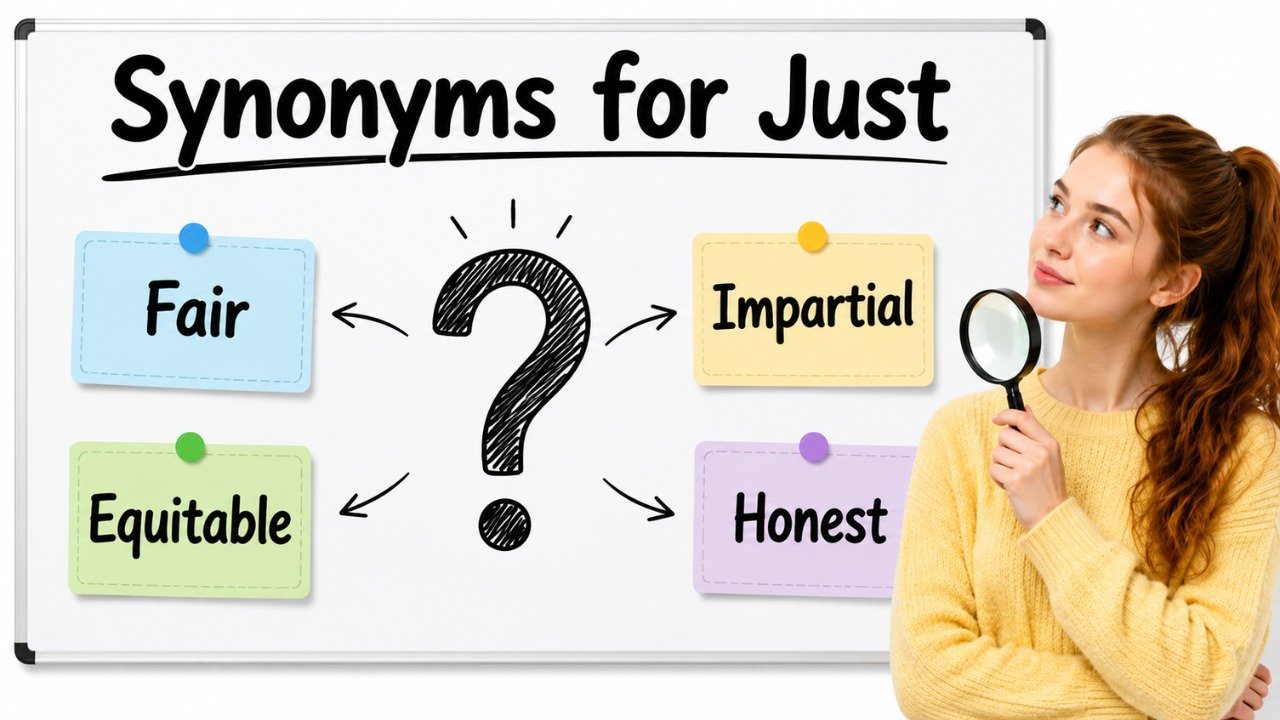
Quick Answer: The best synonyms for just include fair, impartial, equitable, only, merely, simply, exactly, precisely, recently, and barely. Use fair, impartial, or equitable when describing justice and equal treatment. Choose only, merely, or simply when limiting the meaning of a statement. Use exactly or precisely for accuracy and specific detail. Recently works when just refers to a short time ago, while barely is best when something happened by a very small amount.
Pronunciation and Word Details
Word: Just.
Pronunciation: /dʒʌst/.
Part of Speech: Adjective and adverb.
Meaning: Fair and morally right, or used to mean only, exactly, recently, or by a very small amount.
US Pronunciation:
UK Pronunciation:
What Does “Just” Mean?
Just means fair and morally right, but it can also mean only, exactly, recently, simply, or barely.
As an adjective, just describes a person, action, decision, law, or system that treats people fairly.
Example: The judge made a just decision.
In this sentence, just means fair, reasonable, and based on proper principles.
As an adverb, just has several common meanings.
For Limitation: It can mean only or merely.
Example: I need just one minute.
For Exactness: It can mean exactly or precisely.
Example: This is just what I was looking for.
For Recent Time: It can mean a short time ago.
Example: She just arrived.
For a Small Amount: It can mean barely or narrowly.
Example: We just caught the train.
For Emphasis: It can strengthen a feeling, opinion, or statement.
Example: That performance was just wonderful.
The meaning of just depends heavily on its position in the sentence and the words around it. Readers must use context to decide whether it refers to fairness, limitation, time, accuracy, or emphasis.
Meaning, Tone, and Context of “Just”
Just is a common and flexible word used in formal writing, casual speech, academic discussion, legal language, personal communication, and everyday conversation.
When just means fair, its tone is serious, positive, and often formal. It appears in discussions about law, ethics, punishment, equality, leadership, and social responsibility.
Formal Context: A just system protects the rights of every citizen.
When just means only or merely, it usually has a neutral or casual tone. It limits the meaning of a statement or makes a request sound smaller.
Casual Context: I just need a little help.
When just means recently, it is common in conversation and informal writing.
Conversational Context: We just finished dinner.
When just means exactly, it can express accuracy, agreement, or emphasis.
Accuracy Context: The box fits just inside the cabinet.
Agreement Context: That is just what I meant.
Just can also make a sentence sound softer and more polite.
Polite Context: I just wanted to ask a quick question.
However, this softening use can sometimes make writing sound hesitant or less confident. In professional writing, removing just may make a request clearer and stronger.
Less Confident: I just wanted to check whether you received the report.
More Direct: I wanted to check whether you received the report.
When and How to Use “Just”
For Fairness
Use just to describe a decision, rule, punishment, or action that is fair and morally acceptable.
Example: The committee wanted a just outcome for everyone involved.
For Equal Treatment
Use just when people receive balanced and impartial treatment.
Example: Employees deserve a just and transparent evaluation process.
For Moral Correctness
Use just when something agrees with ethical or moral principles.
Example: She believed that defending the innocent was a just cause.
For Limitation
Use just to mean only, merely, or no more than.
Example: We have just three tickets remaining.
For Simplicity
Use just when something is simple and does not involve anything more.
Example: It was just an honest mistake.
For Exactness
Use just to mean exactly or precisely.
Example: The picture is just the right size for the wall.
For Recent Events
Use just when something happened a short time ago.
Example: The meeting has just ended.
For a Narrow Result
Use just when something happened by a small amount or with little time to spare.
Example: He just passed the final examination.
For Emphasis
Use just to strengthen a positive or negative description.
Example: The view from the mountain was just incredible.
For Polite Requests
Use just to make a request or question sound less demanding.
Example: Could I just ask one more question?
Best Synonyms for Just
Fair
Synonym: Treating people equally and according to reasonable principles.
Example: The manager reached a fair decision after hearing both sides.
Impartial
Synonym: Not favoring one person, group, or opinion over another.
Example: An impartial reviewer examined every application.
Equitable
Synonym: Fair in a way that considers different needs and circumstances.
Example: The school introduced an equitable system for distributing resources.
Only
Synonym: No more than a particular number, amount, person, or thing.
Example: Only two seats were available.
Merely
Synonym: Used to show that something is smaller or less important than it may appear.
Example: The comment was merely a suggestion.
Simply
Synonym: Only, plainly, or without additional meaning or complexity.
Example: She was simply trying to help.
Exactly
Synonym: In a completely accurate or precise way.
Example: That is exactly what the instructions require.
Precisely
Synonym: With complete accuracy and careful detail.
Example: The machine must be positioned precisely.
Recently
Synonym: A short time ago.
Example: We recently completed the renovation.
Barely
Synonym: Only by a very small amount or with great difficulty.
Example: The runner barely crossed the finish line before the deadline.
50 Synonyms for Just with Short Meanings
- Fair: Treating people equally and reasonably.
- Impartial: Not favoring one side over another.
- Equitable: Fair according to needs and circumstances.
- Unbiased: Free from personal preference or prejudice.
- Neutral: Not supporting either side in a disagreement.
- Evenhanded: Treating all people or opinions equally.
- Righteous: Morally right and guided by good principles.
- Upright: Honest, moral, and respectable.
- Honorable: Deserving respect because of moral behavior.
- Ethical: Following accepted principles of right conduct.
- Moral: Connected with beliefs about right and wrong.
- Lawful: Allowed or required by law.
- Legitimate: Acceptable, lawful, or properly justified.
- Deserved: Earned through actions or circumstances.
- Warranted: Reasonable and supported by sufficient cause.
- Proper: Correct, suitable, or socially acceptable.
- Reasonable: Fair, sensible, and based on sound judgment.
- Appropriate: Suitable for a particular situation.
- Fitting: Right or suitable for the circumstances.
- Balanced: Fairly considering different sides or interests.
- Innocent: Not responsible for a crime or wrongdoing.
- Only: No more than a stated amount or thing.
- Merely: Nothing more important or complex than stated.
- Simply: Only or in a plain manner.
- Solely: For one reason or purpose alone.
- Exclusively: Limited to one person, group, or purpose.
- Nothing But: Only the stated thing and nothing more.
- No More Than: Limited to a particular amount or level.
- Exactly: Completely accurate or correct.
- Precisely: With careful accuracy and exact detail.
- Directly: In an exact position, direction, or manner.
- Right: Exactly in position, time, or meaning.
- Immediately: Without delay or at once.
- Recently: A short time ago.
- Lately: During the recent past.
- Moments Ago: A very short time before now.
- A Moment Ago: Immediately before the present time.
- Barely: Only by a small amount.
- Scarcely: Almost not or only just.
- Narrowly: By a very small difference or margin.
- Hardly: Almost not or only to a slight degree.
- Purely: Only for one stated reason or purpose.
- Strictly: Limited exactly to what is stated.
- Genuinely: In a sincere and real way.
- Truly: In fact or with complete sincerity.
- Indeed: Used to strengthen or confirm a statement.
- Absolutely: Completely and without doubt.
- Perfectly: Completely or exactly right.
- Completely: Fully and without anything missing.
- Plainly: Clearly, simply, or without hidden meaning.
Read Also:
Synonyms for Balance
Synonyms for Just by Context
When Just Means Fair
Fair, impartial, equitable, unbiased, evenhanded, reasonable, and balanced are suitable when just describes treatment, judgment, rules, or decisions.
Example With Just: The panel reached a just conclusion.
Example With Fair: The panel reached a fair conclusion.
Fair is the most common general replacement. Impartial is better when neutrality matters, while equitable is useful when different circumstances must be considered.
When Just Means Morally Right
Righteous, upright, honorable, ethical, moral, lawful, and legitimate describe actions or people guided by accepted principles.
Example With Just: They believed they were supporting a just cause.
Example With Righteous: They believed they were supporting a righteous cause.
Righteous often carries a strong moral tone. Ethical is more suitable for professional conduct, while lawful refers specifically to legal permission.
When Just Means Deserved
Deserved, warranted, appropriate, fitting, proper, and reasonable work when just describes a response, reward, criticism, or punishment that is suitable.
Example With Just: The employee received a just reward for her work.
Example With Deserved: The employee received a deserved reward for her work.
Deserved emphasizes that something was earned. Warranted means there was enough reason for it.
When Just Means Only
Only, merely, simply, solely, exclusively, nothing but, and no more than limit the meaning or amount of something.
Example With Just: I have just one request.
Example With Only: I have only one request.
Only is usually the clearest replacement. Merely can make something sound less important, while solely often explains a single reason or responsibility.
When Just Means Exactly
Exactly, precisely, right, directly, and perfectly describe an accurate position, amount, result, or match.
Example With Just: The shelf is just the right height.
Example With Exactly: The shelf is exactly the right height.
Exactly is natural in both speech and writing. Precisely sounds more formal and is useful for measurements, instructions, and detailed information.
When Just Means Recently
Recently, lately, moments ago, a moment ago, and immediately before describe events from the recent past.
Example With Just: She just called me.
Example With Recently: She recently called me.
Recently works well in formal writing, but it may describe a longer period than just. Moments ago is more specific when an event happened only a few minutes earlier.
When Just Means Barely
Barely, scarcely, narrowly, and hardly describe something that almost did not happen.
Example With Just: We just reached the station before the doors closed.
Example With Barely: We barely reached the station before the doors closed.
Barely is the clearest replacement for a result achieved by a very small margin. Narrowly is especially useful for avoiding failure, loss, or danger.
When Just Adds Emphasis
Indeed, absolutely, truly, completely, perfectly, and plainly can strengthen a statement.
Example With Just: The final result was just amazing.
Example With Absolutely: The final result was absolutely amazing.
Absolutely gives strong emphasis. Truly sounds more sincere, while indeed sounds more formal.
Another Word for Just
Fair is often the best single replacement when just describes justice, equality, or moral correctness. However, just has several meanings, so no single synonym works in every sentence.
Use only when limiting a number or amount. Use exactly when discussing accuracy. Use recently for events from the near past. Use barely when something almost failed to happen.
Original: The court reached a just decision.
Better Option: The court reached a fair decision.
Original: I need just five minutes.
Better Option: I need only five minutes.
Original: This is just the answer we needed.
Better Option: This is exactly the answer we needed.
Original: They just arrived at the hotel.
Better Option: They arrived at the hotel moments ago.
When Not to Use “Just”
Just can become vague because it has several possible meanings. A more specific synonym often makes the sentence clearer.
When the Meaning Is Unclear
A reader may not know whether just means only, recently, exactly, or fairly.
Weak: He just completed the task.
Better: He completed the task moments ago.
The weak sentence could mean that he recently completed the task or that completing it was the only thing he did.
When Formal Accuracy Is Needed
Just may sound too conversational in technical, academic, or professional writing.
Weak: Place the device just above the opening.
Better: Place the device precisely two inches above the opening.
When Writing About Fairness
In legal or analytical writing, fair, impartial, equitable, or lawful may communicate the intended meaning more precisely.
Weak: The policy must be just.
Better: The policy must be fair, transparent, and impartial.
When Limiting a Quantity
Only is often clearer than just when discussing an exact number or restriction.
Weak: Just registered members may enter.
Better: Only registered members may enter.
When Making a Confident Request
Just can weaken a professional request by making it sound apologetic or uncertain.
Weak: I just wanted to request an update.
Better: I would like to request an update.
When Describing Recent Time
Recently or moments ago may be clearer when the time of an event matters.
Weak: The figures were just updated.
Better: The figures were updated moments ago.
When the Word Is Repetitive
Repeated use of just can make speech or writing sound hesitant.
Weak: I just wanted to say that I just checked the file and just found one error.
Better: I wanted to say that I checked the file and found one error.
Words Commonly Confused With Just
Just vs Fair: Just and fair can both describe equal or morally acceptable treatment. Just often has a stronger connection with morality or law, while fair is more common in everyday language.
Just vs Only: Both words can limit meaning, but their position may change what part of the sentence is restricted.
Just vs Merely: Just can sound neutral, while merely often suggests that something is less important or impressive than expected.
Just vs Exactly: Just can mean exactly in phrases involving position, amount, or suitability. Exactly communicates accuracy more clearly.
Just vs Precisely: Precisely is more formal and detailed than just. It is suitable for measurements, technical instructions, and exact explanations.
Just vs Recently: Just usually refers to the immediate past. Recently may refer to a broader period, such as the past few days or weeks.
Just vs Barely: Just can mean barely when an action almost did not happen. Barely makes the small margin clearer.
Just vs Righteous: Just describes fairness or moral correctness. Righteous suggests strong commitment to moral or religious principles.
Just vs Justice: Just is usually an adjective or adverb. Justice is a noun referring to fairness, legal judgment, or the principle of giving people proper treatment.
Just vs Justified: Just means fair or morally right. Justified means supported by a valid reason or explanation.
Which Synonym Should You Choose?
Choose Fair: When describing everyday decisions, treatment, prices, rules, competitions, or opportunities.
Choose Impartial: When a judge, reviewer, mediator, or authority must avoid favoritism.
Choose Equitable: When fairness requires considering different needs, backgrounds, or circumstances.
Choose Unbiased: When writing about reports, investigations, research, or opinions that should be free from prejudice.
Choose Ethical: When discussing professional standards, responsibilities, or acceptable conduct.
Choose Lawful: When the main question is whether an action is permitted by law.
Choose Deserved: When someone has earned a reward, result, criticism, or consequence.
Choose Only: When limiting a number, amount, person, action, or possibility.
Choose Merely: When showing that something is less important, serious, or complex than it may seem.
Choose Simply: When explaining something plainly or reducing it to its basic meaning.
Choose Solely: When one reason, responsibility, or purpose is involved.
Choose Exactly: When writing about an accurate match, amount, position, statement, or answer.
Choose Precisely: When discussing measurements, instructions, reports, data, or technical details.
Choose Recently: When an event happened during the near past but not necessarily moments ago.
Choose Moments Ago: When something happened immediately before the present moment.
Choose Barely: When an action succeeded by a very small amount.
Choose Narrowly: When someone almost lost, failed, crashed, or encountered danger.
Choose Absolutely: When adding strong emphasis in conversation or expressive writing.
Choose Truly: When emphasizing sincerity or genuine quality.
Choose Indeed: When confirming or strengthening a statement in formal writing.
Real Life Examples of “Just” in Sentences
Original: The judge wanted to reach a just decision.
Better Option: The judge wanted to reach an impartial decision.
Original: We need a just system for distributing the available funds.
Better Option: We need an equitable system for distributing the available funds.
Original: I have just one question about the schedule.
Better Option: I have only one question about the schedule.
Original: It was just a minor misunderstanding.
Better Option: It was merely a minor misunderstanding.
Original: The package is just the right size.
Better Option: The package is exactly the right size.
Original: Please place the chair just beside the window.
Better Option: Please place the chair directly beside the window.
Original: She has just returned from the meeting.
Better Option: She returned from the meeting moments ago.
Original: The team just qualified for the final round.
Better Option: The team narrowly qualified for the final round.
Original: The music was just beautiful.
Better Option: The music was absolutely beautiful.
Original: He just wanted a clear explanation.
Better Option: He simply wanted a clear explanation.
Synonym Groups and Usage Differences
Fairness Group
Fair, impartial, equitable, unbiased, neutral, evenhanded, and balanced describe decisions or treatment that do not unfairly favor one side.
Fair is the most general word. Impartial and unbiased focus on the absence of favoritism. Equitable recognizes that fair treatment does not always mean identical treatment.
Example: An impartial committee reviewed every complaint.
Moral and Legal Group
Righteous, upright, honorable, ethical, moral, lawful, and legitimate describe behavior that follows accepted moral or legal standards.
Ethical is common in professional writing. Lawful focuses on legal permission. Honorable describes behavior worthy of respect.
Example: The organization adopted ethical practices for handling private information.
Limitation Group
Only, merely, simply, solely, exclusively, nothing but, and no more than restrict the meaning, quantity, reason, or purpose of a statement.
Only is the clearest general choice. Merely can reduce importance, while solely emphasizes one cause or responsibility.
Example: The decision was based solely on the available evidence.
Exactness Group
Exactly, precisely, directly, right, and perfectly express accuracy, correct placement, or a close match.
Precisely is best for careful detail. Exactly is more natural in everyday conversation. Right often appears in expressions involving location or time.
Example: The technician positioned the sensor precisely above the opening.
Recent Time Group
Recently, lately, moments ago, a moment ago, and immediately describe actions connected with the near past or present.
Recently covers a wider period. Moments ago refers to the immediate past. Immediately usually emphasizes that there was no delay.
Example: The company recently changed its internal procedure.
Small Margin Group
Barely, scarcely, hardly, and narrowly show that something almost did not happen or existed only in a small amount.
Barely is the most versatile. Narrowly commonly describes avoiding defeat, failure, or danger.
Example: The driver narrowly avoided the fallen branch.
Emphasis Group
Indeed, absolutely, truly, perfectly, completely, and plainly strengthen a description or confirm a statement.
Absolutely is strong and conversational. Indeed is more formal. Truly often emphasizes sincerity or genuine quality.
Example: The final performance was truly memorable.
Antonyms of Just
The antonym of just depends on whether the word refers to fairness, limitation, accuracy, time, or degree.
Unjust: Not fair or morally right.
Unfair: Not treating people equally or reasonably.
Biased: Unfairly favoring one person, group, or opinion.
Partial: Showing preference toward one side.
Inequitable: Unfair because needs or circumstances are not properly considered.
Immoral: Not following accepted principles of right behavior.
Unethical: Contrary to professional or moral standards.
Unlawful: Not permitted by law.
Undeserved: Not earned or justified.
Unwarranted: Lacking a valid reason or sufficient cause.
Excessive: Greater than a reasonable or necessary amount.
Numerous: Existing in large numbers rather than only one or a few.
Approximately: Close to an amount but not exact.
Inaccurately: In a way that is not correct or precise.
Long Ago: At a time far in the past rather than recently.
Easily: Without difficulty, unlike something achieved barely.
Widely: By a large margin rather than narrowly.
Completely Missed: Failed by a clear margin rather than almost succeeding.
Comparison: Just vs Related Words
Just vs Fair
Just often carries a moral, legal, or ethical meaning. Fair is broader and more conversational.
Example With Just: The citizens demanded a just legal system.
Example With Fair: The children wanted a fair chance to participate.
Just vs Impartial
Just describes the fairness of a result or action. Impartial describes a person or process that does not favor either side.
Example With Just: The final ruling was just.
Example With Impartial: The mediator remained impartial throughout the discussion.
Just vs Equitable
Just means fair according to moral or legal principles. Equitable means fair after considering different needs and circumstances.
Example With Just: The law should produce a just result.
Example With Equitable: The resources were distributed through an equitable process.
Just vs Only
Both words can limit meaning, but only is usually clearer in formal writing.
Example With Just: I need just one copy.
Example With Only: I need only one copy.
Just vs Merely
Just often sounds neutral. Merely can suggest that something is less important, valuable, or serious than someone believes.
Example With Just: It was just a suggestion.
Example With Merely: It was merely a suggestion, not a final decision.
Just vs Exactly
Just can mean exactly, especially when something fits, matches, or occurs at the correct point.
Example With Just: The table is just the right length.
Example With Exactly: The table is exactly the right length.
Just vs Precisely
Precisely communicates greater formality and technical accuracy.
Example With Just: Place the mark just below the line.
Example With Precisely: Place the mark precisely one inch below the line.
Just vs Recently
Just usually refers to something that happened moments ago. Recently can refer to a broader period.
Example With Just: She has just left the office.
Example With Recently: She recently started working at the office.
Just vs Barely
Just can suggest a narrow success, but barely states that meaning directly.
Example With Just: He just completed the race before time expired.
Example With Barely: He barely completed the race before time expired.
Just vs Righteous
Just focuses on fairness and proper judgment. Righteous emphasizes moral goodness and strong principles.
Example With Just: The leader supported a just solution.
Example With Righteous: The leader believed the campaign served a righteous cause.
Common Phrases and Expressions With “Just”
Just Right: Exactly suitable in size, amount, quality, or condition.
Just Enough: The exact amount needed, with nothing extra.
Just in Time: At the last possible moment before it becomes too late.
Just Now: A very short time ago or at the present moment.
Just Because: For the stated reason alone, often without further explanation.
Just as: In the same way or at the exact moment that something happens.
Just Like: Very similar to a person, object, action, or situation.
Just One: Only a single person, object, action, or opportunity.
Just the Same: Despite what has been said, or exactly identical.
Just About: Almost, approximately, or nearly.
Common Mistakes to Avoid
Placing Just in the Wrong Position
The position of just can change which part of a sentence it limits.
Unclear: She just told her manager about the problem.
This could mean she told the manager moments ago or that telling the manager was the only action she performed.
Clearer: She told her manager about the problem moments ago.
Clearer Alternative: She told only her manager about the problem.
Overusing Just in Professional Messages
Writers often add just to sound polite, but repeated use can make requests seem hesitant.
Weak: I just wanted to ask if you could just review the document.
Better: Could you review the document?
Using Just Instead of a Precise Time Expression
Just is unclear when readers need to know exactly when an event happened.
Vague: The application was just submitted.
Precise: The application was submitted ten minutes ago.
Confusing Just and Justice
Just is mainly an adjective or adverb. Justice is a noun.
Incorrect: The community demanded just.
Correct: The community demanded justice.
Confusing Just and Justified
Just describes fairness. Justified describes something supported by a good reason.
Incorrect: Her concern was just by the evidence.
Correct: Her concern was justified by the evidence.
Using Merely When No Negative Tone Is Intended
Merely can make something sound unimportant.
Unnatural: She is merely the person who manages the entire department.
Better: She is the person who manages the entire department.
Choosing Fair When Exactness Is Intended
Fair does not replace just when just means exactly.
Incorrect: The chair is fair beside the window.
Correct: The chair is directly beside the window.
Choosing Exactly When Fairness Is Intended
Exactly cannot replace just when discussing justice.
Incorrect: The court issued an exactly decision.
Correct: The court issued a fair decision.
Ignoring Ambiguity
Because just has several meanings, a sentence may need a more specific synonym.
Vague: They just won the competition.
Recent Meaning: They won the competition moments ago.
Narrow Meaning: They barely won the competition.
Using Just as Empty Filler
Just sometimes adds no useful meaning.
Wordy: I just believe that the proposal needs revision.
Direct: I believe that the proposal needs revision.
Conclusion
The best synonyms for just depend on its meaning within the sentence. Choose fair, impartial, or equitable for justice and equal treatment. Use only, merely, or simply for limitation. Exactly and precisely work best for accuracy, while recently and moments ago clarify time. Barely and narrowly describe results achieved by a small margin. Understanding these different senses will help you use synonyms for just naturally, avoid ambiguity, and make your writing clearer, stronger, and more precise.
FAQs About Synonyms for Just
What Is the Best Synonym for Just?
Fair is the best synonym when just means morally right. Only is best for limitation, exactly for accuracy, recently for time, and barely for a narrow result.
What Is Another Word for Just in Formal Writing?
Impartial, equitable, ethical, lawful, warranted, and precisely are useful formal alternatives. The correct choice depends on the intended meaning.
What Is a Synonym for Just Meaning Only?
Only, merely, simply, solely, exclusively, nothing but, and no more than can replace just when it limits a statement.
What Is a Synonym for Just Meaning Fair?
Fair, impartial, equitable, unbiased, evenhanded, reasonable, and balanced are suitable alternatives.
Can Just Mean Recently?
Yes. In a sentence such as “She just arrived,” just means that the action happened a very short time ago.
What Is the Difference Between Just and Fair?
Just often relates to moral or legal correctness. Fair is a broader everyday word for equal and reasonable treatment.
Is Just the Same as Exactly?
Just can mean exactly in certain sentences, especially when describing the correct amount, position, time, or match. However, the words are not interchangeable in every context.
