
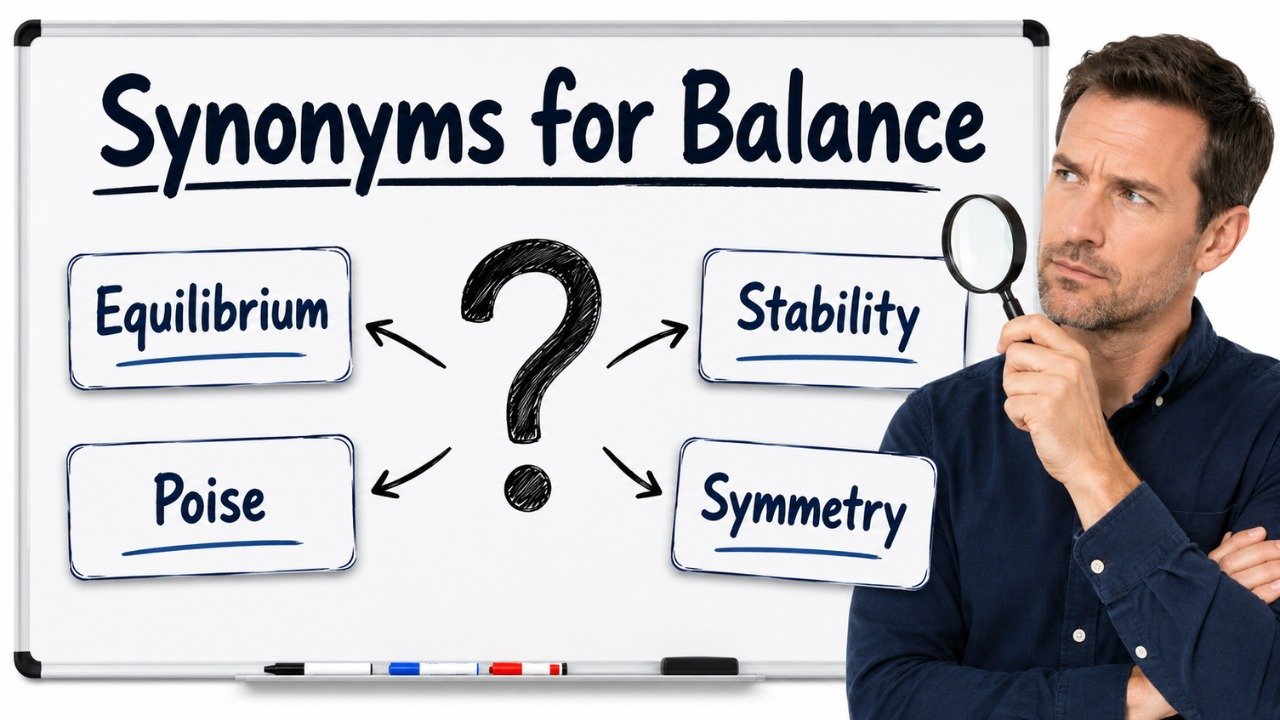
Quick Answer: The best synonyms for balance include equilibrium, stability, harmony, proportion, fairness, moderation, composure, poise, remainder, and offset. Use equilibrium for equal physical or opposing forces, stability for firmness, harmony for peaceful relationships, proportion for suitable amounts, fairness for equal treatment, moderation for avoiding extremes, composure for emotional control, remainder for money or quantities left, and offset when one effect reduces another.
Pronunciation and Word Details
Word: Balance.
Pronunciation: /ˈbæl.əns/.
Part of Speech: Noun and verb.
Meaning: A state in which weight, forces, amounts, duties, or interests are properly controlled or evenly distributed.
US Pronunciation:
UK Pronunciation:
What Does “Balance” Mean?
Balance means a stable, fair, or properly arranged condition in which no part has too much or too little influence.
As a noun, balance can describe physical steadiness, emotional control, fairness, proper proportion, or an amount that remains. A person may keep their balance while standing, maintain balance between work and rest, or check the balance in an account.
As a verb, balance means to keep something steady, compare competing needs, make two sides equal, or arrange different elements appropriately.
The exact meaning depends on the sentence. In physical contexts, balance refers to stability. In financial contexts, it refers to money that remains. In emotional contexts, it suggests calmness and control. In discussions about responsibilities, design, or relationships, it usually means harmony or suitable proportion.
Meaning, Tone, and Context of “Balance”
Balance is a neutral and widely used word. It appears naturally in casual conversation, formal writing, academic discussion, financial language, health advice, sports, design, business, and technical explanations.
Neutral Use: Balance is suitable for most everyday and professional situations.
Formal Use: It often describes fairness, financial totals, competing priorities, or the distribution of power.
Conversational Use: People commonly talk about balancing work, family, rest, exercise, and personal responsibilities.
Technical Use: In science and engineering, balance can describe equal forces, stable systems, or controlled measurements.
Emotional Use: Balance may refer to calmness, self control, or the ability to respond without becoming overwhelmed.
Financial Use: A balance is the amount of money available, owed, or remaining after transactions.
Because balance has several meanings, the most accurate synonym depends on whether the subject is physical stability, emotional control, fairness, proportion, finance, or opposing forces.
When and How to Use “Balance”
For Physical Stability
Use: Balance describes the ability to remain steady without falling.
Example: She used the railing to maintain her balance.
For Fair Distribution
Use: Balance can describe an arrangement in which time, attention, power, or resources are distributed appropriately.
Example: The schedule creates a better balance between study and relaxation.
For Competing Priorities
Use: Balance is useful when two or more responsibilities must receive suitable attention.
Example: He is learning to balance his career with family responsibilities.
For Emotional Control
Use: Balance can describe a calm and controlled mental or emotional state.
Example: Regular breaks helped her regain her emotional balance.
For Visual Proportion
Use: Balance describes the pleasing arrangement of shapes, colors, spaces, or other design elements.
Example: The large window gives the room visual balance.
For Fairness
Use: Balance may refer to an unbiased consideration of different opinions or interests.
Example: The report presents a balance of supporting and opposing views.
For Financial Amounts
Use: Balance can mean the money available, unpaid, or remaining.
Example: The remaining balance must be paid by the end of the month.
For Equalizing Effects
Use: As a verb, balance may mean reducing one effect by introducing an opposing effect.
Example: The sweetness balances the sharp flavor of the lemon.
For Comparing Information
Use: Balance can describe weighing advantages against disadvantages before making a decision.
Example: You should balance the possible benefits against the risks.
Best Synonyms for Balance
Equilibrium
Synonym: A state in which opposing forces or influences are equal.
Example: The structure returned to equilibrium after the movement stopped.
Stability
Synonym: The condition of being firm, steady, or unlikely to change suddenly.
Example: The new support provided greater stability to the table.
Harmony
Synonym: A pleasing state in which different elements work well together.
Example: The colors create harmony throughout the room.
Proportion
Synonym: A suitable relationship between the sizes, amounts, or importance of different parts.
Example: The designer used proportion to connect the furniture with the size of the room.
Fairness
Synonym: Equal, reasonable, and unbiased treatment.
Example: The policy was revised to improve fairness among employees.
Moderation
Synonym: The practice of avoiding excessive or extreme behavior.
Example: Moderation allows people to enjoy treats without ignoring healthy habits.
Composure
Synonym: Calmness and emotional control, especially during pressure.
Example: She maintained her composure during the difficult discussion.
Poise
Synonym: Graceful physical or emotional steadiness.
Example: He answered the unexpected question with confidence and poise.
Remainder
Synonym: The amount left after part has been removed, used, or paid.
Example: The remainder of the payment is due next week.
Offset
Synonym: Something that reduces or counteracts the effect of something else.
Example: The savings helped offset the increased cost of transportation.
50 Synonyms for Balance with Short Meanings
- Equilibrium: A state of equal opposing forces.
- Stability: Firmness or freedom from sudden change.
- Steadiness: The quality of remaining controlled and stable.
- Harmony: A pleasing relationship between different parts.
- Proportion: A suitable relationship between amounts or sizes.
- Symmetry: Balanced arrangement on opposite sides.
- Equality: The condition of being equal in value or status.
- Parity: Equality between two sides or groups.
- Fairness: Reasonable and unbiased treatment.
- Impartiality: Freedom from unfair preference.
- Moderation: Avoidance of excess or extremes.
- Restraint: Control over actions, feelings, or amounts.
- Composure: Calm emotional control.
- Poise: Graceful steadiness and confidence.
- Equanimity: Mental calmness during difficulty.
- Calmness: A peaceful and controlled condition.
- Control: The ability to manage movement, emotions, or conditions.
- Coordination: The organized working of different parts.
- Alignment: Correct positioning or agreement.
- Evenness: Equality or consistency across a surface or amount.
- Levelness: A flat or equally positioned condition.
- Uniformity: Consistency without major variation.
- Consistency: The quality of remaining regular or dependable.
- Correspondence: A close similarity or matching relationship.
- Equivalence: Equality in value, meaning, or effect.
- Proportionality: A suitable relationship between comparative amounts.
- Adjustment: A change made to improve accuracy or stability.
- Distribution: The way something is divided or arranged.
- Apportionment: The fair division of something into shares.
- Counterbalance: A force or influence that balances another.
- Counterpoise: A weight or influence that creates equilibrium.
- Offset: Something that reduces an opposing effect.
- Compensation: Something that makes up for a loss or disadvantage.
- Reconciliation: The process of bringing differences into agreement.
- Settlement: The act of resolving an amount, account, or disagreement.
- Homeostasis: The maintenance of stable internal conditions.
- Footing: A secure physical or practical position.
- Stance: A stable position of the body.
- Center: A point around which weight is evenly arranged.
- Remainder: The portion left after subtraction or use.
- Residue: A small amount remaining after most is removed.
- Surplus: An amount left beyond what is required.
- Reserve: An amount kept for later use.
- Difference: The remaining amount after one figure is subtracted from another.
- Net Amount: The final amount after deductions or adjustments.
- Account Total: The amount recorded in a financial account.
- Stabilize: To make something steady or secure.
- Equalize: To make two sides or amounts equal.
- Harmonize: To make different elements work well together.
- Reconcile: To compare records and correct differences.
Read Also:
Synonyms for Recognize

Synonyms for Balance by Context
When Balance Means Physical Stability
Equilibrium, stability, steadiness, footing, control, and poise describe the ability to remain upright or secure.
Example With Balance: The cyclist struggled to keep her balance on the narrow path.
Example With Stability: The cyclist struggled to maintain stability on the narrow path.
Example With Footing: The cyclist searched for secure footing after stepping off the bicycle.
Equilibrium is more technical than balance. Stability focuses on firmness, while footing refers to the position of a person’s feet.
When Balance Means Fairness or Equality
Fairness, equality, parity, impartiality, and evenness are useful when balance refers to equal treatment or influence.
Example With Balance: The committee wanted a balance of opinions in the discussion.
Example With Fairness: The committee wanted fairness in the way each opinion was considered.
Example With Parity: The new rules were designed to create parity between the two groups.
Fairness emphasizes reasonable treatment. Equality suggests the same rights, value, or opportunities. Parity is common when comparing two groups, teams, or sides.
When Balance Means Harmony or Proportion
Harmony, proportion, symmetry, coordination, alignment, and proportionality describe elements that fit together effectively.
Example With Balance: The room needs better balance between light and dark colors.
Example With Harmony: The room needs greater harmony between light and dark colors.
Example With Proportion: The furniture should remain in proportion to the room.
Harmony is best for elements that work pleasantly together. Proportion focuses on comparative size or amount. Symmetry refers to a similar arrangement on opposite sides.
When Balance Means Moderation
Moderation, restraint, control, and self control are suitable when balance means avoiding extremes.
Example With Balance: A balanced approach to exercise includes activity and rest.
Example With Moderation: Moderation in exercise can reduce unnecessary strain.
Example With Restraint: He showed restraint when choosing how much work to accept.
Moderation emphasizes reasonable limits. Restraint focuses on deliberately controlling an action, desire, or response.
When Balance Means Emotional Control
Composure, poise, equanimity, calmness, and control describe emotional steadiness.
Example With Balance: She maintained her emotional balance during the disagreement.
Example With Composure: She maintained her composure during the disagreement.
Example With Equanimity: She responded to the criticism with equanimity.
Composure is natural in formal and everyday writing. Poise suggests calm confidence. Equanimity is more formal and describes calmness during difficulty.
When Balance Means an Amount Remaining
Remainder, residue, reserve, surplus, difference, and net amount may replace balance in financial or numerical contexts.
Example With Balance: Please pay the outstanding balance before Friday.
Example With Remainder: Please pay the remainder before Friday.
Example With Net Amount: The net amount will appear after all deductions are recorded.
Remainder is the clearest general substitute. Net amount is more specific when deductions are involved. Surplus means more than the amount needed.
When Balance Means Counteracting an Effect
Offset, counterbalance, compensate for, equalize, and neutralize can describe one effect reducing another.
Example With Balance: The fresh herbs balance the richness of the sauce.
Example With Offset: The fresh herbs offset the richness of the sauce.
Example With Counterbalance: The lighter details counterbalance the heavy wooden furniture.
Offset is useful when one effect reduces another. Counterbalance emphasizes an opposing weight, force, quality, or influence.
Another Word for Balance
Equilibrium is often the best single replacement for balance when referring to equal forces, stability, or a controlled state. However, the best alternative depends on the intended meaning.
Use stability for physical or economic firmness, harmony for compatible elements, fairness for equal treatment, composure for emotional control, and remainder for an amount left.
Original: The shelf lost its balance after the books were moved.
Better Option: The shelf lost its stability after the books were moved.
Original: The team needs a better balance of experience and new ideas.
Better Option: The team needs greater harmony between experience and new ideas.
Original: She recovered her balance before answering.
Better Option: She recovered her composure before answering.
Original: I will pay the balance next month.
Better Option: I will pay the remainder next month.
When Not to Use “Balance”
Balance should not be used when a more precise word would explain the intended meaning more clearly.
When Referring to Exact Financial Figures
Balance may be unclear when the reader needs to know whether the amount is available, owed, or remaining.
Weak: The balance is $300.
Better: The remaining amount owed is $300.
When Describing Emotional Control
Balance can sound vague when composure or calmness is the intended meaning.
Weak: She kept her balance during the argument.
Better: She maintained her composure during the argument.
When Discussing Equal Rights or Treatment
Balance may be less accurate than equality, fairness, or impartiality.
Weak: The policy creates balance for all applicants.
Better: The policy promotes fairness for all applicants.
When Discussing Physical Support
Use stability when referring to an object that must remain firm and secure.
Weak: The wider base improves the balance of the cabinet.
Better: The wider base improves the stability of the cabinet.
When Describing Visual Arrangement
Use symmetry, proportion, or harmony when the specific design principle matters.
Weak: The painting has good balance.
Better: The painting uses symmetry to create an orderly composition.
When the Word Becomes Repetitive
Repeating balance several times can make a paragraph sound limited.
Weak: A balanced routine creates balance between work and rest, which helps people feel balanced.
Better: A well planned routine creates harmony between work and rest, which helps people feel more stable.
Words Commonly Confused With Balance
Balance vs Equilibrium: Balance is a broad everyday word for steadiness, fairness, proportion, or a remaining amount. Equilibrium usually describes equal forces or a stable state and often sounds more technical.
Balance vs Stability: Balance refers to the distribution of weight or competing elements. Stability refers to the ability to remain firm and resist sudden change.
Balance vs Equality: Balance means that different parts are suitably arranged. Equality means that people, amounts, rights, or values are the same.
Balance vs Fairness: Balance describes proportion or distribution. Fairness focuses on reasonable and unbiased treatment.
Balance vs Harmony: Balance can involve equal or controlled elements. Harmony means that different elements work pleasantly and effectively together.
Balance vs Symmetry: Balance may exist even when two sides are different. Symmetry requires a similar or matching arrangement on opposite sides.
Balance vs Proportion: Balance describes the overall arrangement. Proportion describes the size or amount of one part compared with another.
Balance vs Poise: Balance can be physical, emotional, financial, or visual. Poise usually describes graceful physical control or calm confidence.
Balance vs Remainder: Balance can refer to money left in an account or still owed. Remainder simply means the portion left after part has been used, removed, or paid.
Balance vs Offset: Balance describes a resulting state. Offset describes the action or influence that reduces another effect.
Which Synonym Should You Choose?
Choose equilibrium when describing equal forces, scientific systems, opposing pressures, or a stable state.
Choose stability when discussing physical support, economic strength, emotional security, or resistance to sudden change.
Choose harmony when different people, ideas, colors, sounds, or responsibilities work well together.
Choose proportion when comparing sizes, amounts, shapes, duties, or visual elements.
Choose fairness when discussing equal treatment, reasonable decisions, workplace policies, or opportunities.
Choose equality when two people, groups, values, or rights should be treated as the same.
Choose parity when comparing the status, performance, pay, or influence of two sides.
Choose moderation when advising someone to avoid excessive behavior or extreme choices.
Choose composure when describing calm emotional control during stress, conflict, or public speaking.
Choose poise when calmness is combined with confidence, grace, or controlled movement.
Choose remainder when discussing an amount of money, time, food, or material that is left.
Choose offset when one cost, force, quality, or effect reduces another.
Choose counterbalance when one weight, force, or influence directly opposes another.
Choose reconcile when comparing financial records or bringing conflicting information into agreement.
Choose symmetry when describing a visually similar arrangement on opposite sides.
Real Life Examples of “Balance” in Sentences
Original: She held the wall to regain her balance.
Better Option: She held the wall to regain her stability.
Original: The manager must balance the needs of customers and employees.
Better Option: The manager must reconcile the needs of customers and employees.
Original: The room has a pleasing balance of color and texture.
Better Option: The room has a pleasing harmony of color and texture.
Original: He maintained his balance during the stressful meeting.
Better Option: He maintained his composure during the stressful meeting.
Original: The new policy creates a better balance between the two departments.
Better Option: The new policy creates greater parity between the two departments.
Original: Please pay the remaining balance by Monday.
Better Option: Please pay the remainder by Monday.
Original: The heavier base gives the lamp better balance.
Better Option: The heavier base gives the lamp greater stability.
Original: The bitter flavor balances the sweetness of the fruit.
Better Option: The bitter flavor offsets the sweetness of the fruit.
Original: The essay needs more balance between evidence and explanation.
Better Option: The essay needs better proportion between evidence and explanation.
Original: She tries to balance exercise with sufficient rest.
Better Option: She tries to combine exercise and sufficient rest in moderation.
Synonym Groups and Usage Differences
Physical Stability Group
Equilibrium, stability, steadiness, footing, stance, and control relate to physical security or resistance to falling.
Stability is best for objects, structures, systems, and long term conditions. Steadiness describes controlled movement. Footing refers to a secure position for the feet.
Example: The climber checked her footing before moving upward.
Fairness and Equality Group
Fairness, equality, parity, impartiality, and evenness relate to equal treatment or influence.
Fairness emphasizes reasonableness. Equality emphasizes sameness in rights or value. Parity usually compares two sides. Impartiality means making decisions without favoritism.
Example: The selection process was reviewed to ensure impartiality.
Harmony and Arrangement Group
Harmony, proportion, symmetry, alignment, coordination, and correspondence describe parts that fit together properly.
Harmony is broad and positive. Proportion concerns relative amounts or sizes. Symmetry concerns visual matching. Alignment suggests correct positioning or shared goals.
Example: Clear communication improved alignment across the team.
Emotional Control Group
Composure, poise, equanimity, calmness, restraint, and control describe steady emotions and behavior.
Composure is useful during difficult moments. Poise includes confidence and grace. Equanimity is formal and emphasizes calmness despite pressure.
Example: He accepted the disappointing result with equanimity.
Moderation Group
Moderation, restraint, regulation, and control refer to avoiding extremes.
Moderation is often positive and practical. Restraint suggests resisting an impulse. Regulation involves controlling something according to a rule or standard.
Example: Moderation is important when dividing time between work and entertainment.
Remaining Amount Group
Remainder, residue, reserve, surplus, difference, and net amount describe what remains after use, payment, or subtraction.
Remainder is the most general. Residue often means a small amount left behind. Reserve is deliberately saved. Surplus is more than what is needed.
Example: The surplus was saved for future expenses.
Opposing Effect Group
Offset, counterbalance, compensation, adjustment, and equalization describe actions that reduce differences or opposing effects.
Offset is common with costs, disadvantages, and effects. Counterbalance suggests a direct opposing influence. Compensation makes up for a loss or weakness.
Example: Flexible hours helped compensate for the longer journey.
Financial Agreement Group
Reconciliation, settlement, difference, account total, and net amount relate to records, payments, and financial calculations.
Reconciliation involves checking that records agree. Settlement means completing a payment or resolving an account. Net amount is the total after deductions.
Example: The monthly reconciliation revealed an incorrect entry.
Antonyms of Balance
The opposite of balance changes according to the intended meaning.
Imbalance: An unequal or poorly arranged condition.
Instability: A lack of firmness, security, or consistency.
Unsteadiness: Difficulty remaining physically controlled.
Inequality: A condition in which rights, amounts, or treatment are not equal.
Unfairness: Biased or unreasonable treatment.
Disproportion: An unsuitable relationship between sizes or amounts.
Asymmetry: A lack of matching arrangement on opposite sides.
Discord: Conflict or lack of agreement.
Disharmony: A condition in which elements do not work well together.
Excess: An amount beyond what is reasonable or necessary.
Extremity: A condition far beyond a moderate level.
Agitation: Emotional disturbance or nervous excitement.
Confusion: A lack of mental order or clarity.
Deficit: An amount that is less than what is required.
Shortfall: The difference between what is available and what is needed.
Discrepancy: A difference between figures, records, or statements that should agree.
Comparison of Balance and Related Words
Balance vs Equilibrium
Balance is the more flexible everyday word. It can refer to physical control, fairness, proportion, emotional calmness, or money. Equilibrium usually refers to equal forces or a stable state.
Example With Balance: She adjusted the load to improve the cart’s balance.
Example With Equilibrium: The system eventually reached equilibrium.
Balance vs Stability
Balance concerns the distribution of weight or influence. Stability concerns the ability to remain firm and resist disruption.
Example With Balance: The performer kept her balance on the narrow platform.
Example With Stability: The reinforced platform provided greater stability.
Balance vs Harmony
Balance suggests proper distribution. Harmony suggests that different elements work pleasantly together.
Example With Balance: The article has a good balance of facts and explanations.
Example With Harmony: The colors work together in harmony.
Balance vs Proportion
Balance describes the overall relationship among several parts. Proportion focuses on the comparative size, amount, or importance of specific parts.
Example With Balance: The photograph has strong visual balance.
Example With Proportion: The size of the frame is in proportion to the photograph.
Balance vs Fairness
Balance may involve considering multiple needs or opinions. Fairness concerns reasonable and unbiased treatment.
Example With Balance: The discussion included a balance of different viewpoints.
Example With Fairness: The moderator treated every speaker with fairness.
Balance vs Equality
Balance does not always require equal amounts. It requires an arrangement that works appropriately. Equality means the same status, value, amount, or opportunity.
Example With Balance: A healthy routine requires a balance of activity and rest.
Example With Equality: The rule guarantees equality of opportunity.
Balance vs Composure
Balance can refer broadly to emotional steadiness, while composure specifically means calm self control.
Example With Balance: The sudden news disturbed his emotional balance.
Example With Composure: He quickly regained his composure.
Balance vs Poise
Balance may simply mean not falling. Poise suggests graceful control, confidence, and calmness.
Example With Balance: She maintained her balance on the wet floor.
Example With Poise: She answered each question with poise.
Balance vs Remainder
Balance may refer to an amount available or still owed. Remainder refers to anything left after part has been removed, used, or paid.
Example With Balance: The account balance is shown on the statement.
Example With Remainder: The remainder of the fee is due next week.
Balance vs Offset
Balance is the state created when effects are properly controlled. Offset is an opposing effect that reduces another effect.
Example With Balance: The recipe has a good balance of sweet and sour flavors.
Example With Offset: The sour flavor helps offset the sweetness.
Common Phrases and Expressions With “Balance”
Keep Your Balance: Remain physically steady and avoid falling.
Lose Your Balance: Become physically unsteady.
Strike a Balance: Find a suitable compromise between competing needs.
Maintain a Balance: Keep different parts or responsibilities properly controlled.
Work Life Balance: A suitable division of time and energy between employment and personal life.
Balance of Power: A distribution of influence that prevents one side from becoming too dominant.
Balance the Books: Check financial records and ensure that totals agree.
Remaining Balance: The amount of money still available or owed.
On Balance: After considering all important facts or arguments.
Delicate Balance: A stable condition that can easily be disturbed.
Sense of Balance: The physical ability to remain upright and understand body position.
Balance the Risks: Compare possible disadvantages with potential benefits.
Common Mistakes to Avoid
Using Balance for Every Meaning
Balance has several meanings, but it is not always the most precise choice. Use stability for firmness, fairness for equal treatment, composure for emotional control, and remainder for an amount left.
Confusing Balance With Equality
A balanced arrangement does not always contain equal parts. A person may need more sleep than entertainment to create a healthy routine. The amounts are not equal, but the arrangement can still be balanced.
Confusing Balance With Symmetry
Symmetry requires similar forms on opposite sides. Balance can also be asymmetrical when different elements still create an even visual effect.
Using the Wrong Preposition
Use balance between when discussing the relationship among competing elements.
Correct: The plan creates a balance between cost and quality.
Use balance with when describing the act of managing one responsibility alongside another.
Correct: She balances her studies with part time work.
Repeating Balance Too Often
Replace repeated uses with harmony, proportion, stability, moderation, fairness, or composure when those words match the intended meaning.
Repetitive: A balanced plan creates balance and helps the team balance its priorities.
Improved: A practical plan creates harmony and helps the team manage its priorities.
Confusing a Financial Balance With Available Money
An account balance may represent money available, money owed, or a total recorded at a particular time. Make the meaning clear when confusion is possible.
Unclear: Your balance is $500.
Clear: You have an available balance of $500.
Using More Balance Instead of Better Balance
When describing quality, better balance is often more natural than more balance.
Unnatural: The essay needs more balance between its sections.
Natural: The essay needs better balance between its sections.
Choosing an Overly Formal Synonym
Equanimity and equilibrium are useful, but they may sound unnecessarily technical in casual sentences.
Too Formal: He regained his equanimity after dropping the plate.
Natural: He regained his composure after dropping the plate.
Conclusion
Synonyms for balance vary according to meaning. Equilibrium and stability work well for physical or technical steadiness. Harmony and proportion describe elements that fit together effectively. Fairness, equality, and parity suit discussions of treatment or influence. Moderation describes the avoidance of extremes, while composure and poise express emotional control. In financial contexts, remainder or net amount may be clearer. Choosing a precise alternative makes sentences more natural, informative, and appropriate for their context.
FAQs About Synonyms for Balance
What Is the Best Synonym for Balance?
Equilibrium is a strong general synonym when balance means equal forces or a stable state. Stability, harmony, fairness, composure, and remainder may be better in specific contexts.
What Is Another Word for Physical Balance?
Stability, steadiness, equilibrium, footing, and poise can describe physical balance. Stability is especially useful for objects and structures.
What Is Another Word for Emotional Balance?
Composure, equanimity, calmness, poise, and self control are useful alternatives. Composure is the most natural choice in many situations.
What Is a Synonym for a Balanced Lifestyle?
Moderation, harmony, stability, and healthy proportion can describe a balanced lifestyle. Moderation is best when the focus is avoiding extremes.
What Is Another Word for Financial Balance?
Remainder, account total, available amount, outstanding amount, net amount, and difference may be suitable. The correct choice depends on whether the money is available, owed, or left.
Are Balance and Equality the Same?
No. Equality means being the same in amount, status, or value. Balance means arranging different elements in a suitable and effective way, even when the amounts are not equal.
What Is the Opposite of Balance?
Common opposites include imbalance, instability, inequality, disproportion, excess, agitation, deficit, and disharmony. The best antonym depends on the meaning of balance in the sentence.
