
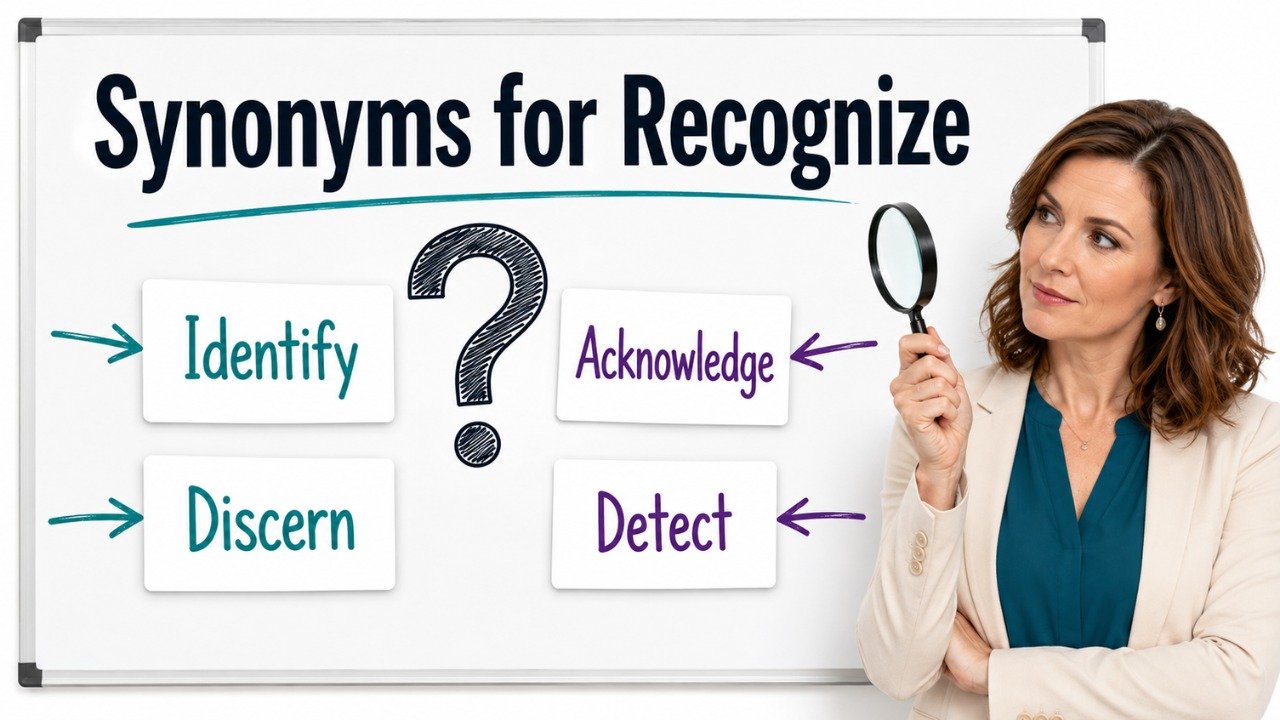
Quick Answer: Common synonyms for recognize include identify, acknowledge, realize, notice, remember, distinguish, appreciate, credit, accept, and honor. Use identify when determining who or what something is, acknowledge when accepting a fact or contribution, and realize when becoming aware of something. Remember works for recalling a familiar person or object, while appreciate, credit, and honor are better when showing respect for an achievement. The best choice among synonyms for recognize depends on whether the context involves identification, awareness, acceptance, memory, appreciation, or official approval.
Pronunciation and Word Details
Word: Recognize.
Pronunciation: /ˈrek.əɡ.naɪz/.
Part of Speech: Verb.
Meaning: To identify someone or something, accept a fact, become aware of something, or show appreciation for achievement.
US Pronunciation:
UK Pronunciation:
What Does “Recognize” Mean?
Recognize means to identify someone or something as familiar, accept that something is true, become aware of an important fact, or show appreciation for a person or achievement.
Recognize is a verb. Its exact meaning changes according to the sentence in which it appears.
It can describe identifying a familiar person.
Example: I recognized her from our previous meeting.
It can mean accepting a fact or situation.
Example: The manager recognized that the schedule needed to change.
It can describe officially accepting the status, authority, or rights of a person, group, or institution.
Example: The organization recognized the new committee as the official representative.
Recognize can also mean praising or rewarding someone for good work.
Example: The school recognized the students for their outstanding effort.
In memory related contexts, recognize means knowing that someone or something has been seen, heard, or experienced before.
Example: He recognized the melody after hearing only a few notes.
Meaning, Tone, and Context of “Recognize”
Recognize is a neutral and versatile word. It is suitable for formal writing, academic discussion, workplace communication, reports, essays, news writing, and everyday conversation.
When it refers to identifying a person, face, sound, place, or object, recognize has a practical and conversational tone.
Example: She recognized the building from an old photograph.
When it means accepting a truth, problem, need, or responsibility, the word can sound thoughtful, serious, or formal.
Example: We must recognize the importance of careful planning.
In professional settings, recognize often means giving credit or appreciation.
Example: The director recognized the team for completing the project successfully.
In legal, political, or institutional contexts, recognize can mean officially accepting the existence, authority, status, ownership, or rights of something.
Example: The agreement recognizes the rights of all participants.
Recognize can therefore communicate familiarity, awareness, acceptance, approval, respect, memory, or official confirmation.
When and How to Use “Recognize”
For Identifying a Person or Object
Use recognize when someone knows who or what something is because it seems familiar.
Example: I recognized the speaker as soon as she entered the room.
For Remembering Something Familiar
Use recognize when a face, voice, place, word, song, or object brings back a previous memory.
Example: He recognized the song from his childhood.
For Becoming Aware of a Fact
Recognize can show that someone has understood or realized something important.
Example: The company recognized the need for better training.
For Accepting the Truth
Use recognize when admitting that a fact, problem, condition, or responsibility is real.
Example: She recognized that her original plan was not practical.
For Showing Appreciation
Recognize can mean giving praise, credit, or attention to someone for an achievement.
Example: The coach recognized the players for their dedication.
For Official Approval
Use recognize when an authority formally accepts a position, right, qualification, organization, or status.
Example: The certificate is recognized by several professional institutions.
For Distinguishing Between Things
Recognize can describe noticing the differences between similar people, objects, sounds, or ideas.
Example: Young children learn to recognize different shapes and colors.
For Understanding Importance
Use recognize when showing that someone understands the value, effect, or significance of something.
Example: Effective leaders recognize the importance of clear communication.
Best Synonyms for Recognize
Identify: To determine who or what someone or something is.
Example: The witness identified the person in the photograph.
Acknowledge: To accept that something exists, is true, or deserves attention.
Example: The report acknowledged several weaknesses in the original plan.
Realize: To become fully aware of a fact or situation.
Example: She realized that she had misunderstood the instructions.
Notice: To become aware of something through observation.
Example: He noticed a small mistake in the final paragraph.
Remember: To recall someone or something from the past.
Example: I remember meeting her at the conference.
Distinguish: To recognize the difference between similar people, things, or ideas.
Example: It can be difficult to distinguish the two materials from a distance.
Appreciate: To understand the value or importance of someone or something.
Example: We appreciate the effort required to complete this work.
Credit: To acknowledge that someone deserves praise for an action or achievement.
Example: The author credited her editor for improving the final draft.
Accept: To recognize something as true, valid, or satisfactory.
Example: The committee accepted the findings of the investigation.
Honor: To publicly recognize someone for an achievement or contribution.
Example: The community honored the volunteers for their service.
50 Synonyms for Recognize with Short Meanings
- Identify: Determine who or what someone or something is.
- Know: Be familiar with a person, object, place, or fact.
- Distinguish: Notice the difference between similar things.
- Detect: Discover something that may not be immediately obvious.
- Spot: Notice or identify something quickly.
- Notice: Become aware of something through attention or observation.
- Perceive: Become aware of something through the senses or mind.
- Discern: Recognize something that is difficult to see or understand.
- Make Out: Manage to recognize something with difficulty.
- Pick Out: Identify one person or thing from a group.
- Single Out: Select or identify one particular person or thing.
- Tell Apart: Recognize the difference between similar things.
- Place: Remember where or how someone or something is known.
- Remember: Bring a familiar person, thing, or experience back to mind.
- Recall: Remember a fact, event, person, or experience.
- Recollect: Make an effort to remember something from the past.
- Acknowledge: Accept that something exists or is true.
- Admit: Accept the truth of something, often reluctantly.
- Accept: Regard something as true, valid, or satisfactory.
- Concede: Admit that a statement or argument is correct.
- Affirm: State or confirm that something is true.
- Validate: Confirm that something is acceptable, reasonable, or valuable.
- Confirm: Establish that something is true or correct.
- Appreciate: Understand the value, quality, or importance of something.
- Credit: Give someone acknowledgment for an achievement.
- Honor: Show public respect or recognition.
- Praise: Express approval of someone or something.
- Commend: Formally praise someone for an achievement.
- Applaud: Express strong approval or appreciation.
- Celebrate: Publicly recognize an achievement or important event.
- Reward: Give something in recognition of effort or success.
- Value: Consider someone or something important or useful.
- Respect: Show regard for someone’s qualities, rights, or achievements.
- Esteem: Hold someone in high respect.
- Realize: Become aware of a fact or situation.
- Understand: Know the meaning, importance, or nature of something.
- Grasp: Understand an idea or situation clearly.
- Comprehend: Fully understand something complex.
- Register: Become aware of something mentally.
- Observe: Notice or carefully examine something.
- Become Aware Of: Begin to understand or notice something.
- Take Note Of: Give attention to something important.
- Be Conscious Of: Know that something exists or is happening.
- Approve: Accept something as satisfactory or suitable.
- Endorse: Publicly express approval or support.
- Authorize: Give official approval or permission.
- Certify: Officially confirm that something meets a standard.
- Legitimize: Give something official or accepted status.
- Salute: Publicly show respect or admiration.
- Welcome: Receive or acknowledge someone or something positively.
Read Also:
Synonyms for Loving
Synonyms for Recognize by Context
When Recognize Means Identify
When recognize means determining who or what someone or something is, useful synonyms include identify, know, spot, detect, distinguish, discern, place, and make out.
Identify: Best for clearly naming or establishing identity.
Example: The technician identified the source of the unusual sound.
Spot: Best for noticing someone or something quickly.
Example: She spotted her friend in the crowded room.
Discern: Suitable when recognition requires careful attention.
Example: He could barely discern the shape through the fog.
Place: Used when someone looks familiar but the exact memory is uncertain.
Example: I recognize his face, but I cannot place where we met.
When Recognize Means Remember
When recognize refers to familiarity or memory, use remember, recall, recollect, know, or place.
Remember: The most natural option for general memory.
Example: I remember seeing this painting before.
Recall: More formal and often used for specific details.
Example: She could not recall the name of the restaurant.
Recollect: Suggests making an effort to remember.
Example: He tried to recollect the events of the previous evening.
Know: Useful when a face, voice, place, or object seems familiar.
Example: I know that voice from somewhere.
When Recognize Means Acknowledge
When recognize means accepting the truth or existence of something, use acknowledge, admit, accept, concede, affirm, or confirm.
Acknowledge: Neutral and suitable for formal writing.
Example: The report acknowledges the need for additional research.
Admit: Often implies reluctance or personal responsibility.
Example: She admitted that the calculation was incorrect.
Concede: Common in arguments and debates.
Example: He conceded that the opposing argument had some merit.
Accept: Suitable for facts, results, conditions, and responsibilities.
Example: The committee accepted that further changes were necessary.
When Recognize Means Realize
When recognize means becoming aware of something, useful alternatives include realize, understand, grasp, comprehend, register, and become aware of.
Realize: Best for a sudden or clear awareness.
Example: She realized that the door had been left open.
Understand: Best when knowledge or meaning becomes clear.
Example: The students understood why the rule was necessary.
Grasp: Suggests gaining a firm understanding.
Example: He quickly grasped the main idea.
Register: Describes information becoming mentally noticeable.
Example: It took several seconds for the warning to register.
When Recognize Means Appreciate
When recognize refers to valuing a person, action, or contribution, use appreciate, credit, value, respect, praise, commend, or honor.
Appreciate: Best for understanding value or expressing gratitude.
Example: We appreciate everything you have done for the team.
Credit: Gives someone acknowledgment for a specific contribution.
Example: The researcher credited her assistants for collecting the data.
Commend: Suitable for formal praise.
Example: The manager commended the staff for their professionalism.
Honor: Best for public or ceremonial recognition.
Example: The organization honored its longest serving members.
When Recognize Means Officially Accept
When recognize means giving official status or approval, use approve, endorse, authorize, certify, validate, legitimize, or accept.
Approve: Indicates formal acceptance of a plan, request, or decision.
Example: The committee approved the revised proposal.
Certify: Confirms that something meets an official standard.
Example: The inspector certified that the building was safe.
Validate: Confirms the value, accuracy, or acceptability of something.
Example: The additional evidence validated the original findings.
Legitimize: Gives accepted or lawful status to something.
Example: The agreement helped legitimize the new governing body.
Another Word for Recognize
Identify is the best general replacement for recognize when the sentence refers to determining who or what someone or something is. However, acknowledge is better for accepting facts, realize is better for awareness, and honor is better for praising achievement.
Original: I recognized the person standing near the entrance.
Better Option: I identified the person standing near the entrance.
Original: The company recognized that its process was inefficient.
Better Option: The company acknowledged that its process was inefficient.
Original: She recognized the importance of careful preparation.
Better Option: She realized the importance of careful preparation.
Original: The school recognized the teacher’s contribution.
Better Option: The school honored the teacher’s contribution.
When Not to Use “Recognize”
Recognize can sound vague when the sentence does not clearly show whether it means identify, remember, accept, realize, appreciate, or officially approve. A more precise synonym often improves clarity.
When Identity Is the Main Point
Use identify when the sentence focuses on establishing exactly who or what something is.
Weak: The witness recognized the person responsible.
Better: The witness identified the person responsible.
When Accepting a Problem
Acknowledge is often clearer when someone admits that a problem exists.
Weak: The manager recognized the communication problem.
Better: The manager acknowledged the communication problem.
When Becoming Aware
Realize is more natural for a sudden understanding or discovery.
Weak: She recognized that she had forgotten her appointment.
Better: She realized that she had forgotten her appointment.
When Giving Formal Praise
Honor, commend, or reward may communicate appreciation more clearly.
Weak: The organization recognized the volunteers at the ceremony.
Better: The organization honored the volunteers at the ceremony.
When Describing Simple Observation
Notice is better when the meaning is only becoming aware of a visible detail.
Weak: He recognized a crack in the wall.
Better: He noticed a crack in the wall.
When Describing Memory
Remember or recall may be more accurate when the focus is bringing information back to mind.
Weak: I recognize that she mentioned the deadline.
Better: I remember that she mentioned the deadline.
When Official Approval Is Required
Approve, certify, or authorize is clearer when a formal decision is involved.
Weak: The authority recognized the new safety procedure.
Better: The authority approved the new safety procedure.
Words Commonly Confused With Recognize
Recognize vs Identify: Recognize often involves familiarity, while identify means establishing exactly who or what someone or something is. You may recognize a face without being able to identify the person by name.
Recognize vs Acknowledge: Recognize has several meanings, including identification and awareness. Acknowledge specifically means accepting that something exists, is true, or deserves attention.
Recognize vs Realize: Recognize can mean becoming aware of something, but realize is more natural for a new or sudden understanding.
Recognize vs Remember: Recognize usually means knowing that something has been experienced before. Remember means bringing information or an event back into the mind.
Recognize vs Notice: Notice means becoming aware of a detail. Recognize means understanding what that detail, person, sound, or object is.
Recognize vs Distinguish: Recognize means identifying something as familiar. Distinguish means noticing the difference between two or more similar things.
Recognize vs Appreciate: Recognize may mean giving attention or credit. Appreciate places greater emphasis on understanding value or feeling gratitude.
Recognize vs Accept: Recognize can mean admitting that something is true. Accept can also imply agreement, willingness, or approval.
Which Synonym Should You Choose?
Choose identify when determining the exact identity of a person, object, place, sound, or problem.
Choose acknowledge when accepting a fact, weakness, contribution, responsibility, or difficult situation.
Choose realize when someone becomes aware of a fact or understands something for the first time.
Choose notice when describing simple observation or awareness of a visible detail.
Choose remember when referring to a person, place, fact, or event stored in memory.
Choose recall when formal writing requires a precise word for bringing information back to mind.
Choose distinguish when comparing similar people, ideas, sounds, objects, or qualities.
Choose appreciate when expressing gratitude or understanding the value of something.
Choose credit when stating that a person deserves acknowledgment for work, ideas, or success.
Choose honor when describing public, official, or ceremonial appreciation.
Choose commend when formal praise is given for good work or responsible behavior.
Choose confirm when evidence establishes that something is true or correct.
Choose validate when supporting the accuracy, value, or legitimacy of a statement, result, or feeling.
Choose approve when an authority formally accepts a request, decision, plan, or document.
In reports and essays, acknowledge, identify, realize, confirm, and validate are often precise choices.
In professional emails, appreciate, acknowledge, confirm, and approve usually sound clear and polite.
In casual speech, know, remember, notice, spot, and realize are natural alternatives.
Real Life Examples of “Recognize” in Sentences
Original: I recognized her from the training session.
Better Option: I identified her as someone from the training session.
Original: The manager recognized that the deadline was unrealistic.
Better Option: The manager acknowledged that the deadline was unrealistic.
Original: She recognized the sound of her brother’s car.
Better Option: She identified the sound of her brother’s car.
Original: We recognize the importance of regular communication.
Better Option: We appreciate the importance of regular communication.
Original: He recognized that his answer was incorrect.
Better Option: He realized that his answer was incorrect.
Original: The committee recognized her contribution to the project.
Better Option: The committee honored her contribution to the project.
Original: I did not recognize the building after the renovation.
Better Option: I could not identify the building after the renovation.
Original: The report recognizes several limitations in the research.
Better Option: The report acknowledges several limitations in the research.
Original: Children soon recognize the difference between the two shapes.
Better Option: Children soon distinguish between the two shapes.
Original: The institution recognized the new qualification.
Better Option: The institution officially approved the new qualification.
Synonym Groups and Usage Differences
Identification Group
Identify, spot, detect, distinguish, discern, make out, and pick out relate to finding or determining identity.
Identify is direct and precise. Spot suggests quick observation. Detect is useful for hidden details. Discern describes careful recognition, while distinguish focuses on differences.
Example: The analyst detected an unusual pattern in the data.
Memory Group
Remember, recall, recollect, know, and place relate to familiarity and memory.
Remember is broad and conversational. Recall is more formal. Recollect suggests effort. Place is useful when someone seems familiar but the exact connection is unclear.
Example: I remember seeing that symbol in an earlier document.
Acceptance Group
Acknowledge, admit, accept, concede, affirm, and confirm involve accepting facts or truth.
Acknowledge is neutral. Admit may suggest reluctance. Concede is common in disagreement. Affirm and confirm provide stronger support for truth or accuracy.
Example: The author acknowledged an error in the first edition.
Awareness Group
Realize, understand, grasp, comprehend, register, and perceive describe mental awareness.
Realize often suggests new awareness. Understand and comprehend relate to meaning. Grasp means understanding something clearly. Register describes information entering conscious awareness.
Example: She quickly grasped the purpose of the new procedure.
Appreciation Group
Appreciate, credit, praise, commend, honor, celebrate, and reward involve positive recognition.
Appreciate shows value or gratitude. Credit identifies who deserves acknowledgment. Praise is general approval. Commend and honor are more formal.
Example: The director commended the team for its careful work.
Official Approval Group
Approve, endorse, authorize, certify, validate, and legitimize involve formal acceptance.
Approve accepts a proposal or decision. Authorize gives permission. Certify confirms a standard. Validate supports accuracy or legitimacy.
Example: The authority certified the equipment for professional use.
Antonyms of Recognize
The opposite of recognize depends on whether the word means identify, remember, accept, understand, appreciate, or officially approve.
Ignore: Deliberately give no attention to someone or something.
Overlook: Fail to notice or consider something.
Miss: Fail to notice, understand, or identify something.
Forget: Lose the memory of someone, something, or an event.
Misidentify: Identify someone or something incorrectly.
Confuse: Mistake one person or thing for another.
Deny: Refuse to accept that something is true.
Reject: Refuse to accept, approve, or consider something.
Dispute: Question or disagree with the truth of something.
Dismiss: Treat something as unimportant or unworthy of attention.
Disregard: Pay no attention to something important.
Neglect: Fail to give proper attention or recognition.
Discredit: Damage or deny someone’s reputation or contribution.
Dishonor: Fail to show respect or bring shame to someone.
Underestimate: Fail to recognize the true value, strength, or importance of something.
Comparison: Recognize vs Related Words
Recognize vs Identify
Recognize often involves familiarity from a previous experience. Identify means determining exactly who or what someone or something is.
Example With Recognize: I recognized the man from a previous meeting.
Example With Identify: The receptionist identified the man as a visiting consultant.
Recognize vs Acknowledge
Recognize can refer to identification, awareness, or appreciation. Acknowledge mainly means accepting a fact, contribution, or situation.
Example With Recognize: The board recognized the need for change.
Example With Acknowledge: The board acknowledged that the current process was ineffective.
Recognize vs Realize
Recognize may involve identifying something familiar or understanding a fact. Realize usually describes becoming aware of something clearly or suddenly.
Example With Recognize: She recognized the warning signs.
Example With Realize: She realized that the situation was becoming serious.
Recognize vs Remember
Recognize means knowing that something is familiar when it appears. Remember means bringing information or an experience back into the mind.
Example With Recognize: I recognized his voice immediately.
Example With Remember: I remembered speaking with him last year.
Recognize vs Notice
Notice means becoming aware of a detail. Recognize means identifying or understanding what that detail is.
Example With Recognize: She recognized the symbol on the package.
Example With Notice: She noticed a symbol on the package.
Recognize vs Distinguish
Recognize means knowing what something is. Distinguish means telling the difference between similar things.
Example With Recognize: He recognized the bird by its call.
Example With Distinguish: He distinguished the bird from a similar species by its call.
Recognize vs Appreciate
Recognize may mean giving acknowledgment. Appreciate means understanding value or feeling gratitude.
Example With Recognize: The company recognized her contribution.
Example With Appreciate: The company appreciated her commitment to the project.
Recognize vs Honor
Recognize is a broad term for giving attention or credit. Honor usually refers to formal or public respect.
Example With Recognize: The school recognized the student’s achievement.
Example With Honor: The school honored the student during the awards ceremony.
Common Phrases and Expressions With Recognize
Recognize a Face: Identify someone by seeing their facial features.
Example: She recognized his face from an earlier meeting.
Recognize a Voice: Identify someone by the sound of their speech.
Example: I recognized her voice before she introduced herself.
Recognize the Importance: Understand the value or significance of something.
Example: Successful teams recognize the importance of cooperation.
Recognize the Need: Become aware that something is necessary.
Example: The committee recognized the need for additional funding.
Recognize a Problem: Accept that a difficulty exists.
Example: The first step is to recognize the problem clearly.
Recognize Someone for an Achievement: Give a person praise or credit for success.
Example: The school recognized him for his excellent attendance.
Officially Recognize: Formally accept the status, authority, or existence of something.
Example: The institution officially recognized the qualification.
Widely Recognized: Known and accepted by many people.
Example: She is widely recognized for her careful research.
Fail to Recognize: Be unable or unwilling to identify or acknowledge something.
Example: The report failed to recognize several important risks.
Recognize the Difference: Understand how two or more things are not the same.
Example: Readers should recognize the difference between fact and opinion.
Common Mistakes to Avoid
Using Recognize for Every Type of Awareness
Recognize can become vague when notice, realize, understand, or identify would be clearer.
Weak: She recognized a spelling error in the report.
Better: She noticed a spelling error in the report.
Confusing Recognize With Remember
Recognize happens when something familiar appears again. Remember involves recalling information from memory.
Incorrect: I recognize that we met last year.
Correct: I remember that we met last year.
Confusing Recognize With Identify
A person may recognize someone without knowing the person’s exact name or identity.
Unclear: She recognized the unknown caller.
Better: She identified the unknown caller through the phone records.
Using Acknowledge in an Identification Context
Acknowledge does not normally mean identifying a familiar person or object.
Incorrect: I acknowledged him from the photograph.
Correct: I recognized him from the photograph.
Choosing Honor When Simple Awareness Is Intended
Honor refers to respect or public appreciation, not ordinary identification.
Incorrect: I honored her voice on the telephone.
Correct: I recognized her voice on the telephone.
Repeating Recognize Too Often
Repeated use can make writing sound limited and unclear.
Repetitive: The report recognizes the problem, recognizes its causes, and recognizes the need for change.
Improved: The report identifies the problem, explains its causes, and acknowledges the need for change.
Ignoring Context When Choosing a Synonym
A synonym must match the intended meaning. Identify, realize, acknowledge, appreciate, and honor are not interchangeable in every sentence.
Weak: The manager identified the employee’s excellent work.
Better: The manager praised the employee’s excellent work.
Using Recognize Without an Object
Recognize is usually followed by a person, thing, fact, contribution, need, right, problem, or clause.
Incomplete: The committee finally recognized.
Complete: The committee finally recognized the need for clearer rules.
Conclusion
Synonyms for recognize vary according to whether the sentence involves identity, memory, awareness, acceptance, appreciation, or official approval. Identify is best for determining who or what something is, while acknowledge suits facts and contributions. Realize expresses new awareness, remember relates to memory, and distinguish shows differences. Appreciate, credit, commend, and honor are effective for praise. Choosing the most precise alternative makes writing clearer, more natural, and better suited to formal documents, essays, emails, and everyday conversation.
FAQs About Synonyms for Recognize
What Is the Best Synonym for Recognize?
Identify is the best general synonym when recognize means determining who or what something is. Acknowledge, realize, remember, or honor may be better in other contexts.
What Is a Formal Synonym for Recognize?
Acknowledge, identify, validate, confirm, appreciate, and certify are useful formal alternatives. The best choice depends on the intended meaning.
What Is Another Word for Recognize a Person?
Identify, know, spot, place, or pick out can replace recognize when referring to a person. Identify is best when the person’s exact identity is established.
What Is a Synonym for Recognize a Fact?
Acknowledge, admit, accept, concede, or realize can replace recognize a fact. Acknowledge is usually the most neutral choice.
What Is a Synonym for Recognize an Achievement?
Honor, praise, commend, celebrate, reward, or credit can replace recognize an achievement. Honor and commend are suitable for formal settings.
What Is the Difference Between Recognize and Realize?
Recognize can mean identifying something familiar or accepting a fact. Realize mainly means becoming aware of something or understanding it clearly.
What Is the Opposite of Recognize?
Common opposites include ignore, overlook, forget, deny, reject, misidentify, dismiss, and disregard. The correct antonym depends on the meaning of recognize in the sentence.
