
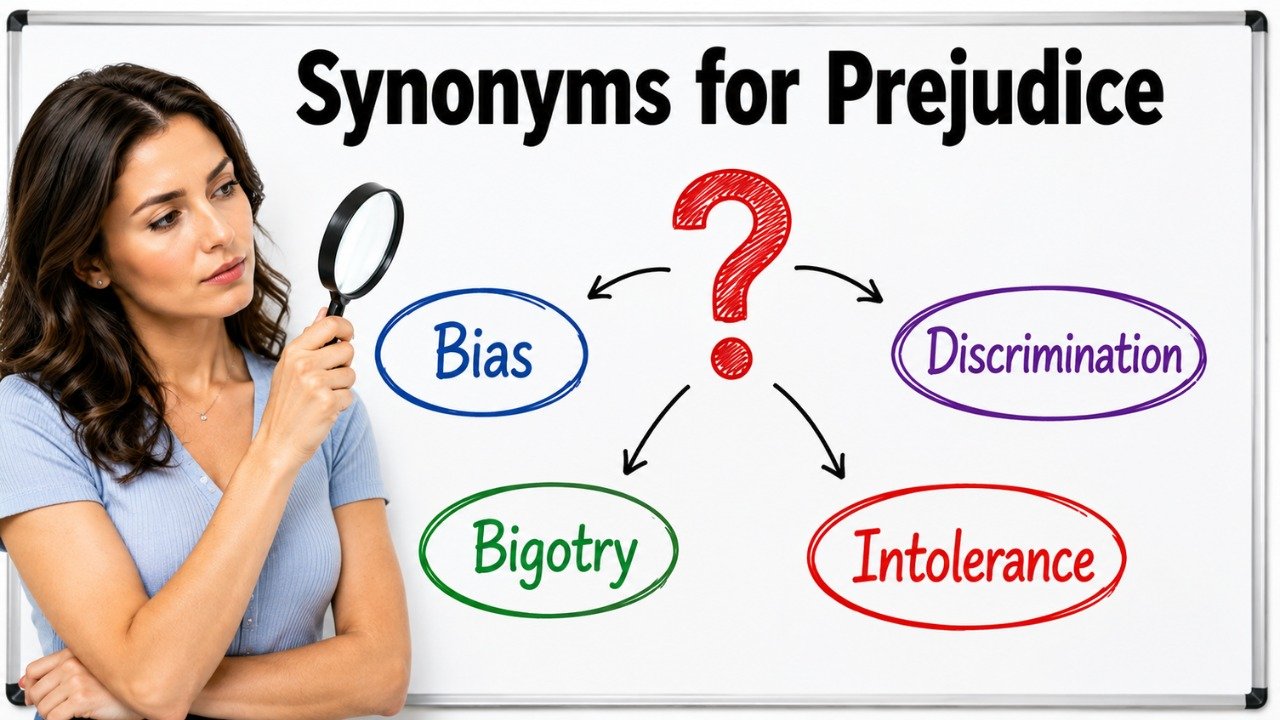
Quick Answer: The best synonyms for prejudice include bias, partiality, bigotry, intolerance, discrimination, preconception, prejudgment, stereotyping, favoritism, and unfairness. Bias is the best general replacement in formal writing, reports, essays, and everyday conversation. Use preconception when someone forms an opinion before knowing the facts. Choose discrimination when prejudice leads to unfair treatment. Bigotry and intolerance describe stronger, deeply held attitudes, while partiality and favoritism are useful when someone unfairly prefers one person, group, or side.
Pronunciation and Word Details
Word: Prejudice.
Pronunciation: /ˈpredʒ.ə.dɪs/
Part of Speech: Noun and verb.
Meaning: An unfair opinion or judgment formed without enough knowledge, reason, or experience.
US Pronunciation:
UK Pronunciation:
What Does “Prejudice” Mean?
Prejudice means an unfair opinion, feeling, or judgment about a person, group, idea, or situation that is formed before all the relevant facts are known.
As a noun, prejudice usually describes an unreasonable attitude based on assumptions, stereotypes, fear, dislike, or personal preference.
Example: Education can help reduce prejudice within a community.
As a verb, prejudice means to influence someone unfairly or make a fair decision less likely.
Example: News of the earlier complaint could prejudice the committee against the applicant.
Prejudice may be directed against people because of their background, appearance, age, beliefs, social position, abilities, or other perceived characteristics. It can also describe unfair preference in favor of one person, argument, or group.
The word is commonly used in discussions of society, education, law, employment, relationships, decision making, and personal behavior.
Meaning, Tone, and Context of “Prejudice”
Prejudice is a serious and usually negative word. It is common in formal, academic, professional, legal, and social discussions, but it also appears in everyday conversation.
The word often carries an emotional or critical tone because it describes judgment that is unfair, unreasonable, or unsupported by evidence.
In academic writing, prejudice may refer to learned attitudes, unconscious assumptions, social divisions, or unfair beliefs about groups.
Example: The study examined how prejudice can influence workplace decisions.
In casual conversation, the word may describe an unfair opinion someone holds before meeting a person or understanding a situation.
Example: She admitted that her first impression had been shaped by prejudice.
In legal language, prejudice can refer to harm caused to a person’s rights, interests, or ability to receive fair treatment.
Example: Releasing the information could prejudice the outcome of the hearing.
Prejudice is stronger than a simple preference. A preference may be based on taste, while prejudice usually involves unfair judgment or treatment.
When and How to Use “Prejudice”
For Unfair Opinions
Use prejudice when someone forms a negative judgment without knowing the complete facts.
Example: His prejudice prevented him from considering her ideas fairly.
For Social Attitudes
Use prejudice when discussing unfair beliefs about a social, cultural, religious, economic, or demographic group.
Example: The program was designed to challenge prejudice and encourage understanding.
For Preconceived Judgments
Use prejudice when an opinion is formed before a person has enough evidence or direct experience.
Example: She approached the unfamiliar tradition without prejudice.
For Unfair Preference
Prejudice can describe an unfair preference in favor of one person, position, or group.
Example: The selection process showed prejudice in favor of experienced applicants.
For Discriminatory Thinking
Use prejudice when an unfair belief may contribute to exclusion or unequal treatment.
Example: Workplace prejudice can affect hiring, promotion, and professional development.
For Legal Harm
As a verb, prejudice can mean harming someone’s chances of receiving a fair decision.
Example: Public discussion of the case might prejudice the proceedings.
For Personal Reflection
Use prejudice when discussing assumptions that influence a person’s thinking or behavior.
Example: He recognized his prejudice and made an effort to question it.
Best Synonyms for Prejudice
Bias
Bias: An unfair tendency to favor or oppose a person, group, idea, or decision.
Example: Personal bias affected the manager’s judgment.
Partiality
Partiality: Unfair support for one person, side, or group over another.
Example: The judge was criticized for showing partiality.
Bigotry
Bigotry: Strong and unreasonable intolerance toward people with different identities, beliefs, or backgrounds.
Example: Community leaders spoke openly against bigotry.
Intolerance
Intolerance: An unwillingness to accept different opinions, practices, beliefs, or people.
Example: The discussion exposed deep intolerance toward unfamiliar customs.
Discrimination
Discrimination: Unfair treatment based on prejudice or membership in a particular group.
Example: The policy was introduced to prevent discrimination in employment.
Preconception
Preconception: An opinion formed before enough information or experience is available.
Example: Her preconception changed after she learned more about the subject.
Prejudgment
Prejudgment: A decision or opinion formed before examining all the facts.
Example: Fair interviews require managers to avoid prejudgment.
Stereotyping
Stereotyping: Assuming that every member of a group has the same qualities or behavior.
Example: The training helped employees recognize harmful stereotyping.
Favoritism
Favoritism: Unfairly giving better treatment to a preferred person or group.
Example: Several workers complained about favoritism in the department.
Unfairness
Unfairness: The quality of being unjust, unequal, or unreasonable.
Example: The students questioned the unfairness of the selection process.
50 Synonyms for Prejudice with Short Meanings
- Bias: An unfair tendency to favor or oppose something.
- Partiality: Unfair support for one side or person.
- Bigotry: Strong intolerance toward different people or beliefs.
- Intolerance: An unwillingness to accept differences.
- Discrimination: Unfair treatment based on personal or group characteristics.
- Preconception: An opinion formed before knowing the facts.
- Prejudgment: A judgment made before proper consideration.
- Preconceived Opinion: A belief formed before receiving enough information.
- Preconceived Notion: An existing idea that may not be supported by evidence.
- Stereotyping: Treating all members of a group as if they are alike.
- Favoritism: Unfair preference for one person or group.
- Unfairness: A lack of justice or equal treatment.
- One Sidedness: Considering only one viewpoint or interest.
- Narrow Mindedness: An unwillingness to consider unfamiliar ideas.
- Closed Mindedness: Refusal to examine different views or evidence.
- Partisanship: Strong support for one side that affects fair judgment.
- Chauvinism: An unreasonable belief in the superiority of one group.
- Dogmatism: Rigid belief that one opinion is unquestionably correct.
- Hostility: Strong unfriendly feeling toward someone or something.
- Animosity: Deep dislike or resentment.
- Antipathy: A strong feeling of dislike.
- Aversion: A powerful dislike or desire to avoid something.
- Distrust: A lack of confidence in someone’s honesty or ability.
- Suspicion: A feeling that someone may be wrong or untrustworthy.
- Predisposition: A tendency to think or respond in a particular way.
- Prepossession: A previously formed opinion that influences judgment.
- Inclination: A tendency to favor a particular idea or person.
- Leaning: A preference toward one side or position.
- Slant: A particular viewpoint that may present information unfairly.
- Preference: A greater liking for one option, sometimes affecting fairness.
- Assumption: A belief accepted without complete proof.
- Presumption: An opinion formed before the facts are confirmed.
- Generalization: A broad conclusion applied to many people or cases.
- Misconception: A belief based on incorrect understanding.
- Fixed Opinion: A belief that a person is unwilling to reconsider.
- Unfair Judgment: A conclusion not based on balanced evidence.
- Negative Attitude: An unfavorable way of thinking about someone or something.
- Discriminatory Attitude: A belief that supports unequal treatment.
- Social Bias: An unfair attitude influenced by social expectations.
- Cultural Bias: Judgment based on the standards of one culture.
- Institutional Bias: Unfairness built into an organization or system.
- Implicit Bias: An automatic attitude that may operate without awareness.
- Explicit Bias: A consciously held unfair belief or preference.
- Unconscious Bias: An unfair assumption a person may not recognize.
- Racial Bias: Unfair judgment based on perceived race.
- Gender Bias: Unfair judgment based on gender.
- Class Bias: Unfair judgment based on social or economic position.
- Age Bias: Unfair judgment based on age.
- Religious Intolerance: Unwillingness to accept different religious beliefs.
- Xenophobia: Fear, distrust, or dislike of people considered foreign.
Read Also:
Synonyms for Opinion
Synonyms for Prejudice by Context
When Prejudice Means an Unfair Opinion
Bias, preconception, prejudgment, assumption, presumption, and fixed opinion are useful when someone forms a judgment without enough evidence.
Bias Example: The interviewer allowed personal bias to affect the final decision.
Preconception Example: His preconception disappeared after he visited the community.
Prejudgment Example: The applicant deserved an assessment free from prejudgment.
Assumption Example: Her assumption was based on limited information.
Presumption Example: The presumption of dishonesty damaged their relationship.
When Prejudice Means Intolerance
Bigotry, intolerance, narrow mindedness, closed mindedness, chauvinism, and dogmatism describe a refusal to respect differences.
Bigotry Example: The organization rejected every form of bigotry.
Intolerance Example: Intolerance can prevent meaningful conversation.
Narrow Mindedness Example: His narrow mindedness made him dismiss unfamiliar customs.
Closed Mindedness Example: Closed mindedness prevented the group from considering new evidence.
Chauvinism Example: Her essay examined cultural chauvinism in historical writing.
When Prejudice Leads to Unfair Treatment
Discrimination, unfairness, favoritism, partiality, institutional bias, and discriminatory attitude are suitable when beliefs affect actions or decisions.
Discrimination Example: The rules protect applicants from discrimination.
Unfairness Example: Employees raised concerns about unfairness in the promotion process.
Favoritism Example: Favoritism damaged trust within the team.
Partiality Example: The official denied showing partiality toward either side.
Institutional Bias Example: The review identified institutional bias in the evaluation system.
When Prejudice Means an Unfair Preference
Partiality, favoritism, leaning, inclination, preference, and partisanship describe favoring one side over another.
Partiality Example: A fair mediator must avoid partiality.
Favoritism Example: The coach was accused of showing favoritism.
Leaning Example: The committee appeared to have a leaning toward the first proposal.
Partisanship Example: Strong partisanship made cooperation difficult.
When Prejudice Means a Stereotyped Belief
Stereotyping, generalization, misconception, social bias, and cultural bias apply when people make broad assumptions about a group.
Stereotyping Example: Stereotyping ignores individual differences.
Generalization Example: The statement was an unfair generalization.
Misconception Example: The lesson corrected a common misconception about the region.
Cultural Bias Example: Cultural bias can affect how behavior is interpreted.
When Prejudice Means Hostile Feeling
Hostility, animosity, antipathy, aversion, distrust, and suspicion describe negative emotions that may support prejudice.
Hostility Example: Years of hostility had divided the two communities.
Animosity Example: Personal animosity influenced the debate.
Antipathy Example: His antipathy toward the proposal was obvious.
Distrust Example: Longstanding distrust made cooperation difficult.
Another Word for Prejudice
Bias is the best general replacement for prejudice. It works naturally in academic writing, professional communication, reports, essays, and conversation. However, the best alternative depends on meaning. Use preconception for an opinion formed too early, discrimination for unfair treatment, and bigotry for severe intolerance.
Original: Prejudice affected the hiring decision.
Better Option: Bias affected the hiring decision.
Original: Her prejudice disappeared after she learned the facts.
Better Option: Her preconception disappeared after she learned the facts.
Original: The policy was created to reduce prejudice in the workplace.
Better Option: The policy was created to reduce discrimination in the workplace.
Original: The speech encouraged prejudice against unfamiliar communities.
Better Option: The speech encouraged intolerance toward unfamiliar communities.
When Not to Use “Prejudice”
Prejudice can be too broad when the sentence requires a more specific description of the belief, action, or behavior.
When Describing Unfair Treatment
Use discrimination when prejudice has led to an action, policy, or unequal outcome.
Weak: The employee experienced prejudice when she was denied equal pay.
Better: The employee experienced discrimination when she was denied equal pay.
When Describing a Mild Preference
Use preference, leaning, or partiality when the attitude is not hostile or deeply unfair.
Weak: He has a prejudice for quiet working environments.
Better: He has a preference for quiet working environments.
When Referring to an Early Assumption
Use preconception or prejudgment when the main issue is that an opinion was formed too soon.
Weak: She had a prejudice about how difficult the course would be.
Better: She had a preconception about how difficult the course would be.
When Describing a Broad Group Belief
Use stereotype or generalization when someone assigns the same quality to every member of a group.
Weak: The statement repeated a prejudice about older workers.
Better: The statement repeated a stereotype about older workers.
When Describing Strong Intolerance
Use bigotry or intolerance when the belief is deeply hostile and resistant to reason.
Weak: His comments revealed a small amount of prejudice.
Better: His comments revealed open bigotry.
When Evidence Supports the Judgment
Do not call a conclusion prejudice when it is based on reliable evidence and fair evaluation.
Weak: Her prejudice led her to reject the proposal after reviewing its inaccurate figures.
Better: Her evidence based judgment led her to reject the proposal.
When the Word Becomes Repetitive
Replace repeated uses of prejudice with more precise alternatives.
Weak: The report examined prejudice, the effects of prejudice, and policies designed to prevent prejudice.
Better: The report examined social bias, its effects, and policies designed to prevent discrimination.
Words Commonly Confused With Prejudice
Prejudice vs Bias: Prejudice is an unfair opinion or feeling, often directed toward a person or group. Bias is a broader tendency that can influence judgment, choices, research, or decisions.
Prejudice vs Discrimination: Prejudice is an attitude or belief. Discrimination is unfair behavior or treatment that may result from that attitude.
Prejudice vs Stereotype: Prejudice is an unfair judgment or feeling. A stereotype is a simplified belief applied to all members of a group.
Prejudice vs Bigotry: Prejudice can range from unconscious assumptions to open hostility. Bigotry is stronger and usually involves stubborn, severe intolerance.
Prejudice vs Racism: Prejudice is a broad term for unfair judgment. Racism is prejudice or discrimination specifically connected to race and may also involve unequal social systems.
Prejudice vs Preconception: A preconception is any opinion formed in advance. Prejudice is normally unfair, negative, or unreasonable.
Prejudice vs Preference: Prejudice involves unfair judgment. Preference is simply liking one option more than another and is not always harmful.
Prejudice vs Intolerance: Prejudice is an unfair belief or attitude. Intolerance is an unwillingness to accept differences.
Which Synonym Should You Choose?
Choose bias when you need a broad and neutral term for unfair influence in reports, essays, professional emails, research, or conversation.
Choose partiality when someone unfairly supports one side, person, argument, or applicant.
Choose preconception when an opinion was formed before enough information became available.
Choose prejudgment when someone reached a conclusion before examining the evidence.
Choose discrimination when prejudice results in unequal treatment, exclusion, or denied opportunities.
Choose stereotyping when someone applies a general belief to every member of a group.
Choose bigotry when describing strong, stubborn, and openly hostile intolerance.
Choose intolerance when someone refuses to respect different beliefs, practices, identities, or viewpoints.
Choose favoritism when one person or group receives unfairly better treatment.
Choose unfairness when the focus is the lack of justice in a rule, action, or decision.
Choose implicit bias when discussing automatic assumptions that may influence behavior without conscious awareness.
Choose cultural bias when standards from one culture are used to judge another culture unfairly.
Choose institutional bias when unfair patterns are connected to the rules or practices of an organization.
Choose assumption in casual conversation when the judgment is unsupported but not necessarily hostile.
Real Life Examples of “Prejudice” in Sentences
Original: The manager’s prejudice affected the interview process.
Better Option: The manager’s bias affected the interview process.
Original: She overcame her prejudice after meeting the new neighbors.
Better Option: She overcame her preconception after meeting the new neighbors.
Original: The campaign encouraged people to challenge prejudice.
Better Option: The campaign encouraged people to challenge intolerance.
Original: Prejudice prevented the committee from making a fair decision.
Better Option: Partiality prevented the committee from making a fair decision.
Original: The policy was intended to protect workers from prejudice.
Better Option: The policy was intended to protect workers from discrimination.
Original: His prejudice was based on a common belief about the profession.
Better Option: His judgment was based on a common stereotype about the profession.
Original: The teacher discussed the effects of prejudice in society.
Better Option: The teacher discussed the effects of social bias in society.
Original: Personal prejudice influenced how the report was written.
Better Option: Personal slant influenced how the report was written.
Original: Her prejudice against unfamiliar ideas limited the discussion.
Better Option: Her closed mindedness toward unfamiliar ideas limited the discussion.
Original: The article revealed prejudice in favor of wealthy applicants.
Better Option: The article revealed favoritism toward wealthy applicants.
Synonym Groups and Usage Differences
Early Judgment Group
This group includes preconception, prejudgment, preconceived opinion, assumption, presumption, and prepossession.
These words describe opinions formed before a person has enough knowledge or evidence. Preconception is usually less severe than prejudice, while prejudgment emphasizes reaching a conclusion too early.
Example: The interview gave her an opportunity to correct the panel’s preconception.
Unfair Preference Group
This group includes bias, partiality, favoritism, leaning, inclination, and partisanship.
These words describe an unfair tendency to support one person, group, argument, or side. Bias is the broadest option, while favoritism usually involves giving someone better treatment.
Example: The selection process must be protected from personal bias.
Intolerance Group
This group includes bigotry, intolerance, narrow mindedness, closed mindedness, chauvinism, and dogmatism.
These terms describe unwillingness to accept differences. Bigotry is especially strong, while narrow mindedness may describe a more general refusal to consider other viewpoints.
Example: Open discussion can sometimes reduce intolerance.
Discrimination Group
This group includes discrimination, unfairness, discriminatory attitude, institutional bias, racial bias, gender bias, class bias, and age bias.
These expressions describe prejudice connected to unequal treatment or unfair systems. Discrimination usually refers to action, while bias may describe the attitude influencing that action.
Example: Clear procedures can help prevent discrimination during recruitment.
Stereotype Group
This group includes stereotyping, generalization, misconception, assumption, cultural bias, and social bias.
These alternatives apply when people form simplified beliefs about individuals or groups.
Example: The statement was based on an inaccurate generalization.
Hostility Group
This group includes hostility, animosity, antipathy, aversion, distrust, and suspicion.
These words focus on the negative feelings that can accompany prejudice. They do not always mean prejudice, but they can describe its emotional effects.
Example: Continued dialogue helped reduce hostility between the groups.
Antonyms of Prejudice
The opposite of prejudice may refer to fair judgment, equal treatment, openness, acceptance, or respect.
Fairness: Equal and reasonable treatment.
Impartiality: Freedom from personal preference or unfair influence.
Neutrality: A position that does not favor either side.
Objectivity: Judgment based on facts rather than personal feelings.
Tolerance: Willingness to accept differences.
Acceptance: Recognition and respect for people or ideas.
Open Mindedness: Willingness to consider new evidence and viewpoints.
Equality: The condition of having equal rights, status, or opportunities.
Justice: Fair treatment according to ethical or legal principles.
Evenhandedness: Consistently fair treatment of all sides.
Inclusion: The practice of welcoming and involving different people.
Respect: Consideration for another person’s rights, views, or dignity.
Understanding: Knowledge that encourages thoughtful and fair judgment.
Acceptance of Difference: Recognition that people can vary without being judged unfairly.
Unbiased Judgment: A conclusion reached without unfair influence.
Comparison: Prejudice vs Related Words
Prejudice vs Bias
Prejudice usually refers to an unfair opinion or feeling about a person or group. Bias is broader and can affect decisions, research, reporting, preferences, and interpretations.
Example With Prejudice: His prejudice made him distrust people from unfamiliar backgrounds.
Example With Bias: The reviewer’s personal bias affected the final score.
Prejudice vs Discrimination
Prejudice is an internal attitude or belief. Discrimination is the unfair action or treatment that can result from prejudice.
Example With Prejudice: Her prejudice influenced how she viewed the applicant.
Example With Discrimination: Refusing to interview the applicant because of that belief was discrimination.
Prejudice vs Stereotype
Prejudice is an unfair judgment or negative feeling. A stereotype is a simplified belief about the characteristics of a group.
Example With Prejudice: His prejudice made him avoid the new employee.
Example With Stereotype: He believed the stereotype that older employees resist change.
Prejudice vs Bigotry
Prejudice may be conscious or unconscious and can vary in strength. Bigotry is severe, stubborn intolerance that is openly resistant to different people or beliefs.
Example With Prejudice: The workshop helped participants recognize hidden prejudice.
Example With Bigotry: The organization publicly rejected the speaker’s bigotry.
Prejudice vs Preconception
Prejudice is normally unfair and often negative. A preconception is any opinion formed before learning enough information and may not always involve hostility.
Example With Prejudice: Her prejudice led her to reject the candidate unfairly.
Example With Preconception: Her preconception about the job changed during the interview.
Prejudice vs Preference
Prejudice is an unreasonable judgment that can harm fair treatment. Preference is a personal choice or liking that may be harmless.
Example With Prejudice: His prejudice prevented him from evaluating the applicants equally.
Example With Preference: His preference was to schedule interviews in the morning.
Prejudice vs Intolerance
Prejudice is an unfair opinion or attitude. Intolerance is the refusal to accept different beliefs, practices, or people.
Example With Prejudice: Prejudice shaped her first impression.
Example With Intolerance: Intolerance prevented him from respecting opposing views.
Common Phrases and Expressions With “Prejudice”
Prejudice Against: An unfair negative opinion about a person, group, or idea.
Example: The policy addresses prejudice against older workers.
Prejudice in Favor of: An unfair preference for someone or something.
Example: The process showed prejudice in favor of internal applicants.
Racial Prejudice: Unfair judgment based on perceived race.
Example: The lessons encouraged students to challenge racial prejudice.
Social Prejudice: Unfair attitudes based on social identity or status.
Example: Social prejudice can limit opportunities.
Religious Prejudice: Unfair judgment based on religious belief or practice.
Example: The community project aimed to reduce religious prejudice.
Personal Prejudice: An unfair belief influenced by individual feelings or experiences.
Example: Officials must not allow personal prejudice to affect their decisions.
Deep Seated Prejudice: A strongly established unfair belief that is difficult to change.
Example: Honest education may help challenge deep seated prejudice.
Overcome Prejudice: To recognize and move beyond unfair beliefs.
Example: Direct experience helped him overcome prejudice.
Free From Prejudice: Not influenced by unfair assumptions or opinions.
Example: Every applicant deserves an assessment free from prejudice.
Without Prejudice: Without giving up a legal right, claim, or position.
Example: The parties continued their discussion without prejudice.
Common Mistakes to Avoid
Confusing Prejudice With Discrimination
Prejudice is an attitude, while discrimination is an action. Use the words according to whether you are describing a belief or unequal treatment.
Incorrect: The employer’s prejudice was refusing to interview qualified applicants.
Better: The employer’s discrimination involved refusing to interview qualified applicants.
Using Prejudice as an Adjective
Prejudice is normally a noun or verb. Prejudiced is the adjective.
Incorrect: He made a prejudice remark.
Better: He made a prejudiced remark.
Treating Preference as Prejudice
Not every preference is unfair. A personal taste becomes prejudice when it leads to unreasonable judgment or unequal treatment.
Incorrect: Her preference for tea is a form of prejudice.
Better: Her preference for tea is simply a personal choice.
Using Strong Synonyms Carelessly
Bigotry is stronger than bias or preconception. Do not use it for a mild assumption unless the attitude is deeply intolerant.
Too Strong: He showed bigotry by assuming the meeting would be boring.
Better: He showed a preconception by assuming the meeting would be boring.
Repeating Prejudice Too Often
Use precise alternatives such as bias, discrimination, stereotyping, partiality, or intolerance to improve clarity.
Repetitive: Prejudice can create prejudice in decisions and prejudice in treatment.
Improved: Biased beliefs can influence decisions and lead to discriminatory treatment.
Using Vague Language
Identify the type of prejudice when the context requires detail.
Vague: The report discusses prejudice.
Clearer: The report discusses age bias in workplace recruitment.
Confusing Evidence With Prejudice
A conclusion based on reliable evidence is not necessarily prejudiced. Prejudice involves unfair judgment formed without adequate reason or balanced evaluation.
Assuming All Bias Is Intentional
Some bias is conscious, while some operates without awareness. Use explicit bias or unconscious bias when the distinction matters.
Conclusion
The strongest synonyms for prejudice include bias, partiality, preconception, prejudgment, intolerance, bigotry, discrimination, stereotyping, favoritism, and unfairness. Bias is the best broad replacement, while preconception describes an opinion formed too early. Discrimination is appropriate when unfair beliefs lead to unequal treatment. Bigotry and intolerance express stronger hostility, while partiality and favoritism describe unfair preference. Choosing the right term makes discussions about judgment, behavior, equality, and social attitudes clearer and more accurate.
FAQs About Synonyms for Prejudice
What Is the Closest Synonym for Prejudice?
Bias is the closest general synonym for prejudice. It describes an unfair influence, preference, or judgment.
Is Discrimination the Same as Prejudice?
No. Prejudice is an unfair attitude or belief, while discrimination is unfair treatment or action that may result from that belief.
What Is a Formal Synonym for Prejudice?
Partiality, preconception, prejudgment, and bias are suitable formal alternatives, depending on the context.
What Is a Stronger Word for Prejudice?
Bigotry and intolerance are stronger words when the attitude is deeply hostile, stubborn, or openly discriminatory.
What Is the Opposite of Prejudice?
Common opposites include fairness, impartiality, neutrality, tolerance, acceptance, objectivity, and open mindedness.
Can Prejudice Be Used as a Verb?
Yes. As a verb, prejudice means to influence someone unfairly or harm a person’s chance of receiving fair treatment.
What Is the Difference Between Bias and Prejudice?
Bias is a broad tendency that influences judgment. Prejudice is usually an unfair opinion or feeling formed without enough knowledge, often about a person or group.
