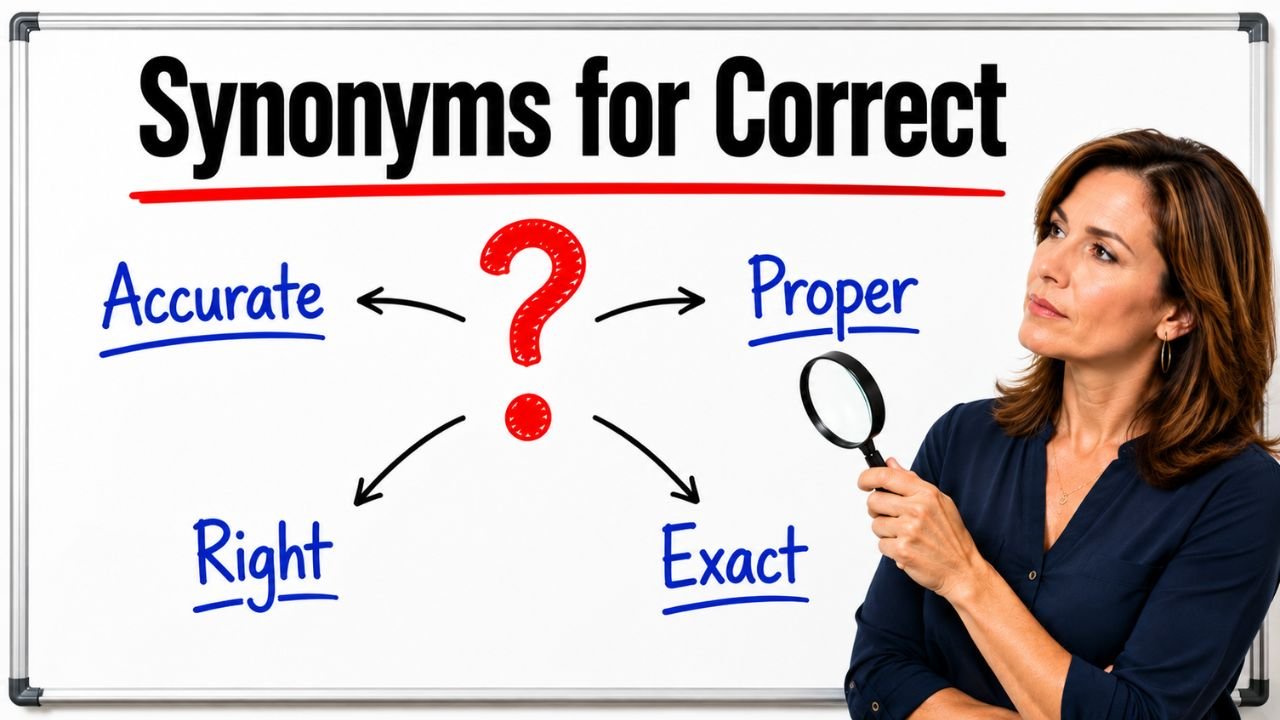
Quick Answer: The best synonyms for correct are accurate, right, true, exact, precise, proper, valid, appropriate, rectify, and revise. Use accurate for facts, data, reports, and descriptions. Choose right for casual speech and agreement. Use exact or precise for measurements and specific details. Proper and appropriate describe suitable behavior, methods, or choices. Valid suits arguments and official information. When correct is a verb, rectify, fix, amend, or revise may be better choices.
Pronunciation and Word Details
Word: Correct.
Pronunciation: /kəˈrekt/.
Part of Speech: Adjective and verb.
Meaning: Correct means free from error, suitable for a situation, or changed to remove a mistake.
US Pronunciation:
UK Pronunciation:
What Does “Correct” Mean?
Correct means accurate, true, proper, or free from mistakes.
As an adjective, correct describes information, answers, calculations, decisions, methods, or behavior that follows facts, rules, or accepted standards.
Example: Her answer was correct.
As a verb, correct means to identify and remove an error, improve something inaccurate, or show someone the proper form.
Example: The teacher corrected the spelling mistake.
The word can also describe something suitable for a particular situation.
Example: This is the correct procedure for submitting the form.
Correct works differently depending on the sentence. It can describe factual accuracy, proper behavior, an accepted method, a suitable choice, or the action of fixing an error.
Factual Use: The information in the report is correct.
Answer Use: You selected the correct option.
Suitability Use: She wore the correct clothing for the ceremony.
Grammar Use: Please correct the sentence.
Behavior Use: The coach corrected the player’s posture.
Meaning, Tone, and Context of “Correct”
Correct has a neutral and flexible tone. It appears in formal writing, casual conversation, academic work, technical instructions, professional communication, education, and everyday speech.
Formal Tone: Correct is suitable for essays, reports, instructions, assessments, and professional emails.
Casual Tone: In ordinary conversation, right often sounds more natural than correct.
Academic Tone: Correct is commonly used for answers, theories, calculations, definitions, and interpretations.
Technical Tone: It can describe accurate measurements, settings, procedures, data, or system configurations.
Polite Tone: Correct can be polite when referring to information or mistakes, but it may sound direct when used about a person.
Strong Tone: Saying someone is correct clearly confirms that the person’s statement or conclusion is accurate.
Neutral Tone: The word usually carries no strong emotion. It simply confirms accuracy, suitability, or compliance with a standard.
Correct is broader than accurate. Accurate mainly concerns facts, measurements, and descriptions, while correct can also describe behavior, procedures, grammar, choices, and accepted forms.
When and How to Use “Correct”
For Accurate Information
Use correct when information agrees with the facts.
Example: The address written on the document is correct.
For Answers
Use correct when an answer, solution, or conclusion is free from error.
Example: Only one of the four answers is correct.
For Calculations
Use correct when numbers or mathematical results have been checked and confirmed.
Example: Her final calculation was correct.
For Proper Procedures
Use correct when an action follows an accepted method, rule, or process.
Example: Please follow the correct procedure when handling the equipment.
For Suitable Choices
Use correct when something is appropriate for a particular situation.
Example: He selected the correct tool for the repair.
For Grammar and Spelling
Use correct as a verb when changing inaccurate spelling, punctuation, grammar, or wording.
Example: Please correct the punctuation in the final paragraph.
For Behavior or Technique
Use correct when improving someone’s posture, movement, method, or conduct.
Example: The instructor corrected her hand position.
For Misunderstandings
Use correct when replacing false information with accurate information.
Example: She corrected the misunderstanding before the meeting began.
For Formal Confirmation
Use correct when confirming that a statement, date, name, or detail is accurate.
Example: Yes, that is the correct meeting time.
Best Synonyms for Correct
Accurate
Synonym: Accurate means free from factual, numerical, or descriptive errors.
Example: The report provides an accurate description of the results.
Right
Synonym: Right means true, suitable, or free from error, especially in casual speech.
Example: You were right about the starting time.
True
Synonym: True means consistent with facts or reality.
Example: Her statement was completely true.
Exact
Synonym: Exact means completely accurate in every detail.
Example: We need the exact dimensions of the room.
Precise
Synonym: Precise means clearly defined and highly accurate.
Example: The technician recorded the precise measurement.
Proper
Synonym: Proper means suitable, accepted, or following established rules.
Example: Everyone must follow the proper safety procedure.
Valid
Synonym: Valid means logically, legally, or officially acceptable.
Example: She presented a valid argument.
Appropriate
Synonym: Appropriate means suitable for a particular situation or purpose.
Example: His response was appropriate for the formal setting.
Rectify
Synonym: Rectify means to correct a mistake, problem, or unfair situation.
Example: The manager acted quickly to rectify the billing error.
Revise
Synonym: Revise means to change something to improve its accuracy, quality, or clarity.
Example: She revised the paragraph before submitting the essay.
50 Synonyms for Correct with Short Meanings
- Accurate: Free from factual or numerical errors.
- Right: True, suitable, or not mistaken.
- True: Consistent with facts or reality.
- Exact: Completely accurate in every detail.
- Precise: Clearly defined and highly accurate.
- Factual: Based on proven or observable facts.
- Valid: Logically, legally, or officially acceptable.
- Sound: Sensible, reliable, and based on good reasoning.
- Proper: Suitable and consistent with accepted rules.
- Appropriate: Suitable for a particular situation.
- Suitable: Right for a specific purpose or need.
- Acceptable: Good enough to meet a required standard.
- Faultless: Containing no mistakes or weaknesses.
- Flawless: Perfect and free from defects.
- Unerring: Consistently accurate and not mistaken.
- Reliable: Dependable and likely to be accurate.
- Authentic: Real, genuine, and not false.
- Genuine: Truly what something claims to be.
- Legitimate: Lawful, reasonable, or officially accepted.
- Just: Fair and morally right.
- Fair: Reasonable and free from unfair treatment.
- Ethical: Consistent with accepted moral principles.
- Lawful: Allowed or required by law.
- Standard: Following an accepted form or level.
- Conventional: Following commonly accepted practices.
- Approved: Officially accepted or permitted.
- Advisable: Sensible and suitable in the circumstances.
- Fitting: Suitable for the situation or purpose.
- Apt: Especially suitable or appropriate.
- On Target: Accurate or directed toward the right result.
- Spot On: Completely accurate in casual speech.
- Dead Right: Entirely correct or accurate.
- Verifiable: Able to be checked and confirmed as true.
- Well Founded: Supported by reliable facts or reasoning.
- Defensible: Able to be supported with sound reasons.
- Rectify: To remove or correct an error.
- Fix: To repair or correct a problem.
- Repair: To restore something to proper condition.
- Amend: To change something in order to improve or correct it.
- Revise: To review and improve written or planned work.
- Edit: To correct and improve written content.
- Adjust: To make a small change for greater accuracy.
- Remedy: To correct a problem or undesirable situation.
- Improve: To make something better or more effective.
- Reform: To correct a system, practice, or behavior.
- Redress: To correct an unfair or harmful situation.
- Set Right: To correct a mistake or difficult situation.
- Put Right: To fix something that is wrong.
- Resolve: To correct or settle a problem.
- Straighten Out: To correct confusion, disorder, or misunderstanding.
Read Also:
Synonyms for Fix
Synonyms for Correct by Context
When Correct Means Accurate
Accurate, exact, precise, factual, true, and reliable are useful when correct refers to information, measurements, descriptions, or results.
Accurate is the strongest general choice for facts and data. Exact emphasizes complete agreement with a specific value. Precise suggests careful detail and narrow accuracy.
Example With Accurate: The article gives an accurate account of the event.
Example With Exact: Please provide the exact date of the appointment.
Example With Precise: The machine requires precise measurements.
When Correct Means Right
Right, true, spot on, dead right, and on target work when confirming an answer, opinion, prediction, or conclusion.
Right is common in everyday conversation. Spot on is informal and enthusiastic. True is better when discussing facts or reality.
Example With Right: You were right about the cause of the problem.
Example With Spot On: Her prediction was spot on.
Example With True: The statement is true.
When Correct Means Proper
Proper, appropriate, suitable, fitting, apt, and advisable describe something that suits a situation, purpose, rule, or standard.
Proper often refers to rules and accepted procedures. Appropriate focuses on suitability. Advisable describes a wise choice.
Example With Proper: Use the proper method when cleaning the material.
Example With Appropriate: Formal clothing is appropriate for the ceremony.
Example With Advisable: It is advisable to review the instructions first.
When Correct Means Valid
Valid, sound, legitimate, defensible, well founded, and verifiable describe ideas, arguments, evidence, claims, and official documents.
Valid suggests acceptance under rules or logic. Sound emphasizes good reasoning. Verifiable means that a claim can be checked.
Example With Valid: The researcher raised a valid concern.
Example With Sound: The decision was based on sound reasoning.
Example With Verifiable: Every claim should be supported by verifiable evidence.
When Correct Means Fair or Morally Right
Just, fair, ethical, lawful, and legitimate describe actions or decisions that follow moral or legal standards.
Just emphasizes fairness. Ethical refers to moral principles. Lawful means permitted by law.
Example With Just: The judge reached a just decision.
Example With Ethical: The organization followed ethical practices.
Example With Lawful: The activity was completely lawful.
When Correct Means Fix
Fix, rectify, amend, revise, edit, adjust, repair, remedy, and resolve are useful when correct functions as a verb.
Fix is broad and conversational. Rectify is more formal. Revise suits writing and plans. Amend is often used for documents, rules, or statements.
Example With Fix: Please fix the error in the form.
Example With Rectify: The company took steps to rectify the mistake.
Example With Revise: She revised her answer after checking the evidence.
Another Word for Correct
Accurate is often the best single replacement for correct when discussing facts, information, calculations, descriptions, or results. However, the strongest alternative depends on the sentence.
Use right in casual conversation, proper for accepted procedures, appropriate for suitable choices, and fix when correct is a verb.
Original: The information in the document is correct.
Better Option: The information in the document is accurate.
Original: You gave the correct answer.
Better Option: You gave the right answer.
Original: This is the correct method for storing the material.
Better Option: This is the proper method for storing the material.
Original: Please correct the mistake before submitting the form.
Better Option: Please fix the mistake before submitting the form.
When Not to Use “Correct”
Correct is useful, but it can sound broad or unclear when a more precise word is available.
When You Mean Factual Accuracy
Accurate is usually clearer when describing reports, statistics, data, or factual information.
Weak: The report contains correct information about the results.
Better: The report contains accurate information about the results.
When You Mean Exact Detail
Exact or precise is better when discussing measurements, times, numbers, or locations.
Weak: Please provide the correct measurement.
Better: Please provide the exact measurement.
When You Mean Suitability
Appropriate or suitable is clearer when something fits a social situation, purpose, or audience.
Weak: His clothing was correct for the formal event.
Better: His clothing was appropriate for the formal event.
When You Mean an Accepted Procedure
Proper is often more natural when discussing rules, methods, behavior, or technique.
Weak: She followed the correct procedure.
Better: She followed the proper procedure.
When Correcting a Person Sounds Harsh
Saying that you corrected someone can sound critical. Clarified, explained, or guided may sound more respectful.
Weak: I corrected my colleague during the discussion.
Better: I clarified the information during the discussion.
When Repetition Weakens the Writing
Repeating correct too often makes a paragraph sound basic and mechanical.
Weak: The correct answer depends on the correct method and the correct information.
Better: The right answer depends on an accurate method and reliable information.
Words Commonly Confused With Correct
Correct vs Accurate: Correct is broad and can describe answers, behavior, procedures, and information. Accurate mainly describes facts, measurements, reports, and details.
Correct vs Right: Correct sounds more formal and objective. Right is more conversational and can also describe moral goodness or direction.
Correct vs Exact: Correct means free from error. Exact means completely specific and matching in every detail.
Correct vs Precise: Correct confirms that something is not wrong. Precise emphasizes careful detail, clarity, and narrow accuracy.
Correct vs Proper: Correct can refer to factual truth. Proper refers more often to accepted rules, methods, behavior, or standards.
Correct vs Appropriate: Correct may describe truth or accuracy. Appropriate describes something suitable for a situation.
Correct vs Valid: Correct means free from error. Valid means acceptable according to logic, rules, law, or official requirements.
Correct vs Rectify: Correct can be an adjective or a verb. Rectify is only a verb and usually means fixing a mistake, problem, or unfair situation.
Correct vs Revise: Correct means removing mistakes. Revise means reviewing and changing something to improve its content, organization, or accuracy.
Which Synonym Should You Choose?
Choose accurate when writing about facts, reports, data, descriptions, records, or results.
Choose right for casual speech, simple agreement, answers, and everyday conversation.
Choose true when confirming that a statement agrees with reality.
Choose exact when discussing a specific number, date, time, location, measurement, or quotation.
Choose precise when emphasizing careful detail, technical accuracy, or clear wording.
Choose proper when writing about rules, procedures, behavior, grammar, or accepted methods.
Choose appropriate when describing something suitable for an audience, occasion, purpose, or situation.
Choose valid when discussing arguments, reasons, documents, tickets, evidence, or official claims.
Choose sound when evaluating reasoning, advice, judgment, or decisions.
Choose rectify in formal writing when describing the correction of an error or unfair situation.
Choose fix in casual speech when describing the removal of a simple problem or mistake.
Choose amend when changing a rule, agreement, document, or formal statement.
Choose revise when improving essays, reports, plans, answers, or written content.
Choose edit when correcting grammar, spelling, punctuation, wording, or structure.
Real Life Examples of “Correct” in Sentences
Original: The information on the application is correct.
Better Option: The information on the application is accurate.
Original: You chose the correct answer.
Better Option: You chose the right answer.
Original: She gave the correct date for the meeting.
Better Option: She gave the exact date for the meeting.
Original: The technician recorded the correct measurements.
Better Option: The technician recorded precise measurements.
Original: This is the correct procedure for reporting a problem.
Better Option: This is the proper procedure for reporting a problem.
Original: His response was correct for the situation.
Better Option: His response was appropriate for the situation.
Original: The researcher presented a correct argument.
Better Option: The researcher presented a valid argument.
Original: Please correct the spelling mistakes in the paragraph.
Better Option: Please edit the spelling mistakes in the paragraph.
Original: The manager corrected the payment error.
Better Option: The manager rectified the payment error.
Original: She corrected her original proposal after receiving feedback.
Better Option: She revised her original proposal after receiving feedback.
Synonym Groups and Usage Differences
Accuracy Group
Accurate, exact, precise, factual, reliable, and verifiable relate to truth, measurements, and information.
Accurate is broad. Exact emphasizes complete matching. Precise emphasizes careful detail. Verifiable means the information can be checked.
Example: The final report contains accurate and verifiable information.
Truth Group
True, authentic, genuine, legitimate, and factual describe things that are real or consistent with reality.
True refers to facts. Authentic and genuine describe something real rather than copied or false. Legitimate suggests lawful or accepted status.
Example: Investigators confirmed that the document was authentic.
Suitability Group
Proper, appropriate, suitable, fitting, apt, and advisable describe choices that fit a purpose or situation.
Proper often follows rules. Appropriate considers the setting. Apt describes something especially suitable or well chosen.
Example: Her explanation was appropriate for a young audience.
Reasoning Group
Valid, sound, defensible, and well founded describe arguments, decisions, opinions, and conclusions.
Valid means acceptable under logic or rules. Sound means sensible and reliable. Defensible means supportable with evidence or reasoning.
Example: The committee reached a sound and defensible conclusion.
Approval and Standard Group
Standard, conventional, approved, and acceptable describe things that meet established expectations.
Standard follows a recognized form. Approved means officially accepted. Acceptable meets the minimum required level.
Example: The application followed the approved format.
Repair and Revision Group
Fix, rectify, amend, revise, edit, adjust, repair, and remedy describe different ways of correcting something.
Fix is general. Rectify is formal. Amend suits official documents. Revise and edit are common for written material.
Example: The editor revised the article to improve its accuracy.
Justice Group
Just, fair, ethical, lawful, and legitimate relate to morally or legally correct actions.
Just and fair emphasize equal treatment. Ethical relates to moral standards. Lawful means allowed by law.
Example: The panel worked to reach a fair and ethical decision.
Antonyms of Correct
The opposite of correct changes according to whether the word describes accuracy, suitability, morality, or the action of fixing something.
Incorrect: Containing an error or not matching the right answer.
Wrong: Not true, suitable, or morally right.
False: Not consistent with facts or reality.
Inaccurate: Containing factual, numerical, or descriptive errors.
Imprecise: Lacking exactness or careful detail.
Mistaken: Based on a wrong belief or understanding.
Invalid: Not acceptable under rules, logic, or official requirements.
Improper: Not following accepted rules, behavior, or procedures.
Inappropriate: Unsuitable for a particular situation.
Unsuitable: Not right for a specific purpose.
Unacceptable: Failing to meet a required standard.
Faulty: Containing errors, defects, or weaknesses.
Flawed: Having a mistake or imperfection.
Unreliable: Not dependable or consistently accurate.
Untrue: Not based on reality or facts.
Unfair: Not treating people equally or reasonably.
Unjust: Not morally right or fair.
Unlawful: Not permitted by law.
Damage: To make something worse rather than repair it.
Distort: To change information so that it becomes misleading or inaccurate.
Comparison: Correct vs Related Words
Correct vs Accurate
Correct is broader and can refer to answers, behavior, procedures, choices, and facts. Accurate is mainly used for information, descriptions, measurements, and data.
Example With Correct: She selected the correct answer.
Example With Accurate: She provided an accurate summary of the results.
Correct vs Right
Correct often sounds formal and objective. Right is more common in everyday speech and can also refer to morality, direction, or entitlement.
Example With Correct: Your calculation is correct.
Example With Right: You were right about the weather.
Correct vs Exact
Correct means not wrong. Exact means matching a particular detail, amount, time, or measurement completely.
Example With Correct: The answer is correct.
Example With Exact: The exact answer is 42.5.
Correct vs Precise
Correct confirms accuracy. Precise highlights careful detail and clearly defined limits.
Example With Correct: The final result is correct.
Example With Precise: The scientist recorded a precise temperature.
Correct vs Proper
Correct can relate to truth or accuracy. Proper usually relates to accepted behavior, rules, methods, and procedures.
Example With Correct: The information is correct.
Example With Proper: Use the proper equipment for the task.
Correct vs Appropriate
Correct may refer to factual truth. Appropriate refers to what is suitable for a setting, audience, purpose, or occasion.
Example With Correct: Her answer was correct.
Example With Appropriate: Her tone was appropriate for the formal meeting.
Correct vs Valid
Correct means free from error. Valid means officially acceptable, logically reasonable, or legally effective.
Example With Correct: The total is correct.
Example With Valid: The document remains valid for another month.
Correct vs Rectify
Correct can describe something accurate or the act of fixing it. Rectify is a formal verb used for removing an error, problem, or unfair condition.
Example With Correct: Please correct the address.
Example With Rectify: The office promised to rectify the billing problem.
Common Phrases and Expressions With “Correct”
Correct Answer: An answer that is true or free from error.
Correct Information: Facts or details that are accurate.
Correct Spelling: The accepted arrangement of letters in a word.
Correct Pronunciation: The accepted or accurate way to say a word.
Correct Procedure: The proper method for completing a task.
Correct Course: The right direction or plan of action.
Correct a Mistake: To identify and remove an error.
Grammatically Correct: Following accepted grammar rules.
Technically Correct: Accurate according to specific technical details or rules.
Perfectly Correct: Completely accurate or true.
Correct Me if I Am Wrong: A phrase used when inviting someone to identify a possible mistake.
Correct Version: A form that contains the required or accurate information.
Common Mistakes to Avoid
Using Correct for Every Meaning
Correct is broad, but it is not always the clearest option. Use accurate for facts, exact for measurements, proper for procedures, and appropriate for social situations.
Unclear: We need the correct details.
Clearer: We need the exact details.
Confusing Correct and Accurate
Accurate is usually better for data, descriptions, reports, and measurements. Correct works better for answers, choices, grammar, and procedures.
Less Natural: The student gave an accurate answer.
More Natural: The student gave the correct answer.
Confusing Correct and Appropriate
A statement can be factually correct but socially inappropriate. These words do not express the same idea.
Example: His statement was correct, but his timing was inappropriate.
Using Correct as Only an Adjective
Correct can also function as a verb.
Adjective: The answer is correct.
Verb: Please correct the answer.
Choosing Rectify for Casual Situations
Rectify can sound overly formal in ordinary conversation.
Too Formal: I need to rectify the spelling error in my message.
Natural: I need to fix the spelling error in my message.
Repeating Correct Too Often
Use varied alternatives to improve readability and precision.
Repetitive: She used the correct method, reached the correct answer, and wrote the correct explanation.
Improved: She used the proper method, reached the right answer, and wrote an accurate explanation.
Using Exact When You Only Mean Correct
Exact suggests complete precision. Do not use it when general accuracy is enough.
Unnatural: His opinion was exact.
Natural: His opinion was well founded.
Correcting People Too Directly
Phrases such as “You are wrong” or “I need to correct you” can sound confrontational. Use polite language when appropriate.
Direct: I need to correct you.
Polite: I would like to clarify one detail.
Conclusion
The most useful synonyms for correct include accurate, right, true, exact, precise, proper, valid, and appropriate. Accurate works best for facts and data, while right suits casual agreement and answers. Choose exact or precise for measurements and details, proper for accepted procedures, and appropriate for suitable behavior or choices. When correct is a verb, use fix, rectify, amend, revise, or edit. Understanding these differences helps you choose clearer language for reports, essays, emails, instructions, and everyday conversation.
FAQs About Synonyms for Correct
What Is the Best Synonym for Correct?
Accurate is the best general synonym when correct refers to facts, information, measurements, or descriptions. Right is often better in casual conversation.
Is Accurate the Same as Correct?
They are similar, but accurate mainly relates to facts and measurements. Correct can also describe answers, procedures, grammar, behavior, and suitable choices.
Can Right Replace Correct?
Right can replace correct in many informal sentences, especially when confirming an answer, opinion, or decision. Correct usually sounds more formal.
What Is a Formal Synonym for Correct?
Accurate, precise, valid, proper, appropriate, rectify, and amend are useful formal alternatives, depending on the intended meaning.
What Is a Verb Synonym for Correct?
Fix, rectify, revise, edit, amend, adjust, repair, and remedy are common verb synonyms for correct.
What Is the Opposite of Correct?
Common antonyms include incorrect, wrong, false, inaccurate, improper, inappropriate, invalid, and mistaken.
What Is the Difference Between Correct and Proper?
Correct often refers to truth or freedom from error. Proper usually refers to accepted behavior, rules, procedures, methods, or standards.
