
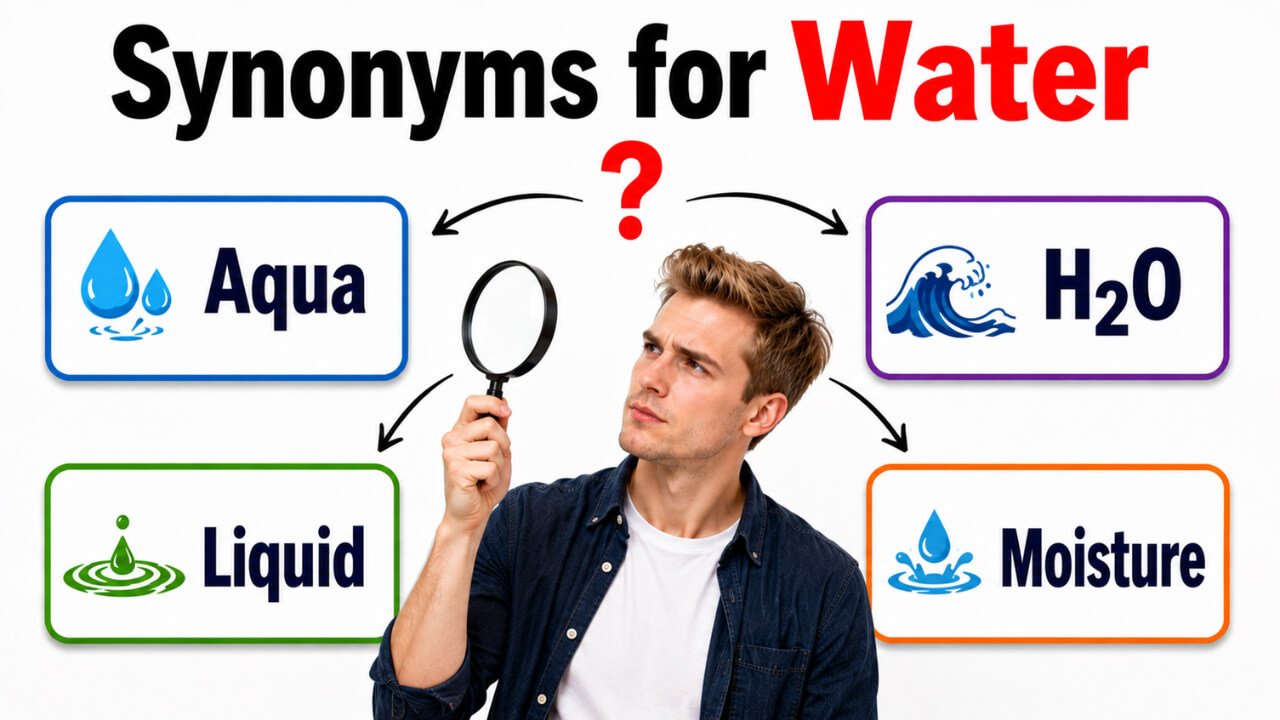
Quick Answer: The best synonyms for water include aqua, liquid, moisture, hydration, rain, freshwater, seawater, fluid, drink, and refreshment. Use aqua as a decorative or literary alternative, liquid when discussing physical form, moisture for small amounts of wetness, and hydration when referring to the water needed by the body. Freshwater is best for water without much salt, while seawater describes ocean water. In casual speech, drink and refreshment may work when water is being consumed.
Pronunciation and Word Details
Word: Water.
Pronunciation: /ˈwɔː.tər/
Part of Speech: Noun and verb.
Meaning: Water is a clear liquid essential for life, and as a verb, it means to give water to something or cause liquid to form in the eyes or mouth.
US Pronunciation:
UK Pronunciation:
What Does “Water” Mean?
Water means the clear liquid found in rain, rivers, lakes, seas, and living organisms. It is mainly used as a noun, but it can also function as a verb.
As a noun, water refers to the liquid people drink and use for cleaning, cooking, farming, and many other purposes.
Example: Please fill the glass with water.
Water can also refer to a particular body or source of water.
Example: The boat moved slowly across the calm water.
In scientific and technical contexts, water may refer to a liquid substance made of hydrogen and oxygen.
Example: Water changes into vapor when heated.
As a verb, water means to provide plants, animals, or land with water.
Example: Remember to water the flowers this evening.
It can also describe the natural production of tears or saliva.
Example: The smoke made her eyes water.
Meaning, Tone, and Context of “Water”
Water is a neutral and widely understood word. It is natural in casual speech, formal writing, scientific explanations, environmental reports, health discussions, cooking instructions, and agricultural guidance.
In everyday conversation, water usually means the liquid people drink or use.
Example: Could I have a glass of water?
In environmental writing, more precise terms such as freshwater, groundwater, surface water, rainwater, seawater, and wastewater may be needed.
Example: The region depends heavily on groundwater.
In scientific writing, liquid, fluid, vapor, moisture, and solution may describe particular forms or conditions involving water.
Example: Moisture collected on the outside of the container.
Water can also have emotional, poetic, and descriptive uses. Calm water may suggest peace, while rough water may suggest difficulty or danger.
Example: The moonlight reflected across the quiet water.
As a verb, water is conversational and direct when discussing plants, animals, land, or physical reactions.
Example: The spicy food made his mouth water.
When and How to Use “Water”
For Drinking
Use water when referring to the clear liquid consumed for hydration.
Example: Drink enough water throughout the day.
For Rivers, Lakes, and Seas
Use water as a general term for the liquid within a natural body of water.
Example: The water in the lake was calm and clear.
For Cleaning
Use water when describing washing, rinsing, or removing dirt.
Example: Rinse the vegetables with clean water.
For Cooking
Use water when a recipe requires liquid for boiling, mixing, steaming, or soaking.
Example: Add two cups of water to the pot.
For Agriculture
Use water as a verb when providing moisture to plants, crops, or soil.
Example: Water the young plants before the afternoon heat.
For Hydration
Use hydration when discussing the process of maintaining enough water in the body.
Example: Proper hydration is important during physical activity.
For Environmental Writing
Use a specific water term when describing a source, condition, or environmental process.
Example: Rainwater collected on the roof flowed into a storage tank.
For Emotional or Physical Reactions
Use water as a verb when the eyes produce tears or the mouth produces saliva.
Example: The smell of fresh bread made her mouth water.
Best Synonyms for Water
Aqua
Synonym: Aqua is a literary, decorative, or technical word for water.
Example: The artist used aqua imagery to create a peaceful mood.
Liquid
Synonym: Liquid is a substance that flows and takes the shape of its container.
Example: Pour the liquid carefully into the bottle.
Moisture
Synonym: Moisture means a small amount of water present in the air, soil, or another material.
Example: The soil needs more moisture.
Hydration
Synonym: Hydration is the process of supplying the body or another substance with water.
Example: Good hydration supports normal physical function.
Freshwater
Synonym: Freshwater is water that contains very little salt.
Example: The lake provides freshwater for nearby communities.
Seawater
Synonym: Seawater is salty water found in seas and oceans.
Example: Seawater covered the rocks during high tide.
Fluid
Synonym: Fluid is a general term for a substance that can flow, including water.
Example: The container holds a clear fluid.
Rain
Synonym: Rain is water that falls from clouds in drops.
Example: The rain filled the garden containers.
Drink
Synonym: Drink can refer to water when it is offered or consumed as a beverage.
Example: She stopped to have a drink after the walk.
Refreshment
Synonym: Refreshment can refer to a drink, including water, provided for comfort or energy.
Example: Cold refreshments were available after the event.
50 Synonyms for Water with Short Meanings
- Aqua: A literary or decorative term for water.
- Liquid: A flowing substance that takes the shape of its container.
- Fluid: A substance that flows, including water.
- Moisture: A small amount of water in the air, soil, or material.
- Hydration: Water supplied to the body or another substance.
- Freshwater: Water containing little or no salt.
- Seawater: Salty water found in seas and oceans.
- Saltwater: Water containing a significant amount of salt.
- Rainwater: Water collected or produced by rain.
- Groundwater: Water stored beneath the surface of the earth.
- Surface Water: Water found above ground in rivers, lakes, and reservoirs.
- Spring Water: Water that naturally flows from an underground source.
- Well Water: Water taken from a hole dug or drilled into the ground.
- River Water: Water flowing through a natural river channel.
- Lake Water: Water contained within a lake.
- Stream Water: Water flowing through a small natural channel.
- Ocean Water: Salt water found in an ocean.
- Drinking Water: Water considered suitable for drinking.
- Potable Water: Water that is safe to drink.
- Clean Water: Water free from harmful dirt or contamination.
- Purified Water: Water treated to remove unwanted substances.
- Filtered Water: Water passed through a filter to remove particles.
- Distilled Water: Water purified through evaporation and condensation.
- Mineral Water: Water containing naturally occurring minerals.
- Tap Water: Water supplied through household pipes.
- Bottled Water: Drinking water packaged in a bottle.
- Meltwater: Water produced by melting snow or ice.
- Runoff: Water flowing across land after rain or melting snow.
- Wastewater: Used water containing waste or unwanted substances.
- Stormwater: Water produced by heavy rain or storms.
- Irrigation Water: Water supplied to crops, gardens, or fields.
- Floodwater: Water that covers land that is normally dry.
- Dew: Small drops of water that form on cool surfaces.
- Mist: Very small drops of water floating in the air.
- Spray: Water scattered through the air in small drops.
- Splash: Water thrown or scattered by sudden movement.
- Droplet: A very small drop of water.
- Condensation: Water formed when vapor cools into liquid.
- Precipitation: Water that falls from the atmosphere as rain, snow, or similar forms.
- Rain: Water falling from clouds in drops.
- Shower: A brief period of rain or a flow of water used for washing.
- Downpour: A sudden and heavy fall of rain.
- Stream: A small flowing body of water.
- Brook: A small natural stream.
- Creek: A narrow natural water channel.
- River: A large natural flow of water.
- Spring: A natural place where underground water reaches the surface.
- Drink: A liquid consumed to reduce thirst.
- Beverage: A liquid prepared or provided for drinking.
- Refreshment: A drink offered to restore comfort or energy.
Read Also:
Synonyms for Bus

Synonyms for Water by Context
When Water Means Drinking Water
Drinking water, potable water, clean water, filtered water, purified water, and bottled water describe water intended for consumption.
Use drinking water in ordinary communication.
Example: The building provides safe drinking water.
Use potable water in technical, environmental, and public health writing.
Example: The emergency supplies included potable water.
Use filtered water when the water has passed through a filtering system.
Example: She filled the container with filtered water.
Use purified water when treatment has removed many unwanted materials.
Example: The laboratory required purified water.
When Water Means Moisture
Moisture, dew, condensation, mist, droplets, and spray refer to water in small amounts or fine forms.
Use moisture when water is present within soil, air, food, or another material.
Example: The roots absorb moisture from the soil.
Use dew for drops that form naturally on cool outdoor surfaces.
Example: Morning dew covered the grass.
Use condensation when water vapor changes into liquid.
Example: Condensation appeared on the cold glass.
Use mist when tiny water droplets remain suspended in the air.
Example: A light mist covered the valley.
When Water Means Rain
Rain, rainwater, precipitation, shower, downpour, runoff, and stormwater relate to water falling from the atmosphere or flowing afterward.
Use rain for the common weather event.
Example: The rain continued throughout the afternoon.
Use precipitation in formal weather, scientific, and environmental writing.
Example: The area receives limited annual precipitation.
Use downpour for unusually heavy rain.
Example: The sudden downpour flooded the path.
Use runoff for water flowing across the ground.
Example: Rain runoff carried soil into the stream.
When Water Means a Natural Source
River, stream, brook, creek, spring, lake, sea, and ocean refer to natural bodies or sources of water.
Use stream or brook for a small flowing body.
Example: A clear stream crossed the forest.
Use river for a larger natural flow.
Example: The river carries water toward the coast.
Use spring for water naturally emerging from underground.
Example: The village developed around a natural spring.
Use lake for a large body of water surrounded by land.
Example: The lake supplies water to nearby farms.
When Water Means a Type of Water
Freshwater, seawater, saltwater, groundwater, surface water, wastewater, and meltwater identify water by source, salt content, location, or condition.
Use freshwater for water with little salt.
Example: Many inland fish live in freshwater.
Use seawater for water from a sea or ocean.
Example: Seawater entered the coastal pool.
Use groundwater for water stored beneath the land surface.
Example: Wells draw groundwater from underground layers.
Use wastewater for water that has already been used.
Example: The facility treats wastewater before release.
When Water Means a Drink
Drink, beverage, and refreshment can replace water when the emphasis is on consumption rather than the liquid itself.
Use drink in casual speech.
Example: She asked for a cold drink.
Use beverage in formal menus, instructions, and general descriptions.
Example: Water is often the simplest beverage choice.
Use refreshment when a drink is offered for comfort.
Example: Refreshments were provided during the break.
Another Word for Water
Aqua is the closest single alternative to water, but it is not natural in every sentence. It usually appears in literary, artistic, descriptive, or technical contexts. In everyday writing, a more specific term such as liquid, moisture, freshwater, rainwater, or drinking water is often better.
Original: Clear water flowed from the spring.
Better Option: Clear freshwater flowed from the spring.
Original: Water formed on the outside of the glass.
Better Option: Condensation formed on the outside of the glass.
Original: The soil contained very little water.
Better Option: The soil contained very little moisture.
Original: The hikers needed more water.
Better Option: The hikers needed more drinking water.
When Not to Use “Water”
Water can sound too general when the source, condition, purpose, or form of the liquid matters. A specific alternative often gives readers more useful information.
When Describing Water Safe for Drinking
Weak: The workers needed water.
Better: The workers needed clean drinking water.
The better sentence explains that the water must be suitable for consumption.
When Discussing Water Beneath the Ground
Weak: The village depends on water below the soil.
Better: The village depends on groundwater.
Groundwater is the accurate environmental term.
When Describing Small Amounts of Wetness
Weak: Water remained in the soil.
Better: Moisture remained in the soil.
Moisture sounds more natural when the water is present in a small amount.
When Writing About Rain Collection
Weak: They stored water from the roof.
Better: They stored rainwater collected from the roof.
Rainwater clearly identifies the source.
When Discussing Used Water
Weak: The factory cleaned its water before releasing it.
Better: The factory treated its wastewater before releasing it.
Wastewater accurately describes water that has already been used.
When Water Becomes Repetitive
Weak: Water from the rain entered the water tank and increased the water supply.
Better: Rainwater entered the storage tank and increased the available supply.
Specific wording avoids repetition and improves readability.
Words Commonly Confused With Water
Water vs Liquid: Water is one specific liquid. Liquid is a broad category that also includes milk, oil, juice, and many other substances.
Water vs Fluid: Fluid includes liquids and substances that can flow. Water is a fluid, but not every fluid is water.
Water vs Moisture: Water usually refers to the liquid itself. Moisture describes a small amount of water present in air, soil, food, fabric, or another material.
Water vs Hydration: Water is the substance being consumed. Hydration is the process or condition of receiving enough water.
Water vs Rainwater: Water is a general term. Rainwater specifically refers to water that falls as rain or is collected from rainfall.
Water vs Freshwater: Water may be fresh or salty. Freshwater contains very little salt and is commonly found in rivers, lakes, and underground sources.
Water vs Seawater: Water is general. Seawater is salty water from seas and oceans.
Water vs Wastewater: Water may be clean or unused. Wastewater has already been used and may contain waste, chemicals, or other unwanted materials.
Which Synonym Should You Choose?
Choose aqua for literary, artistic, decorative, or descriptive writing where a less ordinary word is useful.
Choose liquid when describing the physical state of water or comparing it with solids and gases.
Choose fluid in scientific, medical, mechanical, or technical discussions about substances that flow.
Choose moisture when referring to small amounts of water in soil, air, food, skin, or materials.
Choose hydration when discussing the water needs of the body, plants, or materials.
Choose freshwater when distinguishing river, lake, or underground water from salty water.
Choose seawater or saltwater when discussing oceans, seas, marine environments, or salt content.
Choose rainwater when the water comes directly from rainfall.
Choose groundwater for water stored below the surface of the earth.
Choose potable water in formal reports about water that is safe to drink.
Choose drinking water in everyday instructions, articles, and conversations.
Choose wastewater when discussing used water that requires treatment.
Choose rain, mist, dew, or condensation when the form of water is more important than the general substance.
Real Life Examples of “Water” in Sentences
Original: The plants need more water.
Better Option: The plants need more moisture in the soil.
Original: The town gets its water from underground.
Better Option: The town gets its groundwater from underground sources.
Original: Water collected on the cold window.
Better Option: Condensation collected on the cold window.
Original: The hikers carried enough water for the journey.
Better Option: The hikers carried enough drinking water for the journey.
Original: The water from the storm entered the drainage system.
Better Option: The stormwater entered the drainage system.
Original: The factory must clean the water it has used.
Better Option: The factory must treat its wastewater.
Original: Water fell heavily throughout the night.
Better Option: Rain fell heavily throughout the night.
Original: The field receives water through a network of channels.
Better Option: The field receives irrigation water through a network of channels.
Original: Small drops of water covered the grass.
Better Option: Dew covered the grass.
Original: The fish lives in water without much salt.
Better Option: The fish lives in freshwater.
Synonym Groups and Usage Differences
Drinking Group
Drinking water, potable water, clean water, filtered water, purified water, and mineral water describe water intended for human consumption. Potable water is more formal, while drinking water sounds natural in everyday communication.
Example: The shelter distributed clean drinking water.
Natural Source Group
River water, lake water, stream water, spring water, well water, and groundwater identify water according to where it comes from. These terms are useful in geography, farming, and environmental writing.
Example: The farm depends on well water during dry months.
Weather Group
Rain, rainwater, precipitation, shower, downpour, mist, and stormwater relate to weather and atmospheric water. Precipitation is the broadest formal term.
Example: Heavy precipitation increased the river level.
Moisture Group
Moisture, dew, condensation, droplets, spray, and mist describe small amounts or fine forms of water. These terms are more precise than water when the amount or form matters.
Example: Moisture gathered inside the sealed container.
Salt Content Group
Freshwater, saltwater, seawater, and ocean water distinguish water according to the amount of salt it contains or where it is found.
Example: The plant cannot survive in saltwater.
Treatment Group
Filtered water, purified water, distilled water, wastewater, and treated water describe water according to its condition or processing.
Example: Distilled water was used for the experiment.
Flowing Water Group
River, stream, brook, creek, runoff, and floodwater describe water that moves naturally across land or through channels.
Example: Runoff flowed from the hillside after the storm.
Antonyms of Water
Water does not have one direct opposite in every context. Its opposites usually relate to dryness, lack of moisture, solid land, or dehydration.
Dryness: The condition of having little or no water.
Drought: A long period with unusually little rain.
Dehydration: A condition caused by losing more water than the body receives.
Aridity: Extreme dryness in a climate or region.
Land: Solid ground rather than a body of water.
Desert: A very dry area receiving little rainfall.
Solid: A physical state that does not flow like liquid water.
Vapor: The gaseous form of water rather than its liquid form.
Ice: The solid form of water.
Parchedness: A state of being extremely dry or thirsty.
Comparison: Water vs Related Words
Water vs Aqua
Water is the standard everyday word. Aqua is more decorative, literary, or technical and may sound unnatural in ordinary conversation.
Example With Water: The child asked for a glass of water.
Example With Aqua: The design used aqua imagery to suggest calmness.
Water vs Liquid
Water names a specific substance. Liquid describes any substance that flows and has no fixed shape.
Example With Water: Water filled the glass.
Example With Liquid: The clear liquid filled the container.
Water vs Moisture
Water refers to the substance itself. Moisture usually means a small amount of water within or on something.
Example With Water: The bucket was full of water.
Example With Moisture: The soil retained enough moisture for the seeds.
Water vs Hydration
Water is what a person drinks. Hydration describes the process or condition of receiving enough water.
Example With Water: She drank water after exercising.
Example With Hydration: She focused on hydration after exercising.
Water vs Freshwater
Water is a broad term that may include salty or fresh forms. Freshwater specifically contains little salt.
Example With Water: The animals gathered near the water.
Example With Freshwater: The island has limited freshwater supplies.
Water vs Rainwater
Water can come from many sources. Rainwater specifically comes from rain.
Example With Water: They stored water in a tank.
Example With Rainwater: They collected rainwater in a tank.
Water vs Wastewater
Water may be clean, untreated, or unused. Wastewater has already been used and often requires treatment.
Example With Water: The facility requires water for cleaning.
Example With Wastewater: The facility treats wastewater after cleaning operations.
Common Phrases and Expressions With “Water”
Drinking Water: Water that is suitable for people to drink.
Fresh Water: Water containing little or no salt.
Running Water: Water supplied through pipes or flowing naturally.
Still Water: Water that is calm or not flowing quickly.
Deep Water: Water of considerable depth or a difficult situation.
Hot Water: Water at a high temperature or a state of trouble.
Water Supply: The amount or system of water available for use.
Water Source: The place from which water is obtained.
Water Level: The height of water in a river, lake, tank, or container.
Water Quality: The condition of water based on cleanliness, safety, and composition.
Common Mistakes to Avoid
Treating Every Water Term as an Exact Synonym
Not every related word can replace water in every sentence. Rainwater, seawater, groundwater, and wastewater identify specific types or sources.
Incorrect: Please pour groundwater into my glass.
Better: Please pour drinking water into my glass.
Using Moisture for a Large Amount of Water
Moisture normally refers to a small amount of water within the air, soil, food, or material.
Incorrect: The swimming pool was filled with moisture.
Better: The swimming pool was filled with water.
Confusing Water With Hydration
Water is a substance, while hydration is a process or condition.
Incorrect: She drank hydration after the race.
Better: She drank water to restore hydration after the race.
Using Aqua in Ordinary Conversation
Aqua may sound decorative or unnatural when plain water is more appropriate.
Unnatural: Could I have a glass of aqua?
Natural: Could I have a glass of water?
Repeating Water Unnecessarily
Repeated use of water can make a paragraph sound vague.
Repetitive: Rain water entered the water tank and increased the water available.
Improved: Rainwater entered the storage tank and increased the available supply.
Confusing Fresh Water and Freshwater
Freshwater is commonly used as one word when it describes water containing little salt. Fresh water can simply mean water that is newly supplied or not stale.
Example: The river is a freshwater habitat.
Example: The animals were given fresh water each morning.
Using Beverage as a Perfect Replacement
Beverage includes many drinks, not only water. Use it only when the exact type of drink is not important.
Vague: The bottle contains a beverage.
Clear: The bottle contains drinking water.
Conclusion
The most useful synonyms for water depend on its source, purpose, form, and condition. Use liquid or fluid for physical descriptions, moisture for small amounts of wetness, hydration for bodily water needs, and freshwater or seawater for salt content. Rainwater, groundwater, wastewater, and drinking water provide greater accuracy in environmental and practical writing. These synonyms for water help readers choose language that is clear, natural, and appropriate for conversations, essays, reports, instructions, and scientific explanations.
FAQs About Synonyms for Water
What Is the Best Synonym for Water?
Aqua is the closest general alternative, but liquid, moisture, freshwater, and drinking water are often more natural in specific contexts.
Is Aqua Another Word for Water?
Yes. Aqua can mean water, but it is more common in literary, artistic, decorative, and technical language than in everyday conversation.
What Is a Formal Word for Water?
Potable water, freshwater, groundwater, surface water, and precipitation are formal terms used for particular types or sources of water.
What Is Another Word for Drinking Water?
Potable water is a formal alternative. Clean water and safe drinking water are clearer options in everyday writing.
What Is Another Word for a Small Amount of Water?
Moisture, droplet, dew, mist, spray, and condensation can describe small amounts or fine forms of water.
What Is the Difference Between Water and Moisture?
Water is the liquid substance itself. Moisture is a small amount of water present in the air, soil, food, skin, or another material.
Can Water Be Used as a Verb?
Yes. Water can mean giving water to plants, animals, or land. It can also describe the eyes producing tears or the mouth producing saliva.
