
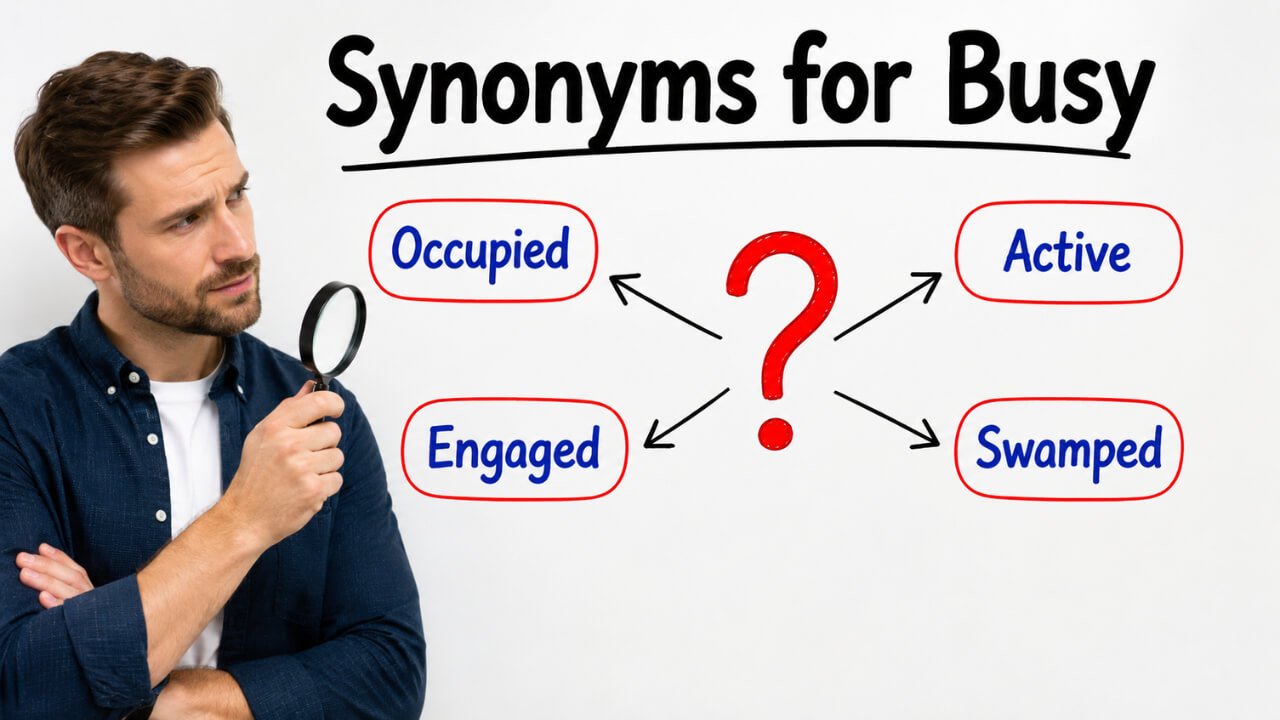
Quick Answer: The best synonyms for busy include occupied, engaged, active, working, productive, bustling, hectic, swamped, committed, and unavailable. Use occupied when someone is doing a task, engaged for formal writing, and active when a person or place has plenty of activity. Productive emphasizes useful work, while hectic describes a rushed and stressful schedule. Swamped is more conversational and suggests having too much work. Bustling works well for crowded places, and unavailable politely explains that someone cannot speak or meet. These synonyms for busy should be chosen according to workload, activity, crowd size, availability, or emotional pressure.
Pronunciation and Word Details
Word: Busy.
Pronunciation: /ˈbɪzi/
Part of Speech: Primarily an adjective and sometimes a verb.
Meaning: Busy means actively involved in work or filled with people, tasks, movement, or activity.
US Pronunciation:
UK Pronunciation:
What Does “Busy” Mean?
Busy means having many things to do, being actively involved in an activity, or being unavailable because of work or another responsibility.
As an adjective, busy can describe a person, schedule, place, period, telephone line, road, or design. A busy person has tasks or responsibilities to complete. A busy place contains many people, sounds, or movements. A busy schedule contains numerous appointments or activities.
Busy can also describe something that is currently being used. For example, a telephone line may be busy when another call is already in progress.
In visual descriptions, busy can mean containing too many details, colors, shapes, or decorative elements. In this context, the word may carry a slightly negative meaning because the design appears crowded or difficult to understand.
Busy occasionally functions as a verb. To busy yourself means to keep yourself occupied with a task.
Example: She busied herself with organizing the files.
The surrounding words show whether busy refers to workload, activity, crowds, availability, use, or visual complexity.
Meaning, Tone, and Context of “Busy”
Busy is a common, neutral, and conversational word. It appears naturally in both spoken and written English.
In everyday conversation, busy usually describes someone who has work, responsibilities, appointments, or personal tasks.
Example: I am busy this afternoon.
In professional communication, busy can sound polite but slightly general. Words such as occupied, engaged, committed, scheduled, or unavailable may express the meaning more precisely.
Example: The director is currently engaged in another meeting.
Busy can have a positive tone when it suggests productivity, energy, or success.
Example: The workshop had a busy and productive morning.
It can also have a negative or emotional tone when it suggests pressure, stress, or excessive work.
Example: It has been a hectic and exhausting week.
When used for a place, busy may be neutral or positive. A busy market can feel energetic and successful, while a busy road may feel crowded and inconvenient.
In formal reports, academic writing, and detailed descriptions, a more specific synonym is often better. Productive emphasizes useful results, congested describes traffic, bustling describes energetic activity, and overloaded highlights an excessive amount of work.
When and How to Use “Busy”
For Workload: Use busy when someone has several tasks, duties, or responsibilities.
Example: She is busy preparing the monthly report.
For a Full Schedule: Use busy when a day, week, or period contains many appointments or activities.
Example: We have a busy schedule this week.
For Temporary Unavailability: Use busy when someone cannot talk, meet, or help because another activity requires attention.
Example: He is busy right now, but he can call you later.
For an Active Place: Use busy when a location contains many people, vehicles, sounds, or movements.
Example: The station becomes busy during the morning.
For Productive Activity: Use busy when a person is actively and usefully completing work.
Example: The team stayed busy throughout the afternoon.
For Excessive Pressure: Use busy when life or work feels demanding, although hectic, swamped, or overloaded may be more precise.
Example: It has been an unusually busy month.
For Something in Use: Use busy when a telephone line, room, machine, or service is currently occupied.
Example: The line was busy when I tried to call.
For Visual Complexity: Use busy when a design contains too many elements.
Example: The patterned background makes the page look busy.
For Keeping Someone Occupied: Use busy as a verb when someone fills time with an activity.
Example: The puzzle busied the children for an hour.
Best Synonyms for Busy
Occupied: Actively doing something and not available for another activity.
Example: She is occupied with an important assignment.
Engaged: Involved in an activity, conversation, or responsibility.
Example: The manager is engaged in a private discussion.
Active: Regularly working, moving, participating, or producing results.
Example: He remains active in several community projects.
Productive: Completing useful work or achieving meaningful results.
Example: The team had a productive morning.
Bustling: Full of energetic movement, people, and activity.
Example: The town center was bustling with visitors.
Hectic: Extremely active, rushed, and often stressful.
Example: Her morning became hectic after several urgent requests arrived.
Swamped: Having far more work than can easily be managed.
Example: I am swamped with assignments this week.
Committed: Already responsible for an activity, appointment, or promise.
Example: She is committed to another project this month.
Unavailable: Not able to meet, talk, or help at a particular time.
Example: The adviser is unavailable until tomorrow.
Crowded: Filled with many people, vehicles, objects, or activities.
Example: The restaurant was crowded during lunch.
50 Synonyms for Busy with Short Meanings
- Occupied: Actively involved in a task or responsibility.
- Engaged: Taking part in an activity or conversation.
- Active: Regularly working, moving, or participating.
- Working: Performing a job or completing a task.
- Employed: Occupied with paid work or a useful activity.
- Involved: Closely participating in a task, event, or situation.
- Absorbed: Giving complete attention to an activity.
- Preoccupied: Thinking deeply about something else.
- Engrossed: Fully interested and focused on an activity.
- Focused: Directing attention toward a particular task.
- Attentive: Carefully concentrating on what is happening.
- Industrious: Regularly working with energy and effort.
- Productive: Achieving useful or valuable results.
- Diligent: Working carefully and consistently.
- Hardworking: Putting substantial effort into work.
- Bustling: Filled with energetic movement and activity.
- Crowded: Containing many people or objects.
- Packed: Completely filled with people, events, or tasks.
- Full: Having no remaining space or available time.
- Congested: Overcrowded and difficult to move through.
- Lively: Full of energy, interest, and activity.
- Thriving: Active, successful, and developing well.
- Buzzing: Filled with excitement, sound, or activity.
- Hectic: Very active, rushed, and stressful.
- Demanding: Requiring considerable time, effort, or attention.
- Intense: Involving a high level of activity or effort.
- Eventful: Containing many important or interesting activities.
- Nonstop: Continuing without a meaningful break.
- Rushed: Acting quickly because little time is available.
- Hurried: Moving or working with excessive speed.
- Pressed: Having limited time because of responsibilities.
- Overloaded: Given more work than can be managed easily.
- Overworked: Required to work too much.
- Swamped: Extremely busy with a large amount of work.
- Burdened: Carrying many difficult responsibilities.
- Strained: Under pressure because of heavy demands.
- Committed: Already promised or assigned to an activity.
- Scheduled: Having planned appointments or activities.
- Booked: Having no available time because of arrangements.
- Tied Up: Temporarily unable to help because of another task.
- Unavailable: Not free to meet, speak, or participate.
- On Duty: Officially working during an assigned period.
- At Work: Currently completing professional tasks.
- In Use: Currently occupied or being used.
- Functioning: Actively operating or performing a purpose.
- Operational: Ready and actively working.
- Flourishing: Developing successfully with visible activity.
- Animated: Full of energy, movement, or excitement.
- Vibrant: Energetic, lively, and full of activity.
- Teeming: Completely filled with people, animals, or activity.
Read Also:
Synonyms for Proficient

Synonyms for Busy by Context
When Busy Means Occupied With Work
Occupied, engaged, working, involved, absorbed, and focused describe someone who is actively completing a task.
Occupied is the best general alternative. Engaged sounds more formal and often appears in professional communication. Absorbed and engrossed emphasize deep concentration.
Example With Occupied: She is occupied with the final preparations.
Example With Engaged: The researcher is engaged in an important study.
Example With Absorbed: He was absorbed in reading the report.
Example With Focused: The team remained focused on meeting the deadline.
When Busy Means Having Too Much Work
Swamped, overloaded, overworked, burdened, pressed, and strained describe an excessive workload.
Swamped is informal and expressive. Overloaded works well when someone has been given too many tasks. Overworked suggests that the amount of labor may be unhealthy or unfair.
Example With Swamped: I am swamped with requests today.
Example With Overloaded: The department is overloaded with unfinished cases.
Example With Overworked: The overworked staff needed additional support.
Example With Pressed: She was pressed for time before the presentation.
When Busy Means Productive
Productive, industrious, diligent, hardworking, active, and focused describe useful effort.
Productive emphasizes results rather than the amount of activity. Industrious and diligent describe positive work habits. Hardworking emphasizes consistent effort.
Example With Productive: We had a productive discussion about the project.
Example With Industrious: The industrious student completed every assignment carefully.
Example With Diligent: Her diligent preparation improved the final result.
Example With Hardworking: He is a hardworking and dependable employee.
When Busy Means Hectic
Hectic, rushed, hurried, intense, demanding, and nonstop describe a period filled with pressure and activity.
Hectic suggests disorder and stress. Rushed and hurried emphasize limited time. Demanding highlights the amount of effort required.
Example With Hectic: The office had a hectic morning.
Example With Rushed: Our conversation felt rushed because the meeting was starting.
Example With Demanding: She completed a demanding week of training.
Example With Nonstop: It was a nonstop day of calls and appointments.
When Busy Describes a Place
Bustling, crowded, packed, lively, buzzing, vibrant, and teeming describe locations filled with people, movement, or energy.
Bustling is often positive and creates an energetic image. Crowded and packed emphasize limited space. Buzzing suggests excitement and conversation.
Example With Bustling: The market was bustling throughout the afternoon.
Example With Crowded: The entrance became crowded before the event.
Example With Buzzing: The hall was buzzing with excitement.
Example With Teeming: The garden was teeming with insects.
When Busy Means Unavailable
Occupied, engaged, committed, booked, tied up, and unavailable explain that someone cannot meet, speak, or accept another task.
Unavailable is clear and polite. Committed suggests an existing responsibility. Booked is common when discussing appointments and schedules.
Example With Unavailable: The consultant is unavailable this morning.
Example With Committed: I am committed to another meeting at that time.
Example With Booked: She is fully booked for the rest of the week.
Example With Tied Up: He is tied up with a client call.
When Busy Means Currently in Use
In use, occupied, operational, functioning, and active can describe equipment, telephone lines, rooms, or services.
In use is usually the clearest choice for an object or facility. Operational means ready and working, while functioning emphasizes successful performance.
Example With In Use: The meeting room is currently in use.
Example With Operational: All production systems are operational.
Example With Functioning: The machine is functioning normally.
When Busy Describes a Design
Crowded, cluttered, overloaded, detailed, and visually intense can describe a design with too many elements.
Crowded suggests limited empty space. Cluttered is usually more negative and indicates poor organization. Detailed can be neutral or positive when the complexity is intentional.
Example With Crowded: The page looks crowded because every space contains text.
Example With Cluttered: Removing two images made the layout feel less cluttered.
Example With Detailed: The fabric has a detailed floral pattern.
Another Word for Busy
Occupied is usually the best single replacement for busy when describing a person who is actively completing a task. It is clear, neutral, and suitable for both casual and formal writing.
However, the best alternative depends on context. Use productive for useful work, hectic for a stressful schedule, bustling for an active place, swamped for excessive work, and unavailable when someone is not free.
Original: I am busy with a report right now.
Better Option: I am occupied with a report right now.
Original: We had a busy morning and completed every task.
Better Option: We had a productive morning and completed every task.
Original: The shopping area was busy during the evening.
Better Option: The shopping area was bustling during the evening.
Original: She is too busy to accept another assignment.
Better Option: She is too overloaded to accept another assignment.
When Not to Use “Busy”
Busy can sound vague when the reader needs to understand the exact type of activity involved. A more precise synonym can show whether someone is productive, stressed, unavailable, deeply focused, or carrying too much work.
Weak: She had a busy day.
Better: She had a hectic day filled with urgent meetings.
Busy may also be too informal in professional communication when you are explaining availability.
Weak: The director is busy.
Better: The director is currently unavailable.
Do not use busy as a compliment when the activity did not produce useful results. Being active is not always the same as being productive.
Weak: The team was busy all afternoon.
Better: The team was productive and completed three important tasks.
Avoid describing serious overwork with a mild word when the pressure needs to be clear.
Weak: The nurses were busy throughout the week.
Better: The nurses were overworked throughout the week.
Busy may sound inaccurate when describing a crowded physical location.
Weak: The road was busy because traffic could barely move.
Better: The road was congested because traffic could barely move.
Do not use busy for a design unless you mean it contains too many competing elements.
Weak: The design is busy and attractive.
Better: The design is detailed and visually engaging.
Repeated use of busy can also make a paragraph sound dull.
Weak: It was a busy office during a busy week, and every worker had a busy schedule.
Better: It was a bustling office during a hectic week, and every worker had a packed schedule.
Words Commonly Confused With Busy
Busy vs Occupied: Busy is a broad word that can describe work, activity, places, schedules, or objects. Occupied usually means actively doing something or currently being used.
Busy vs Productive: Busy means having activity or tasks. Productive means that the activity produces useful results.
Busy vs Hectic: Busy can be neutral or positive. Hectic suggests rushed, disorganized, or stressful activity.
Busy vs Active: Busy often refers to a temporary workload. Active can describe regular participation, movement, or continuing involvement.
Busy vs Engaged: Busy is common and conversational. Engaged is more formal and often describes involvement in a particular task or discussion.
Busy vs Swamped: Busy means having work to do. Swamped means having an excessive and difficult amount of work.
Busy vs Crowded: Busy may describe a place with plenty of activity. Crowded specifically means that many people or objects occupy the available space.
Busy vs Bustling: Busy is neutral and broad. Bustling creates a positive image of energetic movement and activity.
Busy vs Unavailable: Busy gives a reason someone may not be free. Unavailable directly states that the person cannot meet, speak, or help.
Busy vs Preoccupied: Busy usually describes external tasks. Preoccupied describes a mind that is deeply focused on a concern or thought.
Which Synonym Should You Choose?
Choose occupied when someone is actively completing a task.
Choose engaged for formal writing about involvement in a discussion, project, or professional activity.
Choose active when describing regular participation, movement, or continuing involvement.
Choose productive when the work produces useful and measurable results.
Choose focused when attention is directed toward one important task.
Choose absorbed or engrossed when someone is deeply interested and barely notices other things.
Choose hectic when the schedule feels rushed, stressful, or difficult to control.
Choose swamped in casual speech when someone has more work than can easily be handled.
Choose overloaded in reports or professional communication when a person, team, or system has too many demands.
Choose overworked when excessive labor is causing tiredness, pressure, or concern.
Choose committed when someone already has another responsibility or appointment.
Choose unavailable in polite messages, emails, and formal conversations about schedules.
Choose booked when every appointment or time period has already been reserved.
Choose bustling for markets, streets, offices, stations, and other places filled with positive activity.
Choose crowded when a place contains too many people for the available space.
Choose congested for roads, traffic, passageways, or systems where movement is difficult.
Choose buzzing for a place filled with excitement, discussion, and energy.
Choose packed when a schedule, room, or event is completely full.
Choose in use when a room, telephone line, machine, or facility is currently occupied.
Choose cluttered when a design contains too many poorly organized details.
Real Life Examples of “Busy” in Sentences
Original: I am busy preparing the presentation.
Better Option: I am occupied with preparing the presentation.
Original: She had a busy morning and finished every important task.
Better Option: She had a productive morning and finished every important task.
Original: The manager is busy and cannot speak right now.
Better Option: The manager is unavailable and cannot speak right now.
Original: The restaurant becomes busy in the evening.
Better Option: The restaurant becomes bustling in the evening.
Original: The highway was busy after the event.
Better Option: The highway was congested after the event.
Original: He has been extremely busy with new assignments.
Better Option: He has been swamped with new assignments.
Original: The team experienced a busy and stressful week.
Better Option: The team experienced a hectic and stressful week.
Original: She remained busy with the research for several hours.
Better Option: She remained absorbed in the research for several hours.
Original: My calendar is busy for the rest of the month.
Better Option: My calendar is fully booked for the rest of the month.
Original: The page looks too busy because it contains several patterns.
Better Option: The page looks too cluttered because it contains several patterns.
Synonym Groups and Usage Differences
Work and Occupation Group
Occupied, engaged, working, employed, and involved describe participation in work or another responsibility.
Occupied is broad and neutral. Engaged sounds more formal. Employed may refer to paid work, while involved suggests active participation in a project or situation.
Example: She is engaged in planning the annual program.
Concentration Group
Absorbed, engrossed, focused, attentive, and preoccupied describe mental attention.
Absorbed and engrossed usually suggest positive interest. Focused emphasizes purposeful attention. Preoccupied may suggest that a concern is distracting someone from the present situation.
Example: He was engrossed in the detailed research notes.
Productivity Group
Productive, industrious, diligent, hardworking, and active describe useful effort.
Productive focuses on results. Industrious and hardworking describe strong work habits. Diligent adds the idea of care and consistency.
Example: Her diligent work prevented several errors.
Excessive Work Group
Swamped, overloaded, overworked, burdened, strained, and pressed describe pressure caused by too many responsibilities.
Swamped is conversational. Overloaded suits workplace and system descriptions. Overworked often implies that the workload is unreasonable.
Example: The support team became overloaded during the busy period.
Fast Activity Group
Hectic, rushed, hurried, demanding, intense, and nonstop describe activity that requires speed or effort.
Hectic has a stressful tone. Demanding may describe work that is difficult but organized. Nonstop emphasizes a lack of rest.
Example: The final week of preparation was intense.
Full Schedule Group
Booked, scheduled, committed, packed, and unavailable describe limited time.
Booked means all available times are reserved. Committed shows an existing responsibility. Packed emphasizes that a schedule contains many activities.
Example: Her schedule is packed with meetings and training sessions.
Crowded Place Group
Bustling, crowded, packed, buzzing, lively, vibrant, and teeming describe places with people, movement, and activity.
Bustling, buzzing, lively, and vibrant often sound positive. Crowded and packed may suggest discomfort or limited space.
Example: The vibrant neighborhood attracts visitors throughout the day.
Use and Operation Group
In use, occupied, functioning, operational, and active describe rooms, machines, systems, and services.
In use means something is currently being used. Operational means ready and able to function. Functioning means performing as expected.
Example: The second meeting room is currently in use.
Antonyms of Busy
The opposite of busy depends on whether the word describes workload, availability, activity, crowds, or visual detail.
Free: Available and not occupied with another task.
Available: Able to meet, speak, help, or accept work.
Idle: Not currently working or being used.
Inactive: Not participating, moving, or operating.
Unoccupied: Not being used or filled.
Vacant: Empty and available for use.
Quiet: Having little noise, movement, or activity.
Calm: Peaceful and free from pressure or disorder.
Relaxed: Free from stress, urgency, or tension.
Leisurely: Unhurried and comfortable.
Slow: Containing little activity or demand.
Empty: Containing no people, objects, or scheduled activities.
Spacious: Having plenty of open space.
Unscheduled: Not arranged for a particular time.
Uncommitted: Not promised to another activity or responsibility.
Resting: Taking a break from work or activity.
Unproductive: Producing few or no useful results.
Simple: Containing few details or visual elements.
Clear: Easy to understand because unnecessary details are absent.
Available for Work: Ready to accept a task or responsibility.
Comparison: Busy vs Related Words
Busy vs Occupied
Busy describes a general state of activity. Occupied more specifically means that someone is performing a task or that something is currently being used.
Example With Busy: I am busy for most of the afternoon.
Example With Occupied: I am occupied with a client meeting until three.
Busy vs Productive
Busy refers to the amount of activity. Productive refers to the value or results of that activity.
Example With Busy: The staff stayed busy all morning.
Example With Productive: The staff had a productive morning and resolved every request.
Busy vs Hectic
Busy can be organized and manageable. Hectic suggests pressure, speed, confusion, or stress.
Example With Busy: We have a busy schedule today.
Example With Hectic: We have a hectic schedule with several unexpected changes.
Busy vs Active
Busy often describes a temporary situation. Active can describe an ongoing lifestyle, role, place, or level of participation.
Example With Busy: She is busy completing an assignment.
Example With Active: She remains active in local educational programs.
Busy vs Engaged
Busy is common in conversation. Engaged is more formal and usually identifies a particular activity or responsibility.
Example With Busy: The adviser is busy at the moment.
Example With Engaged: The adviser is engaged in a confidential meeting.
Busy vs Swamped
Busy means having tasks to complete. Swamped suggests that the workload is excessive and difficult to manage.
Example With Busy: I am busy with several reports.
Example With Swamped: I am swamped with urgent reports and requests.
Busy vs Bustling
Busy can describe people, schedules, places, objects, or designs. Bustling mainly describes a place filled with lively movement.
Example With Busy: The town is busy during the festival.
Example With Bustling: The town is bustling with performers and visitors.
Busy vs Crowded
Busy emphasizes activity. Crowded emphasizes the number of people or objects within a limited space.
Example With Busy: The station is busy this morning.
Example With Crowded: The station is crowded, and there is little room to move.
Busy vs Preoccupied
Busy describes involvement in tasks. Preoccupied means mentally absorbed by a thought, worry, or concern.
Example With Busy: He was busy reviewing the documents.
Example With Preoccupied: He seemed preoccupied with the approaching deadline.
Busy vs Unavailable
Busy describes the reason someone may not be free. Unavailable directly communicates that the person cannot participate at that time.
Example With Busy: She is busy this morning.
Example With Unavailable: She is unavailable this morning but can meet after lunch.
Common Phrases and Expressions With Busy
Busy Day: A day containing many tasks, appointments, or activities.
Busy Schedule: A timetable filled with responsibilities and events.
Busy Week: A week with a large amount of work or activity.
Busy Morning: A morning containing numerous duties or events.
Busy at Work: Occupied with professional tasks.
Keep Busy: To remain occupied with activities.
Get Busy: To begin working or become active.
Too Busy: Having more responsibilities than available time allows.
Extremely Busy: Experiencing a very high level of activity or work.
Busy With Something: Actively completing or concentrating on a particular task.
Busy Doing Something: Currently involved in an activity.
Busy Place: A location filled with people, movement, or events.
Busy Road: A road carrying a large amount of traffic.
Busy Line: A telephone line that is already in use.
Busy Period: A time when demand or activity is unusually high.
Busy Life: A lifestyle containing many responsibilities and activities.
Busy Pattern: A design containing numerous colors, shapes, or details.
As Busy as Ever: Continuing to have a large amount of work or activity.
Common Mistakes to Avoid
One common mistake is using busy when the intended meaning is productive. A person can perform many activities without achieving useful results.
Incorrect Meaning: We were productive all day, but we completed nothing.
Better Meaning: We were busy all day, but we completed nothing.
Another mistake is using busy repeatedly in the same paragraph. More precise synonyms create stronger and more informative writing.
Repetitive: She was busy during a busy week at a busy office.
Improved: She was swamped during a hectic week at a bustling office.
Writers sometimes use hectic as though it were completely neutral. Hectic usually suggests stress, disorder, or pressure.
Unnatural: We enjoyed a peaceful and hectic afternoon.
Better: We enjoyed a peaceful and active afternoon.
Do not confuse occupied with preoccupied. Occupied means performing a task, while preoccupied means mentally distracted by a thought or concern.
Incorrect: She was preoccupied with completing the routine filing.
Better: She was occupied with completing the routine filing.
Avoid using crowded when you only mean active. A place may be active without containing too many people.
Weak: The workshop was crowded with creative discussions.
Better: The workshop was lively with creative discussions.
Do not use swamped in highly formal writing when overloaded or facing excessive demands would sound more suitable.
Casual: The department is swamped with applications.
Formal: The department is overloaded with applications.
Busy can also create an unclear or dismissive tone when declining a request. Explain your availability more politely when needed.
Unclear: I am busy.
Clear: I am unavailable this afternoon, but I can help tomorrow morning.
Avoid unnatural combinations such as very completely busy or fully extremely busy. Use one clear intensifier.
Incorrect: She is very completely busy today.
Correct: She is extremely busy today.
Finally, choose a synonym that matches the subject. Use congested for traffic, booked for appointments, bustling for active places, productive for useful work, and overloaded for excessive demands.
Conclusion
The most useful synonyms for busy include occupied, engaged, active, productive, hectic, swamped, bustling, crowded, committed, and unavailable. Occupied is the best general replacement for someone completing a task, while productive emphasizes useful results. Hectic and swamped describe pressure, bustling suits energetic places, and unavailable politely explains a lack of free time. Choosing among these synonyms for busy helps readers understand whether the sentence refers to work, concentration, stress, scheduling, crowds, movement, or temporary unavailability.
FAQs About Synonyms for Busy
What Is the Best Synonym for Busy?
Occupied is the best general synonym when busy means actively completing a task. The most suitable word still depends on the sentence.
What Is a Formal Synonym for Busy?
Engaged, occupied, committed, scheduled, and unavailable are useful formal alternatives, especially in professional communication.
What Is a Stronger Word for Very Busy?
Swamped, overloaded, overworked, and hectic express a stronger level of work or pressure than busy.
What Is a Positive Synonym for Busy?
Productive, active, industrious, diligent, thriving, and bustling can present busyness in a positive way.
What Is Another Word for a Busy Place?
Bustling is often the best choice. Crowded, lively, buzzing, vibrant, packed, and teeming are also useful depending on the atmosphere.
Are Busy and Productive the Same?
No. Busy means having many activities or tasks, while productive means achieving useful results through those activities.
How Can I Say I Am Busy Politely?
Say that you are occupied, committed, tied up, or unavailable. You can also offer a specific alternative time to make the response more helpful.
