
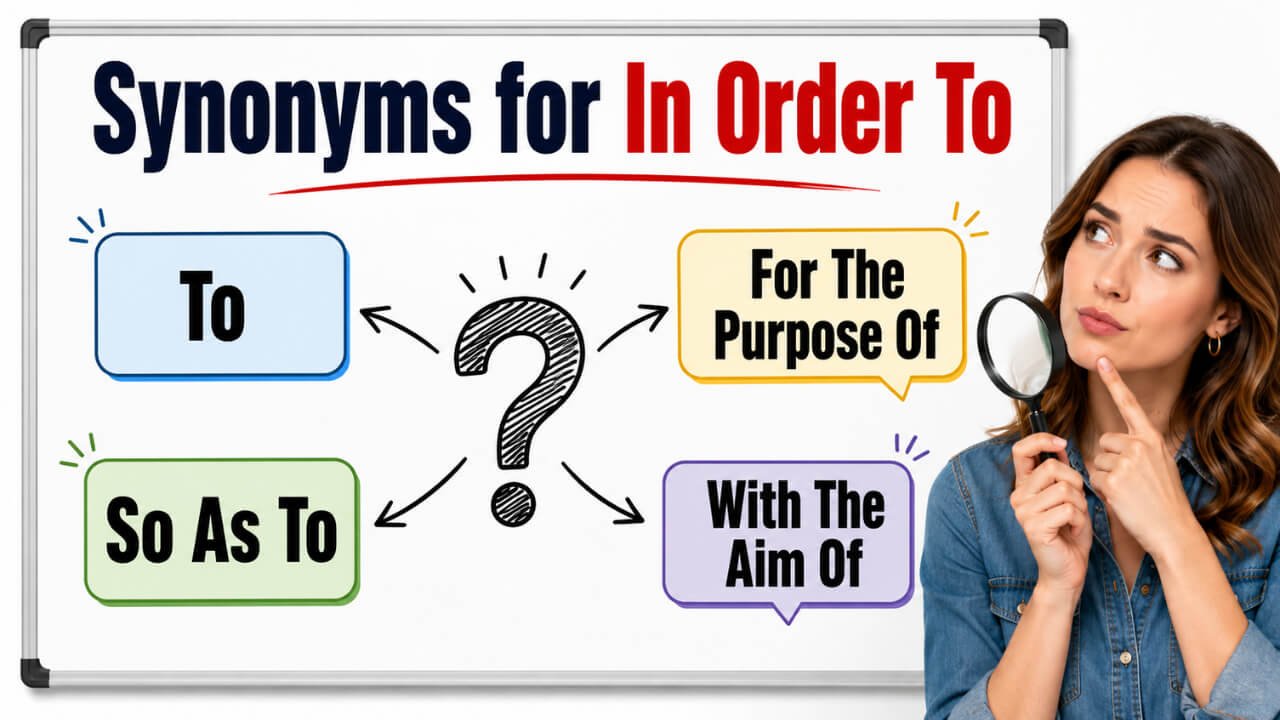
Quick Answer: Synonyms for in order to include to, so as to, so that, for the purpose of, with the aim of, with the intention of, in an effort to, as a means to, to enable, and to ensure. Use to for concise and natural sentences, so that when the purpose needs its own subject, and for the purpose of in formal writing. Choose with the aim of for planned goals, in an effort to for deliberate attempts, and to enable when an action makes something possible.
Pronunciation and Word Details
Word: In order to
Pronunciation: /ɪn ˈɔːrdər tuː/
Part of Speech: Infinitive purpose phrase
Meaning: In order to introduces an action that explains the purpose or intended goal of another action.
US Pronunciation:
UK Pronunciation:
What Does “In Order To” Mean?
In order to means for the purpose of doing or achieving something. It is an infinitive purpose phrase placed before the base form of a verb.
The phrase connects an action with its reason or intended result. It answers questions such as “Why was this done?” or “What was the purpose of this action?”
Example: She reviewed the report in order to find the error.
The action is reviewing the report. The purpose is finding the error.
In order to can appear at the beginning, middle, or end of a sentence.
Beginning: In order to improve your vocabulary, read a variety of texts.
Middle: The team, in order to meet the deadline, divided the work carefully.
End: He saved money in order to buy a new computer.
The phrase is common in formal explanations, instructions, academic writing, reports, and careful speech. In everyday sentences, the shorter word to often expresses the same meaning.
Formal: The researcher repeated the test in order to confirm the findings.
Concise: The researcher repeated the test to confirm the findings.
Both sentences are correct, but the second is shorter and more natural in many situations.
Meaning, Tone, and Context of “In Order To”
In order to has a neutral to formal tone. It clearly shows that one action is performed for a particular purpose.
The phrase is neither emotional nor strongly conversational. It is commonly used when a writer wants to make the relationship between an action and its goal completely clear.
In formal writing, in order to may introduce an objective, method, recommendation, or planned outcome.
Academic Context: Students should evaluate several arguments in order to form a balanced conclusion.
Professional Context: The department changed its process in order to reduce delays.
Instructional Context: Turn the handle slowly in order to release the pressure safely.
Technical Context: The device requires regular updates in order to operate correctly.
In casual speech, people usually choose to because it is shorter.
Formal: I called the office in order to ask about the schedule.
Casual: I called the office to ask about the schedule.
The longer phrase is useful when emphasis or clarity is needed. It can prevent the purpose from being confused with another part of the sentence.
Clear Purpose: She paused in order to let everyone finish speaking.
Here, in order to emphasizes that allowing others to finish was the reason she paused.
When and How to Use “In Order To”
Use in order to when you need to explain why an action is performed. It works best when the intended purpose is important to the meaning of the sentence.
For Explaining Purpose: Use the phrase to connect an action with its intended goal.
Example: He attended the workshop in order to develop stronger communication skills.
For Describing Goals: Use it when someone is working toward a specific result.
Example: The organization revised its plan in order to reach more people.
For Giving Instructions: Use it to explain why a particular step is necessary.
Example: Press the button twice in order to restart the system.
For Presenting Methods: Use it when explaining how a goal can be achieved.
Example: Writers should revise carefully in order to improve clarity.
For Emphasizing Intention: Use the complete phrase when the purpose needs extra attention.
Example: She arrived early in order to speak with the manager privately.
For Avoiding Ambiguity: Use it when the shorter to might connect with the wrong verb or idea.
Example: He moved the chair in order to allow the door to open fully.
For Formal Recommendations: Use it in reports, essays, policies, and professional guidance.
Example: The company should simplify its procedures in order to increase efficiency.
For Negative Purpose: Add not after to when explaining what someone wants to prevent.
Example: He lowered his voice in order not to disturb the class.
Best Synonyms for In Order To
To
Synonym: A concise word that introduces the purpose of an action.
Example: She studied every evening to prepare for the examination.
So As To
Synonym: A slightly formal phrase meaning with the purpose of doing something.
Example: He spoke slowly so as to make every instruction clear.
So That
Synonym: A conjunction used when the purpose clause has its own subject and verb.
Example: She wrote the details down so that everyone could remember them.
For the Purpose Of
Synonym: A formal expression that states the exact purpose of an action.
Example: The committee met for the purpose of reviewing the proposal.
With the Aim Of
Synonym: A formal phrase used for a planned goal or desired achievement.
Example: The program was created with the aim of improving literacy.
With the Intention Of
Synonym: A phrase emphasizing what someone deliberately plans to do.
Example: He entered the discussion with the intention of finding a fair solution.
In an Effort To
Synonym: A phrase showing that someone is deliberately trying to achieve something.
Example: The school added more classes in an effort to meet student demand.
As a Means To
Synonym: A phrase describing an action as a method for reaching a goal.
Example: They used regular surveys as a means to understand public opinion.
To Enable
Synonym: An expression showing that an action makes another action possible.
Example: The instructions were simplified to enable beginners to follow them.
To Ensure
Synonym: An expression used when an action is intended to make a result certain.
Example: Check every figure carefully to ensure the total is correct.
50 Synonyms for In Order To with Short Meanings
- To: For the purpose of performing an action.
- So as to: With the intention of doing something.
- So that: For the purpose that a particular result may happen.
- In order that: So that a planned outcome can occur.
- For: Intended to achieve or support a purpose.
- For the purpose of: Specifically intended for a stated objective.
- With the purpose of: Done to achieve a particular result.
- With the aim of: Directed toward a planned goal.
- With the goal of: Intended to reach a desired outcome.
- With the intention of: Done as part of a deliberate plan.
- With the intent to: Performed because someone plans to do something.
- With a view to: Done while considering a future objective.
- With the objective of: Intended to accomplish a defined target.
- In an effort to: Done as a deliberate attempt.
- In an attempt to: Performed while trying to achieve something.
- As a means to: Used as a method for reaching a goal.
- As a way to: Used as one possible method.
- For the sake of: Done to support, protect, or benefit something.
- In pursuit of: Done while actively seeking a goal.
- Toward: Moving in the direction of an objective.
- Toward the goal of: Intended to bring someone closer to a result.
- To help: Done to support an action or outcome.
- To allow: Done to give someone an opportunity to act.
- To enable: Done to make an action possible.
- To ensure: Done to make a result certain.
- To make sure: Done to confirm that something happens correctly.
- To achieve: Done to reach a desired result.
- To accomplish: Done to complete a planned objective.
- To attain: Done to reach a particular level or goal.
- To obtain: Done to receive or acquire something.
- To reach: Done to arrive at a target or result.
- To gain: Done to acquire a benefit, skill, or advantage.
- To secure: Done to obtain or protect something valuable.
- To support: Done to help an idea, person, or process succeed.
- To promote: Done to encourage progress or development.
- To facilitate: Done to make a process easier.
- To create: Done to produce a particular result.
- To improve: Done to make something better.
- To avoid: Done to prevent an unwanted result.
- So as not to: Done with the purpose of preventing something.
- For fear of: Done to prevent something worrying from happening.
- Lest: Used to express a purpose involving prevention.
- With the hope of: Done because someone desires a certain outcome.
- In hopes of: Done while expecting a positive possibility.
- With a plan to: Done according to an intended future action.
- In preparation for: Done to become ready for something.
- As preparation for: Used as a step toward future readiness.
- For achieving: Intended to help produce a desired result.
- For obtaining: Intended to help someone acquire something.
- For reaching: Intended to help someone arrive at a goal.
Read Also:
Synonyms for Slut

Synonyms for In Order To by Context
When In Order To Introduces a Simple Purpose
Use to when the connection between the action and its purpose is already clear. It is the most concise and natural replacement in most sentences.
Useful Synonyms: To, for, to help, and as a way to.
Example With In Order To: She opened the window in order to let fresh air inside.
Example With To: She opened the window to let fresh air inside.
When In Order To Expresses a Formal Objective
Formal documents often use longer phrases to define an official purpose or goal. These expressions work well in reports, proposals, policies, and academic discussions.
Useful Synonyms: For the purpose of, with the aim of, with the objective of, and with a view to.
Example: The survey was conducted with the aim of identifying common concerns.
When In Order To Shows Deliberate Intention
Use intention based phrases when you want to emphasize that an action was planned rather than accidental.
Useful Synonyms: With the intention of, with the intent to, with a plan to, and with the purpose of.
Example: She joined the course with the intention of improving her writing.
When In Order To Describes an Attempt
Use effort based alternatives when success is not guaranteed. These phrases focus on the attempt rather than the final result.
Useful Synonyms: In an effort to, in an attempt to, in pursuit of, and with the hope of.
Example: The team changed its strategy in an effort to improve performance.
When In Order To Makes Something Possible
Use enable, allow, facilitate, or support when one action creates the conditions needed for another action.
Useful Synonyms: To enable, to allow, to facilitate, and to support.
Example: Additional lighting was installed to enable employees to work safely.
When In Order To Prevents a Negative Result
Use negative purpose expressions when the action is intended to stop something undesirable.
Useful Synonyms: To avoid, so as not to, for fear of, and lest.
Example: She saved a second copy so as not to lose her work.
When In Order To Introduces a Separate Subject
Use so that when the person performing the first action is different from the person performing the second action.
Example: The teacher repeated the directions so that the students could understand them.
Using to in this sentence would be less clear because the teacher repeats the directions, but the students perform the action of understanding.
Another Word for In Order To
The best single replacement for in order to is usually to. It expresses the same basic purpose while making the sentence shorter and more direct.
However, the best alternative depends on sentence structure. Use so that when the purpose clause requires a separate subject. Use with the aim of for formal goals and in an effort to when the action is an attempt.
Original: She left early in order to avoid heavy traffic.
Better Option: She left early to avoid heavy traffic.
Original: The instructions were repeated in order to help everyone understand.
Better Option: The instructions were repeated so that everyone could understand.
Original: The organization launched the project in order to reduce waste.
Better Option: The organization launched the project with the aim of reducing waste.
Original: He reviewed his notes in order to remember the main points.
Better Option: He reviewed his notes as a way to remember the main points.
When Not to Use “In Order To”
Do not use in order to when it makes a simple sentence unnecessarily long. In most everyday writing, to communicates purpose more efficiently.
Weak: I went to the store in order to purchase some milk.
Better: I went to the store to buy some milk.
Avoid repeating in order to several times in the same paragraph. Repetition can make writing sound mechanical or overly formal.
Weak: In order to improve sales, the business changed its prices in order to attract customers in order to increase demand.
Better: To improve sales, the business changed its prices to attract customers and increase demand.
Do not use in order to when the sentence describes a cause rather than a purpose.
Weak: The road was closed in order to the heavy rain.
Better: The road was closed because of the heavy rain.
Do not place a noun directly after in order to. The phrase must normally be followed by the base form of a verb.
Weak: She attended the meeting in order to information.
Better: She attended the meeting in order to receive information.
Do not use the phrase when the outcome was accidental or unplanned.
Weak: He dropped the glass in order to break it, although the fall was accidental.
Better: He accidentally dropped the glass, causing it to break.
Use so that rather than in order to when the purpose clause needs a different subject.
Weak: She sent a reminder in order to everyone remembered the date.
Better: She sent a reminder so that everyone remembered the date.
Words Commonly Confused With In Order To
In Order To vs To: Both introduce purpose, but to is shorter. In order to provides extra clarity or emphasis.
In Order To vs So That: In order to is followed by a base verb. So that is followed by a subject and a verb.
In Order To vs Because: In order to explains a purpose. Because explains a cause or reason that already exists.
In Order To vs Therefore: In order to introduces an intended goal. Therefore introduces a logical result or conclusion.
In Order To vs For: In order to is followed by a verb. For is usually followed by a noun or a verb ending in ing.
In Order To vs In Order That: In order to normally keeps the same subject for both actions. In order that introduces a complete clause with its own subject.
In Order To vs So As To: Both express purpose. So as to can sound slightly more formal and is less common in everyday speech.
In Order To vs With the Aim Of: In order to is followed by a base verb. With the aim of is followed by a noun or a verb ending in ing.
In Order To vs In an Effort To: In order to states a purpose without commenting on success. In an effort to emphasizes the attempt and may suggest difficulty.
Which Synonym Should You Choose?
Choose to for most everyday sentences, instructions, emails, and direct explanations. It is concise and natural.
Choose so that when the purpose clause contains a different subject.
Choose so as to when you need a formal alternative that is still followed by a base verb.
Choose for the purpose of in official documents or when the exact purpose needs to be stated clearly.
Choose with the aim of for planned programs, strategies, research, and organized goals.
Choose with the intention of when you want to emphasize a deliberate personal plan.
Choose in an effort to when someone is trying to achieve something but success is uncertain.
Choose in an attempt to when the action is experimental, difficult, or possibly unsuccessful.
Choose as a means to when describing a method or tool used to reach a goal.
Choose to enable when the first action makes the second action possible.
Choose to ensure when the action is intended to make a result certain.
Choose to avoid or so as not to when describing the prevention of an unwanted outcome.
Choose with a view to for formal writing about future plans or expected developments.
Choose with the hope of when the result is desired but cannot be guaranteed.
Real Life Examples of “In Order To” in Sentences
Original: She set an alarm in order to wake up early.
Better Option: She set an alarm to wake up early.
Original: He wrote the address down in order to remember it.
Better Option: He wrote the address down so that he would remember it.
Original: The team held weekly meetings in order to improve communication.
Better Option: The team held weekly meetings with the aim of improving communication.
Original: They reduced unnecessary expenses in order to save money.
Better Option: They reduced unnecessary expenses as a way to save money.
Original: The student asked several questions in order to understand the lesson.
Better Option: The student asked several questions to better understand the lesson.
Original: The manager reviewed the process in order to prevent future errors.
Better Option: The manager reviewed the process to avoid future errors.
Original: She practiced every day in order to develop greater confidence.
Better Option: She practiced every day with the goal of developing greater confidence.
Original: The family left early in order to arrive before sunset.
Better Option: The family left early so that they could arrive before sunset.
Original: The instructions were simplified in order to help new users.
Better Option: The instructions were simplified to enable new users to follow them.
Original: He lowered the volume in order not to disturb anyone.
Better Option: He lowered the volume so as not to disturb anyone.
Synonym Groups and Usage Differences
Concise Purpose Group
This group includes to and for. These options keep sentences brief and work well when the purpose is obvious.
Example: She called to confirm the appointment.
Use to before a base verb. Use for before a noun or a verb ending in ing.
Example With For: This tool is useful for measuring distance.
Formal Purpose Group
This group includes for the purpose of, with the objective of, with a view to, and with the aim of. These phrases clearly define official or planned objectives.
Example: The policy was introduced with the objective of improving workplace safety.
These alternatives are useful in reports and formal discussions but may sound heavy in casual conversation.
Intention Group
This group includes with the intention of, with the intent to, and with a plan to. They emphasize deliberate choice and personal or organizational planning.
Example: She entered the discussion with the intention of resolving the disagreement.
These phrases are useful when intention is more important than the method.
Effort Group
This group includes in an effort to, in an attempt to, in pursuit of, and with the hope of. They describe actions taken while trying to reach a result.
Example: The researchers repeated the experiment in an attempt to confirm the results.
Use these expressions when success is uncertain or when the task requires noticeable effort.
Enabling Group
This group includes to enable, to allow, to support, and to facilitate. They explain how one action creates an opportunity or makes a process easier.
Example: The schedule was adjusted to allow more time for discussion.
These alternatives often make the relationship between the action and its practical effect more specific.
Achievement Group
This group includes to achieve, to accomplish, to attain, and to reach. They name the exact result that someone wants.
Example: The team changed its strategy to achieve better results.
These words are useful when the goal is measurable, planned, or clearly defined.
Prevention Group
This group includes to avoid, so as not to, for fear of, and lest. They explain that an action is taken to prevent an undesirable outcome.
Example: He checked the figures twice to avoid making an error.
Lest is formal and uncommon in everyday conversation, while to avoid is clear and widely used.
Antonyms of In Order To
In order to does not have one direct antonym because it describes a relationship between an action and its purpose. However, several words and phrases express the opposite idea of acting without intention, direction, or a defined objective.
Accidentally: In a way that was not planned.
Unintentionally: Without meaning or planning to produce a result.
Aimlessly: Without a clear direction or purpose.
Purposelessly: Without a useful or intended objective.
Randomly: Without a clear plan or organized method.
For no reason: Without an identifiable purpose.
Without intending to: With no deliberate plan to cause something.
By mistake: As the result of an error rather than a purpose.
Incidentally: As a secondary or unintended result.
Regardless of: Without allowing a purpose or condition to influence the action.
Example With Purpose: She moved the vase in order to protect it.
Example Without Purpose: She accidentally moved the vase while cleaning.
Comparison: In Order To vs Related Words
In Order To vs To
Both expressions introduce purpose. To is shorter and generally more natural, while in order to adds emphasis or clarity.
Example With In Order To: She paused in order to choose her words carefully.
Example With To: She paused to choose her words carefully.
In Order To vs So That
In order to is followed by a base verb and usually connects actions performed by the same subject. So that introduces a full clause and can include a different subject.
Example With In Order To: He saved money in order to travel.
Example With So That: He saved money so that his family could travel.
In Order To vs So As To
Both phrases are followed by a base verb and express purpose. So as to often sounds more formal and is particularly useful in negative purpose statements.
Example With In Order To: She whispered in order to remain unnoticed.
Example With So As To: She whispered so as to remain unnoticed.
In Order To vs For the Purpose Of
In order to is followed by a verb. For the purpose of is followed by a noun or a verb ending in ing.
Example With In Order To: The group met in order to review the rules.
Example With For the Purpose Of: The group met for the purpose of reviewing the rules.
In Order To vs With the Aim Of
In order to introduces a direct purpose. With the aim of places greater emphasis on a planned goal or strategy.
Example With In Order To: The school added classes in order to improve results.
Example With With the Aim Of: The school added classes with the aim of improving results.
In Order To vs In an Effort To
In order to simply explains why an action occurs. In an effort to emphasizes that someone is trying, often under difficult conditions.
Example With In Order To: They changed the schedule in order to reduce delays.
Example With In an Effort To: They changed the schedule in an effort to reduce continuing delays.
In Order To vs Because
In order to looks forward to an intended purpose. Because looks backward to an existing cause.
Example With In Order To: She studied in order to pass the test.
Example With Because: She studied because the test was important.
In Order To vs Therefore
In order to connects an action to its goal. Therefore connects a reason to its logical result.
Example With In Order To: He revised the paragraph in order to make it clearer.
Example With Therefore: The paragraph was unclear. Therefore, he revised it.
Common Phrases and Expressions With In Order To
In Order to Achieve: Used when an action supports a desired result.
Example: The team must cooperate in order to achieve its goal.
In Order to Improve: Used when an action is intended to make something better.
Example: She requested feedback in order to improve her writing.
In Order to Ensure: Used when an action is intended to make something certain.
Example: Review the details in order to ensure accuracy.
In Order to Avoid: Used when an action is intended to prevent a problem.
Example: Leave early in order to avoid traffic.
In Order to Understand: Used when an action helps someone gain knowledge.
Example: Read the full explanation in order to understand the concept.
In Order to Succeed: Used when describing an action necessary for success.
Example: You must remain consistent in order to succeed.
In Order to Complete: Used when an action helps finish a task.
Example: Follow each step in order to complete the process.
In Order to Protect: Used when an action prevents harm or damage.
Example: Store the document safely in order to protect the information.
In Order to Maintain: Used when an action keeps something at the same level or condition.
Example: Exercise regularly in order to maintain your strength.
In Order to Determine: Used when an action helps discover or decide something.
Example: The results were compared in order to determine the best method.
Common Mistakes to Avoid
One common mistake is using in order to too frequently. Although the phrase is grammatically correct, repeating it can make writing wordy and predictable. Replace it with to when the longer phrase adds no extra clarity.
Another mistake is placing a noun directly after the phrase. In order to must be followed by a base verb.
Incorrect: She visited the office in order to information.
Correct: She visited the office in order to request information.
Writers may also confuse purpose with cause. Use because when explaining why something happened due to an existing condition. Use in order to when explaining an intended result.
Cause: He stayed home because he was ill.
Purpose: He stayed home in order to recover.
Avoid combining in order to with another unnecessary purpose expression.
Incorrect: She studied in order to so that she could pass.
Correct: She studied in order to pass.
Correct: She studied so that she could pass.
Be careful when the two actions have different subjects. In such cases, so that is often clearer.
Unclear: She opened the door in order to the children could enter.
Correct: She opened the door so that the children could enter.
Do not assume that every close alternative uses the same grammar. With the aim of, for the purpose of, and with the intention of are normally followed by a noun or a verb ending in ing.
Correct: They met with the aim of improving communication.
Incorrect: They met with the aim of improve communication.
Writers should also distinguish the purpose phrase in order to from in order, which can mean arranged correctly or following a sequence.
Purpose: He called in order to ask a question.
Arrangement: The files are in order.
Conclusion
Synonyms for in order to help writers express purpose with greater clarity, variety, and precision. To is usually the best choice for concise sentences, while so that works when the purpose clause has its own subject. Use with the aim of for formal goals, in an effort to for difficult attempts, and to enable when one action makes another possible. Choosing the right alternative depends on grammar, tone, intention, and context. Avoid unnecessary repetition, and select the expression that communicates the purpose most naturally.
FAQs About Synonyms for In Order To
What Is the Best Synonym for In Order To?
The best general synonym is to. It is shorter, natural, and suitable for most sentences that express purpose.
Can I Always Replace In Order To With To?
You can replace it with to in many sentences. However, so that may be better when the purpose clause has a separate subject.
Is In Order To Grammatically Correct?
Yes. In order to is a correct purpose phrase followed by the base form of a verb.
Is In Order To Too Formal?
It has a neutral to formal tone. It is appropriate in careful writing, but to often sounds more natural in casual communication.
What Is a Formal Alternative to In Order To?
Formal alternatives include for the purpose of, with the objective of, with the aim of, and with a view to.
What Is the Difference Between In Order To and So That?
In order to is followed by a base verb. So that introduces a complete clause containing a subject and a verb.
How Can I Avoid Repeating In Order To?
Replace some uses with to, so that, with the aim of, in an effort to, as a means to, or to enable according to the sentence context.
