
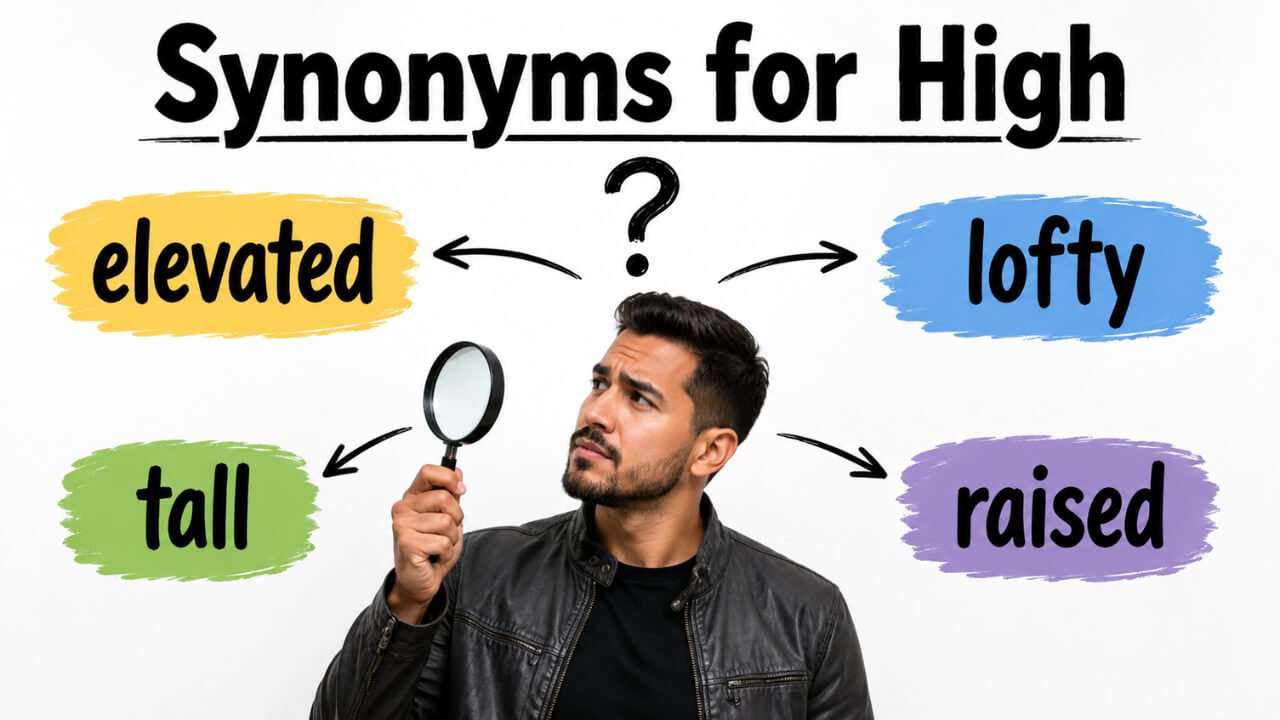
Quick Answer: Common synonyms for high include elevated, tall, lofty, towering, great, substantial, intense, expensive, superior, and senior. The best synonyms for high depend on context. Use elevated for position, tall for physical height, substantial for amounts, intense for feelings or pressure, expensive for price, superior for quality, and senior for rank. Lofty and towering create strong visual emphasis, while great is a flexible choice for levels, quantities, and importance.
Pronunciation and Word Details
Word: High
Pronunciation: /haɪ/
Part of Speech: Adjective, adverb, and noun
Meaning: High describes something far above the ground, large in amount, strong in degree, important in rank, or greater than a normal level.
US Pronunciation:
UK Pronunciation:
What Does “High” Mean?
High means being far above the ground, reaching a great vertical distance, or existing at a level greater than usual. It can describe physical height, quantity, intensity, price, quality, social rank, sound, emotion, or measurement.
As an adjective, high describes a noun.
Example: The bird flew over a high wall.
As an adverb, it describes how far upward something moves or exists.
Example: The kite rose high above the trees.
As a noun, high can refer to a maximum level, a strong feeling of happiness, or the highest recorded point.
Example: Temperatures reached a new high during the afternoon.
The exact meaning changes according to the noun that follows it. A high building is tall, a high price is expensive, a high score is excellent, and a high temperature is above the normal range.
Meaning, Tone, and Context of “High”
High is a common, neutral, and highly flexible word. It appears naturally in casual conversation, professional communication, academic writing, technical reports, weather descriptions, financial discussions, and scientific measurements.
In physical descriptions, high usually refers to vertical position or distance above the ground.
Example: The village sits on a high hill.
In reports and research, high often means large in amount, frequency, percentage, or intensity.
Example: The study recorded a high level of participation.
In business contexts, it can describe price, demand, cost, profit, risk, or performance.
Example: Demand remained high throughout the season.
High can also carry a positive tone when describing quality, standards, achievement, or status.
Example: The school maintains high academic standards.
However, it may have a negative tone when connected with costs, pressure, risk, stress, pollution, or danger.
Example: The project carries a high level of financial risk.
Because high has many meanings, a more precise synonym often improves clarity.
When and How to Use “High”
For Physical Height
Use high when something is far above the ground or reaches a great vertical level.
Example: A high fence surrounded the garden.
For Position Above the Ground
High can describe objects, places, or movement located well above a lower point.
Example: The shelf was too high for the child to reach.
For Large Amounts
Use high for numbers, percentages, quantities, rates, and levels that are greater than normal.
Example: The area has a high population density.
For Strong Intensity
High can describe powerful pressure, heat, speed, emotion, energy, or activity.
Example: The athletes trained at a high intensity.
For Expensive Prices
Use high when a price, cost, fee, or expense is greater than expected or affordable.
Example: The high cost discouraged many buyers.
For Quality and Standards
High can describe excellent quality, strict standards, or impressive achievement.
Example: The restaurant is known for its high standards.
For Rank and Importance
Use high for people or positions with considerable authority, influence, or status.
Example: She holds a high position in the organization.
For Sound
High describes a sound with a fast frequency that may seem sharp, thin, or piercing.
Example: The machine produced a high sound.
For Measurements
High is commonly used for temperature, blood pressure, altitude, scores, and other measured levels.
Example: His test score was unusually high.
For Emotion and Excitement
High can describe strong happiness, confidence, excitement, or enthusiasm.
Example: Spirits were high after the successful event.
Best Synonyms for High
Elevated: Positioned above a normal or lower level.
Example: The house stands on elevated ground.
Tall: Having a great vertical height from bottom to top.
Example: A tall tree shaded the entrance.
Lofty: Very high, impressive, or ambitious.
Example: Snow covered the lofty mountain peaks.
Towering: Extremely tall and visually impressive.
Example: Towering buildings surrounded the narrow street.
Substantial: Large in amount, value, or importance.
Example: The project required a substantial investment.
Intense: Strong in force, feeling, activity, or degree.
Example: The team worked under intense pressure.
Expensive: Costing a large amount of money.
Example: The repairs were more expensive than expected.
Superior: Better in quality, ability, or performance.
Example: The new material offers superior strength.
Senior: Holding a higher rank, position, or level of responsibility.
Example: A senior official approved the final plan.
Shrill: High and unpleasantly sharp in sound.
Example: A shrill alarm interrupted the meeting.
50 Synonyms for High with Short Meanings
- Elevated: Raised above a normal or lower position.
- Tall: Having great physical height.
- Lofty: Very high or impressively elevated.
- Towering: Extremely tall and noticeable.
- Raised: Lifted to a higher position.
- Upper: Located above another part or level.
- Topmost: Positioned at the highest point.
- Soaring: Rising or extending far upward.
- Uplifted: Lifted physically or emotionally.
- Skyward: Directed toward the sky.
- Great: Large in amount, degree, or importance.
- Large: Greater than average in size or quantity.
- Substantial: Considerable in amount or importance.
- Considerable: Large enough to deserve attention.
- Significant: Important or noticeably large.
- Abundant: Existing in a large quantity.
- Numerous: Existing in large numbers.
- Maximum: Reaching the greatest possible level.
- Peak: Reaching the highest point or level.
- Record: Higher than any previously measured level.
- Extreme: Very great in degree or intensity.
- Intense: Strong in force, feeling, or effect.
- Severe: Very strong, serious, or difficult.
- Powerful: Having great force or influence.
- Strong: Great in intensity, effect, or concentration.
- Heightened: Increased beyond a normal level.
- Acute: Strong, serious, or sharply felt.
- Excessive: Greater than what is reasonable or necessary.
- Steep: Rising sharply or costing a large amount.
- Expensive: Costing more than usual.
- Costly: Requiring a large financial payment.
- Premium: Higher in price or quality.
- Inflated: Increased beyond a fair or normal level.
- Overpriced: Costing more than something is worth.
- Superior: Better than others in quality or performance.
- Excellent: Extremely good in quality.
- Exceptional: Unusually good or impressive.
- Outstanding: Clearly better than average.
- Advanced: Existing at a developed or difficult level.
- Prestigious: Respected because of status or achievement.
- Distinguished: Respected and important.
- Senior: Higher in rank or responsibility.
- Chief: Highest or most important in rank.
- Leading: Most important, successful, or influential.
- Prominent: Important, noticeable, or well respected.
- Exalted: Holding a highly respected position.
- Shrill: High, sharp, and often unpleasant in sound.
- Piercing: Extremely sharp and difficult to ignore.
- Sharp: High and clear in pitch.
- Euphoric: Experiencing extremely strong happiness or excitement.
Read Also:
Synonyms for Personality
Synonyms for High by Context
When High Means Far Above the Ground
Elevated, lofty, raised, upper, topmost, soaring, and skyward describe physical position or upward direction.
Elevated is useful for land, platforms, roads, and physical locations. Lofty often describes mountains, ceilings, or impressive structures. Soaring suggests something that rises dramatically.
Example: The castle stood on elevated ground above the river.
Example: Soaring cliffs formed a natural wall around the valley.
When High Means Tall
Tall, towering, lofty, and soaring work well for structures, trees, mountains, and other objects with great vertical height.
Tall is the most natural everyday choice. Towering creates a stronger image and suggests that something dominates its surroundings.
Example: A tall oak tree grew beside the house.
Example: Towering mountains surrounded the quiet village.
When High Means Large in Amount
Great, large, substantial, considerable, significant, abundant, and numerous can replace high when discussing quantity.
Substantial sounds formal and works well in reports, essays, and professional writing. Considerable suggests an amount large enough to be important.
Example: The company experienced a substantial increase in demand.
Example: A considerable number of residents attended the meeting.
When High Means Strong or Intense
Intense, severe, powerful, strong, heightened, acute, and extreme suit pressure, emotions, heat, risk, activity, and concentration.
Intense is useful for feelings and experiences. Severe is better for serious conditions, while heightened describes something that has increased.
Example: The workers faced intense pressure before the deadline.
Example: Heightened security remained in place throughout the event.
When High Means Expensive
Expensive, costly, premium, inflated, overpriced, and steep describe prices, fees, expenses, and financial demands.
Expensive is neutral and widely used. Costly may also suggest harmful consequences. Overpriced clearly expresses that the price is unfair.
Example: The hotel was too expensive for our budget.
Example: Customers complained about the overpriced tickets.
When High Means Excellent in Quality
Superior, excellent, exceptional, outstanding, advanced, and premium describe impressive quality, ability, or performance.
Superior emphasizes comparison. Exceptional means unusually good, while outstanding suggests that something is noticeably better than average.
Example: The product is made from superior materials.
Example: She delivered an outstanding performance.
When High Means Important in Rank
Senior, chief, leading, prominent, prestigious, distinguished, and exalted describe rank, authority, influence, and social position.
Senior is common in professional titles. Chief identifies the most important person or role. Prominent describes someone widely recognized or influential.
Example: The decision was approved by a senior manager.
Example: Several prominent researchers attended the conference.
When High Describes Sound
Shrill, piercing, sharp, and elevated in pitch describe sounds at the upper end of the sound range.
Shrill often has a negative meaning. Piercing suggests a sound that is difficult to ignore, while sharp describes a clear and sudden sound.
Example: A piercing whistle echoed across the field.
Example: The instrument produced a sharp note.
When High Means Very Happy
Euphoric, delighted, joyful, excited, uplifted, and elated can describe a powerful positive emotional state.
Euphoric suggests overwhelming happiness. Uplifted is gentler and often describes improved mood or hope.
Example: The players were euphoric after their victory.
Example: Her encouraging words left everyone feeling uplifted.
Another Word for High
Elevated is one of the best general replacements for high when discussing position, level, status, or measurement. However, no single synonym works in every sentence because high has several distinct meanings.
Use tall for physical height, substantial for large amounts, intense for strong conditions, expensive for price, superior for quality, and senior for rank.
Original: The road passes through a high area.
Better Option: The road passes through an elevated area.
Original: The company reported high profits this year.
Better Option: The company reported substantial profits this year.
Original: The workers experienced high pressure.
Better Option: The workers experienced intense pressure.
Original: She holds a high position in the department.
Better Option: She holds a senior position in the department.
When Not to Use “High”
High may sound vague when a more exact word can identify the type of height, amount, intensity, or quality being described.
Avoid repeating high several times in one paragraph. Using precise synonyms can make the writing more natural and informative.
Do not use tall and high as automatic replacements for one another. Tall usually describes the vertical size of an object or person. High often describes position above the ground or a level on a scale.
Weak: The company has high prices and high costs in a high demand market.
Better: The company charges expensive prices and faces substantial costs in a strong demand market.
Weak: The airplane is very tall in the sky.
Better: The airplane is very high in the sky.
Weak: He lives in a high building with twenty floors.
Better: He lives in a tall building with twenty floors.
Weak: She received a high position after the promotion.
Better: She received a senior position after the promotion.
Weak: The report showed high problems with the system.
Better: The report showed serious problems with the system.
Words Commonly Confused With High
High vs Tall: High commonly describes position, level, amount, or distance above the ground. Tall describes the vertical size of a person or object.
High vs Elevated: High is a broad everyday word. Elevated is more formal and often describes a position or level above normal.
High vs Large: High is natural with rates, prices, levels, temperatures, and scores. Large is more common with amounts, groups, objects, and quantities.
High vs Great: High often refers to a measurable level. Great may describe amount, degree, importance, quality, or emotional force.
High vs Intense: High describes an increased level. Intense emphasizes powerful strength, concentration, or feeling.
High vs Expensive: High describes the level of a price. Expensive describes the item or service that costs a large amount.
High vs Superior: High can describe a standard or level. Superior directly means better in comparison with something else.
High vs Senior: High can describe rank generally. Senior is more precise for professional positions and levels of responsibility.
High vs Lofty: High is neutral and literal. Lofty can sound poetic, impressive, or figurative, especially when describing goals and ideals.
Which Synonym Should You Choose?
Choose elevated when discussing land, platforms, roads, measurements, or levels above normal.
Choose tall when describing the physical height of a person, tree, building, or object.
Choose lofty when you want a formal, literary, or impressive description of height, goals, or ideals.
Choose towering when something is extremely tall and visually dominant.
Choose substantial for large amounts, investments, profits, changes, or evidence in reports and essays.
Choose considerable when an amount or effect is large enough to deserve attention.
Choose intense when discussing pressure, heat, emotion, concentration, competition, or activity.
Choose severe for serious weather, pain, damage, shortages, penalties, or conditions.
Choose expensive when an object, service, trip, or purchase costs a large amount.
Choose steep when describing a sudden rise or an unusually high price.
Choose superior for quality, performance, materials, methods, or results that are better than others.
Choose outstanding for praise, achievement, talent, service, or performance.
Choose senior for rank, professional responsibility, or experience.
Choose prominent for an influential or widely recognized person, role, or position.
Choose shrill or piercing when describing an unpleasantly high sound.
Choose euphoric when describing extremely powerful happiness or excitement.
In casual speech, tall, big, strong, costly, and great may sound natural. In formal reports, elevated, substantial, significant, intense, superior, and senior usually provide greater precision.
Real Life Examples of “High” in Sentences
Original: The plane flew high above the clouds.
Better Option: The plane flew far above the clouds.
Original: A high wall protected the property.
Better Option: A tall wall protected the property.
Original: The business reported high earnings.
Better Option: The business reported substantial earnings.
Original: The region experienced high temperatures.
Better Option: The region experienced extreme temperatures.
Original: The project involves a high level of risk.
Better Option: The project involves a significant level of risk.
Original: The store charges high prices for basic products.
Better Option: The store charges expensive prices for basic products.
Original: She achieved a high score on the examination.
Better Option: She achieved an outstanding score on the examination.
Original: He holds a high role in the organization.
Better Option: He holds a senior role in the organization.
Original: The singer reached a high note.
Better Option: The singer reached a sharp upper note.
Original: Excitement was high before the final match.
Better Option: Excitement was intense before the final match.
Synonym Groups and Usage Differences
Height Group
Tall, elevated, lofty, towering, raised, upper, and soaring relate to physical height or upward position.
Tall describes vertical size. Elevated describes position above normal. Towering emphasizes impressive height, while soaring suggests a dramatic upward rise.
Example: Towering trees covered the elevated slopes.
Quantity Group
Large, substantial, considerable, significant, abundant, and numerous describe quantities greater than usual.
Large is general. Substantial and considerable sound more formal. Abundant refers to more than enough, while numerous applies to countable things.
Example: A substantial number of applications arrived before the deadline.
Intensity Group
Intense, severe, extreme, acute, strong, powerful, and heightened describe a great degree of force or seriousness.
Intense works with emotions, heat, effort, and pressure. Severe is suitable for difficult or harmful conditions. Acute often describes sharp awareness, need, or discomfort.
Example: The region faced a severe shortage during a period of intense demand.
Price Group
Expensive, costly, steep, inflated, premium, and overpriced refer to prices or financial demands.
Expensive is neutral. Steep emphasizes an unexpectedly large amount. Inflated suggests an artificial increase, while overpriced indicates poor value.
Example: The inflated cost made the service seem overpriced.
Quality Group
Superior, excellent, exceptional, outstanding, advanced, and premium describe better quality or performance.
Excellent is broadly positive. Superior requires an implied or direct comparison. Exceptional and outstanding express unusually strong praise.
Example: The team produced outstanding results through superior planning.
Rank Group
Senior, chief, leading, prominent, prestigious, distinguished, and exalted relate to authority, recognition, or social position.
Senior focuses on rank or experience. Chief identifies the main person or role. Prestigious describes respect attached to a position or institution.
Example: A distinguished senior official opened the event.
Sound Group
Shrill, piercing, sharp, and elevated in pitch describe sounds at a high frequency.
Shrill often suggests discomfort. Piercing emphasizes force and impact, while sharp can describe a brief, clear sound.
Example: A shrill, piercing alarm warned everyone to leave.
Emotion Group
Euphoric, joyful, elated, excited, delighted, and uplifted describe positive emotional highs.
Euphoric is the strongest term. Elated suggests great happiness after good news or success. Uplifted describes a gentler improvement in mood.
Example: The successful result left the entire team elated.
Antonyms of High
The opposite of high depends on whether the word refers to position, amount, intensity, price, quality, rank, or sound.
Low: Positioned near the ground or below a normal level.
Short: Having limited vertical height.
Lowered: Moved to a position beneath the previous level.
Small: Limited in size, amount, or quantity.
Slight: Small in degree or importance.
Moderate: Remaining within a reasonable middle range.
Weak: Lacking strength, intensity, or force.
Mild: Gentle and not severe or intense.
Cheap: Costing relatively little money.
Affordable: Priced at a manageable level.
Inferior: Lower in quality or performance.
Poor: Below an acceptable standard.
Junior: Lower in rank or responsibility.
Minor: Less important or influential.
Deep: Low in sound frequency.
Calm: Free from intense emotion or activity.
Depressed: Experiencing a low emotional state.
Minimum: The smallest possible amount or level.
Comparison High vs Related Words
High vs Tall
High describes position above the ground, measurable level, or degree. Tall describes physical height from the bottom to the top.
Example With High: The clock hangs high on the wall.
Example With Tall: A tall cabinet stands beside the wall.
High vs Elevated
High is common and flexible. Elevated is more formal and often suggests that something has been raised above its normal position or level.
Example With High: The patient had a high temperature.
Example With Elevated: The patient had an elevated temperature.
High vs Lofty
High is usually neutral and direct. Lofty sounds more literary and may describe impressive height, ambitious goals, or noble ideas.
Example With High: The birds nested on a high cliff.
Example With Lofty: The birds nested among the lofty cliffs.
High vs Substantial
High is commonly used with levels, rates, costs, and numbers. Substantial describes an amount large enough to be important.
Example With High: The company experienced high demand.
Example With Substantial: The company experienced a substantial increase in demand.
High vs Intense
High indicates that something has reached a large level. Intense emphasizes strength, concentration, or powerful effect.
Example With High: The workers faced high pressure.
Example With Intense: The workers faced intense pressure.
High vs Expensive
High describes the amount of a price or cost. Expensive describes the product, service, or activity that requires a large payment.
Example With High: The price of the service is high.
Example With Expensive: The service is expensive.
High vs Superior
High can refer to a good standard or level. Superior means directly better than another option in quality or performance.
Example With High: The company maintains high standards.
Example With Superior: The company uses superior materials.
High vs Senior
High is a broad description of rank. Senior is a precise adjective for a professional level with greater authority or experience.
Example With High: She has a high position in the office.
Example With Senior: She has a senior position in the office.
Common Phrases and Expressions With “High”
High Above: Located far over a lower surface or position.
High Level: Existing at an advanced, important, or substantial degree.
High Quality: Meeting an excellent standard.
High Standards: Strong expectations for quality, behavior, or performance.
High Price: A cost greater than normal or expected.
High Demand: Strong interest in a product, service, or resource.
High Risk: A strong possibility of danger, loss, or failure.
High Pressure: A demanding condition involving stress or force.
High Hopes: Strong expectations that something positive will happen.
High Spirits: A cheerful, excited, and confident emotional state.
Common Mistakes to Avoid
A common mistake is using high when tall is required. Use tall for the vertical size of people, buildings, trees, and objects. Use high for position above the ground.
Incorrect: The bird sat on a tall branch above us.
Better: The bird sat on a high branch above us.
Writers also use high with nouns that require large. Rates, temperatures, prices, and scores can be high, while groups, objects, and quantities are often large.
Unnatural: A high group of visitors entered the hall.
Better: A large group of visitors entered the hall.
Avoid using expensive to describe the price itself. A product is expensive, but its price is high.
Incorrect: The price was expensive.
Better: The price was high.
Do not replace high with superior unless a comparison of quality is intended. Superior means better, not simply greater in level.
Be careful with positive and negative meanings. High standards are usually positive, but high costs and high risks are often negative.
Avoid excessive repetition in formal writing.
Repetitive: The high demand caused high prices and high profits.
Improved: Strong demand caused elevated prices and substantial profits.
Choose synonyms according to the noun and the intended meaning. A towering mountain sounds natural, but a towering price usually does not. A steep price is the better expression.
Conclusion
The best synonyms for high depend on the meaning you want to express. Use tall, lofty, towering, or elevated for physical height. Substantial and considerable suit large amounts, while intense and severe describe strong conditions. Expensive and steep work for price, superior and outstanding express quality, and senior or prominent describe rank. Understanding these synonyms for high helps you avoid vague repetition and choose words that make descriptions, essays, reports, and everyday sentences clearer and more precise.
FAQs About Synonyms for High
What is the best general synonym for high?
Elevated is a strong general synonym when high refers to position or level. Other meanings may require tall, substantial, intense, or expensive.
What is another word for a high amount?
Substantial, considerable, large, significant, and great are useful alternatives for a high amount.
What is a synonym for high quality?
Superior, excellent, exceptional, outstanding, and premium can describe high quality.
What is a better word for high prices?
Expensive, costly, steep, inflated, and overpriced are suitable choices depending on whether the price is simply large or unfair.
Are high and tall the same?
No. Tall describes vertical size, while high usually describes position above the ground or a level greater than normal.
What is a formal synonym for high?
Elevated, substantial, significant, superior, prominent, and senior are useful formal alternatives.
What is the opposite of high?
Low is the most common opposite. Other antonyms include short, small, mild, cheap, inferior, junior, and minimum, depending on context.
