
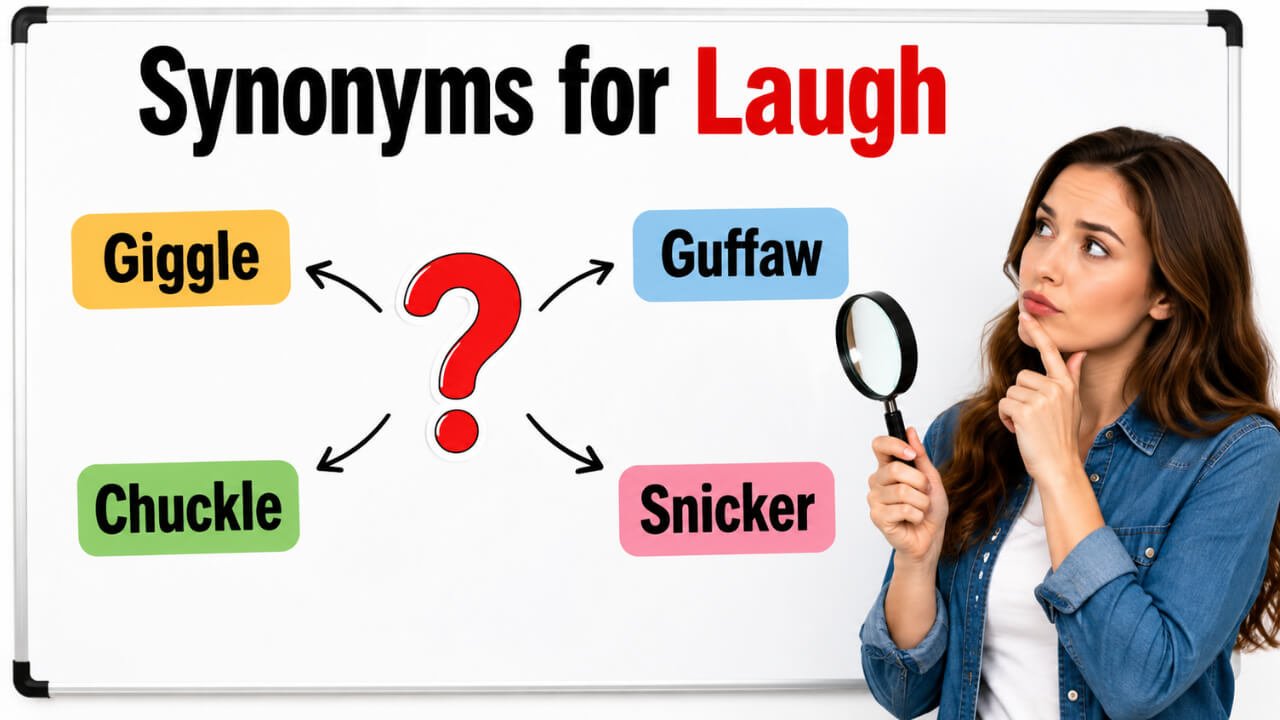
Quick Answer: Common synonyms for laugh include chuckle, giggle, chortle, guffaw, snicker, titter, cackle, roar, howl, and crack up. Choose chuckle for quiet amusement, giggle for light or playful laughter, guffaw for a loud reaction, and snicker for secret or mocking laughter. Roar and howl describe powerful laughter, while crack up is best for casual conversation. The best choice among synonyms for laugh depends on the sound, emotion, intensity, and purpose of the reaction.
Pronunciation and Word Details
Word: Laugh.
Pronunciation: /læf/
Part of Speech: Verb and noun.
Meaning: To make sounds or movements that show amusement, happiness, nervousness, or mockery.
US Pronunciation:
UK Pronunciation:
What Does “Laugh” Mean?
Laugh means to make a sound or facial movement that expresses amusement, pleasure, nervousness, surprise, or ridicule. It can function as both a verb and a noun.
As a verb, laugh describes the action of reacting with amusement.
Example: The children laughed at the funny story.
As a noun, laugh refers to the sound or act of laughing.
Example: His cheerful laugh filled the room.
The word can describe gentle amusement, loud joy, nervous discomfort, or unkind mockery. Its meaning becomes clearer through the surrounding words and situation.
Meaning, Tone, and Context of “Laugh”
Laugh is a common, neutral, and conversational word. It works naturally in everyday speech, stories, essays, messages, and informal writing.
The tone of laugh depends on the context. It can express warmth and happiness when people enjoy a joke together. It can show nervousness when someone feels uncomfortable. It may also sound negative when someone laughs at another person.
In formal writing, more precise expressions such as chuckle, express amusement, ridicule, or respond with laughter may communicate the intended meaning more clearly.
When and How to Use “Laugh”
For Genuine Amusement: Use laugh when someone reacts naturally to something funny.
Example: We laughed at his clever impression.
For Shared Happiness: Use laugh to describe people enjoying a pleasant experience together.
Example: The family laughed throughout dinner.
For Nervousness: Laugh can describe a reaction caused by discomfort, embarrassment, or uncertainty.
Example: She laughed nervously before answering the question.
For Mockery: Laugh at can mean treating someone or something as foolish.
Example: They laughed at his unusual suggestion.
For Storytelling: Use laugh to show a character’s emotional reaction.
Example: He laughed when he finally understood the joke.
For a Pleasant Sound: As a noun, laugh can describe the sound a person makes.
Example: Her warm laugh made everyone feel comfortable.
Best Synonyms for Laugh
Chuckle: To laugh quietly and gently.
Example: He chuckled at the child’s innocent question.
Giggle: To laugh lightly in a playful or nervous way.
Example: The students giggled during the amusing performance.
Chortle: To laugh with visible pleasure or satisfaction.
Example: She chortled when she heard the surprising ending.
Guffaw: To laugh very loudly and openly.
Example: His joke caused the entire audience to guffaw.
Snicker: To laugh quietly in a secretive or disrespectful way.
Example: A few classmates snickered at the incorrect answer.
Titter: To laugh quietly because of nervousness or embarrassment.
Example: The guests tittered at the awkward comment.
Cackle: To laugh loudly with a sharp or harsh sound.
Example: The character cackled after revealing the trick.
Roar: To laugh extremely loudly.
Example: The crowd roared at the comedian’s final joke.
Howl: To laugh loudly and uncontrollably.
Example: We howled when we saw the funny photograph.
Crack Up: To begin laughing strongly and suddenly.
Example: I cracked up when he copied the teacher’s expression.
50 Synonyms for Laugh with Short Meanings
- Chuckle: To laugh quietly and warmly.
- Giggle: To laugh lightly or playfully.
- Chortle: To laugh with pleasure or satisfaction.
- Guffaw: To laugh loudly and openly.
- Snicker: To laugh quietly and disrespectfully.
- Snigger: To give a secret or mocking laugh.
- Titter: To laugh softly because of nervousness.
- Cackle: To laugh with a sharp and noisy sound.
- Roar: To laugh extremely loudly.
- Howl: To laugh loudly and uncontrollably.
- Hoot: To make a loud laugh of amusement.
- Crack Up: To suddenly laugh very hard.
- Burst Out Laughing: To begin laughing suddenly.
- Laugh Aloud: To produce an audible laugh.
- Laugh Heartily: To laugh with genuine enjoyment.
- Belly Laugh: To laugh deeply and powerfully.
- Laugh Softly: To laugh in a quiet manner.
- Laugh Nervously: To laugh because of discomfort.
- Laugh Politely: To laugh to show courtesy.
- Laugh Uncontrollably: To be unable to stop laughing.
- Dissolve into Laughter: To suddenly become overwhelmed by laughter.
- Fall About Laughing: To laugh so hard that movement becomes difficult.
- Split Your Sides: To laugh extremely hard.
- Laugh Your Head Off: To laugh loudly for a long time.
- Chuckle to Yourself: To laugh quietly in private.
- Be Amused: To feel entertained or pleased.
- Show Amusement: To express that something is funny.
- Smile: To show pleasure without making a laughing sound.
- Grin: To smile broadly because of amusement.
- Beam: To smile brightly with happiness.
- Smirk: To smile with pride, secret amusement, or disrespect.
- Scoff: To laugh at something with disbelief or scorn.
- Sneer: To show disrespect through an unpleasant expression.
- Jeer: To laugh at or insult someone openly.
- Mock: To make fun of someone unkindly.
- Ridicule: To make someone appear foolish.
- Deride: To treat someone with contempt and mockery.
- Taunt: To tease someone in a cruel or challenging way.
- Make Fun Of: To joke about someone disrespectfully.
- Poke Fun At: To tease someone, often in a light manner.
- Laugh At: To react with amusement or ridicule.
- Crow: To laugh or speak with proud satisfaction.
- Whoop with Laughter: To make a loud cry while laughing.
- Snort with Laughter: To make a sudden breathing sound while laughing.
- Shake with Laughter: To move because of intense amusement.
- Weep with Laughter: To laugh until tears appear.
- Burst into Giggles: To suddenly begin laughing lightly.
- Laugh Uproariously: To laugh in an extremely loud way.
- Laugh Merrily: To laugh in a cheerful and joyful manner.
- Laugh Boisterously: To laugh in a loud and energetic way.
Read Also:
Synonyms for Desperate
Synonyms for Laugh by Context
When Laugh Means Quiet Amusement
Chuckle, titter, and laugh softly describe quiet laughter. Chuckle usually sounds warm and controlled, while titter often suggests nervousness or embarrassment.
Example: He chuckled quietly while reading the amusing note.
Example: The audience tittered after the speaker’s awkward mistake.
When Laugh Means Light or Playful Joy
Giggle, grin, beam, and burst into giggles work well for playful or youthful amusement. Giggle often suggests a light, repeated sound.
Example: The children giggled as they opened the surprise box.
Example: She beamed when she heard the happy news.
When Laugh Means Loud Amusement
Guffaw, roar, howl, hoot, and belly laugh describe strong and audible laughter. Guffaw suggests a sudden loud laugh, while roar and howl suggest laughter from a group or an uncontrollable reaction.
Example: The audience guffawed at the unexpected punch line.
Example: Everyone howled when the costume fell apart.
When Laugh Means Uncontrolled Amusement
Crack up, dissolve into laughter, shake with laughter, and weep with laughter describe reactions that are difficult to control.
Example: We dissolved into laughter when the dog ran away with the hat.
Example: She shook with laughter throughout the story.
When Laugh Means Nervousness
Giggle, titter, laugh nervously, and laugh politely can describe laughter caused by embarrassment, uncertainty, or social pressure.
Example: He laughed nervously when the manager questioned him.
Example: The guests tittered during the uncomfortable silence.
When Laugh Means Mockery
Snicker, snigger, scoff, jeer, mock, ridicule, and deride describe laughter that expresses disrespect or criticism.
Example: The students snickered at his unusual pronunciation.
Example: Critics scoffed at the original proposal.
Another Word for Laugh
Chuckle is often the best single replacement for laugh when the reaction is gentle, warm, and controlled. However, the best alternative depends on whether the laughter is quiet, loud, playful, nervous, uncontrolled, or mocking.
Original: She laughed at the clever message.
Better Option: She chuckled at the clever message.
Original: The audience laughed loudly at the performance.
Better Option: The audience guffawed at the performance.
Original: The children laughed during the game.
Better Option: The children giggled during the game.
Original: Everyone laughed uncontrollably at his impression.
Better Option: Everyone howled at his impression.
When Not to Use “Laugh”
Avoid using laugh repeatedly when a more descriptive word could show the exact sound, intensity, or emotion. Repetition can make storytelling feel flat.
Weak: He laughed at the joke, and then he laughed again when she repeated it.
Better: He chuckled at the joke and guffawed when she repeated it.
Do not use laugh when the person only smiles without making a sound.
Weak: She laughed silently at the compliment.
Better: She smiled at the compliment.
Avoid laugh when the intended meaning is clearly cruel or disrespectful.
Weak: The crowd laughed at the nervous speaker.
Better: The crowd jeered at the nervous speaker.
Do not use a strong synonym when the reaction is gentle.
Weak: She roared at the mildly amusing comment.
Better: She chuckled at the mildly amusing comment.
Avoid casual expressions such as crack up in highly formal reports or academic analysis.
Weak: The participants cracked up during the experiment.
Better: The participants responded with laughter during the experiment.
Words Commonly Confused With Laugh
Laugh vs Smile: Laugh normally involves sound or visible body movement. Smile describes a facial expression that may be silent.
Laugh vs Giggle: Laugh is a broad term. Giggle describes light, repeated laughter that may sound playful or nervous.
Laugh vs Chuckle: Laugh can have any volume or intensity. Chuckle specifically means a quiet and controlled laugh.
Laugh vs Grin: Laugh is an action that often produces sound. Grin means to smile broadly.
Laugh vs Mock: Laugh may express innocent amusement. Mock means to treat someone with ridicule or disrespect.
Laugh vs Sneer: Laugh shows amusement, while sneer shows contempt through a facial expression or tone.
Laugh vs Scoff: Laugh can be positive or neutral. Scoff expresses disbelief, rejection, or scorn.
Which Synonym Should You Choose?
Choose chuckle when describing quiet, warm, or controlled amusement.
Choose giggle when describing playful, youthful, embarrassed, or nervous laughter.
Choose chortle when someone laughs with satisfaction or visible pleasure.
Choose guffaw when the laughter is sudden, powerful, and loud.
Choose roar when a large group reacts with extremely loud laughter.
Choose howl when someone laughs loudly and cannot easily stop.
Choose crack up in casual speech when someone suddenly finds something extremely funny.
Choose snicker when the laughter is quiet, secretive, or disrespectful.
Choose scoff when someone reacts with disbelief or scorn.
Choose express amusement in formal reports, essays, observations, or professional descriptions.
Choose share a laugh in friendly messages or conversations about a pleasant social moment.
Choose ridicule or deride in formal writing when the laughter is intended to humiliate someone.
Real Life Examples of “Laugh” in Sentences
Original: She laughed when she read the birthday card.
Better Option: She chuckled when she read the birthday card.
Original: The children laughed behind the curtain.
Better Option: The children giggled behind the curtain.
Original: The audience laughed loudly at the final joke.
Better Option: The audience guffawed at the final joke.
Original: We laughed uncontrollably at his impression.
Better Option: We howled at his impression.
Original: He laughed quietly during the meeting.
Better Option: He snickered during the meeting.
Original: The guests laughed nervously at the comment.
Better Option: The guests tittered at the comment.
Original: Everyone laughed when the chair made a strange noise.
Better Option: Everyone burst out laughing when the chair made a strange noise.
Original: She laughed with genuine happiness.
Better Option: She laughed heartily with genuine happiness.
Original: The crowd laughed at the opposing team.
Better Option: The crowd jeered at the opposing team.
Original: I laughed so hard that tears appeared.
Better Option: I wept with laughter until tears covered my face.
Synonym Groups and Usage Differences
Quiet Laughter Group
Chuckle, titter, snicker, and laugh softly describe low volume laughter. Chuckle is usually friendly, titter is often nervous, and snicker may sound secretive or rude.
Example: He chuckled softly at the harmless mistake.
Playful Laughter Group
Giggle, burst into giggles, grin, and beam communicate lighthearted happiness. These words often appear in descriptions of children, friends, or playful situations.
Example: The friends burst into giggles during the game.
Loud Laughter Group
Guffaw, roar, howl, hoot, and belly laugh express strong and clearly audible amusement. These choices make descriptions more energetic.
Example: His unexpected answer caused a loud guffaw.
Uncontrolled Laughter Group
Crack up, dissolve into laughter, shake with laughter, and laugh your head off suggest that someone cannot easily stop laughing.
Example: The entire class dissolved into laughter.
Cheerful Laughter Group
Laugh merrily, laugh heartily, chortle, and share a laugh express positive and enjoyable emotions.
Example: The family laughed merrily around the dinner table.
Mocking Laughter Group
Snicker, scoff, jeer, mock, ridicule, and deride describe amusement mixed with disrespect, criticism, or cruelty.
Example: Several people scoffed at the unusual idea.
Antonyms of Laugh
The opposite of laugh changes according to whether laugh refers to happiness, amusement, sound, or mockery.
Cry: To produce tears because of sadness or pain.
Weep: To cry quietly or emotionally.
Sob: To cry with broken breaths and strong emotion.
Mourn: To express sadness after a serious loss.
Grieve: To feel deep sorrow.
Frown: To make a facial expression showing concern or displeasure.
Scowl: To look at someone with anger or disapproval.
Lament: To express sorrow or regret.
Remain Serious: To avoid showing amusement.
Suppress Laughter: To prevent yourself from laughing.
Show Sympathy: To respond with care instead of amusement.
Comfort: To support someone who feels upset or distressed.
Comparison: Laugh vs Related Words
Laugh vs Chuckle
Laugh is the general word for expressing amusement. Chuckle describes quiet, gentle, and controlled laughter.
Example With Laugh: She laughed when she heard the joke.
Example With Chuckle: She chuckled when she noticed the clever detail.
Laugh vs Giggle
Laugh can describe any type of laughter. Giggle usually describes light, repeated, playful, or nervous laughter.
Example With Laugh: The guests laughed at the story.
Example With Giggle: The children giggled during the puppet show.
Laugh vs Guffaw
Laugh is neutral and does not show volume. Guffaw describes a loud, sudden, and powerful laugh.
Example With Laugh: He laughed at the surprising answer.
Example With Guffaw: He guffawed when the performer fell onto the cushion.
Laugh vs Smile
Laugh usually involves sound or body movement. Smile is a silent facial expression that shows pleasure, friendliness, or amusement.
Example With Laugh: She laughed at the amusing photograph.
Example With Smile: She smiled when she saw her old friend.
Laugh vs Grin
Laugh is an audible or physical reaction. Grin means to smile broadly, sometimes because of happiness, pride, or secret amusement.
Example With Laugh: They laughed after hearing the result.
Example With Grin: He grinned after completing the difficult task.
Laugh vs Mock
Laugh may be friendly, joyful, nervous, or neutral. Mock specifically means making someone appear foolish.
Example With Laugh: We laughed together at the harmless joke.
Example With Mock: They mocked his attempt to speak confidently.
Laugh vs Scoff
Laugh often communicates genuine amusement. Scoff communicates disbelief, rejection, or contempt.
Example With Laugh: She laughed at the playful comment.
Example With Scoff: She scoffed at the unrealistic promise.
Common Phrases and Expressions With “Laugh”
Laugh Out Loud: To laugh loudly enough to be heard.
Have a Laugh: To enjoy something amusing.
Share a Laugh: To enjoy a funny moment with another person.
Burst Out Laughing: To suddenly begin laughing.
Laugh It Off: To treat an embarrassing or difficult event as unimportant.
Laugh At Someone: To react to a person with amusement or ridicule.
Laugh With Someone: To share amusement without insulting the person.
Laugh in Someone’s Face: To show open disrespect or disbelief.
Have the Last Laugh: To succeed after others expected failure.
No Laughing Matter: A serious issue that should not be treated as amusing.
Laugh Until You Cry: To laugh so strongly that tears appear.
A Good Laugh: An enjoyable period of amusement.
Common Mistakes to Avoid
One common mistake is using laugh for every kind of amused reaction. Choose a precise synonym when the sound, intensity, or emotion matters.
Avoid confusing laugh at with laugh with. Laughing with someone suggests shared enjoyment. Laughing at someone can suggest ridicule.
Do not use smile and laugh as exact replacements. A smile may be completely silent, while a laugh usually involves sound or physical movement.
Avoid using giggle for serious or powerful laughter. Giggle sounds light, playful, youthful, or nervous.
Do not use guffaw or roar for a quiet reaction. These words describe loud laughter.
Be careful with snicker, scoff, sneer, and jeer. They usually communicate disrespect rather than friendly amusement.
Avoid repeating laughed several times in one paragraph. Use precise alternatives to improve rhythm and emotional detail.
Do not force unusual synonyms into normal conversation. Clear and natural wording is usually more effective than rare vocabulary.
Conclusion
The best synonyms for laugh depend on the sound, emotion, intensity, and purpose of the reaction. Chuckle suits quiet amusement, giggle suggests playful or nervous laughter, and guffaw describes a loud response. Roar, howl, and crack up express powerful or uncontrolled amusement, while snicker, scoff, and jeer communicate mockery. Choosing a precise alternative makes descriptions clearer and more expressive. Use these synonyms for laugh to improve conversations, stories, essays, messages, and everyday vocabulary without changing the intended meaning.
FAQs About Synonyms for Laugh
What Is the Best Synonym for Laugh?
Chuckle is a strong general alternative when the laughter is quiet and pleasant. The best choice still depends on the context.
What Is a Synonym for a Quiet Laugh?
Chuckle, titter, snicker, and laugh softly can describe a quiet laugh. Chuckle is usually the most positive option.
What Word Means to Laugh Loudly?
Guffaw, roar, howl, hoot, and laugh boisterously all describe loud laughter.
What Is a Synonym for Laughing Uncontrollably?
Crack up, dissolve into laughter, shake with laughter, and laugh your head off describe uncontrollable laughter.
What Is a Formal Word for Laugh?
Express amusement is suitable for formal descriptions. Chortle, guffaw, ridicule, or deride may also work when a more precise meaning is needed.
What Is the Difference Between Chuckle and Giggle?
Chuckle describes quiet and controlled laughter. Giggle describes light, repeated laughter that is often playful or nervous.
Which Synonyms for Laugh Suggest Mockery?
Snicker, snigger, scoff, jeer, mock, ridicule, and deride can suggest disrespectful or mocking laughter.
