
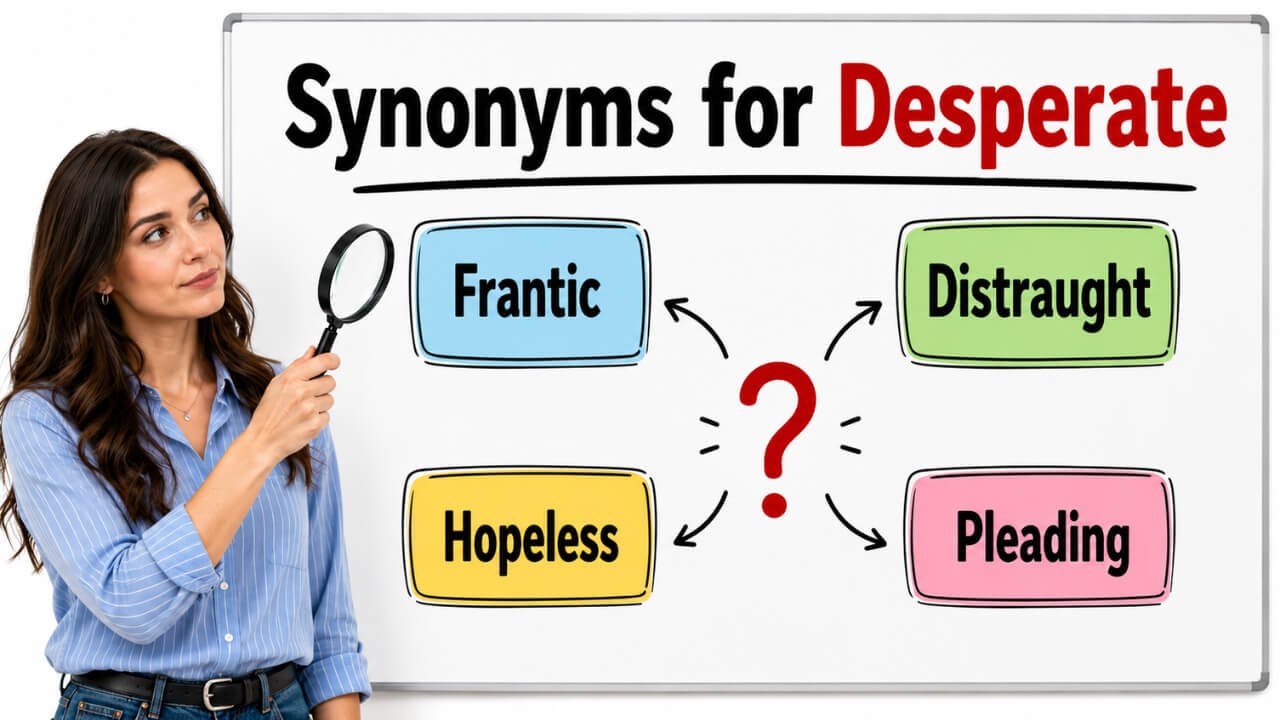
Quick Answer: The best synonyms for desperate are hopeless, despairing, distraught, frantic, urgent, critical, dire, needy, reckless, and drastic. Use hopeless or despairing for someone who has lost hope, distraught for deep emotional pain, and frantic for uncontrolled worry or activity. Urgent, critical, and dire work well for serious situations or immediate needs. Use needy for someone seeking excessive support, reckless for dangerous behavior, and drastic for extreme actions taken during a crisis. The right choice among synonyms for desperate depends on whether you are describing emotion, urgency, danger, intense desire, or extreme determination.
Pronunciation and Word Details
Word: Desperate
Pronunciation: /ˈdespərət/
Part of Speech: Adjective
Meaning: Feeling without hope, needing something urgently, or being willing to take extreme action because of a serious situation.
US Pronunciation:
UK Pronunciation:
What Does “Desperate” Mean?
Desperate means feeling that a situation is so serious or hopeless that normal choices no longer seem sufficient. It is an adjective that can describe a person, emotion, need, situation, action, or attempt.
A desperate person may feel frightened, helpless, or willing to do almost anything to solve a problem. A desperate situation is extremely serious and may require immediate action. A desperate need is an urgent need that cannot easily be ignored.
The word can also express an intense desire. Someone may be desperate for help, desperate to succeed, or desperate to receive an answer. In casual conversation, people sometimes use it for emphasis even when the situation is not truly dangerous.
Emotional Use: She felt desperate after every solution failed.
Urgent Need: The village was desperate for clean water.
Serious Situation: The rescue team faced a desperate situation.
Extreme Action: He made a desperate attempt to escape.
Intense Desire: The student was desperate to improve her results.
Meaning, Tone, and Context of “Desperate”
Desperate usually has a strong, emotional, and negative tone. It often suggests fear, hopelessness, extreme pressure, or urgent need. The word is stronger than worried, concerned, eager, or needy.
In formal writing, desperate may describe severe conditions, urgent shortages, humanitarian needs, dangerous struggles, or extreme attempts. It is also common in reports, essays, news style writing, and serious discussions when the situation involves risk or suffering.
In conversation, desperate can describe a strong desire without suggesting actual danger. A person might say that they are desperate for rest, desperate to leave work, or desperate to hear some good news. In such cases, the word is often an exaggeration used for emphasis.
Desperate may sound judgmental when it describes someone seeking attention, approval, affection, or success. Writers should consider whether a more precise word, such as eager, anxious, lonely, ambitious, or needy, would communicate the intended meaning more fairly.
When and How to Use “Desperate”
For Hopeless Emotion: Use desperate when someone feels that no good solution remains.
Example: She became desperate after weeks of unsuccessful searching.
For Urgent Need: Use desperate when something is needed immediately and seriously.
Example: The patients were desperate for medical assistance.
For a Dangerous Situation: Use desperate when conditions are extremely serious or difficult.
Example: The trapped hikers were in a desperate situation.
For Intense Desire: Use desperate when someone strongly wants an action, result, or opportunity.
Example: He was desperate to prove that he could handle the responsibility.
For Extreme Action: Use desperate when a person takes a risky or unusual step because ordinary methods have failed.
Example: The company made a desperate attempt to avoid closure.
For Emotional Distress: Use desperate when fear, grief, or anxiety becomes difficult to control.
Example: Her desperate voice showed how frightened she was.
For a Final Effort: Use desperate when an attempt is made with little hope of success.
Example: The team launched a desperate effort to score before time ended.
Best Synonyms for Desperate
Hopeless
Meaning: Feeling that no positive result is possible.
Example: He felt hopeless after receiving another rejection.
Despairing
Meaning: Showing a complete loss of hope.
Example: She gave a despairing look when the final plan failed.
Distraught
Meaning: Extremely upset, worried, or emotionally disturbed.
Example: The distraught parent searched everywhere for the missing child.
Frantic
Meaning: Acting with uncontrolled fear, worry, or urgency.
Example: They made frantic calls to every nearby hospital.
Urgent
Meaning: Requiring immediate attention or action.
Example: The family had an urgent need for temporary shelter.
Critical
Meaning: Extremely serious and requiring an immediate response.
Example: Food supplies had reached a critical level.
Dire
Meaning: Very serious, dangerous, or threatening.
Example: The community faced a dire shortage of drinking water.
Needy
Meaning: Requiring or seeking a great deal of help, care, or attention.
Example: His constant requests made him appear emotionally needy.
Reckless
Meaning: Acting without proper concern for danger or consequences.
Example: Their desperate plan became increasingly reckless.
Drastic
Meaning: Extreme and likely to have a powerful effect.
Example: Officials introduced drastic measures to control the crisis.
50 Synonyms for Desperate with Short Meanings
- Hopeless: Feeling that success or improvement is impossible.
- Despairing: Showing that all hope has been lost.
- Despondent: Deeply discouraged and unhappy.
- Forlorn: Sad, abandoned, and without much hope.
- Anguished: Experiencing severe emotional pain.
- Distraught: Extremely worried, upset, or confused.
- Distressed: Suffering from emotional pain or serious difficulty.
- Miserable: Extremely unhappy or uncomfortable.
- Dejected: Sad because of failure or disappointment.
- Crushed: Emotionally defeated by painful circumstances.
- Broken: Emotionally damaged and unable to cope normally.
- Helpless: Unable to protect oneself or improve a situation.
- Defeated: Feeling unable to continue after repeated failure.
- Doomed: Certain or likely to experience failure or disaster.
- Bleak: Offering little hope for a positive result.
- Frantic: Acting with uncontrolled urgency or fear.
- Panicked: Overcome by sudden and intense fear.
- Alarmed: Seriously worried by possible danger.
- Terrified: Experiencing extreme fear.
- Agitated: Disturbed, anxious, or unable to remain calm.
- Hysterical: Showing uncontrolled emotion or fear.
- Urgent: Requiring immediate attention.
- Pressing: Too important to delay.
- Critical: Extremely serious and needing quick action.
- Dire: Very dangerous or severe.
- Grave: Serious enough to cause concern or fear.
- Severe: Extremely difficult, painful, or harmful.
- Acute: Intense, serious, and requiring attention.
- Extreme: Far beyond an ordinary level.
- Drastic: Very severe or forceful.
- Perilous: Full of serious danger.
- Dangerous: Likely to cause harm or loss.
- Serious: Important, harmful, or difficult.
- Needy: Requiring excessive help, care, or attention.
- Anxious: Strongly worried or eager about an uncertain result.
- Eager: Strongly wanting something to happen.
- Craving: Experiencing a powerful desire for something.
- Yearning: Feeling a deep and emotional desire.
- Longing: Strongly wishing for someone or something.
- Impatient: Unable to wait calmly for a desired result.
- Driven: Strongly motivated by need, fear, or ambition.
- Determined: Firmly committed to achieving a result.
- Relentless: Continuing with intense effort despite difficulty.
- Reckless: Ignoring danger or consequences.
- Rash: Acting too quickly without careful thought.
- Foolhardy: Taking unnecessary risks despite obvious danger.
- Cornered: Feeling trapped with no safe choice available.
- In Crisis: Experiencing a highly unstable or dangerous situation.
- In Urgent Need: Requiring immediate help or resources.
- At Breaking Point: Close to losing emotional or physical control.
Read Also:
Synonyms for Bored
Synonyms for Desperate by Context
When Desperate Means Hopeless
Hopeless, despairing, despondent, forlorn, dejected, and defeated describe a person who sees little or no possibility of improvement.
Hopeless: Best when someone believes success is impossible.
Example: He felt hopeless after every appeal was refused.
Despairing: Best when the loss of hope is visible in someone’s words, expression, or behavior.
Example: She sent a despairing message asking for help.
Despondent: Best for deep discouragement that lasts for some time.
Example: The repeated failures left him despondent.
Forlorn: Best for sadness mixed with loneliness or abandonment.
Example: The lost child gave the officer a forlorn look.
When Desperate Means Frantic
Frantic, panicked, distraught, agitated, and alarmed describe emotional pressure that causes hurried or uncontrolled behavior.
Frantic: Suggests fast and disorganized activity caused by fear or urgency.
Example: The family began a frantic search before darkness arrived.
Panicked: Emphasizes sudden fear and loss of calm thinking.
Example: The panicked passengers rushed toward the exit.
Distraught: Focuses on overwhelming emotional pain or worry.
Example: The distraught woman could barely explain what had happened.
Agitated: Describes visible nervousness, restlessness, or emotional disturbance.
Example: He became agitated while waiting for the test results.
When Desperate Means Urgent
Urgent, pressing, critical, acute, grave, and dire describe needs or conditions that demand immediate attention.
Urgent: Best for matters that cannot safely be delayed.
Example: The doctor requested an urgent examination.
Pressing: Best for a responsibility or need that requires prompt action.
Example: Finding temporary housing became their most pressing concern.
Critical: Best for a situation approaching a dangerous point.
Example: The injured patient remained in critical condition.
Dire: Best for extremely serious conditions with harmful consequences.
Example: The region faced a dire need for food and medicine.
When Desperate Means Extremely Serious
Severe, grave, extreme, perilous, dangerous, and bleak describe conditions with serious risks or limited hope.
Severe: Emphasizes intensity or harmful effects.
Example: The area experienced a severe water shortage.
Grave: Sounds formal and emphasizes serious concern.
Example: Officials warned that the country faced a grave economic problem.
Perilous: Emphasizes physical danger or high risk.
Example: The climbers began a perilous journey down the mountain.
Bleak: Describes a future or situation with little reason for hope.
Example: Without additional support, the outlook remained bleak.
When Desperate Means Strongly Wanting Something
Eager, anxious, craving, yearning, longing, impatient, and needy can replace desperate when the focus is intense desire rather than danger.
Eager: A positive alternative for strong interest or enthusiasm.
Example: She was eager to begin her new role.
Anxious: Suggests desire mixed with nervousness or uncertainty.
Example: He was anxious to hear the final decision.
Yearning: Expresses a deep emotional wish.
Example: She was yearning for a sense of peace.
Needy: Describes someone who seeks frequent care, attention, or reassurance.
Example: His constant requests for approval made him seem needy.
When Desperate Means Willing to Take Risks
Reckless, rash, foolhardy, drastic, driven, and cornered describe extreme behavior caused by pressure or limited choices.
Reckless: Best when someone ignores danger.
Example: The reckless escape attempt placed everyone at risk.
Rash: Best for a quick decision made without enough thought.
Example: Selling everything immediately would be a rash response.
Drastic: Best for an extreme action intended to solve a serious problem.
Example: The school introduced drastic changes after enrollment collapsed.
Cornered: Best when someone feels trapped and believes no safe options remain.
Example: Feeling cornered, he accepted terms he would normally reject.
Another Word for Desperate
Hopeless is often the best single replacement for desperate when describing a person who has lost confidence in a positive result. However, the most accurate alternative depends on the intended meaning.
Use frantic for uncontrolled urgency, urgent for an immediate need, dire for a dangerous condition, and eager for a strong desire that is not truly hopeless.
Original: She felt desperate after months without progress.
Better Option: She felt hopeless after months without progress.
Original: They made a desperate search for the missing documents.
Better Option: They made a frantic search for the missing documents.
Original: The community was in desperate need of clean water.
Better Option: The community was in urgent need of clean water.
Original: He was desperate to begin the course.
Better Option: He was eager to begin the course.
When Not to Use “Desperate”
Do not use desperate when a milder or more precise word communicates the meaning better. The word can sound dramatic, judgmental, or exaggerated when the situation is ordinary.
Avoid using desperate to describe simple enthusiasm. Eager, excited, interested, or keen may sound more natural. Do not use it for every serious problem because terms such as urgent, critical, severe, or dangerous may provide clearer information.
Be especially careful when describing someone who wants affection, attention, employment, or approval. Calling a person desperate can sound insulting. A more neutral description may focus on the actual emotion or need.
Weak: I am desperate to watch the new program tonight.
Better: I am eager to watch the new program tonight.
Weak: She sounded desperate because she asked two questions.
Better: She sounded concerned because she needed clarification.
Weak: The office has a desperate paperwork issue.
Better: The office has a serious paperwork problem.
Weak: He made a desperate decision without considering the risks.
Better: He made a reckless decision without considering the risks.
Weak: The patient had a desperate medical condition.
Better: The patient had a critical medical condition.
Words Commonly Confused With Desperate
Desperate vs Hopeless: Desperate may describe a person who feels hopeless but is still taking extreme action. Hopeless focuses more directly on the belief that success is impossible.
Desperate vs Despairing: Desperate can describe emotion, need, action, desire, or circumstances. Despairing mainly describes a visible loss of hope.
Desperate vs Frantic: Desperate describes the seriousness of someone’s need or emotional condition. Frantic focuses on uncontrolled, hurried behavior.
Desperate vs Urgent: Desperate is more emotional and may suggest fear or hopelessness. Urgent is more neutral and means that something requires immediate action.
Desperate vs Dire: Desperate can describe people, needs, attempts, and situations. Dire usually describes very serious conditions, warnings, needs, or consequences.
Desperate vs Needy: Desperate may refer to an urgent need or intense desire. Needy often describes a person who requires frequent emotional, financial, or practical support.
Desperate vs Reckless: Desperate explains the pressure or hopelessness behind an action. Reckless describes the action itself as careless about danger or consequences.
Desperate vs Anxious: Desperate is stronger and may suggest extreme pressure or lack of hope. Anxious usually means worried, nervous, or strongly eager.
Which Synonym Should You Choose?
Choose hopeless when a person believes that improvement or success is no longer possible.
Choose despairing when someone openly shows a loss of hope through words, expressions, or behavior.
Choose distraught when a person is overwhelmed by grief, fear, or worry.
Choose frantic when fear or urgency causes hurried and uncontrolled activity.
Choose urgent when a need, message, request, or task requires immediate attention.
Choose critical when a condition has reached a highly serious or dangerous stage.
Choose dire when describing extremely severe circumstances, shortages, warnings, or consequences.
Choose needy when someone requires frequent assistance, reassurance, affection, or attention.
Choose eager when the intended meaning is strong positive interest rather than hopeless desire.
Choose anxious when someone strongly wants an outcome but also feels worried or uncertain.
Choose reckless when pressure causes someone to ignore obvious risks.
Choose drastic when an action or solution is unusually severe or extreme.
Choose grave in formal reports, essays, or discussions about serious concerns.
Choose acute when describing an intense shortage, problem, illness, or need.
Choose pressing when a responsibility or problem must be handled soon.
Real Life Examples of “Desperate” in Sentences
Original: The parents were desperate for information about their missing son.
Better Option: The parents were distraught as they waited for information about their missing son.
Original: The town was desperate for additional medical supplies.
Better Option: The town had an urgent need for additional medical supplies.
Original: She made a desperate call to her closest friend.
Better Option: She made a frantic call to her closest friend.
Original: The company was in a desperate financial situation.
Better Option: The company was in a critical financial situation.
Original: He was desperate to receive the promotion.
Better Option: He was eager to receive the promotion.
Original: They took desperate action to prevent further damage.
Better Option: They took drastic action to prevent further damage.
Original: The trapped animal made a desperate attempt to escape.
Better Option: The trapped animal made a frantic attempt to escape.
Original: Her desperate expression revealed how little hope she had left.
Better Option: Her despairing expression revealed how little hope she had left.
Original: The family faced a desperate shortage of food.
Better Option: The family faced a severe shortage of food.
Original: His desperate behavior placed everyone in danger.
Better Option: His reckless behavior placed everyone in danger.
Synonym Groups and Usage Differences
Hopelessness Group
Hopeless, despairing, despondent, defeated, and forlorn describe emotional states involving little confidence in a positive outcome. Hopeless is the most direct choice, while despairing emphasizes visible emotion. Despondent suggests lasting discouragement, and forlorn often includes loneliness.
Example: After receiving no response for weeks, she became despondent.
Emotional Distress Group
Distraught, anguished, distressed, miserable, and crushed describe emotional suffering. Distraught combines extreme worry with difficulty thinking clearly. Anguished emphasizes deep pain, while crushed often follows a major disappointment or loss.
Example: He was distraught after hearing that his family was in danger.
Panic and Urgency Group
Frantic, panicked, agitated, alarmed, and hysterical describe intense emotional reactions. Frantic is useful for hurried activity, while panicked focuses on sudden fear. Agitated is less extreme and can describe visible nervousness.
Example: The staff made frantic efforts to control the flooding.
Serious Condition Group
Urgent, critical, dire, grave, acute, and severe describe serious needs or situations. Urgent focuses on time, critical focuses on danger, dire focuses on harmful consequences, and grave has a formal and serious tone.
Example: The hospital reported a critical shortage of trained nurses.
Intense Desire Group
Eager, anxious, craving, yearning, longing, and impatient express different types of strong desire. Eager is usually positive, anxious includes worry, and yearning or longing suggests a deeper emotional wish.
Example: She was eager to demonstrate her abilities.
Extreme Action Group
Drastic, reckless, rash, foolhardy, driven, and relentless describe actions or motivation under pressure. Drastic focuses on severity, reckless and foolhardy emphasize danger, and driven describes powerful motivation.
Example: The organization introduced drastic changes to avoid failure.
Antonyms of Desperate
The opposite of desperate depends on whether the word describes emotion, urgency, danger, desire, or behavior.
Hopeful: Expecting a positive result.
Optimistic: Believing that events will probably improve.
Confident: Feeling certain about one’s abilities or chances.
Calm: Free from panic, agitation, or intense worry.
Composed: Able to remain emotionally controlled.
Secure: Safe, protected, and free from serious fear.
Content: Satisfied without a strong unmet desire.
Patient: Able to wait without becoming upset.
Unconcerned: Not worried about a situation.
Careful: Giving proper attention to risks and consequences.
Cautious: Avoiding unnecessary danger.
Stable: Not likely to collapse, change suddenly, or enter a crisis.
Comfortable: Free from severe difficulty or distress.
Assured: Confident that a desired result will occur.
Moderate: Not extreme in degree, action, or emotion.
Comparison: Desperate vs Related Words
Desperate vs Hopeless
Desperate is broader than hopeless. It may describe a person who has lost hope, but it can also describe urgent need, intense desire, or an extreme attempt. Hopeless directly expresses the belief that success is impossible.
Example With Desperate: He made a desperate attempt to repair the damaged boat.
Example With Hopeless: He believed the damaged boat was hopeless beyond repair.
Desperate vs Frantic
Desperate describes the pressure, need, or hopelessness behind an action. Frantic describes behavior that is hurried, uncontrolled, and driven by fear.
Example With Desperate: She was desperate to find her missing passport.
Example With Frantic: She conducted a frantic search through every drawer.
Desperate vs Urgent
Desperate has stronger emotional meaning. Urgent is more neutral and suitable for professional requests, instructions, and formal communication.
Example With Desperate: The stranded family was desperate for help.
Example With Urgent: The rescue team received an urgent request for assistance.
Desperate vs Dire
Desperate can describe people, actions, needs, and situations. Dire mainly describes conditions, predictions, needs, warnings, or consequences that are extremely serious.
Example With Desperate: The workers made a desperate effort to stop the leak.
Example With Dire: The report warned of dire consequences if the leak continued.
Desperate vs Distraught
Desperate may involve urgent action or intense need. Distraught specifically describes someone who is so upset that clear thinking becomes difficult.
Example With Desperate: He was desperate to contact his family.
Example With Distraught: He became distraught when every call went unanswered.
Desperate vs Needy
Desperate suggests extreme pressure, urgency, or desire. Needy usually describes someone who requires frequent support, attention, affection, or resources.
Example With Desperate: She was desperate for assistance after losing her home.
Example With Needy: The needy family depended on regular community support.
Desperate vs Reckless
Desperate explains why someone might take an extreme action. Reckless evaluates the action as careless or dangerous.
Example With Desperate: The prisoner made a desperate escape attempt.
Example With Reckless: The prisoner’s reckless escape attempt endangered several people.
Desperate vs Eager
Desperate is much stronger and can suggest emotional pressure or lack of control. Eager expresses positive interest, enthusiasm, or readiness.
Example With Desperate: He was desperate to find employment before his savings ended.
Example With Eager: He was eager to begin his new position.
Common Phrases and Expressions With Desperate
Desperate Need: A serious and urgent requirement.
Desperate Situation: A condition involving severe difficulty, danger, or limited hope.
Desperate Attempt: An extreme effort made when normal methods have failed.
Desperate Effort: A forceful final action taken under pressure.
Desperate Measures: Extreme actions used to solve a serious problem.
Desperate Plea: An emotional and urgent request for help.
Desperate Search: A hurried search driven by fear or urgent need.
Desperate Struggle: A difficult fight against danger, failure, or loss.
Desperate Hope: A final hope held despite a low chance of success.
Desperate for Help: Needing assistance immediately and seriously.
Desperate for Attention: Seeking notice or approval in an excessive or obvious way.
Desperate to Succeed: Feeling an intense need to achieve success.
Common Mistakes to Avoid
Using Desperate for Mild Enthusiasm: Desperate is often too strong when someone is simply excited or interested. Use eager, keen, or enthusiastic instead.
Incorrect: She is desperate to visit the new library.
Better: She is eager to visit the new library.
Repeating Desperate Too Often: Repetition can make a paragraph sound dramatic and imprecise. Replace repeated uses with urgent, critical, frantic, hopeless, or dire according to the context.
Repetitive: The desperate family made a desperate request during the desperate situation.
Better: The distressed family made an urgent request during the critical situation.
Choosing a Synonym Without Checking Meaning: Hopeless, frantic, needy, and reckless are not interchangeable. Each word emphasizes a different part of the situation.
Unclear: The hospital had a hopeless need for blood.
Better: The hospital had an urgent need for blood.
Confusing Emotion With Action: A person may feel desperate, but the action taken may be reckless, rash, frantic, or drastic.
Unclear: He made a desperate decision without considering anyone’s safety.
Better: He made a reckless decision without considering anyone’s safety.
Using Desperate as a Verb: Desperate is normally an adjective, not a verb. Do not write desperated.
Incorrect: The continued delays desperated the passengers.
Better: The continued delays made the passengers desperate.
Using the Wrong Preposition: Use desperate for before a noun and desperate to before a verb.
Correct With a Noun: They were desperate for shelter.
Correct With a Verb: They were desperate to find shelter.
Using an Incorrect Comparative Form: Do not write desperater or desperatest. Use more desperate and most desperate.
Correct Comparative: The situation became more desperate overnight.
Correct Superlative: This was their most desperate attempt.
Using Desperate as an Insult: Calling someone desperate may sound harsh, especially when discussing relationships, approval, attention, or employment. Describe the specific emotion or behavior instead.
Harsh: She is desperate because she wants reassurance.
Better: She feels anxious and needs reassurance.
Ignoring the Noun Being Modified: Desperate changes meaning depending on the noun that follows it. A desperate person feels extreme pressure, a desperate need is urgent, and a desperate attempt is an extreme final effort.
Conclusion
The most suitable synonyms for desperate depend on the meaning you want to express. Use hopeless or despairing for lost hope, distraught for emotional pain, and frantic for uncontrolled urgency. Urgent, critical, and dire are clearer for serious needs or dangerous situations. Eager may replace desperate when the desire is positive, while reckless or drastic can describe extreme actions. Understanding these differences helps you choose accurate, natural words and avoid language that sounds exaggerated, repetitive, or unfairly judgmental.
FAQs About Synonyms for Desperate
What Is the Best Synonym for Desperate?
Hopeless is the best general synonym when desperate describes someone who has lost hope. Frantic, urgent, dire, or needy may be better in other contexts.
What Is a Formal Synonym for Desperate?
Dire, critical, grave, acute, and urgent are suitable formal alternatives when describing serious conditions, needs, risks, or shortages.
What Is a Synonym for a Desperate Person?
A desperate person may be described as hopeless, despairing, distraught, frantic, distressed, cornered, or helpless, depending on the situation.
What Is Another Word for a Desperate Situation?
Dire, critical, grave, perilous, severe, or extreme can describe a desperate situation. Critical is especially useful when immediate action is required.
Are Desperate and Hopeless the Same?
Not completely. Hopeless means having no hope, while desperate can also mean urgent, intensely eager, or willing to take extreme action.
Can Desperate Mean Eager?
Yes. Desperate can express a powerful desire, but it is much stronger than eager. Use eager when the feeling is positive and does not involve fear or extreme pressure.
Which Preposition Is Used After Desperate?
Use desperate for before a noun and desperate to before a verb. For example, someone may be desperate for help or desperate to find help.
