
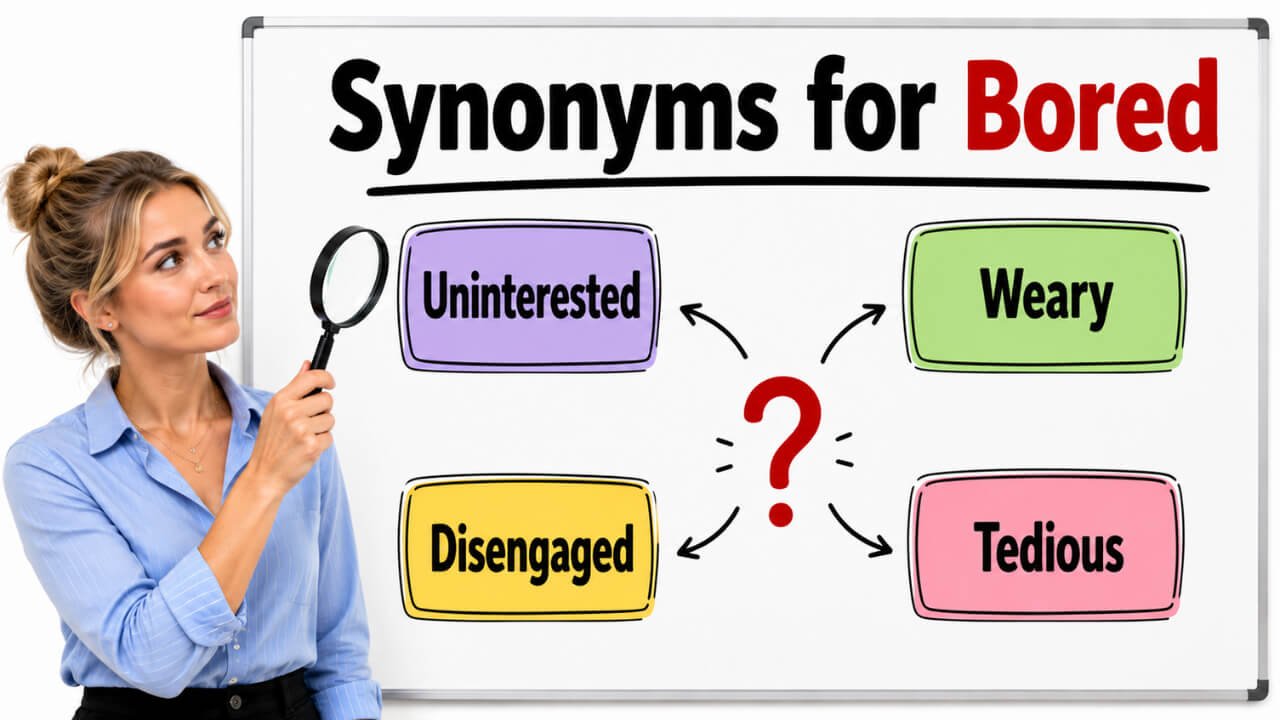
Quick Answer: The best synonyms for bored are uninterested, weary, restless, disengaged, fed up, indifferent, jaded, uninspired, underwhelmed, and unamused. Use uninterested when something fails to hold attention, weary when repetition causes mental tiredness, restless when someone needs activity, disengaged in formal or workplace writing, fed up for strong frustration, and jaded when repeated experiences no longer feel exciting. The exact keyword synonyms for bored helps readers describe different levels of dullness, dissatisfaction, restlessness, and lost interest more accurately.
Pronunciation and Word Details
Word: Bored
Pronunciation: /bɔːrd/
Part of Speech: Adjective
Meaning: Feeling tired, uninterested, or dissatisfied because something is not engaging or stimulating.
US Pronunciation:
UK Pronunciation:
What Does “Bored” Mean?
Bored means feeling uninterested because an activity, situation, or experience is dull, repetitive, or lacking stimulation. It is most commonly used as an adjective to describe the emotional state of a person.
Someone may feel bored during a long meeting, while waiting for something to happen, or after repeating the same activity many times. The word can describe temporary feelings, regular dissatisfaction, or a deeper loss of enthusiasm.
In the sentence “I am bored,” the word describes how the speaker feels. In “The bored students looked outside,” it describes the students. Something that creates this feeling is described as boring, not bored.
Bored can also appear with prepositions such as with, by, and of. For example, someone may be bored with a routine, bored by a speech, or bored of doing the same thing every day.
Meaning, Tone, and Context of “Bored”
Bored is a neutral and common word used in both casual conversation and standard writing. It is easy to understand and usually describes a temporary lack of interest or mental stimulation.
In casual speech, bored often expresses a desire for entertainment or activity. A person might say, “I am bored. Let us do something.”
In workplace, academic, or psychological contexts, more specific alternatives may sound clearer. Disengaged can describe someone who is no longer mentally involved. Unstimulated can suggest that an activity is not challenging enough. Weary can describe mental tiredness caused by repetition.
The emotional strength of bored depends on context. Mild boredom may mean someone is simply unoccupied. Strong boredom may develop into frustration, restlessness, or complete dissatisfaction.
When and How to Use “Bored”
For Lack of Interest: Use bored when an activity does not hold someone’s attention.
Example: Nina became bored during the lengthy presentation.
For Repetitive Activities: Use bored when someone has completed the same task too many times.
Example: He was bored with following the same routine every morning.
For Waiting: Use bored when someone has nothing interesting to do while waiting.
Example: We felt bored while waiting for the delayed appointment.
For Social Situations: Use bored when a conversation or gathering feels dull.
Example: The guests looked bored because the discussion never changed.
For Study or Work: Use bored when a lesson or task is not challenging or engaging.
Example: The employee became bored with entering identical information every day.
For Restlessness: Use bored when a person wants movement, variety, or stimulation.
Example: The children grew bored and started looking for a new game.
Best Synonyms for Bored
Uninterested
Synonym: Uninterested means not feeling curiosity, concern, or enthusiasm.
Example: She seemed uninterested in the discussion.
Weary
Synonym: Weary means mentally or physically tired, often because something has continued for too long.
Example: He grew weary of hearing the same explanation.
Restless
Synonym: Restless means unable to remain calm because of boredom, impatience, or a desire for activity.
Example: The restless audience began checking the time.
Disengaged
Synonym: Disengaged means no longer mentally involved, attentive, or emotionally connected.
Example: Several students appeared disengaged during the lesson.
Fed Up
Synonym: Fed up means strongly annoyed or tired of a repeated situation.
Example: She was fed up with completing the same unnecessary forms.
Indifferent
Synonym: Indifferent means having little interest, concern, or emotional response.
Example: The audience appeared indifferent to the announcement.
Jaded
Synonym: Jaded means no longer impressed or excited because of too much repeated experience.
Example: The critic had become jaded after reviewing hundreds of similar films.
Uninspired
Synonym: Uninspired means lacking excitement, creativity, motivation, or enthusiasm.
Example: He felt uninspired by the predictable assignment.
Underwhelmed
Synonym: Underwhelmed means less impressed or excited than expected.
Example: Visitors were underwhelmed by the short performance.
Unamused
Synonym: Unamused means not entertained, pleased, or interested by something intended to be enjoyable.
Example: She looked unamused throughout the comedy show.
50 Synonyms for Bored with Short Meanings
- Uninterested: Not curious or engaged.
- Weary: Mentally tired after too much repetition.
- Restless: Unable to relax because more activity is needed.
- Fed Up: Strongly tired or annoyed by something.
- Disengaged: No longer mentally involved or attentive.
- Indifferent: Showing little interest or concern.
- Apathetic: Lacking enthusiasm, emotion, or motivation.
- Listless: Lacking energy, interest, or spirit.
- Jaded: No longer excited because of repeated exposure.
- Uninspired: Lacking motivation, excitement, or creative energy.
- Unenthusiastic: Not showing excitement or eagerness.
- Distracted: Unable to focus because attention has moved elsewhere.
- Underwhelmed: Less impressed or excited than expected.
- Unamused: Not entertained or pleased.
- Unstimulated: Not receiving enough mental interest or challenge.
- Unoccupied: Having nothing meaningful to do.
- Idle: Not active, busy, or occupied.
- Impatient: Annoyed because something is taking too long.
- Frustrated: Upset because a situation feels difficult or unsatisfying.
- Dissatisfied: Not pleased with an experience or result.
- Detached: Emotionally or mentally disconnected.
- Numb: Unable to feel much emotion or excitement.
- Weary Of: Tired of experiencing the same thing.
- Tired Of: No longer interested because of repetition.
- Sick Of: Strongly annoyed or tired of something.
- Done With: Unwilling to continue dealing with something.
- Had Enough: No longer willing to tolerate a situation.
- Lost Interest: Stopped feeling curious or engaged.
- Lacking Interest: Not feeling involved or curious.
- Mentally Tired: Exhausted by thinking or repetition.
- Emotionally Flat: Showing little excitement or emotional response.
- Unengaged: Not actively involved or interested.
- Inattentive: Not giving proper attention.
- Daydreaming: Thinking about other things instead of the present activity.
- Fidgety: Moving repeatedly because of impatience or boredom.
- Antsy: Informally restless and eager for change.
- Dulled: Made less alert, interested, or excited.
- Spiritless: Lacking energy, enthusiasm, or liveliness.
- Languid: Lacking energy, activity, or enthusiasm.
- Lethargic: Feeling slow, inactive, or lacking energy.
- Fatigued: Mentally or physically exhausted.
- Drained: Having little energy or enthusiasm remaining.
- Stale: No longer fresh, interesting, or exciting.
- Blasé: Unimpressed because something has become too familiar.
- World Weary: Tired of repeated experiences and disappointments.
- Sated: No longer interested after having too much of something.
- Surfeited: Tired of something because it has been experienced excessively.
- Wearied: Made tired or uninterested by repetition.
- Bored Stiff: Extremely bored and unable to enjoy the situation.
- Bored to Tears: So bored that the experience feels unbearable.
Read Also:
Synonyms for Structure
Synonyms for Bored by Context
When Bored Means Uninterested
Uninterested, disengaged, indifferent, and unenthusiastic describe a lack of attention or enthusiasm. These alternatives work well when a person is not mentally involved in an activity.
Example: The students became disengaged when the lesson stopped challenging them.
Uninterested is the most direct choice. Disengaged sounds more formal and is useful in education or workplace writing. Indifferent suggests that a person does not care strongly about the subject.
When Bored Means Tired of Repetition
Weary, jaded, tired of, sick of, and fed up describe boredom caused by repeated experiences.
Example: She became weary of answering the same questions every week.
Weary is suitable for neutral or formal writing. Jaded suggests that repeated exposure has reduced someone’s excitement. Fed up and sick of express stronger annoyance and are more conversational.
When Bored Means Restless
Restless, fidgety, antsy, impatient, and unoccupied describe boredom that creates a desire for movement or change.
Example: The children grew restless after sitting indoors all afternoon.
Restless is suitable in most contexts. Fidgety focuses on physical movement. Antsy is informal, while impatient suggests irritation caused by waiting.
When Bored Means Emotionally Detached
Apathetic, detached, numb, listless, and emotionally flat describe a deeper lack of emotional response.
Example: He felt detached from a project that once excited him.
These words are stronger than bored. Apathetic suggests very little motivation or concern. Numb may describe a reduced emotional response rather than simple boredom.
When Bored Means Disappointed
Underwhelmed, dissatisfied, unamused, and uninspired describe situations that fail to meet expectations.
Example: The audience was underwhelmed by the predictable ending.
Underwhelmed is useful when something is less impressive than expected. Unamused works when something is intended to entertain. Dissatisfied focuses more on disappointment than lack of stimulation.
Another Word for Bored
The best general replacement for bored is uninterested. However, the most accurate alternative depends on why someone feels bored. Use restless when the person wants activity, weary when repetition causes tiredness, disengaged in formal contexts, and fed up when boredom includes frustration.
Original: I felt bored during the lecture.
Better Option: I felt uninterested during the lecture.
Original: The children were bored after sitting quietly for an hour.
Better Option: The children were restless after sitting quietly for an hour.
Original: She was bored with completing the same daily task.
Better Option: She was weary of completing the same daily task.
Original: The employees looked bored during the meeting.
Better Option: The employees appeared disengaged during the meeting.
When Not to Use “Bored”
Do not use bored when another word can explain the feeling more precisely. Bored may sound vague when the real emotion is frustration, exhaustion, disappointment, or emotional detachment.
In professional reports, disengaged or unmotivated may offer clearer information. In emotional descriptions, weary, jaded, or apathetic may express a deeper feeling.
Avoid using bored to describe something that causes boredom. A person feels bored, but an activity is boring.
Weak: The lesson was bored.
Better: The lesson was boring.
Weak: The workers were bored with the company.
Better: The workers had become disengaged from their responsibilities.
Weak: I was bored after running for two hours.
Better: I was exhausted after running for two hours.
Weak: She was bored because the service did not meet her expectations.
Better: She was dissatisfied because the service did not meet her expectations.
Words Commonly Confused With Bored
Bored vs Boring: Bored describes the person experiencing a lack of interest. Boring describes the person, activity, or situation that causes the feeling.
Bored vs Tired: Bored means lacking interest or stimulation. Tired means needing rest because of physical or mental exhaustion.
Bored vs Uninterested: Bored usually describes a temporary feeling caused by a situation. Uninterested can mean that someone has no natural curiosity about the subject.
Bored vs Restless: Bored describes a lack of interest. Restless describes difficulty staying calm or still, sometimes because of boredom.
Bored vs Apathetic: Bored is often temporary and mild. Apathetic describes a stronger lack of motivation, concern, or emotion.
Bored vs Disappointed: Bored means something is not engaging. Disappointed means something failed to meet expectations.
Bored vs Distracted: Bored means a person lacks stimulation. Distracted means attention has been pulled toward something else.
Which Synonym Should You Choose?
Choose uninterested when someone does not feel curious or involved.
Choose disengaged for formal writing about education, employment, meetings, or participation.
Choose weary when repeated activities have caused mental tiredness.
Choose restless when boredom creates a need for movement, variety, or action.
Choose fed up when someone feels strongly annoyed by a repeated situation.
Choose jaded when repeated exposure has reduced excitement or appreciation.
Choose indifferent when a person has little concern or emotional interest.
Choose underwhelmed when an experience is less impressive than expected.
Choose unamused when something intended to be entertaining fails to create enjoyment.
Choose uninspired when a task or experience does not encourage creativity, enthusiasm, or motivation.
Real Life Examples of “Bored” in Sentences
Original: I became bored while waiting for the meeting to begin.
Better Option: I became restless while waiting for the meeting to begin.
Original: She was bored with completing the same report every Friday.
Better Option: She was weary of completing the same report every Friday.
Original: The students looked bored during the long explanation.
Better Option: The students looked disengaged during the long explanation.
Original: He felt bored by the predictable story.
Better Option: He felt underwhelmed by the predictable story.
Original: We were bored because there was nothing to do.
Better Option: We were unoccupied because there was nothing to do.
Original: The audience appeared bored throughout the performance.
Better Option: The audience appeared unamused throughout the performance.
Original: Maya was bored with hearing the same complaints.
Better Option: Maya was fed up with hearing the same complaints.
Original: After attending similar events for years, he felt bored by them.
Better Option: After attending similar events for years, he felt jaded by them.
Original: The employee became bored and stopped contributing ideas.
Better Option: The employee became disengaged and stopped contributing ideas.
Original: I felt bored by the simple assignment.
Better Option: I felt unstimulated by the simple assignment.
Synonym Groups and Usage Differences
Lack of Interest Group
Uninterested, indifferent, disengaged, and unenthusiastic describe reduced attention or enthusiasm. Uninterested is direct, while disengaged is more formal and may suggest that someone was previously involved.
Example: The class became disengaged when the activity stopped feeling relevant.
Mental Fatigue Group
Weary, wearied, mentally tired, fatigued, and drained describe boredom connected to exhaustion or repetition. These words emphasize reduced energy rather than simple inactivity.
Example: She felt mentally tired after reviewing identical documents all day.
Restlessness Group
Restless, fidgety, antsy, impatient, and unoccupied describe boredom that makes a person seek action or movement.
Example: The restless passengers walked around while waiting for an update.
Frustration Group
Fed up, sick of, tired of, had enough, and done with express strong dissatisfaction with an ongoing situation.
Example: He was fed up with attending meetings that produced no results.
Emotional Detachment Group
Apathetic, detached, numb, listless, and emotionally flat suggest a deeper lack of emotional involvement.
Example: She felt detached from work that once gave her satisfaction.
Disappointment Group
Underwhelmed, dissatisfied, unamused, and uninspired describe experiences that do not provide the expected interest, quality, or enjoyment.
Example: The visitors were underwhelmed by the brief presentation.
Antonyms of Bored
The opposite of bored depends on whether the intended meaning involves attention, excitement, activity, or emotional involvement.
Interested: Curious and willing to pay attention.
Engaged: Actively involved in an activity or discussion.
Absorbed: Giving complete attention to something.
Fascinated: Extremely interested or attracted by something.
Entertained: Enjoying an activity or performance.
Excited: Feeling eager, enthusiastic, or emotionally stimulated.
Stimulated: Mentally encouraged or challenged.
Curious: Eager to learn, discover, or understand.
Attentive: Listening or observing carefully.
Enthusiastic: Showing strong interest and positive energy.
Amused: Entertained or pleasantly interested.
Motivated: Having a clear desire to act or succeed.
Comparison of Bored vs Related Words
Bored vs Uninterested
Bored describes a feeling caused by insufficient stimulation. Uninterested means someone lacks curiosity or concern about a subject.
Example With Bored: I became bored because the speaker repeated the same point.
Example With Uninterested: I was uninterested in the topic before the speech began.
Bored vs Weary
Bored focuses on a lack of interest. Weary emphasizes mental or physical tiredness caused by effort, repetition, or duration.
Example With Bored: She felt bored during the quiet afternoon.
Example With Weary: She became weary after answering the same questions all afternoon.
Bored vs Restless
Bored refers to a lack of engagement. Restless refers to an inability to remain calm or still.
Example With Bored: The child was bored by the slow activity.
Example With Restless: The child became restless and started moving around the room.
Bored vs Jaded
Bored can be temporary and caused by one dull experience. Jaded develops after repeated exposure makes something less exciting or impressive.
Example With Bored: He was bored during the second half of the show.
Example With Jaded: After watching hundreds of shows, he became jaded and difficult to impress.
Bored vs Apathetic
Bored usually means temporarily lacking stimulation. Apathetic means lacking motivation, interest, concern, or emotional energy.
Example With Bored: The student was bored by the easy worksheet.
Example With Apathetic: The student became apathetic and stopped caring about the course.
Bored vs Underwhelmed
Bored means something does not hold attention. Underwhelmed means something is less impressive than expected.
Example With Bored: We were bored during the repetitive performance.
Example With Underwhelmed: We were underwhelmed because the performance did not match the positive description.
Common Phrases and Expressions With Bored
Bored With: No longer interested in a person, activity, or situation.
Bored By: Feeling uninterested because something causes boredom.
Bored Of: Tired of repeatedly experiencing or doing something.
Bored to Tears: Extremely bored by a dull experience.
Bored Stiff: So bored that the situation feels almost unbearable.
Bored Out of My Mind: Informally describes extreme boredom.
Bored Senseless: Extremely uninterested and mentally unstimulated.
Easily Bored: Quickly losing interest in activities or situations.
Feel Bored: Experience a lack of interest or stimulation.
Look Bored: Appear uninterested through facial expressions or body language.
Common Mistakes to Avoid
A common mistake is confusing bored with boring. Use bored for the person experiencing the feeling and boring for the thing causing it.
Do not choose a synonym only because it sounds stronger. Apathetic, numb, and jaded describe deeper emotional states and may not fit ordinary temporary boredom.
Avoid repeating bored several times in the same paragraph. Replace it with precise alternatives such as restless, disengaged, weary, or uninterested when the context supports them.
Be careful with prepositions. Bored with and bored by are widely suitable in formal and standard writing. Bored of is common in everyday speech, especially when discussing repeated activities.
Do not use tired as an automatic synonym. A person can be tired without being bored, and bored without being physically tired.
Avoid vague descriptions. Instead of saying employees were bored, explain whether they were disengaged, unstimulated, dissatisfied, or frustrated.
Use strong expressions such as bored to tears and bored stiff mainly in casual or expressive writing. They may sound exaggerated in reports, essays, or professional communication.
Conclusion
Understanding synonyms for bored helps you describe a lack of interest with greater accuracy. Use uninterested for general disinterest, restless for a desire to act, weary for mental tiredness, and disengaged for formal workplace or academic contexts. Fed up expresses frustration, while jaded describes excitement lost through repeated exposure. Underwhelmed works when an experience fails to meet expectations. Choosing the right alternative makes descriptions clearer, improves tone, and helps readers understand exactly why a person has lost attention or enthusiasm.
FAQs About Synonyms for Bored
What Is the Best Synonym for Bored?
Uninterested is the most direct general synonym. Restless, weary, disengaged, and fed up may be better when the reason for boredom is clear.
What Is a Formal Word for Bored?
Disengaged, unstimulated, indifferent, and unenthusiastic are useful formal alternatives. The correct choice depends on whether the problem involves attention, motivation, or challenge.
What Is a Stronger Word Than Bored?
Fed up, jaded, apathetic, and bored to tears are stronger expressions. Each one adds frustration, emotional detachment, or extreme dissatisfaction.
What Is a Casual Synonym for Bored?
Fed up, sick of, tired of, antsy, and bored stiff are common casual choices. Use them in conversation or informal writing.
Are Bored and Uninterested the Same?
They are similar but not identical. Bored often describes a temporary reaction to a dull situation, while uninterested can describe a general lack of curiosity.
What Is the Difference Between Bored and Boring?
Bored describes how someone feels. Boring describes the person, activity, or situation that causes the feeling.
Which Synonym for Bored Is Best in Professional Writing?
Disengaged is often the best choice when discussing participation or attention. Unstimulated works when a task lacks challenge, while dissatisfied describes unmet expectations.
